CRISPR-Cas9 Knockout: A Comprehensive Guide to Mechanism, Applications, and Optimization for Biomedical Research
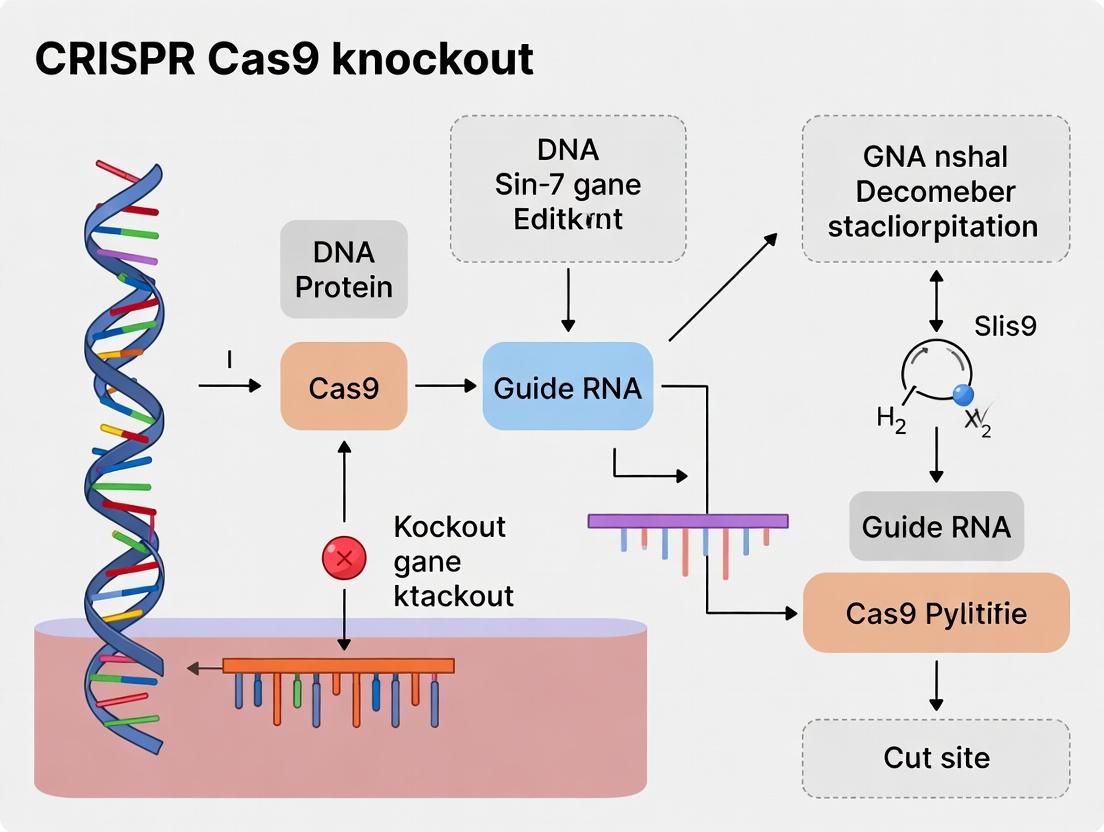
This article provides a detailed, current guide to the CRISPR-Cas9 knockout mechanism for researchers and drug development professionals.
CRISPR-Cas9 Knockout: A Comprehensive Guide to Mechanism, Applications, and Optimization for Biomedical Research
Abstract
This article provides a detailed, current guide to the CRISPR-Cas9 knockout mechanism for researchers and drug development professionals. It begins by explaining the fundamental molecular biology of DNA cleavage and repair pathways (NHEJ vs. HDR) that lead to gene disruption. It then details established and emerging methodological workflows, from sgRNA design to delivery and screening. A critical troubleshooting section addresses common pitfalls like off-target effects and low efficiency, offering optimization strategies. Finally, it covers essential validation techniques and compares CRISPR knockout to alternative technologies like RNAi and base editing, empowering scientists to design robust, reproducible knockout experiments for functional genomics and therapeutic target validation.
Decoding the Molecular Scissors: The Foundational Biology of CRISPR-Cas9 Gene Knockout
The elucidation of the CRISPR-Cas9 system, originating as a prokaryotic adaptive immune defense, represents a paradigm shift in genetic engineering. Within the context of advanced research into knockout mechanisms of action, CRISPR-Cas9 provides a programmable, precise, and efficient methodology for targeted gene disruption. This whitepaper details the biological origin, core molecular mechanics, and experimental implementation of CRISPR-Cas9 as the foundational tool for functional genomics and therapeutic target validation in drug development.
Biological Origin: The Adaptive Immune System in Prokaryotes
CRISPR (Clustered Regularly Interspaced Short Palindromic Repeats) and cas (CRISPR-associated) genes constitute an adaptive immune system in bacteria and archaea. It confers resistance to foreign genetic elements such as plasmids and phages. The system functions in three distinct stages:
- Adaptation: Upon viral infection, Cas1-Cas2 complexes mediate the acquisition of short fragments of foreign DNA (protospacers) and their integration into the host's CRISPR locus as new spacers.
- Expression: The CRISPR locus is transcribed and processed into short, mature CRISPR RNAs (crRNAs).
- Interference: The crRNA guides a Cas nuclease (e.g., Cas9) to complementary foreign DNA sequences, leading to their cleavage and degradation.
The critical discovery was the requirement of a short, conserved sequence adjacent to the protospacer in the target DNA, known as the Protospacer Adjacent Motif (PAM). This allows the system to distinguish between self (the CRISPR locus) and non-self (invader DNA).
Core Mechanism ofStreptococcus pyogenesCas9
The repurposing of the Type II CRISPR-Cas9 system for genetic engineering centers on the simplified, two-component system:
- Cas9 Nuclease: A single, multi-domain protein capable of generating double-strand breaks (DSBs).
- Guide RNA (gRNA): A chimeric RNA combining the functions of the native crRNA and trans-activating crRNA (tracrRNA).
The gRNA directs Cas9 to a target genomic locus via Watson-Crick base pairing. Upon recognizing a 5'-NGG-3' PAM sequence, Cas9 undergoes a conformational change, unwinds the DNA duplex, and positions its two nuclease domains (HNH and RuvC-like) to cleave the target (complementary) strand and the non-target strand, respectively, creating a blunt-ended DSB.
Molecular Pathway to Gene Knockout
Diagram 1: CRISPR-Cas9 mediated gene knockout via NHEJ.
The primary mechanism for generating a knockout exploits the cell's endogenous DNA repair pathways. The predominant, error-prone Non-Homologous End Joining (NHEJ) pathway repairs the DSB, often introducing small insertions or deletions (indels) at the break site. When these indels occur within a protein-coding exon, they can result in a frameshift mutation, leading to a premature stop codon and a non-functional, truncated protein—a complete gene knockout.
Quantitative Data on CRISPR-Cas9 System Efficacy
Table 1: Key Quantitative Parameters of S. pyogenes Cas9 System
| Parameter | Typical Range / Value | Significance & Notes |
|---|---|---|
| Cas9 Protein Size | ~160 kDa (1368 amino acids) | Impacts delivery efficiency (viral packaging, transfection). |
| PAM Sequence | 5'-NGG-3' (where N is any nucleotide) | Defines targetable genomic sites. Specificity varies by Cas9 ortholog. |
| gRNA Length | 20-nucleotide spacer sequence | Dictates targeting specificity. Longer/shorter spacers can reduce efficiency. |
| DSB Distance from PAM | 3 base pairs upstream of NGG | Cleavage site is predictable and consistent. |
| Editing Efficiency (Mammalian Cells) | 20% - 80% (varies by locus, cell type, delivery method) | Measured by NGS or T7E1 assay; requires optimization. |
| Off-Target Effect Frequency | Varies widely; can be <0.1% with high-fidelity variants | Dependent on gRNA specificity, delivery dose, and cell type. Use of HiFi Cas9 reduces this. |
| Optimal Delivery Dose (RNP, HEK293T) | 20-40 pmol per 100k cells (transfection) | High doses increase toxicity and off-targets. Must be titrated. |
Table 2: Comparison of DNA Repair Pathways Exploited in CRISPR Editing
| Pathway | Template Required? | Primary Outcome | Typical Use in KO Research |
|---|---|---|---|
| Non-Homologous End Joining (NHEJ) | No | Error-prone repair → Indels | Default pathway for knockout generation. |
| Microhomology-Mediated End Joining (MMEJ) | No | Deletions flanking microhomologies | Can lead to predictable, larger deletions. |
| Homology-Directed Repair (HDR) | Yes (donor template) | Precise, templated edits (point mutations, insertions) | Knock-in or precise mutation; low efficiency in most somatic cells. |
Detailed Experimental Protocol: CRISPR-Cas9 Mediated Gene Knockout in Mammalian Cell Lines
Protocol: Lipofection of RNP Complexes into Adherent Cells
Objective: To generate a stable, clonal knockout cell line for a target gene of interest.
Part A: gRNA Design and Preparation
- Design: Identify all 5'-NGG-3' PAM sites in the early exons of the target gene. Select a 20-nt spacer sequence with high on-target (e.g., using CRISPick or CHOPCHOP algorithms) and low predicted off-target scores.
- Synthesis: Order the target-specific crRNA sequence and universal tracrRNA as synthetic, chemically modified (e.g., 2'-O-methyl, phosphorothioate) RNAs for stability. Alternatively, order a single chimeric gRNA molecule.
- Resuspension: Resuspend RNAs in nuclease-free TE buffer to a stock concentration of 100 µM. Store at -80°C.
Part B: Ribonucleoprotein (RNP) Complex Formation
- Annealing: Mix equimolar amounts of crRNA and tracrRNA (e.g., 2 µL of each 100 µM stock) in duplex buffer. Heat to 95°C for 5 min, then cool slowly to room temperature (15-20 min).
- Complexing: For one reaction, combine:
- 5 µL of 20 µM annealed gRNA (final 100 pmol)
- 3.2 µL of 62 µM purified S. pyogenes Cas9 protein (final 200 pmol; 1:1 molar ratio)
- 11.8 µL of nuclease-free buffer. Incubate at room temperature for 10-20 min to form the active RNP complex.
Part C: Cell Transfection and Seeding
- Day 0: Seed the target cells (e.g., HEK293T) in a 24-well plate at 1-1.5 x 10^5 cells/well in complete growth medium without antibiotics. Aim for 70-80% confluence at transfection (next day).
- Day 1: a. Dilute the formed RNP complex (20 µL total) in 80 µL of Opti-MEM serum-free medium. b. Dilute 2 µL of a suitable lipofection reagent (e.g., Lipofectamine CRISPRMAX) in 80 µL of Opti-MEM. Incubate separately for 5 min. c. Combine the diluted RNP with the diluted transfection reagent (total 160 µL). Mix gently and incubate for 15-20 min at RT. d. Add the entire mixture dropwise to the cells in the well. Gently rock the plate. e. After 48-72 hours, analyze editing efficiency (see Part D).
Part D: Validation and Clonal Isolation
- Efficiency Check (T7 Endonuclease I Assay): a. Extract genomic DNA from a portion of transfected cells. b. PCR-amplify the target region (~500-800 bp). c. Heteroduplex Formation: Denature and reanneal the PCR product. d. Digest with T7E1 enzyme, which cleaves mismatched DNA. e. Run products on an agarose gel. Cleavage bands indicate indel formation. Calculate efficiency: (1 - sqrt(1 - (cleaved fraction)))*100.
- Single-Cell Cloning: a. 24-48h post-transfection, trypsinize and dilute cells to ~1 cell/100 µL in conditioned medium. b. Seed 100 µL/well into a 96-well plate. Confirm single colonies microscopically. c. Expand clones over 2-3 weeks.
- Genotype Screening: Screen clones by PCR of the target locus and Sanger sequencing. Analyze chromatograms for indels using decomposition software (e.g., ICE Synthego, TIDE).
- Phenotype Validation: Confirm knockout via western blot (loss of protein) and/or functional assay.
The Scientist's Toolkit: Key Research Reagent Solutions
Table 3: Essential Materials for CRISPR-Cas9 Knockout Experiments
| Item / Reagent | Function & Role in Experiment | Key Considerations |
|---|---|---|
| High-Fidelity Cas9 Nuclease (e.g., HiFi Cas9, eSpCas9) | Catalyzes DNA cleavage. High-fidelity variants reduce off-target effects while maintaining on-target activity. | Critical for in vitro and therapeutic applications. Wild-type SpCas9 is sufficient for many basic research knockouts. |
| Chemically Modified Synthetic gRNA (crRNA & tracrRNA) | Provides target specificity and Cas9 scaffolding. Chemical modifications enhance stability and reduce immune response in cells. | Pre-complexed, modified RNAs offer higher efficiency and lower toxicity than plasmid-based expression. |
| Lipofectamine CRISPRMAX Transfection Reagent | A lipid nanoparticle formulation optimized for the delivery of RNP complexes into a wide range of mammalian cell types. | Specifically designed for RNP delivery, offering higher efficiency and lower cytotoxicity than standard transfection reagents. |
| T7 Endonuclease I (T7E1) Mismatch Detection Kit | Rapid, cost-effective validation of editing efficiency by detecting heteroduplex DNA formed from wild-type and mutant alleles. | Provides a quantitative estimate of indel percentage but does not reveal the specific sequences of indels. |
| Surveyor Nuclease (Cel-I) Assay Kit | Alternative to T7E1 for detecting mismatches. Often used for validation. | Similar function to T7E1; choice is often based on lab preference or buffer compatibility. |
| Nucleofector System & Cell Line Specific Kits | Electroporation-based delivery method for hard-to-transfect cell lines (e.g., primary cells, iPSCs, immune cells). | Generally achieves higher delivery efficiency than lipofection for challenging cells but requires optimization of protocols. |
| Next-Generation Sequencing (NGS) Library Prep Kit for Amplicons | Gold-standard for assessing editing outcomes. Quantifies precise indel sequences, frequency, and detects low-frequency off-target events. | Provides the most comprehensive data but is more expensive and complex than T7E1. Kits from Illumina, IDT, or Twist are common. |
| ICE Analysis Software (Synthego) | Web-based tool that analyzes Sanger sequencing traces from edited pools or clones to infer indel sequences and percentages. | Enables rapid, cost-effective genotyping without the need for NGS for initial clone screening. |
This technical whitepaper details the core molecular machinery enabling CRISPR-Cas9-mediated gene knockout. Framed within ongoing research into the mechanism of action for therapeutic gene disruption, this document provides a functional analysis of the Cas9 endonuclease, guide RNA (gRNA), and Protospacer Adjacent Motif (PAM), supported by current quantitative data and standardized experimental protocols.
CRISPR-Cas9 functions as an RNA-programmable DNA endonuclease. For site-specific DNA cleavage, which is foundational to knockout strategies, three core components must interact with precision: the Cas9 protein, a single guide RNA (sgRNA), and a short DNA sequence known as the PAM. This section defines their individual and collective roles in the mechanism of targeted double-strand break (DSB) induction.
Component Deep Dive
Cas9 Nuclease
Cas9 is a multidomain endonuclease responsible for DNA unwinding and cleavage. Its conformational changes, guided by gRNA and PAM recognition, are critical for activity.
Key Domains & Functions:
- REC Lobes (I & II): Bind the gRNA:DNA heteroduplex.
- PAM-Interacting (PI) Domain: Critical for recognizing the PAM sequence on the non-target DNA strand.
- HNH Nuclease Domain: Cleaves the DNA strand complementary to the gRNA (target strand).
- RuvC-like Nuclease Domain: Cleaves the non-complementary DNA strand (non-target strand).
Quantitative Characteristics (Common Streptococcus pyogenes Cas9, SpCas9):
Table 1: Quantitative Profile of SpCas9
Property Value Notes Molecular Weight ~160 kDa Protein Length 1368 amino acids DNA Cleavage Sites 3-4 bases upstream of PAM Generates blunt-ended DSBs PAM Specificity 5'-NGG-3' Canonical; N = any nucleotide Optimal Temperature 37°C Activity decreases significantly above 42°C Mg²⁺ Requirement 1-10 mM Essential cofactor for nuclease activity
Guide RNA (gRNA)
The gRNA is a chimeric RNA molecule that confers DNA target specificity to the Cas9 nuclease.
Structural Components:
- CRISPR RNA (crRNA) Derivative: A 20-nucleotide spacer sequence that determines target specificity via Watson-Crick base pairing.
- Trans-activating crRNA (tracrRNA) Derivative: A scaffold sequence essential for Cas9 binding and stabilization.
Design Parameters & Quantitative Data:
Table 2: gRNA Design and Efficacy Parameters
Parameter Optimal Range/Value Impact on Knockout Efficiency Spacer Length 20 nt Standard for SpCas9; truncation can reduce off-targets. GC Content 40-60% Impacts stability and binding affinity. Seed Region (PAM-proximal 8-12 nt) High specificity critical Mismatches here drastically reduce cleavage. Off-Target Prediction Score Varies by algorithm Tools like CFD (Cutting Frequency Determination) score predict specificity.
The Protospacer Adjacent Motif (PAM)
The PAM is a short, invariant DNA sequence adjacent to the target site that is essential for Cas9 to initiate DNA unwinding and is not present in the host's CRISPR array.
- Function: Serves as a "self vs. non-self" discriminator. Cas9 PI domain recognition of the PAM triggers local DNA melting, enabling gRNA:DNA hybridization.
Variants by Ortholog:
Table 3: PAM Sequences for Common Cas9 Orthologs
Cas9 Ortholog Canonical PAM (5' → 3') PAM Position S. pyogenes (SpCas9) NGG Immediately downstream of target (3') S. aureus (SaCas9) NNGRRT (R = A/G) Immediately downstream of target (3') C. jejuni (CjCas9) NNNVRYM (V = A/C/G, R=A/G, Y=C/T) Upstream of target (5') SpCas9-NG variant NG Expanded targeting range
Integrated Mechanism of Action for Knockout
The knockout process initiates with the formation of a ribonucleoprotein (RNP) complex. Cas9 first scans DNA for a compatible PAM sequence. Upon recognition, the PI domain promotes strand displacement, allowing the seed region of the gRNA to interrogate the adjacent DNA. Successful complementary pairing leads to full heteroduplex formation, activating the HNH and RuvC domains to create a DSB. Cellular repair via error-prone Non-Homologous End Joining (NHEJ) introduces insertion/deletion mutations (indels) that can disrupt the reading frame, resulting in gene knockout.
Diagram 1: CRISPR-Cas9 Knockout Mechanism
Key Experimental Protocols for Functional Validation
Protocol:In VitroCleavage Assay to Verify RNP Activity
Purpose: To confirm the functionality of purified Cas9 protein and synthesized gRNA by assessing target DNA cleavage efficiency. Reagents:
- Purified recombinant Cas9 nuclease.
- Target DNA plasmid (containing the target site with correct PAM).
- Synthesized sgRNA (crRNA:tracrRNA duplex or single transcript).
- Nuclease-Free Duplex Buffer (IDT) or equivalent.
- 10X Cas9 Reaction Buffer (e.g., 200 mM HEPES, 1 M KCl, 50 mM MgCl₂, 1 mg/mL BSA, pH 6.5).
- Proteinase K or STOP solution.
- Agarose gel electrophoresis reagents.
Procedure:
- Annealing (if using separate crRNA/tracrRNA): Mix equimolar amounts (e.g., 1 µL of 100 µM each) in duplex buffer, heat to 95°C for 5 min, then cool slowly to room temp.
- RNP Complex Formation: Combine 1 µL of 10 µM Cas9 with 1.2 µL of 10 µM annealed sgRNA. Incubate at 25°C for 10 min.
- Cleavage Reaction: Add 100 ng (1 µL) of target plasmid and 1 µL of 10X reaction buffer. Adjust volume to 10 µL with nuclease-free water. Incubate at 37°C for 1 hour.
- Reaction Termination: Add 1 µL of Proteinase K (or STOP buffer) and incubate at 56°C for 10 min.
- Analysis: Run the entire reaction on a 1% agarose gel. Successful cleavage converts supercoiled plasmid to linearized (and potentially further cut) forms.
Protocol: T7 Endonuclease I (T7EI) Mismatch Detection Assay
Purpose: To quantify indel mutation frequency and knockout efficiency in transfected cells. Reagents:
- Genomic DNA extraction kit.
- PCR primers flanking the target site (amplicon size: 400-800 bp).
- High-fidelity PCR polymerase.
- T7 Endonuclease I enzyme (NEB).
- NEBuffer 2.1.
- Agarose gel electrophoresis and gel imaging/quantification system.
Procedure:
- Harvest & Extract: Harvest transfected cells 72-96 hours post-transfection. Extract genomic DNA.
- Amplify Target Locus: PCR amplify the genomic region surrounding the target site.
- Heteroduplex Formation: Purify PCR product. Denature and reanneal: 95°C for 10 min, ramp down to 85°C at -2°C/s, then to 25°C at -0.1°C/s.
- T7EI Digestion: Treat reannealed DNA with T7EI (according to manufacturer's protocol, typically 37°C for 1 hour).
- Quantification: Run digested products on an agarose gel. Cleavage products indicate presence of mismatches (indels). Calculate indel frequency using formula: % gene modification = 100 × (1 - sqrt(1 - (b + c)/(a + b + c))), where a is integrated intensity of undigested band, and b+c are intensities of cleavage products.
The Scientist's Toolkit: Essential Research Reagent Solutions
Table 4: Key Reagents for CRISPR-Cas9 Knockout Research
| Reagent/Material | Supplier Examples | Primary Function in Research |
|---|---|---|
| Recombinant SpCas9 Nuclease (WT) | Thermo Fisher, NEB, Sigma-Aldrich | Core enzyme for in vitro assays or RNP delivery. |
| Synthetic sgRNA (chemically modified) | IDT, Sigma-Aldrich, Horizon Discovery | Provides target specificity; modified versions enhance stability. |
| Cas9 Expression Plasmid (e.g., pSpCas9(BB)) | Addgene (#48139) | Enables viral or plasmid-based delivery of Cas9 to cells. |
| Lentiviral sgRNA Library | Dharmacon, Sigma-Aldrich | Enables genome-wide pooled knockout screens. |
| T7 Endonuclease I | New England Biolabs (NEB) | Detects indels via mismatch cleavage in genomic DNA. |
| Surveyor Nuclease | IDT | Alternative to T7EI for indel detection. |
| Next-Generation Sequencing (NGS) Library Prep Kit (for amplicon-seq) | Illumina, Thermo Fisher | Enables deep sequencing for precise quantification of editing spectrum and off-target analysis. |
| Lipofectamine CRISPRMAX | Thermo Fisher | Lipid-based transfection reagent optimized for RNP delivery. |
| Control gRNA (Non-targeting) | Commercial suppliers or designed in silico | Essential negative control for phenotypic assays. |
| Validated Positive Control gRNA (e.g., targeting AAVS1 safe harbor) | Commercial suppliers | Positive control for assessing transfection and editing efficiency. |
Within the framework of CRISPR-Cas9 knockout mechanism of action research, the site-specific generation of a DNA double-strand break (DSB) is the pivotal catalytic event that enables targeted gene disruption. The DSB is not merely a cut; it is a molecular lesion that co-opts the cell's intrinsic repair machinery to produce loss-of-function mutations. This whitepaper provides a technical dissection of the DSB as the central catalyst, detailing the quantitative parameters of its generation and resolution, the experimental protocols for its interrogation, and the essential tools for its study.
Quantitative Dynamics of DSB Formation and Repair
Table 1: Key Quantitative Parameters of CRISPR-Cas9 DSB Formation
| Parameter | Typical Value / Range | Significance / Measurement Method |
|---|---|---|
| DSB Induction Kinetics | Peak at 6-24h post-transfection | Measured via qPCR-based assays (e.g., T7E1, next-gen sequencing (NGS) of target locus). |
| Cas9:sgRNA Complex Half-life | ~80 minutes in nucleus | Influences editing window and potential for off-target activity. |
| On-Target Cleavage Efficiency | 20-80% (cell type & locus dependent) | Primary metric for knockout experiment success, quantified by INDEL frequency via NGS. |
| NHEJ vs. HDR Ratio in S/G2 Phase | ~80% NHEJ / ~20% HDR | Critical for knockout (NHEJ) versus precise correction (HDR) outcomes. |
| Off-Target Cleavage Frequency | <0.1% to ~5% (sgRNA-dependent) | Measured by targeted NGS of predicted off-target sites or unbiased methods like GUIDE-seq. |
Table 2: Outcomes of DSB Repair via Non-Homologous End Joining (NHEJ)
| Repair Outcome | Approximate Frequency | Result on Coding Sequence |
|---|---|---|
| Small Deletion (1-10 bp) | ~50-70% of INDELs | Frameshift or in-frame knockout. |
| Small Insertion (1-10 bp) | ~20-30% of INDELs | Predominantly frameshift. |
| Large Deletion (>50 bp) | 1-10% (locus-dependent) | Complete gene disruption. |
| Precise Repair (No INDEL) | Variable | Failed knockout; functional protein may be expressed. |
Experimental Protocols for DSB Analysis
Protocol 1: Quantitative Measurement of INDEL Formation (NGS-based)
- Target Amplification: Design primers (with overhangs for Illumina) ~150-200bp flanking the CRISPR target site. Perform PCR on genomic DNA from treated and control cells (20-30 cycles).
- Library Preparation: Index the amplicons with a second limited-cycle PCR to add dual indices and sequencing adapters.
- Sequencing: Pool libraries and run on a MiSeq or similar platform to achieve >10,000x coverage per sample.
- Analysis: Use bioinformatics tools (CRISPResso2, Cas-analyzer) to align reads to the reference sequence and quantify the percentage of reads containing insertions or deletions (INDELs) at the target site.
Protocol 2: Detection of Large Genomic Deletions (PCR & Gel Electrophoresis)
- Primer Design: Design three primers: one forward (F1) and two reverse (R1, R2). R1 is proximal (~100-200bp downstream of cut site), and R2 is distal (>1kb downstream).
- PCR Reactions: Set up two PCRs per sample:
- Control PCR: Uses F1 and R1 to amplify the intact allele (short product).
- Deletion PCR: Uses F1 and R2 to amplify only if a large deletion has occurred (long product).
- Analysis: Run products on an agarose gel. The presence of a band in the deletion PCR indicates a large deletion event.
Visualization of DSB Pathways and Experimental Workflows
DSB Formation and Major Repair Pathways
NGS Workflow for INDEL Quantification
The Scientist's Toolkit: Research Reagent Solutions
Table 3: Essential Reagents for CRISPR-Cas9 Knockout Research
| Item | Function & Application |
|---|---|
| High-Fidelity Cas9 Nuclease (WT) | Generates the precise blunt-end DSB. Required for all standard knockout experiments. |
| Validated, Synthetic sgRNA | Guides Cas9 to the target locus. Chemically modified sgRNAs enhance stability and reduce immunogenicity. |
| NHEJ Inhibitors (e.g., SCR7) | Small molecules that transiently inhibit key NHEJ proteins (DNA Ligase IV), used to skew repair toward HDR for knock-in studies. |
| HDR Enhancers (e.g., RS-1) | Small molecules that stimulate Rad51, promoting homologous recombination to improve HDR efficiency when a donor template is present. |
| T7 Endonuclease I (T7E1) / Surveyor Nuclease | Enzymes that cleave heteroduplex DNA formed by annealing wild-type and edited strands. A rapid, lower-cost method for initial editing efficiency estimation. |
| Single-Cell Cloning Dilution Plate | Essential for isolating monoclonal cell populations post-editing to establish pure knockout cell lines. |
| Next-Generation Sequencing Kit (Amplicon) | For precise, quantitative measurement of on-target editing and off-target effects (e.g., Illumina MiSeq Reagent Kit v3). |
| Anti-gamma-H2AX Antibody | Immunofluorescence marker for phosphorylated histone H2AX, used to visualize and quantify DSB foci in cells. |
Within the broader thesis on the mechanism of action of CRISPR-Cas9 for generating gene knockouts, understanding the cellular DNA repair response is paramount. The Cas9 nuclease creates a targeted double-strand break (DSB), but the resulting mutation is not dictated by Cas9 itself. Instead, the knockout phenotype is overwhelmingly the product of the cell's dominant non-homologous end joining (NHEJ) repair pathway. This guide details the molecular choreography of NHEJ, explaining how its error-prone nature is harnessed to create disruptive insertion/deletion (indel) mutations that lead to functional gene knockouts in research and drug development.
The Molecular Mechanism of Canonical NHEJ (c-NHEJ)
NHEJ is the primary DSB repair pathway in mammalian cells, active throughout the cell cycle. Its function is to rapidly ligate broken DNA ends, often with minimal processing, leading to small sequence alterations.
Core Pathway Steps & Key Proteins
Diagram Title: Core c-NHEJ Pathway from DSB to Repair
Step 1: DSB Recognition & End Binding (Ku70/Ku80) The Ku70/Ku80 heterodimer acts as a molecular scaffold, rapidly loading onto DNA ends. It protects ends from resection and recruits the key kinase DNA-PKcs.
Step 2: DNA-PK Activation & Synapsis Formation DNA-PKcs binds to the Ku-bound end, forming the DNA-PK holoenzyme. It undergoes autophosphorylation, triggering a conformational change that facilitates the synapsis (bridging) of the two broken ends.
Step 3: End Processing Non-ligatable ends (e.g., damaged bases, 3'-phosphoglycolates) are processed. The nuclease Artemis, activated by phosphorylated DNA-PKcs, trims overhangs. Polynucleotide kinase (PNKP) and polymerases (Pol μ, Pol λ) may fill in gaps.
Step 4: Ligation The XRCC4-XLF complex forms a filamentous scaffold that stabilizes the synapsed ends and recruits DNA Ligase IV to catalyze the phosphodiester bond formation, sealing the break.
Alternative End-Joining (alt-EJ) Pathways
c-NHEJ is the dominant but not exclusive pathway. Microhomology-mediated end joining (MMEJ), an alt-EJ pathway, involves resection of ends to reveal 5-25 bp microhomologies, annealing, and ligation by Ligase I/III. This typically creates larger deletions.
How NHEJ Generates Knockout-Inducing Indels
The inherent "error-proneness" of NHEJ is the engine of CRISPR knockout generation.
- Minimal End Processing: The drive for rapid ligation often results in the loss or addition of a few nucleotides during processing.
- Template-Independent Synthesis: Polymerases like Pol μ can add non-templated nucleotides.
- Ligation of Incompatible Ends: Ends with short overhangs may be blunted or mismatched before ligation.
The resulting frameshift mutations (indels not divisible by three) within an exon have a high probability of introducing a premature termination codon (PTC), leading to nonsense-mediated decay (NMD) of the mRNA or a truncated, non-functional protein.
Quantitative Data on NHEJ Outcomes & Efficiency
Table 1: Typical NHEJ Outcome Frequencies Post-CRISPR-Cas9 Cleavage in Mammalian Cells
| Outcome Category | Approximate Frequency | Typical Indel Size | Primary Determinants |
|---|---|---|---|
| Precise Repair (No mutation) | 5 - 20% | 0 bp | Cell type, chromatin state, sgRNA sequence. |
| Frameshift-Inducing Indels | 60 - 80% | 1-10 bp (majority -1, -2, +1) | Microhomology near cut site, sequence context. |
| In-frame Deletions/Insertions | 10 - 20% | 3, 6, 9... bp | Can disrupt protein function if critical residues are lost. |
| Large Deletions (>50 bp) | 1 - 10% | Up to several kbp | Often MMEJ-dependent; sgRNA design, genomic locus. |
| Chromosomal Rearrangements | <1 - 5% | N/A | Multiple DSBs, genomic repeats, prolonged Cas9 expression. |
Table 2: Factors Influencing NHEJ vs. HDR Ratio in CRISPR Experiments
| Factor | Promotes NHEJ | Promotes HDR |
|---|---|---|
| Cell Cycle Phase | G0, G1, S, G2 (all phases) | Late S, G2 phase |
| Primary Manipulation | Cas9/sgRNA RNP delivery | Co-delivery of donor template |
| Small Molecule Inhibition | DNA-PKcs inhibitors (e.g., NU7441) | NHEJ inhibitors (e.g., SCR7) |
| Small Molecule Enhancement | Ligase IV activity stabilizers | HDR enhancers (e.g., RS-1) |
| Cas9 Variant | Wild-type Cas9, Cas9 nickase pairs | Fused to HDR-promoting proteins |
Detailed Experimental Protocol: Validating NHEJ-Mediated Knockouts
Protocol Title: T7 Endonuclease I (T7EI) Mismatch Cleavage Assay for NHEJ Indel Detection.
Objective: To detect and semi-quantify the efficiency of NHEJ-induced indel mutations at a CRISPR-Cas9 target site.
Principle: PCR amplicons from edited cell populations contain heteroduplexes of wild-type and indel-containing DNA strands. T7EI cleaves at mismatches, generating fragments that can be resolved by gel electrophoresis.
Materials (The Scientist's Toolkit):
Table 3: Key Research Reagents for NHEJ Validation
| Reagent/Material | Function/Description |
|---|---|
| CRISPR-Cas9 Components | RNPs (recombinant Cas9 protein + synthetic sgRNA) for high-efficiency, transient delivery. |
| Genomic DNA Isolation Kit | To purify high-quality gDNA from transfected/transduced cells 72-96 hrs post-editing. |
| High-Fidelity DNA Polymerase (e.g., Q5, KAPA HiFi) | For specific, error-free PCR amplification of the target locus. |
| T7 Endonuclease I | Enzyme that recognizes and cleaves DNA heteroduplex mismatches. |
| Agilent Bioanalyzer / TapeStation | For capillary electrophoresis, providing precise sizing and quantification of cleavage fragments. |
| Sanger Sequencing Primers | For flanking the target site to sequence PCR amplicons for indel characterization. |
| NGS Library Prep Kit | For deep sequencing (e.g., amplicon-seq) to comprehensively profile all indel variants. |
Procedure:
- Cell Transfection & Editing: Deliver CRISPR-Cas9 components (e.g., 2 µg plasmid or 20 pmol RNP) into 2e5 target cells via appropriate method (nucleofection, lipofection).
- Genomic DNA Harvest: At 72-96 hours post-transfection, harvest cells and isolate gDNA.
- PCR Amplification: Design primers ~200-400 bp flanking the cut site. Perform PCR with high-fidelity polymerase.
- Cycling Conditions: 98°C 30s; [98°C 10s, 65°C 30s, 72°C 30s] x 35 cycles; 72°C 2 min.
- Heteroduplex Formation: Denature and reanneal PCR products to form heteroduplexes.
- Mix 200 ng PCR product in 1x NEBuffer 2. Total volume 19 µL.
- Denature at 95°C for 5 min, then ramp cool to 25°C at -0.1°C/s.
- T7EI Digestion: Add 1 µL of T7EI enzyme (10 U/µL) to the reannealed DNA. Incubate at 37°C for 30 minutes.
- Analysis: Quench reaction and analyze fragments.
- Run on a 2% agarose gel or Agilent Bioanalyzer. Cleaved products will appear as two or more lower molecular weight bands.
- Quantification:
- (Gel) Use densitometry software. Indel % ≈ [1 - sqrt(1 - (b+c)/(a+b+c))] * 100, where a is integrated intensity of undigested band, b & c are cleaved bands.
- (Bioanalyzer) Software calculates molarity and fragment size for direct quantification.
Advanced Methodologies & Pathway Analysis
Protocol for NHEJ Pathway Interference (Using Inhibitors): To confirm NHEJ's role, treat cells with a DNA-PKcs inhibitor (e.g., 1 µM NU7441) or a Ligase IV inhibitor (e.g., SCR7) 1 hour prior to CRISPR delivery and maintain for 24 hours post-transfection. Quantify indel formation via NGS; a significant reduction indicates NHEJ dependence. Concurrent upregulation of HDR (if a donor is present) can be measured.
Diagram Title: CRISPR DSB Repair Pathway Competition & Outcomes
Harnessing NHEJ is foundational to CRISPR-Cas9 functional genomics and therapeutic gene disruption. For researchers, optimizing conditions to maximize NHEJ efficiency (e.g., using RNP delivery, choosing sgRNAs with low microhomology) is key to achieving high knockout rates. In drug development, understanding the spectrum of NHEJ outcomes is critical for assessing potential off-target effects and for designing therapies aimed at disrupting disease-causing genes. The predictable, error-prone nature of NHEJ thus remains the workhorse mechanism for generating loss-of-function mutations that drive both basic discovery and therapeutic innovation.
The Role of HDR and Why It's Not the Primary Knockout Pathway
Within the canonical model of CRISPR-Cas9-mediated gene knockout, two primary DNA repair pathways compete to resolve the programmatic double-strand break (DSB): the error-prone non-homologous end joining (NHEJ) and the high-fidelity homology-directed repair (HDR). This whitepaper elucidates the biochemical and cellular determinants that relegate HDR to a secondary role in knockout generation, framing the discussion within the broader mechanistic analysis of CRISPR-Cas9 action for therapeutic target validation.
The introduction of a site-specific DSB by the Cas9 nuclease is a catalytic event; however, the functional outcome—a gene knockout—is entirely dependent on the cellular DNA Damage Response (DDR). The two major repair pathways operate under fundamentally different principles:
- Non-Homologous End Joining (NHEJ): An error-prone, template-independent process active throughout the cell cycle, particularly in G0/G1 phases. It directly ligates broken ends, often resulting in small insertions or deletions (indels) that frameshift the coding sequence.
- Homology-Directed Repair (HDR): A precise, template-dependent pathway that utilizes a homologous DNA template (sister chromatid or exogenous donor) to restore the sequence. It is restricted primarily to the S and G2 phases of the cell cycle when a sister chromatid is available.
The central thesis is that inherent cellular biological constraints, not enzymatic efficiency, dictate that NHEJ is the dominant pathway for generating knockout alleles, while HDR serves a specialized role in precise knock-in applications.
Quantitative Analysis of Pathway Dominance
Experimental data consistently shows a marked disparity in the efficiency of indel formation (NHEJ) versus precise integration (HDR) across diverse cell types. The following table summarizes key quantitative findings from recent studies.
Table 1: Comparative Efficiency of NHEJ vs. HDR Outcomes in Mammalian Cells
| Cell Type/Tissue | NHEJ Efficiency (% Indels) | HDR Efficiency (% Precise Integration) | HDR Donor Type | Primary Reference |
|---|---|---|---|---|
| Human HEK293T (Immortalized) | 40-60% | 10-20% | ssODN (90nt) | 2023, Nucleic Acids Res |
| Human iPSCs (Pluripotent) | 20-40% | 1-5% | dsDNA plasmid donor | 2024, Cell Stem Cell |
| Mouse Primary T-cells | 30-50% | <1% | AAV6 donor | 2023, Nature Biotech |
| Differentiated Cardiomyocytes | 10-25% | ~0.1% | – | 2024, J. Mol. Cell. Cardiol. |
| In Vivo Mouse Liver | 5-15% (edit/allele) | ~0.5% (edit/allele) | AAV8 donor | 2023, Science Adv. |
Key Takeaway: HDR efficiency is consistently an order of magnitude lower than NHEJ across most physiologically relevant systems, particularly in non-cycling or hard-to-transfect primary cells.
Biochemical and Cell Biological Determinants
Cell Cycle Dependency
HDR requires the presence of a homologous template, predominantly the sister chromatid, which is only available during the S and G2 phases. NHEJ operates throughout the cell cycle. The majority of cells in a typical therapeutic target population (e.g., neurons, hepatocytes, muscle cells) are quiescent or slowly cycling, favoring NHEJ.
Kinetic Competition
NHEJ machinery is constitutively expressed and acts rapidly on DSB ends. HDR involves a more complex, multi-step process including end resection, homology search, and strand invasion, creating a kinetic window where NHEJ can resolve the break first.
Template Availability
For therapeutic knockout, no exogenous donor template is supplied. The only available homologous template for HDR is the sister chromatid, which risks restoring the wild-type sequence rather than creating a mutation. NHEJ inherently disrupts the locus.
Key Experimental Protocols for Pathway Analysis
Protocol: T7 Endonuclease I (T7E1) / Mismatch Detection Assay for NHEJ Efficiency
Purpose: To quantify the frequency of NHEJ-induced indels at the target locus.
- Genomic DNA Extraction: Isolate gDNA 72-96 hours post-CRISPR delivery.
- PCR Amplification: Amplify the target region (∼500bp) using high-fidelity polymerase.
- DNA Denaturation & Reannealing: Purify PCR product. Denature at 95°C for 5 min, then slowly reanneal (ramp from 95°C to 25°C at -0.3°C/sec). This forms heteroduplexes if indels are present.
- T7E1 Digestion: Incubate reannealed DNA with T7 Endonuclease I (cuts mismatched DNA) for 30 min at 37°C.
- Analysis: Run products on agarose gel. Cleavage bands indicate presence of indels. Calculate efficiency: % Indels = 100 * (1 - sqrt(1 - (b + c)/(a + b + c))), where a is intact band density, b and c are cleavage product densities.
Protocol: Flow Cytometry-Based HDR Reporter Assay
Purpose: To quantitatively measure HDR efficiency using a fluorescent reporter system.
- Reporter Construction: Utilize a plasmid containing a truncated fluorescent protein (e.g., GFP) gene, which is restored only upon successful HDR using a co-delivered donor template.
- Co-transfection: Co-deliver the Cas9/sgRNA ribonucleoprotein (RNP) complex, the HDR reporter plasmid, and a single-stranded oligodeoxynucleotide (ssODN) donor template into target cells.
- Incubation & Analysis: Culture cells for 5-7 days to allow for protein turnover and fluorescence development. Analyze cells using flow cytometry.
- Quantification: The percentage of GFP-positive cells directly reports on HDR efficiency. Normalize to transfection efficiency using a control fluorophore.
Visualizing the Pathway Decision Logic
Title: CRISPR Repair Pathway Decision Logic
The Scientist's Toolkit: Key Research Reagent Solutions
Table 2: Essential Reagents for CRISPR Knockout & Repair Pathway Studies
| Reagent / Material | Function & Rationale | Example Vendor/Cat. No. (Representative) |
|---|---|---|
| Alt-R S.p. HiFi Cas9 Nuclease V3 | High-fidelity Cas9 variant reduces off-target cleavage, crucial for clean mechanistic studies. | Integrated DNA Technologies |
| Synthego SYNTHEgo 2.0 sgRNA | Chemically modified, synthetic sgRNA for high potency and nuclease resistance. | Synthego |
| Neon Transfection System | Electroporation system for efficient RNP delivery into hard-to-transfect primary cells. | Thermo Fisher Scientific |
| T7 Endonuclease I | Enzyme for detecting heteroduplex mismatches, standard for initial NHEJ efficiency screening. | New England Biolabs (M0302) |
| Guide-it Long-range PCR Kit | Optimized polymerase for clean amplification of genomic target loci for downstream analysis. | Takara Bio |
| AAV6 or AAVDJ Serotype | High-efficiency viral delivery of donor templates for HDR studies in primary cells. | Vigene Biosciences |
| Cell Cycle Synchronization Agents | e.g., Aphidicolin (S phase), Nocodazole (G2/M). Used to probe cell cycle dependence of repair. | Sigma-Aldrich |
| NHEJ Inhibitor (e.g., SCR7) | Small molecule inhibitor of DNA Ligase IV; used experimentally to bias repair toward HDR. | MilliporeSigma |
| HDR Reporter Plasmid (e.g., pAAV-EF1a-GFP) | Integrated reporter system for quantitative, flow-based measurement of HDR efficiency. | Addgene #11156 |
| Next-Generation Sequencing Kit | e.g., Illumina MiSeq. For unbiased, deep sequencing of target loci to characterize all edit profiles. | Illumina |
HDR is a high-fidelity cellular process essential for precise genome engineering and knock-in generation. However, within the context of generating loss-of-function knockouts—the cornerstone of many target validation and functional genomics studies—its role is secondary and inefficient. The biological constraints of cell cycle dependency, kinetic competition, and template availability fundamentally establish NHEJ as the primary and most reliable pathway for CRISPR-Cas9-mediated gene knockout. Effective experimental design must account for this dichotomy, utilizing NHEJ-focused strategies for knockout generation while employing specialized cell synchronization and donor delivery techniques to enhance HDR where precise editing is the goal.
This whitepaper details the definitive molecular outcomes that constitute a successful CRISPR-Cas9-mediated gene knockout. Framed within broader research on the mechanism of action of CRISPR-Cas9, understanding these endpoints is critical for validating experimental knockouts, interpreting phenotypic data, and developing therapeutic strategies aimed at complete loss-of-function. The core principle is that Cas9-induced double-strand breaks (DSBs) are repaired by error-prone non-homologous end joining (NHEJ), leading to stochastic insertion/deletion (indel) mutations. The functional success of this process is not merely the presence of an indel, but the specific disruption of the encoded protein product.
Core Molecular Outcomes of a Successful Knockout
Three primary, interrelated genetic outcomes define a successful knockout, with their prevalence and impact summarized in Table 1.
Table 1: Prevalence and Impact of Knockout Outcomes
| Outcome | Typical Frequency Range | Key Consequence | Expected Protein Impact |
|---|---|---|---|
| Frameshift Mutation | ~70-80% of NHEJ repairs (indels not multiples of 3) | Alters reading frame downstream of lesion. | Truncated, abnormal C-terminal sequence leading to degradation (NMD) or non-functional protein. |
| Premature Stop Codon (PTC) Introduction | Occurs in ~60-70% of frameshifts | Creates an early termination signal (UAA, UAG, UGA). | Truncated protein; often triggers Nonsense-Mediated Decay (NMD). |
| Critical Exon/ Domain Deletion | Dependent on gRNA design | Removal of essential protein-coding sequence. | Complete loss of functional domains (e.g., catalytic site, binding interface). |
Frameshift Mutations
A frameshift occurs when the indel size is not a multiple of three nucleotides, disrupting the triplet reading frame. This alters every amino acid codon downstream of the mutation, typically introducing a premature stop codon within 50-55 base pairs.
Premature Stop Codons (PSCs) and Nonsense-Mediated Decay (NMD)
The introduction of a PSC is the most reliable predictor of a null allele. Eukaryotic cells possess a robust mRNA surveillance pathway, NMD, which identifies and degrades transcripts containing PSCs located >50-55 nucleotides upstream of an exon-exon junction. This pathway is visualized in Figure 1.
Figure 1: Nonsense-Mediated Decay (NMD) Pathway.
Disruption of Functional Protein Domains
Even in-frame deletions (indels of 3, 6, 9 nucleotides) can constitute a knockout if they remove a critical residue or structural motif essential for protein function (e.g., an active site serine or a zinc finger motif). This underscores the importance of gRNA design targeting essential exonic regions.
Experimental Protocols for Knockout Validation
Validation requires a multi-modal approach spanning DNA, RNA, and protein levels.
Protocol 1: Indel Analysis by Next-Generation Sequencing (NGS)
- Objective: Quantify mutation efficiency and characterize the spectrum of indels.
- Methodology:
- Amplicon Library Prep: Design primers (~150-250 bp amplicon) flanking the Cas9 cut site. Perform PCR on genomic DNA from treated and control cells.
- NGS Library Construction: Attach sequencing adapters and barcodes via a second PCR.
- Sequencing: Run on an Illumina MiSeq or similar platform (≥10,000 reads/sample).
- Analysis: Use CRISPResso2, ICE, or similar tools to align reads to the reference sequence and quantify indel percentages and types. This provides the quantitative data for Table 1 metrics.
Protocol 2: Assessment of Protein Loss by Western Blot
- Objective: Confirm the functional consequence of mutations—loss of target protein.
- Methodology:
- Cell Lysis: Harvest CRISPR-treated and control cells 5-7 days post-transfection. Use RIPA buffer with protease inhibitors.
- Gel Electrophoresis: Load 20-40 µg of total protein per lane on an SDS-PAGE gel.
- Transfer & Blocking: Transfer to PVDF membrane, block with 5% non-fat milk.
- Immunoblotting: Probe with a validated primary antibody against the target protein and a loading control (e.g., GAPDH, β-actin). Use HRP-conjugated secondary antibodies and chemiluminescent detection.
- Analysis: Densitometry to quantify reduction or complete ablation of protein signal.
Protocol 3: Functional Phenotypic Assay
- Objective: Link genetic disruption to a measurable cellular phenotype.
- Methodology: Assay is target-dependent.
- Essential Gene: Perform a cell proliferation/viability assay (e.g., CellTiter-Glo) over 5-7 days. Successful knockout of an essential gene will show显著 reduced viability.
- Signaling Node: Use a phospho-specific Western blot or reporter assay to measure pathway activity downstream of the targeted protein. The workflow is generalized in Figure 2.
Figure 2: CRISPR Knockout Validation Workflow.
The Scientist's Toolkit: Key Research Reagent Solutions
Table 2: Essential Reagents for CRISPR Knockout Validation
| Reagent / Material | Function / Purpose | Example Vendor/Product |
|---|---|---|
| Validated CRISPR-Cas9 System | Delivery of Cas9 nuclease and target-specific gRNA. | Integrated DNA Technologies (IDT) Alt-R S.p. HiFi Cas9. |
| NGS Amplicon-Seq Kit | For preparing indel analysis libraries from PCR amplicons. | Illumina DNA Prep with Enrichment. |
| CRISPR Analysis Software | Quantifies editing efficiency and indel profiles from NGS data. | CRISPResso2 (open source). |
| Target-Specific Antibody (Validated) | Detection of target protein loss via Western blot. | Cell Signaling Technology antibodies. |
| Loading Control Antibody | Normalizes protein loading in Western blots. | Anti-GAPDH, Anti-β-Actin. |
| Cell Viability Assay Kit | Measures functional consequence of essential gene knockout. | Promega CellTiter-Glo. |
| Genomic DNA Extraction Kit | High-quality gDNA for PCR and NGS library prep. | Qiagen DNeasy Blood & Tissue Kit. |
| High-Fidelity PCR Polymerase | Accurate amplification of target locus for sequencing. | New England Biolabs (NEB) Q5. |
From Design to Phenotype: A Step-by-Step Methodology for CRISPR Knockout Workflows
This technical guide is framed within a broader thesis investigating the CRISPR-Cas9 knockout mechanism of action. Understanding the precise determinants of sgRNA efficacy is critical not only for achieving high knockout yields in experimental models but also for deconvoluting the molecular sequelae following DNA double-strand break (DSB) repair. Strategic sgRNA design directly influences the kinetics of indel formation, the spectrum of resulting alleles, and the subsequent phenotypic penetrance—all central pillars of mechanistic research.
Core Principles of Strategic sgRNA Design
Sequence Determinants of On-Target Efficiency
On-target efficiency is governed by specific local sequence features. Key parameters, synthesized from recent literature, are quantified below.
Table 1: Sequence Feature Correlates with sgRNA Efficiency
| Feature | Optimal Characteristic | Impact on Efficiency (Relative) | Proposed Rationale |
|---|---|---|---|
| GC Content | 40-60% | High | Stabilizes DNA-RNA heteroduplex; influences chromatin accessibility. |
| Presence of Polypurine Tracts | 3-4 consecutive purines (A/G) at 3' end of spacer | High | Favors R-loop stability or Cas9 binding. |
| Thermodynamic Stability | Lower ΔG at PAM-distal end, higher ΔG at PAM-proximal end | High | Facilitates R-loop propagation from the PAM. |
| Specific Nucleotide Positions | 'G' at position 20, 'C' at position 16 (5' of spacer) | Moderate to High | Context-dependent Cas9 protein interactions. |
| Secondary Structure | Minimal sgRNA self-folding (low ΔG) | High | Prevents occlusion of critical Cas9-binding regions. |
| Chromatin Accessibility | Open chromatin marks (e.g., DNase I hypersensitivity) | High | Directly impacts Cas9 binding and cleavage kinetics. |
Minimizing Off-Target Effects
Off-target activity is primarily dictated by complementarity in the "seed region" (PAM-proximal 10-12 bases) but also by tolerance to mismatches in the PAM-distal region.
Table 2: Factors Influencing Off-Target Cleavage Risk
| Factor | High-Risk Condition | Mitigation Strategy |
|---|---|---|
| Number of Mismatches | ≤4 mismatches, especially if outside seed region | Select sgRNAs with unique 12bp seed+PAM sequence in genome. |
| Mismatch Position | Mismatches clustered in PAM-distal region | Prioritize sgRNAs where potential off-targets have seed region mismatches. |
| PAM Variant | Non-canonical NAG or NGA PAMs with high complementarity | Use algorithms that score against all known PAM variants. |
| sgRNA Concentration | High intracellular concentration | Use minimal effective delivery dose (e.g., low plasmid copies, optimized RNP amounts). |
Experimental Protocols for Empirical Validation
Protocol: High-Throughput sgRNA Activity Screening (T7E1/CEL-I Assay)
- Objective: Empirically rank the cleavage efficiency of multiple candidate sgRNAs.
- Materials: Designed sgRNA expression vectors or synthetic sgRNAs, Cas9 expression vector or Cas9 protein, target cell line, transfection reagent, genomic DNA extraction kit, PCR reagents, T7 Endonuclease I (T7E1) or CEL-I enzyme.
- Method:
- Delivery: Co-transfect cells with a constant amount of Cas9 and individual sgRNA constructs (n≥3 biological replicates). Include a non-targeting control sgRNA.
- Harvest: 72 hours post-transfection, harvest genomic DNA.
- Amplification: PCR-amplify the target genomic locus (amplicon size 400-600 bp).
- Heteroduplex Formation: Denature and reanneal PCR products: 95°C for 10 min, ramp down to 25°C at -2°C/sec.
- Digestion: Treat reannealed products with T7E1 (NEB) for 30 min at 37°C. This enzyme cleaves mismatched heteroduplex DNA formed by wild-type and indel-containing strands.
- Analysis: Run products on agarose gel. Quantify cleavage efficiency using formula: % Indel = 100 * (1 - sqrt(1 - (b+c)/(a+b+c))), where a is integrated intensity of undigested band, and b+c are digested fragment intensities.
Protocol: Comprehensive Off-Target Assessment (GUIDE-seq)
- Objective: Identify genome-wide, unbiased off-target sites for a lead sgRNA candidate.
- Materials: sgRNA/Cas9 RNP complex, electroporation device, GUIDE-seq oligonucleotide tag (dsODN), PCR reagents for tag integration site enrichment, next-generation sequencing (NGS) library prep kit.
- Method:
- Co-delivery: Electroporate cells with pre-formed sgRNA:Cas9 RNP complexes and the dsODN tag.
- Genomic DNA Extraction: Harvest genomic DNA 48-72 hours post-delivery.
- Tag-Specific Enrichment: Perform PCR to specifically amplify genomic regions flanking integrated dsODN tags.
- NGS Library Prep & Sequencing: Prepare and sequence the amplified products on an Illumina platform.
- Bioinformatic Analysis: Map reads to the reference genome to identify all dsODN integration sites, which correspond to DSB locations (both on- and off-target).
Visualization of Concepts and Workflows
Diagram 1: Strategic sgRNA Design & Validation Workflow (98 chars)
Diagram 2: CRISPR-Cas9 Knockout Mechanism via DSB Repair (99 chars)
The Scientist's Toolkit: Essential Research Reagents & Materials
Table 3: Key Reagent Solutions for sgRNA Validation Experiments
| Item | Function/Description | Example Vendor(s) |
|---|---|---|
| High-Fidelity DNA Polymerase | For accurate amplification of target loci from genomic DNA for downstream analysis (T7E1, NGS). | NEB (Q5), Thermo Fisher (Platinum SuperFi II). |
| T7 Endonuclease I (T7E1) | Enzyme that cleaves mismatched heteroduplex DNA, enabling quick, low-cost estimation of editing efficiency. | NEB, Integrated DNA Technologies. |
| Recombinant Cas9 Nuclease | For forming ribonucleoprotein (RNP) complexes with synthetic sgRNAs, offering rapid activity and reduced off-target persistence. | Synthego, IDT, Thermo Fisher. |
| Synthetic sgRNA (chemically modified) | Enhanced stability and reduced immunogenicity compared to in vitro transcribed guides. Often includes 2'-O-methyl and phosphorothioate backbone modifications. | Synthego, Horizon Discovery, IDT. |
| GUIDE-seq dsODN Tag | A short, double-stranded oligonucleotide tag that integrates into DSBs in vivo, serving as a universal primer site for off-target site amplification. | Custom synthesis (e.g., IDT). |
| Next-Generation Sequencing Kit | For preparing deep-sequencing libraries from PCR-amplified target loci to precisely quantify indel spectra and frequencies. | Illumina (Nextera XT), Swift Biosciences. |
| Genome-Wide Off-Target Prediction Software | Algorithms that integrate sequence and epigenetic data to predict potential off-target sites. | CRISPOR, ChopChop, Benchling. |
Within CRISPR-Cas9 knockout mechanism of action research, the efficacy and precision of genetic manipulation are fundamentally dictated by the chosen delivery system. This whitepaper provides an in-depth technical comparison of three primary delivery modalities: chemical/lipid transfection, viral vectors, and ribonucleoprotein (RNP) electroporation. Each method presents a unique profile of efficiency, cytotoxicity, scalability, and applicability to diverse cell types, directly influencing experimental outcomes and therapeutic potential.
Technical Comparison of Delivery Systems
Table 1: Core Performance Metrics of CRISPR-Cas9 Delivery Systems
| Metric | Chemical/Lipid Transfection | Viral Vectors (AAV/Lentivirus) | RNP Electroporation |
|---|---|---|---|
| Typical Editing Efficiency (in vitro, easy-to-transfect cells) | 40-80% | 50-95% (varies by titer & serotype) | 70-95% |
| Onset of Action | 24-48 hrs (requires transcription/translation) | 24-72 hrs (delayed for integrating vectors) | Immediate (0-24 hrs) |
| Cargo Type | DNA plasmid, mRNA, siRNA | DNA (ssDNA for AAV, RNA for LV) | Pre-complexed Protein + gRNA |
| Cargo Persistence | Transient (days) | Prolonged (weeks-months); can be stable | Extremely Transient (hours-days) |
| Immunogenicity Risk | Low to Moderate | High (pre-existing & adaptive immunity) | Very Low (no DNA) |
| Cytotoxicity | Moderate (lipid-dependent) | Moderate to High (viral response) | Low to Moderate (cell-type dependent) |
| Off-target Effect Risk | Higher (prolonged Cas9 expression) | Highest (sustained expression) | Lowest (short exposure) |
| Primary Cell Efficiency | Very Low | Moderate to High | Very High |
| Scalability for in vivo Use | Limited (local delivery) | Excellent (systemic possible) | Challenging (ex vivo primary) |
| Cost & Complexity | Low, simple | Very High, complex production | Moderate, fast preparation |
Table 2: Suitability for Research Applications
| Application | Recommended System | Rationale |
|---|---|---|
| High-throughput screening in cell lines | Lentiviral Vectors | Stable integration enables pooled screens. |
| Knockout in difficult/primary cells (T cells, HSCs, neurons) | RNP Electroporation | High efficiency, low toxicity, no DNA integration. |
| In vivo gene therapy (local/organ) | Adeno-Associated Virus (AAV) | High transduction efficiency, tissue-specific serotypes. |
| Rapid in vitro assay in standard cell lines | Lipid Nanoparticle (LNP) Transfection | Simple, cost-effective, good efficiency. |
| Studies requiring precise temporal control | RNP Electroporation | Immediate activity enables precise timing studies. |
Detailed Methodologies & Protocols
Protocol 1: CRISPR-Cas9 RNP Assembly & Electroporation for Primary T Cells
This protocol is optimal for knockout studies in primary human T cells for immunology research.
- RNP Complex Assembly:
- Resuspend chemically synthesized CRISPR RNA (crRNA) and trans-activating crRNA (tracrRNA) in nuclease-free duplex buffer to 100 µM.
- Mix equimolar amounts of crRNA and tracrRNA (e.g., 3 µL each), heat at 95°C for 5 min, and cool to room temperature to form guide RNA (gRNA).
- Combine 6 µL of 100 µM gRNA duplex with 4.2 µL of 62 µM recombinant S. pyogenes Cas9 protein (final ratio ~1:1.2 Cas9:gRNA).
- Incubate at room temperature for 10-20 min to form the RNP complex.
- Cell Preparation:
- Isolate PBMCs from leukapheresis product using Ficoll density gradient centrifugation.
- Activate CD3+ T cells using anti-CD3/CD28 beads in TexMACS medium with IL-7/IL-15 for 48-72 hours.
- Electroporation:
- Use a 4D-Nucleofector System (Lonza) or similar. For 100 µL Nucleocuvette: Resuspend 1-2e6 activated T cells in 20 µL P3 Primary Cell Solution.
- Mix cell suspension with pre-assembled RNP complex (10 µL total). Add 2 µL of 100 µM electroporation enhancer (optional).
- Transfer to cuvette, electroporate using program EO-115.
- Immediately add 80 µL pre-warmed medium to cuvette, transfer cells to a 24-well plate with pre-warmed medium. Culture at 37°C, 5% CO₂.
- Analysis:
- Assess editing efficiency at the target locus 48-72 hours post-electroporation via T7 Endonuclease I assay or NGS.
Protocol 2: Lentiviral CRISPR Knockout Pooled Screen
This protocol enables genome-wide functional knockout screening.
- Library Production:
- Use a pooled lentiviral sgRNA library (e.g., Brunello). Co-transfect HEK293T cells with library plasmid, psPAX2 (packaging), and pMD2.G (VSV-G envelope) plasmids using a calcium phosphate or PEI method.
- Harvest lentiviral supernatant at 48 and 72 hours post-transfection, concentrate via ultracentrifugation, and titre on HeLa cells.
- Cell Transduction & Selection:
- Seed target cells (e.g., A549) at low density. Transduce at a low MOI (~0.3) with polybrene (8 µg/mL) to ensure single integration.
- At 48 hours post-transduction, add puromycin (dose determined by kill curve) to select for transduced cells for 5-7 days.
- Screen Execution:
- Passage ≥5e6 transduced cells (maintaining >500x library coverage) under selective pressure (e.g., drug treatment, nutrient stress) for 14-21 population doublings.
- Harvest genomic DNA from pre-selection (T0) and post-selection (Tfinal) populations using a Qiagen Maxi Prep kit.
- Deep Sequencing & Analysis:
- Amplify integrated sgRNA sequences via PCR, add Illumina adapters and barcodes.
- Sequence on an Illumina NextSeq. Align reads to the library reference and use MAGeCK or similar algorithm to identify significantly enriched/depleted sgRNAs.
Visualizations
Diagram Title: Timeline of Cas9 Activity Onset by Delivery Method
Diagram Title: Decision Tree for Selecting a CRISPR Delivery System
The Scientist's Toolkit: Research Reagent Solutions
Table 3: Essential Reagents for CRISPR-Cas9 Delivery Experiments
| Reagent / Solution | Function & Importance | Example Vendor/Brand |
|---|---|---|
| Recombinant S. pyogenes Cas9 Nuclease | High-purity, endotoxin-free protein for RNP assembly. Critical for efficiency and reducing immune activation in sensitive cells. | Thermo Fisher TrueCut, IDT Alt-R S.p. Cas9 |
| Chemically Modified sgRNA (crRNA + tracrRNA) | Enhanced stability and reduced immunogenicity compared to in vitro transcribed guides. Increases editing efficiency and RNP complex stability. | IDT Alt-R CRISPR-Cas9 sgRNA, Synthego sgRNA EZ Kit |
| Nucleofector/Electroporation System & Kits | Device and cell-type specific buffers for high-efficiency delivery of RNPs or nucleic acids into primary and hard-to-transfect cells. | Lonza 4D-Nucleofector X Unit, Neon Transfection System (Thermo) |
| Lipid Nanoparticles (LNPs) | Formulations for in vitro and in vivo delivery of mRNA or plasmid DNA. Key for scalable, low-toxicity transfection of certain cell types. | Invitrogen Lipofectamine CRISPRMAX, GenScript in vivo-jetRNA |
| Lentiviral Packaging Plasmids (psPAX2, pMD2.G) | Second/third generation systems for producing replication-incompetent, high-titer lentiviral particles for stable delivery. | Addgene standard plasmids |
| AAV Helper & Rep/Cap Plasmid Systems | For production of specific AAV serotypes (e.g., AAV2, AAV6, AAV9) with tailored tropisms for in vivo or primary cell delivery. | Addgene, Vigene Biosciences |
| Cell-type Specific Culture Media & Cytokines | Essential for maintaining viability and phenotype of primary cells (e.g., T cells, HSCs, neurons) before and after delivery stress. | STEMCELL Technologies, Gibco |
| Editing Efficiency Assay Kits | For rapid, quantitative assessment of indel formation post-delivery (e.g., T7E1 mismatch detection, ICE analysis). | NEB T7 Endonuclease I, Synthego ICE Analysis Tool |
Within CRISPR-Cas9 mechanism of action research, the generation of knockout models is fundamental. This whitepaper details technical protocols and considerations for applying knockouts across three primary experimental systems: immortalized cell lines, organoids, and animal models. Each system offers unique advantages and challenges for elucidating gene function and validating therapeutic targets.
Knockout Generation in Immortalized Cell Lines
Immortalized cell lines (e.g., HEK293, HeLa, HCT-116) provide a homogeneous, scalable, and cost-effective platform for initial gene function studies.
Core Experimental Protocol: Lipofection of CRISPR-Cas9 Components
Objective: Generate clonal knockout populations in adherent cell lines. Materials:
- Cells: e.g., HEK293T.
- Plasmids: px459 v2.0 (expresses SpCas9 and sgRNA).
- Reagents: Lipofectamine 3000, Opti-MEM, puromycin, cloning disks.
- Equipment: Tissue culture hood, incubator, fluorescence microscope.
Method:
- sgRNA Design & Cloning: Design two sgRNAs targeting early exons of the gene of interest (GOI). Clone annealed oligos into BbsI-digested px459.
- Cell Seeding: Seed 2.5e5 cells per well in a 6-well plate 24h prior to transfection.
- Transfection Complex: Dilute 2.5 µg plasmid DNA in 125 µL Opti-MEM. Dilute 5 µL P3000 reagent in separate 125 µL Opti-MEM. Mix. Add 7.5 µL Lipofectamine 3000 to combined dilution. Incubate 15 min.
- Transfection: Add complex dropwise to cells.
- Selection: At 48h post-transfection, apply 1-3 µg/mL puromycin for 72h.
- Clonal Isolation: Trypsinize, dilute, and seed cells at ~0.5 cells/well in a 96-well plate. Alternatively, pick colonies using cloning disks after 10-14 days.
- Screening: Expand clones and screen via genomic PCR, T7E1 or SURVEYOR assay, and Sanger sequencing. Confirm protein loss via western blot.
Table 1: Typical Efficiency Metrics for Knockout Generation in Common Cell Lines
| Cell Line | Transfection Efficiency (%)* | Editing Efficiency (% indels)* | Time to Clonal Expansion (weeks) |
|---|---|---|---|
| HEK293T | >90 (Lipofection) | 40-70 | 3-4 |
| HeLa | 70-85 (Lipofection) | 30-50 | 4-5 |
| HCT-116 | 50-70 (Electroporation) | 20-40 | 4-6 |
| Jurkat | N/A (Electroporation) | 50-80 (Nucleofection) | 3-5 |
*Data compiled from recent literature (2023-2024). Efficiencies vary based on sgRNA design and delivery method.
Knockout Generation in Organoids
Organoids are 3D, self-organizing structures derived from stem cells that recapitulate key aspects of organ physiology, offering a more physiologically relevant model than 2D cell lines.
Core Experimental Protocol: Electroporation of Intestinal Organoids
Objective: Create knockout mutations in human intestinal organoids. Materials:
- Human intestinal stem cell-derived organoids.
- CRISPR RNP: 10 µg Alt-R S.p. Cas9 Nuclease V3 and 2 nmol Alt-R sgRNA.
- Electroporation Buffer: Nucleofector Solution.
- Reagents: Matrigel, IntestiCult Organoid Growth Medium, Y-27632 (ROCK inhibitor).
- Equipment: Nucleofector device, 37°C incubator.
Method:
- Organoid Dissociation: Harvest organoids, dissociate to single cells using TrypLE for 10 min at 37°C. Quench with medium containing 10% FBS.
- RNP Complex Formation: Incubate Cas9 protein and sgRNA at room temperature for 10-20 min.
- Electroporation: Mix 2e5 single cells with RNP complex in Nucleofector Solution. Electroporate using appropriate program (e.g., DZ-113 for intestinal cells).
- Recovery & Plating: Immediately add pre-warmed medium with Y-27632. Incubate cells for 15 min at 37°C, then mix with Matrigel and plate as domes.
- Culture: After Matrigel polymerization, overlay with organoid growth medium + Y-27632. Refresh medium every 2-3 days.
- Screening: Harvest organoids after 7-10 days for bulk DNA analysis. For clonal lines, manually pick individual organoids, dissociate, and re-expand.
Key Signaling Pathways in Organoid Homeostasis & Analysis
Diagram 1: Wnt/Notch Pathways in Intestinal Organoids
Knockout Generation in Animal Models
In vivo models, particularly mice, are essential for studying gene function in a whole-organism context, including development, systemic physiology, and complex disease phenotypes.
Core Experimental Protocol: Generating Germline Knockout Mice via Zygote Injection
Objective: Create a constitutive, heritable knockout mouse model. Materials:
- Donor zygotes: B6D2F1/C57BL6.
- CRISPR Components: Cas9 mRNA (100-200 ng/µL) and sgRNA (50-100 ng/µL) or recombinant Cas9 protein + sgRNA (RNP).
- Microinjection equipment: Micromanipulator, microinjector, piezo drill.
- Reagents: M2 and KSOM media, hyaluronidase.
- Animals: Pseudopregnant female mice (CD-1).
Method:
- Zygote Collection: Superovulate donor females, mate, and collect fertilized zygotes from oviducts. Remove cumulus cells with hyaluronidase.
- Injection Mix Preparation: Dilute Cas9 mRNA and sgRNA(s) in nuclease-free microinjection buffer (e.g., 10 mM Tris, 0.1 mM EDTA, pH 7.4). Filter through 0.22 µm centrifugal filter.
- Microinjection: Load injection needle with CRISPR mix. Using a holding pipette and piezo drill, inject the mix into the cytoplasm of each zygote.
- Embryo Transfer: Cultivate injected zygotes in KSOM medium for ~24 hours to the 2-cell stage. Surgically transfer 20-30 viable 2-cell embryos into the oviducts of a pseudopregnant female.
- Genotyping Founder Pups (F0): At birth, tail biopsy pups at 10-14 days. Screen by PCR and sequencing of the target region. Identify founders with frameshift indels.
- Establishing the Line: Cross mosaic F0 founders with wild-type mice to screen for germline transmission. Breed heterozygous (F1) offspring to generate homozygous (F2) knockout mice.
Table 2: Comparative Efficiency of CRISPR-Cas9 Knockout Methods in Mice
| Delivery Method | Target | Average Birth Rate of Live Pups (%) | Germline Transmission Rate in Founders (%) | Homozygous Knockout Viability (Phenotype Dependent) |
|---|---|---|---|---|
| Zygote Cytoplasm Inj. | Any Gene | 10-30 | 30-70 (mosaic) | High |
| Zygote Pronuclear Inj. | Any Gene | 10-25 | 20-60 | High |
| RNP Zygote Injection | Any Gene | 20-40 (reduced toxicity) | 40-80 | High |
| In Utero Electroporation | Brain | N/A | Local editing in fetus | Variable |
The Scientist's Toolkit: Key Research Reagent Solutions
Table 3: Essential Reagents for CRISPR-Cas9 Knockout Experiments
| Reagent / Solution | Function & Application | Key Considerations |
|---|---|---|
| Alt-R S.p. Cas9 Nuclease V3 (IDT) | High-purity, recombinant Cas9 protein for RNP complex formation. Reduces off-target effects and immune responses (in cells). Ideal for organoid/primary cell editing. | Requires careful titration. Must be stored at -80°C. |
| px459 v2.0 (Addgene #62988) | All-in-one plasmid expressing SpCas9, sgRNA, and a puromycin resistance marker. Standard for stable cell line selection. | Contains mammalian promoter; not for direct in vivo use. |
| Lipofectamine CRISPRMAX (Thermo Fisher) | Lipid-based transfection reagent optimized for CRISPR RNP or plasmid delivery into difficult-to-transfect cell lines. | Serum-free conditions needed during transfection. |
| CloneAmp HiFi PCR Premix (Takara) | High-fidelity PCR enzyme mix for amplifying genomic regions around the target site from clonal populations. Essential for Sanger sequencing validation. | Reduces PCR errors during amplicon generation for sequencing. |
| T7 Endonuclease I (NEB) | Mismatch-specific endonuclease for detecting indels in a mixed PCR population (Surveyor assay). Quick, cost-effective screening tool. | Less sensitive than NGS; requires heteroduplex formation. |
| Guide-it Genotype Confirmation Kit (Takara) | Combines PCR, in vitro transcription, and Cas9-mediated cleavage to visualize knockout efficiency from bulk or clonal samples. | Provides visual readout (gel-based) without sequencing. |
| Matrigel (Corning) | Basement membrane matrix for 3D organoid culture. Provides essential structural and biochemical cues for stem cell growth and differentiation. | Lot variability; requires cold handling. |
| Y-27632 (ROCK inhibitor) (Tocris) | Selective inhibitor of Rho-associated kinase. Promotes survival of dissociated stem cells and single cells post-electroporation in organoid work. | Use at 10-20 µM; typically only for first 2-3 days of culture. |
Experimental Workflow for Generating Knockout Mouse Models
Diagram 2: Germline Knockout Mouse Generation Workflow
The strategic application of CRISPR-Cas9 knockouts across cell lines, organoids, and animal models forms a hierarchical and complementary framework for robust gene function validation. Cell lines offer rapid screening, organoids provide physiologically complex human cellular contexts, and animal models deliver indispensable systemic insights. The choice of model must be guided by the specific research question within the broader thesis of Cas9 mechanism and therapeutic development, balancing throughput, physiological relevance, and cost. Continuous optimization of delivery methods, screening protocols, and reagent selection, as outlined in this guide, is critical for success.
Within the broader thesis on CRISPR-Cas9 knockout (KO) mechanism of action (MOA) research, the downstream steps of screening, isolation, and clonal expansion of edited cells are critical for data integrity. Following Cas9-mediated DNA cleavage and repair via non-homologous end joining (NHEJ), a heterogeneous cell population is generated, containing unmodified, heterozygous, and homozygous KO clones. This technical guide details the convergent methodologies—fluorescence-based sorting, antibiotic selection, and single-cell cloning—employed to isolate and validate these clonal populations, enabling precise functional genomics and phenotypic analysis.
Core Screening & Isolation Modalities
Fluorescence-Activated Cell Sorting (FACS)
This method utilizes a fluorescent reporter (e.g., GFP, RFP) either co-expressed with the Cas9/sgRNA construct or linked to the target gene via a 2A peptide. Successful knockout can lead to loss (or gain) of fluorescence, enabling physical separation.
Protocol: FACS for CRISPR-KO Enrichment
- Transfection/Transduction: Deliver the CRISPR-Cas9 construct (with fluorescent marker) and sgRNA into target cells.
- Expression Period: Culture cells for 72-96 hours to allow for editing and reporter turnover.
- Cell Preparation: Harvest, wash with PBS, and resuspend in FACS buffer (PBS + 2% FBS + 1 mM EDTA). Filter through a 35-40 µm cell strainer.
- Sorting: Use a high-speed sorter. For a loss-of-fluorescence reporter, gate and collect the fluorescent-negative (or dim) population.
- Recovery: Sort directly into complete growth medium. Centrifuge and plate for expansion or direct single-cell cloning.
Antibiotic Selection
This method relies on a selectable marker (e.g., puromycin N-acetyltransferase) expressed from the CRISPR construct for transient enrichment of transfected cells, or on endogenous gene disruption that confers resistance to a toxin (e.g., 6-thioguanine for HPRT1 KO).
Protocol: Puromycin Selection for CRISPR-Transfected Cells
- Determine Kill Curve: Prior to the experiment, titrate puromycin (e.g., 0.5 - 10 µg/mL) on wild-type cells to find the minimum concentration that kills all cells in 3-5 days.
- Transfection: Deliver plasmid or RNP complexes.
- Selection Initiation: 24-48 hours post-transfection, add the predetermined optimal puromycin concentration.
- Selection Duration: Maintain selection for 3-7 days, replacing media with puromycin every 2-3 days until all untransfected control cells are dead.
- Recovery: Allow surviving, enriched population to recover in standard medium for 24 hours before further analysis or cloning.
Single-Cell Cloning
Essential for deriving homogeneous, isogenic cell lines from a heterogeneous, edited population. Can follow FACS or antibiotic enrichment.
Protocol: Limiting Dilution Clonal Isolation
- Prepare Cell Suspension: After enrichment, create a single-cell suspension. Count accurately.
- Dilution: Serially dilute to a final concentration of 0.5 - 1 cell per 100 µL in complete medium.
- Plating: Seed 100 µL per well into a 96-well plate. For higher assurance, seed multiple plates.
- Visual Confirmation: After 6-24 hours, microscopically mark wells containing exactly one cell. Re-check over subsequent days.
- Expansion: Feed weekly until colonies are ~30-50% confluent, then transfer to larger vessels.
- Screening: Expand and screen clones for desired edits via genomic DNA extraction, PCR, and sequencing (e.g., T7 Endonuclease I assay, Sanger sequencing, or NGS).
Table 1: Comparison of Screening & Isolation Methods
| Method | Typical Enrichment Efficiency | Time to Isolated Clone (Weeks) | Key Advantages | Key Limitations | Primary Use Case in CRISPR-KO |
|---|---|---|---|---|---|
| FACS | 10-1000x enrichment (post-sort purity >90%) | 3-5 | High purity; Can sort based on complex fluorescence patterns; Live cells. | Requires expensive instrumentation; Reporter dependency; Potential cell stress. | Isolating cells based on reporter disruption or surface marker loss. |
| Antibiotic Selection | 10-100x enrichment (surviving population) | 3-6 | Inexpensive; Scalable; No special equipment. | Only enriches for transfection/initial edit; Does not yield pure clones; Cytotoxic stress. | Bulk enrichment of transfected/transduced cells post-CRISPR delivery. |
| Single-Cell Cloning (Limiting Dilution) | N/A (derivation of pure clones) | 4-8 | Gold standard for clonal purity; No special equipment. | Low throughput; Clonal variability; Time-consuming; Risk of monoclonality failure. | Essential final step for generating isogenic cell lines from any enriched pool. |
| Combined Approach (e.g., Selection + FACS + Cloning) | >1000x effective enrichment | 5-8 | Highest probability of obtaining desired pure KO clones. | Most time and resource intensive. | Critical MOA studies requiring genetically uniform populations. |
Table 2: Common Antibiotics & Fluorescent Reporters in CRISPR Workflows
| Reagent | Typical Working Concentration | Mechanism in CRISPR Context | Notes |
|---|---|---|---|
| Puromycin | 1-5 µg/mL (cell line dependent) | Inhibits protein synthesis. Selects for cells expressing pac gene on CRISPR vector. | Apply 24-48h post-transfection for 3-7 days. |
| Blasticidin | 5-20 µg/mL | Inhibits protein synthesis. Selects for cells expressing bsd (blasticidin S deaminase) gene. | Often used in lentiviral CRISPR library selections. |
| GFP/mWasabi | N/A (reporter) | Fluorescent protein co-expressed with Cas9/sgRNA. Loss indicates potential KO if linked to target. | FACS gate on dimmest 10-30% of population. |
| BFP to GFP Conversion Reporter | N/A (reporter) | Target sequence embedded in BFP; Successful HDR-mediated editing converts BFP to GFP. | Positive selection for precise edits via FACS. |
The Scientist's Toolkit: Key Research Reagent Solutions
| Item | Function & Role in CRISPR Screening/Isolation |
|---|---|
| CRISPR-Cas9 Plasmid with puromycin resistance (e.g., pSpCas9(BB)-2A-Puro) | All-in-one vector expressing Cas9, sgRNA, and a puromycin selectable marker for antibiotic enrichment. |
| Lipofectamine CRISPRMAX Transfection Reagent | Optimized lipid nanoparticle reagent for high-efficiency delivery of CRISPR RNP complexes into mammalian cells. |
| Recombinant Cas9 Nuclease & sgRNA (Synthetic) | For RNP complex formation; reduces off-target effects and enables rapid action without vector integration. |
| Flow Cytometry Staining Buffer (PBS + 2% FBS) | Isotonic, protein-supplemented buffer for cell handling during FACS to maintain viability and prevent clumping. |
| CloneDetect Single-Cell Cloning Medium | Specialized, conditioned media formulations designed to improve single-cell survival and proliferation. |
| Matrigel or Fibronectin for 96-well plates | Extracellular matrix coatings to enhance cell attachment in low-density cloning plates. |
| T7 Endonuclease I or Surveyor Mutation Detection Kit | Enzymatic mismatch cleavage assays for initial, rapid screening of editing efficiency in bulk or clonal populations. |
| QuickExtract DNA Solution | Rapid, single-tube solution for lysing small cell pellets (e.g., from a 96-well clone) to prepare PCR-ready genomic DNA. |
Experimental Workflow & Pathway Diagrams
Within the thesis context of CRISPR-Cas9 knockout mechanism of action research, this guide details three pivotal applications in modern drug discovery. The precision of CRISPR-Cas9 in generating loss-of-function mutations has transformed early-stage research, enabling unambiguous target validation, systematic identification of genetic vulnerabilities, and the creation of physiologically relevant disease models. These applications collectively de-risk and accelerate the therapeutic pipeline.
Target Validation
CRISPR-Cas9 knockout is the gold standard for genetic target validation, providing direct causal evidence between a gene's function and a disease phenotype. By permanently ablating the target gene in relevant cellular models, researchers can assess the phenotypic consequences and therapeutic potential.
Core Protocol: CRISPR-Cas9 Knockout for In Vitro Target Validation
- gRNA Design & Cloning: Design two independent single-guide RNAs (sgRNAs) targeting constitutive exons of the gene of interest (GOI). Clone sgRNA sequences into a Cas9-expression plasmid (e.g., lentiCRISPR v2) or a lentiviral transfer plasmid for delivery.
- Delivery & Selection: Transfect or transduce the target cell line (e.g., cancer cell line, iPSC-derived cell). Apply selection (e.g., puromycin) for 3-5 days to enrich for transduced cells.
- Polyclonal Pool Analysis: Harvest a portion of the selected cells 7 days post-transduction for genomic DNA extraction. Assess knockout efficiency via T7 Endonuclease I assay or, preferably, next-generation sequencing (NGS) of the target locus.
- Phenotypic Assay: Perform the relevant phenotypic assay (e.g., proliferation, viability, migration, or a specific signaling reporter assay) on the polyclonal pool.
- Validation: Generate monoclonal cell lines via limiting dilution. Validate biallelic knockout in clones by Sanger sequencing and Western blot. Re-confirm the phenotype in at least two independent knockout clones.
Data Presentation: Table 1: Representative Data from CRISPR-Cas9 Target Validation Study for a Novel Oncology Target (Hypothetical Data)
| Target Gene | Cell Line | Knockout Efficiency (NGS, %) | Proliferation (vs. Control, %) | p-ERK Level (Fold Change) | Viability after Drug X (IC50, nM) |
|---|---|---|---|---|---|
| GOI | A549 | 95.2 | 45.1 ± 3.2 | 0.15 ± 0.02 | 1500 ± 210 |
| Control | A549 | 0.5 | 100 ± 5.1 | 1.00 ± 0.10 | 50 ± 8 |
| GOI | MCF7 | 98.7 | 31.5 ± 2.8 | 0.08 ± 0.01 | >10,000 |
| Control | MCF7 | 0.3 | 100 ± 4.5 | 1.00 ± 0.12 | 75 ± 11 |
Synthetic Lethality Screens
CRISPR knockout screens are the primary tool for genome-wide identification of synthetic lethal interactions, where simultaneous loss of two genes is fatal, but loss of either alone is not. This is exploited for targeting cancer-specific genetic defects (e.g., BRCA1/2 mutations with PARP inhibitors).
Core Protocol: Genome-Wide CRISPR Knockout Screen
- Library Selection: Use a genome-wide sgRNA library (e.g., Brunello, ~76,000 sgRNAs). Include a non-targeting control sgRNA set.
- Lentiviral Production: Generate lentivirus at low MOI (<0.3) to ensure single integration.
- Cell Infection & Selection: Infect target cells (e.g., isogenic pairs with/without a driver mutation) at a coverage of >500x per sgRNA. Select with puromycin.
- Screen Passage: Maintain cells for 14-21 population doublings. Harvest genomic DNA at the start (T0) and end (Tfinal) of the experiment.
- NGS & Analysis: Amplify integrated sgRNA sequences via PCR and sequence. Calculate sgRNA depletion/enrichment using analysis pipelines (MAGeCK, CRISPRcleanR). Hit genes are identified by multiple independent sgRNAs showing significant depletion in the experimental vs. control condition.
Data Presentation: Table 2: Key Metrics from a Genome-Wide Synthetic Lethality Screen (Hypothetical Data)
| Parameter | Specification |
|---|---|
| Library | Brunello (4 sgRNAs/gene, 19,114 genes) |
| Cell Model | Isogenic: KRAS G12D vs. Wild-Type |
| Screening Coverage | 1000x per sgRNA |
| Positive Controls (Essential Genes) | Median Log2 Fold Depletion: -4.2 |
| Negative Controls (Non-targeting) | Median Log2 Fold Change: 0.1 |
| Top Hit Gene | SLC25A22 |
| # Significant sgRNAs (p<0.01) | 4/4 |
| Log2 Fold Change (KRAS G12D vs. WT) | -3.8 |
| False Discovery Rate (FDR) | 0.001 |
CRISP Screen Workflow
Disease Modeling
CRISPR-Cas9 enables precise engineering of patient-specific mutations into human induced pluripotent stem cells (iPSCs), generating isogenic cell lines for disease modeling and phenotypic screening.
Core Protocol: CRISPR-Cas9 Knockin for Isogenic iPSC Disease Modeling
- Design Donor Template: Design a single-stranded oligodeoxynucleotide (ssODN) or double-stranded donor plasmid containing the desired point mutation or small insertion, flanked by homology arms (~1kb each).
- Electroporation: Co-electroporate iPSCs with Cas9 ribonucleoprotein (RNP, complex of purified Cas9 and sgRNA) and the donor template.
- Clone Isolation: Single-cell sort or manually pick clones into 96-well plates.
- Genotypic Screening: Screen clones by PCR and Sanger sequencing. Identify correctly targeted heterozygous/homozygous clones.
- Phenotypic Characterization: Differentiate isogenic iPSC pairs (edited vs. wild-type) into relevant cell types (e.g., neurons, cardiomyocytes). Conduct deep phenotypic assays (e.g., electrophysiology, calcium imaging, multi-omics) to identify disease-relevant phenotypes.
The Scientist's Toolkit: Key Reagents for CRISPR-Cas9 Research
| Reagent / Solution | Primary Function in CRISPR Research |
|---|---|
| High-Efficiency Cas9/sgRNA RNP | Purified, pre-complexed ribonucleoprotein for maximal editing efficiency with minimal off-target effects, ideal for primary cells and iPSCs. |
| Lentiviral sgRNA Libraries | Pooled or arrayed delivery systems for stable genomic integration, essential for genetic screens. |
| Next-Generation Sequencing Kits | For amplicon sequencing of target loci to quantify indel spectra and editing efficiency with high accuracy. |
| T7 Endonuclease I / Surveyor Assay | Quick, cost-effective enzymatic mismatch detection for initial assessment of editing efficiency. |
| Homology-Directed Repair (HDR) Donors | ssODNs or plasmid donors for precise knock-in of point mutations or reporters via HDR. |
| Anti-Cas9 Monoclonal Antibody | For verification of Cas9 protein expression via Western blot or flow cytometry in stable cell lines. |
| Validated Positive Control gRNAs | Targeting essential genes (e.g., RPA3) for use as assay controls in knockout experiments. |
iPSC Disease Modeling Pathway
CRISPR-Cas9 knockout research provides an indispensable mechanistic foundation for target validation, synthetic lethality discovery, and the generation of accurate disease models. This mechanistic clarity directly informs therapeutic hypothesis testing, biomarker identification, and patient stratification strategies. Integrating these applications creates a powerful, genetics-driven framework for modern drug discovery, significantly reducing late-stage attrition by ensuring robust biological validation at the earliest phases of research.
The canonical application of CRISPR-Cas9 knockout (KO) technology has focused on disrupting protein-coding exons to infer gene function. However, this represents a limited view of the genome. The vast majority of human genomic sequence is non-coding, harboring critical regulatory elements—enhancers, silencers, promoters, and non-coding RNA genes—that orchestrate spatiotemporal gene expression. Framed within the broader thesis of CRISPR-Cas9 mechanism of action research, this guide details the technical progression from coding-sequence KOs to the systematic functional dissection of the non-coding genome. This paradigm shift is essential for comprehensively modeling disease etiology and identifying novel therapeutic targets in oncology, neurology, and developmental disorders.
Key Regulatory and Non-Coding Targets for Functional Knockouts
| Target Region Type | Primary Function | Phenotypic Consequence of KO | Quantitative Impact Example (from Literature) |
|---|---|---|---|
| Enhancer | Long-range transcriptional activation of target gene(s). | Downregulation of target gene, altered cellular state. | KO of a MYC super-enhancer reduced MYC expression by 75-90% and inhibited tumor growth in vivo (PubMed ID: 25437549). |
| Silencer/Insulator | Represses transcription or blocks enhancer-promoter interaction. | Derepression or ectopic expression of associated genes. | Deletion of a liver-specific silencer led to a 20-fold increase in alpha-fetoprotein in non-hepatic cells. |
| Promoter (core) | Initiates transcription; contains transcription start site (TSS). | Abolition or severe reduction of specific transcript isoforms. | KO of an alternative promoter reduced a specific oncogenic BCL2 isoform by >80%. |
| Non-Coding RNA Gene (e.g., lncRNA, miRNA) | Gene regulation via RNA-RNA or RNA-protein interactions. | Dysregulation of downstream pathways or target mRNAs. | H19 lncRNA KO in a model led to a 40% increase in Igf2r protein levels. |
| 3' UTR cis-Regulatory Element | Contains miRNA binding sites, AU-rich elements (AREs) for mRNA stability. | Altered mRNA half-life and protein output without affecting transcription rate. | KO of let-7 miRNA sites in LIN28B 3' UTR increased LIN28B protein by 3.5-fold. |
Experimental Design & Methodological Challenges
Designing KO strategies for non-coding regions presents unique challenges distinct from exonic targeting.
3.1. gRNA Design Strategy
- Location: For enhancers/silencers, target DNase I hypersensitive sites (DHSs) or regions with histone marks (H3K27ac for active enhancers, H3K27me3 for silencers). For non-coding RNAs, target exonic sequences or critical secondary structure domains.
- Multiplexing: Use paired gRNAs to create large deletions (>100 bp) to completely ablate a regulatory element's function, as single cuts may be insufficient.
- Control: Design control gRNAs targeting regions of similar epigenetic state but validated to have no regulatory function.
3.2. Functional Validation Assays Merely confirming indel formation via sequencing is insufficient. Phenotypic validation is mandatory:
- Target Gene Expression: Quantify expression of putative target gene(s) via RT-qPCR or RNA-seq (expect modest changes, e.g., 1.5-4 fold).
- Epigenetic Landscape: Assess loss of relevant histone modifications (ChIP-qPCR for H3K27ac, etc.) at the KO site.
- Chromatin Conformation: Use 3C or Hi-C derived methods if investigating long-range interactions.
- High-Throughput Screening: For genome-scale studies, use single-cell RNA-seq (CROP-seq, Perturb-seq) to link regulatory element KO to transcriptomic changes.
Detailed Protocol: KO of a Putative Enhancer Element
Objective: To functionally validate a putative enhancer located 50 kb upstream of Gene X.
Materials:
- Cell Line: Relevant diploid cell line (e.g., HCT-116, K562).
- CRISPR Components: Cas9 nuclease (expressed via plasmid, mRNA, or protein), two synthetic crRNA/tracrRNA duplexes or sgRNA plasmids targeting flanking regions of the enhancer.
- Delivery: Electroporation (for synthetic RNP) or transfection.
- Validation Primers: For PCR across the deletion junction, RT-qPCR for Gene X and control genes, ChIP-qPCR primers for the enhancer region.
Procedure:
- Design & Synthesis: Design two gRNAs (gRNA-A, gRNA-B) flanking the ~500 bp enhancer core identified by H3K27ac ChIP-seq. Order as synthetic crRNAs.
- RNP Complex Formation: Complex 60 pmol of each crRNA with 120 pmol of tracrRNA. Heat to 95°C for 5 min, cool. Mix with 100 pmol of purified Cas9 protein to form RNP complexes.
- Cell Electroporation: Harvest 1e6 cells, resuspend in RNP complex solution. Electroporate using manufacturer protocol (e.g., Neon System, 1650V, 10ms, 3 pulses). Plate cells.
- Screening & Cloning: At 72h post-electroporation, extract genomic DNA. Perform PCR with primers outside the gRNA target sites. A successful large deletion will produce a smaller band (~1 kb vs. ~1.5 kb for WT). Isolate single cells by FACS or limiting dilution to generate clonal populations.
- Genotypic Validation: Screen clones by junction PCR. Sequence the PCR product to confirm precise deletion.
- Phenotypic Validation:
- RNA: Isolve RNA from KO and WT clones. Perform RT-qPCR for Gene X. Include a gene known to be unaffected as control.
- Chromatin: Perform H3K27ac ChIP on KO and WT clones. Use qPCR with primers within the deleted region (should be background) and at a stable positive control region.
Diagram 1: Workflow for Enhancer KO Validation
Pathway Diagram: Systematic Identification of Functional Enhancers via KO Screening
Diagram 2: From Genomic Data to Functional Enhancer
The Scientist's Toolkit: Essential Research Reagents
| Reagent/Material | Function in Non-Coding KO Studies | Example Product/Type |
|---|---|---|
| High-Activity Cas9 Nuclease | Ensures high editing efficiency, crucial for diploid regulatory element disruption. | Alt-R S.p. HiFi Cas9 Nuclease V3; recombinant Cas9 protein. |
| Synthetic crRNA & tracrRNA | For rapid RNP complex formation; reduces off-target effects vs. plasmid delivery. | Alt-R CRISPR-Cas9 crRNA & tracrRNA. |
| Epigenetic Modality ChIP Kits | To validate loss of histone marks at KO site post-editing. | Cell Signaling Technology ChIP Kit; Anti-H3K27ac antibody. |
| Single-Cell Cloning Reagents | To isolate isogenic clones for clean phenotypic analysis. | CloneR Supplement; 96-well limiting dilution plates. |
| Pooled Non-Coding gRNA Library | For genome-scale screening of regulatory regions. | Calabrese et al. style library (targeting DHS sites); commercial SNP-targeting libraries. |
| Perturb-seq-Compatible Vectors | For linking regulatory element KO to whole-transcriptome effects in single cells. | CROP-seq- or sci-Plex-compatible sgRNA expression vectors. |
| Long-Range PCR Master Mix | For robust amplification across large deletion junctions. | Q5 High-Fidelity DNA Polymerase. |
| Digital PCR System | For absolute quantification of deletion efficiency in bulk populations. | ddPCR CRISPR KO assay. |
Solving CRISPR Knockout Challenges: Expert Troubleshooting and Optimization Strategies
Within the broader thesis investigating the molecular mechanisms of CRISPR-Cas9-mediated gene knockout, the challenge of off-target effects represents a critical roadblock to both functional genomics research and therapeutic development. The canonical mechanism involves the Cas9 endonuclease, guided by a single guide RNA (sgRNA), creating a double-strand break (DSB) at a complementary genomic locus. This DSB is subsequently repaired by error-prone non-homologous end joining (NHEJ), leading to insertion/deletion mutations (indels) that can disrupt gene function. However, the sgRNA can tolerate mismatches, bulges, and DNA-RNA heteroduplex distortions, leading to cleavage at unintended genomic sites—off-target effects. This guide details the current landscape of computational prediction for these events and the engineered high-fidelity Cas9 variants designed to mitigate them, ensuring more precise knockout models and safer therapeutic prospects.
Computational Prediction of Off-Target Sites
Accurate in silico prediction of potential off-target loci is the first essential step in experimental design and risk assessment.
Core Prediction Algorithms and Tools
Prediction tools leverage scoring models based on sequence alignment, empirical data from genome-wide screening, and biophysical parameters of Cas9-DNA interaction.
Table 1: Key Off-Target Prediction Tools and Their Features
| Tool Name | Core Algorithm / Method | Input Requirements | Key Output | Primary Use Case |
|---|---|---|---|---|
| CRISPOR | MIT & CFD scoring, genome-wide search | sgRNA sequence, PAM, genome build | Ranked list of off-target sites with scores, potential seed region mismatches. | Standard design and assessment for research sgRNAs. |
| Cas-OFFinder | String search allowing mismatches/ bulges | sgRNA sequence, PAM, mismatch/bulge tolerance, genome build | Comprehensive list of all possible genomic sites matching the input tolerance. | Identifying all potential sites for exhaustive analysis. |
| CCTop | Rule Set 2 scoring, GUIDESeq integration | sgRNA sequence, PAM, genome build | On- and off-target predictions with aggregated scores from multiple models. | Balanced sensitivity and specificity for clinical design. |
| Elevation | Deep learning model (CNN) trained on GUIDE-seq data | sgRNA and target DNA sequence | Quantitative off-target effect score (Elevation score). | High-accuracy ranking for therapeutic lead selection. |
Experimental Protocol for GUIDE-Seq (Genome-wide, Unbiased Identification of DSBs Enabled by Sequencing)
This method is the gold standard for empirical, unbiased profiling of off-target cleavage in vivo.
Detailed Protocol:
Cell Transfection: Co-transfect target cells with three components:
- Plasmid expressing Cas9 (or mRNA/protein) and sgRNA.
- A double-stranded "GUIDE-seq Oligo" (typically a 34-bp blunt, phosphorylated, end-protected dsDNA).
- A transfection control (e.g., GFP plasmid).
Oligonucleotide Capture: The GUIDE-seq oligo is integrated into CRISPR-Cas9-induced DSBs via NHEJ, tagging these genomic locations.
Genomic DNA Extraction and Shearing: Harvest cells 72 hours post-transfection. Extract genomic DNA and shear it to ~500 bp fragments.
Library Preparation:
- End-repair and A-tail the sheared DNA.
- Ligate sequencing adaptors with barcodes.
- Perform two successive rounds of PCR enrichment: a. Primary PCR: Uses one primer specific to the ligated adaptor and one primer specific to the integrated GUIDE-seq oligo. This selectively amplifies fragments containing the oligo tag. b. Secondary PCR (Indexing): Adds full Illumina sequencing indices and flow cell binding sites.
Sequencing and Analysis: Perform paired-end high-throughput sequencing. Bioinformatics pipelines (e.g., the open-source GUIDE-seq software) align reads to the reference genome, identify oligo-integration sites, and rank off-target sites based on read counts.
GUIDE-seq Workflow for Off-target Detection
High-Fidelity Cas9 Variants
To address the intrinsic promiscuity of wild-type SpCas9, structure-guided engineering has produced enhanced-fidelity variants.
Mechanism of Enhanced Fidelity
These variants generally work by destabilizing the non-target strand DNA interaction in the RuvC nuclease domain or by increasing the energy penalty for DNA heteroduplex distortion, thereby making cleavage more sensitive to mismatches, especially those distal to the PAM.
Table 2: Comparison of High-Fidelity SpCas9 Variants
| Variant Name (Year) | Key Mutations | Proposed Mechanism | Reported Fidelity Increase* | Trade-offs & Notes |
|---|---|---|---|---|
| eSpCas9(1.1) | K848A, K1003A, R1060A | Destabilizes non-target strand binding in the RuvC groove. | 10- to 100-fold | Mild reduction in on-target activity for some guides. |
| SpCas9-HF1 | N497A, R661A, Q695A, Q926A | Reduces non-specific interactions with the target strand phosphate backbone. | >85% reduction in off-targets | Consistent high on-target efficiency; widely adopted. |
| HypaCas9 | N692A, M694A, Q695A, H698A | Stabilizes the REC3 domain to prevent premature activation. | ~76-fold (in cells) | Improved specificity without sacrificing on-target activity. |
| Sniper-Cas9 | F539S, M763I, K890N | Derived from directed evolution; comprehensive stabilization. | Up to 100-fold | High on-target activity across diverse sequences. |
| evoCas9 | M495V, Y515N, K526E, R661Q | Phage-assisted continuous evolution (PACE) derived. | >100-fold | Very high fidelity but may have narrower sequence compatibility. |
*Fidelity increase is measured as reduction in off-target activity relative to wild-type SpCas9 under experimental conditions and varies by study and target site.
Experimental Protocol for Validating Fidelity Using Targeted Deep Sequencing
This protocol quantitatively compares the indel frequencies at on-target and predicted off-target sites between wild-type and high-fidelity Cas9.
Detailed Protocol:
sgRNA and Cas9 Design: Select one on-target site and 3-5 top computationally predicted off-target sites. Design PCR primers to amplify ~250-350 bp regions flanking each site.
Cell Transfection: For each Cas9 variant (WT and HiFi), transfect cells in triplicate with the same sgRNA expression construct.
Genomic DNA Harvest: 72-96 hours post-transfection, harvest cells and extract genomic DNA. Pool triplicate samples.
Amplicon Library Preparation:
- Perform first-round PCR to amplify each target locus from the pooled gDNA.
- Purify PCR products.
- Perform a second, limited-cycle PCR to attach unique dual indices and full Illumina sequencing adapters.
Sequencing & Analysis:
- Pool all amplicon libraries equimolarly and sequence on a MiSeq or similar platform (aim for >50,000 reads per amplicon).
- Use bioinformatics tools (e.g., CRISPResso2, ampliconDIVider) to align reads and quantify the percentage of reads containing indels at the cut site.
- Calculate the "Specificity Index" for each variant: (On-target Indel %) / (Average Off-target Indel %). A higher index indicates greater fidelity.
Validation of Cas9 Fidelity by Deep Sequencing
The Scientist's Toolkit: Research Reagent Solutions
Table 3: Essential Reagents for Off-Target Analysis & High-Fidelity Editing
| Reagent / Kit Name | Function & Application | Key Features |
|---|---|---|
| IDT Alt-R S.p. HiFi Cas9 Nuclease V3 | Ready-to-use high-fidelity Cas9 protein for RNP delivery. | HypaCas9 variant; reduces off-target effects; high on-target activity. |
| Thermo Fisher TrueCut Cas9 Protein v2 | High-purity wild-type SpCas9 protein for baseline comparisons. | Carrier-free, high specific activity for consistent performance. |
| Synthego Knockout Kit v2 | Synthetic, modified sgRNAs with Cas9 mRNA or protein. | Enables rapid RNP assembly; includes design tool with off-target scores. |
| Integrated DNA Technologies (IDT) xGen Prism DNA Library Prep Kit | Library preparation for targeted amplicon sequencing. | Optimized for challenging amplicons; low PCR bias for accurate indel quantification. |
| NEB Next Ultra II FS DNA Library Prep Kit | Library prep for whole-genome or GUIDE-seq libraries. | Fast (Fragmentation & Synthesis) module simplifies workflow. |
| Twist Bioscience Custom NGS Panels | Custom hybridization capture panels for deep sequencing of off-target loci. | Scalable solution for validating many off-target sites across many samples. |
| CRISPResso2 (Broad Institute) | Bioinformatics software for deep sequencing analysis. | Quantifies indels from NGS data; compares samples; user-friendly web tool or command line. |
| CHOPCHOP v3 or Benchling | Online sgRNA design platforms. | Integrate multiple off-target prediction algorithms (CRISPOR, etc.) into design workflow. |
The foundational thesis of CRISPR-Cas9 knockout research posits that efficient, heritable gene disruption requires the precise and reliable formation of double-strand breaks (DSBs) followed by error-prone non-homologous end joining (NHEJ). Low knockout efficiency directly undermines this mechanism, leading to mosaic cell populations, ambiguous phenotypic data, and failed experimental or therapeutic outcomes. This guide addresses the two primary pillars governing this efficiency: the in silico and in vitro optimization of the single-guide RNA (gRNA) and the physical and chemical enhancement of its delivery alongside the Cas9 nuclease.
gRNA Optimization: From Sequence to Structure
Determinants of gRNA Efficacy
gRNA efficacy is governed by sequence-specific and structural factors that influence Cas9 binding, genomic DNA recognition, and cleavage activity.
Table 1: Key gRNA Sequence Features and Their Impact on Knockout Efficiency
| Feature | Optimal Characteristics | Quantitative Impact Range | Biological Rationale |
|---|---|---|---|
| GC Content | 40-60% | Can alter efficiency by 2-5 fold | Moderates DNA melting stability and secondary structure formation. |
| Specific Nucleotide Positions | 'G' at position 20; 'G' or 'C' at position 1 | Up to 10-fold variation between best/worst | Influences transcription initiation (U6 promoter) and Cas9 binding stability. |
| Off-Target Potential | High specificity score (>50, CFD or MIT) | Specific on-target efficiency can drop >50% with high off-target activity | Minimizes unintended DSBs, preserving cellular resources for on-target editing. |
| Poly-T Tracts | Avoid 4+ consecutive T's | Can reduce efficiency by ~70% | Acts as a premature termination signal for RNA Pol III (U6 promoter). |
| Secondary Structure | Low free energy (ΔG) in seed region (PAM-proximal) | Folding can reduce efficiency by >80% | Prevents sequestration of the seed sequence, critical for DNA recognition. |
Protocol: A Multi-Parameter gRNA Selection Workflow
- Target Identification: Define a 20-nt sequence immediately 5' of a 5'-NGG-3' PAM in the target exon.
- In Silico Scoring: For each candidate gRNA, calculate:
- On-target score: Use algorithms like Doench '16 (Azimuth), CRISPRscan, or Rule Set 2.0. Prioritize scores >50.
- Specificity score: Perform genome-wide alignment (e.g., using BLAST or CRISPRbowtie). Calculate off-target scores (CFD or MIT). Reject gRNAs with perfect or 1-2 mismatches in seed region off-targets.
- Secondary Structure Prediction: Use tools like RNAfold to assess gRNA folding. Avoid candidates with low ΔG in the seed region (positions 1-12).
- Empirical Validation: Design 3-5 top-ranked gRNAs. Clone into an appropriate expression vector (e.g., lentiCRISPRv2, pSpCas9(BB)).
- T7 Endonuclease I (T7EI) or ICE Analysis:
- Transfect/transduce target cells with gRNA/Cas9 constructs.
- After 72 hours, extract genomic DNA and PCR-amplify the target locus (amplicon size: 400-800 bp).
- For T7EI: Hybridize and re-anneal PCR products (95°C for 10 min, ramp to 85°C at -2°C/s, then to 25°C at -0.1°C/s). Digest with T7EI for 30 min at 37°C. Run on agarose gel.
- Calculation: % Indel = 100 * (1 - sqrt(1 - (b+c)/(a+b+c))), where a is the intensity of the undigested band, and b & c are the cleavage products.
- Select the gRNA with the highest indel percentage and cleanest cleavage profile for downstream experiments.
Title: gRNA Selection & Validation Workflow
Delivery Enhancement: Bridging the Gap to the Genome
Even an optimal gRNA fails without efficient co-delivery of Cas9. Delivery constraints are a major bottleneck in the knockout mechanism.
Table 2: Comparison of CRISPR-Cas9 Delivery Modalities
| Delivery Method | Typical Efficiency (in Difficult Cells) | Key Advantages | Key Limitations | Best Use Case |
|---|---|---|---|---|
| Lentiviral Vectors | 30-80% (stable transduction) | Stable genomic integration, high titer, broad tropism | Size limit (~9kb), random integration, long Cas9 expression increases off-target risk. | Creation of stable knockout cell lines. |
| AAV Vectors | 10-60% (transduction) | Low immunogenicity, specific serotypes, episomal. | Strict size limit (~4.7kb), requires split-Cas9 systems, potential pre-existing immunity. | In vivo delivery, primary cells. |
| Lipid Nanoparticles (LNPs) | 40-90% (transfection) | High payload, transient expression, suitable for RNP delivery. | Cytotoxicity, variable cell-type specificity, complex formulation. | High-efficiency in vitro editing, RNP delivery. |
| Electroporation (Nucleofection) | 50-95% (transfection) | High efficiency in hard-to-transfect cells (e.g., T cells, iPSCs). | High cell mortality, requires specialized equipment, scale-up challenges. | Primary cells, immune cells, stem cells. |
| Polyethylenimine (PEI) | 20-70% (transfection) | Low cost, simple to use, works for plasmid DNA. | High cytotoxicity, aggregation in serum, lower efficiency than LNPs. | Routine plasmid transfection in robust cell lines. |
Protocol: Optimized RNP Delivery via Nucleofection for Primary T Cells
This protocol maximizes knockout efficiency by directly delivering pre-assembled Cas9-gRNA ribonucleoprotein (RNP) complexes, minimizing off-target DNA exposure.
Reagents Needed: Recombinant S. pyogenes Cas9 protein, synthetic crRNA and tracrRNA (or sgRNA), P3 Nucleofector Solution, Restore Solution, pre-validated gRNA targeting locus of interest (e.g., TRAC).
RNP Complex Formation:
- Resuspend Alt-R CRISPR-Cas9 crRNA and tracrRNA (or sgRNA) in nuclease-free buffer to 100 µM.
- Mix equal volumes of crRNA and tracrRNA (e.g., 1.5 µL each), heat at 95°C for 5 min, then cool to room temperature to form guide RNA.
- Combine 3 µL of 100 µM gRNA with 5 µg (≈3.3 µL of 1 µg/µL) Cas9 protein. Incubate at room temperature for 10-20 min to form RNP.
Cell Preparation:
- Isolate primary human T cells using a negative selection kit. Count and ensure >95% viability.
- For each nucleofection, pellet 1-2 x 10^6 cells in a sterile 1.5 mL tube. Aspirate supernatant completely.
Nucleofection:
- Resuspend cell pellet in 100 µL of pre-warmed P3 Nucleofector Solution.
- Add the prepared RNP complex (total volume ~6-7 µL) directly to the cell suspension. Mix gently by pipetting.
- Transfer the entire mixture to a certified nucleofection cuvette. Avoid introducing air bubbles.
- Select the appropriate program on the 4D-Nucleofector (e.g., EH-115 for primary human T cells).
- Insert cuvette and run the program. Immediate pulsing should be observed.
Recovery and Culture:
- Immediately add 500 µL of pre-warmed Restore Solution to the cuvette.
- Gently transfer the cell suspension (now ~600 µL) to a well of a 24-well plate containing 1.4 mL of pre-warmed, cytokine-supplemented RPMI medium.
- Place plate in a 37°C, 5% CO2 incubator.
- Assess editing efficiency at 48-72 hours post-nucleofection via flow cytometry (for surface proteins) or ICE analysis (as in Section 2.2).
Title: RNP Delivery & Knockout Mechanism
The Scientist's Toolkit: Essential Research Reagent Solutions
Table 3: Key Reagents for High-Efficiency Knockout Experiments
| Reagent / Material | Supplier Examples | Function & Rationale |
|---|---|---|
| Alt-R CRISPR-Cas9 crRNA & tracrRNA | Integrated DNA Technologies (IDT) | Chemically modified synthetic RNAs for enhanced stability and reduced immunogenicity in RNP delivery. |
| HiFi Cas9 Protein | IDT, Thermo Fisher | Engineered Cas9 variant with high on-target fidelity and maintained on-target activity. |
| LentiCRISPRv2 Vector | Addgene (#52961) | All-in-one lentiviral vector for stable gRNA expression and Cas9 (WT or mutant) delivery. |
| Lipofectamine CRISPRMAX | Thermo Fisher | Lipid-based transfection reagent specifically optimized for CRISPR RNP or plasmid delivery. |
| P3 Primary Cell 4D-Nucleofector Kit | Lonza | Buffer and cuvette system optimized for high-viability nucleofection of sensitive primary cells like T cells. |
| T7 Endonuclease I | New England Biolabs (NEB) | Mismatch-specific nuclease for quick, inexpensive quantification of indel formation. |
| Surveyor Mutation Detection Kit | IDT | Alternative enzyme (Cel-I) for detecting heteroduplex mismatches from indels. |
| Next-Generation Sequencing (NGS) Library Prep Kit (for CRISPR) | Illumina, Twist Bioscience | For deep sequencing of target loci, providing the most accurate and quantitative measure of editing spectrum and efficiency. |
| Anti-CRISPR Proteins (e.g., AcrIIA4) | Academic sources, MilliporeSigma | Proteins that inhibit Cas9 activity; used as a temporal control to limit off-target editing after initial DSB formation. |
Managing Cell Toxicity and p53 Activation During CRISPR Editing
Within the broader thesis investigating the CRISPR-Cas9 knockout mechanism of action, managing cellular stress responses is paramount for achieving high editing efficiencies without compromising cell viability. A primary challenge is the DNA damage response (DDR), notably the activation of the p53 tumor suppressor pathway, which can lead to cell cycle arrest, apoptosis, or senescence in edited cells, introducing confounding selection biases. This technical guide details current strategies to mitigate these effects.
The p53-Mediated DNA Damage Response to CRISPR-Cas9
CRISPR-Cas9-induced double-strand breaks (DSBs) are recognized as DNA damage by the MRN complex (MRE11-RAD50-NBS1), leading to the activation of the ATM kinase. ATM phosphorylates p53, stabilizing it and promoting its transcriptional activity. Upregulated p53 target genes, such as p21 (CDKN1A) and PUMA, orchestrate cell fate decisions that impact editing outcomes.
Diagram Title: p53 Activation Pathway Following CRISPR-Cas9 DSB
Quantitative Analysis of p53-Dependent Toxicity
The impact of p53 activation varies significantly across cell types and is influenced by experimental parameters. Key quantitative findings are summarized below.
Table 1: Impact of p53 Status on CRISPR-Cas9 Editing Outcomes
| Cell Type / Line | p53 Status | Reported Editing Efficiency (%) | Observed Viability/Clonogenicity Drop | Key p53 Target Gene Upregulation (Fold Change) | Citation |
|---|---|---|---|---|---|
| Human iPSCs | Wild-type | 15-30 | Severe (>70% reduction) | p21: 8-12x; PUMA: 5-8x | Haapaniemi et al., 2018 |
| HCT116 (Colorectal) | Wild-type | 22 | Moderate (∼50% reduction) | p21: 6-10x | Enache et al., 2020 |
| HCT116 | p53-/- | 68 | Minimal (<10% reduction) | Not detected | Enache et al., 2020 |
| RPE1 (hTERT-immortalized) | Wild-type | 25 | Moderate-Severe | p21: ∼15x | Ihry et al., 2018 |
| A549 (Lung Carcinoma) | Wild-type | 18 | Moderate | PUMA: ∼7x | Smith et al., 2022 |
Table 2: Efficacy of Pharmacological Inhibitors in Mitigating p53 Response
| Inhibitor | Target | Working Concentration | Resultant Editing Efficiency Increase (Fold) | Viability Improvement (%) | Key Considerations |
|---|---|---|---|---|---|
| Pifithrin-α (PFT-α) | p53 transcriptional activity | 10-30 µM | 1.5 - 2.5x | 20-40 | Can be cytotoxic at higher doses; transient use recommended. |
| AZD1775 (Adavosertib) | WEE1 kinase | 0.1-1 µM | ∼2.0x | ∼30 | Overrides G2/M checkpoint; may increase genomic instability. |
| SCR7 | DNA Ligase IV (NHEJ) | 1-10 µM | 1.2 - 1.8x* | 10-25 | Primarily affects repair pathway choice; p53 effect may be indirect. |
| RS-1 | RAD51 (HDR enhancer) | 5-10 µM | Context-dependent | Variable | Not a direct p53 inhibitor; can shift repair to HDR, potentially altering DDR kinetics. |
*Effect is highly dependent on cell type and target locus.
Detailed Experimental Protocols
Protocol 1: Assessing p53 Activation Post-Editing via Western Blot
Objective: Quantify p53 protein stabilization and phosphorylation.
- Transfection/Nucleofection: Deliver ribonucleoprotein (RNP) complexes (e.g., 5 µg SpCas9 protein + 3 µg sgRNA) into 1x10^6 target cells.
- Time-Course Harvesting: Lyse cells in RIPA buffer at 6, 12, 24, and 48 hours post-editing. Include non-edited controls.
- Immunoblotting: Resolve 30 µg total protein on 4-12% Bis-Tris gels. Transfer to PVDF membrane.
- Detection: Probe with primary antibodies: anti-p53 (DO-1, 1:1000), anti-phospho-p53 (Ser15, 1:800), and anti-β-actin (loading control, 1:5000). Use HRP-conjugated secondaries and chemiluminescent substrate.
- Analysis: Densitometry to calculate p53-P/total p53 ratio relative to control.
Protocol 2: Measuring p53-Dependent Cell Fate via Flow Cytometry
Objective: Quantify apoptosis and cell cycle arrest in edited populations.
- Editing & Staining: Co-transfect cells with CRISPR RNP and a fluorescent tracer (e.g., GFP mRNA). At 24-48h, harvest and stain using an Annexin V/PI apoptosis kit per manufacturer's instructions. For cell cycle, fix cells in 70% ethanol, then stain with PI/RNase solution.
- Gating Strategy: Analyze on a flow cytometer. Gate on live, single cells, then on fluorescent tracer-positive (edited) cells.
- Analysis: Within the edited (GFP+) population, quantify the percentage of Annexin V+/PI- (early apoptotic) and Annexin V+/PI+ (late apoptotic/necrotic). For cell cycle, model PI fluorescence intensity to determine G1, S, and G2/M fractions.
Protocol 3: Transient p53 Inhibition to Improve Clonogenic Survival
Objective: Enhance survival and clonogenicity of edited stem cells or primary cells.
- Pre-treatment: Add Pifithrin-α (final conc. 20 µM) to culture medium 2 hours prior to editing.
- Editing: Perform CRISPR RNP nucleofection of primary human T cells or iPSCs.
- Post-treatment Maintenance: Maintain cells in medium containing Pifithrin-α for 24 hours post-editing.
- Washout & Recovery: Replace medium with standard growth medium without inhibitor. Allow cells to recover for 24 hours before plating for clonogenic assays or downstream analysis.
- Control: Include an edited cohort without inhibitor and a DMSO vehicle control.
Diagram Title: Workflow for Transient p53 Inhibition During Editing
The Scientist's Toolkit: Key Research Reagent Solutions
Table 3: Essential Materials for Managing Toxicity in CRISPR Experiments
| Item / Reagent | Function & Rationale | Example Product/Catalog # (Illustrative) |
|---|---|---|
| High-Efficiency RNP Complexes | Pre-assembled Cas9 protein + sgRNA. Reduces exposure time and off-targets vs. plasmid delivery, lowering persistent DDR activation. | Alt-R S.p. Cas9 Nuclease V3 (IDT) |
| p53 Pathway Inhibitors | Small molecules for transient suppression of the p53-mediated stress response to improve viability. | Pifithrin-α (Sigma, P4359) |
| Annexin V Apoptosis Detection Kits | To quantify early/late apoptosis specifically in edited cell populations via flow cytometry. | FITC Annexin V/Dead Cell Apoptosis Kit (Thermo, V13242) |
| Cell Cycle Analysis Kits | To measure CRISPR-induced cell cycle arrest (e.g., G1 arrest via p21) in edited cells. | Click-iT EdU Flow Cytometry Assay Kit (Thermo, C10425) |
| NHEJ/HDR Pathway Inhibitors/Enhancers | To modulate DNA repair pathway choice (e.g., SCR7 for NHEJ, RS-1 for HDR) and influence DDR signaling. | SCR7 (pyrazine) (Tocris, 5342) |
| Cas9 Electroporation Enhancer | Short, single-stranded DNA molecules that improve RNP delivery efficiency, allowing lower, less toxic voltages in sensitive cells. | Alt-R Cas9 Electroporation Enhancer (IDT) |
| High-Sensitivity DNA Damage ELISA Kits | Quantify markers of DSBs (e.g., γ-H2AX) from small cell numbers to correlate p53 activation with lesion burden. | γ-H2AX (pS139) ELISA Kit (Abcam, ab228564) |
| p53 Reporter Cell Lines | Engineered lines with fluorescent or luminescent reporters under p53-responsive promoters for real-time, non-invasive monitoring. | CellSensor p53RE-bla HCT-116 Cell Line (Thermo, K1803) |
Overcoming Challenges in Difficult-to-Edit Cell Types (e.g., Primary, Non-Dividing, or Stem Cells)
Within CRISPR-Cas9 knockout mechanism of action research, a pivotal challenge is achieving efficient and precise genetic modification in cell types that are inherently refractory to editing. Primary cells, terminally differentiated non-dividing cells, and sensitive stem cells (e.g., pluripotent or hematopoietic) present unique barriers, including poor transfection, low homologous recombination efficiency, and heightened toxicity. This technical guide synthesizes current strategies to overcome these obstacles, focusing on the delivery, tool optimization, and cellular context critical for robust knockout validation.
Core Challenges and Quantitative Analysis
The efficiency of CRISPR-Cas9 editing is fundamentally linked to the cell's innate biology. The table below summarizes the primary barriers and their impact across difficult cell types.
Table 1: Key Challenges in Editing Difficult Cell Types
| Cell Type | Primary Barrier | Typical Editing Efficiency (Range) | Major Consequence |
|---|---|---|---|
| Primary Cells (e.g., T cells, neurons) | Limited proliferation, senescence, transfection difficulty | 5-30% (v. 70-90% in immortalized lines) | Low yield of modified cells, high background. |
| Non-Dividing Cells (e.g., neurons, cardiomyocytes) | Absence of HDR pathway; reliance on error-prone NHEJ | HDR: <1%; NHEJ: 1-20% | Knock-in nearly impossible; knockouts feasible but inefficient. |
| Pluripotent Stem Cells (hESCs, iPSCs) | Sensitivity to DNA damage, apoptosis, clonal selection pressure | 10-50% (highly variable) | Genomic instability, high false-negative rate in screening. |
| Hematopoietic Stem Cells (HSCs) | Quiescence, low cargo delivery efficiency, toxicity | 10-40% in cultured CD34+; <10% in quiescent HSCs | Compromised stemness and engraftment potential post-editing. |
Advanced Delivery Modalities
Effective delivery of CRISPR ribonucleoprotein (RNP) complexes is the first critical step. Electroporation remains the gold standard for primary and stem cells, but parameters must be finely tuned.
Protocol 1: Neonucleofection of Primary Human T Cells with Cas9 RNP
- Isolate CD3+ T cells from PBMCs using a negative selection kit.
- Complex formation: Incubate 30 µg of purified S. pyogenes Cas9 protein with 60 pmol of synthetic sgRNA (resuspended in nuclease-free duplex buffer) at 25°C for 10 min to form RNP.
- Wash 1-2e6 cells in PBS without Ca2+/Mg2+.
- Resuspend cell pellet in 20 µL of Buffer T from the Neon Transfection System kit.
- Mix cells with the pre-formed RNP complex. Load into a 100 µL Neon Tip.
- Electroporate using pulse conditions: 1600V, 10ms, 3 pulses.
- Immediately transfer electroporated cells to pre-warmed complete medium (RPMI-1640 + 10% FBS + 50 U/mL IL-2) in a 24-well plate.
- Assay editing efficiency at 72h post-electroporation via T7E1 assay or NGS.
Molecular Tool Optimization
For non-dividing cells, the lack of homology-directed repair (HDR) necessitates alternative knockout strategies.
Protocol 2: Dual-sgRNA for Targeted Excision in Post-Mitotic Neurons This protocol uses two sgRNAs to create a double-strand break (DSB) at both ends of a target exon, resulting in a genomic deletion and frameshift knockout via NHEJ.
- Design sgRNAs: Using a design tool (e.g., Benchling), select two sgRNAs with high on-target scores that flank a critical exon, with a spacing of 100-500 bp.
- RNP formulation: Form separate RNP complexes for each sgRNA as in Protocol 1. Combine them at a 1:1 molar ratio (e.g., 30 µg Cas9 + 30 pmol sgRNA-A + 30 pmol sgRNA-B).
- Deliver the combined RNPs into iPS-derived neurons via nucleofection (P3 Primary Cell kit, program CA-137) or via AAV-PHP.eB transduction.
- Genomic DNA extraction: Harvest cells 7 days post-delivery.
- PCR validation: Perform PCR with primers outside the deleted region. A smaller PCR product indicates successful deletion. Confirm by Sanger sequencing.
Table 2: Research Reagent Solutions for Difficult Cell Editing
| Reagent/Tool | Function & Rationale |
|---|---|
| Cas9 RNP (purified protein + sgRNA) | Gold standard for difficult cells; rapid activity reduces toxicity, minimizes off-targets, and avoids DNA vector integration. |
| Cas9-HF1 or HiFi Cas9 | High-fidelity Cas9 variants; crucial for stem cells where off-targets can propagate and confound phenotypic analysis. |
| Inhibitors (e.g., Alt-R HDR Enhancer, SCR7) | Small molecules that transiently inhibit NHEJ, promoting microhomology-mediated end joining (MMEJ) or HDR in slow-dividing cells. |
| Recombinant Cas9-adenovirus | High-efficiency delivery vehicle for hard-to-transfect primary cells; allows titration to balance efficiency and cytotoxicity. |
| Single-Stranded DNA Oligonucleotides (ssODNs) | Short (100-200 nt) donor templates for HDR; less toxic than plasmid donors and effective in some primary cell types. |
| Synergistic Activation Mediator (SAM) sgRNA | For gain-of-function studies in primary cells; allows transcriptional activation without genomic cleavage. |
Pathway & Workflow Visualizations
Workflow for Editing Difficult Cell Types
DNA Repair Pathways After CRISPR Cleavage
Validation and Functional Assays
Robust validation is non-negotiable. For clonal stem cell lines, isolate single-cell clones and confirm knockout via Sanger sequencing and western blot. For bulk-edited primary cultures, use Next-Generation Sequencing (NGS) amplicon analysis to quantify indel percentage and spectrum. Functional assays must be tailored to the cell type: e.g., cytokine release for T cells, calcium imaging for neurons, or differentiation potential for stem cells.
Editing difficult cell types requires a bespoke approach integrating optimized delivery of RNPs, selection of appropriate repair pathways, and rigorous validation. By addressing the unique constraints of primary, non-dividing, and stem cells, researchers can generate more physiologically relevant knockout models, thereby advancing the mechanistic understanding of gene function within the broader thesis of CRISPR-Cas9 action.
Within the broader investigation of CRISPR-Cas9's mechanism of action, achieving a complete and verifiable biallelic knockout (KO) remains a critical challenge. While single-allele disruption is often straightforward, the stochastic nature of DNA repair means that editing outcomes—Non-Homologous End Joining (NHEJ) or Microhomology-Mediated End Joining (MMEJ)—can vary between alleles. Incomplete biallelic knockout, resulting in heterozygous or mosaic cell populations, confounds functional genomics studies and drug target validation. This guide details contemporary strategies to maximize the probability of disrupting both autosomal gene copies, ensuring phenotypic clarity in downstream analyses.
Core Strategies for Enhancing Biallelic Knockout Efficiency
Strategic gRNA Design and Selection
The foundational step is designing highly active and specific single guide RNAs (sgRNAs). Target sites should be prioritized within essential exons to maximize the likelihood of frameshift mutations.
Table 1: Quantitative Metrics for Optimal gRNA Design
| Design Parameter | Optimal Target Value/Range | Rationale & Impact on Biallelic KO |
|---|---|---|
| On-Target Activity Score | >60 (using tools like Doench ‘16) | Higher activity increases probability of cutting each allele. |
| Off-Target Potential | Minimize sites with ≤3 mismatches | Reduces confounding phenotypes from off-target effects. |
| Genomic Context | Target early constitutive exons | Ensures disruption of all transcript variants; frameshifts early in CDS more likely to cause NMD. |
| SNP Presence | Avoid common SNPs in seed region | Prevents allele-specific cutting failure. |
Employing Dual gRNA per Gene
Utilizing two sgRNAs targeting the same gene can create a large genomic deletion, drastically increasing the probability of complete gene disruption and simplifying genotyping.
Protocol 2.2: Dual gRNA Deletion Strategy
- Design: Select two sgRNAs with high individual efficiency, spaced 200-2000 bp apart within the same early exon or adjacent introns/exons.
- Cloning: Clone both sgRNA expression cassettes into a single delivery vector (e.g., pX330-derived plasmid with dual U6 promoters).
- Delivery: Co-transfect the dual-gRNA plasmid and Cas9 (if not expressed from the same vector) into target cells.
- Screening: Use PCR with primers flanking the deletion site. A successful large deletion results in a smaller amplicon distinguishable from the wild-type allele on a gel.
- Validation: Sequence the PCR products to confirm precise deletion junctions.
Optimized Cas9 Delivery and Expression
Sustained, high-efficiency Cas9 expression increases the window for both alleles to be cut.
Table 2: Delivery Method Comparison for Biallelic Knockout
| Delivery Method | Typical Editing Efficiency Range | Advantage for Biallelic KO | Key Consideration |
|---|---|---|---|
| Plasmid Transfection | 20-70% (varies by cell type) | Simple, cost-effective; allows for antibiotic selection. | Lower efficiency in hard-to-transfect cells. |
| Ribonucleoprotein (RNP) | 60-90% | High efficiency, rapid action, reduced off-targets. | Transient activity may require high doses for biallelic editing. |
| Lentiviral Transduction | >90% (with selection) | Near 100% delivery enabling high biallelic KO rates. | Risk of genomic integration; requires careful titration. |
| AAV Transduction | 30-80% | High infectivity in diverse cells; low immunogenicity. | Limited cargo capacity (needs compact Cas9 like SaCas9). |
Application of Selection and Enrichment Strategies
Positive or negative selection enriches for cells with biallelic modifications.
Protocol 2.4: Fluorescence-Activated Cell Sorting (FACS) Enrichment
- Co-delivery: Co-transfect/transduce with your KO construct and a fluorescent reporter plasmid (e.g., GFP) at a 3:1 mass ratio.
- Sorting: 48-72 hours post-delivery, sort single GFP-positive cells into 96-well plates.
- Clonal Expansion: Expand individual clones for 2-3 weeks.
- Genotyping: Screen clones for biallelic mutations via PCR/sequencing (see Section 3).
Protocol 2.4b: Antibiotic Selection (e.g., Puromycin)
- Use a Selection-Ready Vector: Employ a Cas9/gRNA plasmid containing a puromycin resistance gene.
- Delivery & Selection: Transfect cells and apply puromycin (e.g., 1-5 µg/mL, titrated for your cell line) 24-48 hours later for 3-7 days.
- Pool or Clone: The surviving pool is enriched for edited cells. For clonal lines, plate at low density post-selection and pick colonies.
Verification and Genotyping of Biallelic Knockouts
Confirming biallelic disruption is non-trivial. Heterogeneous indels require deep sequencing.
Protocol 3: T7 Endonuclease I (T7E1) or Surveyor Assay (Mismatch Detection) Note: This assay is best for initial screening but cannot definitively confirm biallelic KO due to sensitivity limits.
- PCR: Amplify a ~500-800bp region surrounding the target site from pooled or clonal genomic DNA.
- Hybridization: Denature and re-anneal PCR products to form heteroduplexes if mutations are present.
- Digestion: Treat with T7E1 nuclease, which cleaves mismatched DNA.
- Analysis: Run on gel; cleaved bands indicate editing. Lack of wild-type band in a clonal sample suggests biallelic KO but requires sequencing confirmation.
Protocol 3b: Next-Generation Sequencing (NGS)-Based Genotyping
- PCR Amplification: Perform two-step PCR. First, amplify target locus from gDNA. Second, add barcodes and sequencing adapters.
- Sequencing: Use Illumina MiSeq or similar for deep sequencing (≥5000x coverage for clonal lines).
- Analysis: Use CRISPR-specific tools (e.g., CRISPResso2) to quantify indel frequencies. Biallelic KO is confirmed when <1% of reads are wild-type and ≥2 distinct disruptive indels are present at high frequency.
The Scientist's Toolkit: Research Reagent Solutions
Table 3: Essential Reagents for Biallelic Knockout Experiments
| Reagent / Material | Function & Application | Example Product/Supplier |
|---|---|---|
| High-Efficiency Cas9 Expression Vector | Provides stable, high-level Cas9 expression for prolonged cutting activity. | pSpCas9(BB)-2A-Puro (PX459) V2.1 (Addgene #62988) |
| Dual gRNA Cloning Vector | Allows expression of two sgRNAs from a single plasmid to create deletions. | pX330-Dual (Addgene #163028) |
| Chemically Modified sgRNA / Cas9 RNP | Enhances stability and cutting efficiency; ideal for hard-to-edit cells. | Synthego sgRNA EZ Kit; Alt-R S.p. Cas9 Nuclease V3 (IDT) |
| Transfection Reagent for RNP | Efficiently delivers ribonucleoprotein complexes into cells. | Lipofectamine CRISPRMAX (Thermo Fisher) |
| Cloning/Pooling Selection Antibiotic | Enriches for successfully transfected/transduced cells. | Puromycin Dihydrochloride (Thermo Fisher) |
| Genomic DNA Extraction Kit | Provides high-quality gDNA for downstream genotyping. | DNeasy Blood & Tissue Kit (Qiagen) |
| NGS Library Prep Kit for Amplicons | Prepares targeted amplicons for deep sequencing validation. | Illumina DNA Prep Kit |
Visualizing Strategies and Workflows
Diagram 1: Integrated Strategy Workflow for Biallelic Knockout (99 chars)
Diagram 2: Verification Pathway for Clonal Knockout Lines (94 chars)
CRISPR-Cas9 knockout (KO) technology has revolutionized functional genomics by enabling permanent, complete loss-of-function mutations via double-strand breaks (DSBs) and error-prone non-homologous end joining (NHEJ). However, this approach has inherent limitations: lethality in essential gene studies, confounding off-target effects from DSBs, and adaptive compensatory mutations that obscure phenotype interpretation. These challenges within broader Cas9 KO mechanism of action research have driven the adoption of CRISPR interference (CRISPRi) as a precise, reversible alternative for gene silencing.
CRISPRi utilizes a catalytically "dead" Cas9 (dCas9) fused to transcriptional repressor domains (e.g., KRAB) to achieve targeted epigenetic silencing without altering the DNA sequence. This guide frames CRISPRi not as a replacement, but as a complementary tool that refines knockout research by enabling tunable, transient knockdowns, essential gene analysis, and reduced off-target phenotypes, thereby strengthening mechanistic conclusions.
Core Mechanism: CRISPRi vs. CRISPR-Cas9 Knockout
The fundamental distinction lies in the permanence and mechanism of gene disruption. The following table summarizes key comparative data.
Table 1: Quantitative Comparison of CRISPR-Cas9 KO and CRISPRi
| Parameter | CRISPR-Cas9 Knockout | CRISPRi (dCas9-KRAB) |
|---|---|---|
| Catalytic Activity | Endonuclease (cleaves DNA) | Nuclease-deficient; transcriptional repressor |
| DNA Alteration | Permanent indel mutations | None; epigenetic regulation |
| Typical Knockdown Efficiency | ~100% (complete loss) | 70-99% (tunable) |
| Primary Application | Complete gene disruption | Tunable gene repression |
| Effect on Essential Genes | Lethal | Viable, hypomorphic study |
| Off-Target Rate (DSB-dependent) | Moderate-High (0.1-60%) | Very Low (<0.1%) |
| Reversibility | Irreversible | Reversible |
| Common Delivery Method | Plasmid, RNP | Lentivirus, stable cell lines |
| Key Readouts | INDEL detection (T7E1, NGS), protein loss | mRNA quantification (qPCR), protein reduction |
Diagram 1: Core mechanistic pathways of CRISPR KO and CRISPRi.
Detailed Experimental Protocols
Protocol 3.1: Establishing a Stable CRISPRi Cell Line for Essential Gene Analysis
Objective: Generate a mammalian cell line (e.g., HEK293T) stably expressing dCas9-KRAB for inducible, multiplexed gene repression.
Materials: See "The Scientist's Toolkit" below. Procedure:
- Lentiviral Production:
- Co-transfect HEK293T packaging cells with:
- Transfer plasmid: pLV-dCas9-KRAB-P2A-BlastR (Addgene #135259)
- Packaging plasmids: psPAX2 and pMD2.G (third-generation system)
- Use polyethylenimine (PEI, 1mg/mL) at a 3:1 PEI:DNA ratio. Use 10 µg transfer plasmid, 7.5 µg psPAX2, and 2.5 µg pMD2.G per 10 cm dish.
- Replace media 6 hours post-transfection.
- Harvest virus-containing supernatant at 48 and 72 hours. Pool, filter through a 0.45 µm PVDF filter, and concentrate using Lenti-X Concentrator (Takara Bio) per manufacturer's instructions.
- Co-transfect HEK293T packaging cells with:
Transduction & Selection:
- Seed target cells at 30% confluency in a 6-well plate.
- Add concentrated lentivirus with 8 µg/mL polybrene.
- Spinoculate at 800 x g for 30 minutes at 32°C.
- After 48 hours, begin selection with 5 µg/mL blasticidin. Maintain selection for 7-10 days until control cells (no virus) are dead.
Validation of dCas9-KRAB Expression:
- Perform genomic PCR on extracted DNA to confirm integration.
- Assess expression via Western Blot using an anti-Cas9 antibody.
- Test functionality by transfecting a validated sgRNA targeting a housekeeping gene (e.g., GAPDH) and measuring mRNA reduction (70-90%) via qRT-PCR after 72 hours.
Protocol 3.2: CRISPRi Screen for Identifying Synthetic Lethal Interactions
Objective: Perform a pooled CRISPRi screen to identify genes whose repression synergistically enhances a drug's effect, following up on a Cas9 KO screen that identified candidate essential genes.
Procedure:
- Library Design & Cloning:
- Design sgRNAs (5 per gene) targeting the top 500 hits from the prior KO screen, plus 100 non-targeting controls. Use rules for optimal CRISPRi design: target the transcriptional start site (TSS) region -50 to +300 bp relative to TSS.
- Clone the pooled sgRNA oligos into the lentiguide-puro (Addgene #140253) backbone via BsmBI Golden Gate assembly.
- Verify library representation by deep sequencing (minimum 200x coverage per sgRNA).
Screen Execution:
- Transduce the stable dCas9-KRAB cell line with the sgRNA library at a low MOI (~0.3) to ensure most cells receive one sgRNA. Maintain >500 cells per sgRNA for representation.
- Select with 2 µg/mL puromycin for 7 days.
- Split cells into two arms: Vehicle (DMSO) and Drug (at IC50 concentration). Maintain cultures for 14-21 days, passaging to maintain representation.
- Harvest genomic DNA from ~50 million cells per arm at Day 0 (post-selection) and endpoint.
Next-Generation Sequencing (NGS) & Analysis:
- Amplify integrated sgRNA cassettes from genomic DNA using PCR with indexed primers.
- Sequence on an Illumina MiSeq or HiSeq.
- Align reads to the reference library. Use Model-based Analysis of Genome-wide CRISPR-Cas9 Knockout (MAGeCK) or CRISPRi (MAGeCK-VISPR) algorithm to calculate log2 fold-change and statistical significance (FDR) for each sgRNA and gene between drug and control arms.
- Hits are genes whose sgRNAs are significantly depleted in the drug arm vs. control, indicating synthetic lethality.
Diagram 2: Workflow for a pooled CRISPRi synthetic lethality screen.
The Scientist's Toolkit: Key Research Reagent Solutions
Table 2: Essential Reagents for CRISPRi Experiments
| Reagent / Material | Function / Description | Example Product/Catalog # |
|---|---|---|
| dCas9-KRAB Expression Vector | Expresses nuclease-deficient Cas9 fused to the KRAB transcriptional repression domain. | pLV hU6-sgRNA hUbC-dCas9-KRAB-T2a-Blast (Addgene #140253) |
| CRISPRi sgRNA Cloning Vector | Backbone for expressing sgRNAs with optimal architecture for dCas9-KRAB recruitment. | lentiguide-puro (Addgene #140253) |
| Lentiviral Packaging Plasmids | Third-generation system for safe, high-titer virus production. | psPAX2 (Addgene #12260), pMD2.G (Addgene #12259) |
| Polyethylenimine (PEI) | High-efficiency transfection reagent for lentivirus production. | Linear PEI, MW 25,000 (Polysciences #23966) |
| Lenti-X Concentrator | Quickly concentrates lentiviral particles for higher transduction efficiency. | Takara Bio #631231 |
| Polybrene (Hexadimethrine Bromide) | A cationic polymer that enhances viral transduction efficiency. | Sigma-Aldrich #H9268 |
| Selection Antibiotics | For selecting stable integrants (Blasticidin, Puromycin). | Thermo Fisher Scientific #A1113903, #A1113803 |
| Validated Positive Control sgRNA | sgRNA targeting a constitutively expressed gene (e.g., GAPDH) to validate system repression efficiency. | Synthego (Pre-designed, validated) |
| qRT-PCR Reagents | For quantifying mRNA knockdown efficiency (typically 70-99%). | Bio-Rad iTaq Universal SYBR Green One-Step Kit #1725151 |
| NGS Library Prep Kit | For preparing sgRNA amplicons from genomic DNA for deep sequencing. | Illumina Nextera XT DNA Library Prep Kit #FC-131-1096 |
Data Integration & Complementary Use with KO Studies
CRISPRi and Cas9 KO should be used in a complementary, sequential manner to deconvolute complex genotypes.
Table 3: Integrated Strategy for Mechanistic Research
| Research Phase | Primary Tool | Purpose | Outcome & Follow-up |
|---|---|---|---|
| Primary Screening | CRISPR-Cas9 KO Pooled Screen | Identify genes essential for cell viability or drug resistance in a given context. | Generates a list of candidate essential genes. May have false positives from DSB toxicity. |
| Validation & Titration | CRISPRi (arrayed format) | Validate essential hits with multiple sgRNAs. Titrate repression to study dose-dependent phenotypes. | Confirms essentiality without DSB artifacts. Distinguishes core vs. context-dependent essentials. |
| Mechanistic Dissection | CRISPRi + Inducible/Reversible Systems | Study timing of essentiality and potential compensatory pathways via reversible repression. | Reveals if gene function is required continuously or at a specific phase. |
| Therapeutic Modeling | CRISPRi (with tunable repression) | Mimic pharmacological inhibition more closely than complete knockout. | Provides a more translational model for drug-target validation. |
Diagram 3: Complementary workflow integrating CRISPR KO and CRISPRi.
CRISPRi emerges as an indispensable advanced tool that complements and refines traditional CRISPR-Cas9 knockout research. By providing a reversible, titratable, and DSB-free method for gene repression, it addresses key limitations in KO studies, particularly for essential gene analysis and minimizing off-target confounding effects. Integrating both technologies in a sequential research framework—using KO for broad discovery and CRISPRi for rigorous validation and mechanistic dissection—yields more robust, reproducible, and clinically relevant insights into gene function and therapeutic potential. This synergistic approach represents a best-practice standard in modern functional genomics and drug target validation.
Confirming Your Knockout: Essential Validation Techniques and Technology Comparisons
Within CRISPR-Cas9 knockout mechanism of action research, confirming intended genetic modifications is paramount. Genotypic validation moves beyond phenotypic observation to provide direct evidence of edits at the DNA sequence level. This guide details four core validation methodologies—Sanger sequencing, T7 Endonuclease I (T7E1) assay, Next-Generation Sequencing (NGS), and Tracking Indels by Decomposition (TIDE)—framing them as complementary tools in the researcher's arsenal for robust, multi-faceted analysis of Cas9-induced indels.
Table 1: Comparison of Key Genotypic Validation Methods
| Method | Primary Use Case | Throughput | Sensitivity (Indel Detection) | Quantitative? | Key Output | Approx. Cost/Sample (Relative) | Time to Result |
|---|---|---|---|---|---|---|---|
| Sanger Sequencing | Clonal analysis, precise sequence confirmation. | Low | ~15-20% (for direct trace analysis) | No | Chromatogram, exact sequence | $ | 1-2 days |
| T7E1 / Surveyor Assay | Rapid, initial screening for editing activity. | Medium | ~2-5% | Semi-quantitative | Gel image, cleavage percentage | $ | 1 day |
| TIDE Analysis | Quick quantification of editing efficiency from Sanger data. | Medium | ~1-5% (depends on noise) | Yes | Decomposition profile, efficiency % | $ (software-based) | Hours |
| Next-Generation Sequencing (NGS) | Comprehensive, unbiased profiling of complex editing outcomes. | High | <0.1% | Yes | Exact sequences, frequencies, complex variants | $$$$ | 3-7 days |
Detailed Experimental Protocols
Sanger Sequencing for CRISPR Edit Validation
Purpose: To obtain the precise DNA sequence of cloned alleles or PCR-amplified target regions from a mixed population. Protocol:
- Post-editing, harvest genomic DNA from your cell population or isolate single-cell clones.
- PCR Amplification: Design primers ~150-300 bp flanking the target site. Perform PCR using a high-fidelity polymerase.
- Purification: Clean the PCR product using a spin column or enzymatic cleanup.
- Sequencing Reaction: Set up a standard Sanger sequencing reaction using one of the PCR primers. Use ~5-10 ng of purified PCR product per 100 bp length.
- Purification & Run: Purify the sequencing reaction product and run on a capillary sequencer.
- Analysis: For clonal samples, align sequence to reference to identify indels. For mixed populations, use software tools like TIDE (see below) to deconvolute the complex chromatogram.
T7 Endonuclease I (T7E1) Mismatch Cleavage Assay
Purpose: To rapidly detect and semi-quantify the presence of induced indels in a heterogenous PCR-amplified sample. Protocol:
- Genomic DNA Isolation & PCR: Isolate gDNA and amplify the target region as described for Sanger sequencing.
- DNA Heteroduplex Formation: Denature and reanneal the PCR products in a thermal cycler: 95°C for 5 min, ramp down to 85°C at -2°C/sec, then to 25°C at -0.1°C/sec. This allows mismatches to form between wild-type and indel-containing strands.
- T7E1 Digestion: Incubate 200-400 ng of reannealed PCR product with 5-10 units of T7 Endonuclease I in the supplied buffer (e.g., NEB Buffer 2) for 15-30 minutes at 37°C.
- Analysis: Run the digestion products on a 2-2.5% agarose or 6-10% PAGE gel. Cleavage products indicate the presence of mismatches. Estimate editing efficiency using the formula:
% Indel = 100 * (1 - sqrt(1 - (b+c)/(a+b+c))), where a is integrated intensity of undigested band, and b & c are the cleavage products.
Tracking Indels by Decomposition (TIDE) Analysis
Purpose: To quantitatively decompose a mixed-population Sanger chromatogram into its constituent wild-type and indel sequences. Protocol:
- Generate Sanger Data: Perform Sanger sequencing on the PCR product from the edited bulk population, using a primer close to the cut site.
- Website Tool: Navigate to the publicly available TIDE web tool (https://tide.nki.nl).
- Data Input: Upload the sequencing chromatogram (.ab1 file) of the edited sample and a reference (unedited control) chromatogram or sequence.
- Parameter Setting: Define the CRISPR target sequence and the approximate window of analysis around the expected cut site (typically 10 bp upstream and downstream of the PAM).
- Execution & Interpretation: The algorithm performs a decomposition and returns an efficiency percentage, a detailed list of inferred indels with their frequencies, and a quality score (R²). Results with R² > 0.8 are generally reliable.
Next-Generation Sequencing (NGS) for Deep Profiling
Purpose: To achieve a comprehensive, quantitative, and unbiased characterization of all mutation spectra at the target locus. Protocol:
- Library Preparation (Amplicon-Based): Perform a first-round PCR from gDNA with target-specific primers containing partial adapter sequences.
- Indexing PCR: Add full Illumina adapter sequences and dual-index barcodes in a second, limited-cycle PCR.
- Library Purification & Quantification: Clean up the library and quantify using qPCR or bioanalyzer.
- Sequencing: Pool libraries and sequence on an Illumina MiSeq, HiSeq, or NovaSeq platform (2x250bp or 2x300bp is ideal for amplicons).
- Bioinformatic Analysis:
- Demultiplexing: Assign reads to samples based on barcodes.
- Alignment: Map reads to the reference genome/amplicon using tools like BWA or CRISPResso2.
- Variant Calling: Use specialized tools (CRISPResso2, Cas-Analyzer, MAGeCK) to identify and quantify indels relative to the expected cut site, filtering for low-quality reads.
Visualizing Workflows and Relationships
CRISPR Genotyping Validation Workflow
Method Selection Logic Based on Need
The Scientist's Toolkit: Research Reagent Solutions
Table 2: Essential Reagents and Materials for Genotypic Validation
| Item | Function / Application | Example Vendor/Product |
|---|---|---|
| High-Fidelity DNA Polymerase | Accurate amplification of the target locus for downstream sequencing or assays. | NEB Q5, Takara PrimeSTAR GXL |
| T7 Endonuclease I | Enzyme for mismatch cleavage assay; detects heteroduplex DNA formed from indels. | NEB T7EI, Surveyor Nuclease S |
| Gel Electrophoresis System | Visualization of PCR products and T7E1 cleavage fragments. | Agarose gel rig, Polyacrylamide gel system |
| Sanger Sequencing Service/Kit | Generating sequence chromatograms for analysis. | In-house sequencer or commercial service (Genewiz, Eurofins) |
| NGS Library Prep Kit | Preparing amplicon libraries for deep sequencing. | Illumina TruSeq Amplicon, Swift Biosciences Accel-NGS |
| DNA Cleanup Kits | Purification of PCR products and sequencing reactions. | SPRI beads, Qiagen MinElute, Zymo Clean & Concentrator |
| Genomic DNA Isolation Kit | High-quality gDNA extraction from edited cells. | Qiagen DNeasy, Macherey-Nagel NucleoSpin |
| CRISPR Analysis Software | Tools for decomposing traces or analyzing NGS data. | TIDE Web Tool, CRISPResso2, ICE Synthego |
Selecting the appropriate genotypic validation strategy is critical for accurate interpretation of CRISPR-Cas9 knockout experiments. A tiered approach—using T7E1 for rapid screening, TIDE for efficient quantification from Sanger data, and NGS for definitive, deep characterization—provides a balance of speed, cost, and rigor. For clonal line validation, direct Sanger sequencing remains the gold standard. Integrating these methods ensures robust mechanistic insights into Cas9 action and confident progression of therapeutic development programs.
Within CRISPR-Cas9 knockout mechanism of action (MoA) research, validating genetic edits requires a multi-modal approach. Phenotypic and protein-level validation confirms that observed functional changes are directly linked to the target gene's disruption. This guide details three core validation pillars—Western Blot, Flow Cytometry, and Functional Assays—essential for robust MoA confirmation in drug development.
Western Blot for Protein Knockdown Verification
Western blotting remains the gold standard for confirming the loss of target protein expression following CRISPR-Cas9-mediated knockout.
Detailed Protocol
Cell Lysis: Harvest CRISPR-edited and wild-type control cells. Lyse in RIPA buffer (150mM NaCl, 1% NP-40, 0.5% sodium deoxycholate, 0.1% SDS, 50mM Tris, pH 8.0) supplemented with protease/phosphatase inhibitors for 30 minutes on ice. Centrifuge at 14,000 x g for 15 minutes at 4°C. Protein Quantification & Separation: Determine protein concentration via BCA assay. Load 20-30 µg of total protein per lane onto a 4-20% gradient SDS-PAGE gel. Run at 120V for ~90 minutes. Transfer & Blocking: Transfer proteins to a PVDF membrane using a wet transfer system at 100V for 70 minutes. Block membrane with 5% non-fat dry milk in TBST (Tris-buffered saline with 0.1% Tween-20) for 1 hour at room temperature. Immunoblotting: Incubate with primary antibody (diluted in blocking buffer) overnight at 4°C. Wash 3x with TBST. Incubate with HRP-conjugated secondary antibody (1:5000) for 1 hour at RT. Wash 3x. Detection: Develop using enhanced chemiluminescence (ECL) substrate. Image with a chemiluminescence imaging system. Normalize target band intensity to a housekeeping protein (e.g., GAPDH, β-actin).
Table 1: Representative Western Blot Quantification Data for CRISPR Knockout
| Target Protein | Wild-Type Densitometry (AU) | CRISPR Knockout Densitometry (AU) | % Reduction | Housekeeping Protein |
|---|---|---|---|---|
| Protein Kinase A | 1.00 ± 0.12 | 0.05 ± 0.02 | 95% | GAPDH |
| Caspase-3 (Pro) | 1.00 ± 0.08 | 0.15 ± 0.05 | 85% | β-actin |
| Membrane Receptor X | 1.00 ± 0.10 | 0.10 ± 0.03 | 90% | Vinculin |
Flow Cytometry for Cell Surface Protein and Phenotypic Analysis
Flow cytometry enables quantification of cell surface protein loss and analysis of complex phenotypic changes in heterogeneous cell populations post-knockout.
Detailed Protocol
Sample Preparation: Harvest CRISPR-edited cells (with appropriate controls: wild-type, isotype, unstained). For surface staining, wash cells with cold FACS buffer (PBS + 2% FBS). Aliquot 1x10^6 cells per tube. Staining: Resuspend cell pellet in 100 µL FACS buffer containing fluorochrome-conjugated primary antibody (optimized dilution, typically 1:100-1:200). Incubate for 30 minutes at 4°C in the dark. Wash twice with 2 mL FACS buffer. Analysis: Resuspend cells in 300-500 µL FACS buffer containing a viability dye (e.g., 7-AAD, DAPI). Filter through a 35 µm cell strainer. Analyze on a flow cytometer, collecting at least 10,000 live cell events per sample. Use fluorescence minus one (FMO) controls to set gates. Analyze median fluorescence intensity (MFI) and percentage of positive cells.
Table 2: Flow Cytometry Analysis of Surface Marker Expression Post-Knockout
| Cell Line | Target Marker | Wild-Type MFI | CRISPR KO MFI | % Positive (Wild-Type) | % Positive (CRISPR KO) |
|---|---|---|---|---|---|
| Jurkat (T-cell) | CD3ε | 8500 ± 450 | 210 ± 85 | 99.5% | 2.1% |
| HEK293 | EGFR | 5200 ± 380 | 650 ± 120 | 98.8% | 5.5% |
| U937 (Monocyte) | CD14 | 12500 ± 900 | 950 ± 200 | 99.2% | 8.3% |
Functional Assays for Phenotypic Validation
Functional assays bridge the gap between protein loss and biological consequence, crucial for MoA studies.
Proliferation/Cell Viability Assay (MTT) Protocol
Cell Seeding: Seed wild-type and CRISPR knockout cells in a 96-well plate (2,000-5,000 cells/well in 100 µL complete medium). Incubate for 24, 48, 72, and 96 hours. MTT Incubation: At each time point, add 10 µL of MTT reagent (5 mg/mL in PBS) per well. Incubate for 3-4 hours at 37°C. Solubilization: Carefully remove medium. Add 100 µL of DMSO to each well to solubilize formazan crystals. Shake plate gently for 10 minutes. Measurement: Measure absorbance at 570 nm with a reference filter at 650 nm. Calculate % viability relative to day 0 control.
Table 3: Functional Assay Outcomes Following Target Gene Knockout
| Assay Type | Target Gene | Measured Parameter | Wild-Type Result | CRISPR Knockout Result | Implication |
|---|---|---|---|---|---|
| MTT Proliferation | Oncogene Y | Viability at 96h | 100% ± 8% | 45% ± 12% | Gene essential for proliferation |
| Caspase-3/7 Glo | Anti-apoptotic Z | Luminescence (RLU) | 10,000 ± 1,500 | 65,000 ± 8,000 | Loss induces apoptosis |
| Transwell Migration | Metastasis Gene M | Cells migrated per field | 120 ± 15 | 25 ± 8 | Gene critical for cell motility |
The Scientist's Toolkit: Research Reagent Solutions
Table 4: Essential Reagents for CRISPR Knockout Validation
| Item Category | Specific Example | Function in Validation |
|---|---|---|
| CRISPR Nuclease | S. pyogenes Cas9 Nuclease | Creates double-strand breaks at target genomic locus. |
| Antibodies (Primary) | Rabbit anti-[Target] Monoclonal | Binds specifically to protein of interest for Western Blot or Flow Cytometry. |
| Antibodies (Secondary) | Goat anti-Rabbit IgG-HRP | Conjugated to horseradish peroxidase for chemiluminescent detection in Western Blot. |
| Fluorescent Conjugates | Anti-CD3 FITC | Fluorochrome-linked antibody for detecting surface markers via Flow Cytometry. |
| Viability Probe | 7-AAD Viability Staining Solution | Distinguishes live from dead cells in Flow Cytometry to ensure accurate gating. |
| Cell Lysis Buffer | RIPA Buffer (with inhibitors) | Efficiently extracts total protein while maintaining integrity for Western Blot. |
| Detection Substrate | Enhanced Chemiluminescence (ECL) Substrate | Reacts with HRP to produce light signal for protein band visualization. |
| Functional Assay Kit | Caspase-Glo 3/7 Assay | Provides optimized reagents to luminescently measure caspase activity as a functional readout. |
This whitepaper provides an in-depth technical comparison of two foundational gene function investigation tools: CRISPR-mediated knockout and RNA interference (RNAi)-mediated knockdown. Framed within the critical context of ongoing CRISPR-Cas9 mechanism of action research, this guide elucidates the distinct molecular pathways, experimental outcomes, and optimal applications for each technology. For researchers and drug development professionals, selecting the appropriate tool is paramount for generating reliable data, validating targets, and advancing therapeutic pipelines.
Fundamental Mechanisms of Action
RNA Interference (RNAi) - Knockdown
RNAi is a conserved biological process that mediates post-transcriptional gene silencing. Experimentally, it is triggered by introducing exogenous double-stranded RNA (dsRNA) molecules.
- Mechanism: Long dsRNA is processed by the cytoplasmic ribonuclease Dicer into short interfering RNAs (siRNAs, 21-23 bp). These siRNAs are loaded into the RNA-induced silencing complex (RISC). The RISC complex unwinds the siRNA, uses the guide strand to bind complementary messenger RNA (mRNA) sequences, and the Argonaute (Ago2) protein within RISC cleaves the target mRNA. This prevents translation, leading to a reduction ("knockdown") of protein levels without altering the genomic DNA sequence. Transient transfection of siRNAs or stable expression of short hairpin RNAs (shRNAs) via viral vectors are common delivery methods.
- Key Feature: The effect is reversible and partial, as it targets existing mRNA pools and does not affect new transcription. Efficiency varies (typically 70-95% protein reduction) and off-target effects due to seed-sequence homology are a significant concern.
CRISPR-Cas9 - Knockout
CRISPR-Cas9 is an adaptive immune system from bacteria harnessed for precise genome editing. It creates permanent, heritable changes to the DNA sequence.
- Mechanism (Central to CRISPR-Cas9 MOA Research): A single guide RNA (sgRNA) directs the Cas9 endonuclease to a specific genomic locus complementary to a 20-nucleotide spacer sequence adjacent to a Protospacer Adjacent Motif (PAM). Cas9 creates a double-strand break (DSB) in the DNA. The cell repairs this break via two primary pathways:
- Non-Homologous End Joining (NHEJ): An error-prone repair pathway that often results in small insertions or deletions (indels) at the break site. If these indels occur within a protein-coding exon and shift the reading frame, they lead to a premature stop codon and a complete knockout of the functional protein.
- Homology-Directed Repair (HDR): A precise repair pathway that uses a donor DNA template to introduce specific edits (e.g., point mutations, insertions).
- Key Feature: The effect is permanent and complete at the DNA level, enabling the study of true loss-of-function phenotypes. Research into the Cas9 mechanism of action focuses on enhancing specificity, understanding repair pathway choice, and developing novel Cas variants with altered PAM requirements or reduced off-target effects.
Head-to-Head Comparison: Key Parameters
Table 1: Core Comparative Analysis of RNAi and CRISPR-Cas9
| Parameter | RNAi (Knockdown) | CRISPR-Cas9 (Knockout) |
|---|---|---|
| Molecular Target | mRNA in the cytoplasm | Genomic DNA in the nucleus |
| Effect on Gene | Transcript degradation; reduced protein levels | Permanent DNA modification; gene disruption |
| Level of Effect | Partial reduction (knockdown, typically 70-95%) | Complete, biallelic disruption (knockout) |
| Reversibility | Transient; reversible | Permanent; heritable |
| Primary Mechanism | Post-transcriptional silencing via RISC | DNA double-strand break & repair via NHEJ/HDR |
| Typical Delivery | Transient: Lipid/siRNA complexes. Stable: Lentiviral shRNA | Transient: RNP complexes. Stable: Lentiviral sgRNA + Cas9 |
| Time to Effect | Rapid (24-72 hrs for protein depletion) | Slower (requires DNA cleavage, repair, and protein turnover) |
| Off-Target Effects | Common via miRNA-like seed region effects | Lower, but sequence-dependent; validated by deep sequencing |
| Key Applications | Acute inhibition, target validation, drug sensitization screens, essential gene study | Complete functional ablation, generating stable cell lines, disease modeling, gene therapy |
Table 2: Quantitative Performance Metrics (Representative Data)
| Metric | RNAi (siRNA/shRNA) | CRISPR-Cas9 (NHEJ-mediated KO) |
|---|---|---|
| Typical Protein Reduction | 70 - 95% | ~100% (for frameshift indels) |
| Optimal Design Tool | Algorithms for specificity & efficacy (e.g., from Dharmacon, Sigma) | Algorithms for on-target score & off-target prediction (e.g., CRISPick, CHOPCHOP) |
| Screening Library Density | ~3-5 hairpins/siRNAs per gene | ~3-5 sgRNAs per gene |
| Phenotype Concordance Rate* | ~60-80% | ~80-95% |
| Experimental Timeline (Stable Line) | 1-2 weeks (for selection) | 2-4 weeks (for clonal expansion & validation) |
*Rate at which top hits from independent screens targeting the same gene agree.
Diagram 1: RNAi Knockdown Mechanism
Diagram 2: CRISPR-Cas9 Knockout & Editing Pathways
Detailed Experimental Protocols
Protocol: Generating a Stable CRISPR Knockout Cell Line (Lipofectamine-Based)
Aim: To create a clonal cell population with a biallelic frameshift mutation in a target gene. Key Reagents: See "The Scientist's Toolkit" below.
- sgRNA Design & Cloning: Design two sgRNAs targeting early exons of the gene using a validated tool (e.g., CRISPick). Order oligos, anneal, and ligate into a BbsI-digited lentiviral sgRNA expression plasmid (e.g., lentiCRISPRv2). Transform, sequence-validate plasmid.
- Lentivirus Production (Day 1-3): In a 6-well plate, co-transfect HEK293T cells with the sgRNA plasmid, psPAX2 (packaging), and pMD2.G (VSV-G envelope) plasmids using a transfection reagent (e.g., PEI). Change media after 6-8 hours. Harvest virus-containing supernatant at 48 and 72 hours post-transfection, filter (0.45µm), and concentrate if necessary.
- Cell Line Transduction & Selection (Day 4-7): Plate target cells. Transduce with lentivirus in the presence of polybrene (8µg/mL). 48 hours post-transduction, begin selection with the appropriate antibiotic (e.g., Puromycin, 1-5 µg/mL, depending on cell line kill curve). Maintain selection for 5-7 days until control cells are dead.
- Clonal Isolation (Day 8-21): Serially dilute selected polyclonal population to ~0.5 cells/well in a 96-well plate. Expand single-cell clones over 2-3 weeks.
- Genotypic Validation:
- PCR & Sequencing: Isolate genomic DNA from clones. PCR-amplify the target region (∼500-700bp flanking cut site). Sanger sequence the PCR product. Use TIDE or ICE analysis software to quantify editing efficiency and identify indel sequences. Clonal lines should show clean, biallelic frameshift sequences.
- Surveyor/Cel-I Assay (Optional): For quick assessment of editing efficiency in polyclonal populations.
- Phenotypic Validation: Confirm loss of target protein via western blot (preferred) or immunostaining.
Protocol: Acute Gene Knockdown Using siRNA (Reverse Transfection)
Aim: To rapidly reduce target gene expression for 72-120 hours. Key Reagents: Validated siRNA pools (e.g., ON-TARGETplus), Lipofectamine RNAiMAX, Opti-MEM.
- Reverse Transfection Setup (Day 1): In a sterile tube, dilute siRNA (final concentration 10-50 nM) in Opti-MEM (e.g., 5 µL siRNA + 125 µL Opti-MEM for one well of a 24-well plate). In a separate tube, dilute RNAiMAX reagent (e.g., 1.5 µL) in 125 µL Opti-MEM. Incubate both for 5 minutes.
- Complex Formation: Combine the diluted siRNA and diluted RNAiMAX. Mix gently and incubate at room temperature for 20 minutes.
- Cell Seeding: Trypsinize and count cells. Suspend cells in complete medium without antibiotics. Add the siRNA-lipid complex mixture dropwise to the empty culture well. Immediately seed cells on top (e.g., 50,000 cells in 500 µL medium for a 24-well plate). Gently swirl plate.
- Incubation & Analysis: Incubate cells for 72-96 hours.
- Validation: Assess knockdown efficiency via qRT-PCR (for mRNA, 24-48h) and/or western blot (for protein, 48-96h). Always include a non-targeting siRNA control (NTC) and a positive control siRNA (e.g., against a housekeeping gene).
The Scientist's Toolkit: Essential Research Reagents
Table 3: Key Reagents for CRISPR and RNAi Experiments
| Reagent Category | Specific Item | Function & Explanation |
|---|---|---|
| CRISPR-Cas9 Core | SpCas9 Expression Plasmid (e.g., pSpCas9(BB)-2A-Puro) | Expresses both S. pyogenes Cas9 nuclease and a sgRNA scaffold from a single vector. Contains a puromycin resistance marker for selection. |
| sgRNA Cloning Vector (e.g., pLentiCRISPRv2) | Lentiviral vector for stable sgRNA expression. Allows production of high-titer virus for hard-to-transfect cells. | |
| Synthetic sgRNA + Cas9 Nuclease (RNP) | Pre-complexed, ready-to-electroporate reagent for highly efficient, transient editing with reduced off-target risk. | |
| RNAi Core | ON-TARGETplus siRNA SMARTpools | A pool of 4 individually designed siRNAs targeting the same gene. Reduces off-target effects via lower individual concentrations and improved design algorithms. |
| MISSION shRNA Lentiviral Particles | Pre-packaged, titered lentivirus for direct transduction to achieve stable, long-term knockdown without cloning. | |
| Delivery & Selection | Lipofectamine RNAiMAX | A cationic lipid formulation specifically optimized for high-efficiency siRNA delivery with low cytotoxicity. |
| Polybrene (Hexadimethrine Bromide) | A cationic polymer that enhances viral transduction efficiency by neutralizing charge repulsion between virus and cell membrane. | |
| Puromycin Dihydrochloride | An aminonucleoside antibiotic that inhibits protein synthesis. Used to select for cells successfully expressing a puromycin resistance gene from CRISPR or shRNA vectors. | |
| Validation & Analysis | Surveyor/Cel-I Nuclease | An endonuclease that cleaves heteroduplex DNA formed by annealing wild-type and indel-containing strands. Used to detect CRISPR editing efficiency. |
| TIDE/ICE Analysis Software | Web-based tools that decompose Sanger sequencing traces of edited populations to quantify indel frequencies and spectra. | |
| Droplet Digital PCR (ddPCR) Assays | For absolute quantification of editing efficiency, copy number variation, and detection of rare HDR events without NGS. |
Diagram 3: Choosing Between CRISPR KO and RNAi Workflow
Application in Drug Discovery & Therapeutic Development
- Target Identification & Validation: RNAi is often used in primary, high-throughput phenotypic screens due to its scalability and rapid readout. Top hits are then rigorously validated using CRISPR knockout to eliminate false positives from incomplete knockdown or off-target effects, confirming the target's essentiality.
- Synthetic Lethality Screens: CRISPR knockout libraries are the gold standard for identifying synthetic lethal partners of oncogenic mutations or existing drugs, as they provide complete and consistent gene ablation.
- Biomarker & Resistance Mechanism Discovery: CRISPR knockout of candidate genes can confirm their role in mediating drug sensitivity or resistance identified in patient genomic data.
- Cell & Gene Therapy: CRISPR knockout is used directly ex vivo to disrupt genes in CAR-T cells (e.g., PD-1, TCR) to enhance anti-tumor activity. RNAi is explored in therapeutic modalities like siRNA drugs (e.g., patisiran) but is not typically used for ex vivo engineering.
The choice between CRISPR knockout and RNAi knockdown is not a matter of superiority but of strategic application. RNAi remains a powerful, rapid tool for studying acute gene suppression and conducting certain large-scale screens. However, within the framework of definitive CRISPR-Cas9 mechanism of action research, the permanent, complete, and DNA-level disruption afforded by CRISPR knockout is indispensable for establishing rigorous gene function, validating therapeutic targets, and creating accurate disease models. The modern researcher's strategy often employs both: using RNAi for initial discovery and CRISPR for ultimate validation and mechanistic depth.
The foundational mechanism of CRISPR-Cas9-mediated gene knockout (KO) involves the generation of double-strand breaks (DSBs) in the target DNA sequence, repaired predominantly by error-prone non-homologous end joining (NHEJ). This leads to frameshift mutations and premature stop codons, resulting in permanent gene ablation. This thesis posits that the precision and versatility of the core Cas9 system have enabled its evolution beyond simple ablation into sophisticated transcriptional modulation tools—CRISPR interference (CRISPRi) and activation (CRISPRa). Understanding the mechanistic action of the KO is essential to inform the strategic choice between silencing, activating, or ablating a gene function for research and therapeutic applications.
Core Technology Mechanisms and Comparison
CRISPR Knockout (CRISPRko): Utilizes wild-type Streptococcus pyogenes Cas9 (SpCas9) or other nucleases (e.g., Cas12a) to create a DSB. This is the gold standard for complete, permanent loss-of-function studies.
CRISPR Interference (CRISPRi): Employs a catalytically "dead" Cas9 (dCas9) fused to a transcriptional repressor domain (e.g., KRAB). dCas9 binds to the target DNA without cutting, and the repressor domain silences transcription by promoting heterochromatin formation. This allows for reversible, tunable gene silencing without altering the genomic sequence.
CRISPR Activation (CRISPRa): Uses dCas9 fused to transcriptional activator domains (e.g., VP64, p65, Rta). The complex is targeted to promoter or enhancer regions to recruit RNA polymerase and co-activators, leading to upregulation of gene expression.
The choice between these technologies depends on the biological question, required phenotype (permanent vs. reversible, hypomorph vs. null), and experimental context (e.g., essential gene study, screening, functional genomics).
Quantitative Comparison Table: Core Technologies
Table 1: Key Characteristics of CRISPR Knockout, Interference, and Activation
| Parameter | CRISPR Knockout (KO) | CRISPR Interference (i) | CRISPR Activation (a) |
|---|---|---|---|
| Cas9 Form | Wild-type (nuclease active) | Catalytically dead (dCas9) | Catalytically dead (dCas9) |
| Primary Mechanism | DSB → NHEJ → Indels | dCas9 binding + Repressor recruitment | dCas9 binding + Activator recruitment |
| Genetic Alteration | Permanent genomic sequence change | Epigenetic/steric; reversible | Epigenetic; reversible |
| Typical Effect on Expression | Complete ablation (null allele) | Strong downregulation (up to 90-99%) | Upregulation (2-100x+, context-dependent) |
| Kinetics | Permanent; sustained after initial editing | Rapid onset/offset (hours-days) | Rapid onset/offset (hours-days) |
| Key Application | Essential gene studies, generate null models | Tunable silencing, essential gene studies | Gain-of-function, gene dosage studies |
| Primary Risk/Challenge | Off-target indels, mosaicisms | Off-target binding, potential residual expression | Off-target binding, overactivation toxicity |
| Optimal Targeting Site | Early exons, essential functional domains | Proximal to transcription start site (TSS) | Promoter or enhancer regions upstream of TSS |
Table 2: Performance Metrics from Recent Studies (2023-2024)
| Technology | Typical Editing Efficiency (Model Cell Line) | Max. Transcript Modulation | Key Improved System (Example) |
|---|---|---|---|
| CRISPRko | 70-95% indels (bulk) / >90% (clonal) | 100% reduction | High-fidelity Cas9 variants (e.g., HiFi Cas9) |
| CRISPRi | N/A (binding efficiency >80%) | 90-99% reduction | dCas9-KRAB-MeCP2 (synergistic repression) |
| CRISPRa | N/A (binding efficiency >80%) | 100-500x activation | dCas9-VPR, SAM (SunTag, synergistic activation) |
Experimental Protocols
Protocol 1: Generating a Stable CRISPR Knockout Clonal Cell Line
- Design & Cloning: Design two sgRNAs targeting early exons of the gene of interest (GOI). Clone them into a plasmid expressing SpCas9 and a puromycin resistance gene (e.g., lentiCRISPRv2).
- Delivery: Transfect or transduce target cells (e.g., HEK293T) with the lentiviral sgRNA/Cas9 construct. Include a non-targeting sgRNA control.
- Selection: Treat cells with puromycin (1-3 µg/mL, 48-72 hours) 24 hours post-transduction.
- Enrichment & Cloning: Propagate surviving polyclonal population for 5-7 days. Seed cells at low density (0.5 cells/well) in a 96-well plate for clonal isolation.
- Screening: After 2-3 weeks, expand clones and screen for indels.
- Genomic DNA Extraction: Use a commercial kit to extract gDNA.
- PCR & Analysis: PCR-amplify the target region (primers ~200bp flanking cut site). Analyze by Sanger sequencing (followed by decomposition trace analysis with ICE Synthego or TIDE) or next-generation sequencing.
- Validation: Validate knockout by Western blot (protein loss) and/or functional assay.
Protocol 2: Acute Transcriptional Repression via CRISPRi
- System Selection: Use a stable cell line expressing dCas9-KRAB or transiently co-transfect dCas9-KRAB and sgRNA expression plasmids.
- sgRNA Design: Design 3-5 sgRNAs targeting the region -50 to +300 bp relative to the TSS. Use a validated algorithm (e.g., CRISPick).
- Delivery: For transient assays, co-transfect HEK293 cells with 500 ng dCas9-KRAB plasmid and 250 ng sgRNA plasmid per well (24-well plate) using a PEI or lipofectamine-based reagent.
- Harvest & Analysis: Harvest cells 72-96 hours post-transfection.
- RNA Extraction: Use TRIzol or column-based kit.
- qRT-PCR: Perform reverse transcription and quantitative PCR with TaqMan or SYBR Green assays for the GOI and housekeeping controls (e.g., GAPDH, ACTB).
- Normalization: Calculate fold change using the ∆∆Ct method relative to non-targeting sgRNA control.
Protocol 3: Transcriptional Activation via CRISPRa (SAM System)
- System Assembly: The Synergistic Activation Mediator (SAM) system requires three components: a) dCas9-VP64, b) MS2-p65-HSF1 fusion protein, c) sgRNA with MS2 RNA aptamers (sgRNA^2.0).
- Plasmid Preparation: Use a second-generation lentiviral sgRNA^2.0 backbone. Clone sgRNAs designed for regions -200 to -50 bp upstream of the TSS.
- Cell Engineering: Generate a stable cell line expressing dCas9-VP64 and MS2-p65-HSF1, or transiently co-transfect all three components.
- Activation & Readout: Assay 72-96 hours post-transduction/transfection. Use qRT-PCR (as in Protocol 2) or a reporter assay (e.g., luciferase) for quantitative measurement of activation.
- Titration: For essential gene activation, titrate the amount of sgRNA/dCas9 activator to avoid cytotoxicity from over-expression.
Diagrams
Title: Decision Workflow for CRISPR Gene Modulation Strategy
Title: Molecular Mechanisms of CRISPRko, CRISPRi, and CRISPRa
The Scientist's Toolkit: Key Research Reagent Solutions
Table 3: Essential Reagents for CRISPR Gene Modulation Experiments
| Reagent / Material | Function / Description | Example Vendor/Product |
|---|---|---|
| High-Fidelity Cas9 Nuclease | Reduces off-target editing for cleaner knockout phenotypes. | Integrated DNA Technologies (IDT) Alt-R S.p. HiFi Cas9 |
| dCas9-KRAB Expression Plasmid | Stable expression of the dead Cas9 fused to the KRAB repressor domain for CRISPRi. | Addgene (px458-derived dCas9-KRAB constructs) |
| dCas9-VP64 & SAM System Plasmids | Core components for robust CRISPRa (dCas9-VP64, MS2-p65-HSF1, sgRNA^2.0 backbone). | Addgene (SAM v2.0 system plasmids) |
| Validated sgRNA Libraries | Pre-designed, often pre-cloned, genome-wide or pathway-focused sgRNA sets for knockout or CRISPRa/i screens. | Horizon Discovery (Edit-R libraries), Sigma (MISSION shRNA) |
| Nucleofection Kit | High-efficiency delivery of RNP complexes or plasmids into hard-to-transfect cell lines (e.g., primary cells). | Lonza (Cell Line Specific Nucleofector Kits) |
| Next-Gen Sequencing Kit for Editing Analysis | For deep, quantitative assessment of editing efficiency (indels) and off-target profiling. | Illumina (Truseq DNA UMI kits), Paragon Genomics CleanPlex |
| Anti-Cas9 Antibody | Detection of Cas9 or dCas9 protein expression in engineered cell lines by Western blot or flow cytometry. | Cell Signaling Technology (7A9-3A3) |
| CRISPRoff/CRISPRon System | Epigenetic silencing/activation systems using dCas9 fused to DNA methyltransferases/demethylases for durable, non-genetic modulation. | Addgene (CRISPRoff v2.0) |
Within the broader research on CRISPR-Cas9 knockout mechanisms, the development of precision genome editing tools represents a paradigm shift. Traditional CRISPR-Cas9 knockout relies on the error-prone Non-Homologous End Joining (NHEJ) repair pathway to disrupt genes. In contrast, base editing and prime editing are "search-and-replace" technologies that directly rewrite genomic DNA without creating double-strand breaks (DSBs) or requiring donor DNA templates. This guide details the core mechanisms, quantitative performance, and experimental protocols differentiating these editing platforms.
Core Mechanisms & Quantitative Comparison
Mechanism of Action
Traditional NHEJ-Knockout: Cas9 nuclease creates a DSB. The dominant cellular NHEJ pathway repairs the break, often introducing small insertions or deletions (indels) that disrupt the coding sequence. Base Editing: A catalytically impaired Cas9 (nCas9) or Cas12a fused to a deaminase enzyme directs targeted chemical conversion of one base pair to another (e.g., C•G to T•A) without a DSB. Prime Editing: A prime editor (PE)—an nCas9 fused to a reverse transcriptase (RT)—uses a prime editing guide RNA (pegRNA) to directly copy edited genetic information from the pegRNA into the target site, enabling precise substitutions, insertions, and deletions.
Quantitative Performance Data
Table 1: Key Performance Metrics of CRISPR Editing Platforms
| Parameter | Traditional NHEJ-Knockout | Base Editing | Prime Editing |
|---|---|---|---|
| Primary Edit Type | Random indels | Point mutations (transition types) | Point mutations, small insertions/deletions |
| Theoretical Edit Precision | Low (random disruption) | High (predictable base change) | Very High (programmable sequence change) |
| Typical Editing Efficiency (in cultured cells) | 20-80% (indel rate) | 10-50% (product purity) | 5-30% (edit rate) |
| Unwanted Byproducts | Large deletions, translocations | Undesired base conversions (bystander edits), small indels | Undesired insertions/deletions, pegRNA scaffold-derived edits |
| PAM Flexibility | Dependent on Cas9 variant (e.g., SpCas9: NGG) | Dependent on fused nCas9 | Dependent on fused nCas9; pegRNA extends targeting range |
| Size Capacity for Insertion | Limited (<20 bp via microhomology) | Single base changes only | Up to ~80 bp insertions, ~100 bp deletions |
Table 2: Common Base Editor Systems
| Base Editor | Catalytic Core | Targetable Change | Window of Activity |
|---|---|---|---|
| BE4 | rAPOBEC1-nCas9-UGI | C•G to T•A | ~5 nucleotide window, protospacer positions 4-8 |
| ABE8e | TadA-8e-nCas9 | A•T to G•C | ~5 nucleotide window, protospacer positions 4-8 |
Experimental Protocols
Protocol 1: Traditional NHEJ-Mediated Knockout Validation
Objective: To generate and validate a frameshift knockout in a mammalian cell line. Materials: See "The Scientist's Toolkit" below. Procedure:
- Design & Cloning: Design a sgRNA targeting an early exon of the gene of interest. Clone into a plasmid expressing SpCas9 and the sgRNA.
- Delivery: Transfect the plasmid into target cells (e.g., HEK293T) using a lipid-based transfection reagent.
- Harvest & Analysis: Harvest genomic DNA 72-96 hours post-transfection.
- Validation (T7 Endonuclease I Assay): a. Amplify the target region by PCR (300-500 bp product). b. Hybridize: Denature and re-anneal PCR products to form heteroduplex DNA if indels are present. c. Digest: Treat with T7E1 enzyme, which cleaves mismatched heteroduplexes. d. Analyze fragments by agarose gel electrophoresis. Calculate indel frequency from band intensities.
- Clonal Isolation: For stable knockouts, single-cell sort transfected cells, expand clones, and sequence the target locus to confirm biallelic frameshift mutations.
Protocol 2: Prime Editing Experiment for a Point Mutation
Objective: To install a specific point mutation (e.g., a disease-relevant SNP) without a DSB. Materials: Prime Editor 2 (PE2) plasmid, pegRNA expression plasmid, transfection reagent, genomic DNA extraction kit, HDR-enhancing agents (optional). Procedure:
- pegRNA Design: Design a pegRNA containing: (i) a 13-nt 5' spacer, (ii) the desired edit and primer binding site (PBS, ~13 nt) at the 3' end. The PBS binds the displaced strand to prime reverse transcription.
- Co-transfection: Co-transfect the PE2 and pegRNA plasmids into target cells at a 1:2 mass ratio.
- Harvest: Extract genomic DNA 72-96 hours post-transfection.
- Analysis (Next-Generation Sequencing): a. Perform PCR to amplify the target locus from genomic DNA. b. Prepare sequencing libraries and run on a high-throughput sequencer (e.g., Illumina MiSeq). c. Analyze sequencing reads for the precise edit and byproduct frequencies using tools like CRISPResso2.
- Optimization: If efficiency is low, consider using the PE3 system (which includes an additional nicking sgRNA to induce turnover) or adding HDR-enhancing small molecules.
Visualizing the Editing Pathways
Traditional NHEJ Knockout Pathway
Base Editing Mechanism
Prime Editing Mechanism
The Scientist's Toolkit: Research Reagent Solutions
Table 3: Essential Reagents for CRISPR Genome Editing Experiments
| Reagent / Material | Function | Example Product/Catalog |
|---|---|---|
| SpCas9 Expression Plasmid | Expresses the wild-type Streptococcus pyogenes Cas9 nuclease for NHEJ-knockout. | Addgene #62988 (pSpCas9(BB)-2A-Puro) |
| Base Editor Plasmid (BE4max) | All-in-one plasmid expressing a high-efficiency C-to-T base editor. | Addgene #130994 (BE4max) |
| Prime Editor Plasmid (PE2) | Expresses the prime editor protein (nCas9-RT fusion). | Addgene #132775 (pCMV-PE2) |
| pegRNA Cloning Vector | Backbone for expressing pegRNAs with spacer, scaffold, and extension. | Addgene #132777 (pU6-pegRNA-GG-acceptor) |
| Lipid Transfection Reagent | For delivering plasmid DNA into mammalian cells. | Lipofectamine 3000, Polyethylenimine (PEI) |
| T7 Endonuclease I | Enzyme for detecting indels via mismatch cleavage assay. | NEB #M0302S |
| Next-Gen Sequencing Kit | For preparing amplicon libraries to quantify editing outcomes. | Illumina MiSeq Reagent Kit v3 |
| HDR Enhancer (optional) | Small molecule to modulate DNA repair pathways, can enhance prime editing. | 1 μM NU7026 (DNA-PK inhibitor) |
Within the broader thesis on CRISPR-Cas9 mechanism of action (MoA) research, the selection of an appropriate gene perturbation tool is a critical first step. The choice between knockout (KO), knock-in (KI), base editing, prime editing, RNA interference (RNAi), or CRISPR interference/activation (CRISPRi/a) fundamentally shapes the experimental trajectory and the biological insights that can be gleaned. This guide provides a structured decision framework to navigate this selection, ensuring the tool aligns precisely with the experimental goals in functional genomics and drug target validation.
Decision Framework: Core Considerations
The selection process hinges on four pivotal parameters: the desired genomic alteration, precision requirements, efficiency, and practical experimental constraints.
Table 1: Gene Perturbation Tool Comparison Matrix
| Tool | Primary Mechanism | Genomic Alteration | Precision | Typical Efficiency (in vitro) | Key Applications in MoA Studies |
|---|---|---|---|---|---|
| CRISPR-Cas9 Nuclease | Double-strand break (DSB) repaired by NHEJ | Indel mutations, frameshift KO | Low (random indels) | 40-80% editing | Complete gene knockout, screening for essential genes |
| CRISPR-Cas9 HDR | DSB repaired by donor template | Precise KI or point mutation | High (template-dependent) | 1-20% editing | Introducing specific mutations, tagging genes |
| Base Editor (BE) | Direct chemical conversion of base pairs | C•G to T•A or A•T to G•C | High (no DSB) | 10-50% editing | Modeling point mutations, precise amino acid changes |
| Prime Editor (PE) | Reverse-transcribed edit programmed by pegRNA | All 12 possible base-to-base changes, small insertions/deletions | Very High (no DSB) | 10-30% editing | Installing or correcting most pathogenic SNVs |
| RNAi (shRNA/siRNA) | mRNA degradation/translational inhibition | Transcript knockdown | High (on-target) | 70-95% knockdown | Acute gene suppression, dose-response studies |
| CRISPRi (dCas9-KRAB) | Epigenetic repression via histone methylation | Transcriptional repression | High (targets promoter) | 70-90% repression | Reversible knockdown, studying essential genes |
| CRISPRa (dCas9-VPR) | Transcriptional activation | Gene upregulation | High (targets promoter) | 2-10x activation | Gain-of-function studies, gene expression modulation |
Integrating with CRISPR-Cas9 MoA Research
A core challenge in CRISPR-Cas9 MoA research is distinguishing on-target therapeutic effects from off-target editing consequences and the p53-mediated DNA damage response. The framework must account for these nuances:
- KO for Essentiality: Standard Cas9 nuclease is ideal for identifying essential genes in a pathway.
- Controlled Repression: For studying dosage-sensitive genes or avoiding confounding DNA damage responses, CRISPRi offers a cleaner alternative to nuclease-based KO.
- Modeling Patient Mutations: Base and prime editors enable precise introduction of patient-derived point mutations to study their functional impact within the pathway.
- Rescue Experiments: HDR-mediated precise KI of a wild-type or resistant allele is critical for confirming on-target MoA.
Experimental Protocols
Protocol 1: CRISPR-Cas9 Knockout for Essential Gene Validation
Objective: To generate a stable knockout cell line for a putative essential gene in a signaling pathway. Materials: See "The Scientist's Toolkit" below. Procedure:
- Design & Cloning: Design two sgRNAs targeting early exons of the target gene. Clone into a lentiviral Cas9/sgRNA expression vector (e.g., lentiCRISPRv2).
- Virus Production: Co-transfect the transfer vector with psPAX2 and pMD2.G packaging plasmids into HEK293T cells using a polyethylenimine (PEI) protocol.
- Transduction & Selection: Transduce target cells with filtered lentiviral supernatant in the presence of 8 µg/mL polybrene. 48 hours post-transduction, select with appropriate antibiotic (e.g., 1-2 µg/mL puromycin) for 5-7 days.
- Validation: Harvest genomic DNA from pooled population or isolated clones. Perform T7 Endonuclease I (T7EI) assay or tracking of indels by decomposition (TIDE) analysis on PCR-amplified target region to confirm editing. Confirm protein loss via western blot.
- Phenotypic Assay: Assess impact on cell viability (CellTiter-Glo) and pathway activity (e.g., phospho-antibody western) compared to non-targeting sgRNA control.
Protocol 2: dCas9-KRAB (CRISPRi) for Reversible Gene Repression
Objective: To reversibly repress transcription of an essential gene to study acute phenotypic consequences without inducing DNA damage. Materials: Lentiviral dCas9-KRAB expression vector, sgRNA vector targeting gene promoter (≤ -100 bp from TSS), Doxycycline. Procedure:
- Stable Cell Line Generation: Generate a cell line stably expressing dCas9-KRAB via lentiviral transduction and blasticidin selection.
- sgRNA Transduction: Transduce the dCas9-KRAB line with lentivirus encoding promoter-targeting sgRNA and select with puromycin.
- Repression & Induction: Maintain repression with continued culture. For reversal, wash cells and culture in doxycycline-free media (if using a doxycycline-inducible system) to turn off dCas9-KRAB/sgRNA expression.
- Monitoring: Quantify mRNA levels by qRT-PCR at 72h post-induction and monitor phenotypic recovery over time.
Visualizing the Framework and Pathways
Tool Selection Decision Tree
CRISPR-Cas9 MoA & DNA Damage Pathways
The Scientist's Toolkit: Key Research Reagent Solutions
Table 2: Essential Materials for Gene Perturbation Experiments
| Item | Function & Specification | Example Vendor/Product |
|---|---|---|
| Lentiviral Transfer Plasmid | Expresses Cas9 variant (nuclease, dCas9) and sgRNA. Enables stable integration. | Addgene: lentiCRISPRv2, plenti-dCas9-KRAB |
| sgRNA Expression Vector | Cloning backbone for sgRNA sequence under U6 promoter. | Addgene: pLentiGuide-Puro |
| Packaging Plasmids | Required for lentivirus production (gag/pol, rev, vsv-g). | Addgene: psPAX2, pMD2.G |
| Polyethylenimine (PEI) | High-efficiency transfection reagent for HEK293T cells. | Polysciences, Linear PEI 25K |
| Selection Antibiotics | For selecting successfully transduced cells (Puromycin, Blasticidin). | Thermo Fisher Scientific |
| Genomic DNA Extraction Kit | Clean gDNA for PCR-based editing validation. | Qiagen DNeasy Blood & Tissue Kit |
| T7 Endonuclease I | Enzyme for detecting indel mutations via mismatch cleavage. | NEB, #M0302S |
| Cell Viability Assay | Quantify phenotypic impact of perturbation (luminescence-based). | Promega CellTiter-Glo |
| Next-Gen Sequencing Kit | For deep sequencing of target loci to quantify editing efficiency and specificity. | Illumina TruSeq Custom Amplicon |
| Anti-Cas9 Antibody | Confirm Cas9 or dCas9 protein expression by western blot. | Cell Signaling Tech, #14697 |
| Validated Control sgRNAs | Non-targeting and targeting essential genes (e.g., RPA3) as controls. | Horizon Discovery |
A systematic approach to selecting a gene perturbation tool, anchored in the specific biological question and aware of the confounding pathways in CRISPR MoA research, is indispensable. By applying this framework—weighing the nature of the desired genetic change, precision, efficiency, and the imperative to isolate on-target effects—researchers can design robust, interpretable experiments that accelerate the deconvolution of gene function and therapeutic mechanisms.
Conclusion
CRISPR-Cas9 knockout remains a cornerstone technology for precise gene ablation, offering unparalleled utility in functional genomics and therapeutic target discovery. A successful knockout experiment hinges on a deep understanding of the underlying NHEJ repair mechanism, a robust methodological pipeline from design to delivery, proactive troubleshooting to mitigate efficiency and specificity issues, and rigorous multi-layered validation. As the field evolves, high-fidelity Cas enzymes and novel editing modalities like base editing are expanding the toolkit, allowing for more precise genetic manipulations. For drug development professionals, mastering CRISPR knockout is essential for deconvoluting complex biological pathways, validating novel drug targets with high confidence, and creating accurate cellular and animal models of disease. The future lies in integrating these precise genetic tools with multi-omics analyses to fully understand genotype-phenotype relationships and accelerate the translation of basic research into clinical therapies.