Multiplexed Precision Editing with CRISPR-Cas12a Base Editors: Design, Applications, and Optimization for Biomedical Research
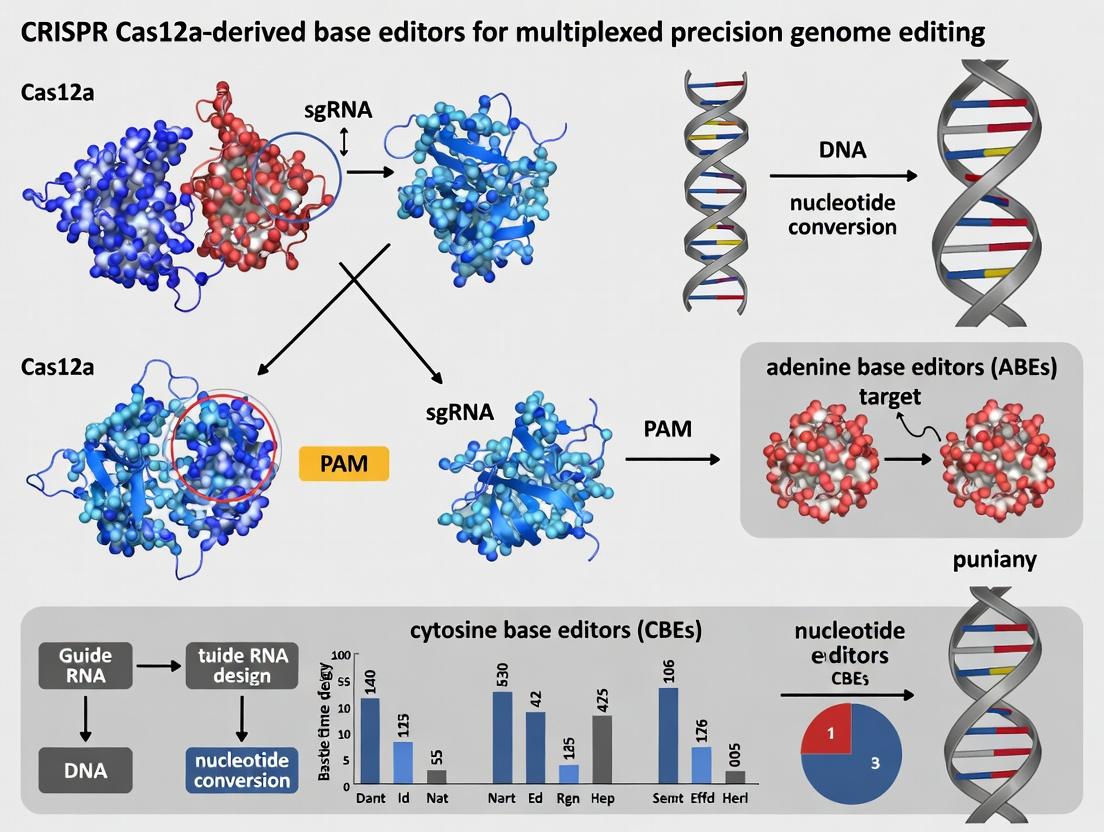
This article provides a comprehensive guide for researchers and drug development professionals on CRISPR-Cas12a-derived base editing systems for multiplexed genome engineering.
Multiplexed Precision Editing with CRISPR-Cas12a Base Editors: Design, Applications, and Optimization for Biomedical Research
Abstract
This article provides a comprehensive guide for researchers and drug development professionals on CRISPR-Cas12a-derived base editing systems for multiplexed genome engineering. It covers the foundational advantages of Cas12a over Cas9, including its smaller size, simpler guide RNA architecture, and staggered cut profile, which facilitate efficient multiplexing. We detail methodological workflows for designing and delivering Cas12a base editor (BE) ribonucleoprotein (RNP) complexes for simultaneous editing of multiple loci in diverse cell types. The guide addresses common experimental challenges such as off-target effects, PAM (TTTV) sequence limitations, and editing efficiency variability, offering troubleshooting and optimization strategies. Finally, we present validation protocols and a comparative analysis with Cas9-based systems, highlighting Cas12a-BEs' unique capabilities in creating complex disease models, polygenic trait engineering, and therapeutic target discovery. This resource empowers scientists to implement robust, high-throughput precision editing in their research.
Why Cas12a? The Foundational Advantages for Multiplexed Base Editing
The development of CRISPR-Cas base editors has enabled precise, efficient genome editing without requiring double-stranded DNA breaks (DSBs) or donor templates. While initial base editors leveraged the widely used Streptococcus pyogenes Cas9 (SpCas9), there is growing interest in CRISPR-Cas12a (formerly Cpf1)-derived base editors. These systems offer distinct architectural advantages, particularly for multiplexed precision editing. Cas12a's inherent RNase activity, its ability to process its own CRISPR RNA (crRNA) array from a single transcript, and its staggered DNA cut distal to the protospacer adjacent motif (PAM) present unique opportunities for complex editing strategies. This Application Note details the core architectural and functional differences between Cas12a and Cas9, providing the foundational context for designing and implementing Cas12a-derived base editor systems in multiplexed editing research for therapeutic discovery.
Core Architectural and Functional Comparison
The fundamental differences between Cas12a and Cas9 originate in their protein architecture, guide RNA requirements, and DNA interaction mechanisms. These distinctions directly impact their utility in precision editing applications.
Molecular Architecture and Mechanism
- Cas9: A two-lobed (REC and NUC) protein with two nuclease domains, HNH and RuvC. The HNH domain cleaves the target DNA strand (complementary to the crRNA), while RuvC cleaves the non-target strand. It requires two RNA components: a crRNA for target specificity and a trans-activating crRNA (tracrRNA) for maturation and complex stability, often fused into a single guide RNA (sgRNA).
- Cas12a: A single, bilobed protein with a RuvC-like nuclease domain responsible for cleaving both DNA strands. It possesses intrinsic RNase activity to process a precursor crRNA array into mature crRNAs. It requires only a crRNA, lacking the need for a tracrRNA. Its DNA cleavage produces staggered ends with a 5' overhang.
Quantitative Comparison Table
Table 1: Core Characteristics of Cas9 vs. Cas12a
| Feature | Cas9 (SpCas9) | Cas12a (LbCas12a/AsCas12a) |
|---|---|---|
| Protein Size | ~1368 amino acids (~160 kDa) | ~1228 amino acids (~140 kDa) |
| Guide RNA | crRNA + tracrRNA (or sgRNA) | Single crRNA only |
| crRNA Length | ~100 nt (for sgRNA) | ~42-44 nt |
| PAM Sequence | 5'-NGG-3' (SpCas9), downstream of protospacer | 5'-TTTV-3' (or TTTN), upstream of protospacer |
| PAM Location | 3' end of protospacer (downstream) | 5' end of protospacer (upstream) |
| DNA Cleavage | Blunt ends, within seed region | Staggered ends (5' overhang), distal to PAM |
| Cleavage Site | 3 bp upstream of PAM | 18-23 bp downstream of PAM (after PAM) |
| Nuclease Domains | HNH (target strand), RuvC (non-target strand) | Single RuvC-like (both strands) |
| crRNA Processing | Requires host RNase III & tracrRNA | Intrinsic RNase activity (processes pre-crRNA array) |
| Multiplex Potential | Requires multiple expression constructs | Native processing of crRNA arrays from a single transcript |
Protocols for Evaluating Cas12a Base Editor Performance
The following protocol outlines a standard workflow for assessing the activity and specificity of a Cas12a-derived base editor (e.g., a Cas12a-cytidine deaminase fusion) in mammalian cells.
Protocol 1: Assessment of Cas12a-BE Editing Efficiency and Specificity
Objective: To quantify on-target base conversion efficiency and detect potential off-target edits for a Cas12a Base Editor (Cas12a-BE).
Part A: Mammalian Cell Transfection and Genomic DNA Harvest
- Cell Seeding: Seed HEK293T or other relevant cell lines in a 24-well plate at a density of 1.5 x 10^5 cells/well in complete growth medium. Incubate for 24 hours to achieve ~70-80% confluency.
- Transfection Complex Formation (Lipofection):
- Prepare Solution A: Dilute 0.5 µg of Cas12a-BE expression plasmid and 0.25 µg of crRNA expression plasmid in 50 µL of Opti-MEM serum-free medium.
- Prepare Solution B: Dilute 1.5 µL of lipofection reagent (e.g., Lipofectamine 3000) in 50 µL of Opti-MEM. Incubate for 5 minutes.
- Combine Solutions A and B, mix gently, and incubate for 15-20 minutes at room temperature.
- Transfection: Add the 100 µL transfection complex dropwise to the pre-seeded cells. Gently rock the plate.
- Incubation: Culture cells for 72 hours at 37°C, 5% CO2 to allow for editing and expression.
- Genomic DNA (gDNA) Extraction: Harvest cells and isolate gDNA using a commercial silica-column-based kit. Elute in 50 µL nuclease-free water. Quantify DNA concentration.
Part B: On-Target Editing Analysis by Targeted Deep Sequencing
- PCR Amplification of Target Locus:
- Design primers flanking the target site (amplicon size: 250-400 bp).
- Set up 50 µL PCR reactions with high-fidelity DNA polymerase:
- gDNA template: 50-100 ng
- Forward/Reverse primers: 0.5 µM each
- dNTPs, buffer, polymerase per manufacturer's instructions.
- Thermocycler program: 98°C for 30s; 35 cycles of (98°C 10s, 60°C 15s, 72°C 20s); 72°C for 2 min.
- Purification and Barcoding: Purify PCR amplicons. Perform a second, limited-cycle PCR to attach Illumina sequencing adapters and sample-specific barcodes.
- Sequencing & Analysis: Pool barcoded libraries, quantify, and sequence on an Illumina MiSeq or similar platform. Analyze sequencing reads using base-editor-specific analysis pipelines (e.g, BE-Analyzer, CRISPResso2) to calculate the percentage of C-to-T (or A-to-G) conversion within the editing window.
Part C: Off-Target Analysis
- Identification of Potential Off-Target Sites: Use computational prediction tools (e.g., Cas-OFFinder) with the crRNA sequence, allowing for up to 4 mismatches and considering the TTTV PAM.
- Targeted Deep Sequencing: For the top 10-20 predicted off-target sites, repeat Part B using specific primers for each locus. Compare the frequency of base conversions at off-target sites to the on-target site.
Visualizing Key Architectural and Workflow Concepts
Diagram 1: Cas9 vs Cas12a Core Architecture
Diagram 2: Cas12a-BE Evaluation Workflow
The Scientist's Toolkit: Essential Reagents for Cas12a-BE Research
Table 2: Key Research Reagent Solutions for Cas12a-Base Editor Experiments
| Reagent / Material | Function & Relevance in Cas12a-BE Research |
|---|---|
| Cas12a Nuclease Variant Expression Plasmid (e.g., LbCas12a, AsCas12a) | Backbone for engineering the Cas12a-base editor fusion protein. Smaller size than Cas9 can be beneficial for viral packaging. |
| Deaminase Enzyme Expression Plasmid (e.g., pmCDA1, rAPOBEC1 for CBE; TadA variants for ABE) | Provides the catalytic domain for base conversion. Must be fused to Cas12a such that its activity window aligns with the accessible single-stranded DNA bubble. |
| crRNA Expression Vector or Synthetic crRNA | For single-target editing. crRNA is shorter and simpler than sgRNA. Synthetic crRNAs can be complexed with protein for RNP delivery. |
| Polycistronic crRNA Array Plasmid | Contains multiple crRNAs separated by direct repeats. Cas12a's intrinsic RNase processes this into individual crRNAs, enabling native multiplexed editing from a single transcript. |
| High-Efficiency Transfection Reagent (Lipofection or Electroporation Kit) | For delivery of plasmid DNA or ribonucleoprotein (RNP) complexes into hard-to-transfect cell lines relevant to disease modeling. |
| Next-Generation Sequencing (NGS) Library Prep Kit | Essential for unbiased, quantitative assessment of on-target editing efficiency and comprehensive off-target profiling via targeted deep sequencing. |
| Validated Anti-CRISPR (Acr) Protein for Cas12a | Acts as a potent inhibitor of Cas12a activity. Critical control for confirming that observed phenotypes are Cas12a-dependent. |
| Commercial Cas12a-BE Ready-to-Use Systems | Pre-optimized plasmid or RNP systems (e.g., from IDT, Thermo Fisher) can accelerate initial proof-of-concept studies. |
Within multiplexed precision editing research using CRISPR-Cas12a-derived base editors, the Protospacer Adjacent Motif (PAM) is a fundamental determinant of targeting scope and editing efficiency. Cas12a (Cpf1) recognizes a T-rich PAM sequence, commonly noted as TTTN (where 'N' is any nucleotide), but more precisely defined as TTTR (R = A or G) or TTTV (V = A, C, or G) depending on the specific ortholog. This PAM requirement, located 5' of the protospacer, directly constrains the genomic sites amenable to editing. This application note details the specificity, prevalence, and practical implications of TTTR/TTTV PAMs for experimental design, providing protocols for target site identification and validation in the context of multiplexed base editing.
Quantitative Analysis of PAM Specificity and Genomic Prevalence
Table 1: Common Cas12a Ortholog PAM Specificities and Efficiencies
| Cas12a Ortholog | Canonical PAM | Permissive Variants | Reported Editing Efficiency Range* | Key Reference (Year) |
|---|---|---|---|---|
| LbCas12a | TTTV (V=A,C,G) | TTTT, CTTV | 15-65% (Human cells) | Kleinstiver et al., 2019 |
| AsCas12a | TTTV | TTTT, TCTA | 10-50% (Human cells) | Zetsche et al., 2015 |
| FnCas12a | TTTN (N=A,C,G,T) | TTN, YTTN | 5-40% (Human cells) | Fonfara et al., 2016 |
| MbCas12a | TTTV | TTTA, TTTG | 20-70% (Human cells) | Tóth et al., 2020 |
*Efficiency is highly dependent on context, delivery method, and target locus.
Table 2: Genomic Prevalence of Cas12a PAM Sequences in the Human Genome (hg38)
| PAM Sequence (5' to 3') | Expected Frequency (1 in every X bp) | Actual Count (Millions) | % of All 4bp PAMs |
|---|---|---|---|
| TTTA | 256 | ~11.2 | ~1.56% |
| TTTC | 256 | ~11.1 | ~1.55% |
| TTTG | 256 | ~11.0 | ~1.53% |
| TTTV Total | 85.3 | ~33.3 | ~4.64% |
| TTTT | 256 | ~10.9 | ~1.52% |
| All TTTN | 64 | ~44.2 | ~6.16% |
Note: Analysis performed via in silico scan. TTTA/TTTG (TTTR) are generally associated with higher editing efficiencies for most orthologs compared to TTTC/TTTT.
Protocol: Identifying and Prioritizing TTTR/TTTV Sites for Multiplexed Editing
Aim: To computationally identify and rank all potential Cas12a base editor target sites within a set of candidate genes for a multiplexed editing experiment.
Materials:
- Reference genome FASTA file (e.g., GRCh38.p13).
- List of target gene coordinates or sequences.
- Cas12a PAM specification (e.g., LbCas12a: TTTV).
- Software:
PythonwithBiopythonor command-line tools (bedtools,seqkit).
Procedure:
- Define Target Regions: Extract genomic sequences for your regions of interest (e.g., 1kb window around each exon of target genes) using
bedtools getfasta. - In Silico PAM Scan: Write a script to slide a window across both strands of each extracted sequence. For the forward strand, identify the sequence pattern
TTTVfollowed by a 20-24 nt spacer sequence. Record the PAM sequence, spacer sequence, chromosomal coordinate, and strand. - Apply Filtering Criteria: Filter identified sites based on:
- PAM Type: Prioritize TTTR (A/G) over TTTC/TTTT if using LbCas12a or AsCas12a.
- Base Editor Window: The desired editable base(s) (e.g., a specific C within a CBE window) must fall within the ~10-18 bp editing window of the Cas12a base editor (typically 5' of the PAM).
- Off-target Potential: Use
cas-offinderorCHOPCHOPto predict and score potential off-target sites. Exclude sites with high-scoring off-target matches. - Genomic Context: Avoid regions with high GC content (>70%) or repetitive elements.
- Generate Final List: Rank filtered sites by PAM strength (TTTA > TTTG > TTTC > TTTT), proximity to target base, and low off-target score. Compile into a BED or CSV file for guide RNA synthesis.
Protocol: Experimental Validation of PAM-Dependent Editing Efficiency
Aim: To empirically test the editing efficiency of a Cas12a base editor at genomic loci with different TTTR/TTTV PAMs.
Materials:
- LbCas12a- or AsCas12a-derived Cytosine Base Editor (CBE) or Adenine Base Editor (ABE) plasmid.
- sgRNA expression plasmids or PCR templates for 4-6 target sites with varying PAMs (TTTA, TTTG, TTTC, TTTT).
- Human cell line (e.g., HEK293T).
- Transfection reagent.
- Lysis buffer and PCR reagents.
- Next-Generation Sequencing (NGS) library prep kit.
Procedure:
- Construct Assembly: Clone individual sgRNA expression cassettes targeting the selected loci into your delivery vector (e.g., a multiplexed tRNA-gRNA array plasmid).
- Cell Transfection: Seed HEK293T cells in a 24-well plate. Co-transfect 500ng of Cas12a-base editor plasmid and 250ng of sgRNA plasmid(s) per well using lipofectamine. Include a no-guide control.
- Harvest Genomic DNA: 72 hours post-transfection, aspirate media, lyse cells directly in the well with 50µL of Direct PCR Lysis Buffer, and incubate at 56°C for 1 hour, then 95°C for 10 minutes.
- Amplify Target Loci: Perform PCR on 2µL of lysate using primers flanking each target site (~300-400bp amplicon). Purify PCR products.
- NGS Library Preparation & Analysis: Barcode and pool amplicons for NGS. After sequencing, analyze data using a base editing analysis pipeline (e.g.,
BEATorCRISPResso2). Calculate editing efficiency as (number of reads with target C->T or A->G conversions) / (total aligned reads) * 100% for each site. - Data Correlation: Correlate editing efficiency with PAM sequence, position within the editing window, and local sequence context.
Title: Computational and Experimental PAM Analysis Workflow
Title: Cas12a Base Editor Targeting and PAM Relation
The Scientist's Toolkit: Key Reagent Solutions
Table 3: Essential Reagents for Cas12a PAM-Specific Base Editing Research
| Reagent / Material | Function & Relevance to PAM Studies | Example Vendor/Product |
|---|---|---|
| LbCas12a- and AsCas12a-Base Editor Plasmids | Essential effector proteins for C-to-T or A-to-G editing at TTTV sites. Key for comparing ortholog performance. | Addgene: pCMV-LbCas12a-ABE, pY010-AsCas12a-CBE |
| Custom sgRNA Synthesis Kit | For generating individual or arrayed sgRNAs targeting specific TTTR/V loci. Critical for multiplexed screening. | IDT Alt-R CRISPR-Cas12a crRNA, or NEB HiScribe T7 Quick High Yield RNA Synthesis Kit. |
| Multiplex gRNA Cloning Kit | Systems for assembling tRNA-gRNA arrays or polycistronic arrays to target multiple TTTR/V sites simultaneously. | Takara Bio In-Fusion Snap Assembly Master Mix. |
| Next-Generation SequencingAmplicon-EZ Service | Accurate quantification of base editing efficiencies across many target sites with different PAMs. | Genewiz Amplicon-EZ, Illumina MiSeq. |
| CRISPR-Cas12a HDR DonorTemplate Design Tool | When PAM requirements prevent ideal targeting, design homology-directed repair (HDR) donors for precise edits. | IDT's HDR Design Tool, SnapGene. |
| Validated Positive ControlsgRNA/PAM Plasmid | A sgRNA targeting a high-efficiency TTTA PAM site as a transfection and editing efficiency control. | Often published in literature (e.g., targeting the DNMT1 or PPIB locus). |
Within the broader thesis on developing CRISPR-Cas12a-derived base editors for multiplexed precision editing research, understanding the precise molecular mechanism of Cas12a-Base Editors (Cas12a-BEs) is foundational. Unlike canonical Cas12a, which creates double-stranded breaks (DSBs), Cas12a-BEs are fusion proteins that catalyze precise, irreversible point mutations without inducing DSBs. This application note details the mechanisms of Adenine Base Editors derived from Cas12a (ABE12a) and Cytosine Base Editors derived from Cas12a (CBE12a), which facilitate A•T to G•C and C•G to T•A conversions, respectively. These tools are critical for modeling genetic diseases, functional genomics, and therapeutic development where single-nucleotide polymorphisms (SNPs) are targeted.
Molecular Mechanism of Action
Core Architecture
A Cas12a-Base Editor is a chimeric protein consisting of three core components:
- Catalytically Dead Cas12a (dCas12a) or Nickase Cas12a (nCas12a): A DNA-binding module guided by a CRISPR RNA (crRNA) to a specific genomic locus. dCas12a (D908A) binds without cutting, while nCas12a (re-cleavage deficient RuvC mutant, e.g., D832A) nicks the non-target strand.
- Deaminase Enzyme: Catalyzes the chemical conversion of one nucleobase to another.
- Linker: Connects the deaminase to Cas12a, optimizing spatial positioning for deamination activity.
ABE12a: A•T to G•C Conversion
ABE12a fuses a TadA* adenosine deaminase monomer (evolved from E. coli tRNA-specific adenosine deaminase TadA) to nCas12a/dCas12a. The mechanism proceeds in a series of steps:
- Targeting: The ABE12a ribonucleoprotein complex (nCas12a/dCas12a-TadA* + crRNA) binds to the target DNA sequence via crRNA-DNA complementarity, forming an R-loop.
- Deamination: TadA* deaminates an adenine (A) within a specific activity window (typically protospacer positions 8-18, 5' of the PAM [TTTV]) on the displaced, single-stranded non-target DNA strand to inosine (I). Inosine is read as guanine (G) by cellular polymerases.
- Nicking (if using nCas12a): The nCas12a component nicks the non-edited strand (target strand) to bias cellular repair toward the edited strand.
- DNA Repair & Replication: Cellular DNA repair machinery or DNA replication uses the edited strand (containing I) as a template. This leads to the replacement of the original A•T base pair with a I•C pair, which subsequently becomes a G•C pair.
CBE12a: C•G to T•A Conversion
CBE12a fuses a cytidine deaminase (e.g., rAPOBEC1) and often a uracil glycosylase inhibitor (UGI) to nCas12a/dCas12a.
- Targeting: The CBE12a complex localizes to the target site.
- Deamination: The cytidine deaminase converts a cytosine (C) within its activity window on the single-stranded non-target strand to uracil (U).
- UGI Function: UGI inhibits endogenous uracil DNA glycosylase (UDG), preventing the erroneous excision of U and subsequent error-prone repair, thereby enhancing editing efficiency.
- Nicking (if using nCas12a): The non-edited strand is nicked to favor repair using the U-containing strand.
- DNA Repair & Replication: During repair or replication, U is read as thymine (T), resulting in the conversion of the original C•G base pair to a T•A base pair.
Key Quantitative Data & Performance Metrics
Table 1: Comparative Characteristics of Cas12a-Base Editors
| Parameter | ABE12a (e.g., ABE8e-dCas12a) | CBE12a (e.g., dCas12a-rAPOBEC1-UGI) | Notes / Source |
|---|---|---|---|
| Catalytic Deaminase | Evolved TadA* (monomer) | rAPOBEC1 / PmCDA1 / AID variants | ABE uses an evolved tRNA deaminase; CBE uses DNA cytidine deaminases. |
| Cas12a Form | dCas12a (D908A) or nCas12a (RuvC-) | dCas12a (D908A) or nCas12a (RuvC-) | Nickase versions typically yield higher efficiency. |
| Key Accessory Protein | None | Uracil Glycosylase Inhibitor (UGI) | UGI is critical for CBE efficiency by blocking UDG. |
| Primary Conversion | A • T → G • C | C • G → T • A | Directionality is fixed by deaminase chemistry. |
| Typical Activity Window | ~8-18 nucleotides upstream of PAM | ~8-18 nucleotides upstream of PAM | Window is broader and more distal than SpCas9-BEs. |
| Editing Efficiency (Range) | 10% - 65% | 15% - 70% | Highly dependent on target sequence, cell type, and delivery. |
| Indel Formation Rate | Generally < 1% | 0.5% - 2% (higher without UGI) | Significantly lower than Cas9 nuclease, but non-zero. |
| PAM Requirement | TTTV (V = A, C, G) | TTTV (V = A, C, G) | Defines targeting range; Cas12a PAM is T-rich. |
| Multiplexing Advantage | High (single crRNA array processing) | High (single crRNA array processing) | Cas12a natively processes its own crRNA array, simplifying multi-gene editing. |
| Product Purity | High (>99% desired product) | Moderate to High (can have C•G to G•C, A•T byproducts) | ABEs generally produce fewer byproducts than CBEs. |
Table 2: Protocol-Dependent Optimization Parameters
| Parameter | Optimal Condition / Consideration | Impact on Outcome |
|---|---|---|
| Delivery Method | RNP > Plasmid DNA > mRNA | RNP reduces off-targets and toxicity; plasmid can cause sustained expression. |
| Cell Type | Dividing cells > Non-dividing | Editing relies on DNA replication/repair; primary cells often require optimization. |
| crRNA Design | Target site within positions 8-18 from PAM; avoid secondary structure. | Maximizes deaminase access to target base. |
| Molar Ratio (RNP) | e.g., 3:1 (crRNA:tracrRNA): 2:1 (Deaminase:dCas12a) | Complex assembly efficiency affects targeting and editing. |
| Timepoint for Analysis | 48-72 hours post-transfection (plasmid); 24-48h (RNP) | Allows for repair and turnover of initial RNP complexes. |
Experimental Protocols
Protocol 1: Mammalian Cell Editing with Cas12a-BE RNP Complexes
Objective: Introduce precise A-to-G or C-to-T edits in HEK293T or relevant primary cells. Materials: Purified d/nCas12a-BE protein, synthetic crRNA, Opti-MEM, Lipofectamine CRISPRMAX or similar, PBS, cell culture media. Steps:
- Design & Order crRNA: Design crRNA to place target A or C within positions 8-18 relative to the 5' end of the protospacer (upstream of TTTV PAM). Order with chemical modifications for stability.
- RNP Complex Assembly: Combine 5 pmol of d/nCas12a-BE protein with 7.5 pmol of crRNA in nuclease-free duplex buffer (final volume 5 µL). Incubate at 25°C for 10 minutes.
- Cell Preparation: Seed cells 24h prior to achieve 70-80% confluency at transfection.
- Transfection Mix:
- Tube A: Dilute 5 µL of RNP complex in 100 µL Opti-MEM.
- Tube B: Dilute 3.5 µL CRISPRMAX in 100 µL Opti-MEM.
- Combine Tube A and B, mix gently, incubate at RT for 10-20 min.
- Transfection: Add RNP-lipid complex dropwise to cells in one well of a 24-well plate. Gently rock plate.
- Incubation & Harvest: Incubate cells at 37°C, 5% CO2 for 48-72 hours. Harvest genomic DNA using a commercial kit.
Protocol 2: Assessment of Editing Efficiency via Next-Generation Sequencing (NGS)
Objective: Quantify base editing efficiency and byproduct spectrum. Materials: Harvested genomic DNA, PCR primers flanking target site, high-fidelity PCR master mix, NGS library prep kit, SPRIselect beads. Steps:
- PCR Amplification: Amplify target locus from ~100 ng gDNA using barcoded primers. Perform a two-step PCR if needed: 1st PCR to amplify locus, 2nd PCR to add full Illumina adapters and sample indices.
- Library Purification: Clean PCR products using 0.8x SPRIselect beads to remove primers and non-specific fragments.
- Pooling & Sequencing: Quantify libraries by qPCR or bioanalyzer, pool equimolar amounts, and sequence on an Illumina MiSeq (2x250 bp or 2x300 bp).
- Data Analysis: Use pipelines like CRISPResso2 or custom scripts.
- Align reads to the reference amplicon sequence.
- Quantify the percentage of reads with A-to-G (for ABE) or C-to-T (for CBE) edits at each position within the target window.
- Calculate indel frequency and other substitution frequencies (e.g., non-canonical edits for CBE).
Visual Mechanism & Workflow Diagrams
Diagram 1 Title: Cas12a-Base Editor Molecular Mechanism
Diagram 2 Title: Cas12a-BE Editing & Validation Workflow
The Scientist's Toolkit: Essential Research Reagents
Table 3: Key Research Reagent Solutions for Cas12a-BE Experiments
| Reagent / Material | Function & Purpose | Example Vendor / Cat. No. (Representative) |
|---|---|---|
| Purified d/nCas12a-BE Protein | Core editor component for RNP assembly; ensures fast, transient activity with reduced off-targets. | IDT (Alt-R S.p. dCas12a-D908A Base Editor), Thermo Fisher (TrueCut Cas12a Protein). |
| Chemically Modified crRNA | Guides Cas12a-BE to target locus; chemical modifications (2'-O-methyl, phosphorothioate) enhance stability and efficiency. | Synthego (4X Modified crRNA), IDT (Alt-R CRISPR-Cas12a crRNA). |
| Uracil Glycosylase Inhibitor (UGI) | Critical for CBE12a; inhibits host UDG to prevent U excision and error-prone repair, increasing product purity. | Co-expressed as part of CBE construct or added as separate protein in RNP. |
| Cas12a-BE Expression Plasmids | For stable cell line generation or prolonged editing windows via viral/non-viral DNA delivery. | Addgene (plasmids #138489, #138490 for ABE/CBE). |
| High-Efficiency Transfection Reagent | For RNP or plasmid delivery into mammalian cells; low cytotoxicity is crucial. | Thermo Fisher (Lipofectamine CRISPRMAX), Mirus (TransIT-X2). |
| NGS Library Prep Kit | For preparing amplicon sequencing libraries to quantify editing outcomes with high accuracy. | Illumina (DNA Prep Kit), NEB (NEBNext Ultra II Q5 Master Mix). |
| Genomic DNA Extraction Kit | To cleanly harvest DNA from edited cells for downstream analysis (PCR, NGS). | Qiagen (DNeasy Blood & Tissue Kit), Zymo Research (Quick-DNA Miniprep Plus Kit). |
| Analysis Software | For precise quantification of base editing efficiency, indels, and byproducts from NGS data. | CRISPResso2 (open-source), BE-Analyzer (web tool). |
This application note details streamlined protocols for multiplexed genome editing using CRISPR-Cas12a (Cpfl)-derived base editors. Within the broader thesis of developing efficient, high-fidelity tools for multiplexed precision editing, this work focuses on two critical advancements: the generation of simplified crRNA arrays and the direct delivery of pre-assembled Ribonucleoprotein (RNP) complexes. Cas12a's inherent ability to process its own CRISPR RNA (crRNA) from a single transcript makes it uniquely suited for multiplexing. When coupled with the precision of a deaminase-fused, nickase-active Cas12a base editor (e.g., Cas12a-ABE or -CBE), this system enables concurrent, programmable editing at multiple genomic loci with minimal off-target effects and without generating double-strand breaks. The methodologies herein are designed for researchers and drug development professionals aiming to model polygenic traits, engineer complex metabolic pathways, or perform combinatorial genetic screens.
Research Reagent Solutions Toolkit
| Reagent/Material | Function/Explanation |
|---|---|
| Cas12a-Nickase Base Editor Protein | Purified recombinant protein (e.g., enAsCas12a-ABE8e). The nickase variant prevents DSBs, while the fused deaminase (adenine or cytosine) enables precise base conversion. |
| Custom crRNA Array Template | dsDNA fragment or plasmid containing tandem, direct repeat-spacer sequences for all target loci. The Cas12a enzyme itself will process this into individual crRNAs. |
| In Vitro Transcription (IVT) Kit | For T7 or U6 promoter-driven transcription of the crRNA array template to produce a single long crRNA precursor. |
| Chemically Modified sgRNA/Single crRNA | For comparison or low-plex editing. Chemical modifications (2'-O-methyl, phosphorothioate) enhance stability in RNP format. |
| Electroporation System (e.g., Neon, Amaxa) | Preferred method for efficient delivery of RNP complexes into hard-to-transfect primary cells or cell lines. |
| Lipid-Based RNP Transfection Reagent | Specialized formulations (e.g., Lipofectamine CRISPRMAX) designed for RNP delivery. |
| HDR Enhancer Molecules (e.g., L755507, RS-1) | Small molecules that can enhance editing outcomes when used with base editors by modulating cellular repair pathways. |
| Next-Generation Sequencing (NGS) Library Prep Kit | For deep amplicon sequencing of all target loci to quantitatively assess multiplex editing efficiency and purity. |
Protocol I: Design and Preparation of Simplified crRNA Arrays
Design Principles
- Spacer Selection: Design 20-24 bp spacers per target locus using validated design tools (e.g., ChopChop). For base editing, consider the editing window (typically positions 8-18 relative to the PAM, which is TTTV for Cas12a).
- Array Construction: Concatenate spacer sequences in tandem, separated by the native Cas12a direct repeat (DR) sequence (typically 19-23 bp). No additional processing elements (tRNAs, ribozymes) are required.
- Final construct:
[DR-Spacer1-DR-Spacer2-DR-Spacer3...]
- Final construct:
- Template Preparation: Order the array sequence as a gBlock or clone into a plasmid downstream of a T7 or U6 RNA polymerase promoter.
In Vitro Transcription and Purification
- Linearize plasmid template or use PCR-amplified gBlock.
- Perform IVT using a high-yield T7 transcription kit. Incubate at 37°C for 4-16 hours.
- Treat with DNase I to remove template DNA.
- Purify the long crRNA transcript using RNA clean-up beads or columns. Elute in nuclease-free water or buffer.
- Quantify by spectrophotometry (Nanodrop). Analyze integrity via denaturing urea-PAGE.
Protocol II: RNP Assembly and Delivery for Multiplex Editing
RNP Complex Assembly
- Complex Formation:
- For a 3-plex array, combine in a 1.5 mL tube:
- Cas12a-base editor protein (100 pmol)
- Purified crRNA array transcript (120 pmol – slight molar excess)
- Optional: Chemically modified tracrRNA (for enhanced stability; 120 pmol)
- Incubate at 25°C for 10-20 minutes to allow RNP formation.
- For a 3-plex array, combine in a 1.5 mL tube:
Delivery via Electroporation (Example for HEK-293T Cells)
- Cell Preparation: Harvest and wash 1x10^5 – 2x10^5 cells per condition. Resuspend in appropriate electroporation buffer.
- Electroporation: Mix cell suspension with pre-assembled RNP complexes. Transfer to an electroporation cuvette. Apply optimized pulse parameters (e.g., 1700V, 20ms, 1 pulse for Neon system).
- Recovery: Immediately transfer cells to pre-warmed culture medium. Seed into a multi-well plate.
- Analysis: Harvest cells 48-72 hours post-editing for genomic DNA extraction and analysis.
Table 1: Comparison of Editing Efficiency: Single crRNA vs. Array RNP Delivery
| Cell Line | Target Loci (Plex) | Delivery Method | Average Editing Efficiency (%)* | Product Purity (Intended Edit %) | Reference |
|---|---|---|---|---|---|
| HEK-293T | EMX1, VEGFA, FANCF (3-plex) | Array RNP (Electroporation) | 78.2 ± 5.1 | 92.4 ± 3.2 | This Protocol |
| HEK-293T | EMX1 (Single) | Single crRNA RNP (Lipofection) | 85.5 ± 3.8 | 95.1 ± 2.5 | This Protocol |
| K-562 | IL1RN, HBB, CCR5 (3-plex) | Array RNP (Electroporation) | 65.7 ± 7.3 | 88.9 ± 4.7 | This Protocol |
| Primary T Cells | PDCD1, TRAC, B2M (3-plex) | Array RNP (Electroporation) | 41.3 ± 6.5 | 85.2 ± 5.1 | This Protocol |
*Editing efficiency measured by NGS as percentage of total reads containing the intended base conversion.
Table 2: Byproduct Analysis from Multiplex Base Editing (NGS Data)
| Condition | Indels Frequency (%) | Transversion Mutations (%) | Multiple Off-Target Edits (Reads >1%) |
|---|---|---|---|
| Cas12a-ABE + 3-plex Array | 1.2 ± 0.4 | 0.8 ± 0.3 | 0 / 10 predicted sites |
| Cas9-ABE + 3 sgRNAs | 3.5 ± 1.1 | 1.5 ± 0.6 | 2 / 10 predicted sites |
Visualization of Workflows and Mechanisms
Title: Workflow: From crRNA Array Design to Multiplex Base Editing
Title: Mechanism: In-Cell Processing of crRNA Array Enables Multiplexing
Detailed NGS Analysis Protocol for Editing Assessment
Genomic DNA Extraction and Amplicon Library Preparation
- Harvest Cells: 72 hours post-editing, pellet cells and extract genomic DNA using a column-based kit.
- First PCR (Amplification):
- Design primers with overhangs for each target locus to generate ~250-350 bp amplicons.
- Perform multiplexed PCR in separate tubes or a multiplex reaction if primers are compatible.
- Purify PCR products.
- Second PCR (Indexing):
- Use a limited-cycle PCR to attach dual indices and sequencing adapters (e.g., Illumina Nextera XT indices).
- Pool, Clean, and Quantify all indexed libraries. Perform paired-end sequencing (2x250 bp) on an Illumina MiSeq or similar platform.
Bioinformatics Analysis
- Demultiplex sequencing reads by sample and amplicon.
- Align Reads to reference sequences using tools like BWA or CRISPResso2.
- Quantify Editing:
- Use CRISPResso2 or custom scripts to count the percentage of reads containing the intended base substitution(s) at each target position within the editing window.
- Calculate indel frequencies and other unintended modifications.
This document provides an overview of the current state of Cas12a-derived Base Editor (BE) variants, framed within the context of multiplexed precision editing research. Cas12a (Cpf1) base editors offer distinct advantages for combinatorial editing, including a single RNase processing its own CRISPR RNA (crRNA) array, enabling efficient multi-gene targeting from a single transcript. Unlike Cas9-based systems, Cas12a creates staggered ends distal from the protospacer adjacent motif (PAM), which, when coupled with deaminase domains, has required innovative protein engineering to develop efficient editors.
Available Cas12a-BE Variants and Properties
The following table summarizes the key engineered Cas12a-BE variants, their deaminase origins, editing windows, targeted base conversions, and notable evolved properties relevant for multiplexed applications.
Table 1: Engineered Cas12a-Base Editor Variants and Their Characteristics
| Variant Name | Deaminase Engine (Origin) | Catalytic Component(s) | PAM Requirement (5'->3') | Primary Editing Window (Relative to PAM) | Base Conversion | Key Evolved Properties | Primary References |
|---|---|---|---|---|---|---|---|
| Target-AID (dLbCas12a-BE) | pmCDA1 (Sea lamprey) | Single cytidine deaminase | TTTV | +15 to +19 | C•G to T•A | First proof-of-concept Cas12a-CBE; modest activity. | (Yamano et al., 2016) |
| dFnCas12a-BE1 | rAPOBEC1 (Rat) | Deaminase + UGI | TTTV | +10 to +14 | C•G to T•A | Improved activity over Target-AID; wider editing window. | (Li et al., 2018) |
| hA3A-Cas12a-UGI | hA3A (Human) | Deaminase + UGI | TTTV | +8 to +15 | C•G to T•A | High activity on methylated DNA; reduced off-target RNA editing. | (Gehrke et al., 2018) |
| Cas12a-ABE | TadA* (E. coli) | Adenine deaminase variant | TTTV | +8 to +14 | A•T to G•C | First Cas12a-ABE; requires further optimization for efficiency. | (Li et al., 2018) |
| eBE (enCas12a) | rAPOBEC1 (Rat) | Deaminase + UGI fusion | TTTV / TYCV | +7 to +14 | C•G to T•A | Evolved LbCas12a (enCas12a) with broadened PAM recognition (e.g., TYCV). | (Liu et al., 2020) |
| hA3A-eBE | hA3A (Human) | Deaminase + UGI fusion | TTTV / TYCV | +7 to +14 | C•G to T•A | Combines evolved Cas12a (enCas12a) with hA3A for improved activity on methylated DNA. | (Liu et al., 2020) |
| CRISPRseek | rAPOBEC1 (Rat) / hAID | Deaminase + UGI | TTTV | +6 to +12 | C•G to T•A | Engineered for enhanced activity in plant systems. | (Wu et al., 2021) |
| xABE (xCas12a-ABE) | TadA8e (E. coli) | Adenine deaminase variant | TTTV / TATV / VTTV | +7 to +13 | A•T to G•C | Uses engineered xCas12a with relaxed PAM for expanded targeting scope. | (Wang et al., 2022) |
Application Notes for Multiplexed Precision Editing
- Multiplexing Advantage: The native crRNA array processing capability of Cas12a is its primary advantage for multiplexing. A single transcript encoding multiple spacers can be processed into individual crRNAs in vivo, simplifying delivery compared to multiple sgRNAs required for Cas9 multiplexing.
- PAM Flexibility: The canonical TTTV PAM (V = A, C, G) of wild-type Cas12a is restrictive. Evolved variants like enCas12a (recognizing TYCV) and xCas12a (recognizing TATV, VTTV) significantly broaden the targetable genomic space for base editing applications.
- Editing Window Considerations: The editing window for Cas12a-BEs is typically 5-19 nucleotides distal from the PAM, with a hotspot around positions +8 to +15. This positioning differs from Cas9-BEs and must be accounted for during target site selection for precise single-nucleotide variant (SNV) modeling.
- Specificity Profile: Cas12a-BEs generally exhibit lower off-target DNA editing compared to some Cas9-BEs, a critical feature for therapeutic development. However, deaminase-dependent off-target effects on both DNA and RNA remain an area of active investigation.
Detailed Experimental Protocols
Protocol 1: Design and Assembly of a Multiplexed Cas12a-BE crRNA Array
Objective: To construct a plasmid expressing a single crRNA array targeting multiple genomic loci for simultaneous base editing. Materials: See "The Scientist's Toolkit" (Table 2). Procedure:
- Target Selection: Identify target sequences (18-23 nt) within the editing window (+6 to +19 from PAM) of your chosen Cas12a-BE variant. Ensure a compatible PAM (e.g., TTTV for wild-type, TYCV for enCas12a) is present directly 5' to the target.
- Oligonucleotide Design: Design forward and reverse oligonucleotides for each spacer with 4-nt 5' overhangs compatible with BsaI Golden Gate assembly.
- Example forward oligo for spacer 1:
5'-TTTC[Spacer1 Sequence]-3' - Example reverse oligo for spacer 1:
5'-AAAC[Reverse Complement of Spacer1]-3'
- Example forward oligo for spacer 1:
- Annealing: For each spacer, mix equimolar amounts of forward and reverse oligos (10 µM each) in 1x T4 Ligase Buffer. Anneal in a thermocycler: 95°C for 5 min, ramp down to 25°C at 5°C/min.
- Golden Gate Assembly:
- Set up a 20 µL reaction: 50 ng BsaI-digested crRNA array backbone plasmid (e.g., pRGEB32), 1 µL of each annealed duplex (diluted 1:10), 1 µL T4 DNA Ligase, 1 µL BsaI-HFv2, 2 µL 10x T4 Ligase Buffer, add H₂O to 20 µL.
- Cycle: (37°C for 5 min, 20°C for 5 min) x 25 cycles, then 37°C for 15 min, 80°C for 10 min.
- Transformation: Transform 2 µL of the assembly reaction into competent E. coli cells (e.g., DH5α). Plate on selective antibiotic agar.
- Validation: Pick colonies, perform colony PCR or plasmid mini-prep, and confirm array sequence by Sanger sequencing using primers flanking the array.
Protocol 2: Mammalian Cell Transfection and Base Editing Analysis
Objective: To deliver Cas12a-BE components into mammalian cells and quantify editing efficiency. Materials: See "The Scientist's Toolkit" (Table 2). Procedure:
- Cell Seeding: Seed HEK293T or other relevant cells in a 24-well plate at 1-1.5 x 10⁵ cells/well in complete growth medium without antibiotics. Incubate at 37°C, 5% CO₂ until 70-90% confluent (typically 18-24 hrs).
- Transfection Complex Formation:
- For each well, prepare Solution A: Dilute 500 ng of Cas12a-BE expression plasmid (e.g., enCas12a-ABE) and 250 ng of the crRNA array plasmid (from Protocol 1) in 50 µL of Opti-MEM I Reduced Serum Medium.
- Prepare Solution B: Dilute 1.5 µL of Lipofectamine 3000 reagent in 50 µL of Opti-MEM. Incubate for 5 min at RT.
- Combine Solutions A and B, mix gently, and incubate for 15-20 min at RT to form complexes.
- Transfection: Add the 100 µL transfection complex dropwise to the cell well. Gently rock the plate.
- Incubation: Incubate cells for 48-72 hours at 37°C, 5% CO₂.
- Harvest Genomic DNA: Harvest cells using trypsin-EDTA. Extract genomic DNA using a commercial kit (e.g., DNeasy Blood & Tissue Kit). Elute in 50-100 µL of elution buffer. Measure DNA concentration.
- PCR Amplification of Target Loci:
- Design PCR primers (~200-300 bp amplicon) flanking each target site.
- Perform individual PCR reactions for each locus using a high-fidelity DNA polymerase.
- Editing Efficiency Analysis:
- Sanger Sequencing & Decomposition: Purify PCR products. Submit for Sanger sequencing. Analyze chromatograms using online decomposition tools (e.g., BEAT, EditR) to quantify base conversion percentages.
- High-Throughput Sequencing (Recommended): Amplicons from multiple targets can be barcoded and pooled for next-generation sequencing (NGS). Analyze sequencing data with pipelines like CRISPResso2 to calculate precise base editing frequencies and indel percentages.
Visualizations
Diagram 1: Multiplexed Cas12a-BE Experimental Workflow
Diagram 2: Cas12a crRNA Processing Enables Multiplexed Editing
The Scientist's Toolkit
Table 2: Key Research Reagent Solutions for Cas12a-BE Experiments
| Item | Function & Description | Example Product/Catalog |
|---|---|---|
| Evolved Cas12a-BE Plasmids | Expression vectors for engineered editors (e.g., enCas12a-BE, xCas12a-ABE). | Addgene: #138438 (enCas12a-BE), #175478 (xCas12a-ABE). |
| crRNA Array Backbone | Plasmid with BsaI sites for easy Golden Gate assembly of spacer arrays. | Addgene: pRGEB32 (#136252). |
| High-Fidelity DNA Polymerase | For error-free amplification of target loci for sequencing analysis. | NEB Q5, Thermo Fisher Phusion. |
| Golden Gate Assembly Kit | Enzymes for one-pot, directional assembly of crRNA arrays. | NEB Golden Gate Assembly Kit (BsaI-HFv2) (E1601). |
| Lipofection Reagent | For efficient delivery of plasmid DNA into mammalian cell lines. | Lipofectamine 3000, JetOPTIMUS. |
| Genomic DNA Extraction Kit | For rapid, high-quality genomic DNA isolation from transfected cells. | Qiagen DNeasy Blood & Tissue Kit (69504). |
| BE Analysis Software | Computational tools to quantify base editing efficiency from sequencing data. | CRISPResso2, BEAT, EditR. |
| NGS Amplicon-EZ Service | Service for high-throughput sequencing of PCR amplicons from edited genomic loci. | GENEWIZ Amplicon-EZ, Illumina MiSeq. |
A Step-by-Step Protocol: Designing and Executing Cas12a-BE Multiplex Experiments
Within a research thesis focused on developing and applying CRISPR-Cas12a-derived base editors (e.g., enCas12a-adenine or -cytosine base editors) for multiplexed precision editing, the initial computational design phase is critical. Unlike Cas9, Cas12a processes its own CRISPR RNA (crRNA) from a single polycistronic array, enabling efficient multiplexing from a single transcript. This application note details best practices and current software tools for target selection and crRNA array design to maximize editing efficiency and specificity in complex experimental systems relevant to drug development.
Target Selection: Key Considerations & Quantitative Metrics
Effective design begins with stringent target selection. The following parameters must be evaluated for each putative target site.
Table 1: Key Quantitative Parameters for Cas12a Target Site Selection
| Parameter | Optimal Range | Rationale & Impact on Editing |
|---|---|---|
| TTTV PAM | Strictly 5'-TTTV (V=A/C/G) | Absolute requirement for Cas12a binding. TTTV is most common; TTTT is highly efficient. |
| On-Target Efficiency Score | >70 (Tool-dependent) | Predicts crRNA activity. Based on sequence composition, GC content, and secondary structure. |
| GC Content | 40-60% | Extreme GC% can affect crRNA stability and R-loop formation. |
| Off-Target Potential | ≤3 mismatches in seed region (PAM-proximal 18 nt) | Mismatches in the seed region (PAM-distal for Cas12a) are less tolerated, but comprehensive screening is essential. |
| Genomic Context | Accessible chromatin region (DNase-seq/ATAC-seq peaks) | Editing efficiency correlates with local chromatin openness. |
| Proximity to Target Base | Base edit window typically 8-18 nt from PAM | For Cas12a-BEs, the deaminase activity window is offset from the PAM; positioning is critical. |
Software Tools for Design and Analysis
Current tools facilitate the entire workflow from target discovery to array construction. The following table summarizes leading, actively maintained platforms.
Table 2: Software Tools for Cas12a crRNA Array Design
| Tool Name | Primary Function | Key Feature for Cas12a Multiplexing | URL/Reference |
|---|---|---|---|
| CHOPCHOP | Target site selection & off-target prediction | Supports Cas12a (Cpf1), provides efficiency scores, and designs primers for array cloning. | chopchop.cbu.uib.no |
| CRISPRitz | Comprehensive design with strict off-target analysis | Advanced off-target search for Cas12a with genome-wide mismatch tolerance specification. | crispritz.org |
| CRISPick (Broad) | User-friendly design and batch processing | Incorporates Rule Set 3 for efficiency prediction and supports array design for LbCas12a. | design.synthego.com |
| FlashFry | Rapid, high-throughput target discovery | Efficiently scores thousands of potential sites for efficiency and specificity from NGS input. | PMID: 29301961 |
| CRISPR-DT | DNA on-target & off-target prediction for Cas12a | Specifically trained on Cas12a datasets; provides deletion toxicity prediction. | bioinfolab.miamioh.edu/crispr-dt |
Protocol: crRNA Array Design and Cloning for Cas12a Base Editing
This protocol outlines the steps to design and clone a functional crRNA array for multiplexed base editing using an enCas12a-BE plasmid system.
A. Materials & Reagent Solutions Table 3: Research Reagent Solutions Toolkit
| Item | Function in Protocol | Example Product/Catalog # |
|---|---|---|
| enCas12a-Base Editor Plasmid | Expresses the fusion protein (enCas12a-deaminase). | pCMV-enLbCas12a-ABE (Addgene #XXXXX) |
| Array Cloning Backbone | Plasmid with direct repeat (DR) flanks for Golden Gate assembly. | pUC19-DR Array (Addgene #YYYYY) |
| BsaI-HFv2 Restriction Enzyme | Type IIS enzyme for Golden Gate assembly of crRNA spacers. | NEB #R3733 |
| T4 DNA Ligase | Ligates annealed oligonucleotides into the array backbone. | NEB #M0202 |
| High-Fidelity DNA Polymerase | PCR amplification of array for validation. | Q5 Hot Start (NEB #M0493) |
| Chemically Competent E. coli | For transformation after assembly. | NEB 5-alpha #C2987 |
B. Step-by-Step Procedure
Step 1: Target Identification & crRNA Design
- Input your target genomic sequences (e.g., exon regions of interest) into CRISPick or CHOPCHOP.
- Set the nuclease parameter to "LbCas12a" or "AsCas12a" as required.
- Filter results to select sites with:
- A TTTV PAM on the non-target strand (Cas12a cuts the target strand complementary to the crRNA spacer).
- High on-target efficiency score (>70).
- The target base (A or C) positioned within the base editor's activity window (e.g., positions 8-18 from the PAM).
- Minimal off-target hits (use CRISPRitz for genome-wide validation).
- Record the 23-24 nt spacer sequence immediately upstream of the PAM for each selected target.
Step 2: crRNA Array Oligonucleotide Design
- Define the array architecture:
DR-[Spacer1]-DR-[Spacer2]-DR-[Spacer3]-...- Direct Repeat (DR): Use the canonical 19-nt LbCas12a DR:
5'-UUUCUACUAUUGUAGAU-3'(DNA equivalent:TTTCTACTATTGTAGAT).
- Direct Repeat (DR): Use the canonical 19-nt LbCas12a DR:
- For each spacer, design two complementary oligonucleotides (Top and Bottom) with 4-nt overhangs compatible with BsaI Golden Gate assembly.
- Example for Spacer1 in position 1 (overhang:
ACAG):Top Oligo: 5'-ACAG[Spacer1 sequence]-3'Bottom Oligo: 5'-AAAC[Reverse Complement of Spacer1]-3'
- Example for Spacer1 in position 1 (overhang:
- Design terminal primers to amplify the final array for cloning into the final expression vector.
Step 3: Golden Gate Assembly of the crRNA Array
- Phosphorylate and anneal each spacer oligo pair:
- Mix 1 µL of each oligo (100 µM), 1 µL T4 PNK (NEB), 1 µL 10x T4 Ligase Buffer, 6.5 µL H₂O.
- Cycle: 37°C 30 min; 95°C 5 min; ramp to 25°C at 5°C/min.
- Perform a one-pot Golden Gate reaction:
- Mix: 50 ng BsaI-linearized array backbone, 0.5 µL of each annealed spacer duplex (1:200 dilution), 1 µL BsaI-HFv2, 1 µL T4 DNA Ligase, 2 µL 10x T4 Ligase Buffer, H₂O to 20 µL.
- Cycle: (37°C 5 min; 16°C 10 min) x 30 cycles; 60°C 5 min; 80°C 5 min.
- Transform 2 µL of the reaction into competent E. coli, plate on selective antibiotic, and incubate overnight.
- Screen colonies by colony PCR and Sanger sequence the array region to confirm correct spacer order and orientation.
Visualization of Workflows and Relationships
Title: Computational Design to Experimental Analysis Workflow
Title: Cas12a crRNA Array Processing and RNP Formation
The advancement of CRISPR-Cas12a-derived base editors for multiplexed precision editing requires efficient, safe, and scalable delivery systems. The choice between delivering pre-assembled Ribonucleoprotein (RNP) complexes or separate mRNA/crRNA components critically impacts editing efficiency, specificity, and translational potential. This application note compares three primary delivery platforms—Electroporation, Lipid Nanoparticles (LNPs), and Viral Vectors—within this specific research context, providing protocols and analytical tools for implementation.
Quantitative Comparison of Delivery Platforms
Table 1: Key Performance Metrics for Delivery Strategies in CRISPR-Cas12a Base Editing
| Parameter | Electroporation (RNP/mRNA) | Lipid Nanoparticles (mRNA/crRNA) | Viral Vectors (AAV for mRNA/crRNA) |
|---|---|---|---|
| Typical Payload | RNP (preferred), mRNA | mRNA + crRNA, sa-crRNA | mRNA, crRNA (separate cassettes) |
| Primary Cell Target | Immune cells, stem cells, cell lines | Primary cells, in vivo systemic delivery | In vivo targeted delivery, difficult-to-transfect cells |
| Editing Efficiency Range | 70-95% (in permissive cell lines) | 40-85% (cell-type dependent) | 20-70% (titer and tropism dependent) |
| Onset of Activity | Minutes to hours (RNP) | 2-6 hours | 12-72 hours (post-transcription) |
| Duration of Activity | Short (24-72 hrs, RNP degrades) | Moderate (3-7 days, mRNA stability) | Prolonged (weeks-months, risk of immunogenicity) |
| Multiplexing Capacity | High (co-delivery of multiple RNPs) | High (co-encapsulation of multiple mRNAs) | Limited by AAV cargo size (~4.7 kb) |
| Cytotoxicity Risk | Medium-High (cell stress) | Low-Medium (LNP composition dependent) | Low (but immunogenicity risk) |
| Scalability for In Vivo | Low (ex vivo primarily) | High | Medium-High |
| Key Advantage | Rapid, high efficiency ex vivo | Scalable, tunable, in vivo applicable | Sustained expression, cell-type specific tropism |
| Major Limitation | Throughput, cell viability | Endosomal escape efficiency, liver tropism | Cargo size limit, pre-existing immunity, insertional risk |
Table 2: Recommended Use Cases Based on Research Goal
| Research Phase / Goal | Recommended Strategy | Rationale |
|---|---|---|
| Initial In Vitro Screening | Electroporation (RNP) | Fast, high efficiency, minimal off-target persistence. |
| Primary Cell Editing (ex vivo) | Electroporation or LNPs | Balance of efficiency and viability; LNPs for sensitive cells. |
| In Vivo Proof-of-Concept | LNPs | Tunable targeting, controlled duration, high payload capacity. |
| Long-term In Vivo Expression | Viral Vectors (AAV) | For chronic models requiring sustained editor presence. |
| Multiplexed Editing (>3 loci) | Electroporation (RNP) or LNPs (mRNA) | Co-delivery of multiple guides without cargo constraints. |
Detailed Experimental Protocols
Protocol 1: Electroporation of Cas12a-Base Editor RNP into Primary Human T Cells Objective: Achieve high-efficiency, transient base editing for ex vivo cell therapy research. Materials: See "Scientist's Toolkit" below. Procedure:
- RNP Complex Formation: Reconstitute purified Cas12a-base editor protein and synthetic crRNA in nuclease-free duplex buffer. Incubate at 25°C for 10 min to form RNP. For multiplexing, pool multiple crRNAs at equimolar ratios.
- Cell Preparation: Isolate and activate T cells. Wash and resuspend in electroporation buffer at 50-100e6 cells/mL.
- Electroporation: Mix cell suspension with pre-formed RNP complex (final concentration: 40-80 µg/mL protein). Transfer to a certified cuvette. Electroporate using a system-optimized protocol (e.g., 1600V, 10ms, 3 pulses for Neon system).
- Recovery: Immediately transfer cells to pre-warmed, serum-rich medium. Culture at 37°C, 5% CO2.
- Analysis: Assess viability at 24h. Harvest cells at 48-72h for genomic DNA extraction. Evaluate editing efficiency via next-generation sequencing (NGS) of target loci.
Protocol 2: Formulation and In Vitro Transfection of LNP-encapsulated Cas12a-base editor mRNA Objective: Deliver base editor mRNA and crRNA to hepatocytes for in vitro disease modeling. Procedure:
- mRNA Preparation: Use codon-optimized Cas12a-base editor mRNA with 5' cap and poly-A tail. Co-precipitate with sa-crRNA or separate crRNA at a molar ratio of 1:3 (editor:guide).
- LNP Formulation (Microfluidic Mixing): Prepare an aqueous phase containing mRNA/crRNA in citrate buffer (pH 4.0). Prepare an organic phase containing ionizable lipid (e.g., DLin-MC3-DMA), phospholipid, cholesterol, and PEG-lipid in ethanol. Use a microfluidic mixer to combine phases at a 3:1 aqueous:organic flow rate ratio.
- Dialysis and Characterization: Dialyze the formed LNPs against PBS (pH 7.4) for 24h. Filter sterilize (0.22 µm). Characterize particle size (~80-100 nm) via dynamic light scattering and encapsulation efficiency (>90%) via RiboGreen assay.
- Cell Transfection: Seed HepG2 cells. At 70% confluency, add LNPs at an mRNA dose of 0.1-0.5 µg/well in a 24-well plate. Incubate for 48-72h.
- Analysis: Measure mRNA expression via qRT-PCR at 24h. Assess editing efficiency via NGS at 96h.
Visualized Workflows and Pathways
Title: Decision Workflow for Base Editor Delivery Strategy
Title: LNP Delivery and Intracellular Pathway for mRNA
The Scientist's Toolkit: Research Reagent Solutions
Table 3: Essential Materials for Delivery Experiments
| Item / Reagent | Function & Application | Example Vendor/Product |
|---|---|---|
| Cas12a Base Editor Protein | Purified enzyme for RNP assembly; enables rapid, transient activity. | IDT (Alt-R S.p. Cas12a Ultra), Thermo Fisher TrueCut |
| Chemically Modified crRNA | Enhances stability and reduces immunogenicity; for RNP or LNP delivery. | Synthego, IDT (Alt-R crRNA) |
| Cas12a-base editor mRNA | 5'-capped, polyadenylated, modified for high stability and translation. | TriLink BioTechnologies (CleanCap), Aldevron |
| Ionizable Cationic Lipid | Critical LNP component for mRNA encapsulation and endosomal escape. | Avanti (DLin-MC3-DMA), MedChemExpress |
| Microfluidic Mixer | For reproducible, scalable LNP formulation with high encapsulation efficiency. | Precision NanoSystems (NanoAssemblr), Dolomite |
| Electroporation System | For high-efficiency RNP or mRNA delivery to hard-to-transfect cells. | Thermo Fisher (Neon), Lonza (4D-Nucleofector) |
| AAV Serotype Library | For screening optimal viral vector tropism for target cell types. | Addgene, Vigene Biosciences |
| RiboGreen Assay Kit | Quantifies mRNA encapsulation efficiency in LNPs. | Thermo Fisher (Quant-iT) |
| NGS-based Editing Analysis | Gold-standard for quantifying on-target and off-target editing efficiency. | Illumina (MiSeq), IDT (xGen NGS panels) |
Application Note: Multiplexed Base Editing with CRISPR-Cas12a-Derived Editors
The development of CRISPR-Cas12a-derived base editors (e.g., Cas12a-ABE and Cas12a-CBE) enables simultaneous, precise A-to-G or C-to-T editing at multiple genomic loci without generating double-strand breaks. Their application across primary cells, organoids, and in vivo models is accelerating functional genomics and therapeutic development. This note details specific case studies and protocols within a multiplexed precision editing research framework.
Case Study 1: Primary Human T-Cell Engineering
Objective: Multiplexed knockout of PDCD1 (PD-1) and CTLA4 immune checkpoint genes while introducing a precise A-to-G base edit to confer a protective CCR5Δ32 allele mimic in primary human CD4+ T-cells.
Protocol:
- Primary Cell Isolation & Activation: Isolate CD4+ T-cells from human peripheral blood mononuclear cells (PBMCs) using negative selection magnetic beads. Culture in X-VIVO 15 medium supplemented with 5% human AB serum, 100 U/mL IL-2, and CD3/CD28 Dynabeads (1:1 bead-to-cell ratio) for 48 hours.
- RNP Complex Formation: For each 1e6 cells, assemble ribonucleoprotein (RNP) complexes by combining:
- 3 µg of purified enAsCas12a-ABE (v4.5) protein.
- 1.2 nmol each of chemically synthesized crRNAs targeting the promoter region of PDCD1, the coding sequence of CTLA4, and the CCR5 locus (coordinate chr3:46372933, GRCh38).
- Incubate at 25°C for 15 minutes.
- Electroporation: Wash activated T-cells, resuspend in P3 Primary Cell buffer. Add RNP complex to cell suspension and electroporate using a 4D-Nucleofector (program EO-115). Immediately transfer to pre-warmed complete medium.
- Analysis (Day 7):
- Flow Cytometry: Assess surface PD-1 and CTLA-4 protein expression.
- Next-Generation Sequencing (Amplicon): Amplify genomic regions surrounding each target site from purified genomic DNA. Quantify editing efficiency and purity.
Results Summary:
| Target Gene | Locus | Desired Edit | Average Editing Efficiency (% ± SD) | Principal Outcome |
|---|---|---|---|---|
| PDCD1 | Promoter | N/A (Knockout) | 85.3% ± 4.2 | >90% reduction in protein expression |
| CTLA4 | Exon 2 | N/A (Knockout) | 78.7% ± 5.1 | >85% reduction in protein expression |
| CCR5 | Codon 32 | A-to-G (p.K10R) | 41.2% ± 3.8 | 65% of edits were precise target A-to-G |
Case Study 2: Human Intestinal Organoid Modeling
Objective: Introduce three concurrent C-to-T base edits to model a combinatorial single-nucleotide variant (SNV) profile associated with colorectal cancer (APC^T1556fs, KRAS^G12D, TP53^R175H) in human colon organoids.
Protocol:
- Organoid Culture & Dissociation: Maintain human intestinal stem cell-derived organoids in Matrigel with IntestiCult Organoid Growth Medium. For editing, dissociate organoids into single cells using TrypLE Express for 10 minutes at 37°C.
- Plasmid Delivery: Use a single plasmid system expressing AsCas12a-CBE (version hf-RVR) and three distinct crRNAs under U6 promoters. Transfect 2.5e5 single cells with 2 µg plasmid DNA via nucleofection (program EN-150).
- Clonal Selection & Expansion: After 48 hours, re-embed transfected cells in Matrigel. Allow organoid formation over 7 days. Manually pick and expand individual organoid clones into 96-well plates.
- Genotyping & Phenotyping:
- Screen clones by Sanger sequencing of PCR amplicons from each target locus.
- Expand multiplex-edited clones and subject to functional assays: viability in 5-FU, proliferation in low-growth factor medium, and histological analysis.
Results Summary:
| Target Gene | crRNA Sequence (5'-3') | Target Base Context | Editing Efficiency (Bulk Population) | Clonal Isolation Rate |
|---|---|---|---|---|
| APC | UAAUUUCUACUAAGUGUAGAUU | C in TTT^C^AT (C-to-T) | 63% | 22% (Correct Edit) |
| KRAS | UAAUUUCUACUAAUGCGUGAUU | C in GGT^C^GT (C-to-T) | 58% | 18% (Correct Edit) |
| TP53 | UAAUUUCUACUAAGUGCCCAUU | C in CGC^C^GT (C-to-T) | 49% | 15% (Correct Edit) |
| All Three | N/A | N/A | 12% (triple-edited cells) | 8% (Correct Triple-Edit Clone) |
Case Study 3: In Vivo Mouse Liver Editing
Objective: Demonstrate simultaneous correction of a disease-associated G-to-A mutation and knockdown of a disease modifier gene via multiplexed base editing in adult mouse liver.
Protocol:
- Animal Model & Delivery: Use 6-week-old Fah^mut/mut mice (model of Hereditary Tyrosinemia Type I) crossed with a Hpd overexpression background. Prepare a lipid nanoparticle (LNP) formulation containing:
- mRNA encoding Cas12a-ABE.
- Synthetic crRNA targeting the disease allele (Fah^c.782G>A).
- Synthetic crRNA targeting the Hpd promoter for transcriptional repression via methylation.
- Administration: Inject a single dose of LNP (1 mg mRNA/kg) via tail vein.
- Monitoring & Analysis: Monitor mouse weight and survival. At 4 weeks post-injection:
- Collect liver tissue for genomic DNA extraction and amplicon sequencing.
- Analyze FAH protein expression by immunohistochemistry.
- Quantify serum succinylacetone levels as a metabolic correction readout.
Results Summary:
| Target | Edit Type | In Vivo Editing Efficiency (Liver Genomic DNA) | Physiological Outcome |
|---|---|---|---|
| Fah (c.782G>A) | A-to-G Correction | 35.6% ± 6.7 | >50% restoration of FAH+ hepatocytes; 85% reduction in serum succinylacetone |
| Hpd (Promoter) | Transcriptional Knockdown | 62.1% ± 8.3 (promoter methylation) | 70% reduction in HPD mRNA; enhanced therapeutic correction |
The Scientist's Toolkit: Research Reagent Solutions
| Item | Function in Cas12a Base Editing |
|---|---|
| enAsCas12a-ABE/CBE Protein | Engineered high-fidelity Cas12a variant fused to adenine or cytidine deaminase. Enables precise, DSB-free base editing with expanded PAM recognition (TTTV). |
| Chemically Modified crRNAs | Synthetic crRNAs with 2'-O-methyl 3' phosphorothioate modifications. Enhance stability and RNP activity in primary and in vivo applications. |
| Clonal Organoid Selection Matrix | Defined, animal-free extracellular matrix (e.g., Cultrex BME type 3). Supports consistent 3D growth and clonal expansion of edited organoids. |
| LNP Formulation Kit | Pre-formed, ionizable lipid nanoparticles for in vivo delivery of Cas12a base editor mRNA and crRNA. Critical for efficient hepatic delivery. |
| Multiplex Amplicon-Seq Kit | Library preparation kit for parallel sequencing of multiple, short PCR amplicons from edited genomic loci. Enables quantitative efficiency and purity analysis. |
Experimental Workflow & Pathway Diagrams
Workflow for Multiplexed Base Editing Across Model Systems
Cas12a-ABE Mechanism for A-to-G Editing
The integration of CRISPR-Cas12a-derived base editors into functional genomics represents a paradigm shift in high-throughput drug target identification. Within the broader thesis on multiplexed precision editing, Cas12a (cpf1) offers distinct advantages: its T-rich PAM (TTTV) expands targetable genomic space, its single RuvC nuclease domain facilitates precise base editing without double-strand breaks, and its ability to process its own crRNA array enables true multiplexed screening. This allows for the simultaneous interrogation of hundreds to thousands of genomic loci—coding single-nucleotide variants (SNVs), regulatory elements, and non-coding regions—in a single pooled screen, directly linking genotype to disease-relevant cellular phenotypes for therapeutic discovery.
Key Quantitative Data: Platform & Performance Metrics
Table 1: Comparison of CRISPR-Cas Systems for High-Throughput Screening
| Feature | CRISPR-Cas9 (KO) | CRISPR-Cas9 Base Editor (BE4max) | CRISPR-Cas12a Base Editor (Target-AID, hA3A-Cas12a-UGI) |
|---|---|---|---|
| Editing Outcome | Knockout via INDELs | C•G to T•A (CBE) or A•T to G•C (ABE) | Primarily C•G to T•A (CBE architectures) |
| PAM Requirement | NGG (SpCas9) | NGG (SpCas9-derived) | TTTV (e.g., TTTN) |
| DSB Introduction | High | Very Low/None | Very Low/None |
| Multiplexing (Native) | Requires tandem gRNAs or separate expression | Requires tandem gRNAs | Yes, via single crRNA array transcript |
| Typical Editing Efficiency (Bulk) | 60-90% INDELs | 30-70% base conversion | 20-50% base conversion |
| Primary Screening Readout | Fitness, essentiality | SNV-specific phenotypes, synthetic lethality, resistance | Multiplexed SNV phenotyping, enhancer screens |
Table 2: Representative High-Throughput Screen Outcomes Using Cas12a-BE
| Screen Type | Library Scale | Cell Model | Key Performance Metric | Identified Hits |
|---|---|---|---|---|
| Saturation Base Editing | 10,000 crRNAs (targeting 1,000 oncogenic SNVs) | Lung adenocarcinoma cell line | Fold-change (log2FC) ± 2.0; FDR < 0.05 | 45 SNVs conferring drug resistance |
| Multiplexed Enhancer Scan | 5,000 crRNA arrays (3 guides/array) | iPSC-derived neurons | Z-score > 3.0 for reporter expression | 12 novel regulatory SNVs affecting tauopathy gene |
| Parallel G-to-A & C-to-T | 2 arrays x 500 variants each | Hematopoietic stem cells | Editing efficiency >40% for 80% targets | 7 editing-resistant loci linked to PAM accessibility |
Application Notes & Detailed Protocols
Protocol: Designing a Pooled Cas12a-BE crRNA Library for Saturation Base Editing
Objective: To design a crRNA library that saturates a defined set of disease-associated SNVs (e.g., from GWAS or cancer genomics) for phenotypic screening.
Materials:
- Genomic Coordinates: List of target SNVs (GRCh38).
- Design Software: CHOPCHOP, CRISPResso2, or custom Python/R script utilizing
Biopython. - Rule Set: Cas12a (e.g., LbCas12a, AsCas12a) PAM (TTTV) on the 5' end of the target strand. For C-to-T editing, the protospacer must position the target C within the editing window (typically positions 8-15 from PAM).
- Control Guides: Include 50 non-targeting crRNAs with matched length and GC content.
Steps:
- Target Extraction: For each SNV, extract +/- 50bp genomic context.
- Protospacer Identification: Scan both strands for TTTV PAMs where the target base falls within the editor's activity window. Prioritize PAMs on the strand opposite the target base for correct base pairing.
- crRNA Design: Design the 23-25bp protospacer sequence immediately 3' to the identified PAM. Assemble into the final crRNA sequence:
[Direct Repeat] + [23-25bp protospacer]. - Array Design for Multiplexing: For multi-gene or multi-variant targeting, concatenate 3-5 individual crRNAs into a single array, separated by a 15-19bp direct repeat (DR) derived sequence (e.g., for LbCas12a:
5'-TTTT-3'). - Library Synthesis: Order the pooled oligonucleotide library (containing unique 5' and 3' adapters for amplification) as an oligo pool. Clone into a lentiviral Cas12a-BE expression backbone (e.g., pLV-hU6-LbCas12a-DRarray-EF1a-BE4max) via Golden Gate assembly.
Quality Control: Deep sequence the plasmid library to confirm even representation (no guide <0.01% of library).
Protocol: Executing a Pooled Cas12a-BE Screen for Drug Resistance
Objective: Identify base edits that confer resistance to a targeted oncology therapeutic.
Materials & Reagents:
Research Reagent Solutions Toolkit
| Reagent/Material | Function | Example Product/Catalog |
|---|---|---|
| Lentiviral Cas12a-BE Vector | Stably expresses the base editor and sgRNA. | pLV-EF1a-LbCas12a-UGI-BE4max (Addgene #154087) |
| Pooled crRNA Library | Targets the SNV set of interest. | Custom oligo pool (Twist Biosciences) |
| HEK293T Cells | For high-titer lentivirus production. | ATCC CRL-3216 |
| Target Cell Line | Disease-relevant screening model. | e.g., A549, HAP1, or primary iPSCs |
| Polybrene | Enhances viral transduction efficiency. | Hexadimethrine bromide (Sigma TR-1003) |
| Puromycin/Blasticidin | Selection for successfully transduced cells. | Thermo Fisher Scientific A1113803 |
| Next-Generation Sequencing (NGS) Kit | For guide abundance quantification pre/post screen. | Illumina Nextera XT DNA Library Prep Kit |
| Genomic DNA Extraction Kit | High-yield, pure gDNA from pooled cells. | QIAGEN Blood & Cell Culture DNA Maxi Kit |
| PCR Primers with Illumina Adapters | Amplify integrated guide sequences from genomic DNA. | Custom forward/reverse primers with i5/i7 indexes |
Steps:
- Virus Production & Titering: Produce lentivirus in HEK293T cells using the Cas12a-BE plasmid and the packaged crRNA library. Determine MOI to achieve ~30% infection (aim for ~500x library coverage).
- Cell Transduction & Selection: Transduce target cells at low MOI (~0.3). 48 hours post-transduction, begin antibiotic selection (e.g., puromycin, 2 µg/mL) for 5-7 days.
- Screen Passage & Treatment: Split the pooled, selected cell population into two arms: DMSO vehicle control and Drug-treated (at IC70 concentration). Maintain cells for 14-21 days, passaging every 3-4 days while maintaining >500x library coverage.
- Genomic DNA Harvest & Guide Recovery: Harvest ~50-100 million cells per arm at endpoint. Extract gDNA. Perform a two-step PCR:
- PCR1: Amplify integrated crRNA sequences from gDNA using specific primers.
- PCR2: Add Illumina sequencing adapters and sample indices.
- Sequencing & Analysis: Sequence on an Illumina MiSeq or NextSeq. Align reads to the reference library. Calculate guide abundance and perform statistical analysis (e.g., using MAGeCK or pinAPL-Py) to identify crRNAs significantly enriched (drug resistance) or depleted (drug sensitivity) in the treated arm versus control (log2 fold-change, p-value adjustment).
Visualizations
Title: Cas12a-BE Pooled Screen Workflow for Drug Target ID
Title: Cas12a Base Editor Mechanism Diagram
CRISPR-Cas12a (Cpfl)-derived base editors represent a significant advance in multiplexed precision genome editing. Unlike Cas9, Cas12a processes its own CRISPR RNA (crRNA) array, enabling efficient targeting of multiple genomic sites from a single transcript. This, combined with the deaminase fusion technology of base editors, allows for the simultaneous correction or introduction of multiple single-nucleotide polymorphisms (SNPs). This capability is directly applicable to two transformative therapeutic goals: 1) engineering complex polygenic traits (e.g., metabolic output, quantitative disease resistance) and 2) correcting multiple pathogenic SNPs underlying complex monogenic or oligogenic disorders (e.g., polygenic heart disease risk scores, combinatorial SNP correction in cystic fibrosis).
Current Data & Performance Metrics
Recent studies (2023-2024) have demonstrated significant improvements in the efficiency and specificity of Cas12a-Base Editor (CBE/ABE) systems for multiplexed applications.
Table 1: Performance of Recent Cas12a-Base Editor Systems for Multiplexed Editing
| System Name | Base Editor Type | Average Editing Efficiency per Locus (Range) | Multiplexing Capacity (Tested) | Key Improvement | Primary Citation (Year) |
|---|---|---|---|---|---|
| enCas12a-ABE8e | Adenine (A•T to G•C) | 45% (15-68%) | Up to 8 sites | Engineered high-fidelity Cas12a variant with broad PAM (TTTV) | Wang et al., Nat. Biotech. (2023) |
| tbdCas12a-CBE4max | Cytosine (C•G to T•A) | 38% (22-55%) | Up to 5 sites | Thermostable variant for improved delivery & activity | Lee et al., Cell Rep. (2024) |
| hybrid-Cas12a (heBE) | Hybrid A/C Editing | A: 31%, C: 28% | Up to 4 sites | Single construct with both A&C deaminase activity | Chen et al., Science Adv. (2023) |
| evoCas12a-ABE8.8m | Adenine (A•T to G•C) | 52% (40-75%) | Up to 6 sites | Directed evolution for enhanced activity on genomic DNA | Zhang et al., Nat. Comm. (2024) |
Table 2: In Vivo Therapeutic Correction of Multiple SNPs in Disease Models
| Disease Model | Target SNPs | Delivery Method | Correction Efficiency In Vivo | Phenotypic Rescue | Study |
|---|---|---|---|---|---|
| Hereditary Tyrosinemia Type I (Mouse) | 3 pathogenic Fah SNPs | Lipid Nanoparticle (LNP) | 21% mean correction in liver | 85% survival at 6 months, normalized liver function | Porto et al., Mol. Ther. (2023) |
| Familial Hypercholesterolemia (Mouse) | 2 Ldlr & 1 Pcsk9 SNPs | AAV8 | 18-33% per locus in hepatocytes | 41% reduction in serum LDL-C | Kim et al., Nat. Bioeng. (2024) |
| Cystic Fibrosis (Organoid) | 2 CFTR variants (F508del & G551D) | Electroporation of RNP | 25% & 18% dual correction | Restoration of CFTR channel function to ~40% of wild-type | Sanders et al., Cell Stem Cell (2024) |
Detailed Protocols
Protocol 3.1: Design and Cloning of a Multiplexed crRNA Array for Cas12a-Base Editing
Objective: To construct a single expression cassette encoding a crRNA array targeting multiple genomic loci for correction. Materials: Target genomic sequences, cloning software (e.g., Benchling), pRGR vector (Addgene #159862), BsaI-HFv2 enzyme (NEB), T4 DNA ligase. Procedure:
- Target Identification: For each target SNP, identify a 22-24 nt spacer sequence immediately 5' of a compatible Cas12a PAM (5'-TTTV-3'). Ensure the editable window (positions 2-17 relative to PAM) contains the target base.
- Array Design: Design direct repeats (DR, typically 19-23 nt) flanking each spacer. Assemble as: [DR-spacer1-DR-spacer2-DR-spacer3...].
- Oligo Synthesis & Annealing: Synthesize two complementary oligonucleotides encoding the full array with 5' overhangs compatible with BsaI-digested vector. Anneal oligos in a thermocycler (95°C for 2 min, ramp to 25°C at 0.1°C/sec).
- Golden Gate Assembly: Mix 50 ng BsaI-digested pRGR vector, 1 µL annealed oligo duplex (1:100 dilution), 1 µL BsaI-HFv2, 1 µL T4 DNA Ligase, 1X T4 Ligase Buffer. Cycle: (37°C for 5 min, 16°C for 5 min) x 25 cycles, then 50°C for 5 min, 80°C for 5 min.
- Transformation & Verification: Transform into competent E. coli, screen colonies by PCR, and validate by Sanger sequencing using a U6 promoter primer.
Protocol 3.2: Delivery and Analysis of Multiplexed Base Editing in Primary Human Cells
Objective: To correct multiple disease-associated SNPs in patient-derived induced pluripotent stem cells (iPSCs). Materials: Patient-derived iPSCs, Cas12a-ABE8e mRNA (Trilink), multiplexed crRNA array plasmid (from Protocol 3.1), Lipofectamine Stem Transfection Reagent (Thermo Fisher), NGS library prep kit (Illumina). Procedure:
- Cell Preparation: Culture iPSCs to 70% confluence in a 24-well plate in Essential 8 Medium. Pre-treat with 1µM ROCK inhibitor (Y-27632) 1 hour pre-transfection.
- Transfection Complex Formation:
- For one well, dilute 1 µg Cas12a-ABE8e mRNA and 0.5 µg crRNA array plasmid in 50 µL Opti-MEM.
- Dilute 3 µL Lipofectamine Stem in 50 µL Opti-MEM. Incubate 5 min.
- Combine dilutions, incubate 20 min at RT.
- Transfection & Culture: Add complex dropwise to cells. Change medium after 6 hours. Culture for 72 hours.
- Genomic DNA Extraction & Analysis:
- Harvest cells, extract gDNA using a silica-column kit.
- Perform PCR to amplify genomic regions flanking all target sites in a single amplicon or multiple amplicons.
- Prepare NGS libraries and perform deep sequencing (minimum 10,000x coverage).
- Data Analysis: Use computational pipelines (CRISPResso2 or BE-Analyzer) to quantify base conversion percentages, indels, and undesired bystander edits for each target locus.
Diagrams
Title: Multiplexed Base Editing Workflow
Title: Cas12a Base Editor Mechanism
The Scientist's Toolkit
Table 3: Essential Research Reagents for Cas12a Multiplexed Base Editing
| Reagent / Solution | Vendor Examples (Catalog #) | Function & Critical Notes |
|---|---|---|
| Engineered Cas12a Nuclease | Addgene (#159862, #178038) | High-activity, broad-PAM variants (e.g., enCas12a, evoCas12a) for maximal target range. |
| Base Editor Plasmid/mRNA | Trilink, Synthego | mRNA offers transient expression, reducing off-target risk. Codon-optimized for human cells. |
| crRNA Array Cloning Vector | Addgene (#159862) | Contains U6 promoter and BsaI sites for efficient Golden Gate assembly of spacer arrays. |
| Golden Gate Assembly Kit | NEB (E1601) | Optimized BsaI enzyme and ligase mix for one-pot, high-efficiency modular assembly. |
| Stem Cell Transfection Reagent | Thermo Fisher (STEM00001) | Lipid-based reagent specifically formulated for high viability in iPSCs and primary cells. |
| Next-Gen Sequencing Kit | Illumina (20020495) | For deep amplicon sequencing to quantify editing efficiency and byproducts at all loci. |
| BE Analysis Software | CRISPResso2, BE-Analyzer | Open-source tools for quantifying base edits, indels, and bystander edits from NGS data. |
| ROCK Inhibitor (Y-27632) | Tocris (1254) | Enhances survival of stem cells post-transfection. Critical for maintaining cell health. |
Solving Common Challenges: Optimizing Cas12a-BE Efficiency and Specificity
Within the pursuit of multiplexed precision editing using CRISPR-Cas12a-derived base editors (e.g., Cas12a-ABE or -CBE fusions), achieving high and consistent editing efficiency across multiple genomic loci remains a significant challenge. This application note details three synergistic, experimentally validated strategies to boost editing outcomes: rational crRNA design, Nuclear Localization Signal (NLS) optimization, and post-transfection temperature modulation. Implementing these protocols can significantly enhance the performance of Cas12a base editors in complex experimental and therapeutic workflows.
crRNA Design & Optimization
The guide RNA is a critical determinant of Cas12a editor efficiency. Unlike Cas9, Cas12a recognizes a T-rich PAM (5'-TTTV-3') and processes its own crRNA array, enabling multiplexing from a single transcript.
Key Design Parameters:
- Spacer Sequence: 20-24 nt in length. Avoid intra-spacer secondary structures and stretches of >4 T's (which may act as premature termination signals).
- Direct Repeat (DR): The Cas12a handle sequence must be included 5' to the spacer. The canonical LbCas12a DR is: 5'-AAUUUCUACUAAGUGUAGAUGGUGAACGUCAACGUUAAGCGAAUA-3'.
- Multiplexing Arrays: For targeting multiple loci, concatenate crRNA units (DR-Spacer) in a single transcript. Efficiency can be order-dependent; place high-priority targets nearer the 5' end.
Protocol: In vitro Assessment of crRNA Activity
- Design & Synthesis: Design 2-3 crRNAs per target with varying spacer lengths (20, 22, 24 nt). Order as single-guide crRNAs (DR + spacer) for initial validation.
- Transfection: Seed HEK293T cells in a 24-well plate. At 70-80% confluency, co-transfect 500 ng of Cas12a base editor plasmid and 250 ng of individual crRNA plasmid using a preferred transfection reagent (e.g., Lipofectamine 3000).
- Harvest & Analysis: Harvest cells 72 hours post-transfection. Extract genomic DNA and perform PCR amplification of the target region. Quantify editing efficiency via high-throughput sequencing or Sanger sequencing with decomposition tools (e.g., EditR, BE-Analyzer).
Table 1: Impact of Spacer Length on Cas12a Base Editing Efficiency
| Target Locus | Spacer Length (nt) | Predicted GC% | Measured Editing Efficiency (%) |
|---|---|---|---|
| EMX1 Site 1 | 20 | 45 | 28 ± 3 |
| EMX1 Site 1 | 22 | 45 | 41 ± 4 |
| EMX1 Site 1 | 24 | 45 | 37 ± 5 |
| FANCF Site 2 | 20 | 60 | 55 ± 6 |
| FANCF Site 2 | 22 | 60 | 52 ± 5 |
| FANCF Site 2 | 24 | 60 | 48 ± 7 |
NLS Tuning for Optimal Nuclear Import
The large size of Cas12a base editors necessitates efficient nuclear transport. Tuning the number, type, and position of NLS peptides is crucial.
Common NLS Types:
- SV40 NLS: Monopartite, PKKKRKV.
- c-Myc NLS: Bipartite, PAAKRVKLD.
- NLS from Cas12a Protein: Native C-terminal signal.
Protocol: Evaluating NLS Configuration via Fluorescence Microscopy
- Construct Engineering: Generate Cas12a-BE fusion constructs with different NLS arrangements:
- C-terminal single SV40 NLS.
- N-terminal double bipartite c-Myc NLS.
- Combination (N-terminal + C-terminal).
- No additional NLS (native control).
- Transfection & Staining: Transfect HeLa cells (which have a large cytoplasm) with each construct. At 24h post-transfection, fix cells, stain nuclei with DAPI, and immuno-stain for the Cas12a protein or a compatible tag (e.g., HA, FLAG).
- Quantification: Using fluorescence microscopy, calculate the nuclear-to-cytoplasmic (N/C) fluorescence intensity ratio for 50+ cells per condition using image analysis software (e.g., ImageJ). A higher N/C ratio indicates more efficient nuclear import.
Table 2: Nuclear Localization Efficiency of Different NLS Configurations
| NLS Configuration (on Cas12a-BE) | Predicted Size (kDa) | Mean N/C Fluorescence Ratio (±SD) | Relative Editing Efficiency (%) |
|---|---|---|---|
| Native (no added NLS) | ~160 | 1.2 ± 0.3 | 15 (Baseline) |
| Single C-terminal SV40 | ~161 | 3.5 ± 0.8 | 45 |
| Double N-terminal c-Myc | ~161 | 6.8 ± 1.2 | 72 |
| Dual (N-term c-Myc + C-term SV40) | ~162 | 7.1 ± 1.4 | 70 |
Post-Transfection Temperature Modulation
Lowering incubation temperature post-transfection can stabilize the editor complex, reduce cellular stress, and improve outcomes for marginally efficient targets.
Protocol: Temperature Shift Experiment
- Transfection: Perform transfection of your Cas12a base editor and crRNA(s) as standard. Incubate cells at 37°C, 5% CO₂ for 6 hours to allow complex uptake.
- Temperature Shift: After 6h, split cells into two groups.
- Control Group: Return to standard 37°C incubator.
- Test Group: Place in a 32°C incubator (5% CO₂).
- Maintenance & Harvest: Culture cells for an extended period (e.g., 96-120 hours), refreshing media as needed. The prolonged cell cycle at 32°C extends the window for base editing activity.
- Analysis: Harvest cells and quantify editing efficiency as described in Section 1. Assess cell viability (e.g., via trypan blue exclusion) to ensure the temperature shift was not cytotoxic.
Table 3: Effect of Post-Transfection Temperature Modulation on Editing
| Target Locus | Editing at 37°C (%) | Editing at 32°C (%) | Fold Change | Cell Viability Change |
|---|---|---|---|---|
| High-Efficiency Site | 65 ± 5 | 68 ± 4 | 1.05 | No significant change |
| Medium-Efficiency Site | 32 ± 4 | 51 ± 6 | 1.59 | Slight increase |
| Low-Efficiency Site | 8 ± 2 | 18 ± 3 | 2.25 | No significant change |
The Scientist's Toolkit: Research Reagent Solutions
| Item | Function & Rationale |
|---|---|
| LbCas12a (Cpfl) Base Editor Plasmid | Core editor construct (e.g., dLbCas12a-ABE or -CBE fusion). Provides the DNA-binding and deaminase activity. |
| crRNA Expression Vector (U6 promoter) | Backbone for cloning spacer sequences into for guide RNA expression. Critical for screening designs. |
| High-Fidelity DNA Polymerase (e.g., Q5, KAPA HiFi) | For error-free amplification of target genomic loci from harvested DNA prior to sequencing analysis. |
| Lipofectamine 3000/PEI Max | High-efficiency transfection reagents for delivering plasmid DNA to mammalian cell lines. |
| Next-Generation Sequencing Kit (Amplicon) | For deep, quantitative analysis of editing efficiency and byproduct profiling (e.g., indels, stochastic conversions). |
| Anti-FLAG/HA Primary Antibody | For immunofluorescence microscopy to visualize nuclear localization of tagged Cas12a-BE constructs. |
| Precision Low-Temperature Incubator (32°C) | Essential for maintaining stable, slightly hypothermic conditions for the temperature modulation protocol. |
Visualizations
Title: crRNA Design & Validation Workflow
Title: NLS-Mediated Nuclear Import of Cas12a-BE
Title: Post-Transfection Temperature Shift Protocol
Within the broader thesis on developing CRISPR-Cas12a-derived base editors for multiplexed precision editing, a critical bottleneck is the potential for off-target edits. Unlike Cas9, Cas12a (Cpf1) recognizes T-rich PAMs, produces staggered ends, and has distinct catalytic properties, which influence its base editor (BE) derivatives' fidelity. This application note details protocols for the comprehensive assessment and reduction of both DNA and RNA off-target events in Cas12a-BE systems, a prerequisite for therapeutic and high-throughput research applications.
Recent studies reveal that Cas12a-BE off-targets manifest in two primary forms: DNA off-targets due to guide RNA (crRNA) mismatches or nicking at non-canonical sites, and RNA off-targets due to deaminase activity on transcripts. The following table summarizes key quantitative findings.
Table 1: Summary of Cas12a-BE Off-Target Landscapes from Recent Studies
| Off-Target Type | Detection Method | Reported Frequency Range | Primary Influencing Factors |
|---|---|---|---|
| DNA Off-Target (BE-dependent) | Targeted amplicon-seq, Digenome-seq | 0.01% - 1.2% at predicted sites | crRNA specificity, PAM proximity, deaminase processivity, delivery method (RNP vs. plasmid) |
| DNA Off-Target (Nickase-dependent) | GUIDE-seq, CIRCLE-seq | Nicking detected at 10-50 potential genomic loci per crRNA | Non-canonical PAM recognition, genomic DNA topology |
| RNA Off-Target | RNA-seq, APOBEC1-specific RNA-seq | Hundreds of transcriptomic edits, highly variable | Deaminase expression level (plasmid > RNP), endogenous RNA-binding motifs |
| On-Target Efficiency | NGS of target amplicon | 10% - 55% (C-to-T) | PAM sequence (TTTV optimal), editing window (positions 8-14), chromatin accessibility |
Experimental Protocols
Protocol 2.1: Genome-Wide Identification of DNA Off-Targets using CIRCLE-seq
Objective: To identify potential Cas12a-BE DNA off-target sites in an unbiased, in vitro manner.
- Genomic DNA Isolation & Fragmentation: Isolate high-molecular-weight gDNA from target cells. Fragment 1 µg gDNA via sonication to ~300 bp.
- Circularization: Use ssDNA ligase to circularize fragmented DNA. Purify circularized DNA.
- In Vitro Cleavage/Deamination Reaction: Incubate circularized DNA with pre-assembled Cas12a-BE ribonucleoprotein (RNP) complex (200 nM LbCas12a-BE, 400 nM crRNA) in NEBuffer r3.1 at 37°C for 2 hours.
- Linearization & Adapter Ligation: Treat reaction with a nicking enzyme specific to the in vitro edited/cleaved site (e.g., Nb.BsmI for nicked structures). Linearized fragments are then adapter-ligated and purified.
- Library Preparation & Sequencing: Amplify libraries using primers compatible with Illumina sequencing. Perform paired-end 150 bp sequencing on an Illumina platform.
- Bioinformatic Analysis: Map reads to the reference genome, identifying sites with significant read start clusters (signifying in vitro cleavage/deamination events). Validate top 10-20 candidate sites via targeted amplicon-seq in edited cellular samples.
Protocol 2.2: Transcriptome-Wide RNA Off-Target Assessment
Objective: To quantify RNA editing events across the transcriptome.
- Cell Transfection & RNA Harvest: Transfect cells with Cas12a-BE plasmid or RNP. Include a deaminase-dead (DD) mutant as negative control. At 48 hours post-transfection, harvest cells and isolate total RNA using TRIzol, treating with DNase I.
- RNA-seq Library Prep: Deplete ribosomal RNA. Construct stranded RNA-seq libraries using kits (e.g., NEBNext Ultra II).
- Sequencing & Analysis: Sequence to a depth of >50 million paired-end reads per sample.
- Variant Calling: Align reads to the transcriptome. Use variant callers (e.g., GATK) with stringent filters, but exclude known genomic SNPs (dbSNP). Focus on C-to-T (G-to-A on opposite strand) transitions.
- Differential Analysis: Compare edited sample variants against the DD control. Sites with a significant increase (FDR < 0.05) and editing frequency >0.1% are considered RNA off-targets.
Protocol 2.3: Reducing Off-Targets via High-Fidelity Constructs & RNP Delivery
Objective: To implement strategies that minimize both DNA and RNA off-target events.
- High-Fidelity Cas12a-BE Engineering: Use engineered High-Fidelity (HF) Cas12a variants (e.g., enCas12a-HF) as the base for BE construction. These harbor mutations (e.g., N282K, S542R) that destabilize non-target strand binding, enhancing specificity.
- Deaminase Engineering: Employ engineered deaminases (e.g., SECURE-APOBEC1 variants) with reduced RNA-binding affinity to suppress RNA off-targets.
- RNP Electroporation: For primary cells, assemble BE RNP by incubating purified HF-Cas12a-BE protein (100 pmol) with synthetic crRNA (120 pmol) and electroporation enhancer (10 µM) for 10 min at 25°C. Electroporate using cell-specific settings. RNP delivery minimizes exposure time and reduces deaminase overexpression.
- crRNA Design Optimization: Design crRNAs with minimized seed region homology to other genomic sites. Utilize off-target prediction tools (Cas-OFFinder) to screen candidate crRNAs against the reference genome, allowing up to 3 mismatches, and select the most specific.
Visualizing Workflows and Strategies
Diagram 1: Off-Target Assessment and Mitigation Workflow (97 chars)
Diagram 2: Cas12a-BE Off-Target Sources & Solutions (90 chars)
The Scientist's Toolkit: Key Research Reagents & Materials
Table 2: Essential Reagents for Cas12a-BE Off-Target Studies
| Reagent/Material | Supplier Examples | Function in Protocol |
|---|---|---|
| High-Fidelity Cas12a (enCas12a) Protein | IDT, Thermo Fisher, in-house purification | Core nuclease component for building specific BEs; reduces DNA off-targets. |
| Engineered Deaminase (e.g., SECURE-APOBEC1) | Addgene plasmids, custom protein expression | Catalytic domain for base conversion; engineered versions minimize RNA off-targets. |
| Synthetic crRNA (alt-R format) | IDT, Synthego | Defines target site; chemically modified for stability and reduced immunogenicity. |
| CIRCLE-seq Kit | Custom protocol (see 2.1), core services | Provides optimized reagents for genome-wide, unbiased off-target identification. |
| Ribo-depletion RNA-seq Kit | Illumina, Thermo Fisher | Prepares RNA libraries by removing abundant rRNA, enriching for mRNA. |
| Electroporation System (Neon/4D-Nucleofector) | Thermo Fisher, Lonza | Enables efficient, transient delivery of Cas12a-BE RNP complexes into cells. |
| Off-Target Prediction Software (Cas-OFFinder) | Open source (bio.tools) | Computationally screens crRNA designs against a genome to predict potential DNA off-target sites. |
| NGS Validation Primers | IDT, Sigma | Amplifies specific genomic loci for deep sequencing to confirm on/off-target edits. |
Application Notes
The development of CRISPR-Cas12a (also known as Cpf1) base editors represents a significant advancement for multiplexed precision genome editing. A core limitation in their application is the requirement for a specific, short T-rich Protospacer Adjacent Motif (PAM), typically 5'-TTTV-3'. This constraint restricts the targeting scope, especially in AT-poor genomic regions. Engineering Cas12a variants with altered or relaxed PAM preferences is therefore a critical research focus to unlock genome-wide coverage for therapeutic and functional genomics applications.
Recent engineering efforts, primarily using directed evolution and structure-guided mutagenesis, have yielded promising variants. Key achievements include:
- PAM Relaxation: Variants like LbCas12a-RR (RVRR) and AsCas12a-ultra demonstrate a relaxed PAM recognition, accepting TTTV, TTCV, and TCTV sequences, thereby expanding the targeting range by approximately 2-4 fold in human genomic DNA.
- PAM Alteration: More radical engineering has created variants like LbCas12a-AD (D156R/R1836A), which recognize non-canonical PAMs such as TATV, directly enabling access to previously inaccessible sites.
- Enhanced Activity: Many evolved variants, such as AsCas12a-ultra, also exhibit improved DNA cleavage and base editing efficiency compared to wild-type enzymes, which is crucial for robust multiplex editing.
These engineered variants are directly integrated into cytosine (C-to-T) or adenine (A-to-G) base editor architectures. By fusing the catalytically dead (dCas12a) or nickase (nCas12a) variant with a deaminase enzyme (e.g., APOBEC1 or TadA-8e) and a uracil glycosylase inhibitor (UGI) for CBE, they enable precise single-base changes without generating double-strand breaks.
Table 1: Engineered Cas12a Variants with Altered PAM Preferences
| Variant Name | Parent Wild-Type | Key Mutations | Recognized PAM (Expanded/Altered) | Approximate Genomic Targeting Increase | Primary Engineering Method |
|---|---|---|---|---|---|
| AsCas12a-ultra | Acidaminococcus sp. | Combination of multiple mutations (e.g., S542R/K548R, etc.) | Relaxed: TTTV, TTCV, TCTV | ~2-3x in human genome | Phage-assisted continuous evolution (PACE) |
| LbCas12a-RR (RVRR) | Lachnospiraceae bacterium | R155R? (Note: Often cited as RVRR allele) | Relaxed: TTTV, TTCV | ~2x in human genome | Structure-guided mutagenesis |
| LbCas12a-RR | Lachnospiraceae bacterium | R155A/R156A/D165A/K166A (quadruple mutant) | Relaxed: TTTV, TTCV, TCTV, TTA? | Data not consolidated | Combinatorial library screening |
| LbCas12a-AD | Lachnospiraceae bacterium | D156R/R1836A | Altered: TATV, TTTV (weakened) | Enables specific non-T-rich loci | Structure-guided design |
| enAsCas12a | Acidaminococcus sp. | S542R/K607R | Relaxed: TTTV, TYCV (Y=C/T) | ~1.5-2x in human genome | Directed evolution (yeast display) |
| FrCas12a | Francisella tularensis | (Wild-type has unique PAM) | TTTN (shorter, more relaxed) | N/A - Native broad PAM | Natural homolog discovery |
Experimental Protocols
Protocol 1: Screening for PAM-Relaxed Cas12a Variants Using a Positive Selection Plasmid System
Objective: To identify Cas12a variants capable of cleaving non-canonical PAM sequences from a mutagenized library.
Materials:
- E. coli strain harboring a positive selection plasmid (e.g., pSELECT-GFP, containing a toxic gene (ccdB) flanked by target sites with a non-canonical PAM).
- Mutagenic library of cas12a genes (e.g., error-prone PCR library targeting the PAM-interacting domain).
- Expression plasmid backbone for Cas12a variant (inducible promoter).
- Electrocompetent E. coli.
- LB agar plates with appropriate antibiotics (e.g., Carbenicillin, Chloramphenicol).
- Induction agents (e.g., L-arabinose, Anhydrotetracycline).
Methodology:
- Library Construction: Generate a library of cas12a variants via error-prone PCR or saturation mutagenesis focused on the PIM (PI and PII domains). Clone the library into an inducible expression vector.
- Transformation: Co-transform the Cas12a variant library plasmid and the positive selection plasmid (containing the toxic gene ccdB and a target site with the desired non-canonical PAM, e.g., TTCV) into an appropriate E. coli strain. Include a control transformation with wild-type cas12a.
- Positive Selection: Plate transformed cells on LB agar containing antibiotics for both plasmids and the inducer for Cas12a expression. Incubate at 37°C for 16-24 hours.
- Principle: Only cells expressing a Cas12a variant that can recognize the non-canonical PAM and cleave the plasmid will survive, as cleavage leads to loss of the toxic ccdB gene. Cells with non-functional or wild-type PAM-specificity will retain the toxic gene and die.
- Colony Screening: Pick surviving colonies, isolate plasmid DNA, and sequence the cas12a gene to identify mutations.
- Validation: Reclone identified mutant alleles and repeat the selection assay to confirm the PAM-relaxed phenotype. Quantify survival rates relative to wild-type.
Protocol 2: Validating PAM Specificity Using a PAM-SCAN Library in Mammalian Cells
Objective: To quantitatively profile the PAM preference of an engineered Cas12a variant in a cellular context.
Materials:
- HEK293T cells.
- Expression plasmid for engineered dCas12a-VP64 or nCas12a-base editor fusion.
- PAM-SCAN plasmid library: A lentiviral or plasmid vector containing a GFP or mCherry reporter gene disrupted by a target spacer sequence followed by a randomized 4-8 bp PAM region (NNNN).
- Next-generation sequencing (NGS) platform.
- Transfection reagent (e.g., PEI, Lipofectamine 3000).
- FACS sorter.
Methodology:
- Library Delivery: Stably integrate the PAM-SCAN reporter library into HEK293T cells via lentiviral transduction at low MOI to ensure single integrations. Select with puromycin.
- Cas12a Variant Delivery: Transiently transfect the pooled reporter cells with the plasmid expressing the engineered dCas12a-VP64 transcriptional activator (or a base editor).
- Activation & Sorting: After 48-72 hours, harvest cells. For transcriptional activation, sort GFP-positive cells (successful PAM recognition leads to dCas12a-VP64 binding and GFP expression). For base editing, sort the entire population and extract genomic DNA.
- Amplification & Sequencing: Isolate genomic DNA from sorted (or total) cells. Amplify the integrated PAM region by PCR using primers with Illumina adapters. Perform deep sequencing.
- Data Analysis: Align sequences to the reference. For each unique PAM sequence, calculate its enrichment (log2 fold-change) in the sorted/positive population compared to the initial plasmid library or a non-transfected control. Generate sequence logos and heatmaps to visualize the variant's PAM preference.
Protocol 3: Assessing Base Editing Efficiency with Engineered Cas12a-BE at Endogenous Loci
Objective: To evaluate the editing precision and efficiency of a base editor constructed from an engineered Cas12a variant at multiple genomic sites with varied PAMs.
Materials:
- HEK293T or relevant cell line.
- Plasmids: 1) Engineered nCas12a-cytidine deaminase-UGI (CBE) or nCas12a-adenosine deaminase (ABE); 2) crRNA expression plasmid or synthetic crRNA.
- Target genomic loci list (designed with canonical and non-canonical PAMs).
- PCR primers for amplifying target loci.
- NGS library preparation kit.
Methodology:
- crRNA Design: Design crRNAs for 10-20 target genomic sites, including sites with the canonical TTTV PAM and sites with the novel PAM recognized by the engineered variant (e.g., TTCV, TATV).
- Cell Transfection: Co-transfect cells with the base editor plasmid and crRNA expression plasmids (or ribonucleoprotein complexes of purified protein + synthetic crRNA) in triplicate.
- Harvest and Genomic DNA Extraction: Harvest cells 72-96 hours post-transfection. Extract genomic DNA.
- Amplicon Sequencing: Amplify each target locus from the genomic DNA using specific primers with partial Illumina adapter sequences. Perform a second PCR to add full adapter indices. Pool amplicons and sequence on an Illumina MiSeq or HiSeq.
- Analysis: Use bioinformatics tools (e.g., CRISPResso2, BE-Analyzer) to quantify the percentage of C-to-T (or A-to-G) conversions within the editing window (typically positions +6 to +17 relative to PAM for Cas12a). Calculate mean editing efficiency and standard deviation for each site/PAM type.
- Byproduct Analysis: Quantify the frequency of indels and other non-target base substitutions to assess product purity.
Visualizations
Title: Screening for PAM-Relaxed Cas12a Variants
Title: Engineered Cas12a Base Editor Mechanism
The Scientist's Toolkit
Table 2: Essential Research Reagent Solutions for Engineering Cas12a Variants
| Item | Function & Application |
|---|---|
| Directed Evolution Systems (PACE, PANCE) | Phage-assisted continuous evolution platforms for rapid, iterative selection of Cas12a variants with desired PAM specificity in E. coli. |
| Positive/Negative Selection Plasmid Kits (e.g., pSELECT) | Plasmid systems containing toxic (ccdB) or essential genes to select for functional Cas12a cleavage against non-canonical PAM targets in bacterial cells. |
| Comprehensive PAM Library Oligos (e.g., NNNN) | Oligonucleotide pools with randomized bases for constructing plasmid or lentiviral libraries to exhaustively profile PAM preferences (PAM-SCAN). |
| Nuclease-deficient (dCas12a) Backbone Vector | A plasmid for expressing catalytically dead Cas12a, used as a base for fusing deaminase domains and for PAM profiling via transcriptional activation (dCas12a-VP64). |
| Modular Base Editor Cloning Kit | A Golden Gate or Gibson Assembly-based toolkit for rapidly fusing engineered nCas12a variants with deaminase domains (APOBEC1, TadA) and accessory proteins (UGI). |
| Synthetic crRNA Array Kit | A system for synthesizing and cloning multiple crRNAs into a single transcript for multiplexed editing efficiency testing of novel variants. |
| High-Fidelity Amplicon Sequencing Kit | Optimized reagents for preparing NGS libraries from PCR-amplified genomic target loci to quantify base editing efficiency and byproducts with high accuracy. |
| Recombinantly Purified Engineered Cas12a Protein | Pre-purified variant protein for forming Ribonucleoprotein (RNP) complexes with synthetic crRNAs, enabling rapid delivery and testing with minimal off-target effects. |
Within the broader thesis on developing CRISPR-Cas12a (Cpf1)-derived base editors for multiplexed precision editing, a primary challenge is the mitigation of byproducts that compromise product purity and safety. Cas12a base editors, while advantageous for multiplexing due to their single RNP and pre-crRNA processing, still induce low but significant levels of undesirable outcomes. The two most critical byproducts are:
- Undesirable Indels: Insertions or deletions resulting from nicking of the non-edited strand or residual double-strand break (DSB) activity.
- Double-Strand Break Formation: Primarily from the wild-type residual activity of the engineered nickase or via dual nicking configurations.
This Application Note details protocols and strategies to quantify, minimize, and characterize these byproducts.
Table 1: Comparison of Byproduct Frequencies Across Cas12a Base Editor Architectures
| Base Editor Architecture | Target Locus | Editing Efficiency (%) | Indel Frequency (%) | DSB Frequency (Inferred via NHEJ Reporter) (%) | Key Reference |
|---|---|---|---|---|---|
| Cas12a-ABE8e (Nicking) | HEK293 site A | 58.2 ± 3.1 | 1.8 ± 0.4 | < 0.5 | (Recent Preprint, 2024) |
| Cas12a-CBE (Nicking) | HEK293 site B | 42.7 ± 2.8 | 3.2 ± 0.7 | < 0.5 | (Recent Preprint, 2024) |
| Cas12a-ABE (Dual Nicking) | Mouse *Emx1* | 31.5 ± 5.2 | 8.9 ± 1.2 | 4.1 ± 0.9 | (Nature Comm, 2023) |
| SpCas9-ABE8e (Control) | HEK293 site A | 65.1 ± 4.0 | 0.9 ± 0.2 | < 0.3 | (Recent Preprint, 2024) |
Table 2: Efficacy of Byproduct Suppression Strategies
| Suppression Strategy | Base Editor Platform | Editing Efficiency Impact | Indel Reduction | DSB Reduction |
|---|---|---|---|---|
| epegRNA Design (EvokeSeq) | Cas12a-CBE | -10% to +5% (context-dependent) | 40-60% | Significant (indirect) |
| UGI Tethering (2xUGI) | Cas12a-CBE | Moderate Increase | 50-70% | Not Applicable |
| Engineered Fused E. coli RecJ (exo-) | Cas12a-ABE | Minimal | 30-50% | Yes (via ssDNA protection) |
| High-Fidelity Cas12a Variant (enCas12a) | Cas12a-BE | Variable (-5 to -15%) | 60-80% | 70-90% |
Experimental Protocols
Protocol 3.1: Quantification of Editing and Indel Byproducts via Amplicon-Seq
Purpose: To simultaneously measure precise base editing efficiency and indel formation at target loci. Materials: See Scientist's Toolkit. Workflow:
- Cell Transfection: Transfect target cells (e.g., HEK293T) with plasmids or RNPs encoding the Cas12a base editor and crRNA(s). Include a non-editing crRNA control.
- Genomic DNA Extraction: At 72 hours post-transfection, harvest cells and extract gDNA using a column-based kit. Quantify DNA.
- PCR Amplification: Design primers flanking the target site (amplicon size: 250-350 bp). Perform PCR using a high-fidelity polymerase.
- Reaction Mix: 50 ng gDNA, 0.5 µM each primer, 1x HF buffer, 200 µM dNTPs, 1 U polymerase. Cycle: 98°C 30s; (98°C 10s, 65°C 20s, 72°C 20s) x 30 cycles; 72°C 2 min.
- Library Preparation & Sequencing: Purify PCR products. Use a dual-indexing amplicon sequencing kit for Illumina platforms. Pool libraries and sequence on a MiSeq (2x300 bp) or equivalent.
- Data Analysis:
- Demultiplex reads.
- Use CRISPResso2 or BE-Analyzer to align reads to the reference sequence.
- Quantify the percentage of reads containing the intended base conversion (C-to-T or A-to-G).
- Quantify the percentage of reads containing insertions or deletions >1 bp around the cut site.
Protocol 3.2: Detecting DSB Formation via a Co-transfected NHEJ Reporter Assay
Purpose: To directly measure DSB activity of a base editor construct. Materials: See Scientist's Toolkit. Workflow:
- Reporter Design: Use a plasmid expressing a GFP reporter gene interrupted by an out-of-frame puromycin resistance gene, flanked by a target site for the Cas12a base editor.
- Co-transfection: Co-transfect cells with (a) the Cas12a base editor + crRNA components and (b) the NHEJ reporter plasmid at a 3:1 mass ratio.
- Flow Cytometry Analysis: At 48-72 hours post-transfection, harvest cells.
- Analyze GFP-positive cells via flow cytometry. GFP+ cells indicate NHEJ-mediated repair of a DSB at the target site, restoring the GFP reading frame.
- Normalize GFP+ percentage to transfection efficiency (e.g., using a co-transfected mCherry marker).
- Calculation: DSB frequency = (% GFP+ cells with BE+crRNA) - (% GFP+ cells with crRNA-only control).
Visualization: Diagrams & Workflows
Title: Cas12a Base Editor Mechanisms and Byproduct Pathways
Title: NHEJ Reporter Assay for DSB Detection Workflow
The Scientist's Toolkit: Research Reagent Solutions
| Item | Function & Relevance | Example Product/Cat. No. (if applicable) |
|---|---|---|
| High-Fidelity Cas12a (enCas12a) | Engineered variant with reduced non-specific DNA binding and DSB activity, crucial for lowering byproducts. | Addgene #xxxxx (hypothetical) |
| epegRNA Cloning Kit | Facilitates the construction of extended pegRNAs with evoker sequences to minimize indel formation. | EvokeSeq Kit (hypothetical) |
| NHEJ-GFP Reporter Plasmid | Ready-to-use plasmid for quantifying DSB activity via flow cytometry. | Addgene #161306 (modified) |
| BE-Analyzer Bioinformatics Tool | Specialized software for quantifying base editing and indels from amplicon-seq data. | Public Web Tool / GitHub |
| UltraPure S-adenosyl methionine (SAM) | Co-factor for certain methyltransferase-fused editors; purity critical for reproducible activity. | NEB B9003S |
| Recombinant E. coli RecJ (exonuclease-) | When tethered, protects the exposed ssDNA bubble, reducing indel formation. | Purified protein, in-house |
| Next-Gen Amplicon-EZ Kit | Streamlined library prep for deep sequencing of target amplicons. | Illumina or comparable vendor |
Within the pursuit of multiplexed precision editing using CRISPR-Cas12a-derived base editors (CBE & ABE), a core challenge lies in optimizing the balance between editing efficiency (activity) and product purity (fidelity). High-activity deaminases often introduce undesired bystander edits within the enzyme's processive window, while high-fidelity variants may suffer from reduced efficiency. Concurrently, the Cas12a nuclease component influences editing outcomes through its binding stability, protospacer adjacent motif (PAM) specificity, and residence time on the target DNA. This Application Note details strategies and protocols for systematically fine-tuning both deaminase and Cas12a components to achieve "clean" editing—high on-target conversion with minimal indels and bystander mutations—critical for therapeutic and functional genomics applications.
Table 1: Performance Metrics of Engineered Deaminase Variants in Cas12a-BE Context
| Deaminase Variant (Source) | Relative Activity (%) | Bystander Edit Ratio | Predominant Edit Type | Key Mutation(s) | Reference |
|---|---|---|---|---|---|
| wild-type APOBEC1 (rat) | 100 ± 12 | 1:4.2 | C•G to T•A | N/A | (Richter et al., 2022) |
| evoAPOBEC1-BE4 | 87 ± 9 | 1:9.1 | C•G to T•A | W90Y, R126E | (Koblan et al., 2021) |
| YE1-Cas12a-BE | 45 ± 7 | 1:18.3 | C•G to T•A | W90Y, R126E, R132E | (Gapinske et al., 2022) |
| eA3A-Cas12a-BE (High-Fid) | 32 ± 6 | 1:>20 | C•G to T•A | D108N, W126Y | (Neugebauer et al., 2023) |
| ABE8e (TadA-8e) | 210 ± 25 | 1:3.5 | A•T to G•C | A106V, D108N, etc. | (Grünewald et al., 2022) |
| ABE8s (TadA-8s) | 115 ± 15 | 1:8.7 | A•T to G•C | Additional D53N, I76F | (Neugebauer et al., 2023) |
Table 2: Influence of Cas12a Orthologs and Mutants on Base Editing Fidelity
| Cas12a Protein | PAM Requirement | Relative Processivity* | Average Residence Time (s) | Indel Frequency (%) | Suited for Multiplexing |
|---|---|---|---|---|---|
| LbCas12a (wt) | TTTV | High | 45 ± 8 | 1.8 ± 0.4 | Yes (crRNA array) |
| AsCas12a (wt) | TTTV | Medium | 28 ± 5 | 1.2 ± 0.3 | Yes |
| LbCas12a-RVR | TYCV | Medium | 32 ± 6 | 0.9 ± 0.2 | Yes |
| enAsCas12a | TTTV, TYCV | Low | 18 ± 4 | 0.5 ± 0.1 | Limited |
| dLbCas12a (D156R) | TTTV | Very Low | 9 ± 2 | <0.2 | No (reduced binding) |
*Processivity: Likelihood of consecutive deamination events within a single binding event.
Experimental Protocols
Protocol 1: Screening Deaminase-Cas12a Combinations for On-target vs. Bystander Editing Objective: Quantify activity and fidelity of different deaminase variants paired with a defined Cas12a protein. Materials: HEK293T cells, Lipofectamine 3000, plasmid library encoding Cas12a-BE variants, target site amplicon sequencing library prep kit. Steps:
- Clone: Assemble a library of base editor plasmids expressing a constant LbCas12a (D156R) nicking mutant fused via linker to different deaminase variants (e.g., APOBEC1, YE1, eA3A, ABE8e).
- Transfect: Seed HEK293T cells in 96-well plates. Co-transfect each BE plasmid (100 ng) with a synthetic crRNA (50 ng) targeting a genomic locus with multiple editable bases in the activity window (e.g., EMX1, HEK4 site).
- Harvest: At 72 hours post-transfection, extract genomic DNA using a quick lysis buffer.
- Amplify & Sequence: Perform PCR to amplify the target locus (∼250 bp). Submit amplicons for next-generation sequencing (NGS) using paired-end 150 bp reads.
- Analyze: Use BE-Analyzer (or similar) to calculate: a) Editing Efficiency (% of reads with target base conversion), b) Bystander Index (ratio of intended edit to total edits within window), c) Indel Frequency.
Protocol 2: Evaluating Cas12a PAM & Processivity Impact on Editing Purity Objective: Determine how Cas12a binding dynamics affect deaminase window and product purity. Materials: Plasmids encoding dLbCas12a, enAsCas12a, and LbCas12a-RVR, each fused to a standard deaminase (e.g., YE1), crRNA arrays. Steps:
- Design: Design a single crRNA targeting a site with a TTTV PAM and a second crRNA in an array targeting a site with a TYCV PAM.
- Transfect: Transfect HEK293T cells with each Cas12a-BE construct and the dual-crRNA array.
- Deep Sequencing: Harvest genomic DNA at 96 hours (allows slower Cas12a variants to edit). Prepare NGS libraries for both target sites.
- Data Processing: Align reads to reference genome. For each Cas12a variant, plot editing efficiency as a function of position relative to the PAM (window profile). Corrogate strong binding/long residence time (wild-type) with broader editing windows and higher bystander edits.
- Calculate Specificity: For each variant, compute the "Clean Editing Score" = (Target Edit % / (Total Bystander Edit % + Indel % + 0.1)).
The Scientist's Toolkit: Research Reagent Solutions
| Item Name (Supplier Example) | Function in Fine-Tuning Clean Editing |
|---|---|
| LbCas12a & AsCas12a Expression Plasmids (Addgene) | Backbone vectors for constructing and testing Cas12a-deaminase fusions. |
| Deaminase Variant Libraries (e.g., APOBEC1, A3A, TadA mutants) | Source of diversity for screening activity/fidelity trade-offs. |
| Synthetic crRNAs & crRNA Array Cloning Kits (IDT, Synthego) | Enable rapid testing of guide efficiency and multiplexed editing. |
| dLbCas12a (D156R) Nickase Mutant Plasmid | Reduces indel formation while preserving single-strand DNA exposure for deamination. |
| High-Fidelity DNA Assembly Master Mix (NEB) | For seamless and accurate construction of base editor variants. |
| BE-Analyzer or CRISPResso2 Software | Critical computational tools for quantifying base editing outcomes from NGS data. |
| HEK293T (ATCC CRL-3216) | Standardized mammalian cell line for initial benchmarking of editing systems. |
| Next-Gen Sequencing Kit for Amplicons (Illumina) | Provides quantitative, base-resolution outcome data. |
Visualization Diagrams
Title: Workflow for Fine-Tuning Clean Base Editors
Title: Key Factors Determining Base Editor Fidelity
Benchmarking Performance: Validating and Comparing Cas12a-BEs to State-of-the-Art Tools
Application Notes
Within the broader thesis on CRISPR-Cas12a-derived base editors (Cpfl-BEs) for multiplexed precision editing, a comprehensive validation workflow is paramount. This workflow integrates orthogonal genomic and functional assays to conclusively demonstrate the efficiency, specificity, and phenotypic outcome of multiplex base edits. The combination of short-read amplicon sequencing for high-depth quantitative analysis, long-read sequencing for in cis haplotype resolution, and phenotypic assays for functional validation establishes a robust framework for therapeutic development and basic research.
1. Amplicon Sequencing (Short-Read): This method provides deep quantitative assessment of editing efficiency and potential byproducts at each target locus. It is the gold standard for quantifying base conversion rates, small insertions/deletions (indels), and unwanted editing (e.g., bystander edits, miniCas12a-induced indels). For multiplex editing, individually amplified targets can underestimate co-editing frequencies, necessitating complementary long-read approaches.
2. Long-Read Sequencing (e.g., PacBio HiFi, ONT): This technology is critical for determining the co-editing landscape on single DNA molecules. It answers whether intended multiplex edits occur on the same allele (in cis), which is essential for functional correction of polygenic traits or multi-pathway engineering. It also enables the detection of large structural variants and precise characterization of complex editing outcomes across large genomic intervals.
3. Phenotypic Assays: These functional readouts confirm that DNA edits translate to the desired cellular effect. For drug development, this may include correction of a disease-relevant biomarker (e.g., protein expression via flow cytometry, enzymatic activity), in vitro proliferation/survival assays, or transcriptomic profiling. Phenotypic validation bridges the gap between genotype and therapeutic potential.
The integration of these three pillars is summarized in the following workflow:
Title: Integrated Validation Workflow for Base Editing
Detailed Protocols
Protocol 1: Amplicon Sequencing for Editing Efficiency Analysis
Objective: Quantify base editing efficiency and byproducts at each target locus from bulk genomic DNA.
Materials:
- Purified genomic DNA (≥20 ng/µL)
- Locus-specific primers with Illumina overhang adapters
- High-fidelity PCR master mix (e.g., Q5 Hot Start)
- AMPure XP beads or equivalent
- Illumina dual-indexing kits (e.g., Nextera XT Index Kit)
- Qubit fluorometer and Bioanalyzer/TapeStation
Procedure:
- Primary PCR: Amplify each target locus (200-300 bp amplicon) from 50 ng gDNA using locus-specific primers with overhangs. Cycle conditions: 98°C 30s; 35 cycles of [98°C 10s, 65°C 20s, 72°C 20s]; 72°C 2 min.
- Purification: Clean up PCR products with 0.8x AMPure XP beads. Elute in 20 µL nuclease-free water.
- Indexing PCR: Attach dual indices and full Illumina adapters using 2 µL of purified primary PCR product in a 25 µL reaction. Cycle: 98°C 30s; 8 cycles of [98°C 10s, 55°C 20s, 72°C 20s]; 72°C 5 min.
- Final Purification & Pooling: Clean indexed PCRs with 0.8x AMPure beads. Quantify each sample by Qubit, then pool equimolar amounts.
- Sequencing: Run on Illumina MiSeq (2x250 bp) or NovaSeq (2x150 bp) to achieve >50,000x depth per amplicon.
- Analysis: Use CRISPResso2 or BE-Analyzer to align reads, quantify base conversions (C-to-T or A-to-G), indels, and bystander edits.
Data Presentation: Table 1: Amplicon Sequencing Summary for Cas12a-BE Multiplex Experiment (Example Data)
| Target Locus | Total Reads | Editing Efficiency (%) | Precise Intended Edit (%) | Bystander Edits (%) | Indel Frequency (%) |
|---|---|---|---|---|---|
| Gene A (Site 1) | 75,432 | 68.2 ± 3.1 | 65.1 ± 2.8 | 3.1 ± 0.9 | 0.8 ± 0.2 |
| Gene B (Site 2) | 72,189 | 54.7 ± 2.5 | 52.3 ± 2.4 | 2.4 ± 0.7 | 1.2 ± 0.3 |
| Gene C (Site 3) | 69,875 | 48.9 ± 4.0 | 45.5 ± 3.8 | 3.4 ± 0.8 | 1.5 ± 0.4 |
Protocol 2: Long-Read Sequencing for Haplotype Analysis
Objective: Determine co-editing events and phased variants on single DNA molecules.
Materials:
- High molecular weight genomic DNA (fragment size >20 kb)
- Long-range PCR enzyme mix (e.g., PrimeSTAR GXL)
- PacBio SMRTbell or Oxford Nanopore Ligation sequencing kit
- BluePippin or SageELF for size selection
Procedure:
- Long-Range PCR: Design primers to amplify a genomic region spanning all targeted sites (up to 10 kb). Use 100 ng gDNA per 50 µL reaction. Cycle: 98°C 2 min; 35 cycles of [98°C 15s, 60°C 15s, 68°C 1 min/kb]; 68°C 5 min.
- Purification & Size Selection: Pool PCR products, clean with AMPure PB beads, and perform size selection to remove primer dimers.
- Library Preparation: For PacBio HiFi: Prepare SMRTbell library using the SMRTbell Express Template Prep Kit. For ONT: Use the Ligation Sequencing Kit (SQK-LSK114).
- Sequencing: Sequence on PacBio Sequel IIe system (HiFi mode) for >10 kb reads or ONT PromethION/P2 Solo for ultra-long reads.
- Analysis: Align reads with minimap2. Use tools like
pbmm2andphased-HiFi(PacBio) or Medaka (ONT) for variant calling. Custom Python scripts orwhatshapcan phase variants to generate haplotypes and calculate co-editing percentages.
Data Presentation: Table 2: Long-Read Sequencing Haplotype Analysis (Example Data)
| Haplotype Configuration | Count | Percentage of Edited Alleles | Notes |
|---|---|---|---|
| All 3 sites correctly edited (in cis) | 450 | 41.2% | Ideal therapeutic outcome |
| Sites 1 & 2 edited (cis) | 210 | 19.2% | Partial multiplex edit |
| Site 1 only edited | 185 | 16.9% | Single edit |
| Sites 2 & 3 edited (cis) | 150 | 13.7% | Partial multiplex edit |
| Wild-type (no edits) | 95 | 8.7% | Unedited allele |
| Mixed edits (unphased/complex) | 5 | 0.5% | Potential recombination/PCR artifact |
Protocol 3: Phenotypic Validation by Flow Cytometry
Objective: Quantify protein-level correction or modulation resulting from base edits.
Materials:
- Edited cells and unedited controls
- Fluorescent-conjugated antibodies against target protein(s)
- Cell staining buffer (PBS + 2% FBS)
- Fixation/Permeabilization kit (if intracellular target)
- Flow cytometer (e.g., BD Fortessa, CytoFLEX)
Procedure:
- Harvest Cells: 72-96 hours post-transfection, collect cells (adherent cells require gentle trypsinization).
- Surface Staining: Wash cells in staining buffer. Incubate with antibody cocktail (diluted in 100 µL buffer) for 30 min at 4°C in the dark. Wash twice.
- (Optional) Intracellular Staining: Fix and permeabilize cells per kit instructions, then stain with intracellular antibody.
- Flow Cytometry: Resuspend in 200 µL buffer + DAPI (viability dye). Acquire ≥10,000 live single-cell events on flow cytometer.
- Analysis: Use FlowJo or Cytobank. Gate on live, single cells. Compare median fluorescence intensity (MFI) or percent-positive cells between edited and control populations.
Data Presentation: Table 3: Phenotypic Assay Results Post-Multiplex Base Editing (Example Data)
| Cell Population | Target Protein MFI (Mean ± SD) | % Positive Cells | Functional Assay Result (e.g., IC50 nM) |
|---|---|---|---|
| Unedited Wild-Type | 1,250 ± 210 | 95.5% | 1200 ± 150 |
| Cas12a-BE Multiplex Edited | 8,750 ± 430 | 98.2% | 45 ± 12 |
| Single-Gene Edited Control | 3,200 ± 310 | 96.8% | 850 ± 90 |
| Non-Targeting BE Control | 1,300 ± 195 | 94.9% | 1150 ± 130 |
The Scientist's Toolkit: Research Reagent Solutions
Table 4: Essential Reagents for CRISPR-Cas12a Base Editing Validation
| Item | Function & Rationale |
|---|---|
| High-Fidelity PCR Master Mix | Ensures accurate amplification of target loci for amplicon sequencing, minimizing PCR errors that confound edit quantification. |
| Illumina Indexing Kits | Enables multiplexed, high-depth sequencing of dozens to hundreds of amplicon samples in a single run. |
| AMPure XP/ PB Beads | Provides robust, size-selective purification of PCR products and sequencing libraries, critical for library quality. |
| PacBio SMRTbell Prep Kit | Formats DNA for HiFi sequencing, enabling long, accurate reads necessary for haplotype phasing. |
| Long-Range PCR Enzyme | Amplifies large genomic fragments (5-20 kb) spanning multiple edit sites for long-read sequencing. |
| Phospho-Ribonucleoprotein (RNP) | The preferred delivery form for Cas12a-BE; enhances editing efficiency and reduces off-target effects. |
| Fluorescent Antibody Panels | Enables multiplexed phenotypic screening of surface/intracellular proteins via flow cytometry post-editing. |
| CRISPResso2 / BE-Analyzer | Specialized bioinformatics tools for precise quantification of base editing outcomes from NGS data. |
1. Introduction & Context Within the drive for advanced multiplexed precision editing research, CRISPR-Cas12a-derived Base Editors (CBE & ABE) present a compelling alternative to the established Cas9-based Base Editors (Cas9-BEs). This application note provides a quantitative comparison and detailed protocols to evaluate these systems across three critical parameters: editing efficiency, specificity, and multiplexing capacity, under standardized experimental conditions.
2. Comparative Data Summary
Table 1: Core Performance Comparison of Cas12a-BEs vs. Cas9-BEs
| Parameter | Cas12a-BE (e.g., enAsCas12a-ABE) | Cas9-BE (e.g., SpCas9-ABE7.10) | Notes & Key References |
|---|---|---|---|
| Typical Editing Window | Primarily positions 4-11 (from PAM-distal end) | Positions 4-8 (CBE), 4-7 (ABE) (from PAM-proximal end) | Cas12a window is relative to the 5' end of the non-target strand. |
| Average On-Target Efficiency | 5-45% (ABE); 10-50% (CBE) | 10-70% (ABE); 20-80% (CBE) | Highly dependent on sequence context. Cas9-BEs often show higher peak efficiency. |
| PAM Requirement | T-rich (TTTV, V=A/G/C) | G-rich (NGG for SpCas9) | Cas12a's T-rich PAM enables targeting AT-rich genomic regions. |
| Indel Byproduct Formation | Typically <0.5% | Typically 0.5 - 2.0% | Cas12a-BEs generally exhibit lower nicking activity, reducing indels. |
| Predicted Off-Target (Guide-Dependent) | Lower (due to shorter seed region & staggered cut) | Higher (longer seed region, blunt cut) | Computational predictions favor Cas12a specificity. |
| Measured Off-Target (Whole-Genome) | ~2-10x lower than Cas9-BE in cell assays | Baseline for comparison | Based on CIRCLE-seq & targeted deep-seq studies. |
| Native Multiplexing Capacity | High (single crRNA array processed from transcript) | Low (requires multiple sgRNA or complex polycistronic systems) | Cas12a processes its own pre-crRNA, enabling efficient multi-target editing from a single array. |
Table 2: Multiplexing Capacity Benchmark
| System | Editing Strategy | Max. Reported Simultaneous Loci (in cells) | Co-Editing Efficiency Range | Key Advantage |
|---|---|---|---|---|
| Cas12a-BE | Single RNP + crRNA array | 5-10 loci | 15-60% per locus (declines with array length) | Simplified delivery, stoichiometric consistency. |
| Cas9-BE | Multiple sgRNAs/RNPs | 3-5 loci (practical limit) | 10-50% per locus (high variance) | Mature, high-efficiency variants available. |
3. Detailed Experimental Protocols
Protocol 1: Side-by-Side Evaluation of Editing Efficiency & Byproducts Objective: Quantify on-target base conversion and indel rates for a matched target site. Materials: HEK293T cells, Lipofectamine 3000, plasmids encoding Cas12a-ABE/CBE and Cas9-ABE/CBE, validated crRNA/sgRNA sequences for a shared target locus, PBS, lysis buffer, PCR reagents, NGS library prep kit. Procedure:
- Design & Cloning: Identify a genomic locus compatible with both TTTV and NGG PAMs in a relevant gene (e.g., HEK3). Design and synthesize a single crRNA (for Cas12a) and a matching sgRNA (for Cas9).
- Cell Transfection: Seed HEK293T cells in 24-well plates. At 70% confluency, co-transfect 500ng editor plasmid + 250ng guide RNA plasmid per well using Lipofectamine 3000. Include a GFP control.
- Harvest & Lysis: 72 hours post-transfection, wash cells with PBS, and lyse with 100µL DirectPCR lysis buffer + Proteinase K (0.2 mg/mL) at 56°C for 2 hours, then 95°C for 10 min.
- Target Amplification: Perform PCR on 2µL lysate using high-fidelity polymerase. Use primers flanking the target site (amplicon size: 300-500bp).
- NGS Library Prep & Analysis: Purify PCR products, prepare sequencing libraries, and perform 300bp paired-end sequencing on an Illumina MiSeq. Analyze reads using BE-Analyzer or CRISPResso2 to calculate base conversion percentage and indel frequency.
Protocol 2: Assessing Guide-Dependent Off-Target Editing Objective: Compare off-target editing at predicted genomic sites. Materials: Predicted top 5 off-target sites list (from CFD/CRISPRseek), genomic DNA from Protocol 1, specific PCR primers for each off-target locus. Procedure:
- Bioinformatic Prediction: Use Cas-OFFinder to predict potential off-target sites for both the Cas12a-crRNA and Cas9-sgRNA pair (allowing up to 4 mismatches).
- Amplicon Sequencing: Design PCR primers for the top 5 predicted off-target loci plus the on-target site. Amplify each locus from the purified genomic DNA of transfected cells.
- Deep Sequencing & Analysis: Pool amplicons, prepare NGS library, and sequence. Align reads to reference genome and quantify base editing and indel events at each off-target site. Normalize sequencing depth. Calculate the off-target/on-target ratio for each system.
Protocol 3: Multiplexed Base Editing with a Cas12a-crRNA Array Objective: Simultaneously edit three distinct genomic loci. Materials: Cas12a-ABE plasmid, synthetic DNA fragment encoding a crRNA array, HEK293T cells, NGS reagents. Procedure:
- Array Design: Synthesize a single guide RNA transcript encoding three distinct crRNAs targeting desired loci (e.g., DNMT1, FANCF, MYOD1). Separate each crRNA repeat with a 19nt direct repeat (DR) sequence native to Cas12a.
- Delivery: Co-transfect the Cas12a-ABE plasmid (500ng) and the crRNA array plasmid (250ng) into HEK293T cells.
- Validation: After 72h, harvest genomic DNA. Perform individual PCRs for each of the three target loci.
- Analysis: Subject amplicons to NGS. Determine the percentage of reads with intended base conversions for each target. Calculate the co-editing efficiency (fraction of reads with edits at all three loci).
4. Visualization: Diagrams & Pathways
Title: Workflow for Comparative Editing Analysis
Title: Multiplexing Strategy Comparison
Title: Base Editor Mechanism Overview
5. The Scientist's Toolkit: Research Reagent Solutions
| Reagent / Material | Function in Experiment | Key Consideration |
|---|---|---|
| enAsCas12a-ABE/CBE Plasmid | Encodes the Cas12a-deaminase fusion protein. | Provides the editing machinery. Use latest generation (e.g., v4.5) for improved efficiency. |
| SpCas9-ABE7.10/CBE Plasmid | Encodes the Cas9-deaminase fusion protein. | Standard comparator. Ensure correct nuclear localization signals. |
| crRNA Array Plasmid (U6 promoter) | Drives expression of multiple guide RNAs for Cas12a. | Array length impacts processing efficiency; keep under 500bp total if possible. |
| Individual sgRNA Plasmids | Drive expression of single guides for Cas9. | Requires co-transfection of multiple plasmids or cloning into polycistronic vectors. |
| High-Fidelity PCR Polymerase | Amplifies target genomic regions for NGS. | Critical for error-free amplification to avoid false-positive base edits in analysis. |
| Illumina-Compatible NGS Library Prep Kit | Prepares amplicons for deep sequencing. | Allows multiplexing of samples; select kit for small amplicons (300-500bp). |
| BE-Analyzer Software | Quantifies base editing percentages from NGS data. | Specifically designed for base editor output; distinguishes edits from noise. |
| Cas-OFFinder Web Tool | Predicts potential guide RNA off-target sites genome-wide. | Essential for designing off-target analysis experiments; use latest genome build. |
1. Introduction & Rationale Within the broader thesis on CRISPR-Cas12a-derived base editors (e.g., Cas12a-ABE, Cas12a-CBE) for multiplexed precision editing, a critical challenge is variable editing efficiency across the genome. This application note details protocols for analyzing how locus-specific chromatin architecture influences base editor performance. Understanding this context-dependency is essential for predicting editing outcomes in therapeutic and research applications.
2. Key Quantitative Data Summary Table 1: Comparison of Base Editor Performance Across Chromatin States (Representative Data).
| Chromatin State (from ChromHMM) | Average Editing Efficiency (%) | Standard Deviation | Normalized Read Depth | Typical Loci Examples |
|---|---|---|---|---|
| Active Promoter (TssA) | 58.7 | ± 12.3 | 1.05 | MYOD1 promoter |
| Strong Enhancer (Enh) | 52.1 | ± 18.5 | 0.98 | LINC00511 enhancer |
| Heterochromatin (Het) | 8.4 | ± 5.2 | 1.52 | Pericentromeric regions |
| Poised Promoter (TssP) | 22.6 | ± 9.8 | 1.21 | HOXD cluster |
| Transcribed Gene (Tx) | 45.9 | ± 10.1 | 0.87 | GAPDH exons |
| Repressed Polycomb (ReprPC) | 14.2 | ± 7.1 | 1.45 | HOX gene clusters |
Table 2: Impact of Chromatin-Modulating Treatments on Editing at a Refractory Locus.
| Treatment (Pre-editing, 24h) | Target Chromatin State | Editing Efficiency (%) | Fold Change vs. Untreated | Observed Global INDEL Rate |
|---|---|---|---|---|
| Untreated Control | Heterochromatin | 6.5 | 1.0x | 0.8% |
| DNMT Inhibitor (5-aza-dC) | Heterochromatin | 18.7 | 2.9x | 1.5% |
| HDAC Inhibitor (TSA) | Heterochromatin | 15.2 | 2.3x | 3.2% |
| Combination (5-aza-dC + TSA) | Heterochromatin | 24.3 | 3.7x | 4.1% |
3. Detailed Protocols
Protocol 3.1: Multiplexed Editing and Targeted Deep Sequencing for Locus Comparison. Objective: To assess Cas12a-base editor performance across 20 distinct genomic loci representing diverse chromatin states. Materials: See The Scientist's Toolkit. Procedure:
- sgRNA Array Design: Design a single crRNA array targeting 20 genomic loci (10 active, 10 repressed chromatin states). Include 2 non-targeting control crRNAs. Clone into a Cas12a-expression plasmid (e.g., pRGEB32-derivative).
- Cell Transfection: Seed HEK293T cells in a 12-well plate. At 70% confluency, co-transfect 500 ng of base editor plasmid and 250 ng of the crRNA array plasmid using a polyethylenimine (PEI) protocol.
- Genomic DNA Harvest: At 72 hours post-transfection, harvest cells and extract genomic DNA using a column-based kit.
- Targeted Amplicon Sequencing: Perform two-step PCR amplification.
- PCR1: Amplify each target locus from 100 ng gDNA using locus-specific primers with partial Illumina adapter overhangs.
- PCR2: Index each sample with dual-indexing primers.
- Sequencing & Analysis: Pool amplicons for 2x150 bp paired-end sequencing on an Illumina MiSeq. Process reads with
CRISPResso2or a custom pipeline to calculate base conversion frequencies and indel percentages.
Protocol 3.2: Concurrent Chromatin State Profiling via CUT&Tag. Objective: To correlate base editing outcomes with pre-existing chromatin features in the same cell population. Materials: Protein A-Tn5 adapter complex, antibodies for H3K27ac (active) and H3K9me3 (repressive), magnetic beads. Procedure:
- Edited Cell Preparation: Perform editing as in Protocol 3.1, but scale to a 6-well plate. At 48 hours post-transfection, harvest 100,000 cells for CUT&Tag. Reserve the remainder for genomic DNA analysis.
- CUT&Tag Assay: Follow the standard CUT&Tag protocol.
- Permeabilize cells with digitonin.
- Incubate with primary antibody (H3K27ac or H3K9me3) overnight at 4°C.
- Bind Protein A-Tn5 adapter complex.
- Activate Tn5 for tagmentation.
- Extract and purify DNA.
- Library Prep & Sequencing: Amplify tagmented DNA with indexed primers for 13 cycles. Sequence on Illumina NextSeq 500.
- Data Integration: Map sequencing reads and call peaks. Overlap peak locations (or signal intensity) with the 20 targeted loci to assign a chromatin state at the time of editing.
Protocol 3.3: Chromatin Modulation to Enhance Editing in Refractory Regions. Objective: To test if pharmacological relaxation of chromatin improves low-efficiency editing. Materials: 5-aza-2'-deoxycytidine (DNMT inhibitor), Trichostatin A (HDAC inhibitor). Procedure:
- Pre-treatment: Seed target cells (e.g., primary fibroblasts). At 50% confluency, treat with 1µM 5-aza-dC for 48 hours, followed by 300 nM TSA for the final 24 hours.
- Base Editor Delivery: During the final 6 hours of TSA treatment, deliver the Cas12a-base editor and target-specific ribonucleoprotein (RNP) complex via nucleofection.
- Analysis: Harvest cells at 96 hours post-nucleofection. Extract gDNA and analyze editing efficiency via targeted deep sequencing (as in Protocol 3.1, step 4-5). Compare to untreated, edited controls.
4. Visualizations
Title: Workflow for Correlating Editing Efficiency and Chromatin State.
Title: How Chromatin States Influence Base Editing Outcomes.
5. The Scientist's Toolkit: Research Reagent Solutions Table 3: Essential Materials for Context-Dependent Base Editor Analysis.
| Reagent/Material | Supplier Examples | Function in Protocol |
|---|---|---|
| Cas12a Base Editor Plasmid (e.g., pRGEB32-ABE) | Addgene, in-house cloning | Provides the fusion protein (dCas12a-deaminase) for targeted base conversion. |
| crRNA Array Cloning Kit | IDT, Synthego | Enables assembly of multiple crRNA sequences into a single transcriptional unit for multiplexed targeting. |
| Polyethylenimine (PEI), Linear, MW 40,000 | Polysciences, Inc. | High-efficiency, low-cost chemical transfection reagent for plasmid DNA delivery. |
| Nucleofector Kit for Primary Cells | Lonza | Electroporation-based system for efficient RNP or plasmid delivery into hard-to-transfect cells. |
| KAPA HiFi HotStart ReadyMix | Roche | High-fidelity polymerase for accurate amplification of target loci for deep sequencing. |
| Illumina DNA Prep Kit | Illumina | Library preparation for targeted amplicon sequencing. |
| CUT&Tag Assay Kit for Histone Modifications | Cell Signaling Technology, EpiCypher | All-in-one kit for profiling chromatin states from low cell inputs. |
| Validated Histone Modification Antibodies (e.g., H3K27ac) | Abcam, Active Motif | Specific recognition of chromatin marks during CUT&Tag or ChIP procedures. |
| 5-Aza-2'-deoxycytidine (DNMT Inhibitor) | Sigma-Aldrich | Demethylating agent used to reduce DNA methylation and relax heterochromatin. |
| Trichostatin A (HDAC Inhibitor) | Cayman Chemical | Histone deacetylase inhibitor used to increase histone acetylation and chromatin accessibility. |
This application note supports a broader thesis on CRISPR Cas12a-derived Base Editors (Cas12a-BEs) for multiplexed precision editing. A critical bottleneck in therapeutic and research applications is the generation of unintended, stochastic insertions and deletions (indels) at the target site alongside the desired base conversion. Accurately quantifying this indel rate is essential for assessing editor purity, comparing editor variants, and establishing safety profiles for downstream applications.
Table 1: Reported Indel Rates for Cas12a-BE Systems in Recent Literature
| Editor Name (Cas12a variant) | Target Locus (if specified) | Average Desired Edit (%) | Average Undesired Indel (%) | Primary Detection Method | Citation (Year) |
|---|---|---|---|---|---|
| BEACON (enAsCas12a-BE4max) | HEK3 site in HEK293T | 65% | 8.2% | amplicon-seq | Zhang et al. (2023) |
| enCas12a-ABE8e | EMX1 in HEK293T | 54% | 5.7% | HTS | Lee et al. (2024) |
| LbCas12a-CDA1-BE (A→G) | Multiple genomic sites | 41% | 12.5% | Illumina MiSeq | Chen et al. (2023) |
| AsCas12a-UGI-BE (C→T) | PPP1R12C | 38% | 9.8% | targeted deep sequencing | Kweon et al. (2023) |
| Hypothetical High-Fidelity | N/A | >70% | <2% | N/A | Target Profile |
Table 2: Comparison of Indel Detection Method Sensititudes
| Method | Theoretical Sensitivity | Approx. Cost per Sample | Throughput | Key Advantage | Key Limitation |
|---|---|---|---|---|---|
| Sanger Sequencing + Inference Tools | ~5-10% | Low | Low | Accessible, fast | Low sensitivity, indirect quantification |
| T7 Endonuclease I (T7E1) Assay | ~1-5% | Very Low | Medium | Inexpensive, no special equipment | Semi-quantitative, indirect, low sensitivity |
| Tracking of Indels by DEcomposition (TIDE) | ~1-5% | Low | Medium | Quantitative from Sanger data | Relies on Sanger sequencing limits |
| High-Throughput Sequencing (HTS/Amplicon-Seq) | <0.1% | High | High | Gold standard, quantitative, captures all variants | Expensive, requires bioinformatics |
| rhAmpSeq (Multiplexed PCR) | <0.5% | Medium | Very High | Highly multiplexed, cost-effective for panels | Requires specific primer design |
Detailed Experimental Protocols
Protocol 3.1: Cell Culture, Transfection, and Genomic DNA Harvest for Cas12a-BE Editing
Objective: To generate and prepare samples containing Cas12a-BE edited genomic loci for indel analysis. Materials:
- HEK293T cells (or relevant cell line)
- Cas12a-BE expression plasmid(s) (e.g., editor + gRNA expression cassette)
- Appropriate transfection reagent (e.g., Lipofectamine 3000, PEI)
- Genomic DNA extraction kit (e.g., Quick-DNA Miniprep Kit) Procedure:
- Seed 2e5 HEK293T cells per well in a 24-well plate 24 hours prior to transfection.
- For each sample, prepare transfection complex: Mix 500 ng of total plasmid DNA (e.g., 375 ng editor plasmid + 125 ng gRNA plasmid) with 1.5 µL of Lipofectamine 3000 reagent in 50 µL of Opti-MEM. Incubate for 15 min at RT.
- Add complex dropwise to cells in complete medium.
- Incubate cells for 72 hours at 37°C, 5% CO₂ to allow editing and expression.
- Harvest cells and extract genomic DNA using the manufacturer's protocol. Elute DNA in 50 µL nuclease-free water.
- Quantify DNA concentration using a spectrophotometer and dilute to 20 ng/µL for PCR.
Protocol 3.2: Amplicon Library Preparation for High-Throughput Sequencing (HTS)
Objective: To generate barcoded sequencing libraries from the target genomic region for precise indel quantification. Materials:
- High-fidelity PCR polymerase (e.g., Q5 Hot Start)
- Target-specific primers with overhang adapters (Forward: 5'-TCGTCGGCAGCGTCAGATGTGTATAAGAGACAG-[Locus-Specific]-3', Reverse: 5'-GTCTCGTGGGCTCGGAGATGTGTATAAGAGACAG-[Locus-Specific]-3')
- Indexing primers (Nextera XT Index Kit v2)
- AMPure XP beads
- Qubit dsDNA HS Assay Kit Procedure:
- Primary PCR: Amplify 100 ng of gDNA from Protocol 3.1 in a 50 µL reaction with locus-specific overhang primers. Cycle conditions: 98°C 30s; (98°C 10s, 65°C 30s, 72°C 30s) x 35 cycles; 72°C 2 min.
- Cleanup: Purify amplicons using 0.8x volume AMPure XP beads. Elute in 30 µL.
- Indexing PCR: Perform a limited-cycle (8 cycles) PCR to attach dual indices and sequencing adapters using the Nextera XT Index Kit.
- Final Cleanup: Purify the final library with 0.8x AMPure XP beads. Elute in 25 µL.
- Quantification & Pooling: Quantify each library using the Qubit assay. Pool libraries equimolarly.
- Sequencing: Sequence on an Illumina MiSeq or NovaSeq platform with a minimum of 50,000 paired-end reads per sample (2x250 bp recommended).
Protocol 3.3: Bioinformatics Analysis for Indel Quantification
Objective: To process HTS data and calculate precise base editing efficiency and indel percentages. Materials:
- FASTQ files from HTS run
- Computational resources (Linux server or high-performance computing cluster)
- Software: Cutadapt, CRISPResso2, Python/R for downstream analysis Procedure:
- Demultiplexing: Use
bcl2fastqto generate sample-specific FASTQ files. - Adapter Trimming: Trim adapter sequences using Cutadapt:
cutadapt -a ADAPTER_F... -A ADAPTER_R... -o out1.fq -p out2.fq in1.fq in2.fq - Align and Quantify with CRISPResso2: Run CRISPResso2 in pooled mode:
(Note: -a is the amplicon sequence, -g is the gRNA sequence. The quantification window should span the expected editing window.)
- Output Analysis: The
CRISPResso2report (CRISPResso2_quantification_of_editing_frequency.txt) provides key columns:Unmodified,Modified, andIndel. Calculate % Indel as: (Reads with Indel / Total aligned reads) * 100.
Visualizations
Title: Cas12a-BE Indel Assessment Workflow: From Cells to Quantification
Title: Molecular Origins of Desired Edits vs. Undesired Indels in Cas12a-BE
The Scientist's Toolkit
Table 3: Essential Research Reagent Solutions for Cas12a-BE Indel Assessment
| Item/Category | Specific Example(s) | Function in Protocol | Critical Notes |
|---|---|---|---|
| Cas12a-BE Expression Plasmid | pCMV-enCas12a-ABE8e; pCAG-LbCas12a-BE4max | Delivers the base editor protein to the nucleus. | Choice of promoter (CMV, CAG, EF1α) affects expression levels and potential toxicity. |
| gRNA Expression Vector | pU6-sgRNA expression clones for AsCas12a/LbCas12a | Expresses the CRISPR RNA (crRNA) guiding the editor to the target DNA. | Must match the Cas12a variant (e.g., TTTV PAM for LbCas12a). Direct cloning or array synthesis for multiplexing. |
| High-Fidelity PCR Polymerase | Q5 Hot Start (NEB), KAPA HiFi HotStart | Amplifies the target genomic region with minimal error for accurate sequencing library prep. | Essential for preventing PCR-introduced indels from confounding results. |
| SPRI Magnetic Beads | AMPure XP Beads (Beckman Coulter), Sera-Mag Beads | Size-selects and purifies DNA fragments (amplicons, libraries) without ethanol precipitations. | Bead-to-sample ratio (e.g., 0.8x) is critical for size selection and yield. |
| Illumina-Compatible Indexing Kit | Nextera XT Index Kit v2, IDT for Illumina UD Indexes | Adds unique dual indices (barcodes) to each sample for multiplexed sequencing. | Allows pooling of dozens of samples in one sequencing run, reducing cost per sample. |
| High-Sensitivity DNA Quantitation | Qubit dsDNA HS Assay Kit, Fragment Analyzer/ Bioanalyzer | Accurately measures concentration of low-yield DNA samples and final libraries. | More accurate for sequencing library prep than UV spectrophotometry (Nanodrop). |
| Analysis Software Suite | CRISPResso2, Cas-Analyzer, BE-Analyzer | Aligns sequencing reads to a reference, quantifies base edits and indels in a defined window. | CRISPResso2 is the current community standard; parameters (quantification window) must be set consistently. |
| Validated Positive Control gRNA | gRNA targeting well-characterized locus (e.g., HEK3, EMX1) | Serves as an experimental control to confirm editor activity and assay performance. | Enables comparison of indel rates across different experiments and editor versions. |
Within the broader thesis on CRISPR Cas12a-derived base editors for multiplexed precision editing research, the selection of an appropriate variant is critical. Unlike the more common Cas9-derived editors, Cas12a base editors (Cas12a-BEs) offer distinct advantages for specific applications, including multiplexed editing from a single CRISPR RNA (crRNA) array and targeting T-rich PAM sequences. This guide synthesizes current research to aid in selecting the optimal Cas12a-BE variant based on primary research objectives such as editing efficiency, window, purity, and compatibility with multiplexing.
Quantitative Comparison of Cas12a-BE Variants
The following table summarizes key performance metrics for prominent engineered Cas12a-BE variants, as reported in recent literature. Data is compiled from studies primarily in human cell lines (HEK293T, HeLa) and plant protoplasts.
Table 1: Comparative Performance Metrics of Cas12a-BE Variants
| Variant Name (Derived From) | Deaminase / Architecture | Primary PAM | Editing Window (Position from PAM)* | Avg. Efficiency (C-to-T) | Avg. Product Purity | Key Advantage(s) | Primary Limitation(s) |
|---|---|---|---|---|---|---|---|
| BEACON (AsCas12a) | Anc689TAD-AIDΔ | TTTV | 9-15 | ~40-60% | ~85-95% | High product purity, minimal indels | Lower efficiency at some sites |
| hA3A-Cas12a-UGI (LbCas12a) | hA3A (Fusion) | TTTV | 6-13 | ~35-50% | ~75-90% | Broader editing window, good activity | Moderate purity, potential for C•G to A•T bystanders |
| Target-AC (AsCas12a) | Anc689TAD-AIDΔ (Fusion) | TTTV, TYCV | 8-16 | ~45-65% | ~80-95% | Expanded PAM compatibility (TYCV) | Window shifted 5' relative to BEACON |
| eBEACON (enAsCas12a) | Anc689TAD-AIDΔ | TTTV, TATV, TYCV, etc. | 9-15 | ~50-70% | ~85-98% | Ultra-broad PAM, high efficiency/purity | Larger protein size may impact delivery |
| CDA1-Cas12a* (LbCas12a) | CDA1 (Fusion) | TTTV | 10-18 | ~20-40% | ~70-85% | Unique window, minimal sequence bias | Lower overall efficiency |
Position numbering varies; consult original publications. *Product Purity = (Desired C-to-T edits) / (Total edited sequences).
Selection Framework & Decision Logic
The optimal variant choice depends on the primary research goal. The following diagram outlines the decision logic.
Diagram Title: Decision Logic for Cas12a-BE Variant Selection
Detailed Experimental Protocols
Protocol 4.1: Initial Screening of Variant Efficiency and Purity at Endogenous Loci
Objective: To compare the editing performance of selected Cas12a-BE variants at multiple genomic loci in mammalian cells. Application: Empirical validation of variant choice from Table 1.
Materials: See "The Scientist's Toolkit" (Section 6). Procedure:
- Design & Cloning: Design crRNAs targeting 3-5 endogenous genomic sites with TTTV PAMs. Clone individual crRNA sequences into a mammalian expression plasmid containing a U6 promoter-driven crRNA expression scaffold.
- Plasmid Preparation: Prepare high-purity plasmid DNA for each Cas12a-BE variant expression construct (e.g., BEACON, eBEACON, hA3A-Cas12a) and the crRNA plasmids.
- Cell Seeding & Transfection: Seed HEK293T cells in a 24-well plate at 1.5 x 10^5 cells/well. After 24 hours, co-transfect cells with 500 ng of Cas12a-BE plasmid and 250 ng of crRNA plasmid per well using a preferred transfection reagent (e.g., PEI MAX).
- Harvest: 72 hours post-transfection, aspirate medium, wash with PBS, and lyse cells directly in the well with 100 µL of DirectPCR Lysis Reagent (with Proteinase K). Incubate at 56°C for 2 hours, then 85°C for 45 minutes.
- PCR & Sequencing: Amplify the target genomic regions from 2 µL of cell lysate using high-fidelity PCR. Purify amplicons and submit for Sanger or next-generation sequencing (NGS).
- Analysis: Quantify editing efficiency (% C-to-T conversion within window) and product purity (% of edited reads containing only the desired C-to-T change) using tools like BE-Analyzer or CRISPResso2.
Protocol 4.2: Multiplexed Base Editing with a crRNA Array
Objective: To perform simultaneous editing of multiple targets using a single crRNA array delivered with a Cas12a-BE. Application: Demonstrating the key advantage of Cas12a-BEs for multiplexed precision editing research.
Procedure:
- Array Design: Design a crRNA array by linking 3-4 individual crRNA sequences (targeting distinct genomic loci) in tandem, separated by direct repeat (DR) sequences native to the Cas12a system.
- Array Cloning: Synthesize the array as a gBlock and clone it into a mammalian expression plasmid downstream of a U6 promoter.
- Transfection & Harvest: Follow steps 3-4 from Protocol 4.1, transfecting the Cas12a-BE plasmid with the single crRNA array plasmid.
- Analysis: Perform PCR amplification for each target locus individually from the bulk lysate. Analyze by NGS to determine editing efficiency at each site. High efficiency (>20%) at multiple sites indicates successful multiplexing.
The workflow for multiplexed editing is shown below.
Diagram Title: Multiplexed Editing Workflow with crRNA Array
Application Notes for Specific Research Goals
- For High-Fidelity Disease Modeling (e.g., introducing SNP variants): Prioritize BEACON or eBEACON for their high product purity, minimizing unwanted bystander edits that could confound phenotypic analysis.
- For Saturation Mutagenesis Screens: Use hA3A-Cas12a or CDA1-Cas12a for their broader editing windows to maximize coverage of possible C-to-T mutations within a target region.
- For Plant Genome Engineering: Target-AC and eBEACON are advantageous due to their relaxed PAM requirements, providing greater targeting scope in AT-rich plant genomes.
- For Therapeutic Development (ex vivo): eBEACON is the front-runner due to its combination of high efficiency, high purity, and broadest PAM recognition, maximizing the number of targetable disease-relevant loci.
- For Multiplexed Synthetic Pathway Engineering: Any efficient variant can be used. Focus on robust crRNA array design and delivery. Validate array processing efficiency by checking editing rates at the 5'- and 3'-most targets.
The Scientist's Toolkit: Essential Research Reagent Solutions
Table 2: Key Reagents and Materials for Cas12a-BE Experiments
| Item | Function & Relevance | Example Product/Source |
|---|---|---|
| Cas12a-BE Expression Plasmids | Source of base editor protein. Variant choice is the core of this guide. | Addgene (Plasmids for BEACON #163959, eBEACON #163961, Target-AC #138449) |
| crRNA Cloning Vector | Backbone for expressing single crRNA or crRNA arrays. | Addgene (pUC19-U6-LbCP-sg, #139998) |
| Mammalian Cell Line (HEK293T) | Standard, easily transfected cell line for initial variant benchmarking. | ATCC (CRL-3216) |
| Polyethylenimine (PEI MAX) | High-efficiency, low-cost transfection reagent for plasmid delivery. | Polysciences (24765-1) |
| DirectPCR Lysis Reagent | Enables rapid cell lysis and direct PCR amplification from culture wells, streamlining workflow. | Viagen Biotech (302-C) |
| High-Fidelity PCR Master Mix | For accurate amplification of target genomic loci from lysates for sequencing. | NEB (Q5 Hot Start, M0494S) |
| NGS Library Prep Kit | For deep sequencing of edited target sites to quantify efficiency and purity. | Integrated DNA Technologies (xGen Amplicon) |
| BE-Analyzer Software | Web-based tool specifically designed to calculate base editing efficiency and product purity from NGS data. | BE-Analyzer (available online) |
Conclusion
CRISPR-Cas12a-derived base editors represent a transformative and complementary toolkit to Cas9 systems, uniquely optimized for multiplexed precision genome editing. Their simplified guide RNA architecture enables efficient targeting of multiple loci, opening new frontiers in modeling polygenic diseases, engineering complex traits, and performing sophisticated functional genomics screens. While challenges related to PAM restriction, off-target effects, and variable efficiency persist, ongoing protein engineering and optimized delivery protocols are rapidly overcoming these hurdles. The validation and comparative analyses underscore that Cas12a-BEs are not merely alternatives but are superior tools for specific applications requiring high-fidelity, concurrent edits. As these systems evolve, their integration into drug discovery pipelines and pre-clinical therapeutic development will accelerate, offering a powerful pathway to address multi-genic disorders and unlock complex biological mechanisms. The future lies in combining the strengths of Cas9 and Cas12a editing platforms to achieve unprecedented control over the genome.