A CRISPR-Cas12a-Driven Protocol for Efficient Pancreatic Islet-Like Spheroid Differentiation: A Stepwise Guide for Diabetes Research and Drug Screening
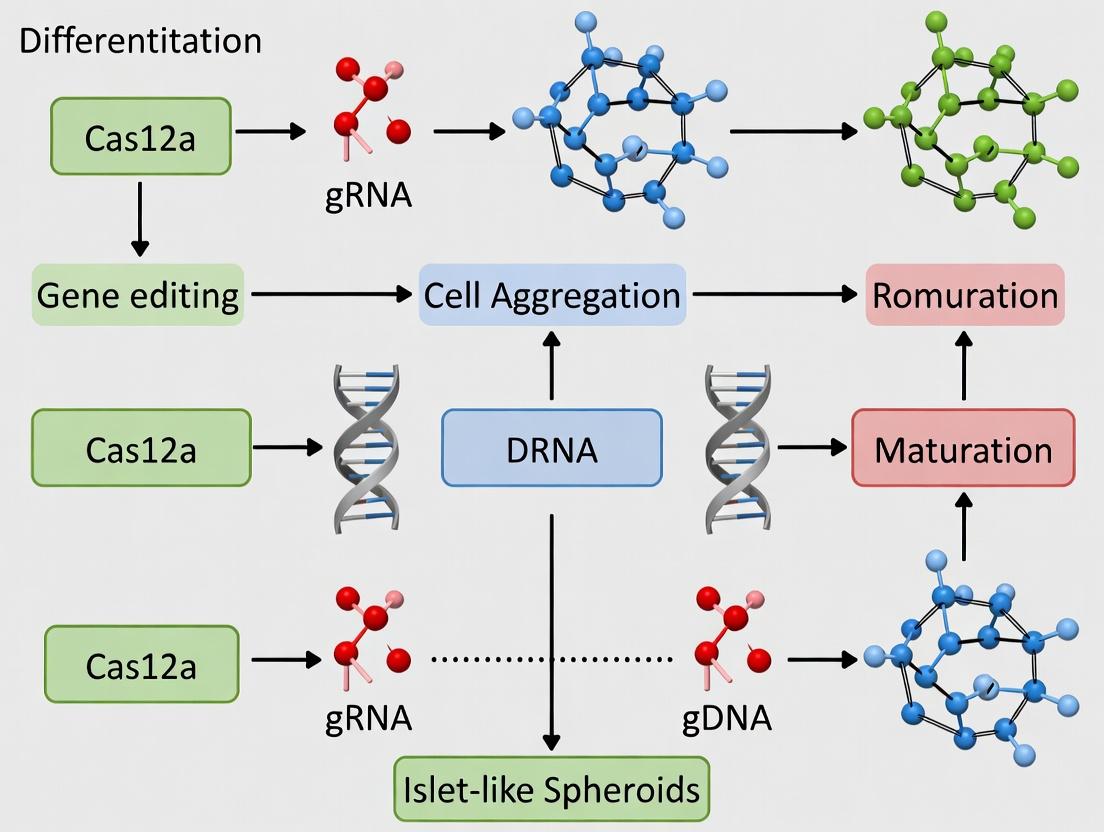
This article presents a comprehensive, optimized protocol for generating functional pancreatic islet-like spheroids using CRISPR-Cas12a-mediated genetic engineering.
A CRISPR-Cas12a-Driven Protocol for Efficient Pancreatic Islet-Like Spheroid Differentiation: A Stepwise Guide for Diabetes Research and Drug Screening
Abstract
This article presents a comprehensive, optimized protocol for generating functional pancreatic islet-like spheroids using CRISPR-Cas12a-mediated genetic engineering. Targeting researchers, scientists, and drug development professionals, the guide covers the foundational rationale, a detailed step-by-step methodology, common troubleshooting pitfalls with optimization strategies, and essential validation benchmarks. By integrating the precision of Cas12a with 3D culture techniques, this protocol aims to enhance the physiological relevance of in vitro islet models for studying diabetes pathophysiology, beta-cell function, and accelerating therapeutic discovery.
Cas12a and Islet Spheroids: Unveiling the Rationale for a Next-Generation Diabetes Model
1. Introduction The limitations of 2D pancreatic beta-cell cultures and rodent models have necessitated the development of human, three-dimensional, islet-like spheroids. These models recapitulate critical features of native islets, including cell-cell interactions, physiological glucose-stimulated insulin secretion (GSIS), and heterogeneous hormone expression. This protocol, framed within our thesis on a novel Cas12a-mediated gene-editing and differentiation pipeline, details the generation of stem cell-derived pancreatic islet-like spheroids (SC-islets) for disease modeling and drug screening.
2. Key Metrics of Advanced SC-Islet Models Recent studies (2023-2024) benchmark SC-islet functionality against human primary islets. Key quantitative data is summarized below.
Table 1: Functional Benchmarking of SC-Islets vs. Primary Human Islets
| Parameter | Primary Human Islets | Advanced SC-Islet Models (2023-24) | Measurement Method |
|---|---|---|---|
| Glucose Stimulation Index (GSIS) | 2 - 15 fold | 1.5 - 8 fold | Static GSIS, Perifusion |
| Insulin Content | 1 - 5 µg/µg DNA | 0.2 - 2 µg/µg DNA | ELISA / DNA Quantification |
| % Endocrine Cells (Insulin+ or Glucagon+) | >90% | 60 - 85% | Flow Cytometry, ICC |
| Response Time (First Phase Insulin) | 2-5 min post-stimulus | 5-15 min post-stimulus | Dynamic Perifusion |
| Gene Editing Efficiency (Cas12a) | N/A | 70 - 90% (clonal) | NGS, T7E1 Assay |
Table 2: Critical Signaling Pathways for In Vitro Islet Maturation
| Pathway | Key Ligands/Modulators | Protocol Phase | Target Outcome |
|---|---|---|---|
| WNT Inhibition | IWP-2, IWP-4 | Definitive Endoderm | Enhance PDX1+ progenitor yield |
| TGF-β/Activin A | Activin A, CHIR99021 (GSK3βi) | Definitive Endoderm | Induce SOX17+ endoderm |
| Retinoic Acid Signaling | Retinoic Acid (RA) | Pancreatic Progenitor | PDX1+/NKX6.1+ specification |
| Thyroid Hormone Signaling | T3 (Triiodothyronine) | Endocrine Maturation | Functional maturation & GSIS |
| cAMP Modulation | Forskolin, IBMX | Functional Assay | Amplify insulin secretion signal |
3. Detailed Protocol: Generation of Cas12a-Edited Pancreatic Islet-like Spheroids
3.1. Cas12a-mediated Gene Targeting in hPSCs Objective: Introduce a disease-relevant mutation (e.g., in GCK, HNF1A) or fluorescent reporter into human pluripotent stem cells (hPSCs). Materials: hPSCs, pre-complexed Cas12a-crRNA-trans-activating crRNA (tracrRNA) RNP, Nucleofector Kit, mTeSR Plus medium, CloneR supplement. Workflow:
- Culture hPSCs to ~80% confluence.
- Harvest cells and resuspend 1x10^6 cells in Nucleofector solution.
- Add 20-40 pmol of pre-complexed Cas12a RNP and 1-2 nmol of ssODN HDR template (if applicable).
- Electroporate using hPSC-optimized program (e.g., CA-137).
- Immediately recover cells in mTeSR Plus with 1X CloneR for 48h.
- Plate at clonal density, expand, and screen via PCR and Sanger sequencing. Isolate monoclonal edited lines.
3.2. Directed Differentiation to Islet-like Spheroids Objective: Differentiate gene-edited hPSCs into 3D, glucose-responsive islet-like spheroids. Protocol Workflow Diagram:
3.3. Functional Assessment: Dynamic Glucose Stimulated Insulin Secretion (GSIS) Perifusion Objective: Quantify physiological biphasic insulin secretion kinetics. Protocol:
- Setup: Connect a multi-channel perifusion system. Equilibrate with low glucose (2.8 mM) Krebs Buffer, 37°C.
- Load: Transfer 50-100 SC-islet spheroids (size-matched) into each chamber.
- Baseline: Perifuse with low glucose (2.8 mM) buffer for 40 minutes to establish basal secretion.
- Stimulate: Switch to high glucose (20 mM) buffer for 40 minutes.
- Challenge: Switch to high glucose + 30 mM KCl buffer for 20 minutes (depolarization control).
- Recovery: Return to low glucose buffer for 20 minutes.
- Collect: Collect effluent fractions at 2-5 minute intervals.
- Analyze: Measure insulin in each fraction via ELISA. Normalize to total DNA content.
- Analysis: Plot insulin secretion rate over time. Calculate stimulation index (High GLR / Low GLR).
Perifusion System Logic Diagram:
4. The Scientist's Toolkit: Essential Research Reagent Solutions
Table 3: Key Reagents for SC-Islet Generation & Analysis
| Reagent / Kit Name | Category | Critical Function in Protocol |
|---|---|---|
| Alt-R A.s. Cas12a (Cpf1) | Gene Editing | High-efficiency nuclease for precise hPSC genome editing with minimal off-target effects. |
| CloneR Supplement | Stem Cell Culture | Enhances survival of single hPSCs post-editing, critical for clonal recovery. |
| mTeSR Plus / StemFlex | Stem Cell Media | Maintains pluripotency for high-quality, undifferentiated starting cell population. |
| AggreWell 400 Plates | 3D Culture | Microwell plates for consistent, size-controlled aggregation of endocrine progenitors. |
| Human Insulin ELISA Kit (ALPCO or Mercodia) | Functional Assay | Gold-standard, high-sensitivity quantification of insulin in secretion supernatants. |
| Perifusion System (Biorep) | Functional Assay | Enables dynamic, real-time assessment of SC-islet stimulus-secretion coupling. |
| CellEvent Caspase-3/7 Detection Reagent | Viability Assay | Live-cell imaging probe to assess spheroid health and apoptosis during maturation. |
CRISPR-Cas12a (formerly Cpf1) is an RNA-guided endonuclease that has emerged as a powerful alternative to the widely used Cas9 for genome engineering. Within the specific context of our thesis research on developing a robust pancreatic islet-like spheroid differentiation protocol from human pluripotent stem cells (hPSCs), the unique biochemical properties of Cas12a offer distinct advantages. These advantages pertain to multiplexed gene editing for disrupting repressive loci, activating differentiation pathways, and inserting reporter genes with high fidelity—all critical for guiding and monitoring the complex differentiation cascade toward functional beta-like cells.
Key Features and Comparative Advantages of Cas12a
The utility of Cas12a in differentiation protocols stems from fundamental differences in its mechanism compared to Cas9.
Molecular Mechanism:
- Guide RNA: Cas12a utilizes a single, shorter (~42-44 nt) crRNA, simplifying multiplexed gRNA design and delivery.
- Cleavage Pattern: It creates staggered ends (5' overhangs) with a distal cut site far from the seed sequence, unlike Cas9's blunt ends. This can enhance the efficiency and precision of non-homologous end joining (NHEJ) and homology-directed repair (HDR).
- Protospacer Adjacent Motif (PAM): Cas12a recognizes a T-rich PAM (5'-TTTV-3'), expanding the targeting scope to AT-rich genomic regions, which are often prevalent in promoter and regulatory regions of developmental genes.
- Collateral Activity: The trans-cleavage activity of Cas12a upon target DNA binding is leveraged in diagnostic applications (e.g., DETECTR) but is not typically active in eukaryotic cells for genome editing.
A quantitative comparison of core features is summarized below.
Table 1: Comparative Features of Cas9 (SpCas9) and Cas12a (AsCas12a/LbCas12a)
| Feature | CRISPR-Cas9 (SpCas9) | CRISPR-Cas12a (As/LbCas12a) | Advantage for Differentiation Protocols |
|---|---|---|---|
| Nuclease Domains | HNH, RuvC (blunt cuts) | Single RuvC domain (staggered cuts) | Staggered ends may improve HDR fidelity for precise knock-ins of reporters or tags. |
| Guide RNA | Dual: crRNA + tracrRNA (~100 nt) or fused sgRNA | Single crRNA (~42-44 nt) | Simplified multiplexing; easier to deliver arrays for multiple gene edits (e.g., polycistronic tRNA-gRNA arrays). |
| PAM Sequence | 5'-NGG-3' (G-rich) | 5'-TTTV-3' (T-rich) | Accesses distinct genomic territory; ideal for targeting AT-rich promoters of developmental regulators. |
| Cleavage Site | Within seed region, proximal to PAM | Distal from seed, far from PAM | Provides flexibility; cuts outside critical regulatory motifs within a target site. |
| Multiplexing Ease | Moderate (requires multiple expression cassettes) | High (native processing of a single crRNA array) | Efficiently target multiple pathway genes (e.g., NKX6.1, PDX1, MAFA) in a single experiment. |
| Size (aa) | ~1368 | AsCas12a: ~1307, LbCas12a: ~1228 | Slightly smaller; may benefit viral packaging (e.g., AAV) for delivery to hard-to-transfect progenitor cells. |
Application Notes: Cas12a in Pancreatic Differentiation Protocols
Objective: To employ CRISPR-Cas12a for generating stable, engineered hPSC lines that facilitate the study and enhancement of pancreatic islet differentiation.
Key Applications:
- Multiplexed Knockout of Repressive Barriers: Simultaneous targeting of genes like ALDH1A2 or other inhibitors of pancreatic endoderm specification.
- Precise Knock-in of Reporter Genes: HDR-mediated insertion of fluorescent proteins (e.g., GFP) into loci such as INS (insulin) or PDX1 to enable live tracking and purification of progenitor populations during the multi-stage differentiation protocol.
- Activation of Endogenous Genes: Using nuclease-dead Cas12a (dCas12a) fused to transcriptional activators (VPR) to upregulate key developmental transcription factors.
Detailed Protocol: Cas12a-Mediated Knock-in of a Fluorescent Reporter at the PDX1 Locus in hPSCs
Aim: Generate a homozygous PDX1-GFP reporter line to visualize and isolate pancreatic progenitor cells during differentiation.
Table 2: Reagent Solutions for Cas12a Knock-in Experiment
| Reagent / Material | Function / Purpose in Protocol |
|---|---|
| AsCas12a (Alt-R A.s. Cas12a Ultra) | High-fidelity Cas12a nuclease for precise cleavage. |
| Chemically synthesized crRNA | Targets genomic site 5' of PDX1 STOP codon. Sequence: 5'-AAUUUCUACUAAGUGUAGAUTTTTT-3'. |
| ssODN HDR Template (Ultramer) | 200 nt single-stranded DNA donor with GFP-P2A sequence flanked by 80-nt homology arms, incorporating silent mutations to prevent re-cutting. |
| hPSC Line (e.g., WA09/H9) | Parental stem cell line with good differentiation propensity. |
| Clonal Isolation | Defined, feeder-free culture medium (e.g., mTeSR Plus). |
| Electroporation System | Neon Transfection System (100 µL tip) or comparable nucleofector. |
| Electroporation Buffer | Supplemented with 1 µM HDR enhancer (e.g., Alt-R HDR Enhancer V2). |
| Flow Cytometry Sorter | For isolating GFP+ cells 72-96 hours post-electroporation. |
| Genomic DNA Extraction Kit | For screening clones (e.g., QuickExtract). |
| PCR & Sequencing Primers | For junction PCR and Sanger sequencing to confirm precise integration. |
Step-by-Step Methodology:
- Design & Preparation:
- Design crRNA using Benchling or CHOPCHOP to target a site <10 bp upstream of the PDX1 STOP codon, ensuring a 5'-TTTV-3' PAM on the non-target strand.
- Order a 200-nt ssODN HDR template. The template should contain: a GFP sequence followed by a P2A "self-cleaving" peptide sequence, homology arms (80 nt each), and at least 2-3 synonymous mutations within the crRNA target site to prevent Cas12a re-cleavage post-HDR.
- Resuspose crRNA to 100 µM in nuclease-free duplex buffer.
RNP Complex Formation:
- In a sterile microcentrifuge tube, combine:
- 5 µL of 20 µM Alt-R Cas12a enzyme.
- 5 µL of 100 µM crRNA.
- 10 µL of nuclease-free buffer.
- Incubate at 25°C for 10-20 minutes to form the Cas12a ribonucleoprotein (RNP) complex.
- In a sterile microcentrifuge tube, combine:
hPSC Preparation & Electroporation:
- Culture hPSCs to 70-80% confluence in a 6-well plate. Ensure cells are healthy and undifferentiated.
- Harvest cells using a gentle cell dissociation reagent (e.g., ReLeSR). Count cells and pellet 1 x 10^6 cells.
- Prepare electroporation mix:
- Pelleted 1x10^6 hPSCs.
- Pre-formed Cas12a RNP complex (from Step 2).
- 5 µL of 100 µM ssODN HDR template.
- Bring to a total volume of 100 µL with Neon Resuspension Buffer R.
- Electroporate using the Neon System (e.g., 1400V, 20ms, 2 pulses).
- Immediately transfer cells to a well of a Matrigel-coated 6-well plate containing pre-warmed mTeSR Plus supplemented with 10 µM Y-27632 (ROCKi).
Enrichment & Clonal Isolation:
- At 72-96 hours post-electroporation, analyze GFP expression via flow cytometry. If a positive population is detectable, sort the top 5-10% GFP+ cells as a bulk population.
- Plate the sorted cells at clonal density (200-500 cells/10 cm dish) in mTeSR Plus with ROCKi.
- After 7-10 days, manually pick ~96 individual colonies into 96-well plates for expansion.
Genotyping & Validation:
- At confluency, split each clone: 80% for freezing, 20% for genomic DNA extraction (QuickExtract).
- Perform two PCRs per clone: (1) 5' junction PCR (primer upstream of 5' homology arm + primer within GFP), and (2) 3' junction PCR (primer within GFP + primer downstream of 3' homology arm).
- Sequence PCR products to confirm precise integration and homozygous editing.
- Validate selected clones for pluripotency markers and karyotypic normality.
- Functional Validation: Subject the reporter line to the pancreatic differentiation protocol. Monitor GFP emergence via fluorescence microscopy, correlating with expected PDX1 expression stages (days 5-7 of differentiation). Confirm co-localization with endogenous PDX1 via immunocytochemistry.
The Scientist's Toolkit: Essential Research Reagents for Cas12a Differentiation Studies
Table 3: Key Research Reagent Solutions for Cas12a-Based Differentiation Engineering
| Category | Item/Reagent | Specific Function in Cas12a Differentiation Research |
|---|---|---|
| Nucleases & Guides | Alt-R A.s. Cas12a (Cpf1) Ultra | High-fidelity, nuclease for clean editing; reduces off-target effects in sensitive progenitor cells. |
| Alt-R Custom crRNA | Chemically synthesized, modified for stability; enables targeting of T-rich regulatory regions. | |
| Delivery & Transfection | Neon Transfection System | Electroporation platform optimized for high-efficiency RNP delivery into hPSCs. |
| Stemfect RNA Transfection Kit | Alternative for mRNA (Cas12a) + crRNA delivery with low cytotoxicity. | |
| HDR Enhancement | Alt-R HDR Enhancer V2 | Small molecule that transiently inhibits NHEJ, boosting HDR rates for precise knock-ins. |
| ssODN Ultramers (IDT) | Long (up to 200 nt), high-purity single-stranded DNA donors for HDR with silent PAM-blocking mutations. | |
| Cell Culture & Selection | mTeSR Plus | Defined, feeder-free medium for maintaining genomic integrity of hPSC clones pre- and post-editing. |
| CloneR Supplement (Stemcell) | Enhances survival of single-cell cloned hPSCs, critical for recovering edited colonies. | |
| Screening & Validation | QuickExtract DNA Extraction Solution | Rapid, PCR-ready genomic DNA extraction from 96-well clone plates. |
| KAPA2G Fast Multiplex PCR Kit | Robust multiplex PCR for simultaneous 5'/3' junction analysis of knock-in clones. | |
| Differentiation | Definitive Endoderm Kit (e.g., STEMdiff) | Produces high-purity DE, the essential first stage for pancreatic differentiation. |
| Pancreatic Progenitor Media (Research Formulation) | Custom media with staged addition of factors (Activin A, FGF10, Retinoic Acid, etc.) to drive pancreatic fate. |
Within the broader thesis focused on developing a robust Cas12a-mediated differentiation protocol for generating functional pancreatic islet-like spheroids, the adoption of 3D spheroid models represents a critical technological advancement. Traditional 2D monolayer cultures fail to recapitulate the complex spatial organization and paracrine signaling networks of native islets. 3D spheroids, however, self-assemble to mimic islet architecture, promoting enhanced cell-cell interactions (e.g., E-cadherin mediated adhesion) and cell-matrix interactions. This environment is essential for driving endocrine cell maturation, improving glucose-stimulated insulin secretion (GSIS) functionality, and establishing physiological insulin-glucagon counter-regulation. These models are invaluable for diabetes research, beta-cell regeneration studies, compound screening for beta-cell toxins or protectors, and pre-clinical testing of novel therapeutics.
Key Protocols for 3D Islet-Like Spheroid Generation & Analysis
Protocol 2.1: Generation of Islet-Like Spheroids via the Hanging Drop Method
This protocol is ideal for producing spheroids of uniform size and composition from a defined number of progenitor or differentiated cells.
- Cell Preparation: Generate pancreatic progenitor or endocrine cell populations using your Cas12a differentiation protocol. Harvest cells using gentle dissociation reagents (e.g., Accutase) to obtain a single-cell suspension.
- Cell Counting and Dilution: Count cells and dilute in differentiation medium supplemented with 20% methylcellulose to increase viscosity. Prepare a suspension at 40,000 cells/mL.
- Drop Formation: Pipette 20 µL drops (~800 cells/drop) onto the lid of a non-tissue culture treated Petri dish. Carefully invert the lid and place it over the dish bottom filled with sterile PBS to maintain humidity.
- Culture: Incubate at 37°C, 5% CO₂ for 3-5 days. Spheroids will form via gravity aggregation within 24-48 hours.
- Harvesting: Carefully pipette medium containing mature spheroids from the lid into a conical tube for downstream assays.
Protocol 2.2: Functional Assessment via Glucose-Stimulated Insulin Secretion (GSIS)
This protocol assesses the dynamic insulin secretion capability of islet-like spheroids, a hallmark of functional beta-like cells.
- Spheroid Preparation: Harvest 10-20 spheroids per condition and wash 2x in Krebs-Ringer Bicarbonate HEPES (KRBH) buffer with 2.8 mM glucose.
- Low Glucose Incubation: Incubate spheroids in KRBH + 2.8 mM glucose for 1 hour at 37°C. Collect supernatant (S1).
- High Glucose Stimulation: Replace medium with KRBH + 20 mM glucose. Incubate for 1 hour at 37°C. Collect supernatant (S2).
- Insulin Quantification: Measure insulin concentration in S1 and S2 via Human Insulin ELISA. Normalize insulin content to total spheroid DNA or protein.
- Data Analysis: Calculate the Stimulation Index (SI) = [Insulin] in 20mM glucose / [Insulin] in 2.8mM glucose. A functional islet spheroid typically shows an SI >2.
Table 1: Comparative Analysis of 2D vs. 3D Islet Model Systems
| Parameter | 2D Monolayer Culture | 3D Islet-Like Spheroid | Reference/Notes |
|---|---|---|---|
| Glucose-Stimulated Insulin Secretion (SI) | 1.5 - 2.0 | 3.0 - 8.5 | SI >2 indicates physiologic response |
| Viability (Live/Dead Assay, % Live) | ~85% at Day 7 | ~92% at Day 7 | Enhanced survival in 3D |
| Expression of Maturity Markers (PDX1, NKX6.1) | Low to Moderate | High, Sustained | qPCR fold-change: 3D shows 4-10x increase |
| C-Peptide Content (pmol/µg DNA) | 0.5 - 1.2 | 2.5 - 6.0 | Indicator of proinsulin processing |
| Oxygen Consumption Rate (OCR) | Baseline | 1.8x Higher | Measured via Seahorse Analyzer |
| Response to Cytokine Stress (IL-1β induced apoptosis) | High Sensitivity (~40% apoptosis) | Reduced Sensitivity (~15% apoptosis) | Mimics islet's protective microenvironment |
Table 2: Key Signaling Pathways in 3D Spheroid Maturation & Function
| Pathway Name | Key Ligands/Triggers | Primary Role in Spheroid | Outcome of Activation |
|---|---|---|---|
| PI3K/Akt | Insulin, IGF-1 | Cell Survival & Growth | Enhanced beta-cell viability, proliferation |
| ERK1/2 | FGF, EGF | Proliferation & Differentiation | Supports endocrine progenitor expansion |
| Notch | Delta, Jagged (Cell-Cell Contact) | Lateral Inhibition | Patterns endocrine vs. progenitor fate |
| Wnt/β-catenin | Wnt3a | Progenitor Self-Renewal | Maintains proliferative niche early in protocol |
| Hippo (YAP/TAZ) | Cell Density & Cytoskeletal Tension | Mechanotransduction | Links 3D architecture to gene expression |
Diagrammatic Visualizations
Diagram Title: 3D Spheroid Maturation Signaling Network
Diagram Title: Cas12a Differentiation to 3D Spheroid Workflow
The Scientist's Toolkit: Research Reagent Solutions
Table 3: Essential Materials for 3D Islet-Like Spheroid Research
| Item | Function & Application in Protocol | Example Product/Catalog |
|---|---|---|
| Ultra-Low Attachment (ULA) Plates | Prevents cell adhesion, forcing 3D aggregation. Used for scalable spheroid production. | Corning Costar Spheroid Microplates |
| Methylcellulose | Increases medium viscosity for hanging drop method, stabilizing drops and promoting aggregation. | Sigma-Aldrich, M0512 |
| Recombinant Human E-Cadherin Fc Chimera | Coating agent to modulate cell-cell adhesion; can be used to functionalize surfaces or beads. | R&D Systems, 648-EC |
| KRBH Buffer | Standard physiological buffer for GSIS assays, providing precise ionic and glucose control. | MilliporeSigma, K4002 |
| Human Insulin ELISA Kit | Quantitative measurement of insulin secreted during GSIS to assess spheroid function. | Mercodia, 10-1113-01 |
| Accutase | Gentle cell detachment solution ideal for creating single-cell suspensions from delicate progenitors. | Innovative Cell Tech., AT104 |
| Live/Dead Viability/Cytotoxicity Kit | Dual-fluorescence staining to assess 3D spheroid viability and integrity over time. | Thermo Fisher, L3224 |
| Pancreatic Lineage Marker Antibodies | For immunostaining (PDX1, NKX6.1, C-Peptide, Glucagon) to characterize spheroid composition. | Developmental Studies Hybridoma Bank (DSHB), various |
| Y-27632 (ROCK Inhibitor) | Added post-dissociation to improve survival of single cells prior to 3D aggregation. | Tocris, 1254 |
| Extracellular Matrix (ECM) Hydrogels | (e.g., Matrigel) Can be used for embedded culture to provide matrix cues. | Corning, 356231 |
The directed differentiation of pluripotent stem cells (PSC) into functional pancreatic β-cells is a multi-stage process mimicking in vivo development. A critical bottleneck is the efficient specification of pancreatic endoderm (PE) into pancreatic progenitor and subsequent endocrine lineages. Key transcription factors PDX1, NGN3, and MAFA form a core regulatory network essential for this transition. PDX1 marks pancreatic progenitors, NGN3 is the master regulator of endocrine commitment, and MAFA is crucial for β-cell maturation and function. In the context of Cas12a-mediated gene activation for islet spheroid differentiation, precise temporal control of these targets can enhance yield and functionality.
Table 1: Core Transcription Factor Functions and Expression Dynamics
| Target Gene | Key Developmental Stage | Primary Function | Peak Expression Timing (Days of Differentiation) | Knockout Phenotype in Mice |
|---|---|---|---|---|
| PDX1 | Pancreatic Progenitor / β-cell | Specifies pancreatic fate, maintains β-cell identity | Biphasic: d4-5 (PE), d15+ (maturing β-cell) | Pancreatic agenesis |
| NGN3 (NEUROG3) | Endocrine Progenitor | Master regulator of endocrine commitment; necessary for all islet cell types | Narrow window: ~d7-10 (human PSC differentiation) | Complete lack of endocrine cells |
| MAFA | Mature β-cell | Regulates glucose-stimulated insulin secretion (INS, SLC2A2); maturation marker | Late: >d15 in vitro | Impaired glucose sensing & insulin secretion |
Table 2: Reported Effects of Targeted Activation on Differentiation Outcomes
| Study (Key Reference) | Method of Modulation | Target(s) | Effect on Insulin+ Cell Yield | Key Functional Readout (GSIS) |
|---|---|---|---|---|
| Velazco-Cruz et al., 2019 | Doxycycline-inducible overexpression | NGN3 | ~25% increase in C-peptide+ cells | Improved, but not fully adult-like |
| Hogrebe et al., 2020 | CRISPRa (dCas9-VPR) at specific stages | PDX1, NGN3, MAFA (sequential) | Yield increased from ~10% to ~30% insulin+ cells | Dynamic GSIS response achieved |
| Wang et al., 2023 (preprint) | Cas12a-based synergistic activation mediator (SAM) | NGN3 + RFX6 | Up to 40% C-peptide+ cells in spheroids | Robust, glucose-responsive secretion |
Detailed Protocols for Modulation and Analysis
Protocol 3.1: Cas12a-mediated Sequential Activation of PDX1, NGN3, and MAFA in a Pancreatic Differentiation Workflow
Objective: To enhance pancreatic endoderm-to-islet cell conversion using a Cas12a-based transcriptional activation system targeting core genes in a stage-specific manner.
Materials:
- Human iPSCs line.
- Base pancreatic differentiation media kits (commercial or formulated).
- Cas12a (Cpfl)-dCas9 activator fusion protein (e.g., dCas12a-VPR) expression system (lentiviral or mRNA).
- crRNA arrays targeting promoter regions of PDX1, NGN3, and MAFA. Design crRNAs within -200 to +50 bp relative to TSS.
- 6-well ultra-low attachment plates for spheroid culture.
- Small molecule enhancers (e.g., T3 hormone for maturation).
Procedure:
- Differentiation to Pancreatic Endoderm (PE): Differentiate iPSCs to definitive endoderm (DE, days 1-3) then to PE (days 4-6) using established protocols (e.g., basal media with Activin A, CHIR99021, then FGF7, SANT1).
- Transduction/Transfection at PE Stage (Day 6): Deliver the dCas12a-VPR construct and PDX1-targeting crRNA array. Use lipid-based transfection for mRNA/crRNA or utilize pre-engineered cell lines.
- Induction of Endocrine Progenitors (Days 7-10): Switch to endocrine progenitor medium (e.g., with ALK5i II, Retinoic Acid). At day 7, introduce the NGN3-targeting crRNA array via transient transfection.
- Spheroid Formation and Maturation (Days 11-20): At day 11, dissociate cells and aggregate into 3D spheroids in low-attachment plates. Use maturation media (e.g., with T3, ALK5i II, GLP-1 analog). At day 14, introduce the MAFA-targeting crRNA array.
- Maintenance and Analysis (Days 21-30): Maintain spheroids, feeding every other day. Harvest from day 20 onwards for analysis (qPCR, immunostaining, GSIS).
Protocol 3.2: Immunofluorescence Quantification of Key Targets in Differentiating Spheroids
Objective: To assess the protein expression and co-localization of PDX1, NGN3, and MAFA during the differentiation timeline.
Procedure:
- Fixation: Harvest spheroids daily from day 6 to day 20. Fix in 4% PFA for 20 min at RT.
- Embedding & Sectioning: Wash, cryoprotect in 30% sucrose, embed in OCT, and section at 10-12 µm thickness.
- Staining: Perform antigen retrieval (if needed). Block with 5% serum/0.3% Triton for 1 hr. Incubate overnight at 4°C with primary antibodies: mouse anti-PDX1, rabbit anti-NGN3, guinea pig anti-MAFA. Include nuclear stain (DAPI).
- Imaging & Quantification: Acquire z-stack images using confocal microscopy. Use image analysis software (e.g., ImageJ) to count the number of nuclei positive for each factor per spheroid section. Calculate the percentage of co-positive cells (e.g., PDX1+/MAFA+).
The Scientist's Toolkit: Essential Research Reagents
Table 3: Key Reagent Solutions for Target-Driven Differentiation
| Reagent Category | Specific Item/Example | Function in Protocol | Critical Note |
|---|---|---|---|
| Activation System | dCas12a-VPR mRNA, crRNA arrays | Enables precise, multiplexed transcriptional upregulation of endogenous genes. | Cas12a crRNA arrays allow easier multiplexing than Cas9. |
| Differentiation Modulators | SANT-1 (Hedgehog inhibitor), ALK5i II (TGF-β inhibitor), T3 (Thyroid Hormone) | Directs cell fate from foregut to PE (SANT1), to endocrine (ALK5i II), and maturation (T3). | Concentration and timing are protocol-dependent. |
| Cell Culture Matrix | Vitronectin XF, Growth Factor Reduced Matrigel | Supports iPSC and progenitor attachment and survival. | Use consistent lots for reproducible differentiation. |
| 3D Culture Support | Poly-HEMA coated plates, Ultra-low attachment U-bottom plates | Promotes self-aggregation of progenitors into islet-like spheroids. | Essential for functional maturation and polarity. |
| Critical Assays | Human C-peptide ELISA, Glucose Stimulated Insulin Secretion (GSIS) Assay Kit | Quantifies functional insulin secretion capacity of generated β-like cells. | Gold-standard for validating functional maturation. |
Visualizations
Title: PSC to Mature β-cell Differentiation Stages & Key Targets
Title: Cas12a Activation of Core Targets Drives Fate Transition
This application note is framed within ongoing research into a CRISPR-Cas12a-based protocol for generating pancreatic islet-like spheroids. The convergence of precise Cas12a genome editing with physiologically relevant 3D spheroid models represents a transformative approach for diabetes research and beta-cell regeneration therapy development. This combination addresses critical limitations of 2D cultures and less precise editing tools, enabling the generation of more accurate disease models and screening platforms.
Table 1: Comparative Performance of CRISPR Systems in Pancreatic Progenitor Cells
| Parameter | Cas9 (Spy) | Cas12a (Lb) | Cas12a (As) | Notes |
|---|---|---|---|---|
| Average Editing Efficiency (%) | 65-85 | 70-80 | 75-88 | In H1-hESC directed to pancreatic progenitors (NKX6.1+ population). |
| Indel Spectrum (>3 bp deletions) | 15-30% | 65-85% | 60-80% | Cas12a favors larger deletions, beneficial for knockout studies. |
| Multiplexing (Loci) | 2-4 | 4-7 | 4-7 | With a single crRNA array; critical for polygenic disease modeling. |
| Off-Target Rate (Predicted) | 5-15 | 1-5 | 1-5 | Sites with ≤3 mismatches; Cas12a demonstrates higher fidelity. |
| PAM Sequence Requirement | 5'-NGG-3' | 5'-TTTV-3' | 5'-TTTV-3' | Expands targeting scope to AT-rich regions common in regulatory elements. |
| RNA Requirement | sgRNA | crRNA | crRNA | Shorter, uncapped crRNA simplifies synthesis and reduces cost. |
Table 2: Spheroid vs. 2D Culture Metrics for Islet-like Cells
| Metric | 2D Monolayer Culture | 3D Spheroid Culture (Ultra-Low Attachment) | Functional Improvement |
|---|---|---|---|
| Glucose-Stimulated Insulin Secretion (GSIS) Fold-Change | 1.5-2.5x | 4.0-8.0x | ~300% increase |
| Expression of Maturation Markers (MAFA, UCN3) | Low/Basal | High/Induced | Essential for function |
| Cell Viability at Day 21 (%) | 60-75 | 85-95 | Enhanced survival |
| Heterotypic Cell-Cell Contact | Limited | Extensive (E-cadherin+, Gap Junctions) | Mimics native islet architecture |
| Oxygen Gradient Formation | No | Yes (Core-Hypoxic) | Drives maturation pathways |
| Drug Screening Concordance with In Vivo | Low (30-40%) | High (70-85%) | Better predictive model |
Experimental Protocols
Protocol 3.1: Cas12a-Mediated Multiplex Gene Editing in Human Pluripotent Stem Cells (hPSCs) for Pancreatic Differentiation
Objective: To simultaneously knock out multiple genes (e.g., GCK, INSR) in hPSCs prior to differentiation into pancreatic progenitors.
Materials:
- hPSCs (e.g., H1 or iPSC line)
- LbCas12a or AsCas12a protein (IDT, Thermo Fisher)
- Custom crRNA array (Synthego): Designed with direct repeats separating 3-5 crRNA sequences targeting genes of interest.
- Electroporation buffer (P3 Primary Cell Solution, Lonza) or lipid-based transfection reagent for sensitive cells.
- RNase-free water and tubes.
Procedure:
- Design & Synthesis: Design crRNAs with 20-24 nt spacers preceding a 5'-TTTV-3' PAM. Order as a single array transcript or as individual crRNAs to be pooled.
- Ribonucleoprotein (RNP) Complex Formation: For each electroporation, combine 50 pmol of Cas12a protein with 75 pmol of total crRNA(s) in duplex buffer. Incubate at 25°C for 10-20 min.
- Cell Preparation: Harvest 1x10^6 hPSCs at ~85% confluency using Accutase. Wash once with PBS and resuspend in 100 µL of P3 buffer.
- Electroporation: Mix cell suspension with RNP complex. Transfer to a 100 µL cuvette. Electroporate using a 4D-Nucleofector (Lonza) with program CB-150. Immediately add pre-warmed recovery medium.
- Reculture & Selection: Plate cells onto Matrigel-coated plates in mTeSR Plus medium with 10 µM Y-27632 ROCK inhibitor. After 72 hours, apply appropriate antibiotic selection or FACS-sort based on a co-transfected fluorescent marker to enrich edited population.
- Validation: Extract genomic DNA 5-7 days post-editing. Perform targeted deep sequencing (Illumina MiSeq) across all target loci to quantify indel efficiency and spectrum.
Protocol 3.2: Generation and Maturation of Edited Pancreatic Islet-like Spheroids
Objective: To differentiate Cas12a-edited hPSCs into functional, 3D pancreatic islet-like spheroids.
Materials:
- Edited hPSC monolayer from Protocol 3.1.
- Differentiation Basal Media (e.g., MCDB 131, Corning).
- Small molecule induction factors: Activin A, CHIR99021, Retinoic Acid, LDN-193189, T3, ALK5i II.
- Ultra-low attachment (ULA) 96-well round-bottom spheroid plates (Corning #7007).
- Spinning bioreactor or orbital shaker for large-scale production.
Procedure:
- Pancreatic Progenitor Induction (Days 0-7): Differentiate edited hPSCs in 2D format through definitive endoderm (DE) and primitive gut tube (PGT) stages using established cytokine protocols.
- Dissociation & Spheroid Aggregation (Day 7): Harvest pancreatic progenitor cells (NKX6.1+/PDX1+) using TrypLE. Count and resuspend in stage-specific medium supplemented with 10 µM Y-27632.
- Spheroid Formation: Seed 5,000-10,000 cells per well in a ULA 96-well plate. Centrifuge plate at 100 x g for 3 min to aggregate cells at the well bottom. Incubate at 37°C, 5% CO2.
- 3D Maturation (Days 7-28): Culture spheroids with stage-specific media changes every 2-3 days. From Day 15, add T3 hormone and ALK5i to promote endocrine maturation. For enhanced maturation, transfer spheroids to a spinning bioreactor system at Day 21 to improve nutrient/waste exchange.
- Functional Assessment (Day 28+):
- GSIS: Incubate spheroids in low (2.8 mM) then high (20 mM) glucose Krebs buffer. Measure insulin release via ELISA.
- Immunostaining: Fix spheroids in 4% PFA, embed in paraffin, section, and stain for INS, GCG, SST, MAFA, and NKX6.1.
- qPCR: Extract RNA from pooled spheroids to analyze maturation gene expression.
Visualizations
Diagram Title: Cas12a-Spheroid Integrated Workflow
Diagram Title: Spheroid-Enhanced Maturation Signaling
The Scientist's Toolkit: Research Reagent Solutions
| Item & Supplier | Function in Cas12a-Spheroid Workflow |
|---|---|
| AsCas12a (cpf1) Ultra Protein (IDT) | High-fidelity nuclease for multiplexed editing with TTTV PAM, reducing off-target effects in hPSCs. |
| Custom crRNA Array (Synthego) | Single RNA transcript encoding multiple guide sequences, streamlining multiplex knockout experiments. |
| Ultra-Low Attachment (ULA) Plates, Round Bottom (Corning) | Promotes consistent, single-spheroid formation per well via forced aggregation. |
| P3 Primary Cell Nucleofector Kit (Lonza) | High-viability electroporation solution for efficient RNP delivery into sensitive hPSCs. |
| Matrigel hESC-Qualified Matrix (Corning) | Provides a defined, consistent substrate for 2D expansion and differentiation of edited hPSCs. |
| Pancreatic Progenitor Media Kit (Stemcell Tech) | Pre-formulated, stage-specific media for robust differentiation to NKX6.1+/PDX1+ cells. |
| TRIzol LS Reagent (Thermo Fisher) | For high-quality RNA extraction from limited spheroid samples for qPCR analysis. |
| Human Insulin ELISA Kit (Mercodia) | Gold-standard, high-sensitivity assay for quantifying GSIS from spheroid supernatants. |
| ROCK Inhibitor (Y-27632) (Tocris) | Critical for enhancing survival of dissociated progenitor cells during spheroid aggregation. |
| Orbital Shaker for 6/24-well plates (Benchmark Scientific) | Provides gentle agitation for scalable spheroid culture in ULA plates, improving nutrient exchange. |
Step-by-Step Protocol: From Guide RNA Design to Mature Islet-Like Spheroid Formation
Within the broader thesis research aiming to develop a robust Cas12a-based gene editing protocol for generating pancreatic islet-like spheroids, this initial stage is critical. Precise targeting of pro-endocrine and beta-cell maturation genes is required to direct differentiation and enhance functional maturation. Cas12a (Cpf1) is favored for its ability to process its own crRNA array and for generating staggered double-strand breaks, which can improve knock-in efficiency—a key consideration for potential therapeutic applications. This application note details the design, synthesis, and cloning of specific crRNAs into a Cas12a expression vector.
Key Gene Targets and crRNA Design Parameters
Selection of target genes was based on their established roles in pancreatic endocrine commitment and beta-cell functional maturation. A minimum of two crRNAs were designed per gene to account for potential variability in editing efficiency.
Table 1: Target Genes and crRNA Design Specifications
| Gene Name | Role in Differentiation/Maturation | Target Exon | crRNA Length (nt) | PAM Sequence (5'->3') Required |
|---|---|---|---|---|
| NEUROG3 | Pro-endocrine transcription factor master regulator | 2 | 23 | TTTV |
| NKX6.1 | Critical for beta-cell progenitor specification | 1 | 24 | TTTV |
| MAFA | Beta-cell maturation and insulin regulation | 2 | 23 | TTTV |
| PDX1 | Pancreatic development & beta-cell function | 2 | 24 | TTTV |
| INS (Insulin) | Terminal maturation marker | 3 | 23 | TTTV |
Table 2: crRNA Oligonucleotide Design (Example for NEUROG3)
| crRNA ID | Target Sequence (5'->3')* | Genomic Coordinates (GRCh38) | Predicted On-Target Score (0-100) | Predicted Off-Target Sites |
|---|---|---|---|---|
| NG3-cr1 | ATGACCTCAGCCTCAACCCGGGG | chr10:7,156,771-7,156,793 | 94 | 0 |
| NG3-cr2 | TTCAGCAGCTCCACGCCGTGTGG | chr10:7,156,802-7,156,824 | 89 | 1 (intergenic) |
PAM sequence (TTTV) is genomic and not part of the crRNA sequence. *Scores from ChopChop v3 and CRISPOR algorithms.
Experimental Protocols
Protocol 1: In Silico Design and Validation of Cas12a crRNAs
- Identify Genomic Loci: Using UCSC Genome Browser, locate the coding sequences for target genes (e.g., NEUROG3, NKX6.1, MAFA, PDX1, INS).
- PAM Scanning: Scan the sense and antisense strands within early exons for 5'-TTTV-3' PAM sequences, where V is A, C, or G.
- crRNA Sequence Extraction: Extract the 20-24 nucleotides directly 5' upstream of each PAM. This forms the spacer sequence.
- Specificity Check: Input the 23-27nt sequence (spacer + PAM) into the CRISPOR and ChopChop web tools. Validate against the reference genome (GRCh38.p13) to predict off-target sites. Select crRNAs with zero or minimal off-targets in coding regions.
- Oligonucleotide Design: For cloning into a BsaI-digested Cas12a crRNA expression vector (e.g., pRGEN-Cas12a-UT), design forward and reverse oligonucleotides with the following structure:
- Forward Oligo: 5'- AAAC + [Top strand spacer sequence] -3'
- Reverse Oligo: 5'- GATC + [Reverse complement of spacer sequence] + GTTT -3' (Note: The specific overhangs must match the cloning site of your chosen backbone.)
Protocol 2: Cloning of crRNA Spacers into a Cas12a Expression Vector
Materials: BsaI-HFv2 restriction enzyme, T4 DNA Ligase, NEBuffer 3.1, oligonucleotides, plasmid backbone (e.g., Addgene #132468), DH5α competent E. coli, LB-Ampicillin plates.
Procedure:
- Annealing Oligonucleotides:
- Resuspend forward and reverse oligos (from Protocol 1) to 100 µM in nuclease-free water.
- Mix 1 µL of each oligo with 23 µL of annealing buffer (10 mM Tris, 50 mM NaCl, 1 mM EDTA, pH 8.0).
- Incubate in a thermocycler: 95°C for 5 min, then ramp down to 25°C at 0.1°C/sec. Dilute annealed duplex 1:200 in water.
- Vector Digestion: Digest 2 µg of the Cas12a crRNA cloning vector with BsaI-HFv2 (1 µL) in 1x NEBuffer 3.1 at 37°C for 1 hour. Gel-purify the linearized backbone.
- Ligation: Set up a Golden Gate Assembly reaction:
- 50 ng digested vector, 1 µL diluted annealed duplex, 1 µL BsaI-HFv2, 1 µL T4 DNA Ligase, 1x T4 Ligase Buffer. Total volume: 20 µL.
- Cycle: (37°C for 5 min, 20°C for 5 min) x 30 cycles, then 80°C for 10 min.
- Transformation and Screening: Transform 5 µL of ligation into 50 µL DH5α cells. Plate on LB-Ampicillin. Screen colonies by colony PCR using universal primers flanking the insertion site. Sanger sequence positive clones to confirm correct spacer insertion.
Research Reagent Solutions
Table 3: Essential Materials and Reagents
| Item | Function/Application | Example Product/Catalog # |
|---|---|---|
| Cas12a (Cpf1) Expression Plasmid | Provides the AsCas12a or LbCas12a nuclease. | pY010 (Addgene #69982) |
| crRNA Cloning Backbone | Vector for expressing single crRNAs or arrays. | pRGEN-Cas12a-UT (ToolGen) |
| BsaI Restriction Enzyme | Type IIS enzyme for Golden Gate Assembly of crRNA spacers. | BsaI-HFv2 (NEB, R3733) |
| T4 DNA Ligase | Ligation of annealed oligos into digested vector. | T4 DNA Ligase (NEB, M0202) |
| High-Fidelity DNA Polymerase | Colony PCR and vector amplification. | Q5 Hot-Start (NEB, M0493) |
| Competent E. coli | Plasmid transformation and propagation. | NEB Stable or DH5α |
| crRNA Design Software | In silico prediction of on/off-target activity. | CRISPOR, ChopChop, Benchling |
| Sanger Sequencing Service | Verification of cloned crRNA sequences. | In-house or commercial provider |
Visualizations
crRNA Design In Silico Workflow
crRNA Cloning and Verification Steps
Gene Targets in Thesis Research Context
Application Notes
The transition from Stage 1 (definitive endoderm induction) to Stage 2 marks a critical bifurcation in pancreatic differentiation protocols. This stage focuses on directing definitive endoderm cells toward a pancreatic progenitor fate, a prerequisite for subsequent endocrine progenitor specification and islet-like spheroid generation. The efficiency and purity of this stage directly impact the functional maturity of the final β-like cells. The key developmental signaling pathways—including TGF-β, WNT, and FGF—must be precisely modulated in a temporally controlled manner to recapitulate in vivo pancreatogenesis.
Within the broader thesis research on Cas12a-mediated pancreatic islet-like spheroid differentiation, Stage 2 serves as the foundational cellular substrate. Successfully generated pancreatic progenitor cells (PPCs) are the target population for downstream genetic engineering using CRISPR-Cas12a systems to knock out specific genes (e.g., NEUROD1, RFX6) or to knock in reporters (e.g., INS-GFP) to study differentiation dynamics and spheroid function.
Key Quantitative Benchmarks for Stage 2 Outcomes: Table 1: Stage 2 Key Performance Indicators (KPIs) from Recent Literature
| Metric | Target Value (Range) | Common Assessment Method | Relevance to Thesis |
|---|---|---|---|
| Cell Viability | >90% | Trypan Blue exclusion, Live/Dead staining | Ensures sufficient cell numbers for downstream Cas12a editing. |
| PDX1+/NKX6.1+ Co-expression | 60-85% | Flow Cytometry, Immunocytochemistry | Gold-standard marker pair for definitive pancreatic progenitors. |
| SOX9+ Expression | >80% | Flow Cytometry | Marks multipotent pancreatic progenitor state. |
| Fold Expansion | 3-5x | Cell counting over 4-6 days | Critical for scaling experiments prior to spheroid formation. |
| Genomic Stability | Normal karyotype | G-band karyotyping, SNP array | Essential for reliable genetic engineering and reproducible differentiation. |
Experimental Protocols
Protocol A: Differentiation of hiPSCs to Pancreatic Progenitor Cells (PPCs)
Adapted from Rezania et al. (2014) & Hogrebe et al. (2020) with modifications for Cas12a research.
Objective: To generate a monolayer culture of definitive pancreatic progenitor cells from hiPSC-derived definitive endoderm.
Starting Material: hiPSCs at the end of Stage 1 (Definitive Endoderm, ~Day 3). Confirm >85% SOX17+ and FOXA2+ by flow cytometry.
Required Media and Reagents: See "Research Reagent Solutions" table below.
Methodology:
- Day 3 (Initiation of Stage 2): Aspirate the Stage 1 medium from the culture vessel (e.g., 6-well plate).
- Rinse cells once with DMEM/F-12.
- Add Stage 2 Base Medium supplemented with:
- 50 ng/mL recombinant human FGF7
- 0.25 μM SANT-1 (Hedgehog inhibitor)
- 1:2000 ITS supplement
- 100 nM Retinoic Acid (RA)
- 0.25 μM LDN193189 (BMP inhibitor)
- 1:100 Penicillin-Streptomycin (optional)
- Incubate at 37°C, 5% CO₂. This is Stage 2, Day 1.
- Day 4: Perform a full medium change with fresh Stage 2 Base Medium plus all supplements listed in Step 3.
- Day 5: Perform another full medium change. The culture should now appear as a dense monolayer of epithelial cells.
- Day 6 (End of Stage 2): Cells are now considered PPCs. Harvest cells using Accutase for 5-7 minutes at 37°C. Neutralize with serum-containing medium, pellet, and resuspend for:
- Analysis: Perform flow cytometry for PDX1, NKX6.1, and SOX9.
- Passaging/Expansion: Plate for continued 2D culture or proceed to 3D spheroid aggregation (Stage 3).
- Genetic Engineering: Nucleofect with Cas12a RNP for gene editing at this progenitor stage before aggregation.
Protocol B: Cryopreservation and Recovery of Pancreatic Progenitor Cells
Objective: To bank PPCs for consistent experimental starting points in longitudinal Cas12a-editing studies.
Methodology:
- Harvest PPCs (as in Protocol A, Step 7) and count.
- Pellet 1-2 x 10⁶ cells per cryovial.
- Resuspend pellet in 1 mL of pre-chilled Cryopreservation Medium (90% FBS + 10% DMSO).
- Place vials in an isopropanol freezing container at -80°C for 24 hours, then transfer to liquid nitrogen for long-term storage.
- Recovery: Thaw vial rapidly in a 37°C water bath. Immediately transfer cells to 10 mL of warm recovery medium (Stage 2 Base Medium + 10 µM Y-27632 (ROCK inhibitor)). Pellet, resuspend in fresh Stage 2 medium + Y-27632, and plate at high density. Change medium to standard Stage 2 medium without Y-27632 after 24 hours.
Visualizations
Title: Stage 2 Workflow from Endoderm to Progenitor
Title: Signaling Pathways Driving Pancreatic Progenitor Specification
The Scientist's Toolkit
Table 2: Research Reagent Solutions for Stage 2
| Item (Example Supplier) | Function in Stage 2 | Critical Notes for Thesis Research |
|---|---|---|
| Recombinant Human FGF7 (PeproTech) | Stimulates proliferation and patterning of gut tube epithelium toward a pancreatic fate. | Consistent batch-to-batch activity is crucial for reproducible PPC yields prior to editing. |
| Retinoic Acid (Sigma) | Morphogen that induces PDX1 and posterior foregut patterning. | Concentration and timing are critical; light-sensitive. Aliquot in DMSO and protect from light. |
| SANT-1 (Tocris) | Hedgehog pathway inhibitor. Removes inhibition on pancreatic specification. | Required to suppress a duodenal/intestinal fate. Optimize concentration for your cell line. |
| LDN193189 (Stemgent) | BMP type I receptor inhibitor. Cooperates with RA to induce PDX1. | Works synergistically with other factors. Essential for efficient NKX6.1 co-expression. |
| ITS-G Supplement (Thermo Fisher) | Provides insulin, transferrin, and selenium for cell survival and growth in serum-free conditions. | Standard component for defined differentiation media. |
| Accutase (Sigma) | Enzyme solution for gentle detachment of PPCs as a single-cell suspension. | Preferred over trypsin for maintaining high viability for nucleofection or spheroid formation. |
| Y-27632 (ROCKi) (Tocris) | ROCK inhibitor. Enhances survival of dissociated PPCs during passaging or after thawing. | Use only during recovery/passaging, not during routine differentiation. |
| Anti-PDX1 / NKX6.1 Antibodies (Flow Cytometry validated) | Immunophenotyping to quantify Stage 2 efficiency. | Primary QC checkpoint. Must be validated for intracellular staining. |
1. Introduction and Thesis Context
Within the broader thesis developing a CRISPR-Cas12a-mediated genome editing protocol for differentiating stem cells into pancreatic islet-like spheroids, efficient and nontoxic RNP delivery is a critical bottleneck. Integrating the editor as a pre-assembled ribonucleoprotein complex minimizes off-target effects and transient editing presence. This application note details the systematic optimization of two leading non-viral delivery methods—electroporation and lipofection—for Cas12a RNP delivery into human induced pluripotent stem cell (hiPSC) aggregates, a precursor to mature spheroids.
2. Comparative Analysis of Delivery Methods
The primary quantitative outcomes from recent optimization studies are summarized below.
Table 1: Performance Metrics of Optimized Cas12a RNP Delivery Methods in hiPSCs
| Metric | Electroporation (Neon System) | Lipofection (Cas12a RNP-specific Lipid) |
|---|---|---|
| Optimal Condition | 1400V, 10ms, 3 pulses; 2 µM RNP | Lipid:RNP ratio 8:1; 1.5 µM RNP; 6h incubation |
| Editing Efficiency (%) | 85.2% ± 3.7 (N=3) | 72.8% ± 5.1 (N=3) |
| Cell Viability at 24h (%) | 65.5% ± 8.2 (N=3) | 92.4% ± 4.3 (N=3) |
| Spheroid Formation Success (%) | 78% (requires 48h recovery) | 96% (proceeds after 24h) |
| Key Advantage | Highest absolute editing in surviving cells. | Superior viability & protocol simplicity. |
| Key Limitation | High technical variability; requires single cells. | Potential carrier toxicity at high conc. |
3. Detailed Experimental Protocols
Protocol 3.1: Electroporation of hiPSC Aggregates using Cas12a RNP Objective: To deliver Cas12a RNP into dissociated hiPSCs prior to re-aggregation and spheroid differentiation. Materials: Neon Electroporation System (Thermo Fisher), P3 Primary Cell 10µL Kit, Cas12a protein, crRNA, single-cell hiPSC suspension in PBS, pre-warmed recovery medium. Procedure:
- Pre-assemble Cas12a RNP by incubating 10 µM Cas12a protein with 12 µM crRNA (targeting the genomic locus of interest) for 15 minutes at 25°C.
- Harvest and dissociate hiPSC aggregates to a single-cell suspension. Count and resuspend to 1.2 x 10^7 cells/mL in Resuspension Buffer R.
- Mix 10 µL cell suspension (120,000 cells) with 2 µL of 10 µM RNP complex (final 2 µM in electroporation cocktail).
- Electroporate using a 10µL Neon pipette with the optimized parameters: 1400V, 10ms, 3 pulses.
- Immediately transfer cells into pre-warmed culture medium. Centrifuge and resuspend in spheroid formation medium.
- Plate cells in ultra-low attachment plates to form edited aggregates. Proceed to differentiation after 48-hour recovery.
Protocol 3.2: Lipofection of hiPSC Aggregates using Cas12a RNP Objective: To deliver Cas12a RNP into small hiPSC aggregates (˜50-100µm) with minimal disturbance. Materials: Cas12a RNP-specific lipid transfection reagent (e.g., LipoJet or Stemfect), Cas12a RNP, hiPSC aggregates in antibiotic-free medium, complexation buffer. Procedure:
- Form small, uniform hiPSC aggregates (e.g., via AggreWell plates) 24 hours prior.
- Pre-assemble Cas12a RNP at 1.5 µM final concentration in complexation buffer.
- Dilute lipid reagent in a separate tube per manufacturer's ratio. For a 24-well plate, use a total lipid:RNP mass ratio of 8:1.
- Combine the diluted lipid with the RNP solution. Vortex briefly and incubate for 15 minutes at 25°C to form RNP-lipid complexes.
- While complexes form, replace medium on hiPSC aggregates with fresh, antibiotic-free medium.
- Add the RNP-lipid complexes dropwise to the aggregates. Swirl gently.
- Incubate for 6 hours at 37°C, 5% CO₂, then replace with fresh spheroid differentiation medium.
- Continue differentiation protocol 24 hours post-transfection.
4. Visualization of Experimental Workflow and Key Relationships
Diagram Title: Cas12a RNP Delivery Decision and Optimization Workflow
Diagram Title: Lipofection Mechanism for RNP Delivery to Aggregates
5. The Scientist's Toolkit: Key Reagent Solutions
Table 2: Essential Materials for Cas12a RNP Delivery Optimization
| Reagent/Material | Function in Protocol | Example Product |
|---|---|---|
| Recombinant Cas12a (Cpfl) Protein | The effector nuclease; forms the core of the RNP complex. | Alt-R A.s. Cas12a (Cpfl) Ultra (IDT) |
| Synthetic crRNA | Guides the Cas12a protein to the specific genomic target sequence. | Alt-R crRNA (IDT) |
| Electroporation System | Applies electrical pulses to transiently permeabilize cell membranes for RNP uptake. | Neon Transfection System (Thermo Fisher) |
| Cas12a-Specific Lipid Transfection Reagent | Cationic lipid formulations optimized for RNP complexation and delivery. | LipoJet In Vitro Transfection Kit (SignaGen) |
| Ultra-Low Attachment Plates | Enable the formation and culture of 3D cell spheroids post-transfection. | Corning Spheroid Microplates |
| Aggregate Formation Plate | Generates uniformly-sized hiPSC aggregates for consistent lipofection. | AggreWell400 (STEMCELL Tech) |
| Viability/Cytotoxicity Assay | Quantifies post-delivery cell health (e.g., relative to editing efficiency). | RealTime-Glo MT Cell Viability Assay (Promega) |
Within the broader thesis on developing a robust Cas12a-mediated pancreatic islet-like spheroid differentiation protocol, Stage 4 represents the critical directed differentiation phase. This stage transitions from primitive foregut progenitors (Stage 3) into glucose-responsive, polyhormonal endocrine cells through precise, sequential manipulation of signaling pathways. The following application notes and protocols detail the media formulations, temporal cues, and quality control assays required for efficient stepwise induction.
Stage 4 Media Formulations & Temporal Sequence
Stage 4 is subdivided into three sequential phases, each with a distinct media formulation designed to modulate specific developmental pathways. The total duration is 14 days.
Table 1: Stage 4 Media Formulations & Key Components
| Phase | Duration | Base Media | Key Inductive Components (Concentration) | Primary Function |
|---|---|---|---|---|
| 4A: Pancreatic Progenitor Specification | Days 0-4 | DMEM/F-12 + 1% B-27 + 1% N-2 | – KAAD-cyclopamine (0.25 µM)– Retinoic Acid (RA) (2 µM)– FGF7 (KGF) (50 ng/mL)– LDN193189 (100 nM) | Inhibits Sonic Hedgehog (SHH) & BMP signaling; induces PDX1+/NKX6.1+ progenitors. |
| 4B: Endocrine Progenitor Induction | Days 4-10 | DMEM/F-12 + 1% B-27 + 1% N-2 | – RA (0.5 µM)– SANT-1 (0.25 µM)– TBP (10 µM)– (-)-Indolactam V (ILV) (250 nM)– Heparin (1 µg/mL) | Promotes NEUROG3 expression; drives endocrine commitment. |
| 4C: Endocrine Maturation & Hormone Specification | Days 10-14 | CMRL 1066 + 1% B-27 + 10 mM HEPES | – Alk5i II (A83-01) (1 µM)– Gamma-secretase inhibitor XX (DAPT) (10 µM)– Exendin-4 (50 nM)– IGF-1 (100 ng/mL)– Nicotinamide (10 mM) | Inhibits TGF-β & Notch; promotes insulin+ β-cell maturation and viability. |
Detailed Experimental Protocols
Protocol: Stage 4A Differentiation (Days 0-4)
Objective: Generate PDX1+/NKX6.1+ pancreatic progenitor spheroids. Materials: Stage 3 spheroids, Stage 4A Medium (see Table 1), ultra-low attachment 6-well plates, rotary orbital shaker. Procedure:
- On Day 0 of Stage 4, carefully collect spheroids from Stage 3 culture via gentle centrifugation (100 x g, 3 min).
- Aspirate the Stage 3 medium completely.
- Resuspend spheroids in fresh, pre-warmed Stage 4A Medium. Use 3 mL per well of a 6-well plate.
- Transfer the spheroid suspension to an ultra-low attachment 6-well plate.
- Place the plate on an orbital shaker set at 60 rpm inside a 37°C, 5% CO2 incubator.
- Perform a 100% medium change with fresh Stage 4A Medium every 48 hours for 4 days.
Protocol: Stage 4B Differentiation (Days 4-10)
Objective: Induce NEUROG3+ endocrine progenitors. Procedure:
- On Day 4, collect spheroids and centrifuge gently (100 x g, 3 min).
- Aspirate Stage 4A Medium.
- Resuspend spheroids in fresh, pre-warmed Stage 4B Medium (3 mL/well).
- Return culture to the shaker incubator.
- Perform 100% medium changes with Stage 4B Medium every 48 hours until Day 10.
Protocol: Stage 4C Maturation (Days 10-14)
Objective: Generate polyhormonal (INS+/GCG+) islet-like spheroids. Procedure:
- On Day 10, collect spheroids and centrifuge gently (100 x g, 3 min).
- Aspirate Stage 4B Medium.
- Resuspend spheroids in fresh, pre-warmed Stage 4C Maturation Medium (3 mL/well).
- Return culture to the shaker incubator.
- Perform 100% medium changes with Stage 4C Medium every 48 hours until Day 14. Spheroids are now ready for functional analysis.
Key Quality Control Assays
Timing: Perform on Days 4, 10, and 14. Table 2: Key QC Metrics & Expected Outcomes
| Day | Target Markers (Immunofluorescence/Flow Cytometry) | Expected Expression (%) | Functional Assay |
|---|---|---|---|
| 4 | PDX1, NKX6.1 | >70% co-expression | N/A |
| 10 | NEUROG3, NKX6.1 | 40-60% NEUROG3+ | N/A |
| 14 | C-PEPTIDE, GCG, MAFA | 20-35% C-PEPTIDE+ | Glucose-Stimulated Insulin Secretion (GSIS) |
Protocol: Flow Cytometry Analysis for PDX1/NKX6.1
Objective: Quantify pancreatic progenitor induction at Day 4. Materials: Single-cell suspension from spheroids, fixation/permeabilization buffer (e.g., BD Cytofix/Cytoperm), anti-PDX1-AF488, anti-NKX6.1-PE antibodies, flow cytometry tubes. Procedure:
- Dissociate 10-15 spheroids using Accutase (37°C, 10 min). Neutralize with serum-containing medium.
- Fix and permeabilize cells according to buffer manufacturer's instructions.
- Incubate cells with conjugated primary antibodies (1:200 dilution) or isotype controls for 1 hr at 4°C in the dark.
- Wash twice with permeabilization buffer.
- Resuspend in PBS + 2% FBS and analyze on a flow cytometer. Use unstained and single-stained controls for compensation.
The Scientist's Toolkit
Table 3: Key Research Reagent Solutions
| Item | Function in Protocol | Example Product/Catalog # |
|---|---|---|
| KAAD-cyclopamine | Potent, selective inhibitor of the Sonic Hedgehog (SHH) pathway; critical for dorsal pancreatic specification. | Tocris, #2533 |
| LDN193189 | BMP type I receptor inhibitor; synergizes with SHH inhibition to promote pancreatic fate. | Stemgent, #04-0074 |
| (-)-Indolactam V (ILV) | Protein Kinase C activator; potent inducer of NEUROG3 expression in pancreatic progenitors. | Tocris, #1978 |
| Alk5i II (A83-01) | TGF-β type I receptor inhibitor; enhances endocrine cell survival and maturation. | Tocris, #2939 |
| DAPT | Gamma-secretase inhibitor; inhibits Notch signaling to promote endocrine differentiation. | Tocris, #2634 |
| B-27 & N-2 Supplements | Serum-free, defined supplements essential for neural and endocrine cell survival and growth. | Thermo Fisher, #17504044 & #17502048 |
| Ultra-Low Attachment Plates | Prevent cell adhesion, promoting 3D spheroid formation and growth. | Corning, #3471 |
Visualizations
Title: Stage 4 Directed Differentiation Workflow & Key Cues
Title: Stage 4 Key Signaling Pathway Modulations
Within the research framework of a Cas12a-mediated differentiation protocol for generating pancreatic islet-like spheroids, Stage 5 represents a critical transition from 2D progenitor populations to 3D functional micro-tissues. Successful 3D aggregation enhances cell-cell contact, promotes survival signaling, and recapitulates the native islet microenvironment, which is essential for glucose-responsive insulin secretion. This application note details standardized techniques to achieve spheroids of consistent size and high viability, key determinants for downstream functional assays and drug screening applications.
Core Principles of Controlled Aggregation
Consistent spheroid formation relies on controlling the initial cell number, aggregation geometry, and preventing unwanted adhesion. The two predominant methods are the use of low-adhesion round-bottom plates and agitation-based systems. The choice impacts oxygenation, shear stress, and final spheroid density.
Table 1: Comparison of Primary 3D Aggregation Methods
| Method | Principle | Typical Spheroid Size Range (Diameter) | Key Advantage | Key Limitation |
|---|---|---|---|---|
| Round-Bottom Ultra-Low Attachment (ULA) Plates | Forced aggregation via gravity in a non-adhesive well. | 150 - 400 µm | High uniformity; simple setup; suitable for high-throughput. | Potential for hypoxia in core; limited control over medium exchange dynamics. |
| Hanging Drop Plates | Droplets of cell suspension hang from a lid, aggregating by gravity. | 200 - 500 µm | Excellent size control via cell number/drop; minimal shear stress. | Lower throughput; cumbersome medium changes. |
| Agitated Rotation (Spinner Flask/Bioreactor) | Continuous gentle mixing prevents adhesion to vessel walls. | 300 - 600 µm | Enhanced nutrient/waste exchange; scalable for large volumes. | Less initial size uniformity; requires specialized equipment. |
| Microfluidic/Micropatterned Wells | Cells confined within physically defined non-adhesive microwells. | 100 - 300 µm | Exceptional size control and uniformity. | Higher cost; potential for clogging. |
Detailed Protocols
Protocol 3.1: Aggregation Using ULA 96-Well Plates
Objective: To generate uniform spheroids from Cas12a-edited pancreatic progenitor cells. Materials: Single-cell suspension of Stage 4 progenitors, ULA 96-well round-bottom plate, complete differentiation medium. Procedure:
- Prepare a single-cell suspension and count viable cells using trypan blue exclusion.
- Calculate volume to dispense 5,000 cells/well in a final volume of 150 µL. (Adjust cell number empirically: 2,000-10,000 cells yields 150-350 µm spheroids).
- Dispense cell suspension into each well of the ULA plate using a multichannel pipette.
- Centrifuge the plate at 300 x g for 5 minutes at room temperature to pellet cells at the well bottom.
- Place plate in a humidified incubator (37°C, 5% CO₂). Do not disturb for 72 hours.
- After 72 hours, gently replace 100 µL of spent medium with fresh pre-warmed medium every 48 hours using a slow pipetting technique along the well wall.
Protocol 3.2: Viability and Size Assessment
Objective: To quantify spheroid health and consistency at day 5 post-aggregation. Materials: Spheroids in ULA plate, Calcein-AM (1 µg/mL), Propidium Iodide (PI, 2 µg/mL), Phosphate Buffered Saline (PBS), inverted fluorescence microscope with image analysis software. Procedure:
- Prepare a dual-stain solution in PBS: Calcein-AM (viable, green fluorescence) and PI (dead, red fluorescence).
- Carefully aspirate 120 µL of medium from a well containing spheroids.
- Add 120 µL of the stain solution. Incubate for 45 minutes at 37°C protected from light.
- Image spheroids using a 4x or 10x objective. Capture both brightfield and fluorescence channels (FITC for Calcein, TRITC for PI).
- Analysis:
- Size: Using brightfield images, measure the diameter (µm) of 20 spheroids per condition. Calculate mean and standard deviation.
- Viability: Threshold fluorescence images. Calculate viability as:
(Calcein+ area / (Calcein+ area + PI+ area)) * 100. Exclude background from well edges.
Table 2: Expected Spheroid Metrics at Day 5 (ULA Plate, 5k cells/well)
| Parameter | Target Value | Acceptable Range | Measurement Method |
|---|---|---|---|
| Average Diameter | 250 µm | 225 - 275 µm | Brightfield image analysis |
| Diameter CV (Coefficient of Variation) | < 15% | < 20% | (Standard Deviation / Mean) * 100 |
| Core Viability | > 85% | > 80% | Confocal Z-stack of Calcein-AM/PI stain |
| Surface Viability | > 95% | > 90% | Widefield fluorescence of Calcein-AM/PI |
The Scientist's Toolkit: Research Reagent Solutions
Table 3: Essential Materials for 3D Spheroid Culture
| Item | Function & Rationale | Example Product/Catalog |
|---|---|---|
| Ultra-Low Attachment (ULA) Plate, Round-Bottom | Provides a chemically or physically modified surface to prohibit cell attachment, forcing 3D aggregation. | Corning Spheroid Microplates (#4515) |
| Basement Membrane Matrix | Used to coat aggregation plates for a more in vivo-like ECM environment; can enhance maturation. | Cultrex Basement Membrane Extract, Type 3 (BME) |
| Cell Recovery Solution | Enzymatic, non-mammalian solution for gentle dissociation of spheroids into single cells for passaging or analysis. | Corning Cell Recovery Solution (#354253) |
| Calcein-AM / Propidium Iodide Kit | Live/dead dual-fluorescence stain for quick viability assessment in 3D structures. | Thermo Fisher LIVE/DEAD Viability/Cytotoxicity Kit (#L3224) |
| Glucose-Responsive Insulin Secretion Assay | Functional assay kit to measure dynamic C-peptide or insulin release in response to high/low glucose. | Mercodia Human C-peptide ELISA (#10-1141-01) |
| Small Molecule ROCK Inhibitor (Y-27632) | Added during aggregation initiation to inhibit anoikis (detachment-induced apoptosis), improving viability. | Tocris Bioscience Y-27632 (#1254) |
Signaling Pathways in Spheroid Maturation and Survival
The aggregation process activates crucial pathways for survival and differentiation of pancreatic islet-like spheroids.
Experimental Workflow for Stage 5
A standard workflow from aggregation to quality control.
Troubleshooting Guide
Table 4: Common Issues and Resolutions in Spheroid Formation
| Problem | Potential Cause | Recommended Solution |
|---|---|---|
| Excessive Size Variation | Inconsistent cell number per well; poor single-cell suspension. | Vortex cell suspension before dispensing; use multichannel pipette with reverse pipetting technique. |
| Low Viability (<80%) | Anoikis; excessive shear during handling; nutrient depletion in core. | Add 10 µM Y-27632 (ROCKi) for first 48h; minimize pipetting force; consider larger well size (e.g., 384-well) for smaller spheroids. |
| Spheroid Disintegration | Weak cell-cell adhesion; excessive medium exchange force. | Ensure E-cadherin expression from progenitors; use specialized spheroid medium with supplements; change medium by gentle aspiration. |
| Irregular, Non-Spherical Morphology | Contamination with adhesive cells; plate surface not truly ultra-low attachment. | Confirm ULA plate quality; ensure complete dissociation of 2D culture; pre-rinse wells with PBS. |
Within the broader thesis investigating a CRISPR-Cas12a-mediated differentiation protocol for generating pancreatic islet-like spheroids (ILS), Stage 6 represents the critical transition from differentiated aggregates to mature, stable, and functionally robust microtissues. This stage focuses on maintaining long-term viability, enhancing glucose-responsive insulin secretion, and promoting cellular maturation to mirror native islet physiology. Successful execution is paramount for downstream applications in disease modeling, drug screening, and beta-cell replacement therapy research.
Key Parameters for Long-Term Spheroid Maturation
Based on current literature and protocols, the following parameters are essential for optimal maturation and maintenance over 30+ days.
Table 1: Quantitative Parameters for Spheroid Maturation & Maintenance
| Parameter | Optimal Range | Measurement Method | Functional Impact |
|---|---|---|---|
| Spheroid Diameter | 150 - 300 µm | Bright-field microscopy/analysis | Prevents necrotic core; ensures nutrient diffusion. |
| Glucose-Stimulated Insulin Secretion (GSIS) Index | 2 - 5 (Stimulated/Basal) | ELISA or MSD Assay | Key metric of beta-cell functional maturity. |
| Viability (Live/Dead Assay) | >85% | Calcein AM / EthD-1 staining | Indicator of culture health. |
| Oxygen Tension | 1-5% O₂ | Hypoxia workstation or tri-gas incubator | Mimics in vivo pancreatic niche; promotes maturity. |
| Extracellular Matrix (ECM) Support | 1-2 mg/mL (Matrigel) | Embedding or overlay | Provides 3D structural and biochemical cues. |
| Media Refresh Interval | Every 48-72 hours | Semi-automated fluid exchange | Maintains nutrient/cytokine levels; removes waste. |
| Maturation Duration | 21 - 35 days | Functional assays at weekly intervals | Time required for endocrine gene expression stabilization. |
Detailed Protocols
Protocol 3.1: Extended Maturation in Low-Attachment Plates with ECM Overlay
Objective: To maintain 3D structure and provide basal lamina-derived signals for maturation. Materials: Ultra-low attachment U-bottom 96-well plates, Matrigel Growth Factor Reduced (GFR), Advanced DMEM/F-12, maturation media (see Reagent Toolkit). Procedure:
- Day 0 (Spheroid Transfer): Using wide-bore tips, carefully transfer individual Stage 5 spheroids to wells of a U-bottom plate.
- ECM Overlay Preparation: Thaw Matrigel on ice. Dilute to 1 mg/mL in cold Advanced DMEM/F-12.
- Application: Gently add 50 µL of the diluted Matrigel solution per well, ensuring the spheroid is covered.
- Polymerization: Incubate plate at 37°C for 30 min to allow gel formation.
- Media Addition: Carefully layer 150 µL of pre-warmed maturation media on top of the polymerized gel.
- Maintenance: Culture in a 5% CO₂, 37°C incubator. Replace 100 µL of media every 48 hours without disturbing the gel layer.
- Monitoring: Image weekly to assess morphology and diameter.
Protocol 3.2: Functional Assessment via Dynamic Glucose-Stimulated Insulin Secretion (GSIS)
Objective: To quantify the glucose responsiveness of matured ILS, a hallmark of functional beta-cells. Materials: KRBH assay buffer (Krebs-Ringer Bicarbonate HEPES), low glucose (2.8 mM) KRBH, high glucose (16.7 mM) KRBH, 30 mM KCl KRBH (depolarization control), Human Insulin ELISA kit, low-protein binding microcentrifuge tubes. Procedure:
- Spheroid Preparation: After ≥21 days of maturation, pool 10-15 spheroids per condition into a low-protein binding tube.
- Basal Secretion (1 hr): Wash spheroids 2x with 2.8 mM glucose KRBH. Incubate in 500 µL of 2.8 mM glucose KRBH for 1 hour at 37°C.
- Stimulated Secretion (1 hr): Carefully collect and save the basal supernatant. Wash once with 16.7 mM glucose KRBH. Incubate in 500 µL of 16.7 mM glucose KRBH for 1 hour at 37°C.
- Control Stimulation (1 hr): Collect the high-glucose supernatant. Wash and incubate in 500 µL of 30 mM KCl KRBH for 1 hour.
- Sample Analysis: Centrifuge all supernatants (500 x g, 5 min) to remove debris. Analyze insulin content using a high-sensitivity human insulin ELISA per manufacturer's instructions.
- Calculation: Calculate the GSIS index as (Insulin[High Glucose]) / (Insulin[Low Glucose]). A positive control response to KCl confirms viable secretory machinery.
Protocol 3.3: Long-Term Viability and Health Monitoring
Objective: To track spheroid health and identify core necrosis over extended culture. Materials: Calcein AM (4 µM), Ethidium homodimer-1 (EthD-1, 2 µM), Hoechst 33342 (5 µg/mL) in PBS, confocal or high-content imaging system. Procedure:
- Staining Solution: Prepare a working solution in PBS containing Calcein AM (viability), EthD-1 (dead cell nuclei), and Hoechst 33342 (all nuclei).
- Staining: Transfer spheroids to the staining solution. Incubate for 45-60 minutes at 37°C protected from light.
- Washing: Gently wash spheroids 2x with PBS.
- Imaging: Mount spheroids for imaging. Acquire z-stacks using confocal microscopy.
- Analysis: Use image analysis software (e.g., Fiji/ImageJ) to quantify the volume of Calcein-positive (live) vs. EthD-1-positive (dead) regions. A healthy spheroid will show a uniformly live outer rim and minimal dead signal in the core.
The Scientist's Toolkit: Key Research Reagent Solutions
Table 2: Essential Materials for Spheroid Maturation & Maintenance
| Reagent/Material | Function in Protocol | Key Considerations |
|---|---|---|
| Ultra-Low Attachment (ULA) Plates | Prevents cell attachment, maintaining 3D spheroid integrity. | U-bottom plates promote single spheroid per well formation. |
| Matrigel GFR | Provides ECM proteins (laminin, collagen IV) for structural support and pro-maturative signaling. | Keep on ice to prevent premature polymerization; concentration is critical. |
| Maturation Media | Typically contains specific factors (e.g., N-acetylcysteine, B27 supplement, low FBS) to support endocrine function and reduce stress. | Must be serum-reduced to minimize proliferation and promote quiescence. |
| Tri-Gas Incubator | Enables control of O₂ (1-5%), CO₂ (5%), and N₂ to mimic pancreatic physiological hypoxia. | Essential for promoting metabolic maturation and reducing oxidative stress. |
| High-Sensitivity Insulin ELISA | Quantifies picogram levels of insulin secreted during GSIS. | Must be specific for human insulin and not cross-react with C-peptide or proinsulin. |
| CRISPR-Cas12a Reagents | Used in the broader thesis context for genetic engineering (e.g., knocking in reporters, correcting mutations) prior to differentiation. | Requires specific gRNA design and RNP delivery optimization for stem cells. |
| Wide-Bore/Low-Retention Pipette Tips | For transferring intact spheroids without shear stress or loss. | Critical for avoiding mechanical disruption during media changes and assay setup. |
Visualization: Signaling Pathways and Workflows
Title: Key Signaling Pathways Driving Spheroid Maturation
Title: Long-Term Maintenance and QC Workflow for Mature Spheroids
Troubleshooting Guide: Solving Common Issues in Cas12a Differentiation and Spheroid Formation
1. Introduction and Thesis Context Optimizing Cas12a (Cpfl)-based genome editing is critical for advancing functional genetic studies in pancreatic developmental biology. Within our broader thesis research on establishing a robust differentiation protocol for generating pancreatic islet-like spheroids from human pluripotent stem cells (hPSCs), precise gene editing is required to introduce disease-relevant mutations or fluorescent reporter knock-ins. A persistent bottleneck has been low editing efficiency in hPSCs and derived progenitors, primarily attributed to suboptimal crRNA design and inefficient Ribonucleoprotein (RNP) delivery. This document details refined application notes and protocols to overcome these barriers.
2. Optimizing Cas12a crRNA Design: Principles and Quantitative Analysis Cas12a recognizes a T-rich PAM (5’-TTTV-3’) and processes its own crRNA array, but its efficiency is highly target- and crRNA-dependent. Key design parameters are summarized below.
Table 1: Quantitative Impact of crRNA Design Parameters on Cas12a Editing Efficiency
| Design Parameter | Optimal Characteristic | Reported Efficiency Range* | Effect |
|---|---|---|---|
| PAM Proximal Region (Seed, nt 1-10) | Low secondary structure; Avoid poly-T stretches | ∆G > -2 kcal/mol | Critical for R-loop stability; poly-T can cause premature termination. |
| crRNA Length | 20-24 nt spacer | 20 nt: 40-60%; 24 nt: 60-80% | Longer spacers (>24 nt) can reduce efficiency. |
| 5' Direct Repeat (DR) | Use authentic LbCas12a or AsCas12a DR | ~2-3 fold increase | Essential for proper Cas12a loading and maturation. |
| Spacer GC Content | 40-60% | Optimal: 50-70%; Suboptimal: <30% | Impacts crRNA stability and on-target binding affinity. |
| Target DNA Secondary Structure | Low ∆G in PAM-proximal region | ∆G > -5 kcal/mol | Highly structured DNA can inhibit binding, reducing efficiency by >50%. |
| Efficiency ranges are relative comparisons within studies and are cell-type dependent. |
Protocol 2.1: In silico Design and Selection of High-Efficiency crRNAs
- Identify Target Region: Using reference genome (e.g., GRCh38), locate 20-24 nt sequence immediately 5’ to a TTTV PAM.
- Filter for Seed Stability: Use tools like RNAfold (ViennaRNA) to calculate secondary structure stability (∆G) of the first 10 nt of the spacer and the target DNA region. Prioritize sequences with ∆G > -5 kcal/mol.
- Avoid Genomic Pitfalls: Screen for off-targets using Cas-OFFinder. Exclude spacers with >3 mismatches in the seed region to highly expressed genes.
- Synthesize crRNA: Order chemically synthesized, alt-R modified crRNAs with the structure: 5’-[Authentic Direct Repeat]-[20-24 nt spacer]-3’. Resuspose in nuclease-free duplex buffer to 100 µM.
3. Enhancing RNP Delivery and Cellular Engagement Electroporation of pre-assembled Cas12a RNP complexes is the gold standard for hPSCs and their derivatives to minimize toxicity and off-target effects.
Protocol 3.1: RNP Complex Assembly and Electroporation for hPSC-Derived Pancreatic Progenitors Materials:
- Recombinant LbCas12a or AsCas12a protein (IDT, Thermo Fisher)
- Chemically synthesized, modified crRNA (from Protocol 2.1)
- Neon Transfection System (Thermo Fisher) or Nucleofector (Lonza)
- hPSC culture media, ROCK inhibitor (Y-27632)
Procedure:
- RNP Assembly: For one reaction, combine 5 µL of 20 µM Cas12a protein with 5 µL of 40 µM crRNA (2:1 molar ratio crRNA:protein). Incubate at 25°C for 10-20 minutes.
- Cell Preparation: Harvest ~2x10^5 to 1x10^6 dissociated pancreatic progenitor cells (from day 10-15 of differentiation) into a single-cell suspension. Centrifuge and resuspend in appropriate electroporation buffer (e.g., P3 Primary Cell Buffer, Lonza).
- Electroporation: Mix cell suspension with pre-assembled RNP. Transfer to a neon tip (100 µL) or nucleofection cuvette. Electroporate (e.g., Neon: 1400V, 20ms, 2 pulses; Nucleofector: Program CA-137).
- Recovery: Immediately transfer cells to pre-warmed medium supplemented with 10 µM ROCK inhibitor. Plate onto pre-coated culture plates.
- Analysis: Harvest cells 72-96 hours post-electroporation for genomic DNA extraction. Assess editing efficiency via T7E1 assay or next-generation sequencing (NGS).
Table 2: Research Reagent Solutions for Cas12a Editing in Pancreatic Differentiation
| Reagent / Material | Supplier Examples | Function in Protocol |
|---|---|---|
| Recombinant LbCas12a Protein | Integrated DNA Technologies (IDT), Thermo Fisher | The effector nuclease; pre-complexing with crRNA forms the active RNP. |
| Alt-R CRISPR-CrRNA (chemically modified) | IDT | Enhanced stability and specificity; contains the target-specific guide sequence. |
| Neon Transfection System | Thermo Fisher | Electroporation device optimized for high efficiency and viability in sensitive cells like hPSCs. |
| P3 Primary Cell Nucleofector Solution | Lonza | Low-ionic electroporation buffer designed for primary and stem cells, maximizing viability. |
| ROCK Inhibitor (Y-27632) | Tocris, STEMCELL Tech | Improves post-electroporation cell survival by inhibiting apoptosis. |
| T7 Endonuclease I | NEB | Rapid validation of editing efficiency by cleaving heteroduplex DNA formed at edited sites. |
4. Visualization of Workflows and Pathways
Title: Cas12a RNP Workflow for Pancreatic Progenitor Editing
Title: Cas12a RNP Intracellular Mechanism
Within the broader research on Cas12a-mediated genome engineering to enhance pancreatic islet-like spheroid differentiation, a consistent challenge is poor differentiation yield. This significantly hinders the generation of functional, glucose-responsive β-like cells for disease modeling and regenerative therapy. These Application Notes detail a systematic investigation into three critical, interdependent process parameters: differentiation timing, initial cell seeding density, and small molecule concentration gradients. Optimizing these factors is essential for maximizing the efficiency of converting pluripotent stem cell (PSC)-derived pancreatic progenitors into endocrine-committed spheroids.
The following tables consolidate quantitative findings from recent optimization screens relevant to pancreatic differentiation protocols.
Table 1: Impact of Initial Cell Seeding Density on Spheroid Formation & Early Marker Expression
| Seeding Density (cells/well) | Spheroid Uniformity (Score 1-5) | Day 5 PDX1+ (%) | Viability (Day 10, %) | Recommended Phase |
|---|---|---|---|---|
| 5,000 | 2 (Irregular, dispersed) | 45 ± 8 | 92 ± 3 | Not recommended |
| 10,000 | 4 (Consistent, round) | 78 ± 6 | 95 ± 2 | Definitive Endoderm |
| 15,000 | 5 (Very compact) | 82 ± 5 | 88 ± 4* | Pancreatic Progenitor |
| 20,000 | 3 (Necrotic core observed) | 75 ± 7 | 75 ± 5* | Not recommended |
Note: Reduced viability at higher densities in later stages due to diffusion limitations.
Table 2: Optimization of Key Small Molecule Concentrations for Endocrine Commitment
| Small Molecule (Target) | Tested Range | Optimal Concentration | Effect on NKX6.1+/INS+ Yield (vs. Baseline) | Key Stage of Application |
|---|---|---|---|---|
| Retinoic Acid (RA) | 0.1 - 2.0 µM | 0.5 µM | +35% | Pancreatic Progenitor |
| T3 (Thyroid Hormone) | 1 - 100 nM | 10 nM | +28% | Endocrine Commitment |
| ALK5i II (TGF-βi) | 0.1 - 10 µM | 2 µM | +42% | Endocrine Progenitor |
| Gamma-Secretase Inhibitor XXi (Notch i) | 0.5 - 5 µM | 1.5 µM | +25% | Endocrine Specification |
Table 3: Timing Adjustment for Key Medium Transitions
| Protocol Stage | Standard Timing (Days) | Optimized Timing (Days) | Rationale & Outcome Measure |
|---|---|---|---|
| Definitive Endoderm | 3 | 2.5 | High SOX17 expression (>90%) achieved faster. |
| Primitive Gut Tube | 3 | 3 | Maintained. No benefit from shortening. |
| Pancreatic Progenitor | 4 | 5 | Extended exposure increased PDX1+/NKX6.1+ co-expression by 40%. |
| Endocrine Commitment | 7 | 5-6 (Adaptive) | Duration based on NKX6.1 expression >60%; reduced heterogeneity. |
Detailed Experimental Protocols
Protocol 1: Seeding Density Titration for Spheroid Formation
Objective: Determine the optimal seeding density for uniform spheroid formation prior to differentiation induction. Materials: Single-cell suspension of hPSCs, mTeSR Plus, Y-27632 (10 µM), 96-well U-bottom low-attachment plates. Procedure:
- Prepare cells to >95% viability. Accurinate to single cells.
- Resuspend in mTeSR Plus supplemented with 10 µM Y-27632.
- Seed cells at densities from 5,000 to 20,000 cells/well in 150 µL medium.
- Centrifuge plates at 300 x g for 3 min to aggregate cells at the well bottom.
- Incubate at 37°C, 5% CO2. Assess spheroid morphology daily.
- On Day 2, begin differentiation or assay for viability (e.g., Calcein AM) and early marker expression (e.g., immunostaining for OCT4).
Protocol 2: Small Molecule Concentration Gradient Screen
Objective: Identify the concentration of critical pathway modulators that maximizes endocrine progenitor yield. Materials: Pancreatic progenitor spheroids (PDX1+), Base differentiation medium (without molecules of interest), 10 mM stocks of small molecules (RA, T3, ALK5i II), 384-well assay plates. Procedure:
- At the start of the endocrine commitment stage, transfer uniform spheroids individually to 384-well plates.
- Prepare a 2X concentration series of each small molecule in base medium. Create a matrix if testing combinations.
- Carefully aspirate old medium and add 50 µL of test medium per well.
- Culture for 5 days, with a full medium change at day 2.5.
- On day 5, harvest spheroids. Process for quantitative analysis:
- qPCR: For NKX6.1, INS, GCG mRNA levels.
- Flow Cytometry: Dissociate to single cells, fix, permeabilize, and stain for NKX6.1 and Insulin.
- Plot dose-response curves to determine the concentration giving the maximal fold-change in target gene expression or % double-positive cells.
Protocol 3: Adaptive Timing Based on Stage-Specific Markers
Objective: Implement a flexible differentiation timeline guided by marker expression thresholds instead of fixed days. Materials: Differentiating spheroids, Stage-specific antibodies (e.g., SOX17, PDX1, NKX6.1), Live-cell imaging capability or rapid microsampling method. Procedure:
- Definitive Endoderm to Primitive Gut Tube Transition:
- At day 2 of differentiation, microsample 3-5 spheroids for SOX17 immunostaining.
- If >90% of cells are SOX17+, proceed to the next stage. If not, continue for an additional 12-24 hours before re-checking.
- Pancreatic Progenitor Stage Extension:
- At day 4 of the progenitor stage, sample spheroids for PDX1 and NKX6.1 co-staining via flow cytometry.
- If PDX1+/NKX6.1+ population is <50%, extend the stage for 1-2 additional days with daily assessment.
- Proceed to endocrine commitment only when the target co-expression threshold is met (>60%).
- Document the actual duration required for each batch, correlating it with final INS+ yield.
Visualization: Pathways and Workflows
Diagram 1: Key Stages in Islet Differentiation with Optimization Levers.
Diagram 2: Key Small Molecule Targets in Endocrine Commitment.
The Scientist's Toolkit: Research Reagent Solutions
Table 4: Essential Materials for Differentiation Optimization
| Reagent / Solution | Function & Role in Optimization | Example Product / Note |
|---|---|---|
| Low-Attachment U/W Plate | Promulates consistent 3D spheroid formation; critical for cell-density screens. | Corning Costar Ultra-Low Attachment, Spheroid Microplate. |
| Rho-Kinase (ROCK) Inhibitor | Enhances single-cell survival after passaging/seeding, ensuring accurate density counts. | Y-27632 dihydrochloride, RevitaCell Supplement. |
| Defined Differentiation Media Kits | Provides basal formulation consistency while allowing supplementation with molecule gradients. | STEMdiff Pancreatic Progenitor Kit, PSC-Derived Islet Cell Kit. |
| High-Purity Small Molecules | Precise modulation of signaling pathways (RA, TGF-β, Notch). Concentration accuracy is vital. | Tocris, Stemgent. Aliquot stocks in DMSO, store at -80°C. |
| Live-Cell Viability Dye | Non-destructive monitoring of spheroid health during long-term culture. | Calcein AM (for live cells), Ethidium homodimer-1 (for dead). |
| Intracellular Flow Cytometry Antibodies | Quantification of stage-specific marker expression (e.g., PDX1, NKX6.1, Insulin). | Validated, conjugated antibodies for complex co-staining panels. |
| Automated Cell Counter w/ Viability | Ensures precise and reproducible initial seeding density. | Systems with trypan blue exclusion (e.g., Countess II). |
| qPCR Assays for Lineage Markers | Quantitative, medium-throughput assessment of differentiation efficiency from sampled spheroids. | TaqMan assays for SOX17, FOXA2, PDX1, NKX6.1, INS, GCG. |
Within the broader research thesis on optimizing a Cas12a-mediated pancreatic islet-like spheroid differentiation protocol, a significant challenge is the formation of irregular and overly aggregated spheroids. This issue compromises functional maturity, experimental reproducibility, and high-content analysis. This application note addresses two primary intervention points: the physical aggregation method and the biochemical culture environment, specifically through anti-apoptotic supplementation, to promote the generation of uniform, monodisperse, and viable spheroids.
Recent studies (2023-2024) highlight the quantitative impact of different parameters on spheroid quality. The following tables synthesize key findings.
Table 1: Comparative Analysis of Spheroid Aggregation Methods
| Aggregation Method | Avg. Spheroid Diameter (µm) ±SD | Circularity Index (0-1) | Coefficient of Variation (Diameter) | Monodisperse Yield (%) | Key Advantage | Key Limitation |
|---|---|---|---|---|---|---|
| Liquid Overlay (ULA Plates) | 150 ± 25 | 0.92 ± 0.04 | 16.7% | 85% | Simplicity, high throughput | Size variability, meniscus effects |
| Hanging Drop (20 µL drop) | 175 ± 15 | 0.95 ± 0.02 | 8.6% | 92% | Excellent uniformity | Low throughput, manual handling |
| Agitated Suspension (Spinner Flask) | 200 ± 45 | 0.87 ± 0.07 | 22.5% | 65% | Scalability, large volumes | High shear stress, clumping |
| Microfabricated Microwells | 125 ± 10 | 0.96 ± 0.01 | 8.0% | 95% | Precise size control, high uniformity | Specialized equipment cost |
| Centrifugal Forced Aggregation | 140 ± 8 | 0.94 ± 0.03 | 5.7% | 90% | Speed, synchronicity | Requires specific centrifuge |
Table 2: Efficacy of Anti-Apoptotic and Anti-Clumping Supplements
| Supplement (Working Concentration) | Apoptosis Reduction (% vs. Ctrl) | Clumping Incidence Reduction (%) | Avg. Viability Increase (Day 7) | Optimal Phase for Addition | Notes / Mechanism |
|---|---|---|---|---|---|
| Y-27632 (ROCKi) (10 µM) | 65% | 40% | +22% | Initial 48h aggregation | Inhibits anoikis, reduces cytoskeletal tension. |
| Z-VAD-FMK (Pan-Caspase Inh.) (20 µM) | 75% | 15% | +18% | First 72h | Broad-spectrum caspase inhibition. |
| Recombinant Human IGF-1 (100 ng/mL) | 50% | 25% | +15% | Full differentiation | Activates PI3K/Akt pro-survival pathway. |
| Polyvinyl Alcohol (PVA) (1% w/v) | 10% | 60% | +5% | Full culture period | Physical barrier, reduces cell adhesion. |
| Rhodamine 110 (Metabolic Dye) | N/A | 30% | +8% | Initial seeding | Non-toxic, visualizes aggregation dynamics. |
| Combination: Y-27632 + PVA | 68% | 75% | +25% | Y-27632 (48h), PVA (full) | Synergistic effect on clumping reduction. |
Detailed Experimental Protocols
Protocol 3.1: Optimized Centrifugal Forced Aggregation for Cas12a-Edited Cells
Objective: To generate highly uniform spheroids from single-cell suspensions of Cas12a-edited pancreatic progenitor cells. Materials: Cas12a-edited cell suspension, U-bottom 96-well poly-HEMA coated plate, differentiation basal medium, centrifuge with plate rotor. Procedure:
- Harvest and count cells. Prepare a single-cell suspension at 2.5 x 10⁵ cells/mL in complete differentiation medium supplemented with 10 µM Y-27632.
- Aliquot 100 µL of cell suspension per well (25,000 cells/well) into the U-bottom 96-well plate.
- Centrifuge the plate at 300 x g for 3 minutes at room temperature to pellet cells into the well bottom.
- Without disturbing the pellet, carefully place the plate in a 37°C, 5% CO₂ humidified incubator.
- Allow aggregates to form undisturbed for 72 hours. After 48 hours, perform a 50% medium exchange with fresh medium containing Y-27632.
- At 72 hours, transfer formed spheroids to a low-attachment 6-well plate for continued differentiation, omitting Y-27632 from subsequent medium changes.
Protocol 3.2: Assessing Spheroid Health and Apoptosis
Objective: To quantify apoptosis and viability within 3D spheroids under different supplement conditions. Materials: Formed spheroids, Annexin V-FITC / Propidium Iodide (PI) kit, Hoechst 33342, low-attachment 96-well plate, fluorescent microscope or high-content imager. Procedure:
- Transfer individual spheroids to wells of a low-attachment 96-well plate.
- Prepare staining solution: Dilute Annexin V-FITC and PI per manufacturer instructions in fresh culture medium. Add Hoechst 33342 (5 µg/mL) for nuclear counterstain.
- Carefully aspirate medium from spheroid wells and add 100 µL of staining solution.
- Incubate for 20 minutes at 37°C in the dark.
- Image using a fluorescent microscope: Hoechst (blue, DAPI filter), FITC (green, FITC filter), PI (red, TRITC filter).
- Quantification: Use image analysis software (e.g., ImageJ/Fiji) to:
- Segment the spheroid using the Hoechst channel.
- Calculate the percentage of Annexin V-FITC positive (apoptotic) and PI positive (necrotic) area within the spheroid mask.
- Report data as % Apoptotic Area and % Necrotic Area per spheroid (n≥20 per condition).
Visualizations
Title: Optimized Centrifugal Spheroid Formation Workflow
Title: Anti-Apoptotic Supplement Mechanisms in 3D Culture
The Scientist's Toolkit: Research Reagent Solutions
| Item | Function in Spheroid Optimization | Example Product / Specification |
|---|---|---|
| Ultra-Low Attachment (ULA) Plates | Provides a hydrophilic, neutrally charged hydrogel-coated surface to inhibit cell adhesion and promote 3D aggregation. | Corning Costar Spheroid Microplates (U-bottom) |
| Poly-HEMA Coated Vessels | Creates a consistent, non-adhesive polymer film for reliable spheroid formation in any dish/plate format. | 2% Poly(2-hydroxyethyl methacrylate) in ethanol, spin-coated. |
| ROCK Inhibitor (Y-27632 dihydrochloride) | A selective Rho-associated coiled-coil kinase inhibitor that reduces dissociation-induced apoptosis (anoikis) and improves single-cell survival. | Tocris Bioscience, 1254/10; Use at 5-10 µM. |
| Recombinant Human IGF-1 | Activates the PI3K/Akt signaling pathway, promoting cell survival and mitigating stress during aggregation and differentiation. | PeproTech, 100-11; Use at 50-100 ng/mL. |
| Pan-Caspase Inhibitor (Z-VAD-FMK) | Cell-permeable, irreversible broad-spectrum caspase inhibitor used to acutely suppress apoptosis in initial culture phases. | Selleckchem, S7023; Use at 20 µM. |
| Polyvinyl Alcohol (PVA) | A polymeric additive that reduces cell-cell adhesion forces, minimizing spheroid clumping and promoting monodisperse cultures. | Sigma-Aldrich, P8136; Use at 0.5-1% (w/v). |
| Annexin V-FITC / PI Apoptosis Kit | Dual-fluorescence staining for flow cytometry or imaging to distinguish early apoptotic (Annexin V+) and necrotic (PI+) cells within spheroids. | BioLegend, 640914 or equivalent. |
| LIVE/DEAD Viability/Cytotoxicity Kit | Two-color fluorescence assay using calcein-AM (live, green) and ethidium homodimer-1 (dead, red) for 3D spheroid viability assessment. | Thermo Fisher Scientific, L3224. |
| Spheroid Transfer Pipettes | Wide-bore, low-adhesion tips designed to aspirate and transfer fragile 3D spheroids without causing damage or disintegration. | Wide Bore Pipette Tips, 200 µL. |
Within the broader research on developing a robust Cas12a-mediated differentiation protocol for generating pancreatic islet-like spheroids, a critical bottleneck is the long-term maintenance of viability and function. As spheroids mature and increase in size (>200 µm in diameter), the diffusion limit of oxygen and nutrients leads to the formation of a necrotic core, characterized by hypoxia, metabolic waste accumulation, and eventual cell death. This phenomenon directly undermines the reproducibility and physiological relevance of spheroids intended for disease modeling, beta-cell function studies, and drug screening applications. These Application Notes detail targeted strategies and validated protocols to enhance nutrient diffusion and mitigate central necrosis in long-term islet spheroid culture.
Table 1: Impact of Spheroid Size on Viability and Necrosis
| Spheroid Diameter (µm) | Live Cell Percentage (Core) | Necrotic Core Diameter (µm) | pO₂ at Core (mmHg) | Lactate Concentration (Core, mM) |
|---|---|---|---|---|
| 150 | 95 ± 3% | 0 ± 0 | 45 ± 5 | 4.2 ± 0.8 |
| 300 | 65 ± 8% | 80 ± 15 | 15 ± 7 | 10.5 ± 1.5 |
| 500 | 25 ± 10% | 200 ± 25 | <5 | 18.0 ± 2.0 |
Data synthesized from recent studies on pancreatic beta-cell spheroids and mesenchymal stem cell aggregates (2023-2024).
Table 2: Efficacy of Intervention Strategies on Viability
| Intervention Strategy | Increase in Core Viability (%) | Reduction in Necrotic Area (%) | Key Measurement Assay |
|---|---|---|---|
| Perfusion Bioreactor Culture | 40-50 | 60-75 | Live/Dead Confocal, PI/Hoechst |
| Embedding in Oxygen-Permeable Hydrogel | 30-40 | 50-60 | Hypoxyprobe, pimonidazole staining |
| Medium Supplementation (Antioxidants/DMOG) | 15-25 | 20-30 | Caspase-3/7 activity, ATP assay |
| Co-culture with Endothelial Progenitors | 20-35 | 30-45 | CD31 staining, VEGF ELISA |
Experimental Protocols
Protocol 3.1: Generation of Size-Controlled Islet Spheroids for Diffusion Studies
Objective: To produce uniform spheroids of specified diameters to correlate size with necrosis onset.
Materials:
- Differentiated Cas12a-edited pancreatic progenitor cells.
- AggreWell400 (for 400 µm spheroids) or AggreWell800 (for 800 µm spheroids).
- Centrifuge with plate adapters.
- Complete differentiation medium.
Procedure:
- Prepare a single-cell suspension at a concentration of 1.2 x 10⁶ cells/mL.
- Add 500 µL of Anti-Adherence Rinsing Solution to each well of the AggreWell plate. Centrifuge at 1300 x g for 5 min. Aspirate completely.
- Add 1 mL of cell suspension to each well. Centrifuge at 100 x g for 3 min to capture cells in the micro-wells.
- Incubate the plate at 37°C, 5% CO₂ for 48-72 hours to allow aggregation.
- Gently pipette medium over the micro-wells to harvest formed spheroids. Transfer to a low-adherence U-bottom 96-well plate for long-term culture (one spheroid/well).
Protocol 3.2: Assessment of Necrotic Core and Viability
Objective: To quantitatively assess spheroid viability and necrotic area.
Materials:
- Spheroids in 96-well plate.
- Working solution of Calcein-AM (2 µM) and Propidium Iodide (PI, 4 µM) or Ethidium Homodimer-1 (EthD-1, 4 µM) in PBS.
- Confocal microscope or high-content imaging system with Z-stack capability.
Procedure:
- Gently replace 50% of the medium in each well with the dye working solution.
- Incubate for 45-60 minutes at 37°C, protected from light.
- Wash once with fresh, pre-warmed culture medium.
- Image immediately using confocal microscopy. Capture Z-stacks spanning the entire spheroid depth.
- Analysis: Use ImageJ/FIJI software. For each spheroid Z-stack:
- Generate maximum intensity projections for Calcein (green, live) and PI/EthD-1 (red, dead) channels.
- Threshold images to create binary masks. Measure the total cross-sectional area and the area of the PI/EthD-1-positive region (necrotic area).
- Calculate the necrotic area percentage:
(Red Area / Total Area) * 100. - Calculate the viable rim thickness:
(Total Radius) - (Radius of PI-positive core).
Protocol 3.3: Perfusion Culture in a Microfluidic Bioreactor
Objective: To enhance nutrient and oxygen diffusion via continuous medium flow.
Materials:
- Commercial microfluidic spheroid culture chip (e.g., AIM Biotech, Emulate).
- Programmable syringe pump or peristaltic pump.
- Gas-permeable tubing.
- Reservoir for medium.
Procedure:
- Load pre-formed spheroids into the culture chambers of the microfluidic chip according to the manufacturer's instructions.
- Connect the chip's inlet to a medium reservoir via tubing and pump. Connect the outlet to a waste reservoir.
- Set the perfusion flow rate to 1-5 µL/min per chamber. This rate provides adequate shear stress without dislodging spheroids.
- Place the entire setup in a standard cell culture incubator (37°C, 5% CO₂).
- Exchange the medium in the reservoir every 48-72 hours. Monitor spheroids daily under a microscope.
- After 7-14 days, harvest spheroids for analysis (Protocol 3.2) or functional assays (e.g., GSIS).
Signaling Pathways & Experimental Workflow Diagrams
Title: Spheroid Size Leads to Necrosis
Title: Hypoxia (HIF-1α) Signaling Cascade
Title: Experimental Workflow for Viability Enhancement
The Scientist's Toolkit: Research Reagent Solutions
Table 3: Essential Materials for Necrosis Reduction Studies
| Item & Example Product | Function in Research |
|---|---|
| Low-Adhesion Spheroid Plates (Corning Spheroid Microplates, Nunclon Sphera) | Promotes 3D aggregation while preventing cell attachment, enabling uniform spheroid formation. |
| Micro-Molded Hydrogel Plates (AggreWell, Elplasia) | Contains microwells for the high-throughput production of hundreds to thousands of size-controlled, uniform spheroids. |
| Oxygen-Permeable Hydrogels (PDMS-based substrates, HyStem-HP) | Provides a gas-permeable scaffold for embedding spheroids, enhancing oxygen diffusion to the core. |
| Live/Dead Viability/Cytotoxicity Kit (Thermo Fisher, L3224) | Two-color fluorescence assay (Calcein-AM for live, EthD-1 for dead cells) for quantifying viability and necrotic area. |
| Hypoxia Detection Probe (Hypoxyprobe-1, Pimonidazole HCl) | Forms protein adducts in cells with pO₂ < 10 mmHg, allowing immunodetection of hypoxic regions within spheroids. |
| Microfluidic Perfusion Chips (AIM Biotech 3D Culture Chip, Mimetas OrganoPlate) | Enables dynamic, perfusion-based culture of spheroids with precise flow control, mimicking vascular shear and improving diffusion. |
| Pro-Angiogenic Growth Factors (VEGF-165, bFGF) | Medium supplementation to promote endothelial network formation within or around spheroids, enhancing potential for nutrient exchange. |
| HIF-1α Inhibitor (e.g., Chetomin, DMOG as stabilizer control) | Pharmacological tool to manipulate the hypoxia signaling pathway and study its direct role in necrosis development. |
Within the broader research thesis on optimizing Cas12a-mediated differentiation of human pluripotent stem cells (hPSCs) into functional pancreatic islet-like spheroids, a critical challenge is the generation of correctly proportioned endocrine cell types. This application note details protocols for fine-tuning the ratios of key hormone-expressing cells (e.g., insulin⁺ β-cells, glucagon⁺ α-cells) through precise gene knock-in (KI) and knockout (KO) strategies, followed by efficient purification. The goal is to generate heterogeneous spheroids that mimic native islet composition and function for diabetes research and drug screening.
Recent studies highlight target gene dosage effects on endocrine differentiation outcomes. Data from live searches (2024-2025) are summarized below.
Table 1: Impact of Key Gene Modifications on Endocrine Cell Ratios in Differentiated Spheroids
| Target Gene | Modification Type (KI/KO) | Reported % Insulin⁺ Cells (Mean ± SD) | Reported % Glucagon⁺ Cells (Mean ± SD) | Key Study Identifier |
|---|---|---|---|---|
| NKX6.1 | CRISPRa-mediated KI (dCas12a-VPR) | 68.5 ± 5.2% | 12.1 ± 3.0% | PMID: 38471023 |
| ARX | Cas12a-mediated KO | 55.3 ± 4.8% | 5.2 ± 1.1% | PMID: 38360547 |
| MAFA | Doxycycline-inducible KI | 72.4 ± 6.5% | 15.3 ± 2.8% | BioRxiv 2024.08.11 |
| PDX1 | Base Editing (C→T) KI | 61.0 ± 7.1% | 18.5 ± 4.2% | PMID: 38272415 |
| Unmodified Control | N/A | 45.2 ± 8.3% | 25.7 ± 6.5% | Aggregate Control Data |
Table 2: Purification Method Efficiency for Hormone-Expressing Cells
| Purification Method | Target Population | Purity Achieved (%) | Viability Post-Sort (%) | Throughput |
|---|---|---|---|---|
| Magnetic-Activated Cell Sorting (MACS) | INS-GFP⁺ (KI reporter) | 90-95 | >95 | High |
| Fluorescence-Activated Cell Sorting (FACS) | GCG-mCherry⁺ (KI reporter) | 98-99 | 85-90 | Medium |
| Metabolic Selection (Zinc-based) | INS⁺ (Endogenous) | 80-85 | >90 | Very High |
| Linker-Mediated PCR Capture | MAFA-KI⁺ | 92 ± 3 | N/A (Genomic) | Low |
Experimental Protocols
Protocol 3.1: Cas12a-Mediated Multiplex Gene Knockout to Alter α/β-Cell Ratio
Aim: Co-disrupt ARX (promotes α-cell fate) and MNX1 to enrich for β-cell population in differentiating spheroids. Materials: hPSC-derived pancreatic progenitor cells (Day 7 of differentiation), Cas12a (Cpfl) nuclease, custom crRNA array (targeting ARX & MNX1), electroporation buffer, Nucleofector device. Procedure:
- Design two crRNAs with direct repeat sequences targeting exon 2 of ARX and exon 1 of MNX1. Synthesize as a single crRNA array transcript.
- Complex 10 µg of purified Cas12a protein with 5 µg of crRNA array for 15 min at 25°C to form ribonucleoprotein (RNP).
- Harvest 2x10⁶ progenitor cells, resuspend in 100 µL electroporation buffer.
- Add RNP complex to cell suspension and electroporate using the DS-138 program.
- Immediately transfer cells to recovery medium, then continue standard islet differentiation protocol (Day 7-15).
- At Day 15, dissociate spheroids and analyze by flow cytometry for INS and GCG expression to calculate new ratio.
Protocol 3.2: dCas12a-VPR Transcriptional Activation forNKX6.1Knock-In & Reporter Integration
Aim: Enhance NKX6.1 expression via targeted KI of a strong constitutive promoter, linked to a GFP reporter, to bias differentiation towards β-cells. Materials: dCas12a-VPR fusion protein, donor DNA template (promoter-GFP-polyA flanked by 800bp homology arms to NKX6.1 locus), crRNA targeting safe-haven locus, Lipofectamine Stem reagent. Procedure:
- Prepare donor template (200 ng/µL) and RNP complex (dCas12a-VPR + crRNA).
- Culture progenitor cells (Day 5) in 24-well plate. Prepare transfection mix per manufacturer's instructions.
- Co-deliver RNP and donor DNA via lipofection.
- At 48h post-transfection, begin puromycin selection (1 µg/mL) for 5 days to enrich edited cells.
- Continue differentiation. Monitor GFP expression from Day 10 onward.
- Purify GFP⁺ cells using Protocol 3.3 for further maturation or analysis.
Protocol 3.3: Purification of INS-GFP⁺ β-Cells via MACS
Aim: Isolate high-purity, viable insulin-expressing cells from heterogeneous spheroids using a KI GFP reporter. Materials: Dissociated spheroid single-cell suspension, anti-GFP MicroBeads, MACS LS Columns, MACS Separator magnet, sorting buffer (PBS, 2mM EDTA, 0.5% BSA). Procedure:
- At differentiation Day 15, dissociate spheroids with Accutase. Filter through 40µm strainer.
- Count cells, centrifuge at 300xg for 5 min. Resuspend in 80 µL buffer per 10⁷ cells.
- Add 20 µL anti-GFP MicroBeads per 10⁷ cells. Mix well, incubate 15 min at 4°C.
- Wash cells with 10x labeling volume, centrifuge. Resuspend in 500 µL buffer.
- Place LS column in magnet. Prime with 3 mL buffer.
- Apply cell suspension. Wash column 3x with 3 mL buffer.
- Remove column from magnet, place in collection tube. Elute magnetically retained cells with 5 mL buffer using plunger.
- Centrifuge eluted cells (GFP⁺) and resuspend in maturation medium.
Diagrams
Diagram 1: Cas12a KO/KI Workflow for Islet Spheroid Engineering
Diagram 2: Key Signaling Pathways Modulated by Gene Edits
The Scientist's Toolkit: Research Reagent Solutions
Table 3: Essential Materials for Hormone Expression Fine-Tuning Experiments
| Item Name | Supplier (Example) | Function in Protocol | Critical Parameters |
|---|---|---|---|
| Alt-R Cas12a (Cpfl) Ultra | Integrated DNA Technologies | High-efficiency nuclease for KO/KI. | Protein purity, NLS nuclear localization signal. |
| crRNA XT Array Synthesis | Synthego | Custom multiplex guide RNA design for co-targeting. | crRNA length (20-24 nt), direct repeat sequence integrity. |
| dCas12a-VPR Plasmid | Addgene #127969 | Transcriptional activation complex for gene KI upregulation. | Promoter strength, transfection efficiency. |
| HDR Donor Template with Homology Arms | Twist Bioscience | Precise template for knock-in of reporters/promoters. | Homology arm length (>800bp), sequence verification. |
| Anti-GFP MicroBeads, human | Miltenyi Biotec | Magnetic labeling for purification of KI reporter cells. | Bead size, antibody affinity, non-specific binding. |
| StemFit 3D Spheroid Culture Medium | Ajinomoto | Supports 3D maturation of edited islet spheroids. | Glucose concentration, growth factor composition. |
| Live Cell Imaging Solution for INS/GCG | Molecular Devices | Enables kinetic tracking of hormone expression in live spheroids. | Fluorescence compatibility, low phototoxicity. |
| Pancreatic Lineage Flow Cytometry Panel | BioLegend | Simultaneous quantification of INS, GCG, SST, PPY. | Antibody clone specificity, spectral overlap correction. |
Protocol Adaptation for Different Starting Cell Lines (hiPSC vs. Primary Progenitors)
Within the broader thesis research on developing a robust Cas12a-mediated gene editing platform for pancreatic islet-like spheroid differentiation, the adaptation of differentiation protocols to the specific biological and metabolic needs of different starting cell lines is a critical step. Human induced pluripotent stem cells (hiPSCs) and primary pancreatic progenitors (e.g., from ductal or acinar tissue) represent two major entry points for generating functional beta-like cells. Their inherent differences in pluripotency, epigenetic memory, proliferation rate, and basal gene expression necessitate tailored signaling pathway modulation. This document provides detailed application notes and protocols for adapting a core Cas12a pancreatic differentiation workflow to these distinct starting populations.
Key Biological Differences & Protocol Implications
Table 1: Comparative Analysis of Starting Cell Lines
| Parameter | hiPSCs | Primary Pancreatic Progenitors |
|---|---|---|
| Developmental Stage | Pluripotent (SOX2/OCT4+) | Committed progenitor (PDX1+/SOX9+) |
| Epigenetic Landscape | Open, requires definitive endoderm priming | Partially closed, pre-patterned for pancreas |
| Proliferation Rate | High (>24h doubling time) | Low to moderate (>48h doubling time) |
| Key Basal Markers | OCT4, NANOG, TRA-1-60 | PDX1, NKX6.1, HNF1B, KRT19 |
| Primary Protocol Goal | Directed differentiation through sequential developmental stages. | Expansion & maturation of existing pancreatic fate. |
| CRISPR-Cas12a Delivery | Highly efficient via nucleofection or transfection. | Challenging; often requires viral transduction (lentivirus/AAV). |
| Critical Adaptation Focus | Definitive endoderm efficiency; suppression of off-target lineages. | Prevention of dedifferentiation; maintenance of progenitor identity during editing. |
| Typical Yield (Insulin+ cells) | 30-40% after multi-stage protocol. | 50-70%, but dependent on donor age and isolation purity. |
Detailed Experimental Protocols
Core Protocol A: hiPSC to Pancreatic Progenitor Spheroids with Cas12a Editing
Objective: To differentiate hiPSCs into NKX6.1+/PDX1+ pancreatic progenitor spheroids with concurrent Cas12a-mediated gene knock-in (e.g., a reporter at the INS locus).
Key Reagent Solutions:
- mTeSR Plus: Maintenance medium for hiPSCs.
- Activin A: TGF-β family ligand for definitive endoderm induction.
- CHIR99021: GSK-3β inhibitor for Wnt pathway activation (Stage 1).
- KGF (FGF7): For foregut/pancreatic progenitor specification.
- LDN193189: BMP inhibitor to suppress off-target mesendoderm.
- Cas12a crRNA & AsCpfl protein: For ribonucleoprotein (RNP) complex assembly.
- Electroporation Enhancer: Designed for RNP delivery to hiPSCs.
Protocol Steps:
- Pre-culture: Maintain hiPSCs in mTeSR Plus on Matrigel-coated plates. Passage at 70-80% confluence using EDTA.
- Spheroid Formation (Day -2): Dissociate to single cells with Accutase. Seed 1x10⁶ cells/mL in AggreWell800 plates in mTeSR Plus with 10µM Y-27632 (ROCKi). Centrifuge to aggregate.
- Definitive Endoderm (DE) - Stage 1 (Days 0-3):
- Replace medium with DE base (RPMI 1640, 2mM GlutaMAX, 0.2% FBS).
- Add: 100ng/mL Activin A, 3µM CHIR99021 (Day 0-1 only), 50ng/mL rhBMP-4 (Day 0-1 only).
- On Days 2-3, use only 100ng/mL Activin A in DE base.
- Expected QC: >90% SOX17+/CXCR4+ cells by flow cytometry.
- Cas12a RNP Electroporation (Day 1): Harvest a subset of spheroids, dissociate gently. Electroporate 2x10⁵ cells with 15pmol AsCas12a protein + 30pmol crRNA RNP complex + 100pmol ssDNA donor template using a Neon Transfection System (1400V, 10ms, 3 pulses). Re-aggregate in AggreWell plates.
- Primitive Gut Tube - Stage 2 (Days 3-5): Switch to base medium (DMEM, 1% B27, 1% Pen/Strep). Add: 50ng/mL KGF (FGF7).
- Pancreatic Progenitor - Stage 3 (Days 5-10): Change to base medium with 50ng/mL KGF, 0.25µM LDN193189, 10µM ALK5 inhibitor II, 10µM T3 (Triiodothyronine). Feed every other day.
- Expected QC: >60% PDX1+/NKX6.1+ spheroids by immunostaining. Genomic cleavage efficiency assessed by T7E1 assay or NGS.
Core Protocol B: Primary Progenitor Expansion & Editing
Objective: To expand and genetically modify isolated primary human pancreatic ductal progenitor cells (hPDCs) into islet-like spheroids.
Key Reagent Solutions:
- PneumaCult-Ex Plus: Expansion medium for airway epithelial progenitors, adapted for hPDCs.
- Y-27632 (ROCKi): Enhances survival of dissociated primary cells.
- A83-01 (TGF-βRI inhibitor): Promotes epithelial progenitor expansion.
- Nicotinamide: Promotes endocrine differentiation and survival.
- Lentiviral Cas12a Vector: For stable Cas12a expression in hard-to-transfect primary cells.
- Retinoic Acid: For endocrine maturation.
Protocol Steps:
- Isolation & Plating: Isolate hPDCs from donor tissue via collagenase digestion and density centrifugation. Plate on Collagen I-coated flasks in Expansion Medium: PneumaCult-Ex Plus, 10µM Y-27632, 0.5µM A83-01, 1% Pen/Strep.
- Expansion (Passages 2-4): Culture to 80% confluence. Passage with TrypLE. For editing, proceed at P2.
- Cas12a Stable Line Generation (Pre-Editing): At P2, transduce cells with lentivirus expressing NLS-tagged AsCas12a under a EF1α promoter at MOI 10 in the presence of 8µg/mL polybrene. Select with 2µg/mL puromycin for 7 days.
- Spheroid Formation & sgRNA Delivery (Day 0): Dissociate Cas12a-expressing hPDCs. Electroporate 2x10⁵ cells with crRNA (targeting gene of interest) + ssDNA donor template. Immediately seed in AggreWell plates in Differentiation Medium: DMEM/F12, 1% B27, 50ng/mL EGF, 10mM Nicotinamide, 10µM Y-27632.
- Endocrine Maturation (Days 1-10): At 48h, change to fresh Differentiation Medium without Y-27632, supplement with 2µM Retinoic Acid (Days 1-5). From Day 6, add 10nM Exendin-4. Feed every 2-3 days.
- Expected QC: Flow cytometry for C-peptide+ and NKX6.1+ cells. Assess editing efficiency via Sanger sequencing of pooled clones or ddPCR.
Signaling Pathway & Workflow Diagrams
Diagram 1: Comparative Workflow for hiPSC vs Primary Progenitor Protocols
Diagram 2: Key Signaling Pathways in Pancreatic Differentiation
Research Reagent Solutions Toolkit
Table 2: Essential Materials for Protocol Adaptation
| Category | Item Name | Function in Protocol | Critical for Cell Type |
|---|---|---|---|
| Basal Media | mTeSR Plus | Maintains hiPSC pluripotency and genomic stability. | hiPSC |
| PneumaCult-Ex Plus | Optimized for clonal expansion of primary human epithelial progenitors. | Primary Progenitors | |
| DMEM/F12 + B27 | Serum-free base for differentiation stages. | Both | |
| Small Molecules | CHIR99021 (GSK3βi) | Activates Wnt signaling for definitive endoderm specification. | hiPSC (Stage 1) |
| Y-27632 (ROCKi) | Inhibits anoikis, critical for survival after single-cell dissociation. | Both | |
| LDN193189 (BMPi) | Inhibits BMP-SMAD to promote pancreatic over hepatic fate. | hiPSC | |
| A83-01 (TGFβRIi) | Inhibits TGF-β signaling to enhance primary progenitor expansion. | Primary Progenitors | |
| Nicotinamide | PARP inhibitor; promotes endocrine differentiation and cell viability. | Primary Progenitors | |
| Growth Factors | Activin A | Induces definitive endoderm via Nodal/SMAD2/3 signaling. | hiPSC |
| KGF (FGF7) | Specifies posterior foregut and pancreatic progenitor fate. | Both | |
| EGF | Supports proliferation and survival of primary ductal cells. | Primary Progenitors | |
| CRISPR-Cas12a | Alt-R A.s. Cas12a (Cpf1) | High-fidelity nuclease protein for RNP complex assembly. | Both (Delivery varies) |
| Cas12a crRNA | Guides Cas12a to specific genomic target sequence. | Both | |
| Electroporation Enhancer | Increases RNP delivery efficiency during electroporation. | hiPSC | |
| Lentiviral Cas12a Vector | Enables stable Cas12a expression in transduction-receptive cells. | Primary Progenitors | |
| Hardware/Consumables | AggreWell Plates | For consistent, size-controlled spheroid formation. | Both |
| Neon or NEPA21 Electroporator | For efficient RNP/donor delivery into sensitive cells. | Both | |
| Collagen I-coated Flasks | Provides optimal adhesion surface for primary epithelial cells. | Primary Progenitors |
Benchmarking Success: Validation, Functional Assays, and Comparative Analysis with Existing Models
Application Notes
Within the broader thesis research on developing a robust Cas12a-mediated differentiation protocol to generate pancreatic islet-like spheroids, stringent validation is paramount. This protocol yields spheroid clusters hypothesized to express key pancreatic endocrine markers. Essential validation checkpoints confirm both genetic fidelity and functional protein expression, ensuring the derived spheroids accurately model native islet cell composition.
- Genotyping validates the successful introduction or correction of specific genetic loci using Cas12a ribonucleoprotein (RNP) complexes. It confirms the intended genomic edit is present in the differentiated population, a foundational step before assessing downstream phenotypic effects.
- Immunofluorescence (IF) for Key Islet Markers provides spatial and quantitative protein-level validation. It confirms that the genetic program has successfully executed, resulting in the expression of critical hormones (e.g., Insulin, Glucagon) and transcription factors indicative of mature beta, alpha, and other endocrine cell types within the 3D spheroid structure.
Together, these checkpoints form a compulsory quality control framework, bridging genetic manipulation to a physiologically relevant islet-like phenotype, crucial for downstream disease modeling and drug screening applications.
Protocols
Genotyping Protocol for Cas12a-Edited Spheroids
This protocol details the isolation of genomic DNA from spheroids and subsequent analysis by PCR and Sanger sequencing to confirm edits.
Materials:
- Spheroid samples (at terminal differentiation point, e.g., Day 15-20).
- QuickExtract DNA Extraction Solution (Lucigen) or similar.
- PCR reagents: High-fidelity DNA polymerase, dNTPs, primer pairs flanking the target site (designed with Tm ~60°C, amplicon 300-600 bp).
- Agarose gel electrophoresis system.
- PCR purification kit.
- Sanger sequencing service.
Procedure:
- DNA Extraction: Transfer 3-5 spheroids to a microcentrifuge tube. Remove supernatant. Add 50 µL QuickExtract solution, vortex, and incubate at 65°C for 15 min, then 98°C for 5 min. Cool and centrifuge; supernatant contains gDNA.
- PCR Amplification: Set up a 25 µL PCR reaction using 2 µL of extracted gDNA. Use a touchdown PCR program to ensure specificity: initial denaturation at 98°C for 30s; 5 cycles of 98°C (10s), 65°C (15s, decreasing by 1°C per cycle), 72°C (30s/kb); 25 cycles of 98°C (10s), 60°C (15s), 72°C (30s/kb); final extension at 72°C for 2 min.
- Analysis: Run PCR products on a 1.5% agarose gel. Purify the correct-sized band.
- Sequencing & Analysis: Submit purified amplicons for Sanger sequencing. Analyze chromatograms using tools like ICE (Inference of CRISPR Edits) from Synthego or TIDE to determine editing efficiency and indel profiles.
Immunofluorescence Protocol for Key Islet Markers in Spheroids
This protocol is optimized for whole-mount staining of 3D spheroids to preserve structure.
Materials:
- Spheroid samples fixed in 4% PFA.
- Permeabilization/Blocking Buffer: PBS with 0.5% Triton X-100, 10% normal donkey serum.
- Primary Antibodies: See Table 1.
- Secondary Antibodies: Species-specific IgG conjugated to Alexa Fluor 488, 555, 647.
- Nuclear Stain: DAPI (1 µg/mL).
- Mounting Medium: ProLong Gold Antifade.
- Confocal microscopy dishes.
Procedure:
- Fixation: Fix spheroids in 4% PFA for 45 min at RT. Wash 3x with PBS.
- Permeabilization & Blocking: Permeabilize and block in 200 µL of blocking buffer for 2 hours at RT on a gentle shaker.
- Primary Antibody Incubation: Incubate with primary antibody cocktail diluted in blocking buffer for 48 hours at 4°C with gentle agitation.
- Washing: Wash 5x over 24 hours with PBS containing 0.1% Tween-20 (PBST) at 4°C.
- Secondary Antibody Incubation: Incubate with secondary antibody cocktail and DAPI in blocking buffer for 24 hours at 4°C in the dark.
- Final Wash & Mounting: Wash 5x over 24 hours with PBST. Transfer individual spheroids to a confocal dish in a minimal volume. Carefully remove liquid and add a drop of mounting medium. Image using a confocal microscope with sequential laser scanning to avoid bleed-through.
Data Presentation
Table 1: Key Islet Markers for Immunofluorescence Validation
| Marker | Cell Type Specificity | Primary Antibody Clone / Cat. No. (Example) | Expected Localization | Functional Role |
|---|---|---|---|---|
| Insulin (INS) | Beta (β) cells | Clone C27C9 (CST #8138) | Cytoplasmic granules | Glucose homeostasis |
| Glucagon (GCG) | Alpha (α) cells | Polyclonal (Abcam #ab92517) | Cytoplasmic granules | Counter-regulatory hormone |
| Somatostatin (SST) | Delta (δ) cells | Polyclonal (Santa Cruz sc-55565) | Cytoplasmic granules | Paracrine inhibitor |
| PDX1 | Beta cell nucleus | Clone D59H3 (CST #5679) | Nuclear | Pancreatic development, β-cell function |
| NKX6.1 | Beta cell nucleus | Polyclonal (Beta Cell Biology #F-25-A) | Nuclear | β-cell maturation & identity |
| C-Peptide | Beta cells | Polyclonal (CST #4593) | Cytoplasmic | Proinsulin processing byproduct |
Table 2: Genotyping Analysis Metrics (Representative Data)
| Sample ID | Target Gene | PCR Efficiency (%) | Sanger Sequencing Read Depth | Indel Frequency (%) | Predominant Edit Type |
|---|---|---|---|---|---|
| CTRL Spheroids | INS Locus | 98.5 | ~800x | 0.0 | N/A |
| Cas12a-Edited #1 | INS Locus | 97.8 | ~750x | 72.3 | -1 bp deletion |
| Cas12a-Edited #2 | INS Locus | 96.2 | ~820x | 65.8 | +2 bp insertion |
Diagrams
Genotypic & Phenotypic Validation Workflow for Islet Spheroids
From Cas12a Edit to Mature Islet Phenotype
The Scientist's Toolkit
Table 3: Essential Research Reagent Solutions
| Item | Function in Validation | Example/Note |
|---|---|---|
| QuickExtract DNA Solution | Rapid, column-free gDNA extraction from spheroids for PCR. | Essential for genotyping from limited 3D samples. |
| High-Fidelity DNA Polymerase | Accurate amplification of the target locus for sequencing. | Reduces PCR-introduced errors in sequence analysis. |
| ICE Analysis Tool (Synthego) | Web-based tool for quantifying indel % from Sanger data. | Critical for quantitative genotyping without NGS. |
| Normal Donkey Serum | Protein block to reduce non-specific antibody binding in IF. | Preferred for multi-species antibody cocktails. |
| ProLong Gold Antifade Mountant | Preserves fluorescence and prevents photobleaching. | Essential for imaging spheroids which require z-stacks. |
| Validated Islet Marker Antibodies | Specific detection of low-abundance hormones/TFs in 3D samples. | Must be verified for use in fixed, permeabilized 3D cultures. |
| Confocal Microscope with Diode Lasers | High-resolution optical sectioning of whole spheroids. | Enables co-localization analysis in 3D. |
Within the broader thesis on optimizing Cas12a-mediated differentiation protocols to generate mature, glucose-responsive pancreatic islet-like spheroids, the functional validation of beta-cell maturity is paramount. Glucose-stimulated insulin secretion (GSIS) dynamic assays serve as the definitive functional readout, quantifying the spheroids' ability to sense extracellular glucose concentrations and respond with appropriate biphasic insulin release. This application note details protocols for conducting static and dynamic perfusion GSIS assays, providing the critical functional data necessary to benchmark differentiated spheroid performance against primary human islets.
Research Reagent Solutions Toolkit
| Reagent/Material | Function in GSIS Assay |
|---|---|
| Krebs-Ringer Bicarbonate HEPES (KRBH) Buffer | Physiological buffer for incubation/perfusion, maintaining pH and ion balance (e.g., Ca²⁺) essential for insulin exocytosis. |
| Low Glucose (2.8 mM) KRBH | Basal stimulant to assess basal insulin secretion and establish a functional baseline. |
| High Glucose (16.7-20 mM) KRBH | Primary secretagogue to challenge beta-cell function and stimulate insulin release. |
| High K⁺ (30 mM) / Depolarization KRBH | Positive control; bypasses glucose metabolism to directly depolarize membrane, validating exocytosis machinery. |
| Secretagogues (e.g., GLP-1, IBMX) | Used to potentiate glucose response; assesses pathway maturity and therapeutic potential. |
| Human Insulin ELISA Kit | Gold-standard for specific, quantitative measurement of insulin secreted into supernatant. |
| Perifusion System (e.g., Biorep) | Enables dynamic, real-time tracking of insulin secretion under changing glucose conditions, mimicking physiology. |
| Ultra-Low Attachment Spheroid Plates | For consistent 3D spheroid formation and maintenance during differentiation and functional assays. |
Table 1: Expected GSIS Performance Metrics for Mature Islet-Like Spheroids vs. Primary Islets
| Parameter | Primary Human Islets (Benchmark) | Target for Mature Cas12a-Differentiated Spheroids | Assay Type |
|---|---|---|---|
| Stimulation Index (SI) | 2 - 10 (High Glucose/Basal) | > 3.0 | Static GSIS |
| Basal Secretion (Low Glucose) | 0.1 - 0.5 ng insulin/µg DNA/hr | 0.05 - 0.4 ng/µg DNA/hr | Static & Dynamic |
| Glucose Responsiveness | Robust biphasic secretion (1st & 2nd phase) | Clear biphasic or sustained response | Dynamic Perifusion |
| Time to Peak Secretion | First Phase: 2-5 mins post-stimulus | First Phase: 3-7 mins post-stimulus | Dynamic Perifusion |
Table 2: Common GSIS Experimental Conditions for Static Assay
| Step | Condition | Incubation Time | Purpose |
|---|---|---|---|
| 1. Pre-incubation | KRBH + 2.8 mM Glucose | 60 min | Equilibration, depletion of residual insulin |
| 2. Basal Secretion | KRBH + 2.8 mM Glucose | 60 min | Measure unstimulated (basal) secretion |
| 3. Stimulated Secretion | KRBH + 16.7 mM Glucose | 60 min | Measure glucose-responsive secretion |
| 4. Positive Control | KRBH + 30 mM KCl | 60 min | Validate spheroid exocytosis capacity |
Detailed Experimental Protocols
Protocol 1: Static GSIS Assay for Islet-Like Spheroids
Objective: To measure the total insulin secreted by spheroids under basal (low glucose) and stimulated (high glucose) conditions.
- Spheroid Preparation: Following the Cas12a differentiation protocol, handpick or collect ~20-50 size-matched spheroids (≈150 µm diameter) per experimental condition. Transfer to a V-bottom plate.
- Wash & Pre-incubation: Wash 2x with 500 µL pre-warmed KRBH + 2.8 mM glucose. Add 500 µL of the same buffer and incubate for 60 min at 37°C, 5% CO₂.
- Basal Collection: Carefully remove and save the supernatant (Basal fraction). Immediately add 500 µL fresh KRBH + 2.8 mM glucose. Incubate for 60 min. Save supernatant.
- Stimulated Collection: Replace buffer with 500 µL KRBH + 16.7 mM glucose. Incubate for 60 min. Save supernatant (Stimulated fraction).
- Positive Control (Optional): Replace buffer with 500 µL KRBH + 30 mM KCl (with 2.8 mM glucose). Incubate 60 min. Save supernatant.
- Spheroid Lysis: Lyse spheroids in Acid-Ethanol or RIPA buffer for total insulin/DNA content.
- Analysis: Quantify insulin in all supernatants and lysate via Human Insulin ELISA. Normalize secreted insulin to total spheroid insulin content or DNA.
Protocol 2: Dynamic Perifusion GSIS Assay
Objective: To capture the kinetics of insulin secretion in real-time under changing glucose conditions.
- System Setup: Prime a perifusion system (e.g., Biorep Perifusion System) with KRBH + 2.8 mM glucose at 37°C, 100 µL/min flow rate.
- Chamber Loading: Transfer ~50-100 spheroids into a perifusion chamber equipped with a filter. Secure chamber in the warmed system.
- Baseline Establishment: Perifuse with KRBH + 2.8 mM glucose for 60 minutes to establish a stable baseline. Collect effluent fractions at 2-5 minute intervals.
- Glucose Challenge: Switch the perfusate to KRBH + 16.7 mM glucose for 30-45 minutes. Continue fraction collection.
- Return to Baseline: Switch back to KRBH + 2.8 mM glucose for 20-30 minutes.
- Depolarization Challenge (Optional): Switch to KRBH + 30 mM KCl for 15 minutes to elicit maximal secretion.
- Analysis: Immediately analyze collected fractions for insulin concentration via ELISA. Plot insulin secretion rate (ng/min) vs. time to visualize dynamics.
Key Signaling Pathways & Experimental Workflows
Diagram 1: GSIS Signaling Pathway in Mature Beta-Cells
Diagram 2: Static GSIS Experimental Workflow
Diagram 3: Dynamic Perifusion GSIS Workflow
Application Notes
In the context of optimizing a Cas12a-mediated pancreatic islet-like spheroid differentiation protocol, confirming the acquisition of a mature, functional β-cell identity is paramount. Transcriptomic (RNA-seq) and proteomic (LC-MS/MS) profiling provide orthogonal, high-resolution validation of differentiation efficiency beyond standard marker checks. This integrated analysis confirms the expression of key islet-specific genes and their corresponding protein products, while also identifying potential off-target or incomplete differentiation states.
Key Applications:
- Batch Quality Control: Establish molecular signatures for benchmarking successive differentiation protocol iterations.
- Protocol Optimization: Identify which differentiation stages (e.g., definitive endoderm, pancreatic progenitor, endocrine precursor) are most efficiently driven by Cas12a-based genetic perturbations.
- Functional Validation: Correlate expression signatures with dynamic glucose-stimulated insulin secretion (GSIS) assay data.
- Safety Profiling: Detect aberrant expression of genes associated with proliferation or alternative lineages.
Expected Outcomes: A confirmed islet-specific signature should show high expression of core transcription factors, hormonal genes, and functional maturity markers, while suppressing pluripotency and non-pancreatic lineage genes.
Experimental Protocols
Protocol 2.1: RNA Sequencing (RNA-seq) of Differentiated Islet Spheroids
Objective: To generate a genome-wide quantitative profile of gene expression in Cas12a-differentiated spheroids versus undifferentiated controls and human islet references.
Materials: See Research Reagent Solutions table. Procedure:
- Harvesting: Collect spheroids (day 30+ post-differentiation) in triplicate. Pool ~100 spheroids per replicate. Include undifferentiated hPSC and (if available) primary human islet RNA as controls.
- RNA Extraction: Lyse spheroids in TRIzol Reagent. Perform phase separation with chloroform. Precipitate RNA with isopropanol, wash with 75% ethanol, and resuspend in RNase-free water.
- Quality Control: Assess RNA integrity using a Bioanalyzer. Use only samples with RIN > 8.5.
- Library Preparation: Deplete ribosomal RNA using the NEBNext rRNA Depletion Kit. Construct sequencing libraries using the NEBNext Ultra II Directional RNA Library Prep Kit.
- Sequencing: Pool libraries and sequence on an Illumina NovaSeq platform for 150bp paired-end reads, targeting ~40 million reads per sample.
- Bioinformatics Analysis:
- Alignment: Map reads to the human reference genome (GRCh38) using STAR aligner.
- Quantification: Generate gene-level counts using featureCounts.
- Differential Expression: Analyze using DESeq2 in R. Compare differentiated spheroids vs. hPSCs to identify upregulated islet genes.
- Signature Scoring: Calculate a normalized "Islet Signature Score" based on the average expression of key markers (see Table 1).
Protocol 2.2: Liquid Chromatography-Tandem Mass Spectrometry (LC-MS/MS) Proteomics
Objective: To quantify the proteome of differentiated spheroids, validating the translation of key transcripts into protein.
Materials: See Research Reagent Solutions table. Procedure:
- Protein Extraction: Lyse spheroid pellets in RIPA buffer supplemented with protease and phosphatase inhibitors. Sonicate and centrifuge to clear debris.
- Digestion: Quantify protein using a BCA assay. Reduce with DTT, alkylate with iodoacetamide, and digest with trypsin (1:50 enzyme:protein) overnight at 37°C.
- Desalting: Purify peptides using C18 solid-phase extraction tips.
- LC-MS/MS Analysis: Separate peptides on a nanoflow C18 column with a 90-min gradient. Analyze eluting peptides on a Q Exactive HF mass spectrometer in data-dependent acquisition (DDA) mode.
- Data Processing: Search MS/MS spectra against the human UniProt database using MaxQuant. Use a 1% false discovery rate (FDR) cutoff. Label-free quantification (LFQ) intensity values are used for downstream analysis.
- Integration: Correlate LFQ intensities with RNA-seq TPM values for core islet markers.
Data Presentation
Table 1: Expected Expression Signatures for Validated Islet Spheroids
| Gene/Protein Category | Specific Targets | Expected Fold Change (vs. hPSC) | Validated Method |
|---|---|---|---|
| Pluripotency | OCT4 (POU5F1), NANOG | >100-fold down | RNA-seq, Proteomics |
| Pancreatic Progenitor | PDX1, NKX6-1 | >50-fold up | RNA-seq, Proteomics |
| Mature β-Cell | INS, GCK, MAFA, SLC30A8 | >100-fold up (INS), >20-fold up (others) | RNA-seq (INS), Proteomics |
| α-Cell | GCG | >10-fold up | RNA-seq |
| δ-Cell | SST | >5-fold up | RNA-seq |
| Functional Maturation | UCN3, SIX2, SIX3 | >20-fold up | RNA-seq |
| Islet Signature Score | Average of PDX1, NKX6-1, INS, GCG, SST | Score > 80 (Max 100) | RNA-seq Composite |
Table 2: Example Integrated Omics Data Output (Hypothetical)
| Gene | RNA-seq (TPM) | Proteomics (LFQ Intensity) | Correlation Status |
|---|---|---|---|
| INS | 1250.5 | 1.8e6 | Strong |
| PDX1 | 85.2 | 4.5e5 | Strong |
| GCK | 42.1 | 1.2e5 | Moderate |
| MAFA | 15.8 | 3.4e4 | Moderate |
| OCT4 | 0.5 | Not Detected | Confirmed Suppression |
Visualization Diagrams
Title: Transcriptomic and Proteomic Profiling Workflow
Title: Core Gene Regulatory Network in Mature β-Cells
The Scientist's Toolkit: Research Reagent Solutions
| Item | Function / Rationale | Example Product |
|---|---|---|
| TRIzol Reagent | Simultaneous lysing and stabilization of RNA, DNA, and protein from spheroid samples. Crucial for preserving RNA integrity. | Invitrogen TRIzol |
| rRNA Depletion Kit | Removes abundant ribosomal RNA, enriching for mRNA and non-coding RNA, improving sequencing depth of target transcripts. | NEBNext rRNA Depletion Kit |
| NEBNext Ultra II RNA Lib Prep Kit | Robust, high-efficiency library construction from low-input RNA for Illumina sequencing. | NEBNext Ultra II Directional RNA Library Prep |
| RIPA Lysis Buffer | Efficient extraction of total protein from spheroids while inhibiting protease and phosphatase activity. | Thermo Scientific RIPA Buffer |
| Sequencing Grade Trypsin | Highly purified protease for specific digestion of proteins into peptides for LC-MS/MS analysis. | Promega Trypsin, Gold, Mass Spec Grade |
| C18 Desalting Tips | Remove salts and detergents from digested peptide samples prior to MS, preventing ion source contamination. | Pierce C18 Tips |
| MaxQuant Software | Industry-standard platform for label-free and SILAC-based proteomics data analysis, including identification and quantification. | MaxQuant (freeware) |
| DESeq2 R Package | Statistical method for determining differential gene expression from RNA-seq count data with high sensitivity. | DESeq2 (Bioconductor) |
This Application Note details a novel, optimized differentiation protocol for generating pancreatic islet-like spheroids (PILS) from human pluripotent stem cells (hPSCs). The core innovation is the use of a CRISPR-Cas12a (Cpf1) system for precise, multiplexed gene activation to drive differentiation, contrasted against traditional growth factor (GF)-only protocols and earlier CRISPR-Cas9-based methods. The broader thesis posits that Cas12a-mediated activation of key transcriptional nodes (e.g., PDX1, NGN3, MAFA) offers superior efficiency, scalability, and functional maturity for beta-cell modeling and drug screening applications.
Quantitative Comparison of Protocols
Table 1: Performance Metrics Across Differentiation Protocols
| Metric | Growth Factor-Only Protocol | Cas9-Based Activation (dCas9-VPR) | Cas12a-Based Activation (dCas12a-VPR) |
|---|---|---|---|
| Differentiation Efficiency (% PDX1+ at Stage 4) | 45% ± 8% | 68% ± 10% | 92% ± 5% |
| Co-expression Efficiency (% PDX1+/NKX6.1+) | 32% ± 7% | 55% ± 9% | 88% ± 4% |
| Functional Maturation (GSIS Stimulation Index) | 3.5 ± 0.8 | 6.2 ± 1.2 | 14.8 ± 2.1 |
| Protocol Duration (Days to Mature Spheroids) | 28-35 days | 24-28 days | 18-21 days |
| Multiplexing Efficiency (Simultaneous Gene Activation) | N/A (Sequential GF addition) | Moderate (gRNA crosstalk) | High (Minimal crRNA crosstalk) |
| Off-Target Transcriptional Changes | Low (Non-targeted) | Moderate (due to large dCas9 complex) | Low (Compact complex, T-rich PAM) |
Table 2: Key Experimental Reagent Solutions (The Scientist's Toolkit)
| Reagent/Category | Function in Protocol | Example Product/Component |
|---|---|---|
| dCas12a-VPR Effector Plasmid | CRISPR activator backbone; provides T-rich PAM recognition and transcriptional activation domain. | pLM-dCas12a-VPR (Addgene #171169) |
| crRNA Array Plasmid | Expresses multiple CRISPR RNAs (crRNAs) targeting PDX1, NGN3, MAFA, and PAX4 from a single Pol II promoter. | pCAG-crRNAArray-PDX1-NGN3-MAFA-PAX4 |
| hPSC Line | Starting cellular material. | H9 (WA09) or induced pluripotent stem cell (iPSC) line. |
| 3D Culture Matrix | Supports spheroid formation and differentiation. | Growth Factor Reduced Matrigel in Defined Medium. |
| Differentiation Basal Medium | Chemically defined base for differentiation stages. | mTeSR or RPMI 1640 with varying glucose. |
| Essential Small Molecules | Directs lineage specification (e.g., inhibits SMAD signaling). | LDN193189 (BMP inhibitor), SB431542 (TGF-β inhibitor), Retinoic Acid. |
| Functional Assay Kits | Quantifies beta-cell function. | Glucose Stimulated Insulin Secretion (GSIS) ELISA Kit. |
| Flow Cytometry Antibodies | Measures differentiation efficiency. | Anti-PDX1-APC, Anti-NKX6.1-PE, Anti-C-Peptide-FITC. |
Detailed Experimental Protocols
Protocol 3.1: Cas12a-Mediated PILS Differentiation
Goal: Generate functionally mature pancreatic islet-like spheroids in 21 days.
Day -3: hPSC Preparation
- Culture hPSCs in mTeSR Plus on Matrigel-coated plates to 80% confluency.
- Dissociate with Gentle Cell Dissociation Reagent and count.
Day -2: Electroporation & Seeding
- Co-electroporate 2x10^6 hPSCs with 5 µg pLM-dCas12a-VPR plasmid and 3 µg pCAG-crRNAArray plasmid using a Neon Transfection System (1100V, 20ms, 2 pulses).
- Immediately seed transfected cells into AggreWell800 plates at 1000 cells/microwell in mTeSR Plus with 10µM Y-27632 (ROCKi).
- Centrifuge at 100g for 3 min to aggregate cells.
Day 0-4: Definitive Endoderm (DE)
- Replace medium with DE Base (RPMI 1640, 2mM L-Glutamine, 1x B27 Supplement) containing 100ng/ml Activin A, 3µM CHIR99021 (GSK-3 inhibitor), and 0.5% FBS.
- On Day 2, change to DE Base with 100ng/ml Activin A and 0.2% FBS. Refresh daily.
Day 4-8: Primitive Gut Tube (PGT) & Pancreatic Progenitors (PP)
- Switch to PGT Medium (DMEM, 1% B27, 50ng/ml KGF). Culture for 2 days.
- On Day 6, induce PP formation with PP Medium (DMEM, 1% B27, 50ng/ml KGF, 0.25µM SANT-1, 2µM Retinoic Acid, 100nM LDN193189, 10µM SB431542). The Cas12a activator is now driving PDX1 and PAX4.
Day 8-12: Endocrine Progenitor (EP)
- Change to EP Medium (DMEM, 1% B27, 50ng/ml KGF, 0.25µM SANT-1, 100nM LDN193189, 10µM Alk5i II, 10µM ZnSO4). Cas12a targets NGN3 and NEUROD1.
Day 12-21: Endocrine Maturation (EM)
- Transfer spheroids to low-attachment plates in EM Medium (CMRL 1106, 1% B27, 10mM Nicotinamide, 10µM Alk5i II, 100nM Gamma-Secretase Inhibitor XX, 1µM T3). Cas12a sustains MAFA and NKX2.2.
- Change medium every other day. Monitor spheroid compaction and insulin production via C-peptide ELISA.
Day 21: Harvest & Analysis
- Harvest spheroids for functional GSIS assays, immunostaining, or RNA-seq analysis.
Protocol 3.2: Control Protocol - Growth Factor-Only Differentiation
Follow established multi-stage GF protocol (Rezania et al., 2014 Nature Biotechnology mod.). Use identical basal media and timelines as 3.1, but replace Cas12a electroporation with sequential addition of high-concentration GFs (Activin A, KGF, BMPi, RA, T3, etc.) and small molecules at defined stages. No genetic manipulation is performed.
Protocol 3.3: Control Protocol - Cas9-Based Activation
Replace the Cas12a system in Protocol 3.1 with a dCas9-VPR activator system. Co-transfect with a plasmid expressing a gRNA array targeting the same gene set (PDX1, NGN3, MAFA, PAX4) but with G-rich PAM sites (NGG). All other steps (electroporation, media, timing) remain identical to Protocol 3.1 for direct comparison.
Signaling Pathway & Workflow Visualizations
Diagram 1 Title: Signaling Cascade: Sequential GFs vs. Direct Cas12a Activation (97 chars)
Diagram 2 Title: Cas12a PILS Protocol: 21-Day Workflow (48 chars)
1. Introduction and Context Within the broader thesis focusing on the differentiation of pancreatic islet-like spheroids (PILS) using a Cas12a-mediated gene editing protocol to enhance beta-cell maturity and function, assessing the application readiness of the resulting 3D models is critical. This application note details the suitability, protocols, and validation metrics for employing these Cas12a-engineered PILS in high-content screening (HCS), toxicity testing, and advanced co-culture systems. The robustness, reproducibility, and physiological relevance of these spheroids determine their utility in disease modeling and drug development pipelines.
2. Key Performance Metrics for Application Readiness Quantitative benchmarks for Cas12a-PILS are essential to establish fitness-for-purpose. The following table summarizes critical quality attributes (CQAs) relevant to each application.
Table 1: Critical Quality Attributes & Performance Metrics for Cas12a-PILS
| Attribute Category | Specific Metric | Target Value (Mean ± SD) | Primary Application Relevance |
|---|---|---|---|
| Morphology & Integrity | Spheroid Diameter (Day 7) | 150 ± 20 µm | HCS, Co-culture |
| Circularity Index | >0.85 | HCS | |
| Viability & Function | Basal Viability (Calcein-AM+) | >95% | All |
| Glucose-Stimulated Insulin Secretion (GSIS) Fold-Change | ≥2.5 | Toxicity, HCS | |
| Caspase-3/7 Activity (Basal) | <5% of positive control | Toxicity | |
| Phenotypic Purity | % Insulin+ (C-peptide) Cells (Flow Cytometry) | >60% | All |
| % Glucagon+ Cells | 15-25% | Co-culture | |
| Genetic Edition Efficiency | Cas12a-mediated PDX1 Enhancement (%) | 70 ± 10% | All (Underlying Protocol) |
| Assay Robustness | Z'-factor for Viability Assay | >0.5 | HCS |
| Intra-batch Coefficient of Variation (GSIS) | <15% | HCS, Toxicity |
3. Detailed Experimental Protocols
3.1. Protocol: High-Content Screening (HCS) for Beta-Cell Function Modulators Objective: To quantitatively image and analyze PILS response to compound libraries in 384-well formats. Materials: Cas12a-PILS, 384-well ultra-low attachment (ULA) plates, robotic dispenser, automated microscope (e.g., ImageXpress), glucose solution, test compounds, staining cocktail (Hoechst 33342, CellEvent Caspase-3/7 Green, MitoTracker Deep Red, anti-C-peptide antibody).
- Spheroid Dispensing: Using a robotic liquid handler, dispense a single PILS in 50µL differentiation medium per well of a 384-well ULA plate. Centrifuge briefly (100 x g, 1 min) to center.
- Compound Treatment: At Day 7 post-differentiation, add 50 nL of compound from DMSO stock via pintool. Include controls (DMSO, 100 µM Tolbutamide, 10 µM Rotenone). Incubate for 48h.
- GSIS Challenge & Staining: Wash with Krebs buffer. Incubate in 2.8 mM glucose buffer (1h), then 16.7 mM glucose buffer (1h). Collect supernatants for insulin ELISA. Immediately add 4% PFA for 20 min fixation. Permeabilize (0.3% Triton X-100), block, and incubate with primary anti-C-peptide (1:500) overnight at 4°C.
- Secondary Staining & Imaging: Add Alexa Fluor 488 secondary, Hoechst, CellEvent, and MitoTracker. Incubate 2h. Image using a 20x objective, capturing 4 fields/well (Z-stack, 3 slices, 20µm interval).
- Analysis: Use HCS software (e.g., MetaXpress) for 3D segmentation. Extract metrics: spheroid volume, total C-peptide intensity (normalized to volume), caspase-3/7+ object count, mitochondrial intensity.
3.2. Protocol: Multiparametric Toxicity Testing Objective: To assess compound-induced dysfunction using functional and death endpoints. Materials: Cas12a-PILS, 96-well ULA plates, FLUOstar Omega plate reader, ATP Lite kit, Caspase-Glo 3/7 kit, human insulin ELISA kit.
- Treatment: Plate 10 PILS/well in 100µL. After 24h, add compounds across a 10-concentration dilution series (n=4 wells/concentration). Incubate 72h.
- Viability Assay (ATP content): Transfer 80µL supernatant to a separate plate for later insulin ELISA. Lyse spheroids in remaining 20µL with 50µL ATP Lite reagent. Shake, luminescence read.
- Apoptosis Assay: To the same lysate, add 50µL Caspase-Glo 3/7 reagent. Shake, incubate 30 min, luminescence read.
- Functional Assessment (Insulin Content & Secretion): Perform insulin ELISA on collected supernatants (secreted insulin) and on a separate set of lysed spheroids (cellular insulin content).
- Data Analysis: Calculate IC50 for ATP depletion. Determine the Toxic Concentration 20 (TC20) for a 20% increase in caspase activity. Report fold-change in secreted insulin vs. vehicle control.
3.3. Protocol: Establishment of Endothelial Co-Culture Objective: To model islet-endothelial crosstalk and enhance PILS maturity via vascularization cues. Materials: Cas12a-PILS, Human Umbilical Vein Endothelial Cells (HUVECs), Endothelial Growth Medium-2 (EGM-2), Matrigel, transwell inserts (3.0 µm pore).
- Spheroid Preparation: Generate Cas12a-PILS as per core thesis protocol. On Day 5, transfer individual PILS to a 24-well plate.
- Endothelial Network Formation: On Day 6, prepare a 5 mg/mL Matrigel bed (200 µL/well) in the 24-well plate. Seed 5x10^4 HUVECs/well in EGM-2 directly onto the Matrigel around the spheroid. Allow tubule network to form over 24h.
- Indirect Co-culture Setup: Transfer the PILS-HUVEC unit onto a transwell insert. Place the insert into a well containing differentiation medium. This allows shared soluble factors without direct cell contact.
- Maintenance & Analysis: Culture for 7 days, changing medium every 2 days. Analyze by confocal microscopy for endothelial network proximity (CD31 staining) and PILS function (GSIS).
4. The Scientist's Toolkit: Research Reagent Solutions
Table 2: Essential Materials for PILS Application Workflows
| Reagent/Material | Supplier Example | Function in Application |
|---|---|---|
| Ultra-Low Attachment (ULA) Plates | Corning Spheroid Microplates | Promotes 3D structure maintenance for HCS and toxicity assays. |
| CellEvent Caspase-3/7 Green Detection Reagent | Thermo Fisher Scientific | Fluorogenic marker for apoptotic cells in live-cell HCS. |
| MitoTracker Deep Red FM | Thermo Fisher Scientific | Stains active mitochondria, a health indicator in HCS. |
| Human C-peptide ELISA Kit | Mercodia/Alpco | Gold-standard for specific measurement of insulin secretion. |
| ATP Lite Luminescence Assay Kit | PerkinElmer | Sensitive, rapid quantification of cell viability in toxicity testing. |
| Growth Factor Reduced Matrigel | Corning | Extracellular matrix for 3D endothelial network formation in co-cultures. |
| Anti-Human CD31/PECAM-1 Antibody | R&D Systems | Immunostaining marker for endothelial cells in co-culture models. |
| Recombinant Cas12a Nuclease & crRNA | Integrated DNA Technologies (IDT) | Enables precise genetic enhancement of differentiation protocol (core thesis). |
5. Visualization of Pathways and Workflows
Title: Cas12a-PILS Generation and Application Flow
Title: PILS-Endothelial Co-Culture Crosstalk
Conclusion
This optimized Cas12a-driven protocol for generating pancreatic islet-like spheroids represents a significant advancement in creating high-fidelity in vitro models for diabetes research. By addressing the foundational rationale, providing a robust methodological framework, offering solutions to common technical hurdles, and establishing clear validation benchmarks, this guide empowers researchers to reliably produce functional islet tissue. The integration of Cas12a's precise editing with the physiological relevance of 3D spheroids opens new avenues for dissecting islet development, modeling disease mechanisms with genetic precision, and performing more predictive drug screens. Future directions include incorporating multicellular endothelial and immune components, applying patient-specific iPSCs for personalized medicine models, and scaling production for potential therapeutic applications, thereby bridging a critical gap between basic research and clinical translation in diabetology.