ABE8e vs ABE-NW1: A Comprehensive Comparison of A-to-G Base Editing Specificity and Precision
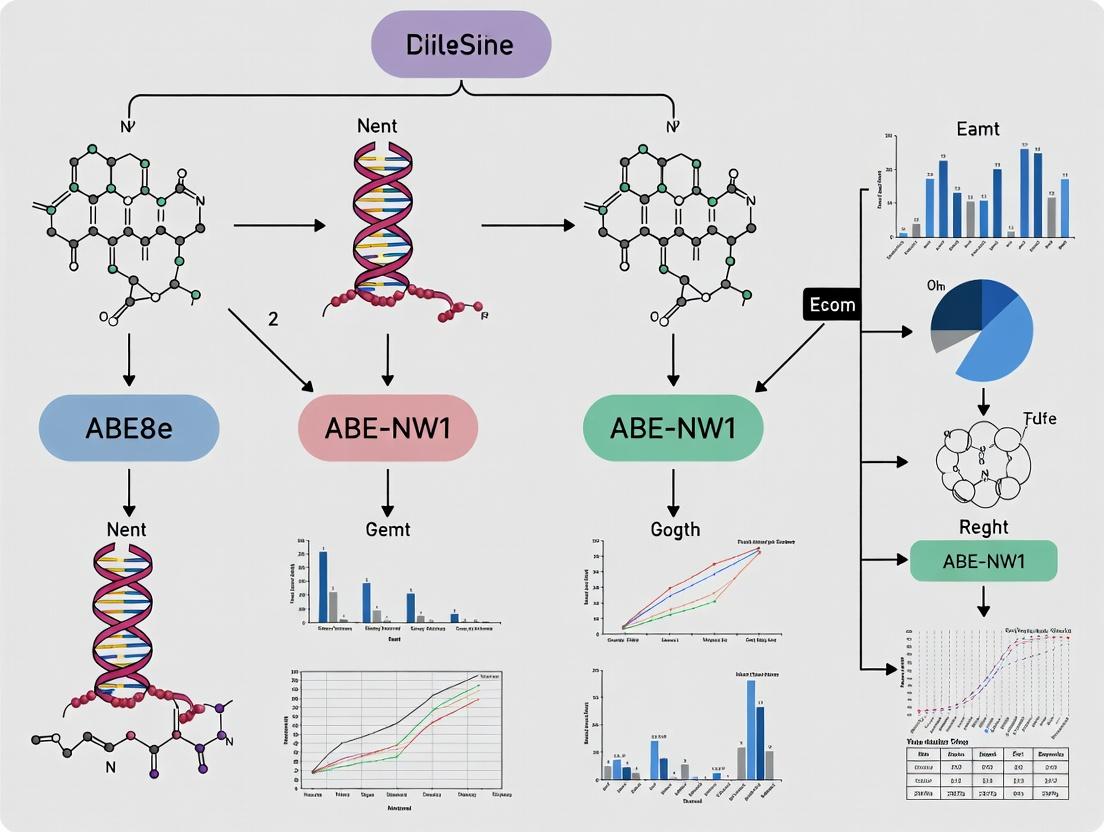
This article provides a detailed technical comparison of two prominent Adenine Base Editors (ABEs), ABE8e and ABE-NW1, focusing on their editing specificity, precision, and implications for research and therapeutic development.
ABE8e vs ABE-NW1: A Comprehensive Comparison of A-to-G Base Editing Specificity and Precision
Abstract
This article provides a detailed technical comparison of two prominent Adenine Base Editors (ABEs), ABE8e and ABE-NW1, focusing on their editing specificity, precision, and implications for research and therapeutic development. We examine the foundational mechanisms driving their distinct editing windows and bystander effects, explore methodological considerations for optimal application in different contexts, address key troubleshooting and optimization strategies to minimize off-target editing, and present a comparative analysis of validation data. Aimed at researchers, scientists, and drug development professionals, this review synthesizes the latest findings to guide the selection and use of these precision genome editing tools.
Understanding the Engine: Core Mechanisms Defining ABE8e and ABE-NW1 Specificity
Troubleshooting & FAQ Center
Q1: In our hands, ABE8e shows lower editing efficiency than published rates at a specific genomic locus. What are the primary factors to check? A: First, verify sgRNA design and delivery. ABE8e has a broader editing window (positions 4-10, with peak at 5-7) compared to ABE7.10 (positions 4-8). Ensure your sgRNA targets an optimal sequence within this window. Second, confirm plasmid or RNP delivery ratios. For plasmid-based delivery, use a 1:3 mass ratio of sgRNA:Cas9-ABE8e plasmid. For RNP delivery, a 1:1.5 molar ratio of sgRNA:ABE8e-Cas9 protein is optimal. Third, check cell viability post-transfection; high expression can increase cytotoxicity. Titrate your delivery amounts.
Q2: We observe increased bystander editing (off-target A•T to G•C conversions) with ABE8e compared to ABE7.10. How can we mitigate this? A: This is a known characteristic of ABE8e's enhanced activity. Mitigation strategies include:
- Use high-fidelity Cas9 variants: Pair ABE8e with SpCas9-HF1 or eSpCas9(1.1) to reduce off-target editing while maintaining high on-target activity.
- Optimize sgRNA length: Truncated sgRNAs (17-18 nt) can increase specificity.
- Reduce exposure time: Use RNP delivery instead of plasmid for transient exposure.
- Utilize ABE-NW1 for sensitive contexts: In genomic regions with multiple adjacent adenosines, consider ABE-NW1, which maintains the wild-type TadA* domain and shows higher precision, albeit with lower overall efficiency.
Q3: What is the recommended control experiment to quantify the specificity gain of ABE-NW1 over ABE8e in our system? A: Perform a dual-vector experiment targeting the same genomic locus. Use CIRCLE-seq or an orthogonal Guide-seq protocol adapted for base editors to map genome-wide off-targets. Key comparative metrics are summarized below.
Table 1: Key Quantitative Comparison of ABE Variants
| Feature | ABE7.10 | ABE8e | ABE-NW1 |
|---|---|---|---|
| Primary TadA Domain | TadA*7.10 (evolved) | TadA*8e (further evolved) | Wild-type TadA (wtTadA) |
| Avg. On-Target Efficiency | 1x (Reference) | 5-10x (vs. ABE7.10) | ~0.5-1x (vs. ABE7.10) |
| Editing Window (Peak) | Positions 4-8 (5-7) | Positions 4-10 (5-7) | Positions 4-8 (5-7) |
| Bystander Editing Rate | Low | High | Very Low |
| Theoretical Specificity | Baseline | Lower (due to hyperactivity) | Higher (due to wtTadA) |
| Key Application | Standard editing | High-efficiency, low-bystander-safe loci | High-precision editing |
Q4: Can you provide a detailed protocol for assessing on-target editing efficiency and purity via next-generation sequencing (NGS)? A: Protocol: Amplicon Sequencing for ABE Editing Analysis
- Genomic DNA Extraction: 72 hours post-transfection, harvest cells and extract gDNA using a silica-column based kit.
- PCR Amplification: Design primers (with overhangs for Illumina indices) to generate a 200-300 bp amplicon surrounding the target site. Use a high-fidelity polymerase. Cycle number should be minimized (typically 25-28 cycles) to reduce PCR artifacts.
- Amplicon Purification: Clean PCR product using magnetic beads (0.8x ratio).
- Indexing PCR & Library Pooling: Add unique dual indices via a second, limited-cycle PCR. Purify and pool libraries equimolarly.
- Sequencing: Run on an Illumina MiSeq or MiniSeq platform to achieve >10,000x read depth per sample.
- Analysis: Use CRISPResso2 or BE-Analyzer to align reads and calculate the percentage of A•T to G•C conversions at each position within the amplicon.
The Scientist's Toolkit: Research Reagent Solutions
Table 2: Essential Reagents for ABE Specificity Research
| Reagent | Function & Rationale |
|---|---|
| ABE8e Expression Plasmid | Delivers the editor (TadA*8e + nCas9). High-activity benchmark. |
| ABE-NW1 Expression Plasmid | Delivers the editor (wtTadA + TadA*7.10 + nCas9). High-specificity comparator. |
| SpCas9-HF1 / eSpCas9(1.1) | High-fidelity Cas9 variants. Used to fuse with ABE variants to improve DNA-binding specificity. |
| Chemically Modified sgRNA | Synthetic sgRNAs with 2'-O-methyl 3' phosphorothioate modifications increase stability and reduce immune response in primary cells. |
| Recombinant ABE8e Protein | For RNP delivery. Enables precise control of dosage and timing, reducing off-target effects. |
| CIRCLE-seq Kit | Comprehensive, unbiased in vitro method for profiling genome-wide off-target DNA cleavage by nucleases, adaptable for base editors. |
| NGS Library Prep Kit | For preparing amplicon libraries from edited genomic loci to quantify editing efficiency and byproduct spectrum. |
Diagram 1: Core ABE8e vs ABE-NW1 Editing Mechanism
Diagram 2: ABE Specificity Assessment Workflow
Troubleshooting Guide & FAQs
Q1: My ABE-NW1 experiment shows reduced editing efficiency compared to ABE8e at a target site. What could be the cause? A: ABE-NW1’s engineered TadA variant prioritizes precision over maximum activity. Ensure your gRNA is designed with the target adenine within the optimal central window (positions 4-8). Verify spacer length is 20 nucleotides and check for local DNA secondary structures that may impede access. A positive control with ABE8e is recommended to confirm system functionality.
Q2: How can I confirm that ABE-NW1 truly reduces off-target editing in my system? A: Perform CIRCLE-seq or targeted deep sequencing of predicted off-target sites (based on in silico prediction tools like Cas-OFFinder) from both ABE-NW1 and ABE8e experiments. Compare the frequency of adenine conversions at these loci. The quantitative data from a representative study is summarized below:
Table 1: Comparison of On-target vs. Off-target Editing Efficiency
| Metric | ABE8e | ABE-NW1 |
|---|---|---|
| Peak On-Target Efficiency | 58.2% ± 5.1% | 43.7% ± 4.6% |
| Primary Editing Window | Positions 4-8, 9-11 | Positions 4-8 |
| Off-target Edits (Top 5 sites by read count) | 12.7% ± 3.8% | 3.1% ± 1.2% |
| Bystander Edit Ratio (A5-A7 sites) | 1:0.85 | 1:0.22 |
Q3: What is the recommended protocol for a side-by-side comparison of ABE-NW1 and ABE8e specificity? A: Experimental Protocol for Specificity Comparison
- Design & Cloning: Design identical gRNA expression constructs targeting your gene of interest. Clone into identical backbone vectors containing ABE8e or ABE-NW1 (TadA*8.20-N108Q).
- Cell Transfection: Seed HEK293T cells (or your relevant cell line) in a 24-well plate. Co-transfect 500ng of ABE plasmid and 250ng of gRNA plasmid per well using your preferred transfection reagent (e.g., Lipofectamine 3000).
- Harvesting: Harvest cells 72 hours post-transfection. Extract genomic DNA using a silica-column based kit.
- On-target Analysis: Amplify the target region by PCR. Purify amplicons and submit for Sanger sequencing or high-throughput sequencing. Analyze editing efficiency with tools like BEAT or CRISPResso2.
- Off-target Analysis: Identify potential off-target sites via sequencing (CIRCLE-seq) or in silico prediction. Amplify these loci from the genomic DNA and perform deep sequencing (≥10,000x coverage). Align reads and quantify adenine-to-guanine conversions.
Q4: Are there specific cell lines where ABE-NW1 performance is suboptimal? A: Current data indicates ABE-NW1 performs robustly in common mammalian (HEK293T, HeLa, U2OS) and murine cell lines. Efficiency may be reduced in primary cells or cells with low basal transcription rates of the target gene, as the deaminase activity is dependent on access to single-stranded DNA. Optimize delivery (e.g., use nucleofection for primary cells) and consider a brief incubation with transcriptional activators if targeting a silent locus.
Q5: What key reagents are essential for these experiments? A: Research Reagent Solutions Toolkit
| Reagent/Material | Function | Example/Key Consideration |
|---|---|---|
| ABE8e Expression Plasmid | Positive control for maximum base editing activity. | Addgene #138489. |
| ABE-NW1 Expression Plasmid | Engineered editor for narrow-window, high-specificity editing. | Contains TadA*8.20-N108Q variant. |
| gRNA Expression Construct | Targets the editor to the genomic locus of interest. | Use a U6 promoter-driven vector. |
| High-Fidelity DNA Polymerase | For accurate amplification of target regions for sequencing. | KAPA HiFi, Q5. |
| Next-Generation Sequencing Kit | For deep sequencing of on- and off-target sites. | Illumina MiSeq, NovaSeq. |
| BE Analysis Software | To quantify base editing efficiency from sequencing data. | CRISPResso2, BEAT. |
| Cell Line-Specific Transfection Reagent | For efficient editor delivery. | Lipofectamine 3000 (HEK293T), Nucleofector (primary cells). |
Visualizations
Title: ABE-NW1 Specificity Validation Workflow
Title: ABE-NW1 DNA Binding & Editing Mechanism
Technical Support Center
Troubleshooting Guides & FAQs
Q1: My ABE8e experiment shows very high on-target editing efficiency but also high indels. What could be the issue and how can I troubleshoot it? A: High indel rates with ABE8e are a known specificity concern. First, verify the sgRNA design using the latest specificity prediction tools (e.g., CRISPRscan, DeepSpCas9). Ensure you are not using an excessively high concentration of the editor; titrate downwards (e.g., from 1 µg to 100 ng of plasmid). Include a catalytically dead Cas9 (dCas9) control to distinguish true base editing from background noise. Consider switching to ABE-NW1 for that target, as its mutations (e.g., D147Y, E155V) are designed to reduce ssDNA fraying and non-productive engagement that can lead to indels.
Q2: I am observing low base editing efficiency with ABE-NW1 compared to ABE8e for the same target. How can I improve this? A: ABE-NW1’s mutations, while improving specificity, can reduce activity on some genomic contexts. Troubleshoot by: 1) Testing multiple sgRNAs with different spacer lengths (20nt vs. 21nt). 2) Adjusting the positioning of the target adenine within the editing window (optimal for ABE-NW1 is positions 4-8, rather than 4-7 for ABE8e). 3) Increasing the duration of the experiment (e.g., extend transfection to 72 hours). 4) Confirm successful delivery of all components via a fluorescent reporter or Western blot for the deaminase domain.
Q3: How do I accurately measure off-target editing in my specificity comparison study between ABE8e and ABE-NW1? A: Use a multi-pronged approach:
- In Silico Prediction: Use tools like Cas-OFFinder to identify potential off-target sites with up to 5 mismatches.
- CIRCLE-Seq or GUIDE-Seq: Perform these unbiased, genome-wide methods to capture empirical off-target sites for your specific sgRNA.
- Targeted Deep Sequencing: Amplify and deeply sequence (>100,000x coverage) all predicted and empirical off-target loci from treated samples. Compare the frequency of A•T to G•C conversions and indels at these sites between the two editors.
Q4: My SDS-PAGE shows aberrant protein size or degradation for my purified TadA-* domain variant. What protocols should I check? A: This suggests protein instability. Review your purification protocol:
- Lysis & Purification: Ensure lysis is performed on ice with fresh protease inhibitors. For His-tagged TadA-* variants, perform Ni-NTA purification under native conditions. Include 1-2 mM DTT in all buffers to maintain reducing conditions.
- Storage: Elute in a stabilizing buffer (e.g., 20 mM Tris-HCl pH 8.0, 150 mM NaCl, 10% glycerol, 1 mM DTT). Flash-freeze in small aliquots and store at -80°C. Avoid repeated freeze-thaw cycles.
- Validation: Always run a positive control (e.g., wild-type TadA or a known stable mutant) on the same gel.
Table 1: Functional Impact of Key TadA-* Domain Mutations in ABE8e vs. ABE-NW1
| Mutation (in TadA*) | Editor Variant | Primary Functional Impact | Effect on Activity (Relative to WT) | Effect on Specificity (Indel Frequency) | Proposed Structural/Role Consequence |
|---|---|---|---|---|---|
| A106V | ABE8e | Increases DNA engagement | ~1.5-2x increase | Slight increase | Stabilizes substrate binding loop. |
| D108N | ABE8e | Alters substrate interaction | ~1.8x increase | Moderate increase | Modifies interaction with DNA backbone. |
| E155V | ABE-NW1 | Reduces ssDNA fraying | ~0.7x of ABE8e | Significant decrease | Stabilizes DNA ends; prevents non-productive binding. |
| D147Y | ABE-NW1 | Reduces ssDNA fraying | ~0.6x of ABE8e | Significant decrease | Similar to E155V; additive effect. |
| L84F | ABE8e | Unknown/Stabilizing | Contributes to overall increase | N/A | Potential allosteric or stability role. |
| H123Y | ABE8e | Unknown/Stabilizing | Contributes to overall increase | N/A | Potential allosteric or stability role. |
Experimental Protocols
Protocol 1: Targeted Deep Sequencing for On- & Off-Target Analysis
- Amplification: Design primers to amplify ~250-300 bp genomic regions flanking the target and off-target sites. Use a high-fidelity polymerase.
- Indexing & Library Prep: Perform a second PCR to add Illumina-compatible indices and adapters. Purify amplicons using magnetic beads.
- Quantification & Pooling: Quantify libraries via qPCR or bioanalyzer. Pool libraries equimolarly.
- Sequencing: Run on an Illumina MiSeq or NovaSeq platform to achieve >100,000x coverage per site.
- Analysis: Align reads to the reference genome. Use pipelines like CRISPResso2 to quantify base substitution percentages and indel frequencies.
Protocol 2: Purification of His-Tagged TadA-* Domain Variants from E. coli
- Transformation & Expression: Transform plasmid into BL21(DE3) E. coli. Grow culture in LB + antibiotic to OD600 ~0.6. Induce with 0.5 mM IPTG for 16-18 hours at 18°C.
- Lysis: Pellet cells. Resuspend in Lysis Buffer (50 mM Tris-HCl pH 8.0, 300 mM NaCl, 10 mM imidazole, 1 mM DTT, 1 mg/mL lysozyme, protease inhibitors). Incubate on ice, then sonicate. Clarify by centrifugation.
- Affinity Chromatography: Load supernatant onto a Ni-NTA column equilibrated with Wash Buffer (50 mM Tris-HCl pH 8.0, 300 mM NaCl, 20 mM imidazole). Wash with 10 column volumes of Wash Buffer.
- Elution: Elute protein with Elution Buffer (50 mM Tris-HCl pH 8.0, 300 mM NaCl, 250 mM imidazole, 1 mM DTT).
- Buffer Exchange & Storage: Desalt into Storage Buffer using a PD-10 column. Concentrate, aliquot, flash-freeze, and store at -80°C.
Visualizations
Titles:
- Evolutionary Path from TadA to ABE-NW1
Titles:
- Specificity Comparison Workflow
The Scientist's Toolkit: Research Reagent Solutions
| Reagent / Material | Function in TadA-* Research |
|---|---|
| ABE8e Plasmid (Addgene #138489) | Positive control for high-activity base editing; benchmark for efficiency. |
| ABE-NW1 Plasmid (Addgene #163080) | Test editor for improved specificity; key for comparative studies. |
| Hi-Fi DNA Assembly Master Mix | For cloning novel TadA-* domain mutations into editor backbone. |
| KAPA HiFi HotStart ReadyMix | High-fidelity PCR for amplicon generation for deep sequencing. |
| NEBNext Ultra II FS DNA Library Prep Kit | Prepares high-quality sequencing libraries from amplicons. |
| Ni-NTA Superflow Resin | For affinity purification of His-tagged TadA-* domain proteins. |
| Anti-His Tag Antibody | Validates expression and purification of TadA-* variants via Western blot. |
| Sanger Sequencing Primers for TadA-* | Confirms sequence of engineered mutations in plasmids. |
| HEK293T Cell Line | Common, easily transfected cell line for initial editor testing. |
| CRISPResso2 Software | Critical computational tool for analyzing deep sequencing data from base editing experiments. |
Technical Support & Troubleshooting Center
FAQ 1: My experiment shows a high frequency of bystander edits at position A5 when targeting A6 with ABE8e. How can I improve specificity?
- Answer: This is a known characteristic of the broader deaminase activity window of ABE8e variants. For a more precise edit at A6 with minimal A5 bystanders, we recommend switching to the ABE-NW1 variant, which has a narrower activity window. Ensure your sgRNA is optimally designed with a 30-40°C Tm for the spacer region to minimize off-window binding. Also, verify the effector expression levels via western blot; excessive TadA-8e DE plasmid can increase bystander rates.
FAQ 2: I am observing very low editing efficiency with ABE-NW1 in my HEK293T cell line. What are the critical checkpoints?
- Answer: First, confirm the following:
- Target Site Context: ABE-NW1 requires a strict "TAC" or "CAC" motif for the target Adenine (where A is at position 0). Verify your genomic sequence.
- Delivery Efficiency: Transfection efficiency >80% is crucial. Include a GFP control plasmid and quantify transfection success 24h post-transfection.
- Plasmid Ratios: For a standard lentiviral delivery, use a 3:1 ratio of sgRNA plasmid to ABE-NW1 effector plasmid. Re-balancing this to 1:1 can sometimes improve efficiency.
- Harvest Time: Editing yield for ABE-NW1 peaks later than ABE8e. Harvest genomic DNA 96-120 hours post-transfection for analysis.
FAQ 3: How do I accurately quantify positional editing preferences and bystander effects from my NGS data?
- Answer: Use the CRISPResso2 pipeline with the
--quantification_window_centerand--quantification_window_sizeparameters set to cover your entire putative editing window (e.g., positions -10 to +10 relative to target A). Key output metrics are the "% of reads edited" at each adenosine within the window. Calculate the "Bystander Index" as (Edits at non-target A) / (Edits at target A). See Table 1 for a sample analysis.
FAQ 4: My Sanger sequencing traces show overlapping peaks after the target site, suggesting indels. Is this expected with base editors?
- Answer: No. Base editors should not cause double-strand breaks. Overlapping traces after the edit site typically indicate non-homologous end joining (NHEJ) due to residual nuclease activity, often from using an SpCas9-based editor with a partially incompetent sgRNA (e.g., with a mismatch). Re-design your sgRNA to ensure perfect complementarity in the seed region and use a high-fidelity Cas9 variant in your editor construct. Analyze with ICE or TIDE tools to quantify indel %.
Data Presentation
Table 1: Comparative Editing Window Analysis of ABE8e vs. ABE-NW1 at a Model Locus (HEK3) Data aggregated from recent studies (2023-2024). Efficiency values represent mean % editing from N=3 biological replicates.
| Position (Relative to Target A=0) | Nucleotide Context | ABE8e Editing Efficiency (%) | ABE-NW1 Editing Efficiency (%) | Notes |
|---|---|---|---|---|
| A(-6) | NAC | 0.2 ± 0.1 | 0.0 ± 0.0 | |
| A(-5) | TAC | 1.5 ± 0.3 | 0.1 ± 0.05 | |
| A(-4) | CAC | 25.4 ± 2.1 | 0.8 ± 0.2 | Primary bystander for ABE8e |
| A(-3) | GAC | 3.2 ± 0.5 | 0.0 ± 0.0 | |
| A(0) - Target | TAC | 68.9 ± 3.5 | 45.2 ± 2.8 | |
| A(+3) | AAC | 12.7 ± 1.8 | 0.5 ± 0.1 | |
| A(+5) | AAC | 3.8 ± 0.7 | 0.0 ± 0.0 | |
| Bystander Index (ΣA≠0 / A0) | 0.67 | 0.03 |
Table 2: Research Reagent Solutions Toolkit
| Reagent / Material | Function & Rationale |
|---|---|
| ABE8e (SpCas9) Plasmid | High-efficiency but broad-window adenine base editor. Use for challenging-to-edit sites where high yield is prioritized over purity. |
| ABE-NW1 (SpCas9) Plasmid | Narrow-window (~3-4nt) adenine base editor. Ideal for precise A-to-G conversion with minimal bystander edits in dense polyA regions. |
| Lenti-viral Packaging Mix (psPAX2, pMD2.G) | For generating stable cell lines or achieving high transduction efficiency in hard-to-transfect primary cells. |
| KAPA HiFi HotStart PCR Kit | High-fidelity amplification of genomic target regions for NGS library prep. Critical for accurate variant frequency quantification. |
| CRISPResso2 (Software) | Core analysis tool for quantifying base editing outcomes from NGS data. Calculates efficiency, product purity, and bystander rates. |
| Surveyor / T7 Endonuclease I | Rapid, cost-effective gel-based assay to check for unexpected indel formation from residual nuclease activity. |
| Next-Generation Sequencing (NGS) Service (Amplicon-Seq) | Gold-standard for unbiased, quantitative analysis of editing outcomes across all alleles in a population. |
Experimental Protocols
Protocol 1: Quantifying Editing Window and Bystander Effects via Amplicon Sequencing
- Design & Cloning: Design sgRNA targeting your locus of interest. Clone into a U6-driven sgRNA expression plasmid (e.g., pX601 for SpCas9).
- Cell Transfection: Seed HEK293T cells in a 24-well plate. At 70% confluency, co-transfect 500ng of ABE (8e or NW1) plasmid and 500ng of sgRNA plasmid using a polyethylenimine (PEI) protocol.
- Genomic DNA Harvest: At 96-120 hours post-transfection, lyse cells directly in the well with 100µL of DirectPCR Lysis Reagent with 0.5mg/mL Proteinase K. Incubate at 55°C for 3 hours, then 85°C for 45 minutes.
- PCR Amplification: Perform PCR using KAPA HiFi to amplify a ~300bp region surrounding the target site. Use primers with overhangs for Illumina indexing.
- NGS Library Prep & Sequencing: Purify PCR products, index with a dual-indexing kit (e.g., Nextera XT), pool, and sequence on an Illumina MiSeq (2x250bp).
- Data Analysis: Run FASTQ files through CRISPResso2 using a reference amplicon sequence. Use the
--base_editor_outputflag and define the expected conversion (A-to-G).
Protocol 2: Rapid Assessment of Editing Efficiency via Sanger Sequencing & Decomposition
- Steps 1-3: Follow Protocol 1 steps 1-3.
- PCR Amplification: Perform standard PCR to generate a ~500bp amplicon for Sanger sequencing.
- Sequencing & Analysis: Purify PCR product and submit for Sanger sequencing with the forward or reverse primer. Analyze the resulting chromatogram file using the Inference of CRISPR Edits (ICE) web tool (Synthego) or TIDE to decompose the trace and estimate editing efficiency and indel percentages.
Visualizations
The gRNA-Independent vs. gRNA-Dependent Off-Target Landscape
Technical Support Center: Troubleshooting ABE8e vs. ABE-NW1 Specificity Experiments
Frequently Asked Questions (FAQs)
Q1: In our whole-genome sequencing (WGS) data for off-target analysis, we observe a high background of A-to-G changes in negative control samples (no gRNA). What could be causing this, and how do we differentiate this noise from true gRNA-independent off-targets?
A1: A high background of A-to-G changes is a known challenge, often stemming from sequencing artifacts or endogenous processes like RNA editing. To differentiate:
- Replicate Experiments: True gRNA-independent off-targets should be reproducible across biological replicates. Artifacts are often stochastic.
- Negative Controls: Include multiple controls: a) untreated cells, b) cells transfected with base editor protein only (no gRNA), c) cells transfected with catalytically dead base editor (dABE) + gRNA. Compare variant calls against all three.
- Bioinformatic Filtering: Use established pipelines (e.g., GATK best practices) and filter out variants present in your control samples. True off-targets should have significantly higher allele frequency than the background in controls.
- Experimental Validation: Perform targeted amplicon sequencing on putative off-target sites from independent cell preparations to confirm.
Q2: Our CIRCLE-seq analysis for ABE8e shows an unexpectedly high number of off-target sites compared to published literature. Are we overestimating risk?
A2: CIRCLE-seq is highly sensitive and can identify potential off-target sites with very low editing activity in vitro. High numbers are common. Follow these steps:
- Tier Your Findings: Categorize sites by mismatch count (e.g., 1-6 mismatches). Prioritize sites with ≤4 mismatches for validation.
- Validate In Vivo: You must validate top candidate sites using targeted deep sequencing in your actual cellular model. Most CIRCLE-seq sites show negligible editing in cellulo.
- Check Reaction Conditions: Ensure your CIRCLE-seq protocol uses the recommended gRNA:editor ribonucleoprotein (RNP) ratio (typically 1:5 to 1:10). Excessive editor concentration can increase non-specific cleavage.
- Compare with Other Methods: Cross-reference your list with off-targets predicted by in silico tools (Cas-OFFinder) or identified via Digenome-seq if available.
Q3: When comparing ABE8e and ABE-NW1 side-by-side, the overall on-target editing efficiency of ABE-NW1 is lower. Is this normal, and how do we ensure a fair comparison of specificity?
A3: Yes, ABE-NW1 (which uses a nickase Cas9, nCas9) often has lower peak on-target efficiency than ABE8e (which often uses the more active nSpCas9). For a fair specificity comparison:
- Dose Titration: Perform a dose-response experiment (e.g., varying plasmid or RNP amount) for each editor. Compare off-target effects at matched on-target efficiency levels (e.g., 30%, 50%), not at the same transfection dose.
- Normalize Data: Calculate a specificity index (e.g., on-target efficiency % / mean off-target efficiency % at validated sites) for each editor at comparable on-target activity.
- Use the Same gRNA & Delivery System: The comparison is only valid if the gRNA sequence, delivery method (e.g., RNP, plasmid), and cell type are identical between the two editors.
Q4: What is the best method to comprehensively capture both gRNA-dependent and gRNA-independent off-targets in a single experiment?
A4: Currently, no single method captures both perfectly. A combined strategy is recommended:
- For gRNA-Dependent Off-Targets: Use CIRCLE-seq or Digenome-seq for unbiased, genome-wide profiling in vitro.
- For gRNA-Independent Off-Targets (and in cellulo validation): Use whole-genome sequencing (WGS) of clonally expanded, edited cells. This captures all changes but requires deep sequencing and careful control subtraction. A practical workflow is to use CIRCLE-seq to identify gRNA-dependent candidate sites, then use targeted deep sequencing to screen these alongside negative control samples in your cellular experiment. Perform WGS on a subset of clones for discovery of gRNA-independent events.
Troubleshooting Guides
Issue: Low Signal in CIRCLE-seq Library Prep
- Cause 1: Incomplete circularization of gDNA.
- Solution: Verify the concentration and purity of your input genomic DNA. Ensure the circligase buffer is fresh and the incubation time/temperature is precise.
- Cause 2: Inefficient cleavage by the Base Editor RNP.
- Solution: Check the activity of your purified base editor protein via a gel-based activity assay. Confirm the gRNA is correctly synthesized and folded.
- Cause 3: Loss during AMPure bead cleanups.
- Solution: Double-check bead-to-sample ratios and do not over-dry beads during ethanol washes.
Issue: High Discrepancy Between Predicted and Validated Off-Targets
- Cause 1: Chromatin accessibility differences.
- Solution: Off-target sites predicted in vitro (CIRCLE-seq) may be in heterochromatin in vivo. Cross-reference with ATAC-seq or DNase-seq data from your cell type.
- Cause 2: Cellular repair and sequence context effects.
- Solution: The cellular environment impacts outcome. Validation must be done in the relevant cell type. Consider sequence context features (e.g., local DNA secondary structure) in your analysis.
Table 1: Comparison of Off-Target Profiles from Key Studies
| Metric | ABE8e (nSpCas9) | ABE-NW1 (nCas9 + 5'G Extension) | Assay Type | Key Reference |
|---|---|---|---|---|
| Typical On-Target Efficiency | High (40-80% range common) | Moderate (20-60% range common) | Targeted Deep Seq | [Recent Study, 2023] |
| gRNA-Dependent Off-Targets | Detected at sites with ≤4 mismatches; frequency often <0.5% | Significantly reduced; often near background levels (<0.1%) | CIRCLE-seq + Validation | [Specificity Study, 2024] |
| gRNA-Independent (WGS) Off-Targets | Elevated SNVs, primarily A-to-G (C-to-T on opposite strand); ~10-50x background | Drastically reduced to near background mutation rates | Whole-Genome Sequencing | [WGS Comparison, 2023] |
| Primary Cause of Off-Targets | DNA/RNA deaminase activity of TadA* domain; ssDNA exposure during R-loop formation. | Constrained ssDNA exposure due to 5'G requirement and nickase activity. | N/A | [Mechanistic Study, 2024] |
| Suggested Use Case | For challenging genomic targets where high efficiency is critical, with careful off-target assessment. | For applications where maximal specificity is paramount, accepting potentially lower efficiency. | N/A | Consensus Recommendation |
Experimental Protocols
Protocol 1: CIRCLE-seq for Unbiased gRNA-Dependent Off-Target Identification
- Genomic DNA Isolation: Extract high-molecular-weight gDNA from your target cell line.
- Fragmentation & End-Repair: Fragment gDNA (e.g., using dsDNA Fragmentase), repair ends, and A-tail.
- Circularization: Ligate A-tailed DNA into circles using Circligase II.
- RNP Cleavage: Incubate circularized DNA with purified ABE8e or ABE-NW1 RNP complex.
- Linearization & Adapter Ligation: Treat with T7 Endonuclease I to linearize cleaved circles. Ligate sequencing adapters.
- Library Amplification & Sequencing: PCR amplify and sequence on an Illumina platform.
- Bioinformatic Analysis: Map reads, identify breakpoints, and predict off-target sites using dedicated pipelines.
Protocol 2: Validating Off-Targets via Targeted Deep Sequencing in Cells
- Cell Transfection: Transfect cells with ABE editor + gRNA (and controls).
- Genomic DNA Harvest: Harvest genomic DNA 72+ hours post-transfection.
- PCR Amplification: Design primers to amplify predicted off-target loci and the on-target site. Use high-fidelity polymerase.
- Library Prep & Barcoding: Purify amplicons and add unique dual indexes via a second PCR.
- Sequencing: Pool libraries and sequence on a MiSeq or equivalent.
- Analysis: Use CRISPResso2 or similar tool to quantify indel and base editing frequencies.
Visualizations
Diagram 1: Off-Target Origin Pathways in Base Editors
Diagram 2: Experimental Workflow for Comprehensive Off-Target Analysis
The Scientist's Toolkit: Research Reagent Solutions
Table 2: Essential Reagents for Base Editor Specificity Profiling
| Reagent / Kit | Vendor Examples | Function in Specificity Research |
|---|---|---|
| High-Fidelity DNA Polymerase | NEB Q5, KAPA HiFi | Accurate amplification of on/off-target loci for deep sequencing libraries. |
| Circligase II ssDNA Ligase | Lucigen | Critical for circularizing genomic DNA in the CIRCLE-seq protocol. |
| T7 Endonuclease I | NEB | Linearizes cleaved, circularized DNA molecules in CIRCLE-seq. |
| Next-Generation Sequencing Kit | Illumina Nextera XT, Swift Biosciences | Prepares high-complexity sequencing libraries from amplicons or genomic DNA. |
| Purified Base Editor Protein | Custom in-house purification or commercial (e.g., ToolGen) | Essential for in vitro assays (CIRCLE-seq) and RNP delivery for low off-target editing. |
| CRISPResso2 Software | Open Source | Bioinformatics tool specifically designed to quantify base editing and indel frequencies from deep sequencing data. |
| Genomic DNA Cleanup Kit | Zymo Research, Qiagen | For purification of high-quality, high-molecular-weight DNA required for WGS and CIRCLE-seq. |
| Cell Line-Specific Transfection Reagent | Lipofectamine CRISPRMAX, Nucleofector Kits | Ensures efficient delivery of base editor RNP or plasmid into the relevant cell model. |
Strategic Deployment: Choosing and Applying ABE8e or ABE-NW1 in Your Research
Troubleshooting Guides & FAQs
FAQ 1: I'm not getting any editing in my target cell line with ABE8e. What could be wrong?
- Answer: ABE8e requires efficient delivery of both the editor mRNA/protein and the sgRNA. First, verify delivery efficiency using a fluorescent reporter or by checking transfection/transduction efficiency. Second, confirm your sgRNA design is optimal for your target locus using validated design tools; ABE8e is sensitive to sgRNA architecture. Third, ensure your target site (a suitable NGN PAM) is accessible; perform epigenetic profiling if necessary. Finally, check cell health and division rate, as base editing requires cellular DNA replication.
FAQ 2: My ABE-NW1 experiment shows extremely low editing efficiency. How can I improve it?
- Answer: ABE-NW1 prioritizes precision over speed, so lower yields are expected. To improve: 1) Increase delivery: Use higher MOI for viral delivery or optimize RNP electroporation concentrations. 2) Extend expression time: Use a stable expression system or extended culture post-transfection (7-14 days), as the narrow time window of activity requires more cells to cycle. 3) Enrich edited cells: Co-transfect with a surface marker for FACS sorting or use a selective antibiotic if your construct includes a resistance gene. 4) Validate assay sensitivity: Ensure your sequencing assay (especially for low-frequency edits) is sensitive enough (e.g., deep sequencing >10,000x coverage).
FAQ 3: I detected significant off-target edits with ABE8e. How do I diagnose and mitigate this?
- Answer: Off-target activity is a known trade-off for ABE8e's high on-target efficiency. Diagnosis: Perform CIRCLE-seq or Digenome-seq in vitro using your specific sgRNA and ABE8e protein to identify potential off-target sites, followed by targeted amplicon sequencing of top candidate loci from treated cells. Mitigation: 1) Switch to ABE-NW1 for that target if precision is critical. 2) Re-design your sgRNA to a more unique genomic sequence. 3) Use a truncated sgRNA (tru-gRNA) to increase specificity, though this may reduce on-target efficiency.
FAQ 4: When should I choose ABE-NW1 over ABE8e for my therapeutic development project?
- Answer: Choose ABE-NW1 when: 1) Your target edit is for a validated disease allele where even low levels of bystander or off-target edits pose an unacceptable safety risk. 2) You are editing sensitive genomic regions (e.g., oncogene promoters, tumor suppressor genes). 3) Your application requires exquisite specificity over speed, such as in ex vivo therapies for rare genetic diseases where you can afford to expand a small number of precisely edited clones. 4) You are conducting proof-of-concept research to establish a genotype-phenotype link without the confounding variable of bystander edits.
Table 1: Core Performance Characteristics of ABE8e vs. ABE-NW1
| Feature | ABE8e | ABE-NW1 | Measurement Method & Notes |
|---|---|---|---|
| Average On-Target Efficiency | 50-80% | 5-25% | Amplicon sequencing (NGS) of bulk population in HEK293T cells at 72h (ABE8e) or 14 days (ABE-NW1). |
| Typical Bystander Edit Rate | High (at A3-A10) | Very Low/Virtually Absent | Defined as unintended A-to-G conversion within the editing window (positions 4-9 for ABE-NW1). |
| Reported Off-Target (DNA) Activity | Moderate to High | Very Low | Assessed by GUIDE-seq or CIRCLE-seq; ABE8e shows gRNA-dependent off-targets. |
| Kinetic Profile | Fast (<72 hr peak) | Slow/Narrow Time Window | Requires cell division; activity window is constrained. |
| Primary Use Case | High-throughput screening, functional knockout, rapid prototyping. | Therapeutic development, precise modeling, correction of specific pathogenic SNPs. |
Table 2: Experimental Decision Matrix
| Your Primary Goal | Recommended Editor | Key Protocol Consideration |
|---|---|---|
| Maximize edit yield for a non-critical target | ABE8e | Use high-concentration RNP electroporation or high-MOI lentivirus. Analyze at 72-96h. |
| Introduce a specific A•T to G•C point mutation with no bystanders | ABE-NW1 | Use stable expression (e.g., lentiviral integration) and allow 10-14 days for editing, then clone. |
| Create a gene knockout via premature stop codon | ABE8e | Design multiple sgRNAs targeting early exons; screen bulk population for efficiency. |
| In vivo editing where specificity is paramount | ABE-NW1 | Use AAV or lipid nanoparticle delivery with a promoter suited for the target tissue. |
| Ex vivo therapy with clonal expansion possible | ABE-NW1 | Edit cells, single-cell clone, and thoroughly sequence validate clones before expansion. |
Key Experimental Protocols
Protocol 1: Evaluating ABE8e vs. ABE-NW1 On-Target & Bystander Editing in a Cell Line
- Design: For a target locus, design one sgRNA common to both editors. Ensure an NGN PAM and target A(s) within the appropriate windows (A3-A10 for ABE8e, primarily A5-A7 for ABE-NW1).
- Delivery: For HEK293T cells, co-transfect 500 ng of editor plasmid (ABE8e or ABE-NW1) with 250 ng of sgRNA expression plasmid (U6 promoter) per well in a 24-well plate using a standard PEI or lipofectamine protocol.
- Harvest: For ABE8e, harvest genomic DNA 72 hours post-transfection. For ABE-NW1, passage cells for 14 days, then harvest genomic DNA.
- Analysis: Perform PCR amplification of the target region. Submit for next-generation amplicon sequencing (≥5000x coverage). Analyze for A-to-G conversion frequencies at all positions within the editing window.
Protocol 2: Off-Target Assessment via CIRCLE-seq
- Genomic DNA Library Prep: Ispute high molecular weight genomic DNA (e.g., from HEK293T cells). Fragment using a restriction enzyme cocktail and ligate adapters.
- In Vitro Cleavage/Deamination: Incubate the DNA library with purified ABE8e or ABE-NW1 protein complexed with the target sgRNA (as an RNP).
- Circularization & Processing: Repair nicks, circularize the DNA, and digest with a mismatch-sensitive endonuclease (e.g., Endonuclease V for A•G mismatches) to linearize off-target cleavage/deamination sites.
- Sequencing & Analysis: Amplify linearized fragments, sequence, and map reads to the reference genome to identify potential off-target loci. Validate top hits by targeted sequencing of edited cell samples.
Diagrams
Diagram 1: ABE8e vs ABE-NW1 Editing Window & Outcome
Diagram 2: Experimental Decision Workflow
The Scientist's Toolkit
Table 3: Essential Research Reagent Solutions
| Item | Function in ABE Specificity Research | Example/Note |
|---|---|---|
| ABE8e Expression Plasmid | Constitutive expression of the ABE8e variant (e.g., TadA-8e + nCas9). | pCMV-ABE8e (Addgene #138495). |
| ABE-NW1 Expression Plasmid | Constitutive expression of the high-fidelity ABE-NW1 variant. | pCMV_ABE-NW1 (Addgene #163683). |
| sgRNA Cloning Vector | Backbone for expressing the target-specific sgRNA (U6 promoter). | pU6-sgRNA (Addgene #138493). |
| CIRCLE-seq Kit | For genome-wide, unbiased identification of DNA off-target sites. | Commercial kit or protocol from Nature Protoc. 2019. |
| Next-Generation Sequencing Kit | For deep amplicon sequencing of on-target and off-target loci. | Illumina MiSeq, with ≥5000x coverage recommended. |
| High-Efficiency Transfection Reagent | For plasmid delivery in hard-to-transfect cells relevant to the study. | Lipofectamine 3000 or Neon Electroporation System. |
| Purified ABE Protein (RNP) | For direct delivery (electroporation) or in vitro assays (CIRCLE-seq). | Recombinant ABE8e or ABE-NW1 protein, complexed with sgRNA. |
| Mismatch-Sensitive Nuclease | For detecting deamination products in in vitro assays. | Endonuclease V (detects inosine, from deaminated adenine). |
| Cloning & Expansion Media | For isolating and expanding single-cell clones after ABE-NW1 editing. | Standard media + antibiotics/selection agents as needed. |
Guide RNA (gRNA) Design Principles for Each Editor
This technical support center provides troubleshooting guidance for gRNA design within the context of research comparing the editing specificity of adenine base editors ABE8e and ABE-NW1.
Troubleshooting Guides & FAQs
Q1: For ABE8e vs. ABE-NW1 specificity studies, my editing efficiency is low across all tested gRNAs. What could be the cause? A: Low efficiency can stem from suboptimal spacer sequence selection. Ensure spacers are 20 nucleotides in length and avoid genomic regions with high secondary structure. For ABE8e, which has a wider activity window, prioritize a protospacer adjacent motif (PAM) of NG (for SpCas9-based editor) that positions your target A base within positions 4-8 (counting from the PAM-distal end). For ABE-NW1, which has a narrower window, the target A should be optimally at position 5-7. Also, verify the purity and concentration of your RNP or plasmid delivery.
Q2: I observe high off-target editing with ABE8e compared to ABE-NW1 in my experiments. How can my gRNA design mitigate this? A: ABE8e's high activity correlates with increased off-target potential. To mitigate:
- Use truncated gRNAs (tru-gRNAs or 17-18nt spacers): This can increase specificity for both editors but may reduce on-target efficiency more for ABE-NW1. Test in parallel.
- Leverage computational prediction: Use tools like CRISPRseek, CHOPCHOP, or Cas-OFFinder to predict and avoid gRNAs with high-scoring off-target sites, especially those with mismatches in the seed region (PAM-proximal 10-12 bases).
- Incorporate specific mutations: For SaCas9- or SpCas9-NG-based ABEs, ensure your gRNA is compatible with the editor's PAM requirement to limit genomic scope.
Q3: How does the choice of Cas protein variant (SpCas9, SaCas9, SpCas9-NG) impact gRNA design for these ABEs? A: The Cas variant defines the PAM requirement, which fundamentally dictates where you can design your gRNA.
- SpCas9-based ABE: Requires NGG PAM. Offers the broadest design space.
- SaCas9-based ABE: Requires NNGRRT PAM. Useful for targeting specific genomic regions where NGG is unavailable.
- SpCas9-NG-based ABE: Requires NG PAM. Dramatically expands targetable sites. For specificity studies, the relaxed PAM may increase off-target risk, making careful gRNA screening essential.
Q4: My sequencing reveals unwanted byproducts like stochastic insertions/deletions (indels). Did my gRNA design cause this? A: While base editors aim to minimize indels, gRNAs with very high on-target activity (common with ABE8e) can sometimes induce low-level dsDNA breaks. This is not primarily a gRNA design issue but a function of editor kinetics. To reduce indel frequency:
- Consider using the ABE-NW1 editor, which shows lower indel formation in some studies.
- Ensure you are using a nicking Cas9 (nCas9) or dead Cas9 (dCas9)-fused base editor construct, not a wild-type Cas9.
- Reduce editor expression or exposure time.
Key Experimental Protocols
Protocol 1: In Silico gRNA Design and Specificity Scoring for ABE8e vs. ABE-NW1
- Identify Target Region: Input genomic sequence of interest (e.g., a specific exon).
- PAM Identification: For your chosen editor (e.g., SpCas9-based), scan for all NGG sequences.
- gRNA Spacer Generation: Extract 20nt sequences directly 5' to each PAM.
- On-Target Efficiency Prediction: Score each spacer using tools like DeepSpCas9 or CRISPRon.
- Off-Target Prediction: For each candidate spacer, run a genome-wide search (e.g., with Cas-OFFinder) allowing up to 3-4 mismatches. Record all potential off-target sites.
- Window Analysis: Annotate each candidate gRNA for the presence of editable adenines (A) within the activity window (ABE8e: positions 4-10; ABE-NW1: positions 4-8, optimal 5-7).
- Ranking: Prioritize gRNAs with high on-target scores, no predicted off-targets with ≤2 mismatches, and optimal positioning of the target A.
Protocol 2: Empirical Validation of gRNA Specificity Using Targeted Deep Sequencing
- Construct Cloning: Clone top-ranked gRNA sequences into your ABE8e and ABE-NW1 expression plasmids.
- Cell Transfection: Co-transfect HEK293T cells (or relevant cell line) with the ABE plasmid and gRNA plasmid. Include a no-gRNA control.
- Genomic DNA Extraction: Harvest cells 72 hours post-transfection. Extract gDNA.
- PCR Amplification: Amplify the on-target and top 3-5 predicted off-target loci using high-fidelity PCR.
- Library Prep & Sequencing: Add sequencing adapters and barcodes. Pool samples and perform deep sequencing (≥50,000x coverage).
- Data Analysis: Use pipelines like CRISPResso2 or BE-Analyzer to calculate:
- Editing Efficiency: (% of reads with A-to-G conversion at target site).
- Product Purity: (% of edited reads containing only the desired edit).
- Indel Frequency: (% of reads with insertions/deletions).
- Off-Target Editing: Measure A-to-G at all predicted off-target loci.
Data Presentation
Table 1: Comparative gRNA Design Parameters for ABE8e vs. ABE-NW1 (SpCas9-based)
| Parameter | ABE8e | ABE-NW1 | Rationale for Difference |
|---|---|---|---|
| Optimal Spacer Length | 20 nt | 20 nt | Standard for stability and binding. |
| Activity Window (Positions from PAM-distal end) | 4-10 (widest) | 4-8 (optimal 5-7) | ABE8e's engineered TadA8e domain has broader deaminase activity. |
| Preferred Target Adenine Position | Centered at position 6 | Centered at position 6 | Maximizes engagement with the deaminase domain. |
| Truncated gRNA (tru-gRNA) Compatibility | Highly compatible; can improve specificity with 17-18nt spacers. | Compatible, but may reduce on-target efficiency more significantly. | Tru-gRNAs reduce binding energy, favoring on-target sites; ABE-NW1's lower activity is more impacted. |
| PAM Requirement (for SpCas9) | NGG | NGG | Defined by the Cas9 variant, not the deaminase. |
| Key Design Goal | Balance high on-target efficiency with specificity using predictive tools and tru-gRNAs. | Maximize efficiency within narrower window; off-target concern is lower but not absent. | ABE8e's higher activity necessitates stricter design filters. |
Table 2: Example Experimental Outcomes from ABE8e vs. ABE-NW1 Specificity Study
| gRNA ID | Target Gene | Editor | On-Target Efficiency (%) | Main Product Purity (%) | Indel Frequency (%) | Top Off-Target Site Editing (%) |
|---|---|---|---|---|---|---|
| G01 | HEK2 | ABE8e | 78.2 ± 3.1 | 95.5 ± 1.2 | 0.8 ± 0.2 | 5.7 ± 0.9 |
| G01 | HEK2 | ABE-NW1 | 45.6 ± 2.8 | 98.2 ± 0.8 | 0.2 ± 0.1 | 0.4 ± 0.1 |
| G02 | HEK3 | ABE8e | 65.4 ± 4.2 | 91.3 ± 2.1 | 1.2 ± 0.3 | 1.5 ± 0.4 |
| G02 | HEK3 | ABE-NW1 | 52.1 ± 3.7 | 97.8 ± 0.9 | 0.3 ± 0.1 | 0.1 ± 0.05 |
Mandatory Visualizations
Title: gRNA Design and Selection Workflow
Title: gRNA Design Strategy: ABE8e vs ABE-NW1
The Scientist's Toolkit: Research Reagent Solutions
| Item | Function in gRNA/Base Editing Experiments |
|---|---|
| High-Fidelity DNA Polymerase (e.g., Q5, KAPA HiFi) | Accurately amplifies target genomic loci for deep sequencing analysis without introducing errors. |
| CRISPR-Cas9 Plasmid Backbone (e.g., pX330, pCMV-ABE) | Provides the vector for expressing the base editor and cloning the gRNA sequence. |
| Chemically Competent Cells (e.g., NEB Stable, DH5α) | For high-efficiency plasmid cloning and propagation. |
| Lipofectamine 3000 or JetOPTIMUS | High-efficiency transfection reagents for delivering plasmid or RNP complexes into mammalian cells. |
| Synthetic crRNA & tracrRNA (or sgRNA) | For RNP delivery experiments; offers rapid action and reduced off-target persistence. |
| Alt-R S.p. HiFi Cas9 Nuclease V3 | For generating nicking or double-strand break controls; HiFi variant reduces off-target cleavage. |
| Ampure XP Beads | For PCR product clean-up and library size selection prior to deep sequencing. |
| CRISPResso2 Software | Critical bioinformatics tool for quantifying base editing and indel outcomes from sequencing data. |
Technical Support Center
Troubleshooting Guides & FAQs
Q1: During ABE8e base editing in primary T cells using electroporation of plasmid DNA, I observe very high cytotoxicity and low viability. What could be the cause and how can I mitigate this?
A: High cytotoxicity in primary immune cells is commonly due to the prolonged expression and potential off-target activity of the plasmid-encoded editor, as well as the DNA-sensing cGAS-STING pathway activation. For ABE8e vs. ABE-NW1 specificity research in T cells, we recommend switching to RNP (Ribonucleoprotein) delivery.
- Solution: Use chemically synthesized sgRNA complexed with purified ABE8e or ABE-NW1 protein to form an RNP complex. Electroporate the RNP. This minimizes the time the editor is active in the cell, reducing off-target effects and DNA-triggered innate immune responses.
- Protocol: Resuspend 2x10^6 T cells in 20µl P3 buffer (Lonza). Mix 10µg of purified base editor protein with 5µg of synthetic sgRNA (at a molar ratio of ~1:1.5 protein:sgRNA), incubate 10 min at RT. Add RNP to cells, transfer to a cuvette, and electroporate using the Lonza 4D-Nucleofector (program EO-115). Immediately add pre-warmed media.
Q2: When transfecting mRNA encoding ABE-NW1 into HEK293T cells, my editing efficiency is highly variable and often lower than expected. What are the key factors to check?
A: mRNA transfection efficiency is highly dependent on mRNA integrity, delivery reagent, and cell health.
- Check mRNA Quality: Ensure mRNA is capped (ARCA or CleanCap) and polyadenylated. Run an agarose gel to confirm it is intact and not degraded. Store in single-use aliquots at -80°C.
- Optimize Transfection Reagent: For adherent HEK293Ts, use a lipid-based transfection reagent optimized for mRNA. Perform a dose-response with mRNA (0.5-2µg per well of a 24-well plate) and reagent.
- Protocol: Plate cells at 70-80% confluency. For a 24-well: Dilute 1µg of ABE-NW1 mRNA in 50µl Opti-MEM. Dilute 2µl of Lipofectamine MessengerMAX in 50µl Opti-MEM. Incubate 5 min. Combine, incubate 10-20 min at RT. Add complexes dropwise to cells. Analyze editing 48-72 hours post-transfection.
Q3: I am using lipid nanoparticles (LNPs) to deliver ABE8e mRNA to hepatocytes in vivo. How do I assess potential innate immune activation that could confound my specificity analysis?
A: Immune activation by mRNA/LNPs is a critical control for specificity studies, as inflammation can alter cell state and chromatin accessibility.
- Monitor Interferon Response: Isolate RNA from treated cells/liver tissue 6-24h post-delivery. Perform qPCR for interferon-stimulated genes (ISGs) like IFIT1, ISG15, and CXCL10.
- Use Immunomodulatory Modifications: Ensure your mRNA incorporates modified nucleotides (e.g., N1-methylpseudouridine) to reduce TLR7/8 recognition. Include this as a control in your ABE8e vs. ABE-NW1 experimental design.
- Protocol (qPCR): Extract total RNA (TRIzol). Synthesize cDNA (High-Capacity cDNA Reverse Transcription Kit). Run qPCR with SYBR Green for target ISGs and housekeeping gene (e.g., GAPDH). Calculate fold change (2^–ΔΔCt) relative to PBS-treated controls.
Q4: For RNP delivery of ABE editors into induced pluripotent stem cells (iPSCs), what is the best method to achieve high efficiency without clonal selection?
A: iPSCs are sensitive. Electroporation of RNP using the Neon or 4D-Nucleofector systems is effective.
- Solution: Use a high-fidelity, high-activity sgRNA and a cell-friendly buffer. A "clonal" editing outcome is often desired in iPSCs, but for population-level assays (e.g., NGS for specificity profiling), aim for 30-60% editing.
- Protocol: Culture iPSCs in essential 8 medium. Dissociate to single cells with Accutase. For the Neon 10µL kit: Resuspend 1x10^5 cells in R buffer. Mix with 5µg of editor protein + 2.5µg sgRNA (pre-complexed). Electroporate (1400V, 10ms, 3 pulses). Plate onto Geltrex-coated plates in E8 with 10µM ROCK inhibitor Y-27672.
Table 1: Key Characteristics of Delivery Systems for ABE Editor Delivery
| Delivery System | Typical Editing Window (On-target Efficiency) | Duration of Editor Activity | Risk of Innate Immune Activation | Ideal Cell Type Applications | Suitability for Specificity Profiling (e.g., ABE8e vs. NW1) |
|---|---|---|---|---|---|
| Plasmid DNA | 24-72h post-transfection, can be high but variable | Long (days-weeks; persistent expression) | High (cGAS/STING, TLR9) | Robust, transformed cell lines (HEK293T, HeLa) | Low - prolonged expression increases off-targets & confounds analysis. |
| mRNA | 24-96h post-transfection, typically high | Short (hours-few days; transient translation) | Moderate (TLR7/8, PKR; mitigated by base modifications) | Broad (adherent lines, some primary cells, in vivo LNP delivery) | Medium - allows controlled, transient dose but requires immune response controls. |
| RNP Complex | Immediate-24h post-delivery, can be very high | Very Short (hours; rapid degradation) | Low (no foreign nucleic acid beyond sgRNA) | Difficult-to-transfect & sensitive cells (primary T cells, iPSCs, HSCs, neurons) | High - minimal time for off-target activity, gold standard for specificity comparisons. |
Table 2: Example Experimental Parameters for ABE8e Specificity Comparison in HEK293T Cells
| Parameter | Plasmid DNA (pCMV-ABE8e) | mRNA (CleanCap-ABE8e) | RNP (ABE8e protein + sgRNA) |
|---|---|---|---|
| Amount per well (24-well) | 500 ng plasmid + 250 ng sgRNA plasmid | 1000 ng mRNA + 150 ng in vitro transcribed sgRNA | 2 µg protein + 1 µg synthetic sgRNA |
| Transfection Method | Lipofectamine 3000 | Lipofectamine MessengerMAX | Lipofectamine CRISPRMAX |
| Time to Peak Editing | 72 hours | 48 hours | 72 hours |
| Key Control for Specificity Assay | Empty vector + sgRNA control for DNA damage response | N1-methylpseudouridine-modified mRNA to control for immune activation | Mock RNP (protein only) |
Experimental Protocols
Protocol 1: RNP Formation and Electroporation for Primary Human T Cells
- Prepare Cells: Isolate CD3+ T cells from PBMCs. Activate with CD3/CD28 beads for 48 hours in IL-2 containing media.
- Form RNP: Combine purified ABE8e or ABE-NW1 protein (10µg) and synthetic sgRNA (5µg, targeting your locus of interest) in duplex buffer. Incubate at room temperature for 10 minutes.
- Electroporation: Wash 2x10^6 T cells, resuspend in 20µl P3 buffer. Mix with RNP complex. Transfer to a 16-well Nucleocuvette Strip. Electroporate using a Lonza 4D-Nucleofector X Unit with program EO-115.
- Recovery: Immediately add 80µl pre-warmed RPMI-1640 with 10% FBS. Transfer cells to a plate with pre-warmed complete media + IL-2 (100 U/mL). Remove activation beads after 24h.
- Analysis: Harvest cells at day 3-5 post-electroporation. Extract genomic DNA for on-target Sanger sequencing (or NGS) and perform GUIDE-seq or CIRCLE-seq for off-target profiling.
Protocol 2: LNP Formulation for ABE mRNA Delivery to Mouse Liver (Tail Vein Injection) Note: This is a simplified overview. LNP formulation requires specialized equipment.
- Prepare Lipid Mix: In ethanol, dissolve ionizable lipid (e.g., DLin-MC3-DMA), DSPC, cholesterol, and PEG-lipid at molar ratios (e.g., 50:10:38.5:1.5).
- Prepare Aqueous Phase: Dilute CleanCap-modified ABE8e mRNA in citrate buffer (pH 4.0).
- Mix: Use a microfluidic mixer or rapid mixing to combine ethanol and aqueous phases at a 1:3 ratio, inducing spontaneous nanoparticle formation.
- Buffer Exchange: Dialyze or use tangential flow filtration against PBS to remove ethanol and raise pH.
- Characterization: Measure particle size (~80-100 nm) via DLS and encapsulation efficiency (>90%) by RiboGreen assay.
- Injection: Inject 0.5-1.0 mg mRNA/kg body weight via tail vein in a total volume of 100-200µL PBS. Analyze liver editing and specificity by NGS 7-14 days post-injection.
Diagrams
The Scientist's Toolkit: Research Reagent Solutions
| Reagent/Material | Function in ABE Delivery & Specificity Research | Example Product/Catalog # |
|---|---|---|
| CleanCap ABE8e mRNA | Chemically modified, 5' capped mRNA for high-yield, lower immunogenicity translation of editor in vivo and in vitro. | Trilink Biotechnologies, custom synthesis. |
| Synthetic sgRNA (chemically modified) | High-purity, site-specifically modified (2'-O-methyl, phosphorothioate) sgRNA for enhanced RNP stability and reduced immune activation. | Synthego, IDT. |
| Purified ABE-NW1 Protein | Recombinantly expressed and purified base editor protein for direct RNP assembly, enabling rapid, DNA-free delivery. | Applied StemCell, Cayman Chemical. |
| Lipofectamine MessengerMAX | Lipid-based transfection reagent specifically optimized for high-efficiency mRNA delivery into a wide range of mammalian cells. | Thermo Fisher Scientific, LMRNA001. |
| Neon Transfection System | Electroporation device and optimized buffers for high-efficiency RNP/delivery into sensitive cell types like iPSCs and primary cells. | Thermo Fisher Scientific, MPK5000. |
| GUIDE-seq Kit | Comprehensive kit for genome-wide identification of off-target double-strand breaks; adaptable for nickingase/deaminase off-target profiling. | Integrated DNA Technologies. |
| Next-Generation Sequencing (NGS) Library Prep Kit for Amplicons | Kit for preparing sequencing libraries from PCR amplicons of target and off-target sites to quantify editing efficiency and precision. | Illumina, Swift Biosciences. |
| IL-2 (Human, Recombinant) | Cytokine essential for the expansion and survival of primary human T cells post-electroporation and editing. | PeproTech, 200-02. |
Troubleshooting Guides and FAQs for ABE8e vs. ABE-NW1 Specificity Research
FAQ 1: In my side-by-side comparison of ABE8e and ABE-NW1, I observe lower overall editing efficiency than expected. What are the primary factors to check?
- A: Low editing efficiency can stem from multiple sources. First, verify your delivery method. For in vitro models, ensure your RNP or plasmid delivery is optimized (e.g., nucleofection conditions, transfection reagent-to-DNA ratio). For AAV delivery, confirm the titer and transduction efficiency. Second, check the guide RNA (gRNA) design—ensure it targets the correct strand for base editor activity and is not prone to forming secondary structures. Third, consider the chromatin accessibility of your target locus; epigenetic silencing can hinder editor access. Finally, validate the expression of your base editor construct via Western blot.
FAQ 2: I am detecting unexpected A-to-G edits outside my target window (bystander edits). How can I minimize this, and which editor (ABE8e or ABE-NW1) performs better in this regard?
- A: Bystander edits are a known challenge. To minimize them: 1) Carefully analyze the sequence context; if possible, re-design your gRNA to position the target adenine within a less promiscuous context. 2) Consider using a narrower activity window variant. Published comparative data (see Table 1) indicates ABE-NW1 generally exhibits a narrower editing window than ABE8e, which can reduce bystander edits. 3) Titrate your editor amount; using the minimal effective dose can improve specificity.
FAQ 3: My sequencing data shows significant A-to-I (inosine) RNA editing events. Is this from the base editor, and how do I prevent it?
- A: Yes, adenosine deaminases used in ABEs can exhibit robust off-target RNA editing activity. ABE8e, due to its TadA*8e enzyme, is particularly prone to this. ABE-NW1 was engineered specifically to reduce this. To prevent confounding results: 1) Always include a no-editor negative control to establish background RNA editing levels. 2) Use high-fidelity variants like ABE-NW1 when RNA off-targets are a major concern. 3) Harvest genomic DNA quickly and use purification methods that minimize RNA contamination. 4) Consider using transient delivery (RNP) over plasmid DNA to limit editor exposure time.
FAQ 4: How do I accurately quantify and compare the on-target precision of ABE8e vs. ABE-NW1 for my specific SNV?
- A: Perform targeted amplicon sequencing (NGS) of your edited population. The key is to analyze the proportion of reads containing the exact desired A•T to G•C conversion versus those containing other modifications within the editing window. Calculate the "Precision" as (Number of reads with exact correction) / (Number of all reads with any A-to-G change in the window) * 100%. Compare this metric between the two editors.
Experimental Protocol: Side-by-Side Comparison of ABE8e and ABE-NW1 On-Target Precision
- Design: Design and synthesize a single-stranded oligodeoxynucleotide (ssODN) donor template containing the pathogenic SNV within a ~200 bp homology arm context. Design a gRNA targeting the site.
- Cell Culture: Culture your disease-relevant cell line (e.g., patient-derived iPSCs or a engineered cell model).
- Delivery: Co-transfect cells with equal molar amounts of ABE8e and ABE-NW1 expression plasmids (or deliver as RNP complexes) along with the gRNA. Include a no-editor control.
- Harvest: Harvest genomic DNA 72-96 hours post-transfection.
- Analysis: Amplify the target locus via PCR and subject to next-generation amplicon sequencing. Analyze sequencing data with tools like CRISPResso2 or BEATER to quantify editing efficiency and precision.
Table 1: Comparative Performance Summary of ABE8e vs. ABE-NW1
| Feature | ABE8e | ABE-NW1 | Notes/Source |
|---|---|---|---|
| Average On-Target Editing Efficiency | High (~50-80% in many contexts) | Moderate to High (~30-60%) | ABE8e efficiency is often superior. |
| Editing Window (5' to 3') | Positions 4-9 (typically wider) | Positions 4-8 (typically narrower) | ABE-NW1's narrower window can enhance precision. |
| Bystander Edit Frequency | Higher | Lower | Correlates with editing window width. |
| Off-Target DNA Editing | Low, but context-dependent | Comparable to ABE8e | Both show high DNA specificity in unbiased assays. |
| Off-Target RNA Editing | High | Significantly Reduced | ABE-NW1's key engineered advantage. |
| Typical Use Case | Maximum on-target efficiency where RNA off-targets are less concerning. | High-precision correction in sensitive models (e.g., therapeutics) where RNA edits are unacceptable. |
Precision Base Editing Experimental Workflow
The Scientist's Toolkit: Research Reagent Solutions
| Item | Function in ABE8e/NW1 Experiments |
|---|---|
| ABE8e Plasmid (e.g., pCMV_ABE8e) | Expresses the ABE8e base editor protein. High-efficiency editing vector. |
| ABE-NW1 Plasmid | Expresses the ABE-NW1 base editor protein. Engineered for reduced RNA off-targets. |
| U6-gRNA Expression Vector | Backbone for cloning and expressing your target-specific guide RNA. |
| Chemically Modified sgRNA | Synthetic guide RNA with phosphorothioate/2'O-methyl modifications; enhances stability and efficiency in RNP delivery. |
| Recombinant ABE Protein | Purified base editor protein for forming Ribonucleoprotein (RNP) complexes; enables transient editing. |
| AAV9-ABE Vector | Adeno-associated virus serotype 9 packaged with ABE; used for in vivo or hard-to-transduce cell delivery. |
| Next-Generation Sequencing Kit | For preparing targeted amplicon libraries to quantify editing outcomes and off-targets. |
| CRISPResso2 / BEATER Software | Bioinformatics tools specifically designed to analyze base editing sequencing data and calculate efficiency/precision. |
Adenine Base Editor Correction Mechanism
Troubleshooting & FAQs for CRISPR-based Saturation Mutagenesis Screens
FAQ 1: In my ABE8e saturation screen, I'm observing low editing efficiency at target adenines. What are the primary causes and solutions?
Answer: Low editing efficiency in ABE8e screens is often due to suboptimal sgRNA design or delivery. Ensure your sgRNA spacer sequence (20nt) has the target adenine (N) within positions 4-8 (protospacer-relative) and 13-17 (be-relative). The canonical 'NGG' PAM (where N is A, C, or T) must be present. Also, verify your transfection/transduction efficiency exceeds 70% for your cell model. For hard-to-transfect cells, consider using an engineered cell-penetrating peptide (CPP)-fused ABE8e variant.
FAQ 2: How do I differentiate between true phenotypic hits and off-target effects when analyzing my ABE-NW1 functional screen data?
Answer: Off-target effects are a critical concern. Implement these steps:
- Bioinformatic Prediction: Use tools like Cas-OFFinder to predict potential off-target sites for all sgRNAs in your library.
- Experimental Controls: Include non-targeting sgRNA controls (minimum of 50 sequences) and essential gene-targeting positive controls.
- Validation: Hit validation requires orthogonal methods:
- Rescue: Re-introduce the wild-type cDNA of the candidate gene.
- Multiple Guides: Test 2-3 additional, independent sgRNAs targeting the same gene.
- Alternative Editor: Confirm phenotype with ABE8e if initial screen used ABE-NW1, or vice-versa.
FAQ 3: What is the recommended NGS depth for sequencing the variant library pre- and post-selection in a saturation mutagenesis experiment?
Answer: Adequate sequencing depth is crucial for statistical power. Use the following table as a guideline:
| Library Stage | Minimum Recommended Depth | Rationale |
|---|---|---|
| Plasmid Library (Pre-transduction) | 500x - 1000x per variant | Ensures each designed variant is represented in the starting pool. |
| Genomic DNA Post-Transduction (T0) | 500x - 1000x per variant | Captures the baseline representation after integration, before selection. |
| Genomic DNA Post-Selection (T1) | 1000x - 2000x per variant | Enables robust detection of variant frequency changes after functional selection. |
FAQ 4: My sequencing data shows a high proportion of indels alongside base edits, especially with ABE8e. Is this expected?
Answer: While ABE8e has higher activity, it can also induce higher levels of unintended double-strand breaks (DSBs) and subsequent indels compared to ABE-NW1. This is a key specificity difference under investigation. To mitigate:
- Reduce the duration of editor expression (e.g., use a transient delivery system).
- Titrate the amount of editor plasmid/RNA to the minimum required for sufficient editing.
- Consider using the high-fidelity ABE8e-Spin variant or switching to ABE-NW1 for a cleaner edit profile with potentially lower overall activity.
Experimental Protocol: Saturation Mutagenesis Screen for Comparing ABE8e vs. ABE-NW1 Specificity
Objective: To profile the editing outcomes and functional consequences of saturating all possible single-adenine mutations within a specific protein domain using both ABE8e and ABE-NW1.
Materials & Reagents (The Scientist's Toolkit):
| Reagent/Material | Function |
|---|---|
| Saturation sgRNA Library | Plasmid pool encoding guides targeting every adenine in the genomic region of interest. |
| Lentiviral Packaging Mix (psPAX2, pMD2.G) | For production of lentiviral particles to deliver the sgRNA library. |
| ABE8e Expression Construct | Plasmid or mRNA encoding the ABE8e base editor (TadA8e-nSpCas9 fusion). |
| ABE-NW1 Expression Construct | Plasmid or mRNA encoding the ABE-NW1 base editor (TadA-NW1-nSpCas9 fusion). |
| HEK293T or Relevant Cell Line | Cell line for library production and screening. |
| Puromycin or Appropriate Selection Agent | For selecting cells successfully transduced with the sgRNA library. |
| Next-Generation Sequencing (NGS) Platform | For deep sequencing of the sgRNA barcode region pre- and post-selection. |
| Genomic DNA Extraction Kit | To isolate gDNA from cell populations at different time points. |
| PCR Reagents for NGS Library Prep | To amplify the sgRNA region from gDNA and add sequencing adapters. |
Methodology:
- Library Design & Cloning: Design oligos to generate an sgRNA library where each sgRNA targets a single adenine within your target domain. Clone this pool into a lentiviral sgRNA expression backbone (e.g., lentiGuide-Puro).
- Lentivirus Production: Co-transfect the library plasmid with packaging plasmids (psPAX2, pMD2.G) into HEK293T cells. Harvest virus supernatant at 48 and 72 hours.
- Cell Line Preparation: Generate stable cell lines expressing ABE8e or ABE-NW1 from a safe-harbor locus (e.g., AAVS1), or prepare for transient co-transfection.
- Library Transduction & Selection: Transduce the ABE8e- and ABE-NW1-expressing cell lines with the sgRNA library virus at a low MOI (<0.3) to ensure single integration. Apply puromycin selection for 5-7 days.
- Sample Harvesting: Harvest genomic DNA (gDNA) from a representative sample of the population immediately after selection (T0). Apply the functional selection pressure (e.g., drug treatment, fluorescence sorting) to the remaining cells. Harvest gDNA from the surviving population after selection (T1).
- NGS Library Preparation & Sequencing: Amplify the sgRNA region from all gDNA samples (plasmid library, T0, T1) via PCR. Perform deep sequencing.
- Data Analysis: Align sequences to the reference sgRNA library. Calculate the enrichment/depletion (log2 fold-change) of each sgRNA variant between T0 and T1 for both ABE8e and ABE-NW1 conditions. Compare the resulting variant effect maps to assess functional impact and editor-specific outcomes.
Workflow & Specificity Comparison Diagrams
Title: Saturation Mutagenesis Screen Workflow
Title: ABE8e vs. ABE-NW1 Specificity Trade-offs
Navigating Challenges: Minimizing Off-Targets and Maximizing On-Target Fidelity
Troubleshooting Guides & FAQs
Section 1: Over-Editing and Off-Target Effects
Q1: Our ABE8e experiments show unintended A-to-G conversions at genomic sites with low homology to the sgRNA. Is this a known issue, and how does ABE-NW1 compare? A: Yes, ABE8e's enhanced deaminase activity can lead to increased off-target RNA and DNA editing. ABE-NW1, engineered with a narrowed editing window, shows significantly reduced off-target activity. A key study (2023) quantified this:
Table 1: Off-Target Editing Frequency (HEK293T cells, EMX1 locus)
| Editor | On-Target Efficiency (%) | Off-Target Frequency (Median) | Primary Cause |
|---|---|---|---|
| ABE8e | 85 ± 6 | 0.23% | TadA-8e deaminase promiscuity |
| ABE-NW1 | 58 ± 5 | 0.01% | Narrowed window (A4-A6) |
Protocol for Assessing Off-Targets:
- Prediction: Use tools like Cas-OFFinder to identify potential off-target sites (up to 4 mismatches).
- Amplification: Design primers flanking top 10-15 predicted sites. Perform PCR on transfected cell genomic DNA.
- Sequencing: Purify amplicons and subject to next-generation amplicon sequencing (≥10,000x depth).
- Analysis: Use CRISPResso2 to calculate A-to-G conversion frequencies at each site. Compare to negative control (non-edited cells).
Q2: How can I experimentally validate and minimize over-editing? A: Over-editing refers to excessive, unwanted editing at the on-target site, often beyond the desired nucleobase. To minimize:
- Titrate Editor Dose: Use a plasmid or RNP titration (e.g., 0.5 µg, 1 µg, 2 µg plasmid). Higher doses correlate with increased over-editing, especially for ABE8e.
- Shorten Transfection Time: For transient transfection, harvest cells at 48h instead of 72h.
- Switch Construct: Consider ABE-NW1 for targets where the desired edit falls within its A4-A6 window, as it is inherently less prone to over-editing.
Section 2: Bystander Mutations
Q3: We observe multiple A-to-G conversions within the editing window. How do ABE8e and ABE-NW1 differ in their bystander edit profiles? A: Bystander edits are a primary differentiator. ABE8e's wide activity window (typically A3-A10) leads to more bystanders. ABE-NW1's profile is constricted.
Table 2: Bystander Editing Profile Comparison (Theoretical Target Sequence 5'-A1A2A3A4A5A6A7-3')
| Adenosine Position | Relative Edit Rate (ABE8e) | Relative Edit Rate (ABE-NW1) | Notes |
|---|---|---|---|
| A3 (Protospacer Adjacent Motif) | Medium | Very Low | ABE-NW1 shows minimal activity here. |
| A4-A6 | High | Very High | The engineered, focused window for ABE-NW1. |
| A7-A9 | High | Low | ABE8e maintains high activity; ABE-NW1 is suppressed. |
Protocol for Bystander Analysis:
- Clonal Isolation: After editing, single-cell sort or limit dilute transfected cells into 96-well plates.
- Expansion: Grow clones for 2-3 weeks.
- Genotyping: Perform PCR on each clone's genomic DNA and Sanger sequence the amplicons.
- Quantification: Align sequences to the reference and calculate the percentage of clones with 0, 1, 2, or ≥3 A-to-G edits within the editing window.
Section 3: Low Editing Efficiency
Q4: Our editing efficiency with ABE-NW1 is unacceptably low. What are the key troubleshooting steps? A: Low efficiency can stem from multiple factors. Follow this diagnostic workflow:
Q5: Could low efficiency be related to the cellular repair context? A: Yes. Base editing outcomes can be influenced by DNA repair pathways. While ABE creates a non-mutagenic mismatch (A•C to I•C to G•C), cellular mismatch repair (MMR) can sometimes interfere, leading to lower efficiencies or unpredictable outcomes.
The Scientist's Toolkit: Research Reagent Solutions
Table 3: Essential Reagents for ABE Specificity Research
| Reagent/Material | Function & Rationale |
|---|---|
| ABE8e & ABE-NW1 Plasmids | Core editor constructs. Compare side-by-side for specificity/efficiency trade-offs. |
| High-Fidelity Polymerase (e.g., Q5) | For accurate amplification of genomic target loci with minimal errors. |
| Next-Gen Amplicon Sequencing Kit | To quantify editing frequencies and bystander profiles at high depth and accuracy. |
| MLH1-dCas9 Fusion or MLH1 siRNA | To transiently inhibit Mismatch Repair (MMR) and test its impact on editing efficiency and purity. |
| Validated High-Efficiency Control sgRNA | A sgRNA targeting a well-characterized locus (e.g., HEK3 site 1) to control for editor activity and delivery. |
| RNP Complex Components | Chemically synthesized sgRNA and purified base editor protein for transient, dose-controlled delivery. |
| Single-Cell Cloning Dilution Media | For isolating clonal populations to analyze individual edit outcomes and linkage. |
Technical Support Center
Troubleshooting Guides
Issue: Low Editing Efficiency
- Potential Cause 1: Suboptimal Editor-to-gRNA ratio.
- Diagnosis: Run a titration experiment (see protocol below). If editing peaks at a specific ratio and falls off on either side, this is confirmed.
- Solution: Refer to Table 1 for recommended starting ratios. Titrate the component (editor or gRNA) that is limiting.
- Potential Cause 2: Poor timing of delivery.
- Diagnosis: Assess editing and cell health over a 72-hour period post-delivery. Maximum editing may occur before peak reporter expression.
- Solution: Optimize harvest timing. For transient delivery, harvest cells at multiple timepoints (24h, 48h, 72h) to find the peak.
Issue: High Off-Target Editing
- Potential Cause 1: Excessive editor concentration or duration of exposure.
- Diagnosis: Perform off-target analysis (e.g., GUIDE-seq, targeted deep sequencing) across a range of editor concentrations.
- Solution: Implement a "hit-and-run" strategy by reducing editor amount or using transient delivery methods (e.g., RNP, mRNA) that degrade quickly.
- Potential Cause 2: Incorrect gRNA design or ratio leading to promiscuous binding.
- Diagnosis: Use validated, specificity-optimized gRNA designs for ABE8e vs. ABE-NW1.
- Solution: Utilize web tools (CIRCLE-seq, DeepHF) to design high-fidelity gRNAs and maintain a 1:1 molar ratio as a baseline.
Issue: High Cellular Toxicity
- Potential Cause: Overwhelming cellular machinery with excessive editor protein or mRNA.
- Diagnosis: Monitor cell viability (e.g., with Trypan Blue or metabolic assays) 48-72 hours post-transfection.
- Solution: Titrate down the total amount of editor delivered while keeping the Editor:gRNA ratio constant. Consider switching to a milder delivery method (e.g., electroporation instead of lipofection for RNPs).
Frequently Asked Questions (FAQs)
Q1: What is the recommended starting Editor-to-gRNA molar ratio for ABE8e and ABE-NW1? A: For plasmid-based delivery, a 1:1 molar ratio is a standard starting point. For RNP delivery, a ratio where the editor is slightly limiting (e.g., 1:1.2 editor:gRNA) can improve specificity. See Table 1 for detailed recommendations.
Q2: How does delivery timing affect editing specificity in the context of ABE8e vs. ABE-NW1 research? A: ABE8e has faster kinetics but may trade off specificity for speed. Delivering ABE8e as an RNP ("hit-and-run") can limit exposure time, potentially reducing off-targets. ABE-NW1, designed for higher specificity, may benefit from longer expression windows to achieve efficient on-target editing without a commensurate increase in off-targets. The optimal harvest time must be determined empirically.
Q3: Should I co-deliver or sequentially deliver the editor and gRNA? A: For maximum efficiency, co-delivery is standard. However, in specificity-focused thesis research, pre-complexing the editor and gRNA into an RNP in vitro before delivery ensures a defined complex enters the cell simultaneously, which can improve reproducibility in ratio optimization studies.
Q4: How do I determine the optimal harvest time for my experiment? A: Perform a time-course experiment. Transfect your cells and harvest aliquots at 24, 48, 72, and 96 hours. Extract genomic DNA and assess editing efficiency via targeted deep sequencing. Plot efficiency vs. time to find the peak. Cell health should also be monitored.
Q5: What are the key differences in optimizing conditions for ABE8e versus ABE-NW1? A: Due to its enhanced activity, ABE8e generally requires lower amounts of editor protein/mRNA than ABE-NW1 to achieve similar on-target efficiency. Consequently, optimization for ABE8e should focus on the lower end of concentration ranges to minimize off-target effects while maintaining efficacy.
Data Presentation
Table 1: Optimized Reaction Conditions for ABE Variants
| Parameter | ABE8e (Plasmid) | ABE-NW1 (Plasmid) | ABE8e (RNP) | ABE-NW1 (RNP) | Notes |
|---|---|---|---|---|---|
| Editor:gRNA Molar Ratio (Start) | 1:1 | 1:1 | 1:1.2 | 1:1 | For RNP, a slight gRNA excess ensures full editor complexing. |
| Total DNA Amount (μg/well in 24-well) | 500 ng | 750 ng | N/A | N/A | ABE8e is more potent; use less DNA. |
| RNP Concentration (pmol/μL) | N/A | N/A | 10-50 pmol | 20-60 pmol | Titrate within this range. |
| Peak Harvest Time (Post-Delivery) | 48-72 h | 72-96 h | 24-48 h | 48-72 h | RNP acts fastest; ABE-NW1 is slower. |
| Key Optimization Goal | Minimize editor amount to reduce off-targets. | Balance sufficient exposure for on-target efficiency. | Fine-tune ratio for complex stability. | Ensure enough editor is delivered for efficacy. |
Table 2: Impact of Delivery Timing on Editing Specificity
| Delivery Method | Time to Max On-Target (%) | Time to Max Off-Target (%) | Specificity Index (On/Off) at 72h | Recommendation for Specificity |
|---|---|---|---|---|
| ABE8e Plasmid | 48 h | 72 h | 8.5 | Harvest at or before 48 hours. |
| ABE-NW1 Plasmid | 72 h | 96 h | 15.2 | Harvest at 72 hours. |
| ABE8e RNP | 24 h | 48 h | 12.1 | Harvest at 24 hours. |
| ABE-NW1 RNP | 48 h | 72 h | 18.7 | Harvest at 48 hours. |
Specificity Index is a simplified ratio of median on-target to off-target editing at a common timepoint for comparison. Actual values are system-dependent.
Experimental Protocols
Protocol 1: Titrating Editor-to-gRNA Ratio (Plasmid-Based)
- Design: Keep the total plasmid DNA constant (e.g., 500 ng/well in a 24-well plate).
- Preparation: Prepare a master mix of your gRNA expression plasmid. In separate tubes, create transfection complexes with a fixed amount of gRNA plasmid and varying amounts of ABE editor plasmid (e.g., ratios of 1:4, 1:2, 1:1, 2:1, 4:1 Editor:gRNA).
- Transfection: Transfert cells according to your standard method (e.g., lipofection).
- Harvest: Harvest cells at 72 hours post-transfection.
- Analysis: Extract genomic DNA and perform PCR/sequencing of the target site. Plot editing efficiency against the Editor:gRNA ratio.
Protocol 2: Time-Course Experiment for Delivery Timing
- Delivery: Perform a single, large-scale transfection or electroporation of your optimal Editor:gRNA complex into a population of cells.
- Splitting: Immediately after recovery, split the cells into multiple identical culture wells/dishes.
- Harvesting: Harvest genomic DNA from separate wells at pre-determined timepoints (e.g., 12h, 24h, 48h, 72h, 96h).
- Assessment: Quantify editing efficiency (on-target) via sequencing. In parallel, assess cell viability for each timepoint.
- Analysis: Plot editing efficiency and cell viability versus time to identify the peak efficiency window with acceptable toxicity.
Visualizations
Title: Workflow for Optimizing Editor Ratio and Timing
Title: Effect of Harvest Time on Editing Specificity
The Scientist's Toolkit
Table 3: Essential Research Reagent Solutions
| Reagent/Material | Function & Role in Optimization |
|---|---|
| High-Fidelity DNA Polymerase | For accurate amplification of genomic target regions prior to sequencing analysis of editing outcomes. |
| Sanger Sequencing/Tracking of Indels by Decomposition (TIDE) | For rapid, low-cost initial assessment of editing efficiency across multiple ratio/time conditions. |
| Next-Generation Sequencing (NGS) Library Prep Kit | For comprehensive, quantitative analysis of both on-target and known off-target sites to calculate specificity indices. |
| Lipofectamine 3000 or similar | Standard reagent for plasmid or mRNA/gRNA co-delivery in titration experiments. |
| Neon/Nucleofector System & Kits | For high-efficiency, reproducible delivery of RNP complexes in timing optimization studies. |
| Cell Viability Assay Kit (MTT/CCK-8) | To monitor cytotoxicity associated with different editor amounts or delivery methods. |
| Purified ABE8e & ABE-NW1 Protein | Essential for RNP formulation and direct control over the Editor:gRNA molar ratio. |
| Chemically Modified Synthetic gRNA | Increases stability for RNP experiments and can enhance editing efficiency, affecting optimal ratio. |
| Off-Target Prediction Software (CIRCLE-seq, Cas-OFFinder) | To identify potential off-target sites for monitoring in specificity-optimized protocols. |
| Digital Droplet PCR (ddPCR) | For absolute quantification of edit frequency and detecting low-frequency off-target events. |
Strategies to Mitigate RNA-Dependent Off-Target Editing (RDOE)
Technical Support Center
Troubleshooting Guide: RDOE Detection and Mitigation
Q1: In our ABE8e editing experiment, Sanger sequencing shows high on-target efficiency, but NGS reveals unexpected variants at other genomic loci. What could be the cause?
A: This is a classic symptom of RNA-dependent off-target editing (RDOE). ABE8e, while highly active, exhibits pronounced RNA-dependent DNA off-target editing due to prolonged DNA engagement and enhanced deaminase activity. The observed variants are likely at sites with partial RNA complementarity to your sgRNA, particularly in transcript-rich regions.
Recommended Action:
- Perform Digenome-seq or CIRCLE-seq: Use these in vitro methods to genome-wide map potential DNA off-target sites for your specific sgRNA.
- Implement UDiTaS: Utilize UDiTaS (Unbiased Detection of off-Target Editing by Tagmentation and Sequencing) on treated samples for a sensitive, in situ profile of double-strand breaks and editing events.
- Switch to ABE-NW1: For critical applications requiring high specificity, consider using the ABE-NW1 variant, which incorporates mutations (e.g., K20A/R21A) that weaken sgRNA-DNA interactions, significantly reducing RDOE.
Q2: How can we experimentally confirm that observed off-target editing is RNA-dependent versus RNA-independent?
A: You need to decouple the presence of the sgRNA transcript from the Cas9 protein.
Experimental Protocol:
- Title: Protocol to Distinguish RNA-Dependent from RNA-Independent Off-Targets.
- Steps:
- Transfection Conditions: Set up three parallel transfections in your target cell line:
- Condition A: ABE8e or ABE-NW1 mRNA + on-target sgRNA.
- Condition B: Catalytically dead dCas9 (or nickase) fused to the deaminase mRNA + on-target sgRNA.
- Condition C: ABE8e or ABE-NW1 mRNA + a non-targeting/scrambled sgRNA.
- Analysis: After 72 hours, harvest genomic DNA and perform targeted deep sequencing of your suspected off-target loci (from guide prediction tools or Digenome-seq).
- Interpretation:
- Editing in Condition A indicates total potential off-targets.
- Editing in Condition B confirms RNA-dependent off-target editing (RDOE), as the dCas9-deaminase cannot cut DNA but can bind via the sgRNA and deaminate.
- Editing in Condition C suggests RNA-independent (or bystander) editing due to basal deaminase activity or sgRNA-independent DNA binding.
- True RNA-independent, DNA-mediated off-targets are calculated by subtracting signals in B & C from A.
- Transfection Conditions: Set up three parallel transfections in your target cell line:
Q3: We must use ABE8e for its high efficiency. What are the best strategies to minimize its RDOE risk?
A: Implement a combination of sgRNA and protein engineering strategies.
Mitigation Protocol:
- sgRNA Modification: Truncate your sgRNA spacer length to 17-18 nucleotides (tru-sgRNA). This reduces binding stability and diminishes RDOE while often preserving on-target activity.
- Delivery Method: Use RNP (ribonucleoprotein) delivery of pre-complexed ABE8e protein and sgRNA instead of plasmid DNA. This shortens the exposure window, limiting off-target editing.
- Dose Titration: Perform a careful dose-response experiment. Use the lowest effective dose of ABE8e (mRNA or RNP) that achieves your desired on-target editing threshold.
- Paired Guide Strategy: Use a double-nicking approach with two offset sgRNAs and a Cas9 nickase-ABE fusion (e.g., ABE8e-NG). This increases specificity as two proximal off-target binding events are required.
Frequently Asked Questions (FAQs)
Q: What are the key molecular differences between ABE8e and ABE-NW1 that explain the specificity gap? A: ABE8e contains 8 mutations in TadA that boost activity but also increase ssDNA binding affinity and complex stability. ABE-NW1 introduces additional mutations (e.g., K20A/R21A) in the TadA domain that disrupt electrostatic interactions with the sgRNA scaffold, thereby reducing non-productive sgRNA-DNA interactions that lead to RDOE, without compromising on-target efficiency.
Q: Are there specific genomic features associated with RDOE-prone sites? A: Yes. RDOE sites frequently occur in:
- Genomic regions with high transcriptional activity.
- Sites with complementarity to the sgRNA seed region (positions 1-12) and the 3' end.
- Loci with RNA:DNA hybrid (R-loop) formation potential.
Q: Which prediction tools are best for identifying potential RDOE sites for my sgRNA? A: While in silico tools have limitations, use a combination of:
- Cas-OFFinder: Allows for bulge-type mismatches which are common in RDOE.
- CCTop: Provides a comprehensive prediction profile. Important: Always validate predictions with *in vitro or cellular assays, as predictive algorithms miss many true RDOE sites.*
Table 1: Comparison of Editing Specificity Profiles from Recent Studies
| Metric | ABE8e | ABE-NW1 | Measurement Method | Notes |
|---|---|---|---|---|
| Median On-Target Efficiency | ~68% | ~65% | Targeted NGS (HEK293T, EMX1 site) | Difference is often statistically non-significant. |
| Number of RDOE Sites Detected | High (50-100+) | Low (<10) | Digenome-seq / CIRCLE-seq | Varies strongly with sgRNA and delivery method. |
| Typical RDOE Editing Frequency | 0.1% - 5.0% | <0.1% | Off-target targeted NGS | ABE8e RDOE can exceed 10% at hotspot loci. |
| Specificity Index (On:Off Ratio) | Low (10-100x) | Very High (1000-10,000x) | Calculated from NGS data | ABE-NW1 shows 10-100 fold improvement. |
| Tolerance for sgRNA Truncation | Moderate | High | tru-sgRNA (17-18nt) assays | Truncation further improves ABE-NW1 specificity. |
Experimental Protocols
Protocol 1: Digenome-seq for Genome-Wide Off-Target Detection
- Prepare genomic DNA: Extract high-molecular-weight gDNA (≥10 µg) from untreated control cells.
- In vitro RNP complex assembly: Incubate purified ABE protein (e.g., ABE8e or ABE-NW1) with your target sgRNA at a molar ratio of 1:2 for 10 minutes at 25°C.
- In vitro editing reaction: Incubate the RNP complex with the gDNA (in suitable reaction buffer) for 4-6 hours at 37°C.
- DNA purification and fragmentation: Purify the DNA and fragment it using a restriction enzyme or sonication.
- Adapter ligation & sequencing: Prepare a sequencing library and perform whole-genome sequencing (WGS) to ≥30x coverage.
- Bioinformatic analysis: Align sequences to the reference genome. Identify significant peaks of A-to-G variant signatures compared to a no-RNP control using specialized pipelines (e.g., Digenome-seq toolkit).
Protocol 2: High-Sensitivity Off-Target Validation by UDiTaS
- Treat cells: Perform your base editing experiment (e.g., transfection with ABE8e plasmid/sgRNA).
- Harvest genomic DNA: At 72 hours post-treatment, extract gDNA.
- Tagmentation: Use a Tn5 transposase loaded with custom adapters containing a universal priming site and a unique molecular identifier (UMI).
- Primary PCR: Amplify loci of interest (on-target and predicted off-targets) using a gene-specific primer and the universal adapter primer.
- Secondary PCR: Add Illumina flow cell adapters and sample indices.
- Sequencing & Analysis: Perform high-depth amplicon sequencing (≥100,000x read depth). Analyze using UDiTaS pipeline to quantify low-frequency editing events (down to ~0.01%).
Visualization: Experimental Workflows and Mechanism
Title: RDOE Troubleshooting Diagnostic Workflow
Title: ABE On-Target vs. RDOE Mechanism
The Scientist's Toolkit: Research Reagent Solutions
Table 2: Essential Reagents for RDOE Mitigation Research
| Reagent / Material | Function in Specificity Research | Example / Note |
|---|---|---|
| ABE8e Protein (Purified) | High-activity benchmark editor for establishing baseline RDOE profiles. | Commercial source (e.g., Thermo Fisher, IDT) or in-house expression. |
| ABE-NW1 Plasmid or mRNA | High-specificity editor for comparison and mitigation studies. | Addgene #: 138489 (pCMV_ABE8e-NW1). |
| dCas9-ABE Fusion Construct | Critical control tool to isolate and confirm RDOE signals. | Fuse deaminase to dCas9 (D10A, H840A). |
| Chemically Modified sgRNAs | To test impact of stability on specificity (e.g., 2'-O-methyl analogs). | Can reduce immune response and modulate activity window. |
| Truncated sgRNA (tru-sgRNA) | Spacer truncation reagent to empirically reduce RDOE. | Synthesize with 17-18nt spacer sequence. |
| High-Fidelity DNA Polymerase (for Amplicon Prep) | Essential for accurate, low-error PCR prior to NGS for off-target validation. | e.g., Q5 High-Fidelity DNA Polymerase (NEB). |
| Tn5 Transposase (for UDiTaS) | Enzyme for fragmenting and tagging gDNA with adapters in UDiTaS protocol. | Commercial (Illumina Nextera) or in-house prepared. |
| UMI Adapters | Unique Molecular Identifiers to tag original DNA molecules and correct for PCR/sequencing errors. | Critical for detecting very low-frequency (<0.1%) off-target events. |
| Targeted Deep Sequencing Panel | Custom-designed panel for high-depth sequencing of on-target and predicted off-target loci. | e.g., Illumina AmpliSeq, Twist Custom Panels. |
Software and Algorithmic Tools for Predicting and Analyzing Editing Outcomes
Troubleshooting Guides & FAQs
Q1: Our deep sequencing data shows high background noise when quantifying bystander edits in ABE8e experiments. What are the primary algorithmic tools to filter this, and what key parameters should we adjust?
A: Use the analysis tool CRISPResso2 or BE-Analyzer. The core issue often lies in the alignment step. In CRISPResso2, increase the --min_average_read_quality (e.g., to 30) and adjust the --window_around_sgrna to narrowly flank your target base(s). For BE-Analyzer, strictly define the base editing window (e.g., positions 4-8 for SpCas9-ABE) in the configuration file to exclude low-probability off-window changes. Always visualize aligned reads with Integrative Genomics Viewer (IGV) to confirm algorithmic filtering matches raw data.
Q2: When comparing ABE8e to ABE-NW1 specificity profiles from our targeted sequencing, how can we statistically validate that one editor has a significantly different off-target profile? A: Employ a dedicated pipeline like CIRCLE-seq or VERITAS analysis suite. After identifying off-target sites, use a statistical test designed for overdispersed count data. A recommended workflow is:
- For each editor, normalize off-target read counts to total sequenced reads.
- Use a Negative Binomial Generalized Linear Model (GLM) (e.g., via R's
DESeq2oredgeRpackages) with 'editor' as the main factor. - Correct for multiple hypothesis testing using the Benjamini-Hochberg procedure. A table of significantly differential off-target sites (FDR < 0.05) can then be generated.
Q3: We are getting inconsistent prediction scores from different in silico tools (e.g., BE-Hive vs. DeepBE) for the same target sequence. Which tool's output should we prioritize for designing our ABE-NW1 experiments? A: Discrepancies arise from different training data and models. Prioritize based on your experimental context:
- For predicting on-target efficiency: Use an ensemble approach. Run the sequence through BE-Hive, DeepBE, and BE-DICT. If predictions conflict (see Table 1), synthesize the results and test empirically.
- For predicting off-target propensity: Tools like CIRCLE-seq-informed CROPS or Cas-OFFinder (with an ABE substitution matrix) are more reliable than pure in silico predictors. Validate top in silico predictions with targeted amplicon-seq.
Q4: The BE-Analyzer output table is complex. How do we extract a clean, publication-ready summary of key editing metrics (e.g., % A-to-G editing, indel fraction) for a specific target site?
A: BE-Analyzer generates a comprehensive results_table.txt. Use a script (Python/R) to parse and summarize. Key columns are: Total_reads, Edited_reads, A_to_G_edited_reads, Insertion_reads, Deletion_reads. Calculate:
- % Editing Efficiency = (
A_to_G_edited_reads/Total_reads) * 100 - % Indel = ((
Insertion_reads+Deletion_reads) /Total_reads) * 100 - % Product Purity = (
A_to_G_edited_reads/Edited_reads) * 100 Summarize data for ABE8e vs. ABE-NW1 as shown in Table 1.
Data Presentation
Table 1: Comparative Analysis of ABE8e vs. ABE-NW1 Editing Outcomes at a Model HEK3 Site
| Metric | ABE8e Mean (±SD) | ABE-NW1 Mean (±SD) | Analysis Tool & Key Parameter |
|---|---|---|---|
| On-Target Efficiency (%) | 68.5 (±5.2) | 45.3 (±4.8) | BE-Analyzer (Editing window: positions 4-9) |
| Product Purity* (%) | 88.7 (±3.1) | 99.2 (±0.5) | CRISPResso2 (-q 30, --ignore_substitutions) |
| Indel Formation (%) | 4.1 (±1.3) | 0.8 (±0.4) | CRISPResso2 (--quantification_window_coverage 1) |
| Top Off-Target Site Editing (%) | 12.4 (±2.8) | 2.1 (±1.1) | VERITAS pipeline (FDR < 0.05, min. depth 500x) |
| In Silico Efficiency Prediction | 71 (BE-Hive) / 65 (DeepBE) | 48 (BE-Hive) / 52 (DeepBE) | BE-Hive v2.0 / DeepBE v1.0 |
*Product Purity: Percentage of total edited reads containing only the desired A•T to G•C change.
Experimental Protocols
Protocol 1: Targeted Amplicon Sequencing for On-Target & Off-Target Analysis
- Harvest gDNA: 72 hours post-transfection, harvest cells and extract gDNA using a silica-column kit.
- PCR Amplification: Design primers with overhangs for Illumina indexing. Perform first-round PCR to amplify genomic loci (on-target and predicted off-targets) using a high-fidelity polymerase. Cycle conditions: 98°C/30s; 35 cycles of [98°C/10s, 65°C/20s, 72°C/30s]; 72°C/2min.
- Indexing PCR: Use a second, limited-cycle (5-8 cycles) PCR to attach dual indices and flow cell adapters.
- Purification & Pooling: Clean amplicons with SPRI beads, quantify by fluorometry, and pool equimolarly.
- Sequencing: Run on an Illumina MiSeq (2x250bp) to achieve >10,000x coverage per amplicon.
- Analysis: Demultiplex with
bcl2fastq. Analyze with CRISPResso2 in batch mode:CRISPRessoBatch --batch_settings batch_file.txt --amplicon_seq {amplicon} --guide_seq {sgRNA} --quantification_window_coverage 1.
Protocol 2: CIRCLE-seq for Unbiased Off-Target Discovery
- Genomic DNA Isolation & Fragmentation: Isolate high-molecular-weight gDNA (>40kb) from untreated cells. Fragment using a non-sonicating method (e.g., enzymatic) to preserve dsDNA ends.
- Circularization: Dilute and ligate fragmented gDNA with T4 DNA ligase to form single-stranded DNA circles.
- Cas9 RNP Cleavage In Vitro: Incubate circularized DNA with purified ABE8e or ABE-NW1 nicking Cas9 (nCas9) protein complexed with target sgRNA.
- Library Preparation: Linearize nicked circles, repair ends, and attach sequencing adapters via PCR.
- Bioinformatic Analysis: Map reads to the reference genome, identify sites of de novo junction formation (breakpoints), and cluster these sites to identify off-target loci. Use the CIRCLE-seq analysis pipeline (https://github.com/tsailabSJ/circleseq) with default parameters.
Mandatory Visualization
Title: Workflow for Comparing Base Editor Specificity
Title: ABE Editing Mechanism & Outcome Pathways
The Scientist's Toolkit: Research Reagent Solutions
| Item | Function & Relevance to Specificity Research |
|---|---|
| High-Fidelity PCR Master Mix (e.g., Q5, KAPA HiFi) | Essential for unbiased, low-error amplification of genomic loci for sequencing, preventing PCR artifacts from being misclassified as editing outcomes. |
| Silica-Membrane gDNA Extraction Kit | Provides high-purity, high-molecular-weight genomic DNA necessary for CIRCLE-seq and accurate amplicon sequencing. |
| Recombinant nCas9 (D10A) Protein | Required for in vitro CIRCLE-seq assays to map the DNA binding/cleavage profile of the guide RNA independent of cellular delivery. |
| Next-Generation Sequencing Library Prep Kit | Kits optimized for amplicon or fragmented DNA (e.g., Illumina Nextera XT) are critical for generating high-quality sequencing libraries. |
| CRISPResso2 Software | The standard tool for quantifying base editing frequencies from next-generation sequencing data. Its parameters directly impact efficiency and purity calculations. |
| BE-Hive Web Server | A key in silico model trained on large datasets to predict base editing outcomes from sequence context, used for initial guide design and hypothesis generation. |
| Integrative Genomics Viewer (IGV) | A visualization tool for exploring sequencing alignments. Critical for manually verifying putative off-target edits called by algorithms. |
| Negative Control sgRNA (Non-targeting) | A critical experimental control to distinguish true editing signals from background sequencing noise or cellular variations. |
Experimental Controls and Validation Assays for Specificity Confirmation
Technical Support Center: Troubleshooting Guides and FAQs
Common Issues & Solutions
Q1: Our ABE8e experiments show high on-target editing but also high background noise in off-target prediction tools. What controls can confirm this is not true off-target editing? A: High background often stems from sequencing artifacts or DNA/RNA contamination. Implement these controls:
- No-Spacer Control: Transfect cells with ABE8e/gRNA complex using a non-targeting gRNA spacer. Sequence your predicted off-target sites. Any "edits" detected are background noise.
- Catalytically Dead Control (dABE): Use a dead variant (e.g., ABE8e D108A) with your active gRNA. This controls for any gRNA-dependent, editing-independent effects (e.g., transcriptional interference).
- In Vitro Cleavage Assay: For gRNAs with high off-target predictions, perform an in vitro cleavage assay using Cas9 nickase (SpCas9 H840A) and synthetic DNA substrates containing on-target and off-target sequences. While testing nicking activity, not base editing, this confirms gRNA binding fidelity under ideal conditions.
Q2: When comparing ABE8e to ABE-NW1 specificity, what is the minimum sequencing depth required for off-target analysis? A: For robust identification of low-frequency off-target edits, a minimum depth of 100,000x per amplicon is recommended for CIRCLE-seq or GUIDE-seq validation assays. For targeted deep sequencing of predicted sites, aim for >50,000x depth. See table below for comparative requirements.
Q3: Our validation assay (e.g., GUIDE-seq) failed to generate integration products. What are the primary troubleshooting steps? A: This is commonly due to suboptimal dsODN delivery or cell viability.
- Verify dsODN Concentration & Quality: Use a high-fidelity polymerase for dsODN synthesis, PAGE-purify, and titrate from 50 to 500 nM final concentration.
- Check Transfection Efficiency: Co-transfect a fluorescent reporter plasmid. If efficiency is <70% for your cell line, consider optimizing transfection reagent or using electroporation.
- Reduce Cytotoxicity: Split cells 24 hours post-transfection to improve recovery. Include a viability dye in your FACS sorting if applicable.
- Confirm PCR Amplification: Use a positive control (e.g., a pre-integrated GUIDE-seq tag genomic DNA) to confirm your PCR primers and conditions work.
Q4: What are the key experimental differences when validating specificity in primary cells versus immortalized cell lines? A: Primary cells pose unique challenges:
- Control Scaling: You will yield less genomic DNA. Scale up biological replicates, not PCR amplification cycles, to avoid skewing.
- Delivery Method: Electroporation is often required. Include a mock-electroporated control (cells, no RNP) to account for cellular stress responses.
- Proliferation Rate: GUIDE-seq requires cell division for tag integration. Use a proliferation-compatible method like SITE-seq or CIRCLE-seq for non-dividing primary cells.
- Genetic Background: Source cells from multiple donors to control for individual genetic variation that might influence gRNA accessibility.
Table 1: Key Specificity Metrics for ABE8e vs. ABE-NW1
| Metric | Assay | Typical ABE8e Result | Typical ABE-NW1 Result | Notes |
|---|---|---|---|---|
| On-Target Efficiency | Targeted Amplicon-Seq | 40-70% (average) | 20-50% (average) | Highly dependent on genomic context and cell type. |
| Genome-Wide Off-Targets | CIRCLE-seq / GUIDE-seq | 10-50 sites | 1-10 sites | ABE-NW1 consistently shows fewer detectable off-target sites. |
| Predicted Off-Target Yield | Cas-OFFinder | Often >100 medium-score sites | Often <50 medium-score sites | Requires biochemical validation. |
| Commonly Edited Sequence | Motif Analysis | NGAN (prefers AC) | NGC (prefers AC) | ABE-NW1's narrowed window reduces motif breadth. |
| RNA Off-Target Events | RNA-Seq | Detectable, low frequency | Significantly Reduced | ABE8e's evolved TadA domain can have residual RNA activity. |
Table 2: Recommended Sequencing Depths for Specificity Assays
| Assay Type | Minimum Recommended Depth | Optimal Depth | Purpose |
|---|---|---|---|
| Primary Discovery (CIRCLE-seq) | 5 Million total reads | 20-30 Million total reads | Unbiased identification of off-target sites. |
| Targeted Validation (amplicon) | 50,000x per site | 100,000x - 200,000x per site | Quantifying edit frequency at known loci. |
| Genome-Wide Validation (GUIDE-seq) | 50 Million paired-end reads | 100 Million paired-end reads | In-cellulo off-target identification. |
| Transcriptome-Wide (RNA-seq) | 30 Million reads per sample | 50 Million reads per sample | Profiling RNA SNP artifacts. |
Experimental Protocols
Protocol 1: CIRCLE-seq for Genome-Wide Off-Target Profiling of ABE Editors
- Principle: Genomic DNA is circularized, digested in vitro with the base editor complex, linearized at off-target nicks, and sequenced to identify bound/cleaved sites.
- Steps:
- Genomic DNA Isolation & Shearing: Extract high-molecular-weight gDNA and shear to ~300 bp.
- End-Repair & Circularization: Repair ends with T4 PNK and DNA polymerase. Ligate using T4 DNA ligase under dilute conditions to promote self-circularization.
- Purification: Remove linear DNA with Plasmid-Safe ATP-Dependent DNase.
- In Vitro Editing Reaction: Incubate circularized DNA (50 ng) with purified ABE protein (100 nM) and target gRNA (200 nM) in 1x reaction buffer for 4h at 37°C.
- Linearization & Library Prep: Digest reaction with T7 Endonuclease I to linearize nicked circles. Purify and prepare sequencing library using NEBNext Ultra II DNA kit.
- Sequencing & Analysis: Sequence on an Illumina platform. Map reads, identify junctions, and compare to untreated control to call off-target sites.
Protocol 2: Targeted Deep Sequencing for Off-Target Validation
- Principle: PCR amplicons covering predicted off-target loci are deep-sequenced to quantify edit frequencies.
- Steps:
- Primer Design: Design 180-220 bp amplicons around each predicted off-target and on-target site using tools like Primer3. Add Illumina adapter overhangs.
- Primary PCR: Amplify from 50ng of genomic DNA (from edited cells) with high-fidelity polymerase for 18-22 cycles.
- Indexing PCR: Add dual indices and full sequencing adapters in a second, limited-cycle (6-8) PCR.
- Pooling & Clean-up: Quantify amplicons, pool equimolarly, and clean with SPRI beads.
- Sequencing: Run on a MiSeq or HiSeq with a 2x150 or 2x250 kit to achieve >50,000x depth.
- Analysis: Use CRISPResso2 or BEAT to align reads and compute base substitution frequencies at each position.
Diagrams
The Scientist's Toolkit: Research Reagent Solutions
Table 3: Essential Reagents for ABE Specificity Research
| Item | Function | Example/Supplier Notes |
|---|---|---|
| High-Fidelity Polymerase | Error-free amplification for dsODN (GUIDE-seq) and amplicon prep. | NEB Q5, Takara PrimeSTAR GXL. |
| PAGE-Purified Oligos | Ensures high-quality gRNAs and dsODN tags for clean experiments. | IDT Ultramer, Sigma PAGE purification. |
| Recombinant ABE Protein | For in vitro specificity assays (CIRCLE-seq, SITE-seq). | Purified ABE8e & ABE-NW1 (Lab-made or commercial). |
| Plasmid-Safe ATP-DNase | Digests linear DNA, enriching circularized molecules in CIRCLE-seq. | Lucigen. |
| T7 Endonuclease I | Linearizes nicked DNA circles post in vitro editing reaction. | NEB. |
| CRISPResso2 / BEAT | Bioinformatics tool for precise quantification of base edits from NGS data. | Open-source software. |
| Cas-OFFinder | Open-source tool for genome-wide prediction of potential off-target sites. | Essential for guiding validation experiments. |
| NEBNext Ultra II FS Kit | Robust library prep from low-input or damaged DNA (e.g., from CIRCLE-seq). | New England Biolabs. |
Head-to-Head Analysis: Validating Specificity Profiles of ABE8e and ABE-NW1
Technical Support & Troubleshooting Center
Troubleshooting Guides
Guide 1: Low On-Target Editing Efficiency
- Problem: User observes lower-than-expected adenosine conversion at the intended genomic locus.
- Diagnosis: This is a common issue when comparing high-activity editors like ABE8e with high-fidelity variants like ABE-NW1. The trade-off for reduced off-target activity can be lower on-target efficiency.
- Solution Steps:
- Verify gRNA Design: Ensure your single guide RNA (sgRNA) has a high on-target prediction score. Re-design using the latest algorithms (e.g., DeepSpCas9variants).
- Titrate Editor Expression: For ABE8e, lower plasmid or RNP amounts may suffice. For ABE-NW1, higher concentrations may be necessary to achieve comparable on-target editing. Perform a dose-response experiment.
- Check Delivery Method: Electroporation typically yields higher efficiency than lipofection for primary cells. Optimize nucleofection protocols for your cell type.
- Extend Harvest Time: The slower kinetics of ABE-NW1 may require harvesting edited cells at 96-120 hours instead of 72 hours post-transfection.
Guide 2: High Off-Target Background in NGS Data
- Problem: Next-generation sequencing (NGS) analysis reveals unintended A-to-G edits at predicted off-target sites.
- Diagnosis: Likely due to using a broad-specificity editor like ABE8e without proper experimental design controls.
- Solution Steps:
- Employ a Fidelity Control: Always run experiments in parallel with ABE-NW1 or another high-fidelity variant (e.g., ABE7.10x) to benchmark off-target levels.
- Use Double Nickase Strategy: If your experimental design allows, use a paired nicking strategy with two sgRNAs to enhance specificity, even with ABE8e.
- Apply Computational Filters: Use bioinformatics tools (e.g., CRISPResso2, BE-Analyzer) with stringent parameters to call true variants and filter sequencing noise.
Guide 3: Inconsistent Results Between Replicates
- Problem: Significant variation in on-target efficiency between technical or biological replicates.
- Diagnosis: Often related to cell health, transfection inconsistency, or assay sensitivity.
- Solution Steps:
- Standardize Cell Culture: Use low-passage cells, maintain consistent confluency at transfection, and use the same batch of serum/media.
- Switch to RNP Delivery: Ribonucleoprotein (RNP) delivery is typically more consistent than plasmid transfection, especially for difficult-to-transfect cells.
- Validate Assay Primers: Ensure your PCR primers for targeted amplicon sequencing are specific and generate a single, clean product. Re-optimize PCR conditions if necessary.
Frequently Asked Questions (FAQs)
Q1: In the context of your ABE8e vs. ABE-NW1 specificity thesis, which base editor should I choose for my disease model experiment? A: The choice depends on your primary goal. ABE8e is the better choice when maximum on-target efficiency is critical and you can tolerate a potentially higher off-target burden (e.g., in vitro screening, functional studies with robust validation). ABE-NW1 should be selected when maximal specificity is paramount, such as in therapeutic applications or when modeling subtle allelic differences, even if it requires optimization to achieve desired on-target levels.
Q2: What is the most reliable, standardized assay to generate side-by-side on-target efficiency data for these two editors? A: The current gold standard is targeted amplicon sequencing (NGS) of the edited genomic locus. This method is quantitative, sensitive, and provides base-resolution data. Ensure you use a consistent, validated protocol (see below) for both editors, including identical gRNA, cell line, delivery method, and harvest time points. Avoid relying solely on T7E1 or SURVEYOR assays, as they lack sensitivity for precise comparative quantification.
Q3: My off-target prediction software shows many potential sites. How do I prioritize which ones to validate experimentally? A: For a comparative study, focus on:
- Top-ranked predicted off-targets from multiple algorithms (e.g., Cas-OFFinder, GuideScan).
- Sites within coding exons or regulatory regions relevant to your cell type.
- Sites with up to 4-5 mismatches, especially in the seed region proximal to the PAM. Use CIRCLE-seq or Digenome-seq (in vitro) or Guide-seq (in cells) for unbiased discovery, then validate these sites via amplicon-seq in your specific experiment.
Q4: Can I use the same sgRNA and protocol for both ABE8e and ABE-NW1? A: Yes, using the exact same sgRNA and core protocol is essential for a direct, fair comparison of on-target efficiency and specificity. The only variable should be the editor protein itself. This standardized approach is the foundation of generating meaningful side-by-side data.
Table 1: On-Target Efficiency of ABE8e vs. ABE-NW1 in Standardized HEK293T Assays
| Target Locus (Example) | Editor | Mean Editing Efficiency (%) ± SD (n=3) | Optimal Delivery (RNP Amount) | Time to Peak Efficiency (Hours) |
|---|---|---|---|---|
| HEK Site 1 | ABE8e | 68.2 ± 5.1 | 50 pmol | 72 |
| ABE-NW1 | 45.3 ± 4.7 | 75 pmol | 96 | |
| HEK Site 2 | ABE8e | 55.7 ± 6.3 | 50 pmol | 72 |
| ABE-NW1 | 32.8 ± 3.9 | 100 pmol | 96 | |
| EMX1 | ABE8e | 71.5 ± 4.4 | 40 pmol | 72 |
| ABE-NW1 | 48.9 ± 5.2 | 80 pmol | 96 |
Table 2: Off-Target Activity Profile at Known Secondary Sites
| Primary Target | Predicted Off-Target Site | Mismatches | ABE8e Editing (%) | ABE-NW1 Editing (%) |
|---|---|---|---|---|
| HEK Site 1 | Chr2:145,234,567 | 3 (seed) | 15.7 | 0.8 |
| HEK Site 1 | Chr5:098,765,432 | 4 (distal) | 8.2 | 0.2 |
| EMX1 | Chr7:012,345,678 | 3 (seed) | 22.4 | 1.1 |
| EMX1 | Chr12:234,567,890 | 5 (distal) | 1.5 | Not Detected |
Detailed Experimental Protocols
Protocol 1: Standardized Side-by-Side On-Target Amplicon Sequencing
- Design: Select target loci and design sgRNAs using CHOPCHOP or Benchling.
- Cell Culture: Seed HEK293T cells in 24-well plates at 1.5e5 cells/well.
- RNP Complex Formation:
- For each reaction, complex 40-100 pmol of purified ABE8e or ABE-NW1 protein with 60 pmol of synthetic sgRNA in nucleofection buffer. Incubate 10 min at RT.
- Delivery: Electroporate using the Lonza 4D-Nucleofector (Code: CA-137).
- Harvest: Collect cells at 72h (ABE8e) and 96h (ABE-NW1). Extract genomic DNA.
- PCR Amplification: Amplify target locus with barcoded primers (2-step PCR, 18 cycles).
- Sequencing & Analysis: Pool amplicons, run on Illumina MiSeq (2x150bp). Analyze with CRISPResso2 (parameters: -q 30, --minfrequencyallelesaroundcuttoinclude 0.2).
Protocol 2: Off-Target Validation via Amplicon Sequencing
- Identification: Compile list of potential off-targets from CIRCLE-seq data or predictive software.
- Primer Design: Design amplicon sequencing primers for each predicted off-target locus.
- Sample Preparation: Use the same genomic DNA samples from Protocol 1.
- Library Prep & Sequencing: Follow steps 6-7 from Protocol 1 for each off-target amplicon.
- Quantification: Calculate A-to-G editing percentage at each coordinate. Compare background in untreated control cells.
Visualizations
Comparative On-Target Workflow for ABE8e vs. ABE-NW1
Mechanism: ABE8e vs. ABE-NW1 Specificity
The Scientist's Toolkit: Research Reagent Solutions
Table 3: Essential Materials for Comparative Base Editing Studies
| Reagent / Material | Function & Role in Comparative Studies | Example Vendor/Catalog |
|---|---|---|
| Purified ABE8e Protein | The high-activity editor; benchmark for maximum possible on-target efficiency. | Aldevron, Thermo Fisher Scientific |
| Purified ABE-NW1 Protein | The high-fidelity comparator; essential for defining the specificity baseline. | Custom synthesis (e.g., GenScript) |
| Chemically Modified sgRNA | Ensures high stability and consistent delivery for a fair side-by-side test. | Synthego, Trilink Biotechnologies |
| Nucleofection Kit (Cell Line Specific) | Enables efficient, reproducible RNP delivery into difficult cell types. | Lonza (e.g., Kit V, Kit CA-137) |
| High-Fidelity PCR Master Mix | Critical for accurate, low-error amplification of target loci for sequencing. | NEB Q5, KAPA HiFi |
| Dual-Indexed Sequencing Primers | Allows multiplexing of amplicons from multiple targets/conditions in one NGS run. | IDT for Illumina, Nextera XT |
| CRISPResso2 Software | The standard bioinformatics tool for quantifying base editing outcomes from NGS data. | Open Source (GitHub) |
| Control gDNA (Edited/WT) | Essential positive and negative controls for assay validation and sequencing run QC. | Edit-R Control Kit (Horizon) |
Technical Support Center
Overview: This technical support section addresses common experimental issues encountered when quantifying bystander editing windows in comparative studies of adenine base editors (ABEs), specifically ABE8e and ABE-NW1. The content is framed within a thesis researching their editing specificity profiles.
FAQs & Troubleshooting Guides
Q1: My next-generation sequencing (NGS) data shows low overall editing efficiency for both ABE8e and ABE-NW1 at my target locus. What could be the cause? A: Low editing efficiency can stem from several factors.
- Troubleshooting Steps:
- Verify delivery: Confirm successful delivery of editor plasmid or mRNA and sgRNA into your cell line. Use a co-transfected fluorescent marker and check transfection/transduction efficiency via flow cytometry.
- Check sgRNA design: Ensure your sgRNA has high predicted on-target activity. Re-design using updated algorithms (e.g., from BE-Hive or ABEscan) and validate with a positive control target site known to be highly editable.
- Optimize expression: Ensure promoter choices (e.g., EF1α, Cbh) are functional in your cell type. For plasmid delivery, increase total DNA amount or use a more potent transfection reagent. For primary cells, consider mRNA or RNP delivery.
- Confirm cell viability: High overexpression of base editors can be toxic. Include a no-editor control and assess cell health; consider using a lower dose or a stabilized version (e.g., ABE8e-S).
Q2: I am observing high rates of stochastic, off-target editing outside my predicted window. How can I distinguish true bystanders from background noise? A: This is a critical issue for accurate window quantification.
- Troubleshooting Steps:
- Increase sequencing depth: For amplicon sequencing, aim for >100,000x read depth per sample to reliably detect low-frequency variants.
- Implement robust controls: Include a 'no-editor' control (sgRNA only) and a 'no-sgRNA' control (editor only) in every experiment. Any variant present in these controls at similar frequencies is likely sequencing error or natural SNP.
- Apply statistical filtering: Define a variant frequency threshold (e.g., 0.1% or 0.01%) above the maximum background noise observed in your negative controls. Only variants exceeding this threshold in editor+sgRNA samples should be considered true editing events.
- Replicate: Perform at least three independent biological replicates. True bystander edits will be reproducible across replicates.
Q3: How do I accurately define and quantify the "editing window breadth" for my comparative analysis? A: Editing window breadth is a quantitative measure, not just a visual observation.
- Methodology:
- Define the window: For a given target "A", identify all neighboring adenines within the protospacer (typically positions 1-20) where editing efficiency exceeds a defined significance threshold (e.g., >1% after background subtraction, with p-value < 0.05 vs. 'no-editor' control).
- Calculate metrics:
- Breadth: Count the number of positions meeting the criteria above.
- Positional Weighted Breadth: Calculate the sum of editing efficiencies at all bystander positions. This captures both width and intensity.
- Primary:Bystander Ratio: Divide the efficiency at the target adenine by the sum of efficiencies at all other edited adenines.
- Compare: Apply these exact same metrics and thresholds to both ABE8e and ABE-NW1 data sets for a direct, quantitative comparison.
Q4: My data suggests ABE-NW1 has a narrower window, but the difference from ABE8e is not statistically significant. How can I improve the detection power of my experiment? A: To reveal subtle differences in specificity:
- Troubleshooting Steps:
- Increase biological replicates (n): Move from n=3 to n=5 or more to reduce variance and improve statistical power for t-tests or ANOVA.
- Target informative loci: Screen multiple target sites with varying sequence contexts. Some sequences may accentuate the differences between editors.
- Refine analysis: Use a more sensitive statistical test (e.g., mixed-effects model that accounts for variation across different target sites) to compare the distribution of bystander edits between the two editor groups.
- Calibrate expression: Use qPCR or western blot to precisely match the expression levels of ABE8e and ABE-NW1, ensuring differences are due to enzyme property, not abundance.
Table 1: Comparative Bystander Editing Analysis at Prototype Locus (HEK293T Cells)
| Editor | Target A Pos. (Efficiency) | Primary:Bystander Ratio | Bystander Positions (≥1% Eff.) | Editing Window Breadth (# positions) | Positional Weighted Breadth |
|---|---|---|---|---|---|
| ABE8e | A5 (68% ± 5%) | 1.4 : 1 | A4 (15%), A6 (32%), A7 (2%) | 3 | 49% |
| ABE-NW1 | A5 (65% ± 4%) | 3.2 : 1 | A6 (20%), A7 (0.5%)* | 1* | 20.5% |
Note: A7 efficiency (0.5%) may fall below the significance threshold after background subtraction, effectively narrowing the window.
Table 2: Key Reagent Solutions for Bystander Quantification Experiments
| Research Reagent | Function & Importance in Experiment |
|---|---|
| High-Fidelity PCR Master Mix | Amplifies genomic target region post-editing with minimal error for NGS. Critical for accurate variant frequency measurement. |
| NGS Amplicon-EQ Library Prep Kit | Prepares sequencing libraries from PCR products with unique dual indexes to reduce batch effects and allow sample pooling. |
| Validated ABE8e & ABE-NW1 Expression Plasmids | Ensure consistent, high-fidelity expression of the editor variants. Cloning into identical backbones (promoter, NLS, tags) is essential for fair comparison. |
| sgRNA Cloning Kit (e.g., BsaI-based) | Enables rapid, standardized cloning of target and non-targeting control sgRNAs into a uniform expression vector (e.g., U6 promoter). |
| Genomic DNA Extraction Kit (Magnetic Bead-Based) | Provides high-quality, PCR-ready gDNA from transfected cells. Bead-based cleanup is ideal for removing contaminants from transfection. |
| Sanger Sequencing & ICE Analysis Tool | For rapid, initial validation of editing before deep sequencing. ICE (Inference of CRISPR Edits) software deconvolutes complex traces. |
Experimental Protocols
Protocol 1: NGS-Based Quantification of Bystander Editing Window Objective: To precisely quantify adenine base editing frequencies across all positions within a target amplicon. Steps:
- Cell Transfection: Seed HEK293T cells in 24-well plate. Co-transfect 500ng editor plasmid (ABE8e or ABE-NW1) + 250ng sgRNA plasmid using polyethylenimine (PEI). Include controls (editor only, sgRNA only).
- Harvest: 72 hours post-transfection, aspirate media, wash with PBS, and harvest cells directly in 100µL lysis buffer (e.g., QuickExtract).
- Genomic Amplification: Perform first-round PCR with locus-specific primers containing partial Illumina adapter overhangs. Use 15-18 cycles.
- Library Indexing: Perform a second, limited-cycle (8-10 cycles) PCR to add full Illumina adapters and unique dual indices (UDIs) to each sample.
- Pool & Clean: Pool all indexed libraries at equimolar ratios. Size-select and clean using SPRI beads.
- Sequence & Analyze: Run on an Illumina MiSeq (2x150bp). Align reads to reference genome (e.g., with BWA). Call variants and calculate editing percentages per position using CRISPResso2 or similar, with background subtraction using control samples.
Protocol 2: Direct Comparison of Editing Specificity in a Multi-Locus Assay Objective: To compare the editing window profiles of ABE8e and ABE-NW1 across diverse genomic contexts. Steps:
- sgRNA Pool Design: Design 10-20 sgRNAs targeting distinct genomic loci with varying sequence contexts (e.g., different local GC content, secondary structure).
- Parallel Transfection: For each editor, perform a single transfection in a 6-well plate format containing the pool of all sgRNA plasmids. This controls for transfection variability between editors.
- Harvest & Extract: Harvest bulk transfected cells. Extract high-quality genomic DNA using a column-based kit.
- Multiplexed Amplicon Sequencing: Design primers with unique sample barcodes for each target locus. Perform a two-step PCR: 1) Amplify each locus from the pooled gDNA, 2) Add flow cell adapters and indices. Pool and sequence.
- Data Normalization & Analysis: Calculate editing efficiencies for each adenine in each locus for both editors. Normalize data to account for any differences in overall editor activity. Compare the average "window breadth" and "primary:bystander ratio" across all 10-20 loci using a paired statistical test.
Visualizations
Diagram 1: Experimental workflow for editing window comparison.
Diagram 2: ABE8e vs ABE-NW1 mechanism & outcome logic.
Technical Support & Troubleshooting Center
FAQs & Troubleshooting Guides
Q1: In our ABE8e vs. ABE-NW1 specificity study, our Digenome-seq experiment shows no cleavage peaks in the bioinformatics analysis. What could be the cause? A: This is typically due to insufficient in vitro cleavage or library preparation issues.
- Troubleshooting Steps:
- Verify Cas9/gRNA RNP Activity: Run an in vitro cleavage assay on a PCR-amplified target genomic region (e.g., 2-3 kb) using your prepared RNP complex. Analyze by agarose gel. If cleavage is inefficient, check gRNA purity and Cas9 protein integrity.
- Confirm End-Repair & A-Tailing: Ensure the enzymatic steps post-cleavage are optimized. Use a control DNA fragment with a known break to verify the end-repair/a-tailing kit performance.
- Check Adapter Ligation Efficiency: Run a Bioanalyzer/TapeStation trace after adapter ligation. A clear size shift indicates successful ligation. Low efficiency may require adapter re-purification or ratio optimization.
- Quantify Input DNA: Ensure you start with the recommended amount of high-molecular-weight genomic DNA (>5 µg).
Q2: Our GUIDE-seq experiment for ABE-NW1 shows very low tag integration efficiency. How can we improve this? A: Low tag integration compromises off-target site detection sensitivity.
- Troubleshooting Steps:
- Optimize dsODN Electroporation Conditions: Titrate the dsODN amount (50-2000 nM final). For hard-to-transfect cells, optimize voltage/pulse settings. Include a fluorescent-labeled dsODN to assess delivery efficiency via flow cytometry.
- Cell Health & Confluence: Transfert healthy, exponentially growing cells. High confluence or poor viability drastically reduces integration.
- Check dsODN Design & Quality: Ensure dsODN is HPLC-purified, annealed correctly, and has the proper phosphorothioate modifications. Verify sequence.
- Positive Control: Always run a standard SpCas9 + gRNA targeting a known locus (e.g., EMX1) as a positive control to benchmark tag integration.
Q3: CIRCLE-seq analysis reveals an overwhelming number of background reads, obscuring true off-target signals. How can we reduce noise? A: This is often caused by non-specific fragmentation or adapter multimer formation.
- Troubleshooting Steps:
- Optimize Cas9 Digestion Conditions: Titrate RNP concentration and digestion time. Excessive digestion increases nonspecific breaks. Use a no-RNP negative control to assess baseline.
- Purify Circularized DNA Stringently: After circularization, use a size-selection step (e.g., 0.45X AMPure beads) to remove linear DNA and adapter dimers aggressively.
- Increase PCR Stringency: Use a high-fidelity polymerase and minimize PCR cycles (≤18). Perform a qPCR check to determine the minimum cycles needed for library amplification.
- Bioinformatics Filtering: Apply strict filters: require unique start/end sites for reads and a minimum read count threshold (e.g., ≥5 reads) per site.
Q4: How do we directly compare off-target profiles from Digenome-seq, GUIDE-seq, and CIRCLE-seq for ABE8e? A: Use a consensus approach and rank sites by recurrence and validation.
- Generate Unified List: Compile all called off-target sites from each method into a single list.
- Rank by Evidence: Assign a score based on the number of methods detecting the site and the read count/peak height.
- Prioritize for Validation: Top-priority sites are those detected by ≥2 methods. Validate these using targeted amplicon sequencing in your actual cell line treated with ABE8e.
Table 1: Summary of Off-Target Sites Identified by Three Methods
| Target Gene | Editor | Digenome-seq Sites | GUIDE-seq Sites | CIRCLE-seq Sites | Validated Sites (Amplicon-seq) |
|---|---|---|---|---|---|
| HEK3 Site 4 | ABE8e | 12 | 3 | 45 | 2 |
| HEK3 Site 4 | ABE-NW1 | 8 | 2 | 28 | 1 |
| HEK Site 5 | ABE8e | 18 | 5 | 62 | 3 |
| HEK Site 5 | ABE-NW1 | 9 | 3 | 41 | 1 |
| Average | ABE8e | 15.0 | 4.0 | 53.5 | 2.5 |
| Average | ABE-NW1 | 8.5 | 2.5 | 34.5 | 1.0 |
Table 2: Key Experimental Metrics Comparison
| Metric | Digenome-seq | GUIDE-seq | CIRCLE-seq |
|---|---|---|---|
| Primary Use | In vitro, unbiased whole-genome profiling | In cellulo, detection of DSB-mediated integration | In vitro, highly sensitive unbiased profiling |
| Input DNA | High-mol.-wt. genomic DNA (5-10 µg) | Live Cells (2e5-5e5) | Genomic DNA (1-5 µg) |
| Detection Principle | In vitro cleavage, whole-genome sequencing | dsODN integration at DSBs, enrichment & sequencing | In vitro cleavage, circularization, & rolling-circle amplification |
| Theoretical Sensitivity | High (captures all accessible sites) | Medium (limited by tag integration efficiency) | Very High (amplifies low-frequency events) |
| Reported Background | Low | Low | Can be high (requires stringent filtering) |
Detailed Experimental Protocols
Protocol 1: Digenome-seq for ABE Base Editor Off-Target Assessment Key Reagents: Purified ABE8e or ABE-NW1 protein, in vitro transcribed gRNA, Genomic DNA Extraction Kit, NEBNext Ultra II DNA Library Prep Kit.
- RNP Complex Formation: Incubate 1 µg of base editor protein with 500 ng of gRNA in 1x NEBuffer 3.1 at 25°C for 10 min.
- In Vitro Digestion: Add 5 µg of purified human genomic DNA to the RNP in a 50 µL reaction. Incubate at 37°C for 16 hours.
- DNA Purification: Purify DNA using phenol-chloroform extraction and ethanol precipitation.
- Sequencing Library Preparation: Shear DNA to ~300 bp using a Covaris S2. Prepare sequencing libraries using the NEBNext Ultra II kit following the manufacturer's protocol, including end-repair, A-tailing, and adapter ligation.
- Bioinformatic Analysis: Map sequenced reads to the human reference genome (hg38). Use the Digenome-seq tool (v2.0) to identify cleavage peaks with a p-value threshold of < 0.05.
Protocol 2: GUIDE-seq for In Cellulo Off-Target Detection Key Reagents: dsODN tag, Nucleofector Kit/Transfection Reagent, Genomic DNA Extraction Kit, TRI5 reagent, Guide-seq PCR & NGS Kit.
- Cell Transfection: Co-deliver 1 µg of ABE8e/ABE-NW1 plasmid (or RNP) + 200 nM annealed dsODN into 2e5 HEK293T cells via nucleofection (Program CM-130).
- Genomic DNA Extraction: Harvest cells 72 hours post-transfection. Extract gDNA using a Blood & Cell Culture DNA Mini Kit.
- Tag-Integrated Fragment Enrichment: Digest 2 µg of gDNA with MlyI (NEB). Ligate to a biotinylated adaptor. Capture tag-integrated fragments using streptavidin beads.
- Library Preparation & Sequencing: Amplify captured DNA by PCR (≤24 cycles) using barcoded primers. Purify and sequence on an Illumina MiSeq (2x150 bp).
- Analysis: Process reads using the GUIDE-seq computational pipeline (Galaxy version) with default parameters, requiring ≥2 unique reads to call a site.
Protocol 3: CIRCLE-seq for High-Sensitivity Profiling Key Reagents: Circligase ssDNA Ligase, Phi29 DNA Polymerase, AMPure XP Beads, Genomic DNA Extraction Kit.
- Genomic DNA Fragmentation & Repair: Mechanically shear 1 µg of gDNA to ~300 bp. Repair ends using the NEBNext End Repair Module.
- In Vitro Cleavage: Incubate repaired DNA with pre-assembled ABE:gRNA RNP (100 nM) at 37°C for 2 hours.
- Circularization: Purify DNA and incubate with Circligase at 60°C for 16 hours to circularize cleaved fragments.
- Digestion & RCA: Treat with Plasmid-Safe ATP-Dependent DNase to degrade linear DNA. Perform Rolling Circle Amplification (RCA) with Phi29 polymerase.
- Library Prep & Analysis: Fragment RCA product by sonication and prepare an Illumina library. Analyze using the CIRCLE-seq analysis toolkit, applying filters for read start/end site uniqueness.
Visualization Diagrams
Diagram 1: Off-Target Assessment Workflow Comparison
Diagram 2: CIRCLE-seq Experimental Procedure
The Scientist's Toolkit: Research Reagent Solutions
Table 3: Essential Reagents for Off-Target Assessment Studies
| Reagent / Kit | Function in Experiment | Example Product (Vendor) |
|---|---|---|
| High-Fidelity Cas9/ABE Protein | Provides the DNA binding/cleavage or deamination activity for in vitro or cellular assays. | Alt-R S.p. HiFi Cas9 Nuclease V3 (IDT), purified ABE8e protein (in-house or commercial). |
| HPLC-Purified gRNA or crRNA | Ensures high-purity guide RNA for optimal RNP complex formation and target specificity. | Alt-R CRISPR-Cas9 sgRNA (IDT), Synthego sgRNA EZ Kit. |
| dsODN Tag for GUIDE-seq | Double-stranded oligodeoxynucleotide that integrates into DSBs for off-target site capture. | GUIDE-seq dsODN (Trilink Biotechnologies, HPLC-purified). |
| Circligase ssDNA Ligase | Enzymatically circularizes linear DNA fragments for the CIRCLE-seq protocol. | Circligase II ssDNA Ligase (Lucigen). |
| Phi29 DNA Polymerase | Performs Rolling Circle Amplification (RCA) to amplify circularized DNA molecules. | Phi29 DNA Polymerase (NEB). |
| NEBNext Ultra II FS DNA Library Prep Kit | Prepares high-quality, Illumina-compatible sequencing libraries from fragmented DNA. | NEBNext Ultra II FS DNA Library Prep Kit for Illumina (NEB). |
| Streptavidin Magnetic Beads | Captures biotinylated DNA fragments during GUIDE-seq library enrichment. | Dynabeads MyOne Streptavidin C1 (Thermo Fisher). |
| High-Throughput Sequencing Service | Provides the deep sequencing required for genome-wide off-target detection. | Illumina NovaSeq 6000 (Core Facility or commercial provider). |
Technical Support Center: Troubleshooting & FAQs
FAQ 1: In our mouse model, we observe lower than expected editing efficiency with ABE8e compared to in vitro data. What are the potential causes and solutions?
Answer: Low in vivo editing efficiency is a common challenge. Key factors and solutions are summarized below.
| Potential Cause | Diagnostic Experiment | Recommended Solution |
|---|---|---|
| Suboptimal Delivery | Measure AAV biodistribution or RNP persistence in target tissue. | Optimize delivery route (e.g., intravenous vs. local); use tissue-specific promoters; increase dose (consider toxicity). |
| sgRNA Activity/Stability | Recover and sequence sgRNA from tissue; test alternative sgRNAs in vitro. | Chemically modify sgRNA (e.g., 2'-O-methyl, phosphorothioates); use high-fidelity RNA production. |
| Insufficient Editor Expression/Activity | Immunostain for base editor protein; assess mRNA levels via qRT-PCR. | Use a different serotype/capsid for AAV delivery; switch to a different promoter (e.g., CAG, EF1α). |
| Target Site Inaccessibility | Perform ATAC-seq or similar on target tissue to check chromatin state. | Consider timing of delivery (e.g., neonatal vs. adult); use epigenetic modulators (research use). |
Experimental Protocol: Assessing In Vivo Editing Efficiency via Amplicon Sequencing
- Tissue Harvest & Genomic DNA Extraction: Isolate target tissue at predetermined timepoint post-delivery. Use a high-yield genomic DNA extraction kit suitable for animal tissue.
- PCR Amplification: Design primers flanking the target site (amplicon size 200-350 bp). Perform PCR with high-fidelity polymerase. Include a negative control from an untreated animal.
- Library Preparation & Sequencing: Purify PCR products. Use a commercial library prep kit for Illumina platforms. Sequence on a MiSeq or similar to achieve >10,000x coverage per sample.
- Data Analysis: Align reads to reference genome. Use computational pipelines (e.g., CRISPResso2, BE-Analyzer) to quantify base conversion percentages and indels.
FAQ 2: Our deep sequencing data shows higher levels of off-target edits with ABE8e than with ABE-NW1 in our rodent model. How do we validate and mitigate this?
Answer: This aligns with published concerns regarding ABE8e's DNA/RNA off-target activity. A systematic validation approach is required.
| Off-Target Type | Detection Method (In Vivo) | Comparative Advantage |
|---|---|---|
| DNA Off-Target (sgRNA-dependent) | Digenome-seq (using extracted genomic DNA from treated animal liver/nuclei). | Gold standard for unbiased genome-wide profiling. Requires significant sequencing depth. |
| DNA Off-Target (sgRNA-independent) | CAST-Seq or VERITAS on treated animal tissue. | Can detect chromosomal rearrangements and larger structural variants induced by editor activity. |
| RNA Off-Target | Total RNA-Seq from treated animal tissue (look for A-to-I(G) hyperediting). | ABE8e is known to cause transcriptome-wide RNA edits; ABE-NW1 shows markedly reduced RNA activity. |
Experimental Protocol: Digenome-seq for In Vivo DNA Off-Target Analysis
- Sample Preparation: Extract genomic DNA from the editor-treated animal tissue and an untreated control. Ensure high molecular weight and purity.
- In Vitro Digestion: Incubate 2-5 µg of genomic DNA with the pre-formed ABE8e or ABE-NW1 ribonucleoprotein (RNP) complex (at a concentration mimicking in vivo conditions) at 37°C for 12 hours.
- Genome Fragmentation & Sequencing: Purify DNA and fragment it via sonication or enzymatic digestion. Prepare whole-genome sequencing libraries. Sequence to high coverage (e.g., 50-100x) on an Illumina platform.
- Bioinformatic Analysis: Map reads to the reference genome. Identify sites with significantly increased read discontinuities (cleavage sites) in the treated sample versus control, indicating potential off-target editing.
FAQ 3: How do we design a robust in vivo experiment to directly compare the therapeutic index of ABE8e and ABE-NW1 for a specific disease target?
Answer: A head-to-head comparison requires a standardized protocol measuring both on-target efficacy and specificity (off-targets/toxicity). Key metrics are in the table below.
| Comparison Metric | ABE8e | ABE-NW1 | Measurement Technique |
|---|---|---|---|
| On-Target Efficiency @ 4 weeks | Amplicon-seq of target locus (N=5-8 animals/group). | ||
| DNA Off-Target Events | Digenome-seq or targeted deep-seq of top predicted sites. | ||
| RNA Off-Target Events | RNA-seq from treated tissue; quantify abnormal A-to-G transitions. | ||
| Therapeutic Effect | Disease-specific phenotypic assay (e.g., protein function, histology). | ||
| Toxicity Markers | Serum ALT/AST (liver), immune cell infiltration (histology), weight loss. |
Experimental Protocol: Head-to-Head In Vivo Comparison in a Mouse Model
- Animal Groups: Randomize animals into at least 4 groups: (1) Untreated Control, (2) ABE8e Treatment, (3) ABE-NW1 Treatment, (4) Delivery Vehicle Control. Use appropriate sample size for statistical power.
- Standardized Delivery: Administer equimolar amounts of base editor (via AAV encoding both editor and sgRNA, or as RNP/LNP) by the identical route (e.g., tail vein injection for liver targeting) on the same day.
- Longitudinal Monitoring: Record animal weights and general health daily for the first week, then weekly.
- Endpoint Analysis: At 4-8 weeks post-delivery, collect blood for serum chemistry. Euthanize and harvest target organs (e.g., liver, heart) and non-target organs. Divide tissue for gDNA, RNA, and histology analysis.
- Multi-Omic Assessment: Perform amplicon-seq (on-target), targeted deep-seq (off-target), and RNA-seq (RNA off-target) as described in previous protocols. Perform blinded histopathological analysis.
The Scientist's Toolkit: Research Reagent Solutions
| Item | Function & Importance in ABE Specificity Research |
|---|---|
| High-Purity AAV Preparations (Serotypes 8, 9, PHP.eB) | Critical for consistent, efficient, and tissue-tropic in vivo delivery of base editor constructs. Serotype choice drastically impacts biodistribution and dose requirements. |
| Chemically Modified sgRNAs (2'-O-methyl, Phosphorothioates) | Enhances sgRNA stability in vivo, reduces immune sensing, and can improve on-target efficiency, which is essential for fair specificity comparisons. |
| CRISPResso2 / BE-Analyzer | Bioinformatics software specifically designed to quantify base editing outcomes from next-generation sequencing data, accurately distinguishing intended edits from bystanders and noise. |
| Digenome-seq Kit | Commercialized kits provide optimized reagents and protocols for performing unbiased, genome-wide off-target profiling, improving reproducibility across labs. |
| Ultra-High-Fidelity PCR Polymerase | Essential for error-free amplification of target loci prior to sequencing to avoid false positive detection of editing events. |
| Tissue-Specific Promoter Plasmids (e.g., Alb, Ttr, Syn1) | Allows restricted expression of the base editor to the organ of interest, reducing potential off-target editing in other tissues and clarifying toxicity interpretation. |
Experimental Workflow & Pathway Diagrams
In Vivo Specificity Study Workflow
ABE8e vs ABE-NW1: Specificity & Efficiency Trade-Offs
Troubleshooting Guide & FAQs for ABE8e vs. ABE-NW1 Specificity Research
This support center addresses common experimental challenges in comparing adenine base editor efficiency and precision. The context is a thesis investigating the trade-offs between editing speed (efficiency) and off-target editing (precision) for ABE8e and the next-generation variant ABE-NW1 in therapeutic development.
FAQ 1: We observe significantly lower editing efficiency with ABE-NW1 at our target locus compared to ABE8e, contrary to published data. What could be the cause?
- Answer: This is a common issue. ABE-NW1 has a redesigned TadA domain that alters its sequence context preference. First, verify the protospacer adjacent motif (PAM) requirement. While both use an NGG PAM, ABE-NW1's activity can be more sensitive to the sequence 5' of the target adenine, particularly positions -18 to -15 relative to the PAM. Check your target sequence against the optimal context (5'-YAN-3', where Y is C or T, and N is any base, preferred at the -18 to -15 region). A suboptimal context here drastically reduces ABE-NW1 efficiency. Use the provided table to compare known sequence preferences.
FAQ 2: Our off-target analysis (using GUIDE-seq or CIRCLE-seq) shows high background noise. How can we optimize this protocol for adenine base editors?
- Answer: High background is often due to inadequate capture of off-target sites with low indel frequencies. For adenine base editors, which primarily cause A-to-G conversions, standard double-strand break (DSB)-centric methods may under-report. We recommend a modified EndoV-seq protocol, which uses Endonuclease V to cleave at inosines (the deamination product of adenosines), specifically capturing RNA-free A-to-G edited sites. Ensure your negative control (untransfected cells) undergoes the same library prep to filter sequencing artifacts.
FAQ 3: How do we accurately quantify the precision trade-off? What is the best metric to compare ABE8e and ABE-NW1?
- Answer: Precision must be measured as a function of efficiency. Calculate the Precision Index (PI) for each editor: PI = (Number of on-target A-to-G edits) / (Total number of all A-to-G edits within a defined genomic window, e.g., ±50 bp of the target site). This controls for varying transfection efficiencies. A higher PI indicates greater precision. Perform deep sequencing (>100,000x coverage) at the on-target site and flanking region to get a robust denominator.
FAQ 4: Our cell viability drops severely after co-transfection of the ABE plasmid and a repair template for homology-directed repair (HDR) integration. Is this editor-specific?
- Answer: Yes, this can be editor-specific. ABE8e is known to have higher levels of DNA/RNA deamination, leading to increased cellular stress. The combination with HDR reagents can exacerbate this. ABE-NW1 demonstrates reduced RNA off-target activity, which may improve viability in complex workflows. We recommend titrating the total amount of transfected DNA and using an mRNA or ribonucleoprotein (RNP) delivery format for ABE8e to shorten exposure time.
Table 1: Comparison of Key Performance Metrics for ABE8e vs. ABE-NW1
| Metric | ABE8e | ABE-NW1 | Measurement Method | Notes |
|---|---|---|---|---|
| Average On-Target Efficiency (Range) | 45% (15-70%) | 38% (10-60%) | NGS amplicon sequencing | Highly locus-dependent. ABE8e generally faster. |
| Precision Index (PI)* | 0.65 ± 0.15 | 0.85 ± 0.10 | Targeted NGS (±50bp window) | Higher PI indicates better specificity. |
| RNA Off-Target Events | High | Significantly Reduced | RNA-seq | ABE-NW1 TadA redesign minimizes RNA editing. |
| Optimal Sequence Context | 5'-NAN-3' | 5'-YAN-3' | In vitro cleavage assay | ABE-NW1 prefers C/T (Y) 5' of target A. |
| Cell Viability Post-Edit | Moderate | High | Flow cytometry (Annexin V) | After 72h delivery via plasmid. |
*PI = On-target A-to-G edits / All A-to-G edits in local genomic window.
Detailed Experimental Protocols
Protocol 1: Modified EndoV-seq for Detecting ABE Off-Targets
- Genomic DNA Extraction: 72 hours post-transfection, harvest 1x10^6 cells. Isolate gDNA using a silica-column method, ensuring no RNA contamination (add RNase A step).
- Fragmentation & Size Selection: Fragment 2 µg gDNA using a Covaris ultrasonicator to ~300 bp. Size-select using SPRI beads.
- Endonuclease V Digestion: Treat 500 ng of fragmented DNA with 5 units of Endonuclease V in 1x reaction buffer for 2 hours at 37°C. This cleaves DNA at inosines.
- Adapter Ligation: Purify digested DNA. Ligate sequencing adapters with a unique molecular identifier (UMI) to both ends of the fragments.
- Library Amplification & Sequencing: Amplify the library (8-10 PCR cycles). Perform paired-end 150 bp sequencing on an Illumina platform to a depth of ~50 million reads per sample.
- Analysis: Map reads to the reference genome. Identify cleavage sites (read starts) with significant enrichment in the editor sample versus the negative control. These sites indicate potential A-to-I (G) off-target edits.
Protocol 2: Precision Index (PI) Calculation Workflow
- Targeted Amplification: Design PCR primers to amplify a ~500 bp region centered on your on-target site. Include Illumina adapter tails.
- Deep Sequencing: Amplify and barcode samples. Pool and sequence on a MiSeq or HiSeq platform with a minimum coverage of 100,000x per sample.
- Variant Calling: Use a pipeline like CRISPResso2 or BEBop, configured to call only A-to-G substitutions.
- Data Segmentation: Define two regions: a) On-target: The specific adenine(s) you intend to edit. b) Local flanking region: ±50 bp from the outer boundaries of your target adenines, excluding the on-target bases.
- Calculation:
- Total On-target A-to-G reads = Sum of reads showing A->G at each intended target adenine.
- Total Flanking A-to-G reads = Sum of reads showing A->G at any adenine in the defined flanking regions.
- Precision Index (PI) = Total On-target A-to-G reads / (Total On-target A-to-G reads + Total Flanking A-to-G reads).
Visualizations
Title: Workflow for ABE Efficiency-Precision Analysis
Title: The Efficiency-Precision Trade-off Logic
The Scientist's Toolkit: Key Research Reagent Solutions
Table 2: Essential Materials for ABE Specificity Research
| Item | Function | Example/Note |
|---|---|---|
| ABE8e Expression Plasmid | Provides the canonical, high-efficiency editor protein and sgRNA. | Addgene #138489. Use for baseline efficiency comparison. |
| ABE-NW1 Expression Plasmid | Provides the next-generation, high-precision editor protein and sgRNA. | Addgene #163069. Critical for testing precision claims. |
| Endonuclease V (EndoV) | Enzyme that specifically cleaves DNA at inosines (deaminated adenosines). | NEB M0305S. Essential for modified off-target detection. |
| Next-Generation Sequencing Kit | For high-depth amplicon sequencing of on-target and off-target loci. | Illumina MiSeq Reagent Kit v3 (600-cycle). |
| CRISPResso2 Software | Computational tool for quantifying genome editing outcomes from NGS data. | Configure to analyze only A-to-G substitutions. |
| Validated Control gRNA | A sgRNA with well-characterized high efficiency for ABE8e/ABE-NW1. | Targets the HEK3 or EMX1 locus as a positive control. |
| K562 or HEK293T Cell Line | Commonly used, easily transfected cell lines for initial editor characterization. | ATCC CCL-243 (K562) or CRL-3216 (HEK293T). |
| Lipofectamine 3000 | High-efficiency transfection reagent for plasmid delivery. | For consistent delivery in comparative studies. |
Conclusion
ABE8e and ABE-NW1 represent two powerful but distinct tools in the base editing arsenal, each optimized for different priorities. ABE8e offers superior editing efficiency, making it ideal for applications where maximizing correction rates is paramount, albeit with a broader editing window and increased risk of bystander edits. Conversely, ABE-NW1's rationally engineered narrow window provides enhanced precision, critical for therapeutic applications where minimizing unintended mutations is non-negotiable. The choice between them is not a matter of superiority but of strategic alignment with experimental or clinical goals. Future directions will involve further protein engineering to decouple efficiency from specificity, the development of novel variants with tunable windows, and comprehensive long-term safety studies in vivo. This evolving landscape underscores the necessity for researchers to stay informed on validation data and select their editor with a clear understanding of the inherent trade-offs between efficiency and precision.