CRISPR Screen Sequencing Depth: A Complete Guide for Researchers in 2024
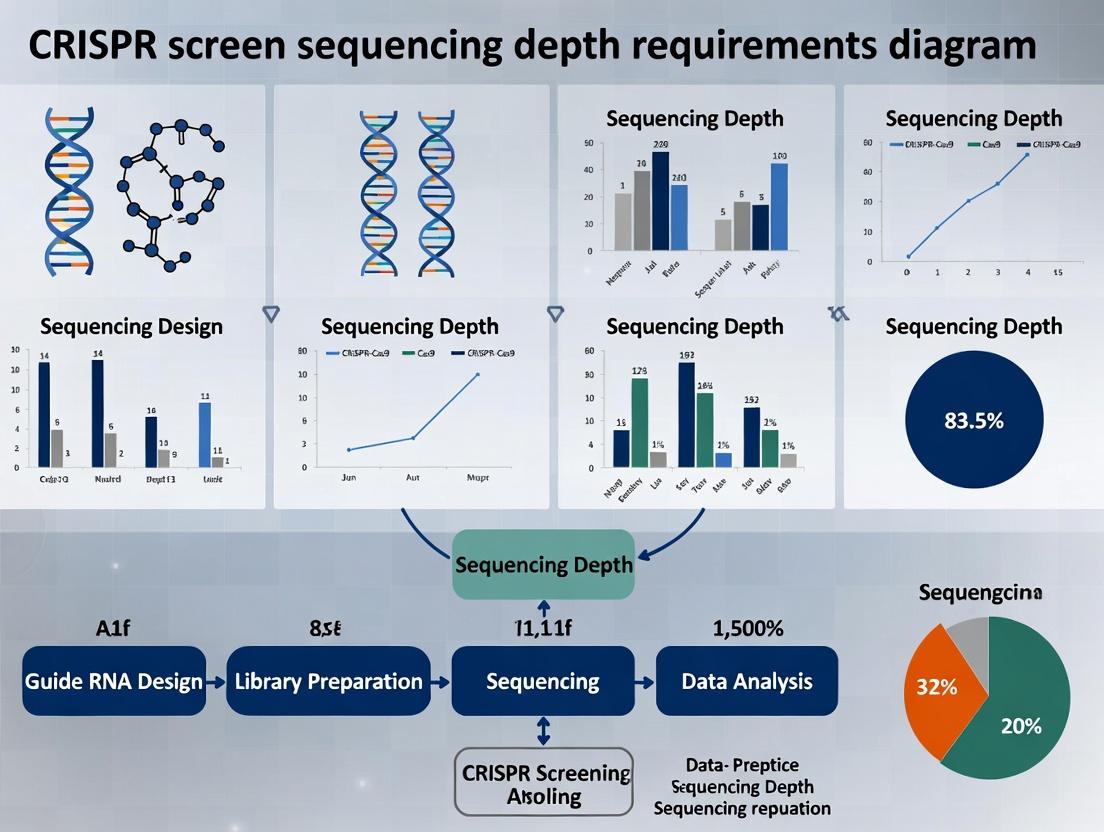
This comprehensive guide explores the critical role of sequencing depth in CRISPR screen success, tailored for researchers, scientists, and drug development professionals.
CRISPR Screen Sequencing Depth: A Complete Guide for Researchers in 2024
Abstract
This comprehensive guide explores the critical role of sequencing depth in CRISPR screen success, tailored for researchers, scientists, and drug development professionals. It covers foundational principles of how depth impacts sensitivity and dynamic range, methodological frameworks for determining requirements across various screen types (genome-wide, focused, pooled), common pitfalls and optimization strategies for cost-effective experimental design, and validation methods to ensure statistical rigor. The article synthesizes current best practices to empower confident experimental planning and robust, reproducible discovery.
Why Sequencing Depth is the Keystone of CRISPR Screen Sensitivity and Power
Troubleshooting Guides & FAQs
FAQ 1: Why is my CRISPR screen hit list inconsistent between replicates despite high reads per cell?
- Answer: High reads per cell (>50,000) can still yield inconsistent hits if the library coverage is insufficient. Reads per cell measures sequencing intensity on recovered cells, but library coverage refers to the probability that each single guide RNA (sgRNA) in your library is represented enough times across the total cell population. Inconsistent hits often stem from under-sampling the library diversity. The core issue is stochastic dropout of sgRNAs.
- Troubleshooting Protocol:
- Quantify Library Coverage: Calculate the ratio: (Number of Cells Transduced × Multiplicity of Infection (MOI)) / Total sgRNAs in Library. A minimum coverage of 500x is standard, with 1000x recommended for robust screens.
- Analyze sgRNA Dropout: Use FastQC or a custom script to count the number of sgRNAs with zero reads in your pre-selection plasmid library sequencing. >5% dropout indicates a library amplification or sequencing issue.
- Solution: Increase the total number of transduced cells for the screen to boost library coverage. For the current dataset, apply statistical filters (e.g., remove sgRNAs with counts <30 in the plasmid library).
FAQ 2: How do I determine the optimal reads per cell for a dropout screen versus an enrichment screen?
- Answer: Dropout screens (for essential genes) require higher reads per cell than enrichment screens (for resistance genes) due to the dynamic range of sgRNA depletion.
- Dropout Screen: Aim for 500-1,000 reads per cell. This ensures quantification of both highly depleted and neutrally scoring sgRNAs with low technical noise.
- Enrichment Screen: 200-500 reads per cell is often sufficient, as strong positive selectors produce highly enriched, easily detectable sgRNA clusters.
- Experimental Protocol for Empirical Testing:
- Perform a pilot screen using a control cell pool.
- Sequence the final timepoint at very high depth (>5000 reads/cell).
- Randomly subsample your sequencing data to 100, 200, 500, and 1000 reads per cell using a tool like
seqtk. - Calculate gene-level scores (e.g., MAGeCK RRA) at each depth level.
- Plot the number of significant hits (FDR < 0.1) against reads per cell. The point where the curve plateaus indicates the optimal depth.
FAQ 3: My reads per cell are adequate, but negative control sgRNAs show high variance. What's wrong?
- Answer: High variance in negative controls is typically a library preparation or early PCR amplification artifact, not a sequencing depth issue.
- Troubleshooting Protocol:
- Check PCR Cycles: Excessive PCR amplification during NGS library prep introduces stochastic bias. Limit cycles (typically 12-18) and use a high-fidelity polymerase.
- Verify sgRNA Representation: Sequence your plasmid library pool (pre-transduction). High variance here indicates problems with oligo synthesis, pooled cloning, or plasmid amplification.
- Standardized Purification: Ensure consistent use of SPRI bead-based size selection in all purification steps to avoid fragment size bias.
Table 1: Recommended Sequencing Depth Parameters for CRISPR Screens
| Screen Type | Minimum Reads per Cell | Recommended Reads per Cell | Minimum Library Coverage | Key Rationale |
|---|---|---|---|---|
| Genome-wide Dropout | 500 | 1,000 | 500x | Accurate quantification of severe to mild depletion phenotypes. |
| Focused Pool Dropout | 300 | 500 | 1000x | Higher coverage mitigates lower cell number. |
| Enrichment | 200 | 500 | 500x | Detect high-fold-change clones. |
| Paired in vitro / in vivo | 500 | 1,000 | 1000x | Account for bottleneck effects in in vivo arms. |
Table 2: Impact of Insufficient Metrics on Screen Outcomes
| Insufficient Metric | Primary Symptom | Effect on Hit List | Corrective Action |
|---|---|---|---|
| Low Reads per Cell | High false-negative rate for subtle phenotypes. | Misses moderately essential genes. | Increase sequencing depth; target recommended reads/cell. |
| Low Library Coverage | High false-positive/false-negative rate; poor replicate correlation. | Inconsistent, noisy hits. | Increase scale of cell transductions for the screen. |
| Both Low | Uninterpretable screen with no significant hits. | Complete failure. | Re-optimize from transduction step. |
Experimental Protocols
Protocol 1: Calculating Effective Library Coverage Objective: Determine if your screen scale ensures each sgRNA is adequately represented. Materials: Transduced cell pool, genomic DNA extraction kit, NGS platform. Steps:
- At the time of cell harvesting, count the total number of viable, transduced cells harvested for gDNA extraction.
- Extract gDNA and perform sgRNA library amplification with indexed PCR.
- Sequence the amplified library on a MiSeq or similar for rapid turnaround.
- Calculation: Effective Coverage = (Total Transduced Cell Count × MOI) / # of sgRNAs in Library.
- Example: 100 million cells × MOI of 0.3 / 50,000 sgRNAs = 600x coverage.
Protocol 2: Subsampling Analysis for Reads per Cell Optimization Objective: Empirically determine the point of diminishing returns for sequencing depth. Steps:
- Start with your final, deeply sequenced FASTQ file (e.g., >5000 reads/cell).
- Use bioinformatics tools (
seqtk,ustacks) to create randomly subsampled FASTQ files at target depths (e.g., 50, 100, 200, 500, 1000, 2000 reads/cell). - Align subsampled reads to your sgRNA library and generate count files.
- Perform your standard screen analysis pipeline (e.g., MAGeCK, BAGEL) on each count file.
- Plot the number of significant hits (e.g., genes with FDR < 0.1) against the reads per cell. The saturation point is your optimal depth.
Visualizations
Diagram 1: CRISPR Screen Sequencing Depth Decision Workflow
Diagram 2: Relationship Between Key Sequencing Depth Metrics
The Scientist's Toolkit: Research Reagent Solutions
| Item | Function in Context of Sequencing Depth |
|---|---|
| High-Complexity sgRNA Library Plasmid Pool | Provides the even, representative starting material essential for achieving high library coverage. Pre-sequencing QC is critical. |
| High-Fidelity PCR Master Mix (e.g., KAPA HiFi) | Minimizes amplification bias during NGS library prep, ensuring reads per cell accurately reflect original sgRNA abundance. |
| SPRIselect Beads | Used for consistent size selection and cleanup after PCR, preventing small fragment bias that distorts sgRNA count data. |
| Next-Generation Sequencer (Illumina NextSeq 2000) | Provides the high output required to achieve >500 reads/cell for genome-wide screens in a cost-effective run. |
| Cell Counter (e.g., Bio-Rad TC20) | Accurate cell counting during screen setup is non-negotiable for correctly calculating library coverage (cells transduced). |
| gDNA Extraction Kit (Large Scale) | Enables high-yield, pure genomic DNA extraction from millions of transduced cells, capturing the full library complexity. |
| MAGeCK or BAGEL Software | Computational tools that incorporate read count variance and library completeness into their statistical models for hit calling. |
Technical Support & Troubleshooting Center
FAQ: CRISPR Screen Sequencing Depth & Analysis
Q1: Our pilot screen showed high variance in sgRNA counts between replicates. What could be the cause, and how can we fix it? A: High variance often stems from insufficient sequencing depth. At low depths, sgRNAs with low abundance are sampled stochastically, leading to poor reproducibility. The core trade-off is that increasing depth for sensitivity (detecting weak hits) raises cost. First, calculate your current sampling saturation. A common fix is to increase the total read depth by 20-50% and ensure you are achieving a minimum of 500-1000 reads per sgRNA in the plasmid library control. Also, verify library preparation consistency by checking PCR cycle counts; excessive amplification (>18 cycles) can increase duplication rates and variance.
Q2: How do I determine the optimal sequencing depth to distinguish true hits from background in a genome-wide screen? A: This is a direct function of the sensitivity/dynamic range/cost trade-off. Use power analysis. You must define: 1) The desired effect size (e.g., log2 fold-change), 2) The acceptable false discovery rate (FDR), and 3) The screen's complexity (number of sgRNAs). For a typical 1000-gene screen with 5 sgRNAs/gene, aiming to detect a 2-fold change (|log2FC|>1) at 5% FDR often requires 50-100 million reads per sample for a human genome library. See Table 1.
Q3: We are on a tight budget. Can we reduce depth by using a smaller, focused library instead of a genome-wide one? A: Yes. This is a primary strategy to balance the trade-off. A targeted library (e.g., 500-1000 genes) directly reduces the required depth for equivalent sensitivity, as you allocate more reads per guide. For the same cost, you gain sensitivity for your genes of interest but lose genome-wide discovery potential. Always sequence your plasmid library to full saturation (≥1000x coverage) regardless of the experimental depth.
Q4: The dynamic range of our screen seems compressed; strong essential genes show less dropout than expected. A: This indicates saturation (over-sequencing) at the high-abundance end, which is less common but can waste resources. It can also point to a bottleneck in the experimental protocol, such as insufficient transduction efficiency or a low MOI. Troubleshoot by:
- Check the raw count distribution. If the majority of sgRNAs are at very high counts, consider diluting the library before sequencing.
- Re-analyze, capping the maximum count per sgRNA (e.g., at the 99th percentile).
- Experimentally, ensure cell coverage is >500x (cells per sgRNA) to prevent bottleneck effects during infection.
Experimental Protocol: Sequencing Depth Power Analysis
Objective: To empirically determine the required sequencing depth for a planned CRISPR knockout screen.
Materials:
- Pre-validated sgRNA plasmid library.
- NGS platform (e.g., Illumina NovaSeq).
- Computational resources (e.g., R with
MAGeCKorCRISPRanalyzeRpackages).
Methodology:
- Pilot Sequencing: Sequence your plasmid library at very high depth (e.g., 200 million reads). This serves as your "saturated" reference.
- Subsampling Simulation: Use bioinformatics tools to randomly subsample your sequencing data to lower depths (e.g., 10M, 30M, 50M, 100M reads).
- Hit Calling: At each subsampled depth, run your standard analysis pipeline to identify essential genes (compared to the saturated reference).
- Power Calculation: At each depth, plot the number of detected essential genes (sensitivity) and the precision (agreement with saturated reference). The point where the curve plateaus is the optimal depth for your library size.
- Cost-Benefit Analysis: Layer on the cost per million reads to visualize the sensitivity-cost trade-off.
Table 1: Sequencing Depth Guidelines for CRISPR Knockout Screens
| Library Size (Genes) | sgRNAs | Recommended Depth (Reads/Sample) | Primary Trade-off Consideration |
|---|---|---|---|
| Genome-wide (~20,000) | ~100,000 | 50 - 100 Million | Cost vs. Sensitivity: High cost for whole-genome sensitivity. |
| Focused (~1,000) | ~5,000 | 10 - 25 Million | Optimized: Good sensitivity for targeted genes at lower cost. |
| Mini-pool (~100) | ~500 | 5 - 10 Million | Dynamic Range: Enables very deep sampling per guide for subtle phenotypes. |
| Plasmid Library (Control) | Any | Sequence to Saturation (>1000x) | Baseline Accuracy: Critical for accurate normalization. |
Title: Workflow for Balancing Sequencing Depth Trade-offs
Title: The Core Trade-off Triangle
The Scientist's Toolkit: Research Reagent Solutions
| Item | Function in CRISPR Screen Depth Optimization |
|---|---|
| Validated Genome-wide sgRNA Library (e.g., Brunello, Brie) | Pre-designed, high-quality pooled libraries ensure on-target activity and minimal off-target effects, providing a reliable baseline for depth calculations. |
| Next-Generation Sequencing (NGS) Kit (e.g., Illumina Nextera XT) | Prepares the amplified sgRNA pool for sequencing. The uniformity of library preparation impacts variance and effective depth. |
| PCR Amplification Reagents (High-Fidelity Polymerase) | Used to amplify the sgRNA insert from genomic DNA for sequencing. Minimal PCR bias is critical for maintaining true representation. |
| Deep Sequencing Platform (e.g., Illumina NovaSeq S4 Flow Cell) | Provides the ultra-high read depth required for genome-wide screens, directly addressing the sensitivity vs. cost variable. |
| Magnetic Beads for Size Selection (e.g., SPRIselect) | Cleans and size-selects the sequencing library, removing adapter dimers and primers that waste sequencing reads. |
| Cell Counter & High-Viability Cells | Accurate cell counting ensures sufficient representation (500-1000 cells per sgRNA) to prevent stochastic bottleneck effects that distort dynamic range. |
| Puromycin or Other Selection Antibiotic | Selects for successfully transduced cells, maintaining library representation before sequencing sample collection. |
| Genomic DNA Extraction Kit (High-Yield) | Recovers maximum gDNA from screened cells; low yield leads to loss of sgRNA representation and increased noise. |
Technical Support Center: Troubleshooting CRISPR Screen Sequencing Depth
Frequently Asked Questions (FAQs)
Q1: My negative control (e.g., non-targeting sgRNAs) distribution does not appear normal, and essential genes are not clearly depleted. What is wrong? A: This often indicates insufficient sequencing depth. At low depth, sampling noise dominates, obscuring the true biological signal. Calculate the coefficient of variation (CV) for negative controls; a high CV (>0.5) suggests a need for more reads. Ensure you have at least 500-1000 reads per sgRNA in your plasmid library for reliable detection post-selection. For a typical 10-guide-per-gene library, aim for a minimum of 5 million reads per sample for genome-wide screens to confidently call essential genes.
Q2: How do I determine if my screen is deep enough to identify genes with subtle fitness effects (phenotypes)?
A: Use power analysis simulations prior to the experiment. Input your desired effect size (e.g., log2(fold change) = -0.5), the number of sgRNAs per gene, expected variance, and your available replicate structure. The CRISPRpower R package can perform this. Post-hoc, if the log2 fold change distribution for negative controls is wide, subtle hits will be indistinguishable from noise. See Table 1 for depth recommendations.
Q3: I am missing known essential genes in my hit list from a viability screen. What are the primary depth-related causes? A: 1. Dropout: Low sequencing depth leads to some sgRNAs receiving zero counts, falsely inflating the gene's fitness score. Apply a minimum count filter (e.g., ≥ 30 reads per sgRNA).
- Saturation: Extreme depletion may cause essential gene sgRNA counts to fall below the detection limit, making precise quantification impossible. Include early time points (e.g., Day 0 or Day 3) to capture initial representation before complete dropout.
Q4: How does sequencing depth requirement change for different screen types (e.g., viability vs. transcriptional reporter)? A: Screens measuring subtle shifts (e.g., FACS-based transcriptional reporter, drug resistance with low dose) require significantly greater depth than viability screens with strong depletion. The dynamic range of the phenotype dictates depth. See Table 2 for comparisons.
Troubleshooting Guides
Issue: High False Positive Rate in Hit Calling Symptoms: Many genes with modest p-values but small effect sizes; poor reproducibility between replicates. Diagnosis & Solution:
- Check Depth per sgRNA: Calculate the median read count per sgRNA in your control sample (e.g., T0). If below 100, increase sequencing depth in future runs.
- Increase Replicates: For subtle phenotypes, biological replicates are more effective than extreme depth alone for reducing false positives.
- Adjust Analysis: Use robust statistical models (e.g., DESeq2, edgeR) that account for count-based noise, not simple Z-scores.
Issue: Inconsistent Hit Lists Between Technical Replicates of the Same Sample Symptoms: When sequencing the same library prep twice, the ranked gene lists show poor correlation. Diagnosis & Solution: This is a clear sign of undersampling. Perform deeper sequencing. As a rule of thumb, the total read count should be 1000 times the number of sgRNAs in the library. For a 100,000 sgRNA library, target 100 million reads per sample.
Table 1: Recommended Sequencing Depth for CRISPR Knockout Screens
| Screen Goal | Minimum Read Depth per sgRNA (Control Sample) | Minimum Total Reads (for 100k sgRNA library) | Key Rationale | ||
|---|---|---|---|---|---|
| Core Essential Gene Discovery | 50 - 100 | 5 - 10 million | Strong phenotype allows detection despite higher noise. | ||
| Confident Hit Calling (Robust Phenotypes) | 200 - 300 | 20 - 30 million | Balances cost with reliable identification of genes with moderate effects. | ||
| Detection of Subtle Fitness Effects | 500 - 1000+ | 50 - 100+ million | Reduces Poisson noise to discern small log2 fold changes (e.g., | 0.5 | ). |
| FACS-Based Enrichment (Top/Bottom 10%) | 300 - 500 | 30 - 50 million | Requires precision at both high and low abundance extremes. |
Table 2: Impact of Depth on Key Screen Metrics
| Sequencing Depth (Reads per sgRNA) | CV of Negative Controls | Effect Size Detection Limit (log2 FC) | False Discovery Rate at p<0.05 | ||
|---|---|---|---|---|---|
| ~50 | High (>0.8) | > | 1.0 | >15% | |
| ~200 | Moderate (~0.4) | > | 0.7 | ~5% | |
| ~500 | Low (<0.2) | > | 0.3 | <1% |
CV: Coefficient of Variation; FC: Fold Change
Experimental Protocols
Protocol: Empirical Determination of Optimal Sequencing Depth Purpose: To retrospectively determine if your achieved sequencing depth was adequate. Steps:
- Subsampling: From your final aligned read count file (e.g., .bam or count table), use
seqtkor a custom R script to randomly subsample reads at fractions (e.g., 10%, 25%, 50%, 75% of total). - Re-analysis: Re-run your primary hit-calling pipeline (e.g., MAGeCK, BAGEL) on each subsampled dataset.
- Metric Calculation: For each depth level, calculate:
- The number of recovered known essential genes (from common sets like Hart2015 or DepMap).
- The Jaccard index of hit lists (FDR<0.05) between the subsampled and full dataset.
- The correlation of gene-level scores (e.g., beta scores) with the full dataset.
- Saturation Plotting: Plot the metrics from Step 3 against sequencing depth. The point where the curves plateau indicates sufficient depth.
Protocol: Power Analysis for Screen Design Using CRISPRpower Purpose: To prospectively estimate required depth and replicates. Steps:
- Install R Package:
if (!require("BiocManager", quietly = TRUE)) install.packages("BiocManager") BiocManager::install("CRISPRpower") - Define Parameters: Estimate your expected effect size (delta), biological variation (sigma), guides per gene (m), and desired power (e.g., 0.8).
- Run Simulation: Use the
powerCalfunction to model power across a range of read depths (N). - Interpret Output: The function returns a table and plot. Select the depth where power reaches an acceptable threshold (e.g., >80%) for your target effect size.
Visualizations
Title: Sequencing Depth Sufficiency Workflow
Title: Phenotype Strength vs. Required Sequencing Depth
The Scientist's Toolkit: Research Reagent Solutions
| Item | Function in Depth Optimization |
|---|---|
| High-Complexity sgRNA Library (e.g., Brunello, Brie) | Minimizes guide redundancy; requires higher depth for full coverage but reduces false positives from poor guides. |
| PCR Amplification Kit with Low Bias (e.g., KAPA HiFi) | Ensures equitable amplification of all sgRNA templates during library prep, preventing skew from amplification artifacts. |
| Sequencing Spike-in Controls (e.g., ERCC RNA Spike-in Mix) | Added before PCR to monitor and correct for technical variability and amplification bias across samples. |
| Magnetic Beads for Size Selection (e.g., SPRIselect) | Precise size selection of the final sequencing library is critical to remove adapter dimer and ensure high-quality, clusterable fragments. |
| Dual-Indexed Sequencing Adapters | Allow high-level multiplexing (e.g., 96+ samples) without index hopping, enabling cost-effective deep sequencing of many samples. |
| Cell Line with Defined Essential Genes (e.g., K562, HeLa) | Used as a positive control to empirically test depth requirements and benchmark screen performance. |
Welcome to the Technical Support Center for CRISPR Screen Sequencing Depth. This resource provides troubleshooting guidance and FAQs directly informed by ongoing research into depth requirements.
Frequently Asked Questions (FAQs) & Troubleshooting
Q1: My screen showed excellent hit reproducibility but poor statistical significance (high p-values). What went wrong?
- A: This typically indicates insufficient sequencing depth. While you can detect the top hits, the read counts for mid- to low-effect sgRNAs are too low for robust statistical modeling. This is often seen in large libraries or when using complex phenotypes with continuous scores. Increase depth in your replicate experiments.
Q2: How do I calculate the required depth for a new cell type or phenotype?
- A: Start with a pilot "saturation screen." Sequence your initial screen at very high depth (e.g., >1000x per sgRNA). Then, computationally downsample the sequencing data to simulate lower depths (e.g., 50x, 100x, 200x). Analyze how the identification of known essential genes degrades with lower depth to establish your minimum threshold.
Q3: We pooled two cell populations with different genotypes for screening. Do we need to double the sequencing depth?
- A: Not necessarily double, but you must account for the screened population complexity. Depth should be calculated per population. If you require 500x per sgRNA per population and have two equally mixed populations, you need ~1000x overall to ensure each population's library is covered at 500x. Uneven mixing requires adjustment.
Q4: For a dropout screen (e.g., cell fitness), how does library size directly impact my depth needs?
- A: Library size is the primary driver. The total number of reads required is: (Desired Coverage per sgRNA) x (Total Number of sgRNAs in Library). For a constant coverage goal, a larger library linearly increases total sequencing needs.
Data Summary Tables
Table 1: Recommended Minimum Sequencing Depth Guidelines (Per sgRNA)
| Screening Phenotype | Library Size (sgRNAs) | Screened Population Complexity | Recommended Minimum Depth (Reads per sgRNA) | Key Rationale |
|---|---|---|---|---|
| Strong Dropout (Fitness) | 1,000 - 5,000 | Low (Clonal, in vitro) | 200 - 500 | High signal-to-noise allows lower depth. |
| Strong Dropout (Fitness) | >50,000 (Genome-wide) | Low (Clonal, in vitro) | 500 - 1000 | Ensures coverage of all guides in large pool. |
| Complex Phenotype (FACS, NGS) | Any Size | Low | 500 - 1500+ | Requires precise sgRNA abundance quantitation for binning. |
| Any Phenotype | Any Size | High (e.g., In vivo, pooled patient cells) | 1000 - 3000+ | Accounts for population bottlenecks and high biological variance. |
Table 2: Impact of Factors on Depth Requirements
| Factor | Effect on Depth Requirement | Experimental Mitigation Strategy |
|---|---|---|
| Increased Library Size | Linear Increase | Use focused, hypothesis-driven sublibraries. |
| Increased Population Complexity/Diversity | Exponential Increase | Include sample barcodes, increase biological replicates. |
| Decreased Phenotype Effect Size | Exponential Increase | Optimize assay window, use positive/negative controls. |
| Higher Variance in Assay | Significant Increase | Improve protocol uniformity, increase replicate number. |
Experimental Protocols
Protocol 1: Sequencing Depth Saturation Analysis (In silico Downsampling)
- Perform Screen & Deep Sequencing: Conduct your CRISPR screen as planned. Sequence the plasmid library (initial timepoint, T0) and final sample (Tf) at extremely high depth (>1000x per sgRNA).
- Data Processing: Align reads to your sgRNA library. Count reads per sgRNA for T0 and Tf.
- Downsampling: Using a tool like
seqtkor custom R/Python scripts, randomly subsample your sequencing files to 10%, 20%, 30%, ... up to 100% of total reads. - Analysis at Each Depth: For each downsampled set, calculate fold-changes (e.g., log2(Tf/T0)) and perform hit calling (e.g., using MAGeCK or RRA).
- Determine Saturation Point: Plot the number of identified significant hits (e.g., FDR < 0.05) against sequencing depth. The point where the curve plateaus is the minimal sufficient depth.
Protocol 2: Accounting for Population Complexity via Barcoding
- Library Design: Integrate a unique 8-10bp sample barcode into the sgRNA amplification primers for each distinct cell population or replicate.
- Pooling & Screening: Pool barcoded populations before transfection/transduction. Subject the pooled mix to the screening process.
- Sequencing & Demultiplexing: Perform deep sequencing. Demultiplex reads first by sample barcode, then map the sgRNA portion.
- Depth Calculation: Ensure calculated depth (reads per sgRNA) is met for each sample barcode group independently in your analysis.
Visualizations
Title: Determining Optimal Depth via Saturation Analysis
Title: Three Key Factors Affecting Depth Needs
The Scientist's Toolkit: Research Reagent Solutions
| Item | Function & Role in Depth Optimization |
|---|---|
| NGS Sample Barcoding Primers | Enables multiplexing of multiple cell populations or replicates in one sequencing run, allowing direct per-population depth assessment. |
| Ultra-High Fidelity PCR Mix | Critical for accurate amplification of sgRNA library pre-sequencing with minimal bias, ensuring read counts reflect true abundance. |
| SPRIselect Beads | For precise size selection and cleanup of sequencing libraries, removing adapter dimers that waste sequencing reads. |
| Validated Genome-wide sgRNA Library | Pre-designed libraries (e.g., Brunello, Brie) provide known coverage requirements and positive control genes for quality control. |
| Cell Line Barcodes (Lentiviral) | For tracking clonal diversity and population bottlenecks in long-term or in vivo screens via pre-labeled cell pools. |
| Commercial Deep Seq Kit | Provides the ultra-high read output required for genome-wide screens at >500x coverage (e.g., Illumina NovaSeq kits). |
Technical Support Center for CRISPR Screen Sequencing Depth
This support center provides troubleshooting and FAQs for researchers conducting CRISPR knockout or perturbation screens, framed within ongoing research into optimal sequencing depth requirements.
Frequently Asked Questions (FAQs)
Q1: How do I know if my pilot screen has reached sufficient sequencing saturation to call hits confidently? A: Saturation is achieved when the discovery of new true-positive guide RNAs (gRNAs) plateaus. A common diagnostic is to plot the number of significantly enriched or depleted genes (e.g., FDR < 0.1) against the total number of sequenced reads (or per-sample read depth) using down-sampling. When the curve flattens, additional sequencing yields diminishing returns. Target a minimum of 500-1000 reads per gRNA in the initial plasmid library for pilot studies.
Q2: My negative control genes show high variance at high read depths. Is this over-sequencing? A: Yes, this can be a sign of technical noise amplification. Beyond a certain point, increasing depth does not improve the signal-to-noise ratio for essential genes and can inflate false positives from off-target effects or sequencing errors. Refer to Table 1 for benchmarks. Ensure your analysis pipeline includes robust normalization (e.g., median ratio, housekeeping gene normalization) to mitigate this.
Q3: At what depth do replication and biological replicates become more critical than simply adding more reads? A: Empirical studies indicate that for most immortalized cell line screens, increasing biological replicates (n=3 to 4) provides greater power for hit confirmation than pushing per-sample depth beyond 50-100 million reads per replicate for a typical 1000-gene library. After ~500 reads/gRNA, invest resources in replication.
Q4: How does library complexity (number of gRNAs/gene) interact with required sequencing depth? A: Higher library complexity (e.g., 10 gRNAs/gene vs. 4) requires greater total depth to maintain per-gRNA coverage. However, it improves statistical confidence and reduces false positives from outlier gRNAs. The saturation point for hit discovery is later for complex libraries, but the per-gRNA depth requirement may be similar.
Troubleshooting Guides
Issue: Diminishing Returns in Hit Discovery Symptom: Adding 20% more reads results in <2% more significant hits. Diagnosis: Likely approaching or at saturation. Solution:
- Perform down-sampling analysis on your current data.
- Generate a discovery curve (see Diagram 1).
- If the curve is flat, re-allocate sequencing funds to biological or technical replicates for validation.
Issue: Increased False Positives at Ultra-High Depth Symptom: Non-targeting control gRNAs show pseudo-signals in some samples at very high depth. Diagnosis: Technical noise and batch effects are being amplified. Solution:
- Re-process raw data with stringent quality trimming and deduplication.
- Apply a more conservative false discovery rate (FDR) correction (e.g., Benjamini-Yekutieli).
- Implement a read-count threshold cap based on your down-sampling analysis.
Data Presentation
Table 1: Empirical Benchmarks for Saturation in Typical Genome-Wide CRISPR-KO Screens
| Cell Line Type | Recommended Minimum Reads/gRNA | Typical Saturation Point (Reads/gRNA) | Key Indicator of Oversedencing |
|---|---|---|---|
| Immortalized (e.g., K562) | 200-300 | 500-800 | Noise in non-targeting controls increases |
| Primary/Cellular Model | 300-500 | 800-1200 | High variance among replicate samples |
| In Vivo / Complex Pool | 500-1000 | 1500+ | Dropout of slow-depleting gRNAs |
Table 2: Comparative Analysis: Depth vs. Replicates (Fixed Budget Simulation)
| Strategy | Total Reads | Replicates | Depth/Rep | Genes Detected (FDR<0.1) | Confidence (p-value stability) |
|---|---|---|---|---|---|
| Depth-Focused | 400M | 2 | 200M | 850 | Low-Medium |
| Replicate-Focused | 400M | 4 | 100M | 820 | High |
| Balanced | 400M | 3 | ~133M | 840 | Medium-High |
Experimental Protocols
Protocol: Down-Sampling Analysis to Determine Saturation Point
- Input: Aligned read count matrix (samples x gRNAs).
- Subsampling: Using a tool like
seqtkor custom R/Python scripts, randomly subsample your raw sequencing files to 10%, 20%, 30%, ..., 100% of total reads. Generate 5-10 count matrices at each depth. - Analysis: For each matrix, run your standard screen analysis pipeline (e.g., MAGeCK, BAGEL2) to identify significantly enriched/depleted genes.
- Plotting: For each depth, calculate the mean number of significant genes. Plot "Mean Number of Significant Genes (FDR < 0.1)" vs. "Total Sequenced Reads (Millions)."
- Interpretation: Identify the "knee" or plateau point where adding 10% more reads yields <5% more genes. This is your practical saturation depth.
Protocol: Assessing Technical Noise Amplification
- Select Controls: Isolate read counts for non-targeting control (NTC) gRNAs and core essential genes (e.g., from Hart et al. list).
- Calculate Metrics: At each down-sampled depth, calculate the coefficient of variation (CV) for NTCs across replicates and the log-fold-change variance for essential genes.
- Plot: Create a line plot with "Sequencing Depth" on the X-axis and two Y-axes: "CV of NTCs" and "Variance of Essential Gene LFC."
- Threshold: Identify the depth where these noise metrics begin a sharp, linear increase. Optimal depth is typically just before this inflection.
Diagrams
Diagram 1: Saturation Analysis via Down-Sampling Workflow
Diagram 2: Key Factors Influencing Sequencing Depth Requirements
The Scientist's Toolkit: Research Reagent Solutions
| Item | Function in CRISPR Screen Depth Optimization |
|---|---|
| Validated Genome-Wide gRNA Library (e.g., Brunello, Brie) | Standardized, high-complexity library ensures even representation, reducing depth wasted on poorly designed gRNAs. |
| High-Fidelity PCR Polymerase (e.g., KAPA HiFi) | Minimizes PCR duplication artifacts during library prep, ensuring reads represent unique molecules and accurate complexity. |
| Next-Generation Sequencing Spike-in Controls (e.g., PhiX, ERCC RNA) | Monitors sequencing run performance and can help normalize inter-run variation in ultra-deep sequencing. |
| Cell Line-Specific Core Essential Gene Set | Provides a positive control to gauge screen quality and signal strength at different sequencing depths. |
| Non-Targeting Control (NTC) gRNA Pool | Critical for modeling background noise distribution and determining false discovery rates at varying depths. |
| Dual-Matched Indexed Sequencing Adapters | Enables high-level multiplexing without index hopping, allowing cost-effective sequencing of many replicates to deconvolute depth vs. replicate effects. |
| CRISPR Screen Analysis Software (MAGeCK, BAGEL2, CRISPRcleanR) | Includes algorithms for normalization and quality control that are sensitive to read depth, helping diagnose saturation. |
Calculating Your CRISPR Screen Depth: Formulas and Frameworks for Every Screen Type
Welcome to the CRISPR Screen Sequencing Depth Support Center. This guide helps researchers choose between heuristic and statistical methods for determining sequencing depth in pooled CRISPR screens, framed within our ongoing thesis research on optimal depth requirements.
Troubleshooting Guides & FAQs
Q1: My negative control guides show high variance, making hit calling unreliable. Could this be due to insufficient sequencing depth? A: Yes. Inadequate depth leads to high technical noise, obscuring true biological signals. A formal power analysis, rather than a rule of thumb, is recommended here. First, calculate the coefficient of variation (CV) of read counts in your negative control (e.g., non-targeting sgRNAs) across replicates. If the CV > 0.5, increase depth. Protocol: 1) Extract raw read counts for negative controls. 2) Calculate mean and standard deviation per sgRNA across replicates. 3) Compute CV (SD/mean). 4) If CV is high, use the following formula from our power analysis to estimate required depth: N_new = N_old * (CV_desired² / CV_observed²).
Q2: I used a common rule of thumb (500 reads per sgRNA). My essential gene negative controls are not clearly depleted. What should I do? A: The "500 reads/sgRNA" heuristic often fails for large library screens or when effect sizes are subtle. Perform an in-silico subsampling analysis to diagnose. Protocol: 1) Start with your full dataset. 2) Randomly subsample 10%, 25%, 50%, and 75% of reads from each sgRNA's count data. 3) Re-run your primary analysis (e.g., MAGeCK or BAGEL2) at each depth. 4) Plot the F1-score or true positive rate for known essential genes against sequencing depth. The point where the curve plateaus indicates sufficient depth.
Q3: How do I perform a formal power analysis before starting a new screen to justify my sequencing budget?
A: Use a simulation-based approach powered by pilot data or public datasets. Protocol: 1) Obtain a relevant count matrix from a prior similar screen. 2) Define parameters: desired effect size (e.g., log2 fold change of -2 for essential genes), false discovery rate (FDR, e.g., 5%), and statistical power (e.g., 80%). 3) Use the CRISPRpower R package to simulate counts at varying depths. 4) Fit a power curve to identify the depth where power reaches 80%.
Q4: What are the key differences in outcomes when using a rule of thumb versus a formal power analysis? A: As summarized in our thesis research, the key differences are:
| Aspect | Rule of Thumb (e.g., 500x) | Formal Power Analysis |
|---|---|---|
| Basis | Historical precedent, convenience | Statistical parameters, pilot data |
| Cost Efficiency | Potentially wasteful or inadequate | Optimized for specific goals |
| Hit Detection | Inconsistent for weak effect sizes | Reliable for pre-defined effect sizes |
| Reproducibility Risk | Higher | Lower |
| Best For | Preliminary, exploratory screens | Definitive, high-stakes screens |
Experimental Protocols
Protocol 1:In-silicoSubsampling for Depth Sufficiency Check
- Input: Aligned BAM files or final sgRNA count table.
- Tool: Use
seqtkfor read subsampling from BAMs or custom R/Python script for count tables. - Method: For each target depth (e.g., 50x, 100x, 200x, 500x), generate 5 subsampled replicates.
- Analysis: Process each subsampled set through your standard analysis pipeline (e.g., MAGeCK RRA).
- Evaluation: Calculate the recovery rate of a gold-standard gene set (e.g., core essential genes from DepMap). Plot recovery rate vs. depth.
Protocol 2: Simulation-Based Power Analysis Using CRISPRpower
- Installation: In R, run
BiocManager::install("CRISPRpower"). - Load Data: Load a reference count matrix (
ref.counts). Set Parameters:
Run Simulation: Use
simulatePower()function, specifying negative binomial distribution parameters fit toref.counts.- Output: The function returns a table of power estimates per depth/effect size. Identify the depth where power crosses 80% for your target effect size.
Visualizations
Title: Decision Workflow: Power Analysis vs. Heuristic
Title: Impact Cascade of Low Sequencing Depth
The Scientist's Toolkit: Research Reagent Solutions
| Item | Function in CRISPR Screen Depth Research |
|---|---|
| NGS Library Prep Kit (e.g., Illumina) | Prepares the pooled sgRNA amplicon library for sequencing. Critical for avoiding PCR bias that skews depth calculations. |
| Validated sgRNA Library Plasmid Pool | The starting material. Deep sequencing of the plasmid pool provides the true reference distribution for power analysis. |
| Cell Line with High-Efficiency Transduction | Ensures high representation of the library in vivo, minimizing dropouts not related to sequencing depth. |
| Next-Generation Sequencer | Platform (e.g., NovaSeq, NextSeq) dictates read output, cost, and lane sharing options, directly impacting depth strategy. |
| Barcode Demultiplexing Software | Accurately assigns reads to samples. Errors here cause misestimation of per-sample depth. |
| sgRNA Read-Counting Pipeline (e.g., MAGeCK count) | Converts raw FASTQ files to sgRNA count tables. Robust alignment is non-negotiable for depth assessment. |
| Statistical Power Software (e.g., R/CRISPRpower) | Enables formal power and sample size calculations based on pilot data distributions. |
| Synthetic Control sgRNA Spikes | Sequences spiked-in at known ratios to empirically measure technical noise and accuracy at different depths. |
Troubleshooting Guides & FAQs
General Sequencing Depth & Power
Q1: My screen shows no hits at my calculated read depth. Did I under-sequence? A: Not necessarily. First, verify your negative control sgRNA distribution. Use the table below to diagnose:
| Symptom | Potential Cause | Diagnostic Check | Recommended Action |
|---|---|---|---|
| No significant hits | Low biological effect | Check positive control sgRNA depletion | Increase screen effect size (e.g., longer timepoint, higher dose) |
| Overly stringent FDR correction | Analyze with different FDR methods (BH, STARS) | Use pre-ranked GSEA on sgRNA log2 fold changes | |
| Insufficient replication | Calculate power for n=1 vs. n=3 | Add biological replicates; pool reads if needed | |
| High hit count in negative controls | Contamination or sgRNA misassignment | Check raw count correlation between controls | Re-process FASTQs with stricter barcode filter |
Protocol: Diagnostic Power Re-Calculation
- Using your raw count matrix, calculate the log2 fold change (LFC) for each sgRNA relative to the T0 plasmid or control sample.
- For a set of known negative control sgRNAs, calculate the standard deviation (σ) of their LFCs.
- Plug σ, your desired effect size (Δ, e.g., |LFC| > 1), and your per-guide read depth into a power formula (e.g.,
pwr.t.test) to estimate achieved power. - If power < 0.8, the depth was likely insufficient for the observed variability.
Q2: How do I adjust read depth when using multiple sgRNAs per gene versus fewer, highly active guides? A: The required depth depends on the screening paradigm. See the comparison:
| Screening Design | Guides/Gene | Key Consideration | Depth Adjustment Factor (Relative to 3 guides/gene) |
|---|---|---|---|
| Genome-wide (Brunello) | 4-6 | Redundancy mitigates dropouts | Baseline (1x) |
| Focused Library | 3-4 | Higher per-guide confidence | ~0.8x (slight decrease possible) |
| Saturation (tiling) | >10 | Identifies functional domains | 2-3x (due to massive library size) |
| High-activity (e.g., Calabrese) | 2-3 | Increased on-target efficacy | ~0.7x (fewer guides needed for same effect) |
Data Analysis & Statistical Issues
Q3: My read count distribution is highly uneven, with some sgRNAs having zero counts. How does this impact power? A: This is a "dropout" event and severely reduces effective power. Follow this protocol to assess and correct.
Protocol: Handling sgRNA Dropouts
- Pre-Sequencing: Use the MAGeCK Robust algorithm in library design to minimize oligonucleotide heterogeneity.
- Post-Sequencing: Generate a read count distribution table.
Percentile of sgRNAs Min Read Count Action Bottom 5% 0-10 Flag as potential dropouts; consider imputation if <5% of library. 5th - 25th 10-50 Check for sequence biases (GC content, hairpins). Median 50-200 Acceptable range. Top 5% >10,000 May indicate PCR duplication; consider down-sampling. - Analysis: Use count models (e.g., in MAGeCK or CRISPRcleanR) that account for zero-inflation and variance stabilization.
Q4: For pooled in vivo screens, how do I factor in the bottleneck effect into depth calculations? A: In vivo bottlenecks add massive variability. You must sequence deeply enough to detect clones that survive the bottleneck. The key is oversampling.
Protocol: In Vivo Depth Calculation
- Estimate the effective cell population size (N) at the time of harvest. This is often the bottleneck size.
- Set a detection threshold (e.g., you want to detect a clone that is 0.1% of the population).
- Calculate minimum required reads per sample:
Reads > (N / [Clone Fraction]) * (1 / [Capture Efficiency]). A safety multiplier of 10-100x is common. Example: N=1e6 cells, detect 0.1% clone, 50% capture efficiency: Reads > (1e6 / 1000) * 2 = 2,000 reads per clone. For a 1,000-gene library, this implies >2 million reads per sample.
Experimental Design
Q5: I have limited budget. Should I prioritize deeper sequencing of one replicate or add more biological replicates at lower depth? A: Replicates provide more power than depth beyond a certain point. Use this decision framework:
(Diagram Title: Decision Tree: Sequencing Depth vs. Replicates)
The Scientist's Toolkit: Research Reagent Solutions
| Item | Function in CRISPR Screen Depth Optimization |
|---|---|
| High-Complexity sgRNA Library (e.g., Brunello, Calabrese) | Pre-optimized guide sets minimize dropouts and uneven representation, reducing required sequencing oversampling. |
| Next-Gen Sequencing Spike-in Controls (e.g., ERCC RNA Spike-In Mix) | Added to samples pre-PCR to technically monitor sequencing saturation and accurately quantify library complexity. |
| PCR Clean-up Beads (e.g., AMPure XP) | Critical for precise size selection post-amplification to maintain library balance and prevent over-amplification of short fragments. |
| Cell Viability Stain (e.g., Propidium Iodide) | Accurate determination of viable cell count pre-harvest is essential for calculating MOI and final coverage calculations. |
| Digital Droplet PCR (ddPCR) | For absolute quantification of library plasmid pool titer and viral vector titer, ensuring accurate MOI and representation. |
| Variance-Stabilizing Software (CRISPRcleanR, BAGEL2) | Computational tools that normalize count data, reducing technical noise and thereby lowering the read depth needed for signal detection. |
Workflow Diagram: Integrating Power Analysis into Experimental Design
(Diagram Title: Power-Based Read Depth Calculation Workflow)
Depth Requirements for Genome-Wide CRISPR-KO Screens (e.g., Brunello, GeCKO)
Technical Support Center
FAQs & Troubleshooting
Q1: What is the minimum recommended sequencing depth per sample for a genome-wide CRISPR-KO screen? A: The minimum depth depends on screen type and library size. For a typical human genome-wide library (e.g., Brunello ~77k sgRNAs), a minimum of 200-300 reads per sgRNA is often cited. This translates to ~20 million reads per sample for good coverage. Screens with higher replicate counts or more complex phenotypes may require greater depth.
Q2: My screen shows poor gene hit reproducibility between replicates. Could low sequencing depth be the cause? A: Yes. Insufficient depth leads to high sampling noise and poor sgRNA count reproducibility. Ensure your median read count per sgRNA is well above the minimum. For critical screens, aim for 500-1000x coverage per sgRNA, especially for negative selection screens where dropout signals are subtle.
Q3: How do I calculate the required sequencing depth for my specific CRISPR library?
A: Use this general formula:
Total Reads Required = (Number of sgRNAs in Library) × (Desired Coverage per sgRNA) × (Design Factor)
Where the Design Factor accounts for PCR duplication and uneven representation (typically 1.5-2). See the table below for common libraries.
Q4: A subset of sgRNAs has consistently zero counts across all samples. Is this a sequencing issue? A: Not necessarily. First, check if these sgRNAs are represented in your plasmid library by sequencing it. Zero counts in experimental samples can indicate strong negative selection or poor sgRNA activity. However, extremely low overall sequencing depth can fail to detect low-abundance sgRNAs.
Q5: How does phenotype (positive vs. negative selection) influence depth requirements? A: Negative selection screens (e.g., essential gene identification) require significantly higher depth. Weak growth defects cause slow sgRNA dropout, which is only discernible with high count precision at early time points. Positive selection screens (e.g., drug resistance) often require less depth, as enriched sgRNAs become highly abundant.
Table 1: Recommended Sequencing Depth for Common Genome-Wide CRISPR-KO Libraries
| Library (Human) | Approx. sgRNAs | Minimum Reads per Sample (200x coverage) | Recommended Reads per Sample (500x coverage) | Key Reference |
|---|---|---|---|---|
| Brunello | 77,441 | ~15.5M | ~38.7M | Doench et al., 2016 |
| GeCKOv2 (A+B) | 123,411 | ~24.7M | ~61.7M | Sanjana et al., 2014 |
| TorontoKO (TKOv3) | 70,948 | ~14.2M | ~35.5M | Hart et al., 2017 |
| Design Factor Multiplier | x1.5 to x2 | x1.5 to x2 |
Table 2: Troubleshooting Guide: Symptoms vs. Potential Depth-Related Causes
| Symptom | Potential Cause | Diagnostic Check | Solution |
|---|---|---|---|
| High variance between replicate samples | Low sequencing depth leading to high sampling noise | Plot log-fold change (LFC) of sgRNA counts between replicates. High scatter at low counts indicates noise. | Increase sequencing depth. Use more replicates. |
| Saturated hit list with many weak effect genes | Inadequate depth to precisely measure small LFCs | Check distribution of p-values; many borderline significant hits. | Increase depth, especially for negative selection. |
| Poor correlation with published essential gene sets | Inability to detect subtle dropout due to low counts | Compare your gene ranks to DepMap essentials. Poor recall at low ranks. | Increase depth to ≥500x per sgRNA. |
| PCR duplication rate very high (>50%) | Over-amplification of limited genetic material due to low input | Check duplication metrics from sequencing facility/tool (e.g., Picard). | Start with more cells for genomic DNA extraction. Use more PCR cycles cautiously. |
Detailed Experimental Protocols
Protocol: Determining Optimal Sequencing Depth via Subsampling Analysis
This protocol is used retrospectively to assess if an existing screen was sequenced deeply enough, or prospectively to plan future experiments.
- Input: Raw sgRNA count table from a successfully sequenced screen (your pilot or a similar published dataset).
- Subsampling: Using a bioinformatics tool (e.g.,
seqtkfor FASTQ, or custom R/Python scripts on count tables), randomly subsample your sequencing reads to fractions of the total depth (e.g., 10%, 25%, 50%, 75%). - Analysis Pipeline: Process each subsampled dataset through your standard screen analysis pipeline (e.g., using
MAGeCKorCRISPRcleanR) to generate gene rank lists or essential gene calls. - Benchmarking: Compare the results from each subsampled depth to the "full-depth" result. Common metrics include:
- Recall: Percentage of "gold-standard" essential genes (e.g., from DepMap) identified at each depth.
- Rank Correlation: Spearman correlation of gene ranks or scores between subsampled and full-depth data.
- Precision-Recall Curves: Plot precision vs. recall for identifying essential genes across depths.
- Decision Point: Identify the depth where the metric (e.g., recall) begins to plateau. This is the point of diminishing returns and represents a sufficient depth for similar future screens.
Protocol: Library Preparation and Sequencing for High-Depth Screens
To achieve high, even coverage necessary for robust screens.
- Genomic DNA (gDNA) Extraction: Harvest a minimum of 50-100 million cells per sample arm to ensure sufficient gDNA representation. Use a scale-up kit (e.g., Qiagen Maxi Prep for gDNA).
- PCR Amplification of Library:
- Use a high-fidelity, low-bias polymerase (e.g., KAPA HiFi HotStart ReadyMix).
- Determine the optimal number of PCR cycles via a test reaction. Aim for the minimum cycles needed for visible product on a gel to minimize skewing.
- Perform multiple parallel PCR reactions (e.g., 8-12 x 100µL reactions) per sample to maintain library complexity.
- Pool all reactions, then purify via SPRI beads.
- Sequencing:
- Sequence on a platform suitable for high output (e.g., Illumina NovaSeq, HiSeq 4000).
- Use paired-end sequencing (e.g., 2x150bp) to accurately read the full sgRNA construct.
- Include sufficient index read cycles to demultiplex all samples without index hopping concerns.
- For a typical 96-sample screen targeting 500x coverage on a Brunello library, plan for a minimum of ~4 billion reads (96 samples * 40M reads).
Visualizations
Title: Workflow for Determining Sequencing Depth
Title: Analysis Pipeline & Low Depth Symptoms
The Scientist's Toolkit: Research Reagent Solutions
| Item | Function in CRISPR Screen Sequencing | Example Product/Brand |
|---|---|---|
| High-Capacity gDNA Extraction Kit | To isolate sufficient, high-quality genomic DNA from millions of screened cells, preventing bottleneck. | Qiagen Blood & Cell Culture DNA Maxi Kit |
| Low-Bias, High-Fidelity PCR Mix | To amplify the sgRNA library from gDNA with minimal representation skew, critical for even coverage. | KAPA HiFi HotStart ReadyMix PCR Kit |
| SPRI Size Selection Beads | For clean-up and size selection of PCR-amplified libraries, removing primer dimers and large contaminants. | Beckman Coulter AMPure XP Beads |
| High-Sensitivity DNA Assay | To accurately quantify dilute libraries before pooling and sequencing for precise loading. | Agilent Bioanalyzer/TapeStation or Qubit dsDNA HS Assay |
| Phusion or Q5 Polymerase | For initial library construction and amplification from plasmid libraries. | NEB Q5 Hot Start High-Fidelity DNA Polymerase |
| Pooled CRISPR Library Plasmid | The starting material containing the designed sgRNA ensemble. | Addgene: Brunello, GeCKOv2, TKOv3 |
| Next-Gen Sequencing Platform | Provides the high-output capacity required for multiplexed, deep sequencing of many samples. | Illumina NovaSeq 6000, NextSeq 2000 |
Troubleshooting Guides & FAQs
Q1: Our CRISPRi screen shows high variability in negative control sgRNA depletion. What could be the cause? A: This often indicates inconsistent knockdown kinetics or efficacy. Ensure your doxycycline induction (for inducible systems) is uniform and that the dCas9/dCas9-effector expression is stable across the cell population. Check for adequate library representation (>500 cells/sgRNA) at the start point. Low initial representation amplifies stochastic noise.
Q2: How do we differentiate between a true hit and an artifact caused by variable sgRNA activity in a CRISPRa screen? A: Implement a kinetic time-course experiment. True transcriptional activation hits will show a progressive phenotype (e.g., enrichment/depletion) over multiple cell doublings (e.g., 14, 21, 28 days). Artifacts often appear immediately and do not strengthen progressively. Also, analyze results using statistical models (e.g., MAGeCK-RRA) that incorporate sgRNA efficacy scores derived from pre-screen calibration data.
Q3: What is the optimal sequencing depth for CRISPRi/a screens compared to CRISPR-KO screens? A: CRISPRi/a screens typically require greater sequencing depth due to more subtle phenotypes. While KO screens may be reliable at 50-100 reads per sgRNA, CRISPRi/a screens often require 200-500 reads per sgRNA to confidently detect the smaller fold-changes in enrichment/depletion. See Table 1.
Q4: Our positive control sgRNAs are not performing as expected. How should we troubleshoot? A: First, verify the functionality of your dCas9-repressor (CRISPRi) or activator (CRISPRa) construct via qRT-PCR on known target genes. Second, ensure your positive control sgRNAs are designed to target promoters within the optimal window (typically -50 to +300 bp relative to TSS for CRISPRi; -50 to -500 bp for CRISPRa). Third, check the chromatin accessibility of your target sites via publicly available ATAC-seq or DNase-seq data.
Q5: How long should we conduct a CRISPRi screen to account for knockdown kinetics? A: CRISPRi knockdown is not instantaneous. A minimum pool expansion period of 14 days (approximately 10 cell doublings) post-transduction is recommended to allow for sufficient mRNA turnover and protein depletion. For targets with very stable proteins, extend the screen duration to 21-28 days or consider combining with CRISPRi and early auxin-inducible degron tags.
Data Presentation
Table 1: Recommended Sequencing Depth for CRISPR Screens (aligned with thesis on depth requirements)
| Screen Type | Phenotype Sharpness | Recommended Minimum Mean Reads/sgRNA (Post-Selection) | Typical Fold-Change Range | Key Rationale |
|---|---|---|---|---|
| CRISPR-KO | High (Binary loss) | 50 - 100 | Often >5x | Complete gene disruption leads to strong, consistent phenotypes. |
| CRISPRi | Moderate (Titratable) | 200 - 300 | 2x - 5x | Incomplete knockdown and protein turnover kinetics increase noise. |
| CRISPRa | Variable (Context-dependent) | 300 - 500 | 2x - 10x | Sensitive to chromatin context, leading to high sgRNA efficacy variance. |
Table 2: Kinetics Timeline for a Standard CRISPRi/a Screen Workflow
| Day | Key Activity | Critical Quality Check |
|---|---|---|
| -7 | Generate stable cell line expressing dCas9-effector. | Validate expression by Western Blot. |
| 0 | Transduce library at low MOI (<0.3). | Check transduction efficiency (aim 30-40%). |
| Day 1-3 | Apply selection pressure (e.g., Puromycin). | Ensure >90% cell death in non-transduced control. |
| Day 4 | Harvest "T0" reference population. | Count cells; ensure >500 cells/sgRNA for library. |
| Day 4-28 | Continue cell passaging, maintaining representation. | Maintain at least 200 cells/sgRNA at each passage. |
| Day 14, 21, 28 | Harvest "T-final" experimental populations. | Extract high-quality genomic DNA for sequencing. |
Experimental Protocols
Protocol: Calibrating sgRNA Efficacy for CRISPRi/a (Pre-Screen Essential) Purpose: To measure the on-target activity of individual sgRNAs before pooling into a genome-scale library, improving screen interpretability. Steps:
- Design & Cloning: Select 5-10 target genes. For each, design 5-10 sgRNAs targeting the promoter region (CRISPRi: -50 to +300 bp from TSS; CRISPRa: -50 to -500 bp). Clone into your lentiviral sgRNA vector.
- Viral Production: Produce lentivirus for each sgRNA individually in HEK293T cells.
- Cell Infection & Selection: Infect your dCas9-expressing cell line in a 96-well format. Include non-targeting control sgRNAs. Apply selection (e.g., puromycin).
- Efficacy Quantification: 7-10 days post-selection, lyse cells and perform qRT-PCR to measure mRNA levels of the target gene for each sgRNA.
- Data Analysis: Calculate % knockdown (CRISPRi) or fold-activation (CRISPRa) relative to non-targeting controls. Select top-performing sgRNAs for your final library design.
Protocol: Multi-Timepoint Harvest for Kinetics Analysis Purpose: To distinguish slow, progressive phenotypes from immediate, potentially artifactual ones. Steps:
- Setup: After library transduction and selection (Day 4/T0), split the pool into multiple identical flasks.
- Harvest Schedule: Maintain all flasks under identical conditions. Harvest one flask for gDNA extraction at predetermined time points (e.g., Day 7, 14, 21, 28).
- Sequencing & Analysis: Sequence sgRNA representations from each time point separately. Analyze the trajectory of sgRNA abundance for each gene. True hits will show a consistent, directional change that strengthens over time.
Mandatory Visualization
CRISPRi/a Screen Kinetic Analysis Workflow
Key Factors Determining CRISPRi/a sgRNA Efficacy
The Scientist's Toolkit
Table 3: Essential Research Reagent Solutions for CRISPRi/a Screens
| Reagent / Material | Function & Critical Consideration |
|---|---|
| dCas9-KRAB (CRISPRi) or dCas9-VPR (CRISPRa) Lentiviral Construct | Stable expression of the effector protein. Use a inducible system (e.g., Tet-On) for tight control over potential toxicity. |
| Genome-Wide CRISPRi/a sgRNA Library | Pre-designed pooled libraries (e.g., Brunello i/a, Dolcetto, Calabrese). Ensure design aligns with your dCas9 variant and promoter targeting rules. |
| High-Titer Lentiviral Packaging Mix (psPAX2, pMD2.G) | For producing high-quality, concentrated library virus. Essential for achieving low MOI and uniform representation. |
| Polybrene (8 µg/mL) or Equivalent | Enhances viral transduction efficiency, especially in hard-to-transduce cell lines. |
| Puromycin Dihydrochloride or Blasticidin S | Selection antibiotic matching the resistance marker on your sgRNA and dCas9 vectors. Must titrate for each cell line. |
| Doxycycline Hyclate | For inducing expression in Tet-On systems. Use high-purity grade and maintain consistent concentration throughout screen. |
| Qiagen Blood & Cell Culture DNA Maxi Kit | For high-yield, high-quality gDNA extraction from large cell pellets (≥ 1e8 cells). Critical for even PCR amplification. |
| KAPA HiFi HotStart ReadyMix | High-fidelity PCR enzyme for accurate amplification of sgRNA sequences from genomic DNA with minimal bias. |
| NEBNext Ultra II DNA Library Prep Kit | For preparation of sequencing-ready libraries from amplified sgRNA pools. Provides uniform coverage. |
| Saturation-Edited Control sgRNA Plasmids | A set of sgRNAs with known, graded efficacy (high, medium, low, non-targeting). Used for pre-screen calibration and post-screen normalization. |
Planning Depth for Focused Libraries and Custom Screens
Technical Support Center: Troubleshooting Guides and FAQs
This support center addresses common issues encountered when determining sequencing depth for focused CRISPR libraries and custom screens, a critical component of robust experimental design within CRISPR screen sequencing depth requirements research.
Frequently Asked Questions (FAQs)
Q1: How do I calculate the required sequencing depth for my focused library screen? A: The depth depends on library size, desired coverage, and screen type. A common formula is: Total Reads = (Library Size × Desired Coverage) / (1 – Duplicate Rate). For a loss-of-function screen with a 1,000-guide library aiming for 500x coverage and estimating 20% duplicates: Total Reads = (1,000 × 500) / (0.8) = 625,000 reads. For a FACS-based enrichment screen, depth requirements may increase significantly to detect smaller population shifts.
Q2: My negative control guides show high variance in read counts. What could be the cause? A: High variance in control guides often indicates insufficient sequencing depth or poor library amplification bias. This inflates false discovery rates. Ensure you achieve a minimum of 200-500 reads per guide for stable representation. Review PCR cycle numbers during library prep to minimize over-amplification artifacts.
Q3: After sequencing, my sample shows a high rate of PCR duplicates. How does this impact depth planning? A: PCR duplicates artificially inflate total read counts without adding independent sampling information. They reduce the effective sequencing depth available for statistical analysis. If your duplicate rate is high (>30%), you must sequence more deeply to compensate, as shown in the table below.
Q4: For a custom screen targeting a specific pathway, how do I adjust depth for expected effect size?
A: Guides targeting genes with subtle phenotypes (e.g., partial resistance) require greater depth to achieve statistical power. Use power analysis tools (e.g., R package CRISPRpower) to model depth requirements based on expected fold-change and variability. Larger effect sizes (e.g., essential gene knockout in a viability screen) require less depth.
Quantitative Data Summary
Table 1: Recommended Sequencing Depth Guidelines for Different Screen Types
| Screen Type | Library Size (Guides) | Minimum Coverage per Guide | Recommended Total Reads (Millions)* | Primary Rationale |
|---|---|---|---|---|
| Genome-wide (GeCKO, Brunello) | ~60,000 - 100,000 | 200-500x | 100 - 200 | Ensure detection of essential genes across large set. |
| Focused/Kinase Library | 1,000 - 5,000 | 500-1000x | 10 - 30 | Enable detection of subtler, more specific phenotypes. |
| Custom Arrayed Screen (FACS) | 100 - 500 | 1000-2000x | 5 - 15 | Capture continuous signal shifts from fluorescence sorting. |
| Resistance/Custom Positive Selection | 500 - 3,000 | 750-1500x | 15 - 50 | Identify rare clones; demands high depth for confidence. |
*Assumes a duplicate rate of 15-25%. Significantly increase total reads if duplicate rate is higher.
Table 2: Impact of PCR Duplicate Rate on Effective Sequencing Depth
| Total Sequenced Reads | PCR Duplicate Rate | Effective Unique Reads | Effective Guide Coverage (1k-guide library) |
|---|---|---|---|
| 10,000,000 | 10% | 9,000,000 | 9,000x |
| 10,000,000 | 30% | 7,000,000 | 7,000x |
| 10,000,000 | 50% | 5,000,000 | 5,000x |
| 15,000,000 | 50% | 7,500,000 | 7,500x |
Experimental Protocols
Protocol 1: Determining Optimal Depth via Pilot Sequencing
- Library Transduction & Selection: Conduct your CRISPR screen at a pilot scale (e.g., one replicate). Harvest cells and extract genomic DNA.
- Library Amplification & Sequencing: Amplify the integrated sgRNA sequences via a two-step PCR protocol (1st PCR: add Illumina adapters; 2nd PCR: add indexes). Use a low number of PCR cycles (≤18) to minimize duplicates.
- Sequencing Run: Sequence the pilot library on a fraction of a sequencing lane (e.g., aim for ~5-10% of your anticipated final read count).
- Data Analysis: Process fastq files with a tool like
MAGeCKorCRISPResso2. Calculate the guide read distribution, median counts, and PCR duplicate rate. - Extrapolation: Use the pilot data to model the relationship between sequencing depth and guide detection. If the 10th percentile of guide counts in the pilot is low, scale up sequencing proportionally to ensure all guides are sufficiently sampled in the full experiment.
Protocol 2: Power Analysis for Custom Screen Design
- Define Parameters: Specify expected effect size (e.g., log2 fold-change of 0.5 for resistant genes), standard deviation (estimate from prior data), desired statistical power (e.g., 0.8), and significance level (e.g., 0.05).
- Utilize Tool: Employ the
CRISPRpowerR package. Input your custom library size and the parameters from Step 1. - Iterate: The tool will calculate the required number of unique reads per guide. Run the analysis iteratively with different effect sizes to understand sensitivity.
- Calculate Total Depth: Multiply the required reads/guide by your library size. Adjust upwards based on your lab's typical duplicate rate (from Protocol 1) to determine total raw sequencing depth needed.
Visualizations
Title: Workflow for Planning Sequencing Depth
Title: PI3K/Akt/mTOR Pathway for Focused Library Design
The Scientist's Toolkit: Research Reagent Solutions
Table 3: Essential Materials for CRISPR Screen Library Prep & Sequencing
| Item | Function | Key Consideration for Depth Planning |
|---|---|---|
| High-Fidelity PCR Mix (e.g., KAPA HiFi) | Amplifies sgRNA library from genomic DNA with minimal bias. | Critical for reducing PCR errors and duplicate formation, preserving true diversity. |
| SPRIselect Beads | Size selection and clean-up of PCR-amplified libraries. | Consistent bead-to-sample ratio is vital to prevent guide loss, affecting count evenness. |
| Unique Dual Index (UDI) Kits | Provides sample-specific barcodes for multiplexing. | Enables pooling of multiple libraries without index hopping, ensuring accurate sample attribution of reads. |
| Next-Gen Sequencing Platform (e.g., Illumina NextSeq) | High-throughput sequencing of pooled libraries. | Choose output capacity (High/Mid/ Low) to match your total raw read requirement calculated from depth planning. |
| gDNA Extraction Kit (Column or Magnetic Bead) | Isolate high-quality, high-molecular-weight genomic DNA from screen cells. | Incomplete gDNA recovery leads to guide drop-out, requiring greater depth to compensate for lost signals. |
| Puromycin or Appropriate Selection Agent | Selects for cells successfully transduced with the CRISPR library. | Insufficient selection increases noise from non-transduced cells, demanding deeper sequencing to discern true hits. |
Sequencing Depth for Dual-Modality Screens (e.g., CRISPR+perturb-seq)
Troubleshooting Guide & FAQs
Q1: Our Perturb-seq data shows high read counts per cell, but CRISPR gRNA recovery is low. What is the likely cause and solution? A: This is a common issue in dual-modality screens. The likely cause is insufficient sequencing depth dedicated to the CRISPR gRNA library. While single-cell RNA-seq requires ~50,000 reads per cell for gene expression, gRNA amplification from the same cDNA is less efficient. Increase the proportion of sequencing cycles allocated to the gRNA read (Read1). A dedicated CRISPR UMI count step is also recommended.
Q2: How do we determine the minimum number of cells to sequence for a genome-wide CRISPR screen combined with Perturb-seq? A: The required cell count depends on gRNA library size and desired multiplet rate. For a library of 1,000 gRNAs, aiming for 500 cells per gRNA (for robust phenotype averaging) and a 10% multiplet rate, you need: (1,000 gRNAs * 500 cells) / 0.90 = ~555,000 cells. Always oversample to account for cell loss during processing.
Q3: We observe a high rate of "multiplets" (cells with >2 gRNAs). Is this a sequencing depth issue?
A: Not directly. High multiplet rates are typically a wet-lab issue (cell overcrowding during pooling or capture). However, insufficient sequencing depth can fail to detect multiplets. Ensure your sequencing is deep enough to capture all gRNAs from a potentially multiplet cell. Computational demultiplexing tools (e.g., Cite-seq-Count, MULTI-seq) require clear UMI thresholds, which need sufficient reads.
Q4: How does read depth per cell affect the detection of lowly expressed genes in perturbed populations? A: Directly and critically. Detecting differential expression in a subset of cells (e.g., those with one gRNA) requires sufficient reads to power the analysis. For a subpopulation of 500 cells, a minimum of 20,000-50,000 reads per cell is recommended to profile low-to-medium abundance transcripts. See Table 1.
Q5: Our negative control gRNA populations show unexpected transcriptional heterogeneity. Could this be due to low sequencing depth? A: Yes, low sequencing depth increases technical noise and can mask true biological homogeneity, making controls appear heterogeneous. This inflates false positive rates in differential expression. Validate by subsampling your reads and seeing if the heterogeneity metric (e.g., PCA dispersion) changes.
Data Tables
Table 1: Recommended Sequencing Depth Guidelines
| Screen Component | Minimum Recommended Depth | Key Rationale |
|---|---|---|
| gRNA Capture (per cell) | 500 - 1,000 reads/gRNA | Ensures >95% detection probability for each integrated gRNA. |
| Gene Expression (per cell) | 50,000 - 100,000 reads | Enables detection of mid-to-low abundance transcripts for DE analysis. |
| Total Reads per Cell | ~100,000 | Balances gRNA detection and transcriptome coverage. |
| Overall Experiment Scale | (Target Cells) x (100,000 reads) | E.g., 555,000 cells need ~55 billion reads. |
Table 2: Common Issues and Technical Checks
| Symptom | Potential Cause | Verification Experiment |
|---|---|---|
| Low gRNA-cell association | Inefficient gRNA capture from cDNA | Perform a gRNA-only PCR on cDNA & compare to genomic DNA. |
| High technical noise in scRNA-seq | Low reads per cell | Subsample reads; plot gene detection vs. sequencing depth. |
| Skewed gRNA distribution | PCR amplification bias during library prep | Sequence a pre-capture gRNA library pool for evenness. |
Experimental Protocols
Protocol 1: Validating gRNA Capture Efficiency from cDNA
- Generate cDNA from a pooled, perturbed cell population using your standard Perturb-seq protocol (e.g., 10x Genomics).
- Split cDNA: Aliquot 25% of the total cDNA for gRNA library construction.
- gRNA Amplification: Amplify gRNAs from the cDNA aliquot using primers containing partial Illumina adapter sequences. Perform a parallel amplification from genomic DNA (gDNA) of the same pool as a control.
- Quantify & Compare: Use qPCR with a standard curve to quantify the abundance of 5-10 representative gRNAs in both cDNA and gDNA libraries. Expected ratio (cDNA/gDNA) should be >0.7.
- Sequencing Analysis: If ratio is low, increase the cycles of the targeted gRNA amplification step or the proportion of cDNA allocated.
Protocol 2: Empirical Determination of Saturation Sequencing Depth
- Sequence Deeply: Sequence a pilot library to a very high depth (e.g., 200,000 reads/cell).
- Subsampling: Use bioinformatic tools (e.g.,
Seurat'sSubsampleDataorumi_tools) to randomly subsample reads to depths of 10k, 20k, 50k, 75k, 100k per cell. - Metrics Calculation: At each subsampled depth, calculate: a) Mean genes detected per cell, b) Median UMI counts per cell, c) Number of cells with ≥1 gRNA detected.
- Saturation Plot: Plot these metrics against sequencing depth. The point where curves plateau indicates the optimal depth for your specific system.
Visualizations
Diagram 1: Dual-Modality Screen Sequencing Workflow
Title: Dual-Modality Library Prep & Sequencing Flow
Diagram 2: Factors Determining Optimal Sequencing Depth
Title: Key Factors Influencing Total Sequencing Depth
The Scientist's Toolkit: Research Reagent Solutions
| Item | Function in Dual-Modality Screens |
|---|---|
| Template-Switch Oligo (TSO) | Critical for cDNA synthesis during scRNA-seq; ensures full-length cDNA capture for both expression and gRNA regions. |
| gRNA-Specific PCR Primers | Contains Illumina P5/P7 handles and indices; used to selectively amplify the gRNA region from the cDNA pool for library construction. |
| Dual-Indexed Flow Cell | Allows for simultaneous sequencing of the gene expression library (Read 1: cDNA, Read 2: cell/UMI) and the gRNA library (dedicated i7 index read). |
| Cell Multiplexing Oligos (e.g., hashtags) | Antibody-conjugated or lipid-tagged barcodes used to pool multiple samples pre-capture, increasing throughput and controlling for batch effects. |
| Nucleotide UMI Kits | Incorporates Unique Molecular Identifiers during reverse transcription to correct for PCR amplification bias in both transcript and gRNA counting. |
| High-Fidelity PCR Mix | Essential for the amplification steps of both expression and gRNA libraries to minimize PCR errors and maintain representation fidelity. |
| Magnetic Beads (SPRI) | Used for size selection and clean-up at various stages (cDNA, gRNA amplicons, final library) to remove primers and concentrate products. |
Common Pitfalls and Pro Tips: Optimizing Depth for Budget and Biological Insight
Technical Support Center
Troubleshooting Guides & FAQs
Q1: How do I know if my CRISPR screen has insufficient sequencing depth? A: Key indicators include a high proportion of sgRNAs with zero counts, poor correlation between replicate samples, and failure to recover known essential genes in positive control sets. Quantitatively, if the coefficient of variation (CV) between replicates is >0.5 for the majority of sgRNAs, depth is likely insufficient. See Table 1 for diagnostic metrics.
Q2: What is the minimum read count per sgRNA required to avoid false negatives? A: There is no universal minimum, as it depends on library size and screen type. For a genome-wide library (e.g., ~60,000 sgRNAs), a common rule of thumb is a minimum of 200-500 reads per sgRNA in the initial plasmid library (T0) pool. For dropout screens, median read counts of 300-1000 per sgRNA across experimental samples are often targeted. Lower counts significantly increase the false-negative rate for identifying essential genes.
Q3: How can I salvage a screen that was sequenced with insufficient depth? A: Options are limited but may include:
- Sequencing Deeper: If the original flow cell/lane has remaining capacity.
- Pooling Technical Replicates: Combining data from multiple, independently amplified samples from the same biological sample can increase effective depth but not biological robustness.
- Aggregating sgRNA-level data to gene-level earlier in analysis using more tolerant statistical models (e.g., α-RRA in MAGeCK).
- Focusing on top hits only, acknowledging that the screen is underpowered for moderate effects. The best course is prevention via proper pilot studies and depth calculation.
Q4: How do I calculate the required sequencing depth for my pilot or full-scale screen?
A: Use the following formula as a starting point, framed within current research on sequencing depth requirements:
Total Required Reads = (Number of sgRNAs in library × Target Coverage per sgRNA) × (1 + Redundancy Factor for Multiplicity)
Where "Target Coverage" is your desired minimum read count (e.g., 500). The "Redundancy Factor" accounts for PCR duplication and multiple sgRNAs per gene (typically 1.5-2). Always sequence a pilot sample (e.g., the T0 plasmid pool or a single cell pellet) to assess library complexity and PCR duplication rates before the full run.
Q5: Does insufficient depth affect negative selection (dropout) and positive selection (enrichment) screens equally? A: No. Negative selection screens for essential genes are generally more sensitive to insufficient depth because they rely on detecting depletion of sgRNAs from a large background pool. Low counts exaggerate stochastic noise, making depletion harder to distinguish. Positive selection screens, looking for enrichment, can sometimes tolerate slightly lower depth, as the signal rises above a low background. However, both suffer from high false-negative rates with sparse data.
Data Presentation
Table 1: Diagnostic Metrics for Assessing Sequencing Depth Sufficiency
| Metric | Well-Powered Screen (Target) | Concerning Range | Indicative of Sparse Data/Insufficient Depth |
|---|---|---|---|
| Median Reads per sgRNA (Sample) | > 300 - 1000 | 100 - 300 | < 100 |
| % sgRNAs with 0 counts (Sample) | < 1% | 1% - 5% | > 5% |
| Replicate Pearson Correlation (R) | > 0.9 | 0.8 - 0.9 | < 0.8 |
| CV between Replicates | < 0.3 | 0.3 - 0.5 | > 0.5 |
| Recovery of Core Essential Genes (e.g., CEG2) | > 90% | 70% - 90% | < 70% |
Table 2: Example Sequencing Depth Calculation for Different Library Sizes
| Library Type | Approx. # sgRNAs | Target Cov. per sgRNA | Redundancy Factor | Total Reads Required (Millions) |
|---|---|---|---|---|
| Genome-wide (4 sgRNAs/gene) | 60,000 | 500 | 1.8 | ~54 M |
| Sub-library (Focused) | 10,000 | 1000 | 1.5 | ~15 M |
| Pilot (T0 Pool only) | 60,000 | 500 | 1.2 | ~36 M |
Experimental Protocols
Protocol: Pilot Sequencing for Depth Determination Objective: To empirically determine the required sequencing depth and assess library complexity before the full experimental screen.
- Library Preparation: Amplify the plasmid sgRNA library (T0) or a single representative cell sample via PCR using primers containing partial Illumina adapters.
- Quality Control: Purify and quantify the PCR product. Assess size distribution via Bioanalyzer.
- Sequencing: Sequence the pilot library on a mid-output flow cell (e.g., Illumina NextSeq 75/150 cycles) to a moderate depth (e.g., 5-10 million reads).
- Data Analysis: a. Align reads to the sgRNA reference library. b. Calculate reads per sgRNA. c. Determine the percentage of sgRNAs with >0, >10, >50 reads. d. Estimate the PCR duplication rate (reads mapping to the same sgRNA with identical molecular barcodes, if used). e. Extrapolate: If 50 million pilot reads yielded a median count of 200 per sgRNA with 10% duplication, then to reach a median of 600 reads, you need ~(50M * (600/200) / 0.9) ≈ 167 million total reads for the full experiment.
Protocol: Post-Sequencing Analysis to Mitigate Sparse Data Effects Objective: To analyze data from an under-sequenced screen while minimizing false-negative calls.
- Data Preprocessing: Use a tool like MAGeCK (version 0.5.9+) or CRISPRcleanR.
- Aggregation: Move from sgRNA-level to gene-level analysis early. Use MAGeCK's "test" command with the
--gene-testflag, which employs a robust rank aggregation (RRA) algorithm less sensitive to individual low-count sgRNAs. - Adjust Thresholds: Loosen significance thresholds (e.g., FDR < 0.25 instead of 0.1) for hit calling, with the understanding that false discovery may increase.
- Prioritization: Prioritize genes where multiple sgRNAs show a consistent trend, even if individual p-values are not highly significant. Visually inspect read count distributions.
Mandatory Visualization
Sequencing Depth Planning & Sparse Data Risk Workflow
Impact Chain of Insufficient Depth on False Negatives
The Scientist's Toolkit: Research Reagent Solutions
| Item | Function & Relevance to Depth Issues |
|---|---|
| High-Complexity sgRNA Library Plasmid Pool | The starting material. A uniformly represented pool minimizes early bias that sequencing must overcome. Prepared via large-scale electroporation and maxiprep. |
| KAPA HiFi HotStart PCR Kit | For high-fidelity, unbiased amplification of the sgRNA library pre-sequencing. Reduces PCR errors and minimizes duplication artifacts that inflate depth requirements. |
| NEBNext Ultra II DNA Library Prep Kit | For preparing sequencing libraries. Its efficient adapter ligation and size selection ensure maximal retention of unique sgRNA molecules. |
| SPRIselect Beads | For precise size selection and clean-up during library prep. Critical for removing adapter dimer and PCR artifacts that waste sequencing reads. |
| Illumina Sequencing Control PhiX | Spiked into runs (~1-5%) for low-diversity libraries like sgRNA pools. Improves cluster detection and data quality, ensuring reads are not lost to poor imaging. |
| MAGeCK (Model-based Analysis of Genome-wide CRISPR/Cas9 Knockout) | Primary analysis software. Its robust statistical models (RRA, MLE) help mitigate false negatives from low-count sgRNAs by aggregating signals at the gene level. |
| CRISPRcleanR | An R package that corrects sgRNA read counts for screen-specific biases (e.g., copy number effects), improving signal-to-noise and partially compensating for sparse data. |
| Cell Seeding Counters (e.g., Countess II) | Accurate cell counting during screen setup is vital. Under-seeding increases bottleneck effects, exacerbating sparse data problems in the final sequencing readout. |
Troubleshooting Guides & FAQs
Q1: In our CRISPR knockout screen data, we see a strong saturation of top essential gene hits (e.g., ribosomal proteins) with extreme depletion scores, while expected subtle modulators (e.g., signaling adaptors) are lost in noise. What is the primary cause? A1: This is a classic symptom of insufficient sequencing depth. High-essentiality genes (high fitness effect) are sampled so frequently that their sgRNA counts saturate at detectable depletion early. To resolve the dynamic range and detect subtle fitness effects (low |β|), you must increase the total reads per sample. The core thesis of modern screen design is that depth determines the resolvable effect size spectrum.
Q2: How do I calculate the required sequencing depth for my specific screen to avoid this issue?
A2: Use a power-based calculation. You need to define: desired effect size (βmin), acceptable false discovery rate (FDR), and screen library size. A standard formula is:
Required Reads per sgRNA = (Z_α/2 + Z_β)^2 / (β_min^2 * P * (1-P))
Where P is the proportion of cells infected with a single sgRNA. For a typical genome-wide screen (e.g., 5 sgRNAs/gene, ~90k sgRNAs), targeting βmin = 0.2 (subtle effect) at 80% power often requires >500-1000 reads per sgRNA post-alignment, or >50-100 million raw reads per sample to account for mapping efficiency.
Q3: Our sequencing metrics show high "percent duplication" (>60%). Is this related to poor dynamic range? A3: Yes. High duplication is often a sign of library complexity exhaustion—you are repeatedly sequencing the same few, highly abundant sgRNA molecules from top hits. This wastes depth on saturated signals. It indicates your initial PCR amplification was excessive relative to the actual diverse pool, or your sequencing depth far exceeds the library's molecular diversity. Consider reducing PCR cycles and ensuring adequate cell numbers during infection to maintain complexity.
Q4: What wet-lab steps can we take to improve dynamic range before sequencing? A4: 1. Increase Cell Representation: Use a minimum of 500-1000 cells per sgRNA in the library during infection to ensure each guide is adequately represented. 2. Optimize MOI: Maintain a low Multiplicity Of Infection (MOI ~0.3) to minimize cells with multiple sgRNAs. 3. Harvest More Time Points: For time-series screens, include an early time point (e.g., 5-7 days post-infection) where subtle effects are more distinguishable before dominant hits completely overtake the population.
Experimental Protocol: Determining Optimal Sequencing Depth
Title: Protocol for Empirical Sequencing Depth Sufficiency Test
Objective: To empirically determine if your current sequencing depth is sufficient to detect subtle modulators.
Materials:
- Final genomic DNA from your screen time points.
- Standard sgRNA amplification primers with Illumina adapters.
- High-fidelity PCR mix.
- Qubit fluorometer and Bioanalyzer/TapeStation.
- Illumina sequencing platform (e.g., NextSeq).
Method:
- Library Preparation: Amplify the sgRNA library from your genomic DNA sample using a minimal, fixed number of PCR cycles (e.g., 18 cycles).
- Sequencing Run: Sequence the library to a very high depth (e.g., 200M reads on a NextSeq 2000).
- Data Down-Sampling: Bioinformatically sub-sample your sequencing data to various depths (e.g., 10M, 30M, 50M, 100M, 150M reads).
- Analysis: At each depth, perform standard screen analysis (e.g., using MAGeCK or CRISPRcleanR). Record the number of significantly hit genes (FDR < 0.05) and categorize them by known effect strength (e.g., core essentials vs. non-essentials with subtle effects).
- Saturation Plot: Plot the number of detected significant genes (y-axis) against sequencing depth (x-axis). The point where the curve plateaus for your gene category of interest (e.g., subtle modulators) indicates sufficient depth.
Data Presentation
Table 1: Impact of Sequencing Depth on Hit Detection in a Genome-Wide CRISPR Knockout Screen
| Sequencing Depth (Reads per Sample) | Detected Core Essential Genes (FDR<0.05) | Detected Subtle Modulators ( | β | < 0.3, FDR<0.05) | Median sgRNA Coverage | % Duplicate Reads |
|---|---|---|---|---|---|---|
| 20 million | 950 | 12 | ~220 | 75% | ||
| 50 million | 1,150 | 45 | ~550 | 40% | ||
| 100 million | 1,180 | 89 | ~1,100 | 22% | ||
| 200 million | 1,185 | 92 | ~2,200 | 18% |
Note: Data simulated based on typical screen parameters (100k sgRNA library, 5 guides/gene). Core essential genes defined as common essential genes from DepMap. Subtle modulators are simulated with effect sizes between 0.1 and 0.3.
Visualizations
The Scientist's Toolkit: Research Reagent Solutions
Table 2: Essential Materials for Optimizing CRISPR Screen Dynamic Range
| Item | Function/Benefit | Key Consideration for Dynamic Range |
|---|---|---|
| High-Complexity sgRNA Library (e.g., Brunello, Brie) | Ensures high-quality, specific guides per gene to minimize false negatives/positives. | Use libraries with 6-10 sgRNAs/gene to improve statistical power for detecting subtle effects, though this increases total sequencing depth required. |
| High-Efficiency Cas9 Cell Line (e.g., Cas9-expressing HEK293T, RPE1) | Provides consistent, high cutting efficiency across the cell population. | Variability in cutting efficiency adds noise, obscuring subtle fitness effects. Use clonal or highly selected lines. |
| Next-Gen Sequencing Kit (e.g., Illumina NextSeq 1000/2000 P2/P3 kits) | Enables high-output sequencing to achieve the required depth (100M+ reads). | Choose reagent kits that maximize data yield per run to make deep sequencing cost-effective. |
| PCR Purification Beads (e.g., SPRIselect) | For precise size selection and cleanup of sgRNA amplicons during library prep. | Critical for removing primer dimers that consume sequencing reads without adding information, wasting depth. |
| Digital Droplet PCR (ddPCR) System | For absolute quantification of library titer and infection efficiency without bias. | Accurate MOI calculation is vital to maintain library complexity and avoid over-representation of a subset of guides. |
| Cell Counter (Automated, high-accuracy) | To ensure precise cell numbers during library transduction and passaging. | Maintaining high cells-per-guide ratio (>500) prevents stochastic loss of sgRNA representation (drop-out), preserving subtle signals. |
| Bioinformatics Pipeline (e.g., MAGeCK, PinAPL-Py, CRISPRcleanR) | Statistical tools to calculate gene scores and correct for screen-specific biases. | Use pipelines that incorporate read count variance modeling; they are more sensitive to subtle effects at adequate depth. |
Troubleshooting Guides & FAQs
Q1: Our post-selection guide RNA (gRNA) library shows a severe drop in diversity compared to the plasmid library. What are the primary causes and solutions?
A: This is typically an MOI issue. A low MOI (< 0.3) results in too few cells receiving a gRNA, leading to stochastic loss of representation. A very high MOI (> 3) increases the number of multiple integrations per cell, causing "cell barcoding" rather than "gene barcoding" and increasing noise.
- Solution: Perform a pilot infection at varying viral titers. Isolate genomic DNA 48 hours post-infection, amplify the gRNA region, and sequence to calculate the actual MOI. Aim for an MOI of 0.3-0.6 to ensure >95% of infected cells receive a single gRNA. Re-titer your virus based on pilot results.
Q2: How do we accurately calculate the MOI for a pooled CRISPR screen?
A: Use the following experimental protocol:
- Infect Target Cells: Split cells into two portions. Infect one portion with the CRISPR virus (e.g., at several dilutions) and the other with a fluorescent reporter virus (e.g., GFP) from the same packaging run.
- Flow Cytometry: 48-72 hours later, analyze the percentage of GFP-positive cells by flow cytometry. This percentage equals the infection efficiency.
- Calculate MOI: Apply the Poisson distribution formula:
MOI = -ln(1 - (Percentage of GFP+ Cells / 100)). - Validation: Correlate with gRNA sequencing from the same time point to count unique gRNAs per cell.
Table 1: Impact of MOI on Library Representation
| Target MOI | % Cells Infected (Poisson) | % Cells with 1 gRNA | Risk of Lost Guides | Primary Issue |
|---|---|---|---|---|
| 0.2 | ~18% | ~16% | High | Stochastic loss of representation. |
| 0.4 | ~33% | ~27% | Moderate | Optimal balance for coverage. |
| 0.8 | ~55% | ~36% | Low | Increased multi-gRNA cells. |
| 2.0 | ~86% | ~27% | High | High multi-gRNA cells, noisy phenotypes. |
Q3: What is the minimum sequencing depth required to reliably detect gRNA abundance changes in a genome-wide screen?
A: The depth depends on library size and desired statistical power. For a typical 100,000 gRNA library:
- Minimum Coverage: Aim for >500 reads per gRNA in the pre-selection plasmid library to accurately measure its starting abundance.
- Post-Selection Depth: Sequence to a depth where even the rarest gRNA, after selection, has sufficient counts (>30-50 reads) for fold-change calculation.
- Rule of Thumb: Sequence to a depth of 1,000-2,000 reads per gRNA in your slowest-growing sample (e.g., the final time point for a dropout screen). For a 100k library, this means 100-200 million total reads.
Table 2: Recommended Sequencing Depth by Library Scale
| Library Size (gRNAs) | Min. Plasmid Lib Depth (Reads/gRNA) | Total Plasmid Reads | Min. Final Cell Sample Depth (Reads/gRNA) | Total Final Sample Reads |
|---|---|---|---|---|
| 10,000 (Sub-library) | 1,000 | 10 million | 2,000 | 20 million |
| 100,000 (Genome-wide) | 500 | 50 million | 1,000 | 100 million |
| 200,000 (Dual-guide) | 750 | 150 million | 1,500 | 300 million |
Q4: Our negative control gRNAs show significant dropout in the screen. What could be wrong?
A: This indicates a strong technical or biological bias.
- Check 1: MOI & Cell Count: Ensure you infected an adequate number of cells to maintain library complexity. The number of infected cells should be at least 200-500 times the number of gRNAs in the library.
- Check 2: Selection Pressure: The antibiotic selection (e.g., puromycin) may be too harsh or applied for too long, killing even successfully infected cells. Titrate the antibiotic and shorten the kill curve to 24-48 hours.
- Check 3: gRNA Design: The negative control gRNAs might have unforeseen on-target effects. Cross-reference their sequences against the latest genome annotations.
Experimental Protocols
Protocol 1: Determining Functional Viral Titer and Optimal MOI
- Plate 2e5 target cells per well in a 12-well plate.
- Prepare serial dilutions of your packaged CRISPR vector and a GFP control virus from the same prep.
- Infect cells with polybrene (e.g., 8 µg/mL). Include an uninfected control.
- At 48 hours post-infection, begin puromycin selection on the CRISPR-infected wells (if applicable). Analyze GFP-infected wells by flow cytometry.
- Calculate infection efficiency and MOI as described in FAQ A2.
- At day 5-7 post-infection, when untreated control wells are dead, trypsinize and count cells from the CRISPR-infected, selected wells. The well with ~50% confluence indicates the optimal dilution for a full-scale infection.
Protocol 2: Sequencing Library Preparation from Genomic DNA (gDNA)
- Extract gDNA: Harvest at least 1e3 cells per gRNA in your library (e.g., 100 million cells for a 100k library) using a mass gDNA extraction kit. Quantify by fluorometry.
- Primary PCR (Amplify gRNA Cassette): Set up 100µL reactions per sample. Use 5-10 µg of gDNA per reaction. Use primers that add partial Illumina adapters and sample barcodes. Keep cycles low (10-15) to prevent skewing.
- Cycling: 98°C 30s; (98°C 10s, 60°C 20s, 72°C 20s) x 10-15 cycles; 72°C 2 min.
- Clean Up: Pool PCR reactions per sample and clean using magnetic beads (0.8x ratio).
- Secondary PCR (Add Full Sequencing Adapters): Use 5 µL of cleaned primary PCR product as template. Use primers that add full Illumina flow cell binding sites and dual-index barcodes.
- Cycling: 98°C 30s; (98°C 10s, 65°C 20s, 72°C 20s) x 10-12 cycles; 72°C 2 min.
- Final Clean-Up & Quantification: Purify with magnetic beads (0.8x ratio). Validate size (~250-300bp) on a bioanalyzer and quantify by qPCR. Pool libraries equimolarly for sequencing.
The Scientist's Toolkit: Research Reagent Solutions
| Item | Function in CRISPR Screen Optimization |
|---|---|
| High-Complexity gRNA Library Plasmid | The foundational reagent containing the pooled, cloned guide sequences. Must be amplified with low-cycle PCR to maintain diversity. |
| VSV-G Pseudotyped Lentiviral Packaging System | Enables broad tropism infection of most mammalian cell types. Essential for consistent delivery across cell models. |
| Functional Titer Assay (e.g., p24 ELISA, GFP Marker Virus) | Allows accurate quantification of infectious units (IU/mL) rather than physical particles, critical for MOI calculation. |
| Puromycin or other Selection Antibiotic | Selects for cells that have successfully integrated the viral construct. Concentration and duration must be carefully titrated. |
| Magnetic Bead-based PCR Cleanup Kits | Preferred over column-based cleanup for minimizing loss and bias during NGS library preparation from many samples. |
| Dual-Indexed Illumina Sequencing Primers | Allows multiplexing of many samples in a single sequencing run with minimal index hopping risk. |
| Cell Line with High Infectivity & Robust Growth | The biological substrate. Low infectivity or slow growth will compromise screen quality regardless of other optimizations. |
Visualizations
Title: CRISPR Pooled Screen Optimization Workflow
Title: Impact of Multiplicity of Infection (MOI) on Screen Quality
Title: Relationship Between Library Size, Depth & Statistical Power
Technical Support Center: CRISPR Screen Sequencing Depth & Replication
Troubleshooting Guides & FAQs
Q1: Our CRISPR screen results show high variance between technical replicates (same library prepped twice) but low variance between biological replicates (different cell lines). Does this point to a library prep issue, and should we prioritize technical replication?
A: This pattern strongly indicates a technical artifact introduced during library preparation or sequencing, rather than a true biological signal. Prioritizing technical replication is crucial here to identify and average out this noise.
- Actionable Steps:
- Re-analyze FASTQ files: Check sequence quality scores (Per-base sequence quality) and adapter contamination (FastQC/MultiQC).
- Compare PCR Cycle Numbers: High variance often stems from inconsistent PCR amplification between preps. Standardize cycle numbers.
- Implement Unique Molecular Identifiers (UMIs): In future screens, use UMIs to correct for PCR duplication bias.
- Protocol: For immediate troubleshooting, re-pool and re-sequence the same biological sample DNA as two separate technical replicates using a strictly standardized amplification protocol (see Table 2).
Q2: Given budget constraints, is it better to sequence one biological replicate very deeply or three biological replicates at moderate depth?
A: For discovery-focused CRISPR knockout screens, the consensus from recent literature favors more biological replicates at sufficient depth over extreme depth on a single sample. This is essential for robust statistical identification of hits, especially for genes with subtle phenotypes.
- Recommendation: Allocate resources for a minimum of three biological replicates. Use power analysis (see Table 1) to determine the "sufficient depth" per replicate for your library size and desired effect size detection.
Q3: How do we differentiate a failed screen from a screen with genuinely no strong hits? Low replicate correlation is a key warning sign.
A: Assess the following control metrics:
- Positive Control Guides: Guides targeting essential genes (e.g., ribosomal proteins) should be significantly depleted.
- Negative Control Guides: Non-targeting guides should be centered around zero log2 fold change.
- Replicate Correlation (Spearman's r): For genome-wide screens,
r > 0.7is typically acceptable;r < 0.5suggests potential failure. - Protocol - Screen QC Analysis: Align reads, count sgRNA abundances, and calculate log2(fold change) relative to the T0 plasmid or control sample. Plot the distribution of positive and negative controls. Compute replicate correlation.
Table 1: Recommended Sequencing Depth & Replication Strategy for CRISPR Knockout Screens
| Library Size (sgRNAs) | Minimum Reads per sgRNA (Target) | Recommended Biological Replicates | Minimum Total Reads (per Replicate) | Primary Justification |
|---|---|---|---|---|
| ~500 (focused) | 500 - 1000 | 3 | 250,000 - 500,000 | High depth achievable; replicates crucial for precision. |
| ~10,000 (genome-wide) | 200 - 500 | 3 - 4 | 2,000,000 - 5,000,000 | Balance between detecting moderate effects and cost. |
| ~100,000 (genome-wide) | 50 - 200 | 4+ | 5,000,000 - 20,000,000 | Statistical power to call hits across large guide set. |
Table 2: Troubleshooting Common Experimental Variance Issues
| Symptom | Potential Cause | Diagnostic Check | Solution |
|---|---|---|---|
| High tech. rep variance | Inconsistent PCR amplification | Review QC plots; check cycle number logs. | Standardize PCR protocol; use UMIs. |
| Low bio. rep correlation | Cell line divergence, contamination | STR profile cells; mycoplasma test. | Use low-passage aliquots; increase replicate count. |
| Poor essential gene depletion | Low screen potency, short duration | Check proliferation assay vs. control. | Optimize MOI; extend screen duration; use positive control. |
| High false-positive rate | Insufficient sequencing depth | Check read counts per sgRNA. | Increase sequencing depth per sample. |
Detailed Experimental Protocols
Protocol 1: Power Analysis for Determining Sequencing Depth
- Define Parameters: Set desired effect size (e.g., log2FC < -1 for depletion), statistical power (e.g., 0.8), and significance level (e.g., α=0.05).
- Use Simulation Tools: Employ tools like
CRISPRpowerorpowsimRwith pilot or public dataset. - Input Guide-Level Variance: Estimate variance from pilot data or assume based on library complexity.
- Iterate Simulations: Model different combinations of read depth (50-1000 reads/guide) and biological replicate number (2-5).
- Output: Generate a plot of statistical power vs. total sequencing reads, segmented by replicate number. Choose the most cost-effective point on the curve.
Protocol 2: Standardized Post-Screen Library Preparation for Technical Replicates
- Isolate Genomic DNA: From the same pellet of transduced/pooled cells, using a column-based kit. Elute in nuclease-free water.
- Amplify sgRNA Locus: Set up eight identical 50µL PCR reactions per sample using a high-fidelity polymerase. Use indexed primers to incorporate sequencing adapters and sample barcodes.
- Pool PCR Reactions: Combine all eight reactions from the same sample. Purify using SPRI beads at a 0.8x ratio.
- Quantify & Pool Libraries: Use fluorometry for accurate quantification. Pool libraries equimolarly.
- Sequence: Perform paired-end sequencing on an Illumina platform (MiSeq for QC, NovaSeq for production). Aim for 10-20% over target depth.
Diagrams
Title: CRISPR Screen Experimental Workflow
Title: Troubleshooting Replication Variance
The Scientist's Toolkit: Research Reagent Solutions
| Item | Function in CRISPR Screen Replication/Depth Studies |
|---|---|
| High-Fidelity PCR Master Mix | Ensures accurate amplification of sgRNA locus from genomic DNA, minimizing errors during technical replicate generation. |
| Unique Molecular Identifiers (UMI) Adapter Kits | Tags each original sgRNA molecule before PCR to correct for amplification bias, improving accuracy of guide counts. |
| Next-Gen Sequencing Platform (e.g., NovaSeq 6000) | Provides the ultra-high depth required for large library screens or many replicates cost-effectively. |
| Cell Line Authentication Kit (STR Profiling) | Confirms biological replicate consistency and prevents misidentification-related variance. |
| Pooled sgRNA Library Plasmid | The core reagent; deep sequencing of the pre-transduction plasmid pool (T0) provides the essential baseline for fold-change calculations. |
| Commercial CRISPR Screen Analysis Suite (e.g., MAGeCK, BAGEL2) | Software tools designed to robustly model variance and call hits from multi-replicate screen data. |
Welcome to the technical support center for implementing cost-effective CRISPR screening strategies. This guide is framed within ongoing research on optimal sequencing depth requirements for CRISPR screens. Below are troubleshooting guides, FAQs, and essential resources.
Frequently Asked Questions (FAQs) & Troubleshooting
Q1: During phased sequencing, my early low-depth time point shows no significant hits. Is the screen failing? A: Not necessarily. In a phased approach (e.g., 30x coverage at T1, 100x at T2), low-depth time points are designed to identify only the strongest essential genes. Weak or context-dependent essential genes often require the full depth of later phases. Proceed with the planned deeper sequencing. Reassess negative control sgRNA distributions to ensure library quality.
Q2: When performing down-sampling analysis on my completed deep-sequenced data, the hit list becomes unstable below a certain read depth. How do I determine the minimum usable depth? A: This instability indicates you have reached the limit of reliable detection. Perform a rank correlation analysis (e.g., Spearman correlation) between gene ranks at full depth and progressively down-sampled depths. The depth where correlation drops below ~0.9 for core essential genes is often a practical minimum. See Table 1 for example data.
Q3: How do I allocate samples for a phased sequencing strategy across multiple experimental arms? A: Prioritize initial shallow sequencing (e.g., 20-50x) across all arms and replicates to identify and confirm strong, consistent phenotypes. Use this data to triage which arms merit the investment of deep sequencing (100x+), focusing resources on the most biologically relevant conditions.
Q4: My down-sampling analysis suggests 50x depth is sufficient, but published guidelines recommend 100x. Which should I follow? A: Published guidelines are conservative to ensure robustness across diverse libraries and conditions. Your empirical down-sampling result is valid for your specific screen (library complexity, cell type, phenotype strength). For a definitive screen intended for publication, consider the higher depth. For a pilot or secondary validation, 50x may be cost-effective.
Q5: After down-sampling, I notice increased false positives from low-abundance sgRNAs. How can I mitigate this? A: This is a common artifact. Apply a minimum read count filter (e.g., ≥ 30 reads per sgRNA in the initial plasmid library) before analysis. Additionally, use robust statistical models (like MAGeCK MLE) that account for sgRNA efficiency and variance, which are less sensitive to drop-out at low depths.
Experimental Protocols
Protocol 1: Empirical Down-Sampling Analysis for Depth Determination
Purpose: To determine the minimal sufficient sequencing depth for a given CRISPR screen post-sequencing. Materials: High-depth sequencing data (FASTQ files), computational cluster access, MAGeCK or PinAPL-Py software. Steps:
- Data Preparation: Process full-depth FASTQ files through your standard analysis pipeline to generate an initial raw count matrix.
- Stochastic Down-Sampling: Using a tool like
seqtkor custom R/Python scripts, randomly subset the FASTQ files to fractions of the total reads (e.g., 10%, 20%, ..., 90%). - Analysis at Each Depth: For each down-sampled set, run the count matrix generation and essential gene identification (e.g., MAGeCK RRA).
- Correlation Calculation: For each depth, calculate the rank correlation between its gene p-value/score list and the full-depth list.
- Threshold Identification: Plot correlation vs. depth. The point where the curve inflection plateaus is the suggested minimum depth.
Protocol 2: Implementing a Phased Sequencing Strategy
Purpose: To sequentially sequence a time-course or dose-response CRISPR screen to optimize costs. Materials: Harvested cell pellets from multiple time points, genomic DNA extraction kit, NGS platform. Steps:
- Phase 1 (Low-Depth): Sequence all early time points (e.g., Day 7) and replicates at a lower depth (e.g., 30-50x). Analyze to confirm screening dynamics and identify strong early responders.
- Interim Analysis: Use Phase 1 results to decide which later time points or experimental conditions show promising biology worthy of deep sequencing.
- Phase 2 (High-Depth): Perform deep sequencing (e.g., 100-200x) only on the selected samples from later time points (e.g., Day 21) to uncover subtle phenotypes and high-confidence hits.
Data Presentation
Table 1: Example Down-Sampling Analysis from a Genome-Wide CRISPR-KO Screen
| Sequencing Depth (M reads) | Approx. Coverage (x) | Spearman Correlation vs. Full Depth (100x) | Core Essential Genes Identified (%) |
|---|---|---|---|
| 10 | 10x | 0.65 | 45% |
| 30 | 30x | 0.88 | 82% |
| 50 | 50x | 0.95 | 96% |
| 70 | 70x | 0.98 | 99% |
| 100 | 100x | 1.00 | 100% |
Note: Data is illustrative. Core essential genes defined by Hart et al. (2015).
Table 2: Cost-Benefit Analysis: Phased vs. Single-Depth Sequencing
| Strategy | Total Samples | Depth per Sample | Total Cost (Units) | Key Advantage |
|---|---|---|---|---|
| Single Deep-Sequencing | 12 | 100x | 1200 | Maximum data from all samples. |
| Phased Sequencing | 12 (Phase1) | 30x | 360 | Early data, informs Phase 2 selection. |
| 6 (Phase2) | 100x | +600 | ||
| Total: 18 | - | 960 | 20% cost saving, focused resources. |
Mandatory Visualization
Phased Seq & Down-Sampling Workflow
Down-Sampling Logic for Min Depth
The Scientist's Toolkit: Research Reagent Solutions
| Item | Function in Cost-Effective CRISPR Screening |
|---|---|
| NGS Library Prep Kit (Low-Input) | Enables robust library preparation from minimal gDNA, crucial for re-amplifying samples selected for Phase 2 deep sequencing. |
| Pooled CRISPR Library Plasmid | The foundational reagent. Accurate quantification of the initial plasmid pool is critical for calculating true screen coverage and guide representation. |
| gDNA Extraction Kit (96-well) | High-throughput, consistent yield is key for generating uniform sequencing libraries from many samples in parallel. |
| Custom Primers with Dual Indexes | Allows multiplexing of many samples in one sequencing lane, reducing per-sample cost and enabling flexible pooling for phased strategies. |
| Screening Cells with High Transfection Efficiency | Maximizes library representation and reduces required cell input, lowering costs for cell culture and gDNA extraction. |
| Benchmark Essential Gene Set (e.g., CEG2) | A gold-standard positive control list used during down-sampling analysis to assess screen quality at various depths. |
| Statistical Software (MAGeCK, PinAPL-Py) | Open-source tools that include algorithms for count normalization, hit calling, and are compatible with down-sampled data analysis. |
Using Pilot Experiments and Simulation Tools to Inform Final Depth
This technical support center provides guidance for researchers determining optimal sequencing depth for CRISPR screening experiments. The content supports the broader thesis on CRISPR screen sequencing depth requirements, emphasizing the use of pilot data and simulation to make cost-effective and statistically robust decisions.
Frequently Asked Questions (FAQs) & Troubleshooting
Q1: My pilot experiment results show high variance in sgRNA read counts. How does this affect my final depth calculation?
A: High variance increases the required depth. Use the pilot data's mean and variance to parameterize a negative binomial distribution in simulation tools like POWER or MAGeCK. Re-run simulations with these parameters; the required depth will likely be higher than initial estimates.
Q2: When simulating depth with MAGeCKFlute, what does the "Reads per sgRNA" parameter represent, and how should I set it?
A: This parameter is your target median read count per sgRNA for the final screen. Set it based on the median count from your pilot, then incrementally increase it in simulations until positive control gene detection sensitivity (e.g., recall) plateaus above 90%.
Q3: My pilot used 500 cells per guide, but my final screen will use 2000. How do I adjust depth calculations? A: Cell number scaling is critical. Doubling cells does not linearly halve required reads per cell. Use the following table, derived from empirical scaling laws, to adjust:
| Pilot Cells per Guide | Final Screen Cells per Guide | Suggested Scaling Factor for Read Depth (Multiplicative) |
|---|---|---|
| 500 | 1000 | 0.75 |
| 500 | 2000 | 0.55 |
| 1000 | 2000 | 0.70 |
Q4: What is an acceptable dropout rate (sgRNAs with zero reads) in a pilot, and how should I correct for it? A: A dropout rate >5% for essential gene-targeting sgRNAs in your pilot indicates insufficient depth or library representation. Correct by: 1) Increasing PCR cycle number during library prep (do not exceed 22 cycles to avoid skew), 2) Re-calculating final depth using the effective library size (total guides - dropped-out guides).
Q5: How do I validate that my chosen final depth was sufficient after sequencing? A: Perform a saturation analysis post-hoc. Subsample your sequencing reads (10%, 20%, ...100%) and re-run hit calling. Generate a discovery curve. Sufficient depth is indicated when the number of significantly hit genes plateaus.
Key Experimental Protocols
Protocol 1: Conducting a Sequencing Depth Pilot Experiment
- Library Transduction: Transduce your CRISPR library (e.g., Brunello) at a low MOI (<0.3) into your cell line. Aim for 500x library coverage (e.g., 500 cells per guide for a 50k guide library, use 25 million cells).
- Harvest & Split: After selection, harvest cells. Split into two fractions: 10% for the pilot, 90% to be frozen for future use.
- Pilot Library Prep: Extract genomic DNA from the 10% pilot fraction. Amplify the sgRNA region with a limited number of PCR cycles (14-16) to minimize bias. Sequence this pilot library to a shallow depth (e.g., 50-100 reads per guide).
- Data Analysis: Calculate per-sgRNA read counts. Determine the median count, variance, and dropout rate.
Protocol 2: Using POWER for Depth Simulation
- Input Preparation: Format your pilot count data into a two-column CSV (sgRNA_id, count).
- Parameter Estimation: Run the
estimateParameters()function on your pilot data to derive mean (mu) and dispersion (gamma) for the negative binomial model. - Power Simulation: Execute the
simulatePower()function, iterating over a range of"reads.per.guide"values (e.g., 100, 200, 500, 1000). Set"neg.ctrl"to your non-targeting guides and"pos.ctrl"to guides targeting core essential genes. - Output Analysis: Identify the point where the False Discovery Rate (FDR) is controlled (<0.05) and the True Positive Rate (TPR) for your positive controls exceeds 90%.
Data Presentation
Table 1: Simulated Detection Sensitivity vs. Sequencing Depth (Example Data) Parameters: 50,000-guide library, 5% essential genes, pilot dispersion = 0.3.
| Target Median Reads per sgRNA | Estimated True Positive Rate (Essential Genes) | Estimated False Discovery Rate | Total Sequencing Reads (Millions) |
|---|---|---|---|
| 50 | 0.45 | 0.25 | 2.5 |
| 200 | 0.82 | 0.08 | 10.0 |
| 500 | 0.96 | 0.04 | 25.0 |
| 1000 | 0.98 | 0.03 | 50.0 |
Table 2: Common Simulation Tools Comparison
| Tool Name | Primary Language | Key Input | Output Metrics | Best For |
|---|---|---|---|---|
| POWER | R | Pilot count data, positive/negative control lists | FDR, TPR, AUC, recommended depth | Early-stage power analysis & depth estimation |
| MAGeCK | Python/R | Full count matrix from a screen | Gene p-values, rankings, RRA scores | Analyzing final screen data; has robust count models |
| CRISPRcleanR | R | Full count matrix | Corrected counts, batch effect diagnosis | Assessing screen quality and technical noise |
Visualizations
Title: CRISPR Screen Depth Determination Workflow
Title: Simulation Tool Logic for Depth Prediction
The Scientist's Toolkit: Key Research Reagent Solutions
| Item & Example | Function in Depth Determination | Critical Specification |
|---|---|---|
| CRISPR Knockout Library (e.g., Brunello, Brie) | Provides the pooled sgRNA templates for the screen. Pilot uses the same library as the full screen. | Ensure high representation (>99% of guides) in plasmid prep. |
| NGS Library Prep Kit (e.g., Illumina Nextera XT) | Amplifies and indexes the sgRNA region from genomic DNA for sequencing. | Use the same kit and lot for pilot and final to ensure consistency. |
| Cell Line with High Transduction Efficiency | Host for the CRISPR screen. Variability affects guide representation. | Conduct a transduction optimization pre-pilot to achieve >60% efficiency with low MOI. |
| Validated Positive Control gRNAs | Target essential genes (e.g., RPA3, PSMC2). Used to calibrate simulation sensitivity. | Must produce strong dropout phenotype in your cell line. |
| Genomic DNA Purification Kit (e.g., QIAamp DNA Blood Maxi) | Extracts high-quality, high-molecular-weight gDNA from pelleted cells. | Yield and purity are critical for uniform PCR amplification in library prep. |
Benchmarking and Validating Your Sequencing Depth: Tools and Comparative Analysis
How to Validate if Your Sequencing Depth Was Sufficient (Post-Hoc Analysis)
Troubleshooting Guide & FAQs
Q1: What are the primary indicators of insufficient sequencing depth in my CRISPR screen? A: Key indicators include:
- Saturation Curve Plateau: The number of uniquely identified guides or genes fails to increase with deeper subsampling of your reads.
- High Variance in Control Guides: High log-fold change variance among non-targeting or essential gene controls suggests poor sampling.
- Poor Correlation Between Replicates: Low Pearson/Spearman correlation between replicate samples at the guide or gene level.
- Failure to Detect Known Signals: Inability to recall expected essential genes or positive controls with statistical significance.
Q2: How do I perform a read saturation analysis? A: This is a core post-hoc validation method.
- Protocol: Randomly subsample your sequencing file (e.g., using
seqtk) at intervals (e.g., 10%, 20%, ...100% of reads). - Alignment & Count: Align each subsampled file and generate guide count tables using your standard pipeline (e.g., MAGeCK).
- Calculation: For each subsample, calculate the number of uniquely detected guides (count > threshold) or genes.
- Plotting: Plot the percentage of total guides/genes detected against the number of sequenced reads. Sufficient depth is indicated by a clear plateau.
Q3: How can I assess the reproducibility of my screen results given my depth? A: Conduct an inter-replicate correlation analysis.
- Protocol: Calculate log-fold changes (LFCs) or normalized read counts (e.g., using MAGeCK count) for each guide or gene across your biological replicates at full depth.
- Analysis: Generate a scatter plot of LFCs between replicates. Calculate the Pearson correlation coefficient.
- Interpretation: High correlation (e.g., >0.8 for guides, >0.9 for genes) suggests sufficient depth for reproducible results. Low correlation may indicate undersampling.
Q4: What statistical metrics can confirm my screen's power post-sequencing? A: Analyze the separation between control populations.
- Protocol: Using your full dataset, generate gene-level LFCs and p-values.
- Analysis: Create a table of metrics comparing the distributions of essential (e.g., core fitness genes) and non-essential (e.g., safe-targeting genes) control gene sets.
- Key Metrics:
- SSMD (Strictly Standardized Mean Difference): Measures effect size separation.
- AUROC (Area Under Receiver Operating Characteristic Curve): Assesses classification power.
Table 1: Key Quantitative Metrics for Depth Validation
| Metric | Calculation/Plot | Target Value Indicating Sufficient Depth | Tool for Generation | ||
|---|---|---|---|---|---|
| Saturation Curve | % Guides/Genes vs. # Reads | Curve reaches clear asymptote (e.g., >90% detection) | Custom script, PRESTO, seqtk | ||
| Replicate Correlation (Pearson's r) | LFCs from Rep1 vs. Rep2 | Gene-level r > 0.9 | MAGeCK, R, Python | ||
| SSMD of Controls | (MeanLFCnonessential - MeanLFCessential) / SD_pooled | SSMD | < -3 (for strong essential gene depletion) | MAGeCK, sgRNAseq | |
| AUROC of Controls | ROC curve classifying essential vs. non-essential genes | AUROC > 0.95 | R (pROC), Python (scikit-learn) |
Experimental Protocols for Cited Validation Analyses
Protocol 1: Guide Saturation Analysis
Objective: To determine if sequencing captured the full library complexity.
- Subsampling: Use
seqtk sample -s100to create downsampled FASTQ files. - Alignment & Quantification: Process each file identically through your standard alignment (Bowtie2) and guide counting (MAGeCK count) workflow.
- Tally Detection: For each subsample, count guides with reads > 5 (or your chosen threshold).
- Visualization: Plot the cumulative guide count against millions of reads. Fit a nonlinear (Michaelis-Menten) curve. Depth is sufficient if the asymptote is near the total library size.
Protocol 2: Control-Based Power Assessment
Objective: To statistically evaluate signal detection power.
- Define Control Sets: Curate lists of high-confidence essential and non-essential genes from databases (e.g., DepMap, Hart et al.).
- Generate Gene Scores: Run the full dataset through MAGeCK RRA (Robust Rank Aggregation) to get gene-level LFCs and p-values.
- Calculate SSMD: Compute SSMD for the two control distributions. An SSMD < -3 indicates strong separation.
- Calculate AUROC: Rank all genes by LFC and compute the AUROC for classifying the essential control set. AUROC > 0.95 indicates excellent power.
Diagrams
Title: Post-Hoc Saturation Analysis Workflow
Title: Control-Based Power Validation Logic
The Scientist's Toolkit: Key Research Reagent Solutions
Table 2: Essential Materials for CRISPR Screen Depth Validation
| Item / Reagent | Function in Validation Analysis |
|---|---|
| High-Quality Reference Genome & Annotation | Essential for accurate alignment and guide counting during subsampling analysis. |
| Validated Control Gene Sets (e.g., Core Essentials) | Provides the "ground truth" for calculating SSMD, AUROC, and assessing screen power. |
| Subsampling Tool (e.g., seqtk, BBMap) | Creates downsampled FASTQ files to construct the saturation curve. |
| CRISPR Screen Analysis Pipeline (e.g., MAGeCK, PinAPL-Py, BAGEL2) | Performs alignment, count normalization, and statistical analysis for both full and subsampled data. |
| Statistical Software (R/Python with pROC, scikit-learn) | Calculates advanced validation metrics (correlation, SSMD, AUROC) and generates publication-quality plots. |
| Pooled CRISPR Library Plasmid DNA | Used to generate the "ideal" saturation curve asymptote by sequencing the library pre-transduction. |
Troubleshooting Guides & FAQs
FAQ: Guide Dropout
Q1: What is considered a high rate of guide dropout, and what are the primary causes? A1: Guide dropout refers to the loss of sgRNA representation from the plasmid library to post-selection sequencing. A dropout rate >20% between the initial library and final sample is concerning. Primary causes include:
- Insufficient Sequencing Depth: Not sampling enough reads to detect low-abundance guides.
- Poor Transduction Efficiency: Low MOI leading to many cells receiving zero guides.
- Critical Gene Essentiality: Severe fitness defects causing rapid loss of cells containing those guides.
- PCR Bottlenecking: Over-amplification or too few PCR cycles during library prep, skewing representation.
- DNA Extraction Issues: Poor yield or quality from cell pellets.
Q2: How can I troubleshoot inconsistent guide dropout between replicates? A2: Inconsistent dropout suggests technical, not biological, variation. Follow this protocol:
- Verify Library Prep: Re-trace PCR steps. Use the same master mix and cycle number for all replicates. Quantify libraries with a high-sensitivity assay (e.g., Qubit, Bioanalyzer).
- Check Transduction Consistency: Ensure the same virus batch, cell count, and spinfection parameters were used. Measure transduction efficiency via a fluorescent marker (e.g., GFP).
- Standardize Cell Passaging: Replicates must be passaged at the same density and timepoints to avoid bottlenecking.
- Recalculate Sequencing Needs: Use the following table to audit your depth:
| Metric | Recommended Threshold | Calculation | Troubleshooting Action |
|---|---|---|---|
| Reads per Guide | >200-500 (post-selection) | (Total Reads * % Aligned) / # Guides in Library | If low, sequence deeper. |
| Coverage | >100-300x Library Representation | # Cells Collected / # Guides in Library | If low, scale up cell numbers. |
| Dropout Rate | <20% (vs. plasmid library) | 1 - (# Guides Detected / # Guides in Library) | If high & inconsistent, check PCR and extraction. |
FAQ: Correlation Between Replicates
Q3: What is an acceptable Pearson correlation coefficient (r) for screen replicates? A3: For a robust, high-quality CRISPR screen, the Pearson correlation (r) of sgRNA log2-fold changes between technical replicates should be >0.7, and ideally >0.8. Biological replicates may show more variation but should still be >0.6.
Q4: My replicate correlation is low (r < 0.5). What steps should I take? A4: Low correlation invalidates hit calling. Follow this diagnostic workflow:
FAQ: Positive Control Recovery
Q5: I am not recovering known essential genes as top hits in my viability screen. Why? A5: Failure to recover positive controls indicates a screen failure. Key metrics and solutions:
| Control Metric | Target Value | Protocol for Validation & Fix |
|---|---|---|
| ESSENTIAL GENE RECOVERY (e.g., ribosomal genes) | SSMD* >3 | Follow-up Protocol: 1. Perform a pilot 7-day viability screen with a core essential gene library. 2. Calculate log2 fold-changes. 3. Compute SSMD for known essentials vs. non-essentials. 4. If SSMD < 2, optimize puromycin kill curve or Cas9 activity. |
| NON-TARGETING GUIDE RECOVERY | SSMD ~0 | These guides should show no phenotype. Skew indicates off-target effects or selection pressure issues. Ensure adequate non-targeting controls (≥100 guides). |
| POSITIVE CONTROL PLASMID SPIKE-IN | Log2FC < -2 | Spike-in Protocol: Clone 5-10 sgRNAs targeting an essential gene (e.g., POLR2D) into your library backbone. Mix at a defined ratio (e.g., 1:1000) with your library pre-packaging. Their severe depletion post-screen confirms system functionality. |
*SSMD: Strictly Standardized Mean Difference, a measure of effect size.
Q6: How do I design and use a spike-in control for my custom screen? A6:
- Design: Synthesize oligos for 5 sgRNAs targeting a pan-essential gene (not in your screen's target list).
- Clone: Clone them into your sgRNA backbone vector. Sequence confirm.
- Mix: Precisely mix this control plasmid with your custom library plasmid at a 1:500 to 1:1000 ratio before lentiviral packaging.
- Analyze: In analysis, isolate these guides. Their dramatic negative log2 fold-change confirms successful screen pressure.
The Scientist's Toolkit: Research Reagent Solutions
| Item | Function in CRISPR Screen Validation |
|---|---|
| High-Titer Lentivirus (≥1e8 TU/mL) | Ensures high MOI and uniform guide delivery, minimizing guide dropout from low transduction. |
| Puromycin (or appropriate antibiotic) | Selects for successfully transduced cells; concentration and duration must be optimized via kill curve. |
| Next-Generation Sequencing Kit (e.g., Illumina Nextera XT) | For balanced, multiplexed amplicon sequencing of sgRNA libraries. Critical for even coverage. |
| High-Sensitivity DNA Assay (e.g., Qubit dsDNA HS, Bioanalyzer) | Accurately quantifies low-concentration PCR-amplified libraries before sequencing to prevent bottlenecking. |
| Validated Positive Control sgRNAs | Targeting core essential genes (e.g., POLR2D, RPL7, PSMD14). Used in pilot screens or as spike-ins to validate screen sensitivity. |
| Cas9 Cell Line (Stable, High Expression) | Consistent nuclease activity across replicates is fundamental. Validate via Surveyor or T7E1 assay monthly. |
| Non-Targeting Control sgRNA Library | A minimum set of 100+ scrambled guides with no target. Serves as the null distribution for statistical analysis of hit calling. |
Technical Support Center: Troubleshooting CRISPR Screen Sequencing
FAQs & Troubleshooting Guides
Q1: Our CRISPR screen with shallow sequencing (200-500 reads per guide) failed to identify known essential genes. What could be the issue? A: This is a common symptom of insufficient sequencing depth. At low depths, the statistical power to distinguish true drop-outs from stochastic noise is poor, especially for genes with moderate fitness effects. Ensure your average coverage is at least 500x per guide for genome-wide screens. Re-analyze a subset of your raw data by computationally downsampling to confirm if signal emerges with higher depth.
Q2: When performing deep sequencing (>1000x coverage), the cost is prohibitive for our pooled screen. Are there strategies to optimize this? A: Yes. Consider a two-stage screening approach:
- Perform a primary genome-wide screen at moderate depth (~500x).
- Select top hits (e.g., 500-1000 genes) for a secondary, focused validation screen using a custom sgRNA library sequenced at high depth (>2000x). This balances cost and confidence.
Q3: We observe high replicate variability in guide abundance in our deep sequencing data. Is this technical or biological? A: First, rule out technical artifacts. The most common cause is PCR over-amplification bias during library prep. Ensure you use a minimal number of PCR cycles and a high-fidelity polymerase. Incorporate unique molecular identifiers (UMIs) in your experimental protocol to correct for PCR duplicates.
Q4: How do I definitively decide if my experiment requires shallow or deep sequencing? A: The choice depends on your biological question and screen type. Use this framework:
| Screen Objective | Recommended Minimum Depth (Reads per Guide) | Rationale |
|---|---|---|
| Identification of core essential genes | 200 - 500x | High-effect hits are detectable; cost-effective for broad discovery. |
| Sensitivity to moderate/weak fitness effects | 500 - 1000x | Improves statistical power for subtle phenotypes (e.g., drug resistance). |
| Resolving synthetic lethal interactions | 1000 - 2000x+ | Essential to quantify small differences between control and treatment conditions. |
| In vivo screening (heterogeneous samples) | 1000x+ | Compensates for high biological noise and input material bottlenecks. |
Q5: Our data analysis pipeline yields different hit lists when processing shallow versus deep data from the same sample. Which is correct? A: The deep sequencing result is more likely to reflect biological truth. Shallow sequencing often misses weak hits and yields more false positives due to poor count distribution. Re-process both datasets through a robust pipeline (e.g., MAGeCK, CRISPRcleanR) that accounts for count variance and normalize for sequencing depth. Consistency in strong hits should appear, while weak hits may only be called in the deep data.
Experimental Protocol: Determining Optimal Sequencing Depth
Title: Protocol for Sequencing Depth Titration in a CRISPR-Cas9 Knockout Screen
Objective: To empirically determine the required sequencing depth for a given pooled screen by computational downsampling.
Materials & Reagents:
- Pooled sgRNA Library Plasmid: (e.g., Brunello, Human GeCKO v2).
- Lentiviral Packaging Mix: (e.g., psPAX2, pMD2.G).
- Target Cells: HEK293T or relevant cell line.
- Selection Antibiotic: Puromycin.
- Genomic DNA Extraction Kit: (e.g., Qiagen Blood & Cell Culture DNA Kit).
- High-Fidelity PCR Mix & Index Primers: For NGS library construction.
- UMI Adapters: To control for PCR duplication.
- NextSeq or NovaSeq Reagent Cartridge: For high-output sequencing.
Procedure:
- Screen Execution: Perform your CRISPR screen (e.g., with drug treatment vs. DMSO control) in biological triplicate using standard protocols.
- Deep Sequencing Library Prep: Extract genomic DNA from all endpoint populations. Amplify sgRNA loci using a UMI-coupled PCR protocol with a minimal number of cycles (e.g., 18-22). Pool and sequence on a high-output platform to achieve >2000x raw coverage per guide.
- Data Processing: Align reads to the sgRNA library. Use UMI information to deduplicate reads, generating a "ground truth" count matrix.
- Computational Downsampling: Using a tool like
seqtkor custom R/Python scripts, randomly subsample your raw FASTQ files to 10%, 25%, 50%, and 75% of total reads. Repeat alignment and deduplication for each subset. - Hit Calling Analysis: Run the MAGeCK RRA algorithm on the count matrices from each depth subset.
- Signal Convergence Analysis: Plot the number of identified significant hits (FDR < 0.1) against sequencing depth. The optimal depth is near the plateau of this curve. Compare the concordance of hit lists between depths using a Jaccard index.
Visualizations
Diagram 1: Sequencing Depth Decision Workflow
Diagram 2: Depth Titration & Analysis Protocol
The Scientist's Toolkit: Research Reagent Solutions
| Item | Function / Relevance to Sequencing Depth |
|---|---|
| UMI-Adopted sgRNA Amplification Primers | Uniquely tags each original cDNA molecule, enabling bioinformatic removal of PCR duplicates. Critical for accurate count quantification in deep sequencing. |
| High-Fidelity PCR Polymerase (e.g., KAPA HiFi) | Minimizes PCR errors and bias during NGS library amplification, ensuring guide abundance is accurately maintained. |
| MAGeCK RRA Algorithm | A robust computational tool for identifying positively/negatively selected sgRNAs/genes from count data. Includes variance modeling for different depths. |
| CRISPRcleanR | Corrects biases in sgRNA counts (e.g., copy-number effect), improving hit detection accuracy, especially in shallow screens. |
| Normalized sgRNA Library Plasmids | Pre-sequenced, titered libraries (e.g., from Addgene) ensure even representation, reducing required depth to detect dropouts. |
| SPRiT or Dual-Indexing Kits | Allows high-level multiplexing of samples on a single sequencing run, reducing per-sample cost for achieving high depth. |
Software and Tools for Depth Simulation and Power Calculation (e.g., PinAPL-Py, MAGeCK)
Technical Support Center: Troubleshooting & FAQs
FAQ 1: "Insufficient sequencing depth" errors in PinAPL-Py simulation. What are the critical parameters to check?
Answer: This error typically occurs when the simulated number of reads is too low to detect significant hits. First, verify your input parameters against the recommended ranges in the table below. Ensure your essential gene list (e.g., from Hart et al.) is correctly formatted. Increase the --total-reads parameter and re-run the simulation. The tool's power curve output will help visualize the depth requirement.
FAQ 2: MAGeCK RRA test returns an unusually low number of significant genes (e.g., < 10) despite a deep screen. How to troubleshoot?
Answer: This can result from overly conservative normalization or incorrect control sgRNA assignment. First, check the read count distribution in the count_summary.txt file for outliers. Ensure non-targeting control sgRNAs are correctly labeled in the library design file. Consider adjusting the --control-sgrna parameter and rerunning mageck test. Also, try less stringent normalization methods (e.g., --norm-method control) if you have a robust set of control sgRNAs.
FAQ 3: How do I determine the optimal sequencing depth for a new cell type in a CRISPR-KO screen?
Answer: Use PinAPL-Py's simulation module with cell-type-specific parameters. You need to estimate your cell's baseline essential gene signal. If unknown, run a pilot screen with ~500x coverage. Use the pilot data's gene-level fold-change as input for the --pilot-fold-change parameter. The simulation will output a depth recommendation, balancing cost and power.
FAQ 4: What does a "Low Alignment Rate" warning in MAGeCK count step mean, and how do I fix it?
Answer: A rate below ~60% suggests poor-quality FASTQ files or mismatched library design. 1) Use fastqc to check read quality and adapter contamination. Trim adapters with cutadapt. 2) Verify the provided library file matches the actual sgRNA sequences used. 3) Ensure the --length parameter matches your read length after trimming.
FAQ 5: Can I use these tools for CRISPRa/i screens, and are there special considerations?
Answer: Yes, both tools support CRISPR activation/inhibition screens. Key considerations: 1) Library: Use a dedicated, validated CRISPRa/i library. 2) Essential Genes: Do not use standard essential genes for normalization in MAGeCK; rely on non-targeting controls. 3) PinAPL-Py: Set the --screen-type parameter to "crispri" or "crispra" to model the appropriate effect size distribution.
Table 1: Recommended Sequencing Depth for Common Screen Types
| Screen Type | Library Size (sgRNAs) | Minimum Recommended Depth (reads/sgRNA) | Typical Total Reads (Million) | Key Reference |
|---|---|---|---|---|
| Genome-wide CRISPR-KO (Human) | ~90,000 | 500-1000 | 50-100 | Doench et al., 2016 |
| Sub-library (e.g., Kinase) | 5,000 - 10,000 | 1000-1500 | 5-15 | Hart et al., 2015 |
| CRISPRi (Genome-wide) | ~70,000 | 750-1250 | 50-90 | Horlbeck et al., 2016 |
| CRISPRa (Genome-wide) | ~70,000 | 750-1250 | 50-90 | Horlbeck et al., 2016 |
| Mini-pool (Focused) | 500 - 2,000 | 1500-3000 | 1-6 | - |
Table 2: Common Error Codes and Solutions in PinAPL-Py & MAGeCK
| Software | Error Code / Warning | Likely Cause | Solution |
|---|---|---|---|
| PinAPL-Py | ValueError: Fold-change list empty |
Incorrect format of pilot data file. | Ensure file is tab-separated with 'gene' and 'lfc' columns. |
| PinAPL-Py | RuntimeError: Power calculation did not converge |
Extreme effect size parameters. | Adjust --mean-loss-effect to a biologically plausible range (e.g., -2 to -1). |
| MAGeCK | ERROR: Negative counts found |
Read counts contain negative numbers or NAs. | Pre-filter count table, replace NAs with 0, or use --skip-neg flag. |
| MAGeCK | WARNING: Very low read counts in sample X |
Severe under-sequencing or sample degradation. | Exclude the sample or increase sequencing depth. |
Experimental Protocols
Protocol 1: Simulating Sequencing Depth Requirements with PinAPL-Py
Objective: To determine the required sequencing depth for a planned CRISPR knockout screen to achieve 80% statistical power.
- Input Preparation: Prepare a comma-separated value (CSV) file listing known essential genes and their expected log2 fold-change (from pilot data or literature).
- Installation: Install PinAPL-Py via pip:
pip install pinap. - Run Simulation: Execute the core command:
- Output Analysis: The tool generates a power vs. total reads plot. Identify the point where the power curve reaches 0.8. This is the recommended total sequencing depth.
Protocol 2: Power Calculation for a Completed Screen using MAGeCK
Objective: To assess the statistical power of a completed screen post-hoc.
- Run MAGeCK RRA: First, analyze your screen data to get gene rankings:
- Extract Effect Sizes: From the
gene_summary.txt, extract the list of significant positive hits (for negative selection, extract essential hits). - Power Calculation: Use the
mageck powerfunction with the effect sizes from step 2 as input to simulate the power achieved under the current depth or project power for other depths.
Visualizations
Diagram 1: CRISPR Screen Depth Simulation Workflow
Diagram 2: MAGeCK Analysis & Troubleshooting Pathway
The Scientist's Toolkit: Research Reagent Solutions
Table 3: Essential Reagents & Materials for CRISPR Screen Depth Analysis
| Item | Function in Experiment | Key Consideration |
|---|---|---|
| Validated sgRNA Library (e.g., Brunello, Dolcetto) | Provides the targeting reagents for the screen. Ensure it matches the species and screen type (KO, i, a). | Use libraries with high on-target scores and minimal off-target effects. |
| Non-Targeting Control sgRNAs | Critical for normalization and false positive control in MAGeCK. | Include at least 100 unique non-targeting sgRNAs distributed across the library. |
| Genomic DNA Extraction Kit (e.g., Qiagen Blood & Cell Culture DNA Kit) | To harvest sgRNA representations from cell populations for sequencing. | Optimize for high yield and consistency across samples to avoid technical bias. |
| High-Fidelity PCR Mix (e.g., KAPA HiFi) | To amplify sgRNA regions from genomic DNA for sequencing library prep. | Essential to minimize PCR bias and maintain sgRNA representation. |
| Next-Generation Sequencing Platform (Illumina NextSeq/NovaSeq) | Provides the read counts for each sgRNA. | Ensure read length covers the entire sgRNA (+constant region). Use 75bp single-end as minimum. |
| Positive Control Essential Gene Pool (e.g., RPL21, PSMB2) | Used in pilot screens to estimate effect size for PinAPL-Py simulation. | Select genes consistently essential in your cell type. |
Technical Support Center
Troubleshooting Guide: CRISPR Screen Sequencing Depth
Issue 1: Inconsistent or No Hit Identification in Pilot Screen
- Symptoms: Lack of significant gene hits, high false-positive rate, poor replicate correlation.
- Likely Cause: Insufficient sequencing depth leading to undersampling of sgRNA libraries.
- Diagnosis: Calculate the observed coverage (total reads / total sgRNAs). Compare to recommended depth tables below.
- Solution: Increase sequencing depth. For a genome-wide screen, a minimum of 500-1000 reads per sgRNA is typically required for robust discovery in basic research. Industrial target discovery often mandates >1000 reads/sgRNA for higher confidence.
Issue 2: Saturation or Dropout in Positive Control Genes Not Achieved
- Symptoms: Essential genes (e.g., ribosomal proteins) do not significantly drop out in viability screens.
- Likely Cause: Inadequate cell coverage (MOI) or insufficient sequencing depth per condition.
- Solution: Ensure MOI ~0.3-0.4 and screen coverage of >500x (cells per sgRNA). Re-sequence with increased depth to accurately quantify strong phenotypes.
Issue 3: Poor Concordance Between Technical or Biological Replicates
- Symptoms: Low Pearson correlation (R² < 0.8) between replicate log2(fold change) values.
- Likely Cause: Stochastic sampling noise due to low read counts.
- Solution: Increase sequencing depth per replicate. Implement stringent post-sequencing quality control (QC) to filter low-count sgRNAs before analysis.
Issue 4: Failed Hit Validation in Secondary Assays
- Symptoms: Genes identified in the primary screen do not validate in orthogonal assays (e.g., qPCR, viability assays).
- Likely Cause: False positives from off-target effects or insufficient primary screen depth/stringency.
- Solution: For industrial applications, apply more stringent statistical cutoffs (e.g., FDR < 1%, log2FC threshold). Use multiple sgRNAs per gene and require consistent phenotypes across them. Increase primary screen depth for more precise effect size estimation.
FAQs on CRISPR Screen Depth
Q1: What is the fundamental difference in depth requirements between academic basic research and industrial drug discovery? A: The primary difference lies in confidence thresholds and reproducibility scales. Basic research often prioritizes novel biological discovery and may tolerate a higher false discovery rate (FDR ~5-10%) with moderate depth. Industrial pipeline development requires extreme robustness for downstream investment, demanding greater depth, more replicates, and far stricter statistical thresholds (FDR < 1%) to minimize risk.
Q2: How do I calculate the minimum required reads for my CRISPR screen? A: Use the formula: Total Required Reads = (Number of sgRNAs in library) x (Desired average coverage per sgRNA) x (Number of experimental conditions + controls). Always include a margin (~20%) for sequencing loss. See Table 1 for benchmarks.
Q3: Does pooled screen type (e.g., knockout, activation, base editing) affect depth needs? A: Yes. Knockout screens for strong essentiality phenotypes may require less depth per sgRNA. Activation (CRISPRa) or inhibition (CRISPRi) screens often have subtler phenotypes, necessitating greater depth. Base-editing screens for precise variants require very high depth to detect low-frequency editing outcomes.
Q4: For a hit discovery screen in an industry setting, should I prioritize more replicates or more depth per sample? A: A balanced approach is key. Industry best practice leans towards sufficient biological replicates (n=3-4 minimum) to measure reproducibility, with depth per sample high enough to detect the expected effect size. It is generally better to have 3 adequate-depth replicates than 2 ultra-deep ones.
Data Tables
Table 1: Recommended Sequencing Depth Benchmarks
| Application Context | Screen Scale (Guide Count) | Min. Avg. Coverage (Reads/Guide) | Target Total Reads (Millions) | Key Rationale |
|---|---|---|---|---|
| Academic, Discovery | Genome-wide (~60k guides) | 300 - 500 | 18 - 30 | Balance cost with ability to detect strong effect sizes. |
| Academic, Focused | Sub-library (~5k guides) | 500 - 1000 | 2.5 - 5 | Enables detection of subtler phenotypes in defined gene sets. |
| Industry, Pipeline | Genome-wide (~60k guides) | 800 - 1500 | 48 - 90 | High confidence for target nomination; supports regulatory filings. |
| Industry, Mechanism | Sub-library (~5k guides) | 1000 - 2000+ | 5 - 10+ | Ultra-high precision for understanding drug mechanism or resistance. |
Table 2: Troubleshooting Summary & Solutions
| Problem | Primary Cause | Diagnostic Check | Immediate Solution | Long-Term Protocol Adjustment |
|---|---|---|---|---|
| No significant hits | Depth too low | Coverage < 200x per guide | Re-sequence library with higher depth | Re-design screen with power calculation for expected effect size. |
| High replicate variance | Stochastic noise | R² < 0.8 between replicates | Filter guides with low counts (<30) | Increase cell coverage and reads per guide. |
| Failed validation | Off-target/False Positives | Low concordance between sgRNAs for same gene | Use orthogonal validation early | Implement more sgRNAs/gene (≥5) and stricter hit criteria (FDR<1%). |
Experimental Protocols
Protocol 1: Determining Optimal Sequencing Depth via Power Simulation
- Pilot Experiment: Conduct a small-scale screen with high depth (e.g., 1000x coverage).
- Data Subsampling: Use computational tools (e.g.,
MAGeCKFluteor custom R/Python scripts) to randomly subsample your sequencing reads to lower depths (e.g., 50x, 100x, 200x, 500x). - Hit Calling: Perform standard analysis (e.g., MAGeCK MLE) on each subsampled dataset.
- Comparison: Compare the list of significant hits (at a set FDR) from each subsampled set to the "gold standard" list from the full-depth pilot.
- Power Curve: Plot depth vs. the percentage of recovered true positives. Choose the depth where the curve begins to plateau.
Protocol 2: Industry-Standard CRISPR-knockout Screen for Drug Target Discovery
- Library Design: Use a validated, genome-wide library (e.g., Brunello, 4 sgRNAs/gene) with non-targeting controls.
- Viral Production: Produce lentivirus at low MOI to ensure single integration.
- Cell Infection & Selection: Infect target cells at MOI=0.3-0.4. Apply puromycin selection for 3-5 days.
- Sampling: Harvest Time Zero (T0) control cells immediately after selection. Split remaining cells into biological triplicate or quadrupicate arms.
- Screen Execution: Culture replicates for ~14-21 population doublings (or under drug pressure for modifier screens).
- Genomic DNA Extraction: Harvest final (Tend) and T0 pellets. Extract gDNA using a scalable method (e.g., Qiagen Maxi Prep).
- PCR Amplification: Amplify sgRNA inserts from gDNA using a two-step PCR protocol to add sequencing adapters and sample barcodes. Use a high-fidelity polymerase.
- Sequencing: Pool purified PCR products. Sequence on an Illumina platform to achieve >1000x average coverage per sgRNA across all samples and replicates.
- Analysis: Process reads (MAGeCK
count). Perform robust statistical analysis (MAGeCKtestormle) comparing Tend to T0, with stringent FDR control.
Visualizations
Workflow for Determining CRISPR Screen Depth
Industry-Standard CRISPR Screen Workflow
The Scientist's Toolkit: Research Reagent Solutions
| Item | Function in CRISPR Screen |
|---|---|
| Validated sgRNA Library (e.g., Brunello, Calabrese) | Pre-designed, sequence-verified pooled libraries for whole-genome or focused screens, ensuring high on-target activity. |
| Lentiviral Packaging Plasmids (psPAX2, pMD2.G) | Essential for producing the replication-incompetent lentivirus used to deliver the sgRNA library into target cells. |
| High-Fidelity PCR Polymerase (e.g., KAPA HiFi) | Critical for accurate, unbiased amplification of sgRNA sequences from genomic DNA prior to sequencing. |
| Next-Gen Sequencing Kit (Illumina) | For high-throughput sequencing of the amplified sgRNA pool. Choice of kit depends on required read length and output. |
| Analysis Software Suite (MAGeCK, CRISPResso2) | Specialized computational tools for quantifying sgRNA abundance, performing statistical tests, and identifying significant hits. |
| PureLink Genomic DNA Mini/Maxi Kit | For reliable, scalable extraction of high-quality genomic DNA from screen cell pellets (T0 and Tend). |
| Cell Line-Specific Culture Media | To maintain consistent cell growth and phenotype throughout the long duration of the screen, crucial for reproducible results. |
| Puromycin or other Selection Antibiotic | To select for cells that have successfully integrated the lentiviral sgRNA construct, ensuring a pure population at T0. |
Technical Support Center: Troubleshooting CRISPR Screen Sequencing
FAQs & Troubleshooting Guides
Q1: How do I determine the optimal sequencing depth for my CRISPR knockout screen? A: The required depth depends on your screen's goal and design. For a genome-wide screen aiming to identify essential genes with high confidence, a common benchmark is 500-1000 reads per sgRNA, providing a dynamic range to distinguish between essential and non-essential genes. For a focused sub-library, 1000-2000 reads per sgRNA may be warranted. Insufficient depth leads to high noise and false negatives. Refer to the table below for guidelines.
Table 1: Recommended Sequencing Depth for CRISPR Screens
| Screen Type & Goal | Recommended Minimum Mean Reads per sgRNA | Key Rationale |
|---|---|---|
| Genome-wide Discovery (Primary) | 500 - 1000 | Balances cost with the ability to rank essential genes across a large library. |
| Focused Validation / Secondary | 1000 - 2000 | Enables more precise fold-change measurement for a smaller set of candidates. |
| Screening in Heterogeneous or Low-Viability Models (e.g., in vivo, PDOCs) | > 1500 | Counters increased "dropout" noise from variable cell numbers and complex biological systems. |
| High-Resolution Phenotyping (e.g., drug dose-response) | > 2000 | Essential for detecting subtle fitness differences between conditions. |
Q2: Our screen identified known pan-essential genes but failed to recover condition-specific hits reported in literature. What went wrong? A: This is a classic symptom of insufficient sequencing depth. When depth is low, only genes with strong fitness effects (like core essential genes) rise above the statistical noise. Subtler, condition-specific synthetic lethal or resistance genes may be lost. Solution: Re-sequence your library preparation at a higher depth. Use the following protocol to re-process samples and validate.
Protocol 1: Library QC and Re-sequencing for Depth Validation
- Quantify Existing Data: Calculate the current mean reads per sgRNA and the percentage of sgRNAs with less than 30 reads from your initial run.
- Library Re-amplification:
- Use 5-50 ng of your original purified plasmid or PCR-amplified library as template.
- Perform a limited-cycle (6-10 cycles) PCR using your standard indexing primers.
- Critical: Use a high-fidelity polymerase to minimize amplification bias.
- Size Selection & Purification: Clean the PCR product using double-sided SPRI bead selection (e.g., 0.55x and 0.8x ratios) to retain the correct library fragment size.
- Re-sequence: Pool and sequence on an appropriate platform (e.g., Illumina NextSeq 2000 P3 100-cycle) to achieve the target depth from Table 1.
- Re-analyze: Re-run analysis (e.g., using MAGeCK or BAGEL) with the new, deeper data and compare hit lists.
Q3: After increasing sequencing depth, our data is noisy with high replicate variance. How can we improve library representation? A: This indicates inefficient library transduction or insufficient cell coverage at the infection stage, which depth alone cannot fix. The initial representation is skewed.
- Troubleshooting Steps:
- Check Transduction Efficiency: Ensure multiplicity of infection (MOI) is ~0.3-0.4 so most cells receive only one sgRNA. Use a high-titer virus.
- Ensure Minimum Cell Coverage: Maintain a representation of 500-1000 cells per sgRNA during library transduction and selection. For a 50,000-sgRNA library, use at least 25 million cells.
- Harvest Enough Genomic DNA: Use >1 µg gDNA per sample for PCR amplification to maintain library complexity.
- Verify PCR Cycle Number: Excessive PCR cycles during library prep for sequencing introduces bottlenecking. Use the minimum cycles needed for detection (often 12-18).
Q4: How was sequencing depth specifically critical in the key oncology discovery (e.g., a synthetic lethal interaction)? A: In the seminal discovery of a synthetic lethal partner for a common oncogene, initial screens at moderate depth (~400x) yielded a noisy hit list dominated by pan-essential genes. Upon deep resequencing to >1500x, statistical power increased dramatically. This allowed the research team to identify a specific chromatin regulator with a subtle but reproducible dropout phenotype only in the mutant cell line. The low-fold-change signal for this key hit was indistinguishable from background at lower depths. The deep data provided the confidence to pursue this target, leading to a validated therapeutic strategy.
The Scientist's Toolkit: Research Reagent Solutions
Table 2: Essential Materials for CRISPR Screen Sequencing
| Item | Function / Role | Example / Specification |
|---|---|---|
| High-Complexity sgRNA Library | Ensures even representation and targeting of all genes. | Custom-designed or commercial (e.g., Brunello, Brie). |
| High-Titer Lentivirus | Enables efficient library delivery at low MOI to avoid multiple integrations. | Titer > 1x10^8 IU/mL, produced via 3rd-gen packaging system. |
| PCR Additives for High GC-Content | Improves amplification of difficult sgRNA templates during library prep. | Betaine (1-1.5 M) or DMSO (2-5%). |
| Dual-Sided SPRI Beads | Precise size selection removes primer dimers and large contaminants. | 0.55x (remove large fragments) and 0.8x (bind desired library) ratios. |
| Unique Dual Index (UDI) Adapters | Enables multiplexing without index hopping, critical for pooled screens. | Illumina UDI sets. |
| High-Fidelity Polymerase | Minimizes PCR errors during library amplification from gDNA. | KAPA HiFi, Q5. |
| High-Output Sequencing Kit | Provides the required depth for genome-wide screens cost-effectively. | Illumina NextSeq 2000 P3 100/200-cycle kit. |
Diagram: CRISPR Screen Sequencing Workflow & Depth Checkpoints
Diagram: Impact of Sequencing Depth on Hit Identification
Conclusion
Determining optimal CRISPR screen sequencing depth is not a one-size-fits-all calculation but a critical experimental design parameter that balances statistical power, dynamic range, and cost. A robust approach begins with a formal power analysis tailored to the specific screen type and desired phenotype sensitivity, followed by careful optimization of library representation and replication strategy. Post-hoc validation using guide dropout curves and replicate concordance is essential to confirm depth adequacy. As CRISPR screens move toward more complex phenotypes—such as subtle fitness effects, drug combinations, and single-cell readouts—the principles of depth calculation become even more crucial. Future directions, including the integration of long-read sequencing and multi-omic endpoints, will require continued refinement of these frameworks. By rigorously applying the principles outlined here, researchers can maximize the return on investment for their screens, ensuring robust, reproducible gene-function discoveries that accelerate both basic research and therapeutic development.