Indel Formation Rates in Gene Editing: A Comparative Analysis of CRISPR, TALEN, ZFN, and Prime Editing Platforms
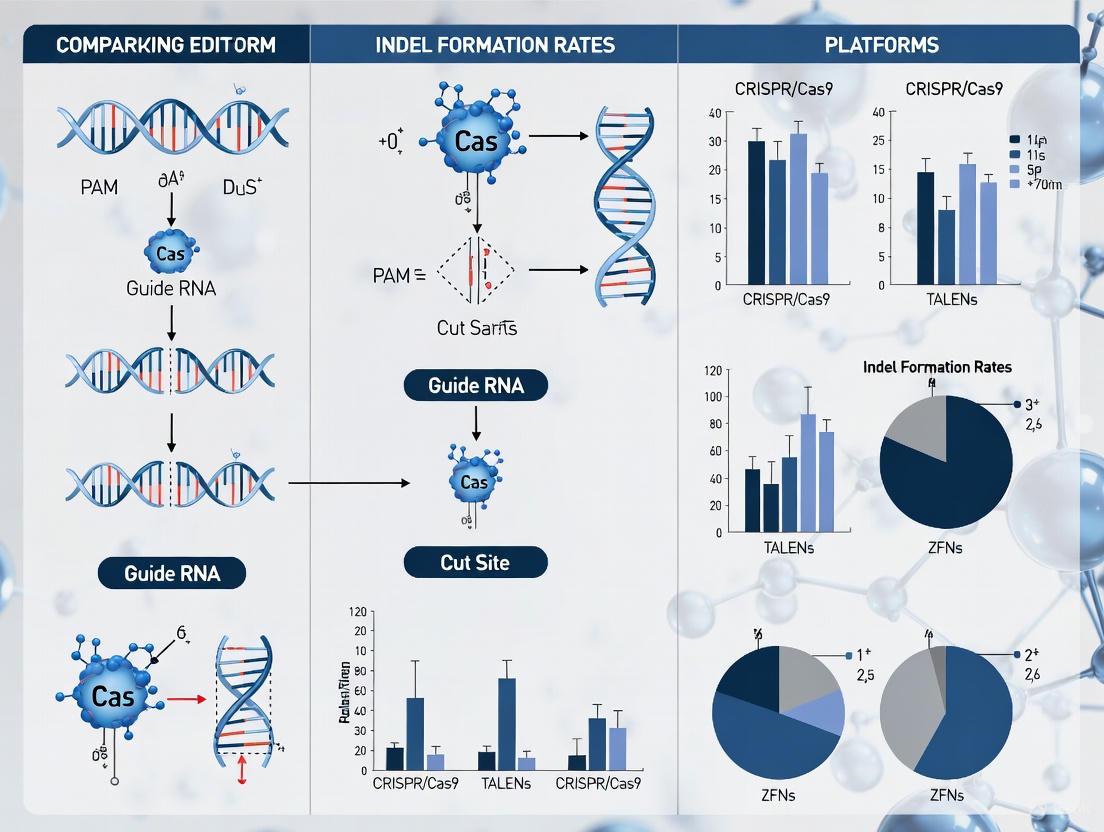
This article provides a comprehensive comparison of insertion/deletion (indel) formation rates across major gene-editing platforms, including CRISPR-Cas9, TALENs, ZFNs, base editors, and prime editors.
Indel Formation Rates in Gene Editing: A Comparative Analysis of CRISPR, TALEN, ZFN, and Prime Editing Platforms
Abstract
This article provides a comprehensive comparison of insertion/deletion (indel) formation rates across major gene-editing platforms, including CRISPR-Cas9, TALENs, ZFNs, base editors, and prime editors. Tailored for researchers and drug development professionals, it explores the fundamental mechanisms driving indel formation, presents methodological applications across diverse systems, details optimization strategies to minimize unwanted indels, and establishes validation frameworks for accurate comparative analysis. By synthesizing findings from recent preclinical studies and technological advancements, this review serves as a critical resource for selecting appropriate editing technologies to maximize on-target efficiency while mitigating genotoxic risks in therapeutic and research applications.
Understanding Indel Formation: Mechanisms and Risks Across Editing Platforms
In the realm of genome engineering, insertions and deletions, collectively known as indels, represent a fundamental class of DNA modifications that arise from the cellular repair of targeted double-strand breaks (DSBs). These modifications range from the alteration of a single DNA base pair to the insertion or removal of larger DNA segments, with profound implications for genomic integrity and function [1]. When nucleases such as CRISPR-Cas9 or TALENs create DSBs at specific genomic locations, the cell primarily utilizes the non-homologous end joining (NHEJ) pathway for repair, an error-prone process that frequently results in indel formation [1]. The spectrum of indel mutations directly influences gene function, where frameshift mutations often lead to gene knockout by introducing premature stop codons, while in-frame mutations may preserve partial function or create altered protein products [2].
The formation and frequency of indels vary significantly across different genome editing platforms, influenced by factors including the mechanism of DNA cleavage, the nature of the resulting DNA ends, and the cellular context in which editing occurs [3]. While early editing technologies like CRISPR-Cas9 and TALENs inherently produce indels as primary outcomes, the development of more precise editors such as base editors and prime editors aims to minimize or eliminate these unintended modifications [4]. Understanding the spectrum and consequences of indel formation remains crucial for selecting appropriate gene editing tools, predicting off-target effects, and ensuring the safety and efficacy of therapeutic genome editing applications.
Mechanisms of Indel Formation Across Editing Platforms
CRISPR-Cas9 and NHEJ-Mediated Indel Formation
The CRISPR-Cas9 system, derived from Streptococcus pyogenes, induces blunt-end double-strand breaks (DSBs) at genomic sites specified by a guide RNA (gRNA) and adjacent to a protospacer adjacent motif (PAM) sequence [3] [5]. Following DSB formation, the predominant cellular repair mechanism in most eukaryotic cells is the error-prone non-homologous end joining (NHEJ) pathway. During NHEJ, the broken DNA ends are processed and ligated back together, a process that often results in the loss or gain of nucleotide bases at the repair junction, creating indel mutations [1]. The frequency and spectrum of these indels are influenced by multiple factors, including the specific target site sequence, chromatin accessibility, and the cell type being edited [6]. While CRISPR-Cas9 enables highly efficient genome editing, its propensity to generate indels at both target (on-target) and partially complementary (off-target) sites presents significant challenges for therapeutic applications requiring precision [7] [5].
TALENs and FokI-Dimerization Dependent Cleavage
Transcription activator-like effector nucleases (TALENs) employ a distinct mechanism for targeted DNA cleavage. Each TALEN consists of a customizable DNA-binding domain derived from TAL effectors fused to the FokI nuclease domain. Unlike the single-protein Cas9 system, TALENs function as pairs that bind opposing DNA strands separated by a spacer region [2] [1]. The requirement for FokI dimerization to activate cleavage means that both TALEN monomers must bind in correct orientation and spacing to generate a DSB. This paired binding mechanism inherently increases specificity, as it requires the simultaneous recognition of two independent binding sites [1]. TALEN-induced DSBs typically result in overhanging ends rather than blunt ends, which may influence the pattern of indels produced during NHEJ repair [3]. While TALENs can exhibit high editing efficiencies comparable to CRISPR-Cas9, their larger size and more complex cloning process have limited their widespread adoption despite potentially superior specificity profiles in some applications [2] [1].
Table 1: Fundamental Mechanisms of Indel Formation by Major Genome Editing Platforms
| Editing Platform | Cleavage Mechanism | DNA End Type | Primary Repair Pathway | Key Specificity Factors |
|---|---|---|---|---|
| CRISPR-Cas9 | Single RNA-guided nuclease creates DSB | Blunt ends | NHEJ | gRNA complementarity, PAM requirement |
| TALENs | Paired protein binding with FokI dimerization | Overhanging ends | NHEJ | Dual binding site requirement, spacer length |
| Prime Editing | Nickase activity with reverse transcription | Single-strand break | DNA flap replacement | pegRNA design, no DSB formation |
Emerging Editors with Reduced Indel Propensity
Recent advancements in genome editing technology have focused on developing systems that minimize or eliminate indel formation by avoiding double-strand break generation altogether. Prime editing represents a particularly innovative approach that functions as a "search-and-replace" system without requiring DSBs or donor DNA templates [4]. The system utilizes a prime editing guide RNA (pegRNA) that both specifies the target site and encodes the desired edit, along with a fusion protein consisting of a Cas9 nickase (H840A) and an engineered reverse transcriptase [4]. This architecture allows direct copying of the edit from the pegRNA into the target DNA via a nicked intermediate and subsequent DNA repair mechanisms that favor incorporation of the edited strand. By completely bypassing DSB formation, prime editing dramatically reduces indel rates compared to conventional CRISPR-Cas9 systems [4] [8].
Further refinements to the prime editing system have led to the development of evolved pegRNAs (epegRNAs) that incorporate structured RNA motifs at their 3' end, enhancing stability and improving editing efficiency by 3-4 fold across multiple human cell lines [4]. Additionally, engineered Cas9 nickase variants with reduced DSB activity (H840A + N863A) have been shown to further minimize indel formation while maintaining efficient target editing [4]. When combined with optimized delivery methods and the inhibition of DNA mismatch repair pathways, these next-generation editing platforms achieve remarkable precision with significantly improved edit-to-indel ratios, addressing a critical limitation of earlier genome editing technologies [8].
Comparative Analysis of Indel Formation Rates
Direct comparative studies provide valuable insights into the indel formation profiles of different genome editing platforms. In a systematic investigation targeting the EGFP gene in HEK293FT cells, researchers directly compared the editing outcomes of CRISPR-Cas9 and TALENs [3]. The study revealed that paired Cas9 nucleases induced targeted genomic deletions more efficiently and precisely than TALEN pairs when the goal was intentional gene disruption. However, when the experimental aim was homology-directed repair (HDR) with a supplied template, TALENs stimulated HDR more efficiently than CRISPR/Cas9 while causing fewer targeted genomic deletions as unwanted byproducts [3]. This finding highlights the context-dependent performance of these platforms and suggests that the optimal choice depends on the desired genomic outcome.
Further illuminating the differences between platforms, a benchmarked prime editing system demonstrated dramatically reduced indel formation compared to standard CRISPR-Cas9 approaches [8]. By coupling DNA mismatch repair (MMR) inhibition with optimized pegRNA designs, researchers achieved editing efficiencies exceeding 95% at certain endogenous loci while maintaining exceptionally low indel rates. Specifically, at the HEK3 locus, prime editing with MMR suppression reached 95.2% efficiency with epegRNAs compared to 48.3% with traditional pegRNAs [8]. This enhanced precision positions prime editing as particularly advantageous for therapeutic applications where minimizing unintended mutations is critical.
Table 2: Quantitative Comparison of Indel Formation Across Editing Technologies
| Editing Technology | Typical Editing Efficiency | Reported Indel Rates | Key Influencing Factors | Best Applications |
|---|---|---|---|---|
| CRISPR-Cas9 | Up to 70% indel formation [1] | Variable: 1-50% (on-target); off-target site-dependent [7] | gRNA design, delivery method, nuclease form (RNP vs plasmid) | Gene knockout, large deletions |
| TALENs | ~33% indel formation in optimized conditions [3] | Generally lower off-target indels than CRISPR-Cas9 [2] [1] | CpG methylation, spacer length, protein design | Gene knockout with enhanced specificity |
| Prime Editing | 48-95% precise editing (with optimization) [8] | Significant reduction (up to 60-fold fewer indels than PE3) [4] [9] | pegRNA design, MMR status, editor version | Point mutations, small insertions/deletions |
| Cas9 Nickase | Reduced compared to wild-type Cas9 | Lower than wild-type but not eliminated | Paired gRNA design, spacing | Reduced off-target activity |
The progression from earlier to more advanced platforms reveals a consistent trend toward improved specificity and reduced indel formation. Next-generation engineered editors continue to push these boundaries further. For instance, the recently developed vPE (variant Prime Editor) system destabilizes competing 5' DNA strands through Cas9-nickase mutations, reducing indel formation by up to 60-fold while maintaining editing efficiency [9]. This innovation achieves remarkable edit-to-indel ratios of 543:1, representing a significant advancement for precision genome editing applications [9]. Similarly, AI-designed editors like OpenCRISPR-1 have demonstrated substantially reduced off-target activity while maintaining robust on-target editing, showing a 95% reduction in editing at known SpCas9 off-target sites [10].
Methodologies for Indel Detection and Analysis
T7 Endonuclease I (T7EI) Mismatch Detection Assay
The T7 Endonuclease I assay is a widely utilized method for detecting indel mutations resulting from genome editing. This technique capitalizes on the enzyme's ability to recognize and cleave DNA heteroduplexes formed when wild-type and indel-containing DNA strands are annealed [2]. In practice, genomic DNA is extracted from edited cells, and the target region is amplified by PCR. The resulting amplicons are denatured and reannealed, allowing heteroduplex formation when indel sequences are present. T7EI cleavage produces distinct fragments that can be separated and quantified by gel electrophoresis, enabling estimation of editing efficiency [2]. While this method provides a rapid and accessible means of assessing editing outcomes, its resolution is limited to detecting the presence of indels rather than characterizing their specific sequences or size distributions.
High-Throughput Sequencing Approaches
Next-generation sequencing (NGS) technologies offer the most comprehensive analysis of indel spectra, providing base-pair resolution of editing outcomes across thousands of cells. Amplicon sequencing involves PCR amplification of the target region from edited cell populations, followed by high-depth sequencing to characterize the diversity and frequency of induced mutations [2]. This approach enables precise quantification of editing efficiency while simultaneously capturing the full spectrum of indel sizes and sequences. For genome-wide off-target assessment, methods like integrase-defective lentiviral vector (IDLV) capture can be employed to identify potential off-target sites in an unbiased manner [2]. More recently, computational tools have been developed to predict potential off-target sites based on sequence similarity to the intended target, though empirical validation remains essential for comprehensive characterization [6].
Diagram 1: Experimental workflow for indel detection and analysis following genome editing. The two primary methodological pathways (T7 Endonuclease I assay and high-throughput sequencing) are shown with their respective steps leading to indel characterization.
Functional Assessment of Editing Outcomes
Beyond molecular detection, functional assays provide critical validation of editing outcomes, particularly in therapeutic contexts. For gene knockout applications, flow cytometry enables rapid assessment of protein expression loss when targeting fluorescent markers or surface proteins [3]. In the study comparing CRISPR-Cas9 and TALENs targeting EGFP, flow cytometric analysis quantified the percentage of cells with disrupted fluorescence, directly correlating indel formation with functional consequences [3]. For endogenous genes without visible markers, Western blotting or immunohistochemistry can similarly verify protein-level changes. Cellular phenotyping assays, such as proliferation measurements or functional responses, further connect indel formation to biological outcomes, especially in high-throughput screening contexts where libraries of guide RNAs target multiple genomic loci simultaneously [8].
Table 3: Essential Research Reagents for Indel Analysis in Genome Editing
| Reagent/Resource | Function | Example Applications | Considerations |
|---|---|---|---|
| T7 Endonuclease I | Detection of DNA heteroduplexes formed by indel mutations | Rapid assessment of editing efficiency; quality control of editing experiments [2] | Semi-quantitative; does not provide sequence information |
| High-Fidelity Polymerase | Error-free amplification of target loci for sequencing | Preparation of sequencing libraries; amplification of edited genomic regions | Critical for minimizing PCR-introduced errors in NGS analysis |
| Next-Generation Sequencing Platform | High-depth sequencing of target amplicons | Comprehensive indel spectrum analysis; off-target assessment | Requires bioinformatic expertise for data analysis |
| pegRNA Design Tools | Computational design of prime editing guide RNAs | Optimization of prime editing experiments; minimizing off-target effects [4] | Specific structural requirements differ from standard sgRNAs |
| MMR-Deficient Cell Lines | Enhancement of prime editing efficiency by suppressing mismatch repair | Achieving high editing rates in challenging loci [8] | May alter cellular physiology; not suitable for all applications |
| Structured RNA Motifs (e.g., evopreQ) | Stabilization of pegRNA 3' end | Improving prime editing efficiency 3-4 fold [4] | Requires modification of standard pegRNA synthesis |
The landscape of genome editing technologies reveals a clear trajectory toward increasingly precise modifications with reduced unintended indel formation. While early platforms like CRISPR-Cas9 and TALENs revolutionized biological research by enabling targeted gene disruption, their reliance on double-strand break formation and subsequent error-prone repair inherently produces indels as both intended and unintended outcomes [1] [3]. The development of newer editors, particularly prime editing systems, represents a paradigm shift by largely decoupling desired edits from indel generation through novel mechanisms that avoid DSBs entirely [4] [8].
The choice of editing platform must be guided by the specific experimental or therapeutic goals. For applications where complete gene knockout is desired, such as in functional genomics screens or the generation of disease models, the efficient indel formation of CRISPR-Cas9 remains advantageous [1]. Conversely, for therapeutic correction of pathogenic mutations without introducing additional genomic alterations, prime editing and other precision platforms offer superior specificity despite potentially more complex implementation [4] [9]. As these technologies continue to evolve, with enhancements in editing efficiency, specificity, and delivery, the precise control over genomic outcomes will undoubtedly expand, opening new possibilities for research and medicine while minimizing the consequences of unwanted indels on genomic integrity.
In the field of genome editing, the precise modification of DNA sequences holds immense potential for therapeutic applications and biological research. Central to this process is the creation of double-strand breaks (DSBs) at specific genomic locations by engineered nucleases. However, the ultimate editing outcome is not determined by the cutting tool itself, but by the cell's endogenous DNA repair machinery. This review focuses on how the two primary nuclease platforms, CRISPR/Cas9 and TALENs, engage DSB repair pathways, leading to the formation of insertions and deletions (indels). Understanding the distinct indel profiles and repair kinetics associated with each platform is crucial for researchers and drug development professionals to select the appropriate editing tool for specific applications, particularly in the context of therapeutic genome editing where precision is paramount.
DSB Repair Pathways and Their Connection to Indel Formation
When a nuclease induces a DSB, the cell primarily utilizes one of several competing pathways to repair the lesion. The choice between these pathways significantly influences whether a precise repair occurs or if indels are generated.
The non-homologous end joining (NHEJ) pathway operates throughout the cell cycle and directly ligates the broken DNA ends. This process is inherently error-prone, often resulting in small insertions or deletions at the repair junction [11]. In contrast, microhomology-mediated end joining (MMEJ), also known as alternative end-joining (Alt-EJ), relies on short homologous sequences (5-25 base pairs) flanking the break site for repair. MMEJ typically results in deletions of the DNA between these microhomology regions [12] [13]. A third pathway, single-strand annealing (SSA), requires longer homologous sequences and is Rad52-dependent, frequently causing deletions of the intervening sequence between repeats [12]. Finally, the homology-directed repair (HDR) pathway uses a template for precise repair, but its activity is largely restricted to the S and G2 phases of the cell cycle, making it less efficient in non-dividing cells [11] [14].
The following diagram illustrates how these different repair pathways process a single DSB to generate varying indel outcomes:
Figure 1: DSB Repair Pathways and Their Associated Indel Outcomes. The cellular repair pathway choice following a nuclease-induced double-strand break determines the type of insertion/deletion (indel) mutations generated. NHEJ typically creates small indels, MMEJ produces larger deletions between microhomology regions, and SSA can result in complex patterns including asymmetric HDR.
Comparative Analysis of CRISPR/Cas9 and TALEN Platforms
Fundamental Mechanism Differences
CRISPR/Cas9 and TALENs represent two distinct technological approaches to genome editing with fundamentally different mechanisms of DNA recognition and cleavage. The CRISPR/Cas9 system utilizes a guide RNA (gRNA) molecule that directs the Cas9 nuclease to the target DNA via Watson-Crick base pairing. Upon recognition of a protospacer adjacent motif (PAM) sequence, Cas9 induces a blunt-ended DSB typically 3-4 base pairs upstream of the PAM site [3]. In contrast, TALENs are fusion proteins comprising a customizable DNA-binding domain derived from transcription activator-like effectors and a FokI nuclease domain. TALENs function as pairs that bind opposing DNA strands with a spacer sequence in between, with the FokI domains dimerizing to create a DSB that often results in overhanging ends [3].
Quantitative Comparison of Editing Outcomes
Direct comparative studies reveal significant differences in the efficiency and precision of indel formation between CRISPR/Cas9 and TALEN platforms. The table below summarizes key performance metrics based on experimental data:
Table 1: Direct Comparison of CRISPR/Cas9 and TALEN Editing Outcomes
| Performance Metric | CRISPR/Cas9 | TALENs | Experimental Context |
|---|---|---|---|
| Targeted Deletion Efficiency | Higher (Precise deletions between two DSBs) [3] | Lower | EGFP gene in HEK293FT cells [3] |
| HDR Efficiency | Lower | Higher (with plasmid template) [3] | EGFP to EBFP conversion [3] |
| Mutation Efficiency | 3.39% (with sgRNA#2) [15] | 0.08% (targeting same locus) [15] | APT gene in Physcomitrium patens [15] |
| Indel Distribution | Broader range of outcomes [11] | More constrained profiles | iPSCs vs. neurons [11] |
| Genomic Deletion Formation | More efficient and precise [3] | Less efficient | Between two DSB sites [3] |
Cell Type-Specific Repair Variations
The repair outcomes following DSB formation exhibit remarkable variation across different cell types, significantly impacting the resulting indel profiles. In dividing cells such as induced pluripotent stem cells (iPSCs), DSB repair occurs rapidly, with indels typically plateauing within a few days post-Cas9 delivery. These cells frequently employ MMEJ, resulting in larger deletions between microhomology regions [11]. Conversely, in postmitotic cells like neurons and cardiomyocytes, indel accumulation follows a prolonged timeline, continuing for up to two weeks after Cas9 exposure. These cells predominantly utilize NHEJ pathways, yielding predominantly smaller indels compared to their dividing counterparts [11].
This cell-type specificity extends to HDR efficiency as well. Naïve human pluripotent stem cells (hPSC) demonstrate approximately 40% lower rates of HDR-mediated repair compared to conventional 'primed' hPSCs, correlating with a higher proportion of naïve cells in the G1 phase of the cell cycle where HDR is less active [14].
Experimental Approaches for Assessing Indel Formation
Methodologies for DSB Repair Kinetics Analysis
Droplet digital PCR (ddPCR) assays enable precise quantification of DSB repair kinetics over time. In this method, primed hPSCs are electroporated with HiFi Cas9 ribonucleoprotein (RNP) complexes along with guide RNAs and single-stranded oligodeoxynucleotide (ssODN) repair templates. Cell pellets are collected over a time course (e.g., 0-96 hours), followed by genomic DNA extraction and analysis using sequence-specific probes to distinguish between HDR, NHEJ, and unresolved DSBs [14]. This approach has revealed that in hPSCs, cut but unrepaired alleles peak within 12-24 hours, HDR plateaus after approximately 24 hours, while NHEJ continues until 48 hours post-electroporation [14].
Comprehensive Genome-Wide Specificity Assessment
Whole-genome sequencing (WGS) provides an unbiased method for evaluating off-target effects and unexpected mutations. In this protocol, edited clones are derived from single cells (e.g., protoplasts in plants) to establish clonal lines. Genomic DNA is then extracted and subjected to next-generation sequencing, with the resulting data aligned to a reference genome. Mutation calling is performed using specialized algorithms, with careful comparison to non-transfected controls and samples subjected to the delivery method alone (e.g., polyethylene glycol treatment) [15]. Application of this method in Physcomitrium patens revealed that both CRISPR/Cas9 and TALEN strategies induced minimal off-target mutations, with no significant difference from background mutation rates caused by the transformation method itself [15].
Indel Calling Algorithms and Their Applications
Accurate identification of indels from sequencing data requires specialized algorithms, each with distinct strengths. The table below compares commonly used indel detection tools:
Table 2: Comparison of Indel Calling Algorithms for Next-Generation Sequencing Data
| Algorithm | Primary Method | Optimal Use Case | Insertion Size Detection | Deletion Size Detection |
|---|---|---|---|---|
| GATK HaplotypeCaller [16] | De novo assembly + Hidden Markov Model | Short indels in multi-sample runs with high read depth | Up to 108 bp | Up to 113 bp |
| GATK UnifiedGenotyper [16] | Bayesian genotyping using read pileups | SNV detection with incidental indel calling | Up to 59 bp | Up to 59 bp |
| Pindel [16] | Pattern growth algorithm identifying breakpoints | Larger indels and structural variants at lower read depths | Up to 57 bp | Up to 30,861 bp |
Advanced Strategies for Modifying Indel Outcomes
Manipulating DNA Repair Pathways
The predictable nature of indel formation has inspired innovative approaches to improve precision editing outcomes. Chemical inhibition of specific DNA repair pathway components represents a powerful strategy to shift the balance between competing repair mechanisms. For instance, inhibition of key NHEJ proteins such as DNA Ligase IV or DNA-PKcs can suppress error-prone repair, while POLQ inhibitors specifically target the MMEJ pathway [12] [13]. Similarly, Rad52 inhibitors can reduce SSA-mediated repair, which is particularly effective at decreasing asymmetric HDR outcomes—a pattern where only one side of the donor DNA integrates precisely [12].
Secondary gRNA Strategies ("Double Tap" Method)
The "double tap" method leverages the reproducible nature of indel sequences by employing secondary gRNAs that target the most common indel byproducts. This approach provides a second opportunity for HDR-mediated editing at sites that initially repaired via end-joining pathways. In practice, researchers first characterize the most frequent indel sequences resulting from a primary gRNA, then design secondary gRNAs specifically targeting these sequences. When tested across 15 genomic loci in human cell lines, this method improved HDR efficiencies for point mutations, small insertions, and deletions without increasing overall indel rates [13].
The following workflow illustrates the experimental process for implementing this strategy:
Figure 2: Experimental Workflow for the "Double Tap" Method. This strategy involves initial characterization of indel patterns from primary editing, followed by design of secondary gRNAs that target common byproducts to provide a second chance for HDR-mediated editing.
Table 3: Key Research Reagent Solutions for DSB Repair and Indel Analysis Studies
| Reagent/Resource | Function | Example Application |
|---|---|---|
| Alt-R HDR Enhancer V2 [12] | NHEJ pathway inhibitor | Increasing HDR efficiency in CRISPR editing experiments |
| ART558 [12] | POLQ inhibitor targeting MMEJ pathway | Reducing large deletion outcomes in knock-in experiments |
| D-I03 [12] | Rad52 inhibitor targeting SSA pathway | Decreasing asymmetric HDR and imprecise donor integration |
| Virus-Like Particles (VLPs) [11] | Protein delivery vehicle | Efficient Cas9 RNP delivery to postmitotic cells (neurons, cardiomyocytes) |
| HiFi Cas9 Protein [14] | High-fidelity nuclease | Reduced off-target cutting while maintaining on-target activity |
| Droplet Digital PCR Assay [14] | Absolute quantification of editing outcomes | Kinetic analysis of HDR vs. NHEJ repair pathways over time |
| PacBio Long-Read Sequencing [12] [17] | Comprehensive variant detection | Identification of complex indels and structural mutations missed by short-read technologies |
Genome editing technologies have revolutionized biological research and therapeutic development, but a critical challenge remains: achieving high on-target efficiency while minimizing unwanted byproducts, particularly insertions and deletions (indels). While CRISPR-Cas9 systems offer unprecedented programmability and accessibility, their reliance on double-strand breaks (DSBs) and subsequent DNA repair pathways inherently generates indel formations as a major byproduct. These indels can confound experimental results in research settings and pose significant safety risks in therapeutic applications, including potential oncogenesis through disruption of tumor suppressor genes or creation of oncogenic fusion proteins.
The propensity for indel formation varies substantially across different genome editing platforms, influenced by their underlying mechanisms of action. Traditional nuclease-based systems like ZFNs and TALENs, while structurally distinct from CRISPR-Cas9, similarly induce DSBs and engage cellular repair pathways. More recently developed technologies, particularly base editing and prime editing systems, operate through fundamentally different mechanisms that can significantly reduce or eliminate indel byproducts. Understanding the comparative performance of these systems is therefore essential for researchers and drug development professionals to select the appropriate tool for their specific application, balancing efficiency, precision, and safety considerations.
Comparative Analysis of Gene Editing Platforms
Mechanism of Action and Byproduct Generation
CRISPR-Cas9: This system creates double-strand breaks (DSBs) at targeted genomic locations guided by RNA molecules. Cellular repair of these breaks occurs primarily through non-homologous end joining (NHEJ), which is error-prone and frequently produces indels, or homology-directed repair (HDR), which enables precise edits using a DNA template. The DSB repair outcome distribution varies significantly between cell types, with dividing cells predominantly utilizing microhomology-mediated end joining (MMEJ) pathways that create larger deletions, while non-dividing cells like neurons favor classical NHEJ pathways that yield smaller indels [18].
Zinc Finger Nucleases (ZFNs) and TALENs: These protein-based systems also induce DSBs through FokI nuclease domains, similarly engaging NHEJ and HDR pathways. While they can achieve high specificity through extensive protein engineering, their DSB-dependent mechanism nonetheless produces indel byproducts comparable to CRISPR-Cas9, albeit potentially with different sequence preferences and distributions [19].
Base Editors: These systems utilize catalytically impaired Cas9 variants (nickases) fused to deaminase enzymes to directly convert one base pair to another without creating DSBs. By avoiding DSBs, base editors significantly reduce indel formation compared to nuclease-dependent platforms. Cytosine base editors (CBEs) facilitate C•G to T•A conversions, while adenine base editors (ABEs) facilitate A•T to G•C conversions. However, they can cause unintended bystander edits at adjacent nucleotides within the editing window and have limitations in the types of base conversions they can achieve [4].
Prime Editors: These more advanced systems combine a Cas9 nickase with a reverse transcriptase enzyme, programmed through a prime editing guide RNA (pegRNA) that specifies both the target site and the desired edit. Without creating DSBs, prime editors can achieve all 12 possible base-to-base conversions, as well as small insertions and deletions, with dramatically reduced indel formation compared to DSB-based approaches. Engineered versions (PE2, PE3) with optimized reverse transcriptase and additional strand-nicking capabilities have further improved editing efficiency while maintaining low indel rates [4].
Table 1: Comparison of Major Genome Editing Platforms and Indel Formation
| Editing Platform | Mechanism of Action | DSB Formation | Primary Editing Outcomes | Indel Byproduct Rate | Theoretical Limitations |
|---|---|---|---|---|---|
| CRISPR-Cas9 | DSB induction with RNA-guided targeting | Yes | NHEJ: indels; HDR: precise edits | High (varies by guide, cell type, delivery) | PAM requirement, off-target editing, extensive indels |
| ZFNs | DSB induction with protein-guided targeting | Yes | NHEJ: indels; HDR: precise edits | High | Complex protein engineering, limited targeting sites |
| TALENs | DSB induction with protein-guided targeting | Yes | NHEJ: indels; HDR: precise edits | Moderate to High | Large protein size, complex cloning |
| Base Editors | Chemical conversion without DSB | No | Base transitions (C>T, A>G) | Low | Bystander edits, restricted conversion types, off-target RNA editing |
| Prime Editors | Reverse transcription without DSB | No | All base conversions, small insertions/deletions | Very Low | Complex pegRNA design, efficiency challenges for large edits |
Quantitative Comparison of Editing Efficiency and Indel Formation
Direct comparisons of editing platforms reveal significant differences in their performance characteristics. In a murine model of sickle cell disease, base editing of hematopoietic stem cells demonstrated higher editing efficiency and reduced concerns regarding genotoxicity compared to CRISPR-Cas9, despite similar engraftment rates [20]. Meanwhile, prime editing has achieved up to 60% editing efficiency in patient keratinocytes for correcting pathogenic COL17A1 variants causing junctional epidermolysis bullosa, with edited cells showing a remarkable selective advantage in xenograft models [20].
The cell type being edited significantly influences both efficiency and byproduct formation. Research comparing induced pluripotent stem cells (iPSCs) to iPSC-derived neurons found that neurons accumulated indels over a much longer timeframe (up to two weeks post-transduction) and exhibited different distributions of indel types compared to genetically identical dividing cells [18]. This prolonged editing window in non-dividing cells presents both challenges and opportunities for controlling outcomes.
Table 2: Experimentally Measured Editing Efficiencies and Indel Rates Across Platforms
| Editing Platform | Target Gene/Cell Type | On-Target Efficiency | Indel Rate | Experimental Context |
|---|---|---|---|---|
| CRISPR-Cas9 | TCRα and PDCD1/Jurkat cells | Varies by guide | Varies by guide | Single-cell sequencing assessment [21] |
| CRISPR-Cas9 | B2Mg1/iPSCs vs. neurons | Varies by cell type | Higher MMEJ-like deletions in iPSCs | Isogenic cell comparison [18] |
| Base Editing | HSPCs in sickle cell model | Higher than CRISPR-Cas9 | Significantly lower | Competitive transplant study [20] |
| Prime Editing | COL17A1/patient keratinocytes | Up to 60% | Very low | Therapeutic correction with selective advantage [20] |
| Prime Editing | Multiple targets/human cells | 3-4 fold improvement with epegRNA | Minimal with engineered systems | Stabilized pegRNA systems [4] |
Methodologies for Assessing Editing Outcomes
Experimental Workflows for Quantifying Editing Efficiency and Indels
Accurate measurement of editing outcomes requires sophisticated methodological approaches that can quantify both intended edits and unwanted byproducts. The following workflow diagrams illustrate key experimental processes for assessing CRISPR editing outcomes:
Diagram 1: Workflow for Assessing Genome Editing Outcomes
Comparative Methodologies for Measuring Editing Efficiency
Multiple established methods exist for quantifying genome editing efficiency, each with distinct strengths and limitations for assessing on-target activity and indel byproducts:
T7 Endonuclease I (T7EI) Assay: This mismatch detection method identifies heteroduplex DNA formed between wild-type and indel-containing sequences through cleavage of mismatched bases. While rapid and inexpensive, it provides only semi-quantitative data and lacks sensitivity for detecting low-frequency edits or precisely characterizing indel sequences [22].
Tracking of Indels by Decomposition (TIDE): This computational method decomposes Sanger sequencing chromatograms from edited samples to quantify the spectrum and frequency of indel mutations. It offers more quantitative data than T7EI without requiring next-generation sequencing, but its accuracy depends on sequencing quality and it has limited sensitivity for complex editing outcomes [22].
Droplet Digital PCR (ddPCR): This highly quantitative method uses sequence-specific fluorescent probes to distinguish between edited and unedited alleles, providing absolute quantification of editing efficiency with high sensitivity. However, it requires specialized equipment and prior knowledge of expected sequences, making it less suitable for discovering novel indels [22].
Next-Generation Sequencing (NGS): Bulk NGS approaches provide comprehensive characterization of editing outcomes by sequencing PCR amplicons spanning target sites, enabling precise quantification of editing efficiency and detailed characterization of indel sequences and frequencies. While highly informative, bulk NGS provides population-level data that may mask cellular heterogeneity in editing outcomes [22].
Single-Cell DNA Sequencing (scDNA-seq): Platforms like Tapestri enable targeted sequencing of edited genomic regions across thousands of individual cells, revealing co-occurrence of edits at multiple loci, zygosity, and cell-to-cell heterogeneity in editing outcomes that bulk methods would average. This approach is particularly valuable for characterizing complex editing products and quantifying precise genotype-phenotype relationships [21].
Table 3: Methods for Measuring Genome Editing Outcomes
| Method | Detection Principle | Quantification Capability | Indel Characterization | Key Limitations |
|---|---|---|---|---|
| T7EI Assay | Mismatch cleavage | Semi-quantitative | Limited | Low sensitivity, no sequence information |
| TIDE/ICE | Sequencing trace decomposition | Quantitative | Moderate | Limited to simple indel patterns, sequencing quality-dependent |
| ddPCR | Allele-specific probe detection | Highly quantitative | Low | Requires predefined sequences, not for discovery |
| Bulk NGS | High-throughput sequencing | Highly quantitative | High | Population average, misses heterogeneity |
| scDNA-seq | Single-cell amplification & sequencing | Quantitative at single-cell level | High | Cost, complexity, lower coverage |
Advanced Platform Engineering to Minimize Indels
CRISPR System Engineering for Enhanced Specificity
Substantial engineering efforts have focused on reducing indel formation in CRISPR systems through various strategic approaches:
High-Fidelity Cas Variants: Engineered Cas9 variants like HiFi Cas9 maintain robust on-target activity while dramatically reducing off-target effects through mutations that destabilize non-specific interactions with DNA. These variants represent a direct improvement to the core CRISPR machinery for cleaner editing outcomes [23].
Dual-Nickase Systems: Using paired Cas9 nickases that each create single-strand breaks on opposite strands can significantly reduce indel formation compared to DSB-generating nucleases. The requirement for two closely spaced nicks to create a DSB dramatically increases specificity while still enabling genome modification through the HDR pathway [23].
Chemical Modification of gRNAs: Incorporating specific chemical modifications such as 2'-O-methyl analogs (2'-O-Me) and 3' phosphorothioate bonds (PS) into synthetic guide RNAs can enhance stability and reduce off-target editing while maintaining or improving on-target efficiency. These modifications protect gRNAs from degradation and potentially alter binding kinetics to favor specific target recognition [23].
Engineered pegRNAs: For prime editing systems, engineering the 3' structure of pegRNAs with evopreQ, mpknot, or other RNA motifs dramatically improves editing efficiency by protecting against exonucleolytic degradation. These engineered pegRNAs (epegRNAs) can increase prime editing efficiency 3-4 fold across diverse human cell types without increasing indel formation [4].
Controlling DNA Repair Pathways
Beyond engineering the editing proteins themselves, manipulating cellular DNA repair pathways presents a complementary strategy for controlling editing outcomes:
Chemical Modulation: Small molecule inhibitors targeting specific DNA repair pathway components can shift the balance between different repair outcomes. For instance, inhibiting key NHEJ factors can enhance HDR efficiency in certain contexts, while other compounds can modulate the balance between different DSB repair pathways to favor desired outcomes [18].
Temporal Control of Editing: Using self-inactivating delivery systems or degron-tagged editors to limit the duration of nuclease activity can reduce off-target effects and potentially influence the spectrum of editing outcomes by engaging different repair pathways operating at various timescales [23].
The following diagram illustrates how different CRISPR systems interact with DNA repair pathways to produce varying indel profiles:
Diagram 2: DNA Repair Pathways and Editing Outcomes
Essential Research Reagents and Tools
Successful genome editing experiments require carefully selected reagents and tools optimized for specific applications. The following research reagent solutions represent key materials for conducting editing assessments:
Table 4: Essential Research Reagents for Editing Assessment
| Reagent/Tool Category | Specific Examples | Function in Editing Assessment | Considerations for Selection |
|---|---|---|---|
| Nuclease Systems | SpCas9, HiFi Cas9, Cas12f | Core editing function | Balance efficiency and specificity; consider size for delivery |
| Editing Enhancers | epegRNA scaffolds, MMLV-RT variants | Improve efficiency of advanced editors | Prime editing efficiency depends on RT stability and processivity |
| Delivery Tools | Virus-like particles (VLPs), electroporation systems | Introduce editing components into cells | VLPs effective for neurons; electroporation for immune cells |
| Detection Enzymes | T7 Endonuclease I, restriction enzymes | Detect sequence changes in target sites | T7EI useful for initial screening but limited quantification |
| Amplification Reagents | Q5 Hot Start Master Mix, target-specific primers | Amplify target loci for analysis | High-fidelity polymerases reduce errors in amplification |
| Sequencing Platforms | Sanger sequencers, Illumina NGS, PacBio | Characterize editing outcomes at sequence level | NGS needed for comprehensive indel profiling |
| Analysis Software | TIDE, ICE, CRISPOR | Design guides and analyze editing results | ICE provides quantitative editing efficiency from Sanger data |
The landscape of genome editing technologies continues to evolve rapidly, with ongoing innovations focused on achieving perfect precision without unwanted byproducts. CRISPR-Cas9 systems remain the most widely accessible platform but require careful optimization and characterization to balance on-target efficiency with indel byproduct formation. The development of base editing and prime editing platforms represents significant advances toward eliminating indel formation, though these systems face their own challenges in efficiency and targeting scope.
Future directions in the field include continued engineering of editing proteins with enhanced specificity, improved delivery systems that provide temporal control over editing activity, and better manipulation of cellular DNA repair pathways to favor desired outcomes. Additionally, the integration of artificial intelligence into guide RNA design and outcome prediction is expected to further improve the precision and efficiency of genome editing platforms [24]. As these technologies mature, researchers and therapeutic developers will have an increasingly sophisticated toolkit for achieving precise genetic modifications with minimal unwanted byproducts, ultimately enabling safer and more effective applications across basic research, biotechnology, and human therapeutics.
Within the context of a broader thesis on comparing indel formation rates across gene editing platforms, this guide provides an objective performance comparison of Zinc-Finger Nucleases (ZFNs) and Transcription Activator-Like Effector Nucleases (TALENs). The zebrafish (Danio rerio) model serves as a critical in vivo system for this evaluation, as its transparency, high fecundity, and genetic tractability offer unique advantages for assessing the efficacy and mutagenicity of gene-editing tools [25] [26]. While CRISPR-Cas9 currently dominates the gene-editing landscape, a detailed comparison of its predecessors, ZFNs and TALENs, remains essential for understanding the evolution of editing platforms and for applications where CRISPR may be less suitable, such as editing within complex repetitive regions or the mitochondrial genome [27].
Both ZFNs and TALENs are engineered nucleases that function by creating double-strand breaks (DSBs) at specific genomic loci. These breaks are subsequently repaired by the cell's error-prone non-homologous end joining (NHEJ) pathway, which often results in insertion or deletion mutations (indels) that can disrupt gene function [25]. The core difference between these technologies lies in their DNA-recognition architecture: ZFNs use arrays of zinc-finger motifs, while TALENs utilize arrays of TALE repeats. This fundamental distinction has significant implications for their design, targeting scope, and overall editing efficiency, which are quantitatively explored in this guide.
The divergent designs of ZFNs and TALENs directly influence their practical application. The following diagram illustrates the core structural components and the DNA binding logic of each nuclease system.
ZFN Architecture
- DNA-Binding Domain: ZFNs utilize an array of engineered zinc-finger motifs, where each individual motif recognizes a specific 3-base pair (bp) triplet in the DNA sequence. A typical ZFN array comprises 3 to 6 fingers, enabling the recognition of a 9 to 18 bp target sequence [28].
- Nuclease Domain: The DNA-binding domain is fused to the catalytic domain of the FokI restriction enzyme. A critical requirement for FokI activity is dimerization; therefore, ZFNs are designed and used in pairs. Two ZFN monomers bind to the sense and antisense DNA strands in a tail-to-tail orientation, separated by a 5-7 bp "spacer" sequence. This positioning allows the two FokI domains to dimerize and create a double-strand break within the spacer region [28].
- Design Challenge: A significant limitation of ZFNs is context dependence, where the DNA-binding specificity of individual zinc fingers can be influenced by their neighboring fingers. This interference makes the rational design of highly specific and efficient ZFN arrays challenging and often requires sophisticated selection assays, such as phage display, to identify functional combinations [28].
TALEN Architecture
- DNA-Binding Domain: TALENs are built from arrays of TALE (Transcription Activator-Like Effector) repeats, each comprising 33-35 amino acids. The key feature is the two hypervariable amino acids at positions 12 and 13, known as the Repeat-Variable Diresidue (RVD). Each RVD recognizes a single, specific DNA nucleotide (e.g., NI for Adenine, NG for Thymine, HD for Cytosine, and NN for Guanine/Adenine) [27].
- Nuclease Domain: Similar to ZFNs, the TALE array is fused to the FokI nuclease domain. TALENs also function as pairs, with the two monomers binding to opposite DNA strands separated by a spacer (typically 12-20 bp). The dimerization of the FokI domains induces the DSB [28] [27].
- Design Advantage: The modularity and simplicity of the TALE code (one repeat to one base pair) make TALENs substantially easier to engineer for a novel target sequence compared to ZFNs. There is minimal context dependence between adjacent repeats, allowing for reliable and predictable design using standard molecular biology techniques [28].
Comparative Performance Analysis in Zebrafish
A large-scale, direct comparison of ZFN and TALEN mutagenicity was conducted in developing zebrafish embryos, providing robust quantitative data on their editing profiles [28]. The study utilized deep sequencing to rigorously analyze mutation rates and patterns, offering a high-resolution view of their performance.
Table 1: Summary of Comparative Indel Profiling in Zebrafish [28]
| Performance Metric | ZFN Performance | TALEN Performance | Experimental Context |
|---|---|---|---|
| Overall Mutagenicity | Lower success rate | Significantly more likely to be mutagenic | Analysis of multiple nuclease pairs |
| Average Mutation Rate | Lower (Reference level) | ~10-fold higher | Injected embryos, deep sequencing of target sites |
| Germline Transmission | Possible even with low somatic rates | Strong correlation with high somatic rates | Raising injected embryos to adulthood |
| Targeting Flexibility | Limited by G-rich sequence preference and context dependence | Ability to target essentially any genomic sequence | Design and testing of nucleases against various sites |
| Predictive Guidelines | Poorly predictive of in vivo success | Poorly predictive of in vivo success; CpG content may influence | Comparison of proposed design rules vs. observed activity |
Key Findings from Comparative Data
- Superior Mutagenicity of TALENs: The most striking finding was that TALENs were significantly more likely to be mutagenic than ZFNs. Furthermore, when active, TALENs induced an average of 10-fold more mutations at their target sites compared to active ZFNs. This greatly enhances the probability of obtaining the desired genetic modification, reducing the number of animals and injections required for a successful experiment [28].
- Germline Transmission Correlation: The study found a strong correlation between the somatic mutation rate (measured in injected embryos) and the germline mutation rate (transmitted to the next generation). This correlation is a valuable practical tool, as it allows researchers to screen for effective nuclease pairs in the F0 generation, saving significant time and resources. Notably, the research demonstrated that ZFNs with somatic mutation rates well below the commonly used 1% threshold could still produce germline mutations, albeit at lower frequencies [28].
- Limitations of Design Guidelines: Previously proposed in silico guidelines for predicting optimal ZFN and TALEN target sites showed little correlation with actual in vivo mutagenicity in this study. However, one sequence feature—CpG content—was negatively correlated with TALEN activity. This suggests that target site methylation may be a factor that can explain the poor performance of some TALEN constructs in vivo [28].
Detailed Experimental Workflow for Zebrafish Models
The following diagram and protocol detail the standard methodology for comparing nuclease architectures in zebrafish, from target design to germline analysis.
Key Experimental Protocol
The comparative analysis of ZFNs and TALENs relies on a standardized workflow in zebrafish [28] [26].
Nuclease Construction:
- ZFN Construction: ZFN pairs can be designed using online tools like ZiFiT Targeter. DNA fragments encoding the zinc-finger arrays are synthesized and cloned into expression vectors containing the FokI nuclease domain. To enhance specificity and reduce off-target cleavage, obligate heterodimeric FokI variants (e.g., EL/KK pairs) are used to prevent homodimerization [28].
- TALEN Construction: TALE repeat arrays are assembled using standardized kits (e.g., the REAL Assembly TALEN Kit) and cloned into wild-type FokI expression vectors. All constructs should be sequence-verified prior to mRNA synthesis [28].
mRNA Synthesis and Embryo Injection:
- Expression plasmids are linearized and used as templates for in vitro mRNA synthesis using a kit such as mMessage mMachine T7 Ultra, which includes a polyA tailing reaction to enhance mRNA stability during early development.
- The synthesized mRNA is purified and dissolved in nuclease-free water. Approximately 50-100 pg of each nuclease mRNA (for both ZFN and TALEN pairs) is co-injected into the cytoplasm of one-cell stage zebrafish embryos [28].
Analysis of Somatic Mutations:
- At 72-96 hours post-fertilization (hpf), genomic DNA is extracted from a pool of approximately 12 injected embryos. The target genomic region is PCR-amplified, and the resulting amplicons are prepared for deep sequencing (e.g., on an Illumina platform) [28] [26].
- Indel detection is performed using sensitive alignment software (e.g., SHRiMP2 and BLAT) to map sequencing reads and identify insertion/deletion events with high confidence. The analysis pipeline should filter out potential artifacts, such as indels located too close to the PCR primer sites [28].
Isolation of Germline Mutants:
- Injected embryos (F0 founders) are raised to adulthood. To test for germline transmission, these founder fish are outcrossed to wild-type partners.
- Genomic DNA is isolated from a pool of up to 96 F1 embryos at 72 hpf. The target locus is amplified by PCR and screened for mutations. Screening methods can include restriction fragment length polymorphism (RFLP) assays if the indel disrupts a restriction site, or capillary electrophoresis if using fluorescently labelled primers to detect size shifts [28].
- F1 embryos carrying mutations can be raised to establish stable mutant lines.
The Scientist's Toolkit: Essential Research Reagents
Table 2: Key Reagents for ZFN and TALEN Analysis in Zebrafish
| Reagent / Solution | Function and Description |
|---|---|
| TALEN Assembly Kit | Standardized kit (e.g., REAL Assembly TALEN Kit) for rapid and reliable construction of TALE repeat arrays [28]. |
| FokI Expression Vectors | Plasmids for expressing ZFN or TALEN proteins; often use obligate heterodimer FokI variants (e.g., EL/KK) for ZFNs to minimize off-target activity [28]. |
| In Vitro Transcription Kit | High-yield mRNA synthesis kit with polyA tailing (e.g., mMessage mMachine T7 Ultra) to produce stable mRNA for microinjection [28]. |
| Deep Sequencing Platform | Next-generation sequencing (e.g., Illumina GAIIx/HiSeq) for high-throughput, quantitative analysis of indel profiles and frequencies [28]. |
| SHRiMP2/BLAT Software | Specialized short-read alignment software packages used for sensitive and comprehensive detection of indels from sequencing data [28]. |
This comparative guide demonstrates that within the zebrafish model, TALEN architecture offers significant advantages over ZFNs for routine targeted mutagenesis. The empirical data from a large-scale in vivo analysis clearly shows TALENs are more frequently mutagenic and can induce mutation rates an order of magnitude higher than ZFNs [28]. The simpler, more predictable "one-repeat-to-one-base" design principle of TALENs, combined with their superior success rate, established them as the dominant technology before the rise of CRISPR-Cas9.
This comparison underscores a critical evolution in nuclease design: moving from the context-dependent and complex engineering of ZFNs to the modular and straightforward assembly of TALENs. While CRISPR-Cas9 systems now offer even greater simplicity and scalability, the in-depth understanding of ZFN and TALEN performance profiles remains valuable. It informs tool selection for specific applications where CRISPR may be less effective and provides a historical framework for appreciating the rapid advancements in the field of genome engineering [25] [27]. For researchers working in zebrafish, the high efficiency and germline transmission rates of TALENs make them a powerful and reliable tool for generating stable knockout lines.
The high frequency of insertions and deletions (indels) has long represented a critical challenge in therapeutic genome editing. These unintended mutations predominantly arise as byproducts of the cellular repair process following double-strand breaks (DSBs), which are deliberately induced by conventional CRISPR-Cas9 nucleases and other programmable nucleases like ZFNs and TALENs [4] [19]. While these DSB-dependent editors are powerful tools for gene disruption, their utility for precise gene correction is severely limited by the fact that DSB repair via non-homologous end joining (NHEJ) often results in a high percentage of indels that can disrupt gene function and potentially cause oncogenic transformations [4] [29] [30].
Prime editing represents a paradigm shift in precision genome editing by enabling a wide range of targeted changes—including all 12 possible base-to-base conversions, small insertions, and small deletions—without creating double-strand breaks and without requiring donor DNA templates [4] [31] [32]. This fundamental difference in mechanism underlies prime editing's exceptional ability to minimize indel formation while maintaining precision, making it particularly valuable for therapeutic applications where unwanted mutations could have serious consequences.
Comparative Mechanisms: How Editing Platforms Handle DNA
Conventional Nuclease Platforms (CRISPR-Cas9, ZFNs, TALENs)
Traditional genome editing platforms, including CRISPR-Cas9, ZFNs, and TALENs, function by creating intentional double-strand breaks in the DNA backbone at targeted locations [19]. The CRISPR-Cas9 system, for instance, uses a guide RNA to direct the Cas9 nuclease to a specific DNA sequence, where its HNH and RuvC catalytic domains cleave both DNA strands [29]. This DSB triggers the cell's endogenous repair mechanisms:
- Non-homologous end joining (NHEJ): An error-prone repair pathway that directly ligates the broken ends, often resulting in small insertions or deletions (indels) at the break site [19] [29].
- Homology-directed repair (HDR): A precise repair pathway that uses a DNA template to repair the break, but is primarily active in dividing cells and typically outcompeted by NHEJ [29] [30].
The reliance on DSBs constitutes the fundamental source of indel formation in these systems, with indel rates frequently exceeding HDR efficiency and compromising the purity of editing outcomes [30].
Base Editing Platforms
Base editors emerged as an important innovation that reduces, but does not completely eliminate, the reliance on DSBs. These systems fuse a catalytically impaired Cas protein (a nickase that cuts only one DNA strand) to a deaminase enzyme, enabling direct chemical conversion of one base to another without creating a DSB [4] [29]. Cytosine base editors (CBEs) convert cytosine to thymine, while adenine base editors (ABEs) convert adenine to guanine [4] [32].
Although base editors represent a significant advance by avoiding DSBs, they face important limitations: they can only perform four transition mutations (C→T, T→C, A→G, G→A) rather than all 12 possible base-to-base changes, and they often exhibit bystander editing where adjacent nucleotides within the editing window are unintentionally modified [4] [31] [30]. While indel formation is substantially reduced compared to nuclease-based approaches, it is not entirely eliminated.
Prime Editing Platform
Prime editing introduces a fundamentally different mechanism that avoids both DSBs and the limitations of deaminase-based approaches. The system comprises two key components:
- A prime editor protein: A fusion of a Cas9 nickase (H840A) with a reverse transcriptase (RT) enzyme [4] [31] [32].
- A prime editing guide RNA (pegRNA): A specially engineered guide RNA that both specifies the target site and encodes the desired edit via a reverse transcriptase template (RTT) and primer binding site (PBS) [4] [32].
The prime editing mechanism proceeds through several key steps, illustrated in the diagram below:
Prime Editing Mechanism: Search-and-Replace Workflow
This "search-and-replace" mechanism allows prime editing to correct targeted sequences with high precision while avoiding the DSBs that are the primary source of indel formation in conventional editing platforms [31] [32] [30].
Quantitative Comparison: Indel Rates Across Editing Platforms
Direct comparison of experimental data reveals substantial differences in indel formation frequencies between prime editing and other genome editing technologies. The table below summarizes quantitative findings from multiple studies assessing editing outcomes across different platforms:
Table 1: Comparative Indel Formation Across Genome Editing Technologies
| Editing Platform | Editing Mechanism | Typical Indel Frequency | Edit:Indel Ratio | Key Limitations |
|---|---|---|---|---|
| CRISPR-Cas9 Nuclease [19] [29] | DSB induction followed by NHEJ/HDR | High (often >20%) [31] | Low (HDR typically <10% of products) [31] | High indel background from NHEJ; low HDR efficiency |
| Base Editing [4] [29] | Direct chemical conversion without DSB | Low to Moderate [4] | Variable | Restricted to 4 transition mutations; bystander editing |
| Prime Editing (PE2/PE3) [4] [31] | Reverse transcription without DSB | Low (typically 1-10%) [31] | Moderate | Variable efficiency requiring optimization |
| Prime Editing (PEmax) [33] [34] | Optimized PE architecture | Low | ~10:1 to 30:1 [33] | Still generates measurable indel errors |
| Precision PE (pPE) [33] [34] | Engineered Cas9 nickase with relaxed positioning | Very Low | 276:1 [34] | Slight reduction in editing efficiency |
| Very Precise PE (vPE) [33] [34] | Combined pPE with La protein stabilization | Minimal | 465:1 to 543:1 [33] [34] | Most advanced system with maximal precision |
Recent advances in prime editing have substantially improved its precision advantages. In 2025, MIT researchers introduced engineered prime editors with dramatically reduced indel formation [33] [34]. By incorporating mutations that relax Cas9 nick positioning and promote degradation of competing 5' DNA strands, they developed a "very precise prime editor" (vPE) that achieves edit:indel ratios as high as 543:1—representing up to a 60-fold reduction in indel errors compared to previous prime editors [33] [34]. This remarkable improvement demonstrates how mechanistic understanding of the sources of residual indel formation in prime editing systems can drive engineering solutions that further enhance their precision.
Experimental Evidence: Key Studies and Methodologies
Foundational Prime Editing Study (2019)
The original prime editing study established the proof-of-concept for DSB-free genome editing and provided the first quantitative evidence of its reduced indel formation [31] [30].
Experimental Protocol:
- Cell model: HEK293T cells and other human cell lines
- Targets: Endogenous loci (HEK3, HEK4, EMX1)
- Editors tested: PE1, PE2, and PE3 systems
- Analysis method: Next-generation sequencing of amplified genomic regions
- Key findings: Demonstrated 20-50% editing efficiency with 1-10% indels in HEK293T cells, substantially lower than the >20% indel rates typical of Cas9 nuclease [31]
Engineering High-Fidelity Prime Editors (2025)
A landmark 2025 study systematically addressed the residual indel formation in prime editing systems through protein engineering [33] [34].
Experimental Protocol:
- Engineering approach: Screened Cas9 nickase mutations that relax nick positioning and promote degradation of competing 5' DNA strands
- Key mutations: Identified R780A, K810A, K848A, K855A, R976A, and H982A as reducing indel errors
- Optimal combination: K848A-H982A (pPE) reduced indels 36-fold compared to standard PE
- Further optimization: Added efficiency-boosting mutations and La protein fusion to create vPE
- Validation: Tested across six genomic loci (CXCR4, EMX1, GFP, MYC, STAT1, TGFB1) in HEK293T cells
- Results: vPE achieved edit:indel ratios of 465:1 to 543:1, representing the highest precision reported for any genome editing technology [33] [34]
The workflow below illustrates the experimental approach used to develop and validate these high-fidelity prime editors:
Development Workflow for High-Fidelity Prime Editors
Research Reagent Solutions for Prime Editing Studies
Successful implementation of prime editing requires specific reagents and optimization approaches. The table below outlines essential materials and their functions for researchers designing prime editing experiments:
Table 2: Essential Research Reagents for Prime Editing Experiments
| Reagent Category | Specific Examples | Function and Importance | Optimization Considerations |
|---|---|---|---|
| Prime Editor Proteins | PE2, PEmax, PE6 variants, vPE [4] [31] [34] | Catalytic core that executes nicking and reverse transcription | PE2/PEmax: General purpose; PE6/vPE: Enhanced efficiency/precision |
| pegRNA Systems | Standard pegRNA, epegRNA [4] [31] | Target specification and edit templating | epegRNAs with 3' RNA motifs improve stability and efficiency |
| Delivery Vehicles | AAV vectors, lipid nanoparticles (LNPs) [4] [35] [29] | Intracellular delivery of editing components | Dual AAV systems often needed due to large size; LNPs enable transient delivery |
| Strand-Nicking sgRNAs | PE3 and PE3b systems [4] [31] [32] | Enhance editing efficiency by nicking non-edited strand | PE3b reduces indels by targeting only after edit incorporation |
| Mismatch Repair Inhibitors | MLH1dn (used in PE4/PE5) [31] | Improve editing efficiency by modulating cellular repair | Temporary inhibition prevents permanent disruption of DNA repair |
| Analysis Tools | Next-generation sequencing, Edit-deconvolution tools [33] [31] | Accurate quantification of editing outcomes and byproducts | Essential for calculating edit:indel ratios and detecting rare byproducts |
Discussion and Future Perspectives
The empirical evidence consistently demonstrates that prime editing's fundamental mechanism—avoiding double-strand breaks—enables a substantial reduction in indel formation compared to conventional genome editing platforms. While no technology is completely free of off-target effects, the progressive engineering of prime editors with dramatically improved edit:indel ratios, now exceeding 500:1 in the case of vPE, represents a remarkable advance toward the goal of truly precise genome editing [33] [34].
For therapeutic applications, this precision advantage is particularly significant. The high incidence of indels associated with CRISPR-Cas9 nucleases has raised safety concerns about potential oncogenic transformations due to large deletions, chromosomal rearrangements, and p53 activation [4] [30]. Prime editing's cleaner profile with minimal indel byproducts addresses these concerns directly, making it particularly attractive for clinical applications where safety is paramount.
Current challenges in prime editing primarily revolve around variable efficiency across genomic contexts and delivery limitations due to the large size of the editing system [4] [32]. However, the rapid pace of innovation—including the development of smaller prime editors compatible with AAV delivery and engineered systems with enhanced efficiency—suggests these limitations are being actively addressed [4] [31] [34].
As the field progresses, prime editing is poised to become the technology of choice for therapeutic applications requiring precise genetic corrections with minimal unwanted mutations. Its ability to install a wide range of edits without inducing double-strand breaks represents a fundamental advantage that aligns with the safety requirements of clinical genome editing.
The advent of CRISPR-based base editing has introduced a powerful alternative to conventional nuclease-based editing by enabling direct chemical conversion of single DNA bases without generating double-strand breaks (DSBs) [36]. This technology theoretically offers a safer profile for therapeutic applications by avoiding the error-prone repair pathways associated with DSBs. However, base editors present their own unique set of constraints, primarily the tension between their restricted editing windows and the desirable reduction of insertions and deletions (indels). While designed to minimize indels, certain base editor architectures can still generate these unwanted byproducts, creating a significant consideration for researchers and therapeutic developers when selecting appropriate editing platforms [37] [36]. This analysis objectively compares the performance of various base editing systems, focusing specifically on the interdependence of editing window constraints and indel formation rates, providing experimental data to guide platform selection for research and drug development.
Architectural Foundations of Base Editing Systems
Base editors are fusion proteins that typically combine a catalytically impaired Cas protein (either dead Cas9/dCas9 or nickase Cas9/nCas9) with a deaminase enzyme [38]. The Cas component provides DNA targeting specificity guided by an RNA, while the deaminase performs the core chemical conversion of nucleotides.
- Cytosine Base Editors (CBEs): These systems utilize a cytidine deaminase (e.g., APOBEC1) to convert cytosine (C) to uracil (U), which is subsequently read as thymine (T) during DNA replication, effecting a C•G to T•A conversion. To preserve the U-G intermediate, CBEs often incorporate a uracil glycosylase inhibitor (UGI) to block base excision repair pathways that would otherwise reverse the edit [39] [36].
- Adenine Base Editors (ABEs): These employ an engineered tRNA adenosine deaminase (TadA) to convert adenine (A) to inosine (I), which is interpreted as guanine (G) by cellular machinery, resulting in an A•T to G•C conversion [39] [38].
The fundamental difference between dCas9 and nCas9 architectures is critical to the indel reduction dilemma. dCas9 is completely catalytically dead and only binds DNA, while nCas9 makes a single-strand nick in the non-edited strand. This nicking was originally incorporated to increase editing efficiency by directing cellular repair to incorporate the edit, but it can also inadvertently increase indel formation [37].
Table 1: Core Components of Major Base Editing Systems
| Component | Cytosine Base Editor (CBE) | Adenine Base Editor (ABE) |
|---|---|---|
| Cas Protein | dCas9 or nCas9 (D10A) | dCas9 or nCas9 (D10A) |
| Deaminase Enzyme | Cytidine deaminase (e.g., APOBEC1) | Engineered adenosine deaminase (e.g., TadA) |
| Key Accessory Domains | Uracil glycosylase inhibitor (UGI) | None (TadA functions as a heterodimer) |
| Primary Conversion | C•G → T•A | A•T → G•C |
| Intermediate | Cytosine → Uracil → Thymine | Adenine → Inosine → Guanine |
Figure 1: Base Editor Architecture and Key Constraints. The core complex consists of a Cas protein and deaminase enzyme guided to DNA by an RNA. The system is fundamentally constrained by its defined editing window and the inherent indel risk, particularly from nCas9 nicking activity.
Quantitative Comparison of Editing Windows and Indel Formation
The editing window is a narrow region within the target DNA protospacer where the deaminase enzyme can effectively access and modify bases. For early base editors like BE3 and ABE7.10, this window typically spanned positions 4-8 and 4-7 (counting from the PAM-distal end), respectively [39]. This constraint means that the target base must fall within this ~5-nucleotide window to be editable, significantly limiting the scope of targetable disease-causing mutations. Subsequent engineering has yielded variants with altered windows, but they remain spatially restricted.
Critically, the choice of Cas protein variant directly influences indel rates. A 2023 study directly compared nCas9- and dCas9-based editors, revealing that using dCas9 instead of nCas9 in base editors successfully eliminated unintended indels at the target sites in human cell lines and mouse primary myoblasts [37]. However, this indel reduction came at a cost: editing efficiency was generally lower with dCas9-based systems. To counter this, the same study found that fusing chromatin-modulating peptides (CMPs) to the base editors could improve nucleotide conversion efficiency without reintroducing indel mutations [37].
Table 2: Performance Comparison of Base Editor Variants
| Base Editor | Editing Window (positions) | Indel Frequency | Editing Efficiency | Key Features & Notes |
|---|---|---|---|---|
| BE3 (CBE) | 4-8 [39] | Moderate [39] | ~50% C->T conversion [38] | Original nCas9 CBE; UGI inhibits base excision repair. |
| BE4 (CBE) | 4-8 [39] | Lower than BE3 (2.3-fold reduction) [39] | 1.5x higher than BE3 [39] | Additional UGI and linkers to reduce indels & non-C->T edits. |
| ABE7.10 (ABE) | 4-7 [39] | Low [39] | Up to 50% A->G conversion [39] | Early ABE with low indel rates but restricted window. |
| ABE8e (ABE) | Expanded [40] | Higher than ABE7.10 [37] | Highly efficient [37] | Engineered for higher activity; increased indel risk. |
| dCas9-BE (CBE/ABE) | Defined by deaminase | Minimal to none [37] | Lower than nCas9 versions [37] | Catalytically dead Cas9 eliminates nicking; CMP fusion can boost efficiency. |
The data illustrates a clear trade-off: while the original BE3 editor offers reasonable efficiency, it produces measurable indels. The improved BE4 reduces this liability but does not eliminate it. Conversely, the highly active ABE8e, while powerful, demonstrates that increases in editing efficiency and scope can correlate with increased indel formation [37] [40]. The dCas9 architecture appears to be the most effective for applications where complete avoidance of indels is paramount, though it may require additional optimization to achieve therapeutic levels of editing.
Experimental Workflows for Assessing Editing Outcomes
Rigorous assessment of both editing efficiency and indel formation is crucial for comparing platforms. The following methodologies represent best practices derived from recent literature.
Cell Culture and Transfection
A typical experiment involves transfecting cultured cells (e.g., HEK293T) with base editor and sgRNA plasmids. For instance, in the 2023 study comparing dCas9 and nCas9 editors, cells were seeded in 24-well plates and transfected 16 hours later with a mix of 750 ng of base editor plasmid and 250 ng of sgRNA plasmid using Lipofectamine 3000. Cells were then harvested 72 hours post-transfection for genomic DNA (gDNA) extraction [37].
Analysis via Targeted Deep Sequencing
The most comprehensive method for evaluating editing outcomes is targeted deep sequencing (e.g., Illumina iSeq or MiSeq). After PCR amplification of the target genomic region from extracted gDNA, high-throughput sequencing provides a quantitative readout of all sequence changes at the target site.
- Data Analysis: The resulting sequencing data is processed using specialized tools like Cas-Analyzer or the EUN program to calculate the percentages of precise base conversions, insertions, deletions (indels), and other unintended edits (e.g., C->A or C->G in the case of CBEs) [37]. This method simultaneously quantifies desired base conversion efficiency and the frequency of unwanted indels, providing a complete picture of editing purity.
Alternative Assessment Methods
While deep sequencing is the gold standard for its quantitative nature, other methods are used for rapid screening.
- T7 Endonuclease I (T7EI) Assay: This method detects heteroduplex DNA formed by hybridization of wild-type and indel-containing strands. It is semi-quantitative and primarily detects indels, not base substitutions [22].
- Tracking of Indels by Decomposition (TIDE): This technique decomposes Sanger sequencing chromatograms from edited samples to estimate the spectrum and frequency of indel mutations [22].
- Droplet Digital PCR (ddPCR): Using sequence-specific fluorescent probes, ddPCR can provide absolute quantification of specific edit types but is less suited for discovering novel, unexpected edits [22].
Figure 2: Experimental Workflow for Assessing Base Editing. Key steps involve transecting cells, amplifying the target site, and using deep sequencing followed by bioinformatic analysis to obtain quantitative data on all editing outcomes.
Successful base editing experiments require careful selection of molecular tools and reagents. The following table details key components for researchers designing such studies.
Table 3: Essential Research Reagents and Resources for Base Editing
| Reagent / Resource | Function & Description | Examples & Considerations |
|---|---|---|
| Base Editor Plasmids | Encoding the fusion protein (Cas-deaminase). | BE4max (CBE), ABEmax (ABE), ABE8e (high-efficiency ABE), dCas9-based variants for reduced indels [37] [36]. |
| sgRNA Expression Vectors | Guides the base editor to the specific genomic target. | Must be co-transfected with BE plasmid. Sequence is critical for efficiency and specificity [38]. |
| Cell Lines | Model systems for in vitro editing. | HEK293T (high transfection efficiency), mouse primary myoblasts (relevant for therapeutic models) [37]. |
| Delivery Reagent | Introduces plasmids into cells. | Lipofectamine 3000, JetPrime (for primary cells) [37]. |
| gDNA Extraction Kit | Isolates genomic DNA for analysis. | Quality and purity are crucial for subsequent PCR. |
| Deep Sequencing Service/Platform | Quantifies editing outcomes and indel rates. | Illumina iSeq/MiSeq; provides comprehensive, quantitative data [37] [22]. |
| Prediction Software | In silico guide RNA design and outcome prediction. | Deep learning models (e.g., CRISPRon-ABE/CBE) can predict gRNA efficiency and bystander edits [41]. |
The objective comparison of base editing systems reveals that the constraint of the editing window and the goal of indel reduction are intrinsically linked, primarily through the choice of the Cas protein component. The use of nCas9-based editors offers broader activity and higher efficiency within a defined window but carries a measurable risk of indel formation. In contrast, dCas9-based editors, particularly when enhanced with CMPs, represent a path toward near-elimination of indels, though sometimes at the expense of peak efficiency [37].
For research and drug development professionals, the choice of platform must be guided by the specific application. For functional gene knockout where the primary goal is to disrupt a gene and a low level of indels is acceptable, highly active nCas9 editors like ABE8e may be optimal. Conversely, for correcting pathogenic point mutations in a therapeutic context where precision is paramount, especially in dominant disorders where introducing new indels could be harmful, the dCas9-based editors represent a safer, more precise alternative despite their potentially lower activity. Future engineering efforts will continue to narrow this trade-off, striving for editors that combine the wide target scope and high efficiency of nCas9 systems with the exceptional purity of dCas9-based editors.
Platform Selection and Workflow Design for Indel Monitoring
The choice of delivery vector is a critical determinant in the efficiency and outcome of genome editing experiments, particularly concerning the rates of insertion and deletion (indel) mutations. These indels are primary indicators of non-homologous end joining (NHEJ) activity and are crucial for achieving gene knockouts. Viral vectors, such as adeno-associated virus (AAV), and non-viral vectors, such as lipid nanoparticles (LNP), represent the two dominant delivery paradigms, each with distinct mechanisms of action that directly impact indel formation [42] [43]. This guide objectively compares these vector classes, providing supporting experimental data and methodologies to inform researchers and drug development professionals.
Vector Systems and Their Core Characteristics
Fundamental Properties and Workflows
The journey from vector design to genomic modification differs significantly between viral and non-viral systems. The diagram below illustrates the core workflows and key mechanisms that influence final indel rates.
Diagram 1: Comparative workflows of viral (AAV) and non-viral (LNP) delivery vectors and their impact on indel formation. A key difference is the sustained expression from AAV leading to higher integration at double-strand breaks (DSBs) versus the transient activity of LNPs.
The fundamental distinction lies in their persistence and mechanism of action. Viral vectors like AAV are engineered to deliver a DNA genome that can lead to sustained expression of editing machinery, while non-viral vectors like LNPs typically deliver mRNA or ribonucleoproteins (RNPs) that result in a transient, powerful burst of editing activity [42] [43]. This difference directly influences the kinetics and potential consequences of indel formation.
Direct Comparative Analysis of Vector Properties
The choice between viral and non-viral vectors involves balancing multiple factors, from cargo capacity to safety profiles. The table below provides a structured comparison of their key characteristics.
Table 1: Characteristic comparison between viral and non-viral vectors
| Characteristic | Viral Vectors (AAV) | Non-Viral Vectors (LNP) |
|---|---|---|
| Cargo Capacity | Limited (~4.7 kb) [44] | Effectively unrestricted [43] |
| Primary Cargo | DNA (ssDNA) [45] | mRNA, proteins, sgRNA [43] |
| Expression Kinetics | Sustained/long-term [42] | Transient/short-term [43] |
| Typical Indel Mechanism | NHEJ, often with AAV integration [46] | Standard NHEJ [47] |
| Immunogenicity | Higher; pre-existing antibodies common [43] | Lower; suitable for re-dosing [43] |
| Tropism & Targeting | Defined serotypes with natural tropism; can be engineered [45] | Naturally liver-tropic; requires engineering for other tissues [43] |
A critical challenge for AAV is its limited packaging capacity of approximately 4.7 kb, which can constrain the size of the genetic payload [44]. Furthermore, the sustained expression of Cas9 nuclease from AAV vectors raises safety concerns, as it increases the window for off-target editing. In contrast, LNPs can deliver larger cargo, including full-length prime editors or base editors, and their transient expression limits the duration of nuclease activity, potentially reducing off-target effects [43].
Quantitative Data on Indel Formation
Experimental Findings on Vector Performance
The theoretical differences between vector systems are borne out in empirical data. The following table summarizes key experimental findings related to their editing outcomes.
Table 2: Experimental data on editing outcomes from key studies
| Vector System | Experimental Model | Key Finding on Indels/Integration | Reference |
|---|---|---|---|
| AAV | Mouse neurons (in vitro) | AAV capture ratio of 13.8% - 36.5% at on-target sites [46] | [46] |
| AAV | Mouse hippocampus (in vivo) | AAV integration at 10.8% - 39.3% of total indels [46] | [46] |
| AAV | Mouse muscle (in vivo) | AAV integration efficiency of up to 47.5% [46] | [46] |
| LNP (enGager) | Primary human T cells | 33% targeted CAR transgene integration (HDR) [47] | [47] |
| cssDNA + enGager | Human K562 cells | 1.5- to 6-fold higher knock-in efficiency vs. standard Cas9 [47] | [47] |
A particularly striking finding is the high frequency of AAV vector integration at CRISPR-induced double-strand breaks (DSBs), a phenomenon observed across multiple tissues and target genes [46]. This integration is not a rare event but can account for a significant proportion of the total editing outcomes, with reported "AAV capture ratios" (reads with AAV integration normalized to all indel reads) reaching up to 47.5% in muscle tissue [46]. This suggests that for AAV-delivered CRISPR systems, a substantial number of perceived "indels" are in fact NHEJ-mediated integration events of the viral vector itself.
Advanced non-viral systems, such as the enGager/TESOGENASE platform, demonstrate how efficiency challenges are being overcome. This system uses a nuclear-localized Cas9 fused to single-stranded DNA-binding peptides to co-tether a circular single-stranded DNA (cssDNA) repair template, creating a tripartite editing complex. This approach achieved a 33% targeted integration rate of a chimeric antigen receptor (CAR) transgene in primary human T cells, highlighting the potential for non-viral methods in therapeutic applications [47].
Methodologies for Quantifying Indel Rates
Experimental Protocols for Efficiency Determination
Accurate measurement of indel rates is fundamental for evaluating and comparing vector performance. The following sections detail two prominent methodological approaches.
Targeted Amplicon Sequencing (AmpSeq) Protocol
Overview: Targeted amplicon sequencing by next-generation sequencing (NGS) is widely considered the gold standard for quantifying genome editing efficiency due to its high sensitivity, accuracy, and ability to provide a comprehensive profile of all mutation types at the target locus [48].
Detailed Workflow:
- gDNA Extraction: Isolate high-quality genomic DNA from edited cells or tissues.
- PCR Amplification: Design and validate primers flanking the target site. Amplify the region of interest using a high-fidelity DNA polymerase to minimize PCR-derived errors. For potential large integration events (e.g., from AAV), use a long extension time during PCR [46].
- Library Preparation: Purify the PCR amplicons and attach sequencing adapters and sample barcodes (indexes) to allow for multiplexed sequencing.
- High-Throughput Sequencing: Sequence the prepared library on an NGS platform (e.g., Illumina MiSeq/HiSeq) to achieve sufficient coverage (typically >10,000x per sample is recommended for sensitivity to low-frequency edits).
- Bioinformatic Analysis: Process the raw sequencing data.
- Demultiplexing: Assign reads to respective samples based on their barcodes.
- Alignment: Map reads to the reference genome sequence.
- Variant Calling: Use specialized algorithms (e.g., CRISPResso2, CRISPResso) to identify and quantify insertions, deletions, and substitutions around the cut site. These tools can precisely delineate the spectrum and frequency of indels [48].
Genome Editing Test PCR (getPCR) Protocol
Overview: The getPCR method is a qPCR-based technique that leverages the sensitivity of Taq DNA polymerase to mismatches at the 3' end of a primer. It allows for rapid, cost-effective quantification of editing efficiency without requiring NGS, making it suitable for high-throughput screening [49].
Detailed Workflow:
- Primer Design:
- Watching Primer: Design a primer that spans the Cas9 cut site, with its 3' end placed to interrogate the most frequently altered nucleotides. This primer will efficiently amplify only the unedited (wild-type) sequence, as any indel at the 3' end will cause a mismatch and inhibit polymerization.
- Control Primer: Design a primer set amplifying a stable, unedited genomic region hundreds of base pairs away from the target site for normalization.
- qPCR Run: Perform two parallel qPCR reactions for each sample: one with the watching primer set and one with the control primer set.
- Data Analysis: Use the ∆∆Ct method to calculate the relative quantity of wild-type DNA in the edited sample compared to a control (un-edited) sample.
- Editing Efficiency Calculation: The genome editing efficiency (indel frequency) is calculated as: Efficiency (%) = (1 - 2^(-∆∆Ct)) × 100 [49].
Benchmarking Indel Detection Methods
Selecting the appropriate quantification method is crucial, as techniques vary in their accuracy, sensitivity, and cost. The following diagram illustrates the decision-making pathway for method selection based on experimental goals.
Diagram 2: A decision pathway for selecting the appropriate method to quantify indel rates, balancing the need for comprehensive data against constraints of time, cost, and throughput.
A systematic benchmarking study compared various methods for quantifying CRISPR edits and found that while all techniques could detect edits, they showed differences in quantified frequency [48]. When benchmarked against AmpSeq, methods like droplet digital PCR (ddPCR) and PCR-Capillary Electrophoresis (IDAA) were found to be highly accurate, whereas enzyme-based assays (T7E1, RFLP) and some Sanger sequencing analysis tools showed more variability, especially for low-frequency edits [48]. The choice of method should therefore be aligned with the required level of precision and the scale of the experiment.
The Scientist's Toolkit: Essential Research Reagents
Successful experimentation requires a suite of reliable reagents and tools. The following table outlines key solutions for conducting vector comparison studies.
Table 3: Essential research reagents and tools for vector comparison studies
| Reagent/Tool | Primary Function | Specific Application in Vector Studies |
|---|---|---|
| High-Fidelity Polymerase | Accurate PCR amplification of target loci | Prevents false indel calls during AmpSeq library prep [48]. |
| NGS Library Prep Kit | Preparation of sequencing-ready libraries | For AmpSeq; enables multiplexing of samples [48]. |
| getPCR Primer Sets | qPCR-based editing efficiency quantification | Contains a "watching primer" spanning the cut site and a control primer set [49]. |
| cssDNA Donor Template | Homology-directed repair (HDR) template | Used with non-viral systems like enGager for efficient knock-in; safer than dsDNA [47]. |
| enGager Cas9 Fusion | Enhanced Cas9 fused to ssDNA-binding peptides | Tethers cssDNA donor to boost HDR efficiency in non-viral editing [47]. |
| Bioinformatics Software (e.g., CRISPResso2) | Analysis of NGS data | Precisely quantifies the spectrum and frequency of indels from AmpSeq data [48]. |
Viral and non-viral vectors engender fundamentally different cellular journeys for editing machinery, leading to distinct profiles in indel rates and editing outcomes. AAV vectors are highly efficient for in vivo delivery but are hampered by a limited cargo capacity and a propensity for viral genome integration at DSBs, which can confound the analysis of true indel rates and raises safety concerns [44] [46]. In contrast, LNP-based non-viral vectors offer a larger cargo capacity, transient editing activity, and a superior safety profile, making them increasingly suitable for therapeutic genome editing, despite ongoing challenges in achieving efficient extra-hepatic delivery [43]. The choice between these systems is not a simple binary but must be informed by the specific experimental or therapeutic objective, with a clear understanding of how each vector's biology directly shapes the genomic outcome.
The selection of a gene-editing platform is a critical determinant of success in creating mouse disease models. Indels (insertions and deletions) are the primary mutations generated by programmable nucleases to create gene knockouts. These mutations occur when cellular repair mechanisms resolve double-strand breaks (DSBs) via the error-prone non-homologous end joining (NHEJ) pathway [50] [51]. The efficiency and specificity with which different platforms induce these DSBs directly impact model generation success rates, experimental timelines, and phenotypic reliability.
While traditional methods like Zinc Finger Nucleases (ZFNs) and Transcription Activator-Like Effector Nucleases (TALENs) enabled early targeted mutagenesis, the CRISPR-Cas9 system has revolutionized the field due to its simplicity, cost-effectiveness, and high efficiency [19]. CRISPR-Cas9 utilizes a guide RNA (gRNA) for target recognition, a mechanism that is more easily reprogrammed than the complex protein engineering required for ZFNs and TALENs [52]. This review provides a objective comparison of these platforms, focusing on quantitative data for editing efficiency and indel formation in mouse models, to guide researchers in selecting the optimal tool for their specific application.
Comparative Analysis of Editing Platforms
Performance Metrics and Key Differentiators
The table below summarizes the core characteristics and performance metrics of the three major gene-editing platforms.
Table 1: Comparative Overview of Major Gene-Editing Platforms for Mouse Models
| Feature | CRISPR-Cas9 | TALENs | ZFNs |
|---|---|---|---|
| Targeting Mechanism | gRNA for DNA recognition via base pairing [19] | TALE protein repeats for DNA recognition (one repeat per base pair) [52] | Zinc finger protein domains for DNA recognition (one domain per three base pairs) [52] |
| Nuclease Component | Cas9 protein [51] | FokI nuclease domain (requires dimerization) [52] | FokI nuclease domain (requires dimerization) [52] |
| Typical Indel Efficiency | High (often >80% in embryos) [53] [54] | Moderate to High [52] | Moderate [19] |
| Relative Cost | Low [19] | High [19] | High [19] |
| Ease of Design & Scalability | Simple and highly scalable for high-throughput experiments [19] | Labor-intensive protein engineering limits scalability [19] | Complex protein engineering required, low scalability [19] |
| Multiplexing Capacity | High (capable of editing multiple genes simultaneously) [54] | Low (difficult and costly to design multiple TALENs) [19] | Low (difficult and costly to design multiple ZFNs) [19] |
| Primary Advantage | Simplicity, high efficiency, versatility, and low cost [50] | High specificity with lower potential for off-target effects compared to CRISPR [52] | Proven precision in well-validated, niche applications [19] |
| Primary Limitation | Potential for off-target effects [19] | Time-consuming and expensive design process [19] | Most expensive and technically challenging platform [19] |
Quantitative Efficiency Data in Mouse Embryos
Direct comparisons of indel mutation rates in mouse embryos highlight the high efficiency of CRISPR-Cas9. Recent studies using electroporation for reagent delivery demonstrate robust editing.
Table 2: Quantitative Indel Efficiency in Mouse Embryos via CRISPR-Cas9 Electroporation
| Target Gene | Embryo Stage | Delivery Method | Indel Efficiency | Key Findings | Source Context |
|---|---|---|---|---|---|
| Tyr | Two-cell (Fresh) | Electroporation | 93% | Comparable efficiency to fertilized eggs; no blastomere fusion with modified protocol [53] | [53] |
| Tyr | Two-cell (Frozen-thawed) | Electroporation | 81% | Demonstrates utility of cryopreserved embryo resources for model generation [53] | [53] |
| Tyr | Fertilized Egg | Electroporation | ~100% | Baseline high efficiency in zygotes [53] | [53] |
| Adm, Ramp1 | Two-cell | Electroporation | High (specific rate not given) | Confirmed high efficiency across multiple genetic loci [53] | [53] |
| Various | Fertilized Egg | Microinjection | High success rate | JAX generated >110 KO models using this approach [54] | [54] |
The data shows that CRISPR-Cas9-mediated editing in two-cell-stage mouse embryos via a modified electroporation method achieves indel efficiencies comparable to those in fertilized eggs (93% vs. ~100%), providing a highly efficient and accessible workflow [53]. Furthermore, the high efficiency achieved with frozen-thawed two-cell embryos (81%) underscores the potential of leveraging cryopreserved embryo banks worldwide for model generation [53].
Detailed Experimental Protocols
CRISPR-Cas9 Workflow for Mouse Model Generation
The process for generating genetically modified mice using CRISPR-Cas9 can be divided into five key steps [51]:
- Model Design: In silico design of the desired allele, genotyping strategy, and experimental plan.
- Reagent Synthesis: Preparation of Cas9 mRNA/protein, sgRNA, and optional donor template for knock-ins.
- Founder Generation: Delivery of CRISPR-Cas9 reagents into mouse zygotes or two-cell embryos via microinjection or electroporation.
- Germline Transmission: Breeding of founder mice, which are often mosaic, with wild-type mice to transmit the edited allele to the F1 generation.
- Study Cohort Generation: Expansion and phenotypic analysis of the mouse line.
Modified Electroporation for Two-Cell Embryos
A critical advancement in embryo editing is a modified electroporation method for two-cell-stage mouse embryos that prevents blastomere fusion, a common issue that can lead to tetraploidy and developmental failure [53].
Key Protocol Details [53]:
- Embryo Orientation: The axis of the contact surface between the two blastomeres must be oriented horizontally to the electrodes (Type A orientation) to prevent fusion.
- Electroporation Parameters: Using a 1:1 mixture of Opti-MEM and 75% PBS media, with CRISPR/Cas9 components (200 ng/µL gRNA, 50 ng/µL Cas9 protein). The optimal electrical setting is 20 V for 3 ms (on)/97 ms (off), repeated 5 times.
- Outcome: This method resulted in a 93% indel mutation rate in fresh two-cell embryos with a high blastocyst development rate and no instances of blastomere fusion.
Alternative Delivery Methods
While electroporation is gaining popularity, microinjection remains a standard method for delivering CRISPR reagents into fertilized eggs [51] [54]. Additionally, viral delivery methods, such as using adeno-associated viruses (AAVs) to deliver sgRNAs to Cas9-expressing transgenic mice, enable in vivo somatic cell editing in specific tissues like the brain or liver without generating new mouse lines [54]. The choice of delivery method depends on the experimental goal, available resources, and expertise.
The Scientist's Toolkit: Essential Reagents and Materials
Successful genome editing in mouse models relies on a core set of well-validated reagents and materials.
Table 3: Essential Research Reagent Solutions for CRISPR Mouse Model Generation
| Reagent / Material | Function and Importance in the Workflow |
|---|---|
| Cas9 Nuclease | The engine of the CRISPR system; can be delivered as mRNA, protein, or encoded in a plasmid. Pre-assembled Cas9 protein with gRNA as a Ribonucleoprotein (RNP) complex allows for rapid editing and reduces off-target effects [55]. |
| Guide RNA (gRNA) | Provides targeting specificity by complementary base pairing to the genomic DNA locus. The design and synthesis quality of the gRNA are paramount for on-target efficiency and minimizing off-target effects [51]. |
| Donor Template | A single-stranded oligodeoxynucleotide (ssODN) or double-stranded DNA plasmid containing the desired knock-in sequence (e.g., point mutation, epitope tag) flanked by homology arms. Required for HDR-mediated precise editing [51]. |
| Mouse Zygotes/Embryos | The target cells for editing. Typically obtained from superovulated female mice. The genetic background (e.g., C57BL/6) can influence embryo handling and editing efficiency [51]. |
| Electroporation System | A physical delivery method that uses electrical pulses to create transient pores in embryo membranes, allowing CRISPR reagents to enter. Specifically adapted for embryos (e.g., with specialized electrodes and chambers) [53]. |
| Microinjection System | The traditional method for reagent delivery, involving precise injection of CRISPR components directly into the pronucleus or cytoplasm of a fertilized egg using a fine glass needle [51] [54]. |
The comparative data presented in this guide unequivocally demonstrates that CRISPR-Cas9 offers a superior combination of high editing efficiency, simplicity, and versatility for generating indel-based mouse disease models. While TALENs maintain an advantage in specific scenarios demanding extremely high specificity with minimal off-target risks, the rapid advancements in high-fidelity Cas9 variants are addressing this limitation [19].
The development of robust protocols like two-cell embryo electroporation further enhances the accessibility and efficiency of CRISPR-Cas9. By providing detailed experimental data and protocols, this guide aims to empower researchers and drug development professionals to make informed decisions, ultimately accelerating the creation of precise mouse models for understanding disease mechanisms and developing novel therapies.
Sickle cell disease (SCD) is one of the most common inherited disorders worldwide, originating from a single A>T point mutation in the β-globin gene (HBB) that leads to the production of abnormal sickle hemoglobin (HbS) [56] [57]. This mutation causes red blood cells to adopt a sickle shape under hypoxic conditions, leading to vaso-occlusion, chronic hemolysis, and progressive multiorgan damage[cite:6]. For decades, treatment options were limited to symptom management, with allogeneic hematopoietic stem cell transplantation (allo-HSCT) remaining the only curative approach, albeit with substantial morbidity and mortality risks[cite:1]. The emergence of programmable nucleases has revolutionized therapeutic development for monogenic disorders like SCD, enabling precise correction of the underlying genetic defect.
The current genome editing landscape for SCD primarily features two strategic approaches: nuclease-mediated correction of the pathogenic HBB mutation and nuclease-mediated reactivation of fetal hemoglobin (HbF) to compensate for HbS dysfunction[cite:6][cite:9]. The former strategy directly addresses the root cause of SCD and can be accomplished using different nuclease platforms, including transcription activator-like effector nucleases (TALENs) and clustered regularly interspaced short palindromic repeats (CRISPR-Cas9)[cite:9]. This case study focuses specifically on TALEN-mediated gene correction of the sickle mutation, examining its efficiency, specificity, and therapeutic potential in comparison to CRISPR-based approaches, with particular attention to indel formation rates as a critical safety parameter.
Fundamental Architecture and DNA Recognition
Transcription activator-like effector nucleases (TALENs) are engineered fusion proteins consisting of a customizable DNA-binding domain fused to the catalytic domain of the FokI restriction enzyme[cite:2]. The DNA-binding domain comprises tandem repeats of 33-34 amino acid modules, each recognizing a single specific nucleotide through hypervariable diresidue (RVD) regions[cite:2][cite:7]. The RVD code follows specific recognition patterns: "NI" recognizes adenine, "HD" recognizes cytosine, "NN" recognizes guanine, and "NG" recognizes thymine[cite:2]. This modular protein-DNA recognition system provides TALENs with exceptional targeting specificity and has established them as valuable tools for therapeutic genome editing.
Target Search Mechanism and Chromatin Accessibility
Single-molecule imaging studies in live cells have revealed fundamental differences in how TALEN and CRISPR-Cas9 systems navigate nuclear environments to locate their target sequences. TALENs employ a combination of 3-D diffusion and local search behaviors characterized by relatively brief interactions with non-specific sites (approximately 1.8 seconds)[cite:7]. This efficient navigation strategy enables TALENs to maintain robust editing activity across different chromatin contexts. Notably, research demonstrates that TALEN achieves up to fivefold higher editing efficiency than Cas9 in heterochromatin regions[cite:7], where Cas9 becomes encumbered by prolonged non-specific interactions lasting approximately 5.87 seconds[cite:7]. This differential performance in compact chromatin regions has significant implications for therapeutic applications where target sites may reside in heterochromatic environments.
Experimental Design and Methodology
TALEN Design and Optimization for HBB Locus
The therapeutic approach for sickle cell mutation correction employed two specifically designed TALENs: TALEN-HBBss and TALEN-HBBββ, which recognize the mutant and wild-type versions of HBB exon 1, respectively[cite:1][cite:5]. This strategic design enabled selective targeting of the pathogenic allele while minimizing disruption of the healthy counterpart. The TALEN mRNAs were produced using optimized in vitro transcription protocols to ensure high integrity and functionality[cite:1].
The experimental workflow encompassed several critical stages, beginning with the collection of hematopoietic stem and progenitor cells (HSPCs) from either healthy donors or homozygous HbSS patients[cite:5]. These cells underwent precise engineering through the following methodologically rigorous steps:
- Cell Source and Preparation: Plerixafor-mobilized HSPCs were collected from donors and prepared for electroporation under defined culture conditions[cite:5].
- Nucleoprotein Delivery: TALEN-encoding mRNA and single-stranded oligonucleotide (ssODN) repair templates were co-delivered via electroporation using optimized parameters[cite:5].
- HDR Enhancement: The protocol incorporated mRNA encoding HDR-Enh01, an indirect non-homologous end joining (NHEJ) inhibitor, to boost homology-directed repair (HDR) efficiency[cite:5].
- Viability Optimization: To counter P53-mediated toxicity observed in Good Manufacturing Practice (GMP)-compatible conditions, Via-Enh01 mRNA encoding an anti-apoptotic protein was included[cite:5].
- Transplantation and Analysis: Edited HSPCs were transplanted into immunodeficient NCG mice, with human chimerism and HDR frequency assessed 16 weeks post-transplant using flow cytometry and digital droplet PCR (ddPCR)[cite:1].
DNA Repair Template Design and Delivery Methods
The study comprehensively compared viral versus non-viral delivery of DNA repair templates, a critical variable in therapeutic development. The repair templates contained the sickle-to-wild type mutation along with additional silent mutations to prevent TALEN-mediated re-cleavage of corrected sequences[cite:5]. Both adeno-associated virus serotype 6 (AAV6) and single-stranded oligonucleotides (ssODNs) were evaluated as delivery vehicles for these repair templates in clinically relevant HSPCs[cite:1][cite:5]. This comparative approach provided crucial insights into how delivery methodology impacts editing outcomes, engraftment potential, and cellular toxicity.
Analytical and Assessment Methods
Rigorous quantification of editing outcomes employed multiple complementary techniques. Digital droplet PCR (ddPCR) and AmpliconSeq were utilized to determine HDR efficiency and indel frequencies[cite:1][cite:5]. Functional correction was assessed through hemoglobin electrophoresis measuring adult hemoglobin (HbA) expression in differentiated red blood cells[cite:5]. Single-cell RNA sequencing (scRNAseq) provided high-resolution analysis of p53 pathway activation and population dynamics within edited HSPC populations[cite:1]. Engraftment potential and long-term repopulating capacity were evaluated in xenograft mouse models through serial transplantation and monitoring of human cell chimerism in bone marrow niches[cite:5].
Comparative Performance Analysis
Editing Efficiency and Precision
The optimized TALEN-mediated approach achieved remarkable correction efficiencies in HSPCs from sickle cell patients. Quantitative assessment revealed that the non-viral ssODN delivery strategy produced over 50% expression of normal adult hemoglobin in differentiated red blood cells without inducing β-thalassemic phenotypes[cite:5]. When comparing editing platforms, CRISPR-Cas9 typically demonstrates higher overall editing rates in euchromatin regions, while TALEN exhibits superior performance in heterochromatin environments[cite:7].
Table 1: Comparative Editing Efficiencies Between TALEN and CRISPR-Cas9 Platforms
| Editing Platform | HBB Correction Efficiency | Indel Formation Rate | HDR/Indel Ratio | Heterochromatin Efficiency |
|---|---|---|---|---|
| TALEN (non-viral) | 30-38%[cite:1][cite:5] | 19.2%[cite:5] | ~1.8:1[cite:5] | 5x higher than Cas9[cite:7] |
| CRISPR-Cas9 | 22-73%*[cite:3] | Variable[cite:2] | Lower in some contexts[cite:2] | Lower than TALEN[cite:7] |
Efficiency range depends on specific optimization and cell type
The HDR/indel ratio represents a critical metric for evaluating editing precision, with higher ratios indicating more accurate repair. The optimized TALEN protocol achieved a favorable HDR/indel ratio greater than 1.5:1, significantly improved from approximately 1:1 in non-optimized conditions[cite:5]. This enhancement was attributed to the inclusion of HDR-Enh01, which shifted DNA repair balance toward homology-directed repair while suppressing error-prone non-homologous end joining pathways.
Engraftment Efficiency and Stem Cell Preservation
A decisive advantage emerged for the non-viral TALEN approach in preserving the engraftment capacity of edited hematopoietic stem cells. In immunodeficient mouse models, cells edited using the non-viral delivery strategy demonstrated significantly higher engraftment levels (16 weeks post-transplant) compared to those edited with viral AAV6 templates[cite:1]. Single-cell RNA sequencing analysis attributed this superior performance to reduced p53 pathway activation and better preservation of primitive HSPC subpopulations when using non-viral DNA delivery[cite:1].
Table 2: Engraftment and Cellular Toxicity Profiles
| Parameter | TALEN with Non-viral Delivery | TALEN with Viral Delivery | CRISPR-Cas9 with RNP |
|---|---|---|---|
| Engraftment in NSG Mice | High[cite:1] | Reduced[cite:1] | Variable[cite:3] |
| p53 Pathway Activation | Minimal[cite:1] | Significant[cite:1] | Moderate[cite:3] |
| Long-term HSC Preservation | Enhanced[cite:1] | Impaired[cite:1] | Context-dependent |
| Cell Viability Post-editing | >80%[cite:5] | ~70%[cite:5] | >74%[cite:3] |
Indel Formation and Off-Target Effects
Indel formation at the target site represents a significant safety concern in therapeutic gene editing, as it can potentially inactivate the targeted allele and produce aberrant proteins. The optimized TALEN approach substantially reduced indel frequencies from approximately 38.7% to 19.2% with ssODN delivery through the incorporation of HDR-Enh01[cite:5]. Comparative studies between platforms indicate that TALEN generally exhibits lower off-target effects than first-generation CRISPR-Cas9 systems[cite:2][cite:8], though advanced CRISPR variants with improved fidelity have narrowed this gap.
In a direct comparison targeting the CCR5 gene, CRISPR-Cas9 demonstrated 4.8 times higher editing efficiency than TALEN but with increased off-target potential[cite:2]. However, the same study noted that truncated guide RNAs could effectively mitigate CRISPR-Cas9 off-target effects[cite:2]. For clinical applications where minimizing unintended modifications is paramount, TALEN's inherent specificity profile offers a distinct advantage, particularly when targeting genes with homologous pseudogenes or repetitive genomic regions.
Therapeutic Outcomes and Functional Correction
Phenotypic Rescue in Erythroid Cells
The ultimate validation of the TALEN-mediated approach came from comprehensive functional assessments demonstrating phenotypic correction of sickle cell pathology. Edited HSPCs from homozygous HbSS patients produced over 50% normal adult hemoglobin upon differentiation into erythroid cells, with a corresponding decrease in pathological HbS[cite:5]. Importantly, the corrected cells showed minimal evidence of β-thalassemic characteristics, indicating that the editing process did not compromise β-globin expression from corrected alleles[cite:5].
Orthochromatic erythroblasts derived from edited HSPCs maintained normal differentiation dynamics and morphology under normoxic conditions[cite:3]. When subjected to hypoxic challenge, corrected cells exhibited significantly reduced sickling compared to unedited controls, confirming functional rescue at the cellular level[cite:3]. This robust phenotypic correction underscores the therapeutic potential of TALEN-mediated gene editing for sickle cell disease.
In Vivo Validation and Long-Term Engraftment
The translational relevance of the TALEN approach was further established through rigorous in vivo studies. Transplantation of edited HSPCs into immunodeficient mice demonstrated higher engraftment and gene correction levels with non-viral delivery compared to the viral strategy[cite:1]. Human cell chimerism remained stable for 16 weeks post-transplantation, indicating that the editing process preserved the long-term repopulating capacity of hematopoietic stem cells[cite:1].
Transcriptomic profiling of engrafted cells revealed that the non-viral editing approach mitigated p53-mediated toxicity and maintained higher proportions of long-term hematopoietic stem cells (LT-HSCs)[cite:1][cite:5]. This preservation of stem cell fitness is crucial for therapeutic efficacy, as LT-HSCs are responsible for sustained production of corrected blood cells throughout the patient's lifespan.
Comparative Platform Analysis
TALEN versus CRISPR-Cas9: Strategic Considerations
The selection of an appropriate nuclease platform for therapeutic applications involves careful consideration of multiple parameters, including efficiency, specificity, chromatin accessibility, and practical implementation factors.
Table 3: Comprehensive Platform Comparison for Therapeutic Genome Editing
| Characteristic | TALEN | CRISPR-Cas9 |
|---|---|---|
| Target Recognition | Protein-DNA[cite:2] | RNA-DNA[cite:2] |
| PAM Requirement | None | Required (5'-NGG-3' for SpCas9)[cite:2] |
| Assembly Complexity | High (protein engineering)[cite:2][cite:4] | Low (guide RNA design)[cite:4] |
| Heterochromatin Efficiency | High[cite:7] | Reduced[cite:7] |
| Typical Editing Efficiency | Moderate to High[cite:1][cite:8] | High[cite:2][cite:3] |
| Off-Target Profile | Favorable[cite:2] [58] | Higher, but improvable[cite:2][cite:4] |
| Multiplexing Capacity | Limited[cite:4] | High[cite:4] |
| Therapeutic Development | Established clinical use | Rapidly advancing |
For sickle cell disease applications, TALEN's lack of PAM restrictions provides greater flexibility in targeting the specific HBB mutation, while its favorable performance in heterochromatin may advantageously target hematopoietic stem cell genes with compact chromatin architecture[cite:7]. Conversely, CRISPR-Cas9 offers simpler redesign and multiplexing capabilities, potentially enabling simultaneous targeting of multiple regulatory elements[cite:4].
Molecular and Pathway Diagrams
The following diagrams illustrate key molecular mechanisms and experimental workflows discussed in this case study.
Diagram 1: Comparative chromatin accessibility and editing outcomes between TALEN and CRISPR-Cas9 platforms. TALEN demonstrates robust activity in both euchromatin and heterochromatin regions, while CRISPR-Cas9 efficiency is significantly reduced in heterochromatic environments.
Diagram 2: Experimental workflow for TALEN-mediated correction of sickle cell mutation in hematopoietic stem cells. The optimized protocol incorporates specific enhancers to improve HDR efficiency and maintain cell viability throughout the editing process.
The Scientist's Toolkit: Essential Research Reagents
Table 4: Key Research Reagents for TALEN-Mediated SCD Gene Editing
| Reagent/Category | Specific Examples | Function and Application |
|---|---|---|
| Nuclease Platform | TALEN-HBBss, TALEN-HBBββ[cite:5] | Mutation-specific and wild-type-specific nucleases for HBB targeting |
| Delivery Materials | Electroporation systems, ssODN repair templates[cite:1][cite:5] | Non-viral delivery of editing components |
| Enhancer Molecules | HDR-Enh01 mRNA, Via-Enh01 mRNA[cite:5] | Improve HDR efficiency and cell viability during editing |
| Cell Culture | GMP-compatible media, cytokine combinations[cite:5] | Maintain HSPC viability and stemness during ex vivo manipulation |
| Analysis Tools | ddPCR, AmpliconSeq, scRNA-seq[cite:1][cite:5] | Quantify editing outcomes and transcriptomic responses |
| In Vivo Models | Immunodeficient NCG mice[cite:1] | Assess engraftment potential and long-term correction |
This therapeutic case study demonstrates that TALEN-mediated gene editing represents a promising approach for precise correction of the sickle cell mutation. The optimized platform achieves high efficiency HBB correction while minimizing indel formation and preserving the engraftment capacity of hematopoietic stem cells. Compared to CRISPR-Cas9 systems, TALEN offers particular advantages in editing efficiency within heterochromatin environments and potentially lower off-target effects, though with greater design complexity and reduced multiplexing capability.
The critical importance of delivery methodology is underscored by the superior performance of non-viral DNA templates, which mitigate p53 pathway activation and enhance engraftment compared to viral AAV6 delivery. These findings highlight how platform selection and protocol optimization collectively influence therapeutic efficacy and safety profiles.
As the gene editing field continues to evolve, TALEN-based approaches maintain relevance for applications demanding high precision and robust activity across diverse chromatin contexts. Future developments may explore hybrid strategies that leverage the unique strengths of both TALEN and CRISPR platforms, potentially combining TALEN's chromatin accessibility with CRISPR's modularity for next-generation sickle cell therapies.
The application of homology-directed repair (HDR)-based genome editing in hematopoietic stem cells (HSCs) represents a transformative approach for treating genetic disorders. However, maintaining the fitness and long-term repopulation capacity of HSCs during this process remains a significant challenge. The inherent competition between precise HDR and error-prone repair pathways like non-homologous end joining (NHEJ) can lead to low correction efficiencies and unintended genomic alterations that compromise HSC function [59]. This guide objectively compares the performance of contemporary editing platforms and HDR-enhancing strategies, with a specific focus on their impact on HSC genomic integrity and fitness, providing researchers with experimental data to inform therapeutic development.
DNA Repair Pathway Competition in HSCs
In mammalian cells, including HSCs, the repair of CRISPR-Cas9-induced double-strand breaks (DSBs) is dominated by the NHEJ pathway, which operates throughout the cell cycle and often results in small insertions or deletions (indels) [59]. Homology-directed repair (HDR), which utilizes a donor template for precise genetic modifications, is restricted primarily to the S and G2 phases of the cell cycle and is inherently less efficient [59] [60]. This pathway competition is a central bottleneck for precise genome editing in HSCs, as the desired HDR outcome is typically the minority product.
The following diagram illustrates the critical decision points between these competing pathways following a DSB, which is particularly relevant in the context of slow-cycling or quiescent HSCs.
Figure 1: Competing DNA Double-Strand Break Repair Pathways. The critical initial steps of end protection (favouring NHEJ) versus end resection (favouring HDR) determine the editing outcome. HDR is restricted to cell cycle phases with an available homologous template.
Comparative Performance of Gene-Editing Platforms
The choice of genome-editing technology directly influences the spectrum of repair outcomes, indel profiles, and consequent impact on HSC fitness. The table below provides a quantitative comparison of the major platforms.
Table 1: Performance Comparison of Major Genome-Editing Platforms
| Editing Platform | Typical HDR Efficiency | Indel Formation Rate | Key Genetic Outcomes | Primary Limitations |
|---|---|---|---|---|
| CRISPR-Cas9 (HDR) | 0.5% - 20% [60] [61] | 5% - 60% (NHEJ-dominated) [59] [62] | Precise insertions/ substitutions; competing NHEJ indels | Low HDR efficiency; cell-cycle dependent; requires DSB [60] |
| Cytosine Base Editor (CBE) | N/A (Does not use HDR) | 0.1% - 3% (from nicking) [36] | C•G to T•A conversions; bystander edits within window [36] [63] | Restricted to C>T, C>G, C>A transitions; bystander edits; off-target deamination [36] |
| Adenine Base Editor (ABE) | N/A (Does not use HDR) | 0.1% - 3% (from nicking) [36] | A•T to G•C conversions [36] | Restricted to A>G transitions; bystander edits; off-target deamination [36] |
| Prime Editor (PE) | N/A (Reverse transcription) | Generally < 1% - 5% [64] [62] | All 12 base-to-base changes; small insertions/deletions [64] | Complex machinery; variable efficiency; potential for large deletions [64] [62] |
DSB-Dependent Editing: CRISPR-Cas9 HDR
The standard CRISPR-Cas9 system creates a DSB, triggering a race between NHEJ and HDR. In HSCs, this often results in unproductive NHEJ indels at the target site, which can disrupt gene function and reduce the pool of cells available for precise correction [59]. The low intrinsic HDR efficiency often necessitates the use of enrichment strategies or HDR-enhancing compounds, which can introduce new risks, as discussed in Section 4.
DSB-Free Editing: Base and Prime Editors
Base editors and prime editors represent a significant advance by largely avoiding the formation of DSBs, thus minimizing the induction of indels.
- Base Editors (BEs): These are fusion proteins that combine a catalytically impaired Cas protein (nCas9) with a deaminase enzyme. They mediate direct chemical conversion of one base to another without a DSB [36] [60]. While they dramatically reduce indel rates compared to Cas9, their application is limited to specific transition mutations, and they can cause unwanted "bystander" edits at adjacent bases within the editing window [36] [63].
- Prime Editors (PEs): These systems use a prime editing guide RNA (pegRNA) and a fusion protein of nCas9 with a reverse transcriptase to directly copy edited genetic information from the pegRNA into the target DNA site [64]. This versatile "search-and-replace" technology can achieve all types of point mutations and small indels without DSBs, resulting in very low indel frequencies [64]. However, editing efficiency can be variable and the large size of the machinery poses delivery challenges.
HDR Enhancement Strategies: Trade-offs and Hidden Risks
A common strategy to improve HDR yield is the pharmacological inhibition of key NHEJ proteins. However, recent evidence indicates that this approach can have severe, previously underappreciated consequences for genomic stability in HSCs and other primary cells.
Table 2: Impact of HDR-Enhancing DNA-PKcs Inhibition on Genomic Integrity
| Experimental System | Reported HDR Increase (Short-Read Sequencing) | Re-evaluated Outcome (Long-Read/Other Assays) | Impact on HSC Fitness & Safety |
|---|---|---|---|
| AZD7648 (DNA-PKcs Inhibitor) in RPE-1 & K-562 cells [61] | Apparent HDR rates up to ~90% | Kilobase-scale deletions increased 2 to 35-fold (up to 43% of reads) | Large deletions can disrupt essential genes and regulatory elements, posing oncogenic risks. |
| AZD7648 in Human CD34+ HSPCs [61] | Apparent HDR increase at multiple loci | Kilobase-scale deletions increased 1.2 to 4.3-fold | Compromises long-term repopulation potential and functional genomic integrity of edited HSCs. |
| AZD7648 in Clonal K-562 Model [61] | Apparent pure HDR population at target site | Megabase-scale deletions & chromosome arm loss detected by ddPCR and scRNA-seq | Loss of large chromosomal segments is potentially cell-lethal or oncogenic, critically impacting clonal fitness. |
The use of the potent DNA-PKcs inhibitor AZD7648 exemplifies this risk. While it initially appears to dramatically increase HDR frequencies in short-read sequencing data, more comprehensive long-read sequencing and single-cell assays reveal that it concurrently promotes widespread kilobase- and even megabase-scale deletions, as well as chromosomal translocations [62] [61]. These large-scale structural variations (SVs) are particularly dangerous because they can evade detection by standard amplicon-based sequencing (which is misled by "allelic dropout" when primer binding sites are deleted), leading to a gross overestimation of true HDR efficiency and product safety [61].
The following experimental workflow diagram outlines a rigorous protocol for characterizing editing outcomes that can detect these hidden anomalies.
Figure 2: Comprehensive Workflow for Detecting Diverse CRISPR-Editing Outcomes. Reliance solely on short-read sequencing (green) misses large, hazardous structural variations (red). A multi-modal approach is necessary for a complete safety assessment in therapeutic editing.
The Scientist's Toolkit: Essential Reagents and Methods
Table 3: Key Research Reagent Solutions for HSC Editing Experiments
| Reagent / Method | Function / Utility | Application Notes |
|---|---|---|
| High-Fidelity Cas9 | Reduces off-target cleavage while maintaining on-target activity. | Critical for improving the specificity of DSB-dependent HDR and minimizing genotoxic stress [62]. |
| Virus-Like Particles (VLPs) | Protein-based delivery of CRISPR RNPs. | Enables transient editor expression; effective in hard-to-transfect cells like neurons and potentially HSCs [18]. |
| AZD7648 (DNA-PKcs Inhibitor) | Potently inhibits NHEJ to redirect repair toward HDR. | Use with extreme caution. Validates the necessity of comprehensive SV screening due to high risk of large deletions [61]. |
| Oxford Nanopore/PacBio | Long-read sequencing platforms. | Essential for identifying kilobase-scale on-target deletions that are invisible to short-read sequencing [61]. |
| Single-Cell RNA-seq (scRNA-seq) | Profiles gene expression in thousands of single cells. | Detects megabase-scale copy number variations via coherent blocks of lost gene expression [61]. |
| Mismatch Repair (MMR) Inhibitors | Suppresses correction of edited strands. | Used in advanced prime editors (e.g., PE4/PE5) to boost editing efficiency by inhibiting MMR [64]. |
Preserving HSC fitness during HDR requires a careful balance between enhancing precise editing and maintaining genomic integrity. While DSB-free editors like base and prime editors offer a superior safety profile by minimizing indel formation, DSB-dependent HDR remains necessary for large sequence insertions. The critical lesson from recent studies is that aggressive enhancement of HDR via NHEJ inhibition, particularly with DNA-PKcs inhibitors, can introduce catastrophic structural variations that jeopardize the safety and fitness of edited HSCs. A successful therapeutic editing strategy must therefore prioritize comprehensive genomic characterization, moving beyond short-read sequencing to fully account for the spectrum of editing outcomes in these precious therapeutic cells.
Prime editing is a versatile "search-and-replace" genome editing technology that enables precise genetic modifications without inducing double-strand breaks (DSBs) or requiring donor DNA templates [64] [4]. The system utilizes a prime editor (PE) protein—a fusion of a Cas9 nickase (nCas9) and a reverse transcriptase (RT)—programmed with a specialized prime editing guide RNA (pegRNA) [65]. The pegRNA not only directs the complex to the target genomic locus but also encodes the desired genetic edit within its extended structure. While this architecture enables unprecedented precision, the original pegRNAs presented substantial practical challenges due to their inherent instability and susceptibility to cellular degradation, which limited initial editing efficiencies [64] [4].
The specificity and efficiency of prime editing are fundamentally constrained by pegRNA performance. These molecules are significantly longer than standard single-guide RNAs (sgRNAs), typically ranging from 120 to 190 nucleotides, due to the essential addition of the primer binding site (PBS) and reverse transcription template (RTT) sequences [32]. This extended length makes pegRNAs prone to degradation by cellular exonucleases, reduces their expression levels, and complicates delivery [4] [32]. Consequently, structural engineering of pegRNAs has emerged as a critical strategy to enhance prime editing specificity, stability, and overall efficiency, directly addressing a key bottleneck in the broader adoption of this technology.
Table 1: Core Components of the Prime Editing System
| Component | Structure & Function | Impact on Specificity |
|---|---|---|
| Prime Editor (PE) | Fusion of nCas9 (H840A) and engineered M-MLV reverse transcriptase [64] [65]. | The nicking activity avoids DSBs, fundamentally reducing off-target indels and chromosomal rearrangements compared to Cas9 nuclease [66]. |
| pegRNA | Standard sgRNA scaffold plus 3' extension containing PBS (10-15 nt) and RTT (25-40 nt) [32]. | The longer, more complex sequence is susceptible to degradation, which was an initial source of variability and reduced efficiency [4]. |
| Nicking sgRNA | An optional second sgRNA used in PE3/PE3b systems to nick the non-edited strand [64] [65]. | Can increase final editing efficiency but requires careful design to avoid introducing unintended nicks at off-target sites [64]. |
Structural Modifications to Enhance pegRNA Stability
3' RNA Motif Engineering
A primary strategy for improving pegRNA performance involves stabilizing the 3' terminus against exonucleolytic degradation. Researchers have engineered pegRNAs (epegRNAs) by incorporating structured RNA motifs at their 3' end, which act as physical barriers to exonucleases [4]. Several specific motifs have demonstrated success:
- evopreQ and mpknot Motifs: These naturally occurring RNA structures were integrated into the 3' end of pegRNAs, leading to a significant 3–4 fold improvement in editing efficiency across multiple human cell lines and primary human fibroblasts without increasing off-target effects [4]. The structured motif protects the pegRNA from degradation, thereby increasing the number of functional pegRNA molecules available for editing.
- Zika Virus Exoribonuclease-Resistant Motif (xr-pegRNA): Derived from a viral RNA element that resuses host exonuclease activity, this motif confers similar stability enhancements to epegRNAs [4].
- G-Quadruplex (G-PE) and Stem-Loop Aptamers: Synthetic G-quadruplex structures and other engineered stem-loop aptamers (used in split prime editors, sPE) have also been shown to stabilize pegRNAs, yielding comparable improvements in prime editing outcomes [4].
The mechanism by which these motifs enhance efficiency is twofold: they increase the intracellular half-life of the pegRNA, and by preventing degradation of the 3' extension, they ensure the reverse transcriptase has intact PBS and RTT sequences to work with, reducing the formation of editing-incompetent complexes [4].
Circular RNA Templates
An innovative approach to overcome the inherent instability of linear RNA molecules is the use of circular pegRNAs (cpegRNAs). This strategy was notably implemented in Cas12a-based prime editing systems [64]. The circular RNA topology eliminates free ends that are vulnerable to exonuclease attack, thereby dramatically increasing the molecule's stability. In experimental models, the cpegRNA system achieved editing efficiencies of up to 40.75% in HEK293T cells [64]. This method represents a paradigm shift in guide RNA design, moving from stabilizing linear molecules to creating fundamentally more robust circular architectures.
Engineered Prime Editor Proteins and Systems
While pegRNA engineering focuses on the guide, parallel advancements have been made in optimizing the protein component of the prime editing system to work synergistically with improved pegRNAs and further enhance specificity.
Evolution of Prime Editor Versions
The development of prime editors has progressed through several generations, each improving upon the last in terms of efficiency and precision, as summarized in Table 2 below.
Table 2: Evolution of Prime Editor Systems and Their Efficiencies
| PE Version | Key Components & Modifications | Reported Editing Frequency | Impact on Specificity & Indel Formation |
|---|---|---|---|
| PE1 | Original nCas9-RT fusion [64]. | ~10–20% in HEK293T [64]. | Proof-of-concept; established the system but with moderate efficiency and purity. |
| PE2 | Optimized RT with enhanced stability/processivity [64] [65]. | ~20–40% in HEK293T [64]. | Improved fidelity and efficiency; reduced error rates compared to PE1. |
| PE3 | PE2 + nicking sgRNA for non-edited strand [64]. | ~30–50% in HEK293T [64]. | Higher editing efficiency but can slightly increase indel formation due to the additional nick [64]. |
| PE4 | PE2 + dominant-negative MLH1 (MLH1dn) to inhibit MMR [64]. | ~50–70% in HEK293T [64]. | Suppressing MMR reduces the reversal of edits, increasing efficiency and edit purity while reducing indels [64]. |
| PE5 | PE3 + MLH1dn [64]. | ~60–80% in HEK293T [64]. | Combines the efficiency of dual nicking with MMR inhibition for high efficiency and precision. |
| PE6a/b/c | Compact, engineered RTs (e.g., Ec48, Tf1) or processivity-enhanced RT (PE6d) with epegRNAs [64] [65]. | ~70–90% in HEK293T [64]. | Smaller size improves delivery (e.g., via AAVs). Enhanced processivity enables more complex edits with lower pegRNA scaffold integration [65]. |
| PE7 | PE + La protein fusion to stabilize pegRNA complex [64]. | ~80–95% in HEK293T [64]. | Improves pegRNA stability and editing outcomes, especially in challenging cell types. |
Engineering Cas9 to Minimize Unwanted Indels
Although prime editing uses a nickase, the original H840A nCas9 variant can still occasionally generate DSBs, leading to unwanted indel mutations [4]. To address this, a double-mutant nCas9 (H840A + N863A) was engineered. This variant demonstrated a significantly reduced frequency of on-target and off-target DSBs, thereby minimizing indel formation without compromising target editing efficiency [4]. When this engineered nCas9 is incorporated into PE systems like PE2 and PE3 and combined with epegRNAs, it yields purer editing outcomes with fewer byproducts, enhancing the safety profile for therapeutic applications.
The Split Prime Editor (sPE) System
The large size of the prime editor fusion protein poses a challenge for delivery via adeno-associated virus (AAV) vectors. The split prime editor (sPE) system addresses this by separating the nCas9 and RT into two expression units [4]. This design allows them to assemble and function cooperatively inside the cell. This separation maintains the high precision of full-length editors without increasing undesirable indels and has been successfully used for in vivo editing in mouse models [4]. The sPE system often pairs with a circular RNA RT template, which offers enhanced stability and flexibility compared to linear pegRNAs [4].
Diagram 1: A workflow of pegRNA and protein engineering strategies for enhancing prime editing specificity. Arrows indicate the evolutionary path from initial components to improved versions, leading to the final enhanced outcome.
Comparative Performance Data: Indel Formation Across Platforms
A core thesis in modern gene editing is the comparative safety profiles of different platforms, with indel formation being a critical metric. The following table synthesizes experimental data from key studies to compare the genotypic outcomes of various editing technologies.
Table 3: Comparative Indel and Structural Variation Formation Across Gene Editing Platforms
| Editing Technology | Mechanism of Action | Reported Indel & SV Formation | Key Specificity Findings |
|---|---|---|---|
| CRISPR-Cas9 Nuclease | Creates DSBs, repaired by NHEJ or HDR [66]. | High indel rates at DSB site; significant risk of large SVs (kb-Mb deletions, translocations) [66]. | DSBs are genotoxic; DSB-induced SVs are a pressing safety concern for clinical translation [66]. |
| Base Editing (CBE/ABE) | Direct chemical conversion of bases without DSBs [64]. | Very low NHEJ-derived indels; but can have bystander edits within a ~5-nt window [64] [67]. | Limited to specific base transitions (C>T, A>G); off-target DNA/RNA editing possible due to deaminase activity [64]. |
| Prime Editing (PE2) | Reverse transcription from pegRNA without DSBs [64]. | Low indel rates; significantly lower than Cas9 [64] [67]. | Whole-genome sequencing in hPSCs showed pegRNA-independent off-target mutations were not observed [67]. |
| Prime Editing (PE3) | PE2 + additional nicking sgRNA [64]. | Can have higher indel rates than PE2, but still lower than Cas9, due to the second nick [64]. | The nicking sgRNA must be carefully designed to avoid creating a DSB if nicks are too close. |
| Prime Editing (PE5/PE6) | Advanced PE with MMR inhibition and optimized components [64]. | Further reduced indel formation; high edit purity [64]. | Combining MMR suppression (PE4/PE5) with engineered nCas9 (N863A) minimizes both DSBs and edit reversal [64] [4]. |
Detailed Experimental Protocols for Assessing Specificity
To generate the comparative data discussed, researchers employ rigorous experimental workflows. Below is a detailed protocol for a key experiment that evaluates prime editing specificity and indel formation.
Protocol: Evaluating On-Target Editing and Indel Formation in hPSCs
This protocol is adapted from a comprehensive analysis of prime editing outcomes in human pluripotent stem cells (hPSCs) [67].
Cell Line Generation:
- Generate a stable hPSC line (e.g., H9 hESCs) with a doxycycline-inducible PE2 expression cassette knocked into the AAVS1 safe harbor locus using TALENs.
- Include a fluorescent reporter (e.g., mCherry) for tracking transfected cells.
pegRNA/sgRNA Transfection:
- Treat the iPE2-hPSCs with doxycycline (1 μg/mL) for 24-48 hours to induce PE2 expression.
- Dissociate cells into a single-cell suspension using Accutase.
- Electroporate 1x10^5 cells with 250 ng of pegRNA-encoding plasmid. For PE3 systems, co-transfect with 83 ng of a nicking sgRNA-encoding plasmid.
- Use a NEON electroporation system (e.g., 1050V, 30ms, 2 pulses).
- Seed the transfected cells in 48-well plates in Essential 8 medium supplemented with a ROCK inhibitor (Y-27632, 10 μM) for the first 24 hours.
Genomic DNA Extraction and Analysis:
- Harvest cells 3 days post-transfection. Lyse cells directly in the culture well using a buffer containing proteinase K.
- Inactivate proteinase K by heating to 85°C for 15 minutes. Use the lysate directly for PCR.
- Amplify the target genomic locus using a high-fidelity PCR kit (e.g., KAPA HiFi HotStart).
- Prepare sequencing libraries for NGS via a two-step PCR with Illumina barcoding primers.
- Pool and purify the final libraries for sequencing on an Illumina platform.
Data Analysis for Editing Efficiency and Indels:
- Process the NGS data using bioinformatic tools designed for prime editing analysis (e.g., CRISPResso2 or PE-Analyzer).
- Calculate the percentage of sequencing reads containing the precise desired edit.
- Quantify the percentage of reads containing insertions or deletions (indels) at the target site.
- Compare the ratio of precise edits to indels for different PE systems (e.g., PE2 vs. PE3) and against controls using base editors or Cas9 nuclease.
The Scientist's Toolkit: Essential Reagents for pegRNA Engineering
Table 4: Key Research Reagents for pegRNA Engineering and Specificity Analysis
| Reagent / Solution | Function & Application | Example & Notes |
|---|---|---|
| Engineered pegRNAs | The core reagent for directing precise edits; stabilized versions are critical for efficiency. | epegRNAs with 3' evopreQ or mpknot motifs; cpegRNAs for Cas12a systems [64] [4]. |
| Advanced Prime Editor Plasmids | Provide the protein backbone for the editing complex. | Plasmids for PEmax, PE6 variants, or split-PE systems (e.g., Addgene #132775, #180002) [67] [65]. |
| Mismatch Repair Inhibitors | Co-expressed proteins to increase editing efficiency by preventing repair machinery from reversing edits. | Plasmid encoding dominant-negative MLH1 (MLH1dn), used in PE4 and PE5 systems [64]. |
| NGS Library Prep Kit | Essential for quantifying editing outcomes, efficiency, and indel frequencies. | KAPA HiFi HotStart PCR Kit for high-fidelity amplification of target loci from genomic DNA [67]. |
| Cell Line Engineering Tools | For creating stable, inducible cell lines to ensure consistent editor expression. | AAVS1 TALEN Kit & donor vector (e.g., Addgene #59025, #59026) for targeted integration in hPSCs [67]. |
| Specialized Delivery Vectors | To accommodate the large size of PE and pegRNA, especially for in vivo work. | Dual AAV vectors for split-PE systems; lipid nanoparticles (LNPs) for delivering pegRNA/PE complexes [4] [32]. |
This guide provides an objective comparison of the performance of AI-designed gene editors, focusing on OpenCRISPR-1, against other established editing platforms. The data is framed within research comparing indel formation rates across different technologies.
The following table summarizes quantitative data on editing performance and key characteristics for OpenCRISPR-1 and common gene-editing platforms.
| Editor / Platform | Median On-Target Indel Rate (%) | Median Off-Target Indel Rate (%) | Key Characteristics | Primary Applications |
|---|---|---|---|---|
| OpenCRISPR-1 (AI-designed Cas9) [68] [69] [70] | 55.7 | 0.32 | 403 mutations from SpCas9; 95% lower off-target editing than SpCas9; compatible with base editing [69] [70] [71]. | High-fidelity therapeutic editing, basic research. |
| SpCas9 (Industry Standard) [68] [69] [70] | 48.3 | 6.1 | Widely adopted; known immunogenicity in human cells [71] [19]. | Broad research and therapeutic applications. |
| TALENs (Traditional Method) [19] | N/A (Context-dependent) | Generally lower than CRISPR [19] | High specificity; complex, time-consuming protein engineering required [19]. | Niche applications requiring validated high-specificity edits, stable cell line generation [19]. |
| ZFNs (Traditional Method) [19] | N/A (Context-dependent) | Generally lower than CRISPR [19] | High specificity; expensive and limited scalability [19]. | Therapeutic applications like HIV and hemophilia [19]. |
Detailed Experimental Protocols for Performance Validation
The performance data for AI-designed editors, particularly OpenCRISPR-1, were derived from a series of rigorous experiments. The core methodology is outlined below.
Experimental Workflow for Testing AI-Designed Editors
The diagram below illustrates the end-to-end workflow for the AI design and experimental validation of novel gene editors like OpenCRISPR-1.
Key Steps in the Validation Protocol
- Plasmid Construction: The DNA sequences of 209 AI-generated Cas9-like proteins were human-codon optimized, synthesized, and cloned into mammalian expression plasmids [68] [69].
- Cell Culture and Transfection: HEK293T cells were cultured and co-transfected with the plasmid expressing the novel Cas9 protein and a plasmid expressing a single-guide RNA (sgRNA) targeting a specific genomic site [69].
- Assessment of Editing Efficiency:
- On-Target Analysis: Genomic DNA was harvested from transfected cells. The target loci were amplified by PCR and subjected to next-generation sequencing (NGS) to quantify the frequency of insertions and deletions (indels), which serve as a measure of editing efficiency [68] [69].
- Off-Target Analysis: Potential off-target sites were identified in silico for each guide RNA used. These sites were similarly amplified and deep-sequenced to measure unintended editing events [68] [69].
- Data Analysis: Indel rates were calculated from the NGS data. The performance of each AI-generated editor was compared directly to SpCas9 tested in parallel under identical conditions [68] [70].
The Scientist's Toolkit: Research Reagent Solutions
The table below details essential materials and reagents used in the development and testing of advanced gene editors like OpenCRISPR-1.
| Item | Function in Experiment |
|---|---|
| CRISPR-Cas Atlas | A curated dataset of >1 million CRISPR operons; used to train the AI language models for generating novel protein sequences [68] [70]. |
| ProGen2 Language Model | A large language model fine-tuned on the CRISPR-Cas Atlas; the core AI tool used for de novo protein design [68] [69]. |
| AlphaFold2 | Protein structure prediction software; used to assess the structural viability of AI-generated protein sequences in silico [68]. |
| Mammalian Expression Plasmid | A vector used to express the AI-designed Cas9 protein in human cells (e.g., HEK293T) [69]. |
| Next-Generation Sequencing (NGS) | A high-throughput sequencing technology critical for precisely quantifying indel formation rates at both on-target and off-target sites [68] [69]. |
| sgRNA Expression Construct | A plasmid or synthetic RNA that expresses the guide RNA molecule which directs the Cas protein to its specific DNA target [69] [19]. |
| Base Editor Deaminase | An enzyme (e.g., a deaminase) that can be fused to a nickase version of OpenCRISPR-1 to achieve precise single-base changes without double-strand breaks [69] [70]. |
Comparative Analysis of Editing Outcomes
The following diagram illustrates the core mechanism of CRISPR-Cas9 systems and the key functional difference between SpCas9 and OpenCRISPR-1 that leads to reduced off-target effects.
Strategies for Minimizing Unwanted Indels in Precision Genome Editing
The advent of CRISPR-Cas9 technology has revolutionized genetic engineering, offering unprecedented control over genome modification. However, the initial promise was tempered by significant challenges in specificity, primarily concerning off-target effects and unintended mutations. Early CRISPR-Cas9 systems frequently produced insertions and deletions (indels) at non-target genomic sites, posing substantial risks for therapeutic applications [72]. This limitation catalyzed the development of two principal engineering strategies: high-fidelity Cas9 variants and nickase systems. High-fidelity variants address off-target effects through protein engineering that enhances DNA recognition stringency, while nickase systems fundamentally alter the DNA damage mechanism by creating single-strand breaks instead of double-strand breaks (DSBs) [19] [73]. Understanding the relative performance, mechanisms, and optimal applications of these engineered nucleases is crucial for researchers selecting appropriate tools for specific gene-editing applications, particularly when indel formation poses a critical concern.
High-Fidelity Cas9 Variants: Enhanced Specificity with Efficiency Trade-offs
Engineering Principles and Mechanisms
High-fidelity Cas9 variants are engineered through strategic mutations that reduce non-specific interactions with DNA while preserving on-target activity. Structural biology studies have been instrumental in this development, revealing that Cas9 recognizes DNA mismatches through a sophisticated mechanism involving conformational changes in its REC3 domain and kinking of the target strand-sgRNA duplex [72]. These structural insights enabled rational design of variants with improved discrimination against off-target sites. For instance, substitutions like R780A, K810A, and K848A in the DNA-binding clefts relax nick positioning, while mutations in positively charged residues reduce non-specific DNA contacts, collectively increasing specificity [33] [74]. The development of SuperFi-Cas9 exemplifies this structure-guided approach, demonstrating dramatically reduced off-target activity while maintaining near wild-type on-target cleavage efficiency [72].
Performance Data and Limitations
Established high-fidelity variants such as SpCas9-HF1, eSpCas9(1.1), and xCas9 have demonstrated significantly reduced off-target effects compared to wild-type SpCas9. However, this enhanced specificity often comes at the cost of reduced on-target editing efficiency [74]. The activity of these variants is particularly sensitive to the 5' nucleotide of the sgRNA, with perfectly matched GN19 sgRNAs only partially restoring functionality in human cells [74]. Experimental data indicate that while wild-type SpCas9 maintains robust activity across different sgRNA configurations, high-fidelity variants like HF1 and eCas9 show substantially reduced efficiency, with HF1-GN20 exhibiting minimal activity at most tested sites in human cells [74]. This efficiency trade-off presents a significant constraint for applications requiring high editing rates, prompting the development of compensatory strategies such as tRNA-processing systems to restore activity [74].
Table 1: Comparison of High-Fidelity Cas9 Variants
| Variant | Key Mutations | On-Target Efficiency | Off-Target Reduction | Primary Applications |
|---|---|---|---|---|
| SpCas9-HF1 | N497A, R661A, Q695A, Q926A | ~15% (with GN19 sgRNA) [74] | No detectable genome-wide off-target effects [72] | Gene knockouts, therapeutic applications requiring high specificity |
| eSpCas9(1.1) | K848A, K1003A, R1060A | ~25% (with GN19 sgRNA) [74] | Significantly reduced off-target effects [74] | High-specificity editing in sensitive cell types |
| SuperFi-Cas9 | Not specified in results | Near wild-type [72] | Extreme-low mismatch rates [72] | Applications requiring both high efficiency and specificity |
| xCas9 | Not specified in results | Varies by site and sgRNA design [74] | Broad PAM compatibility with improved specificity [74] | Targeting non-canonical PAM sites |
Nickase Systems: Minimizing Indels Through Alternative DNA Repair Pathways
Fundamental Mechanisms and Configurations
Nickase systems represent a paradigm shift from conventional CRISPR editing by employing engineered Cas9 variants that create single-strand breaks (nicks) rather than DSBs. Two primary nickase versions have been developed: nCas9-D10A (nD10A), containing an inactivated RuvC domain that cleaves only the target DNA strand bound by the gRNA; and nCas9-H840A (nH840A), with an inactivated HNH domain that cleaves only the non-target strand [75] [73]. This mechanistic difference is crucial—single nicks are primarily repaired using high-fidelity base excision repair pathways rather than error-prone non-homologous end joining (NHEJ), dramatically reducing indel formation [73]. Unlike wild-type Cas9 that generates blunt-ended DSBs, paired nickases can be designed to create staggered cuts with 5' or 3' overhangs when using appropriately spaced guide RNAs, further influencing repair outcomes [75].
Performance and Applications in Precision Editing
The CRISPR Nickase system demonstrates remarkable precision with minimal indel formation. In yeast systems, this approach enabled precise base editing up to 53 bp from the nicking site without detectable off-target effects, addressing a significant limitation of standard CRISPR-Cas9 systems [73]. The strategic introduction of nicks promotes homology-directed repair (HDR) while minimizing NHEJ, resulting in significantly higher precision compared to DSB-based approaches. In prime editing systems, combining nickase mutations (e.g., K848A-H982A) in the precise Prime Editor (pPE) reduced indel errors by up to 36-fold compared to standard PE systems [33]. This dramatic improvement in fidelity enables edit:indel ratios as high as 543:1, making nickase-based systems particularly valuable for therapeutic applications where minimizing unintended mutations is paramount [33]. The performance advantages are especially pronounced in systems employing dual nickases for gene drive applications, where nD10A demonstrated higher HDR rates than nH840A [75].
Table 2: Performance Comparison of Nickase Systems
| System | Cas9 Version | Editing Efficiency | Indel Rate | Key Advantage |
|---|---|---|---|---|
| CRISPR Nickase (Yeast) | nCas9-D10A | Precise editing up to 53 bp from nick site [73] | No detectable off-target editing [73] | Genome-wide precision editing beyond PAM limitations |
| Paired Nickase Gene Drive | nCas9-D10A + nCas9-H840A | Super-Mendelian inheritance in Drosophila [75] | Reduced resistant allele formation [75] | Specificity with staggered DSB formation |
| Precise Prime Editor (pPE) | nCas9-H840A with K848A-H982A | Comparable to PEmax [33] | 7.6-26x lower than PEmax [33] | Ultra-high edit:indel ratios (up to 543:1) |
| Prime Editing (PE3) | nCas9-H840A | ~30-50% in HEK293T cells [64] | Lower than DSB-based methods [64] | Versatile edits without DSBs |
Direct Comparative Analysis: Indel Formation Across Platforms
Quantitative Indel Performance
When comparing indel formation rates across platforms, nickase systems consistently demonstrate superior performance over both wild-type and high-fidelity Cas9 variants. Prime editors incorporating nickase mutations, such as the precise Prime Editor (pPE) with K848A-H982A mutations, reduce indel errors by 7.6-fold to 36-fold compared to previous editors [33]. This remarkable improvement enables edit:indel ratios as high as 543:1, far surpassing the performance of even advanced high-fidelity nucleases [33]. The CRISPR Nickase system in yeast achieved precise editing with no detectable off-target mutations, while the standard CRISPR/Cas9 system produced significant unintended mutations, particularly when editing outside the PAM and gRNA-targeting sequences [73]. High-fidelity variants like SuperFi-Cas9 achieve substantial off-target reduction but cannot match the near-elimination of indels possible with optimized nickase systems [72].
Efficiency Trade-offs and Targeting Flexibility
The enhanced specificity of both platforms involves significant trade-offs in editing efficiency and targeting flexibility. High-fidelity variants like SpCas9-HF1 and eSpCas9(1.1) typically show 40-60% reduced on-target efficiency compared to wild-type SpCas9, necessitating optimization strategies such as tRNAGln-sgRNA fusions to restore activity [74]. Nickase systems, while achieving exceptional precision, often require more complex experimental designs, including dual guide RNAs for efficient editing and extended cellular cultivation to promote HDR over simple repair [73]. The CRISPR Nickase system liberates targeting from PAM position constraints, enabling editing up to 53 bp from the nicking site [73], while high-fidelity variants remain constrained by the PAM requirements of their parent proteins, though with expanded targeting scope in variants like xCas9 [74].
Table 3: Comprehensive Platform Comparison Based on Experimental Data
| Performance Metric | Wild-Type Cas9 | High-Fidelity Variants | Nickase Systems |
|---|---|---|---|
| On-Target Efficiency | High (reference standard) | Reduced (40-60% of WT) [74] | Variable (50% of WT in yeast [73], comparable in prime editing [33]) |
| Indel Formation Rate | High (reference standard) | Significantly reduced [72] | Dramatically reduced (up to 36-fold [33]) |
| Off-Target Effects | Substantial | Minimal to undetectable [72] | Undetectable in optimized systems [73] |
| Targeting Flexibility | Limited by NGG PAM | Some variants with expanded PAM [74] | Editing up to 53 bp from nick site [73] |
| Therapeutic Safety Profile | Lower due to indel risks | Improved | Highest (favorable edit:indel ratios [33]) |
Experimental Protocols for Assessing Nuclease Performance
Standardized Workflow for Evaluating Indel Formation
A robust methodology for comparing nuclease performance involves a standardized workflow encompassing target selection, editor delivery, editing validation, and comprehensive analysis. The process begins with careful selection of target loci representing diverse genomic contexts (e.g., CCR5, EMX1, AAVS1, FANCF) to assess editor performance across varying sequence landscapes [33] [74]. Editors are typically delivered via plasmid transfection or ribonucleoprotein (RNP) electroporation into relevant cell lines (HEK293T, HAP1, U2OS, or induced pluripotent stem cells). Following a 72-hour expression period, genomic DNA is extracted and analyzed through next-generation sequencing (NGS) of PCR-amplified target regions [76] [33]. Key to accurate quantification is the use of orthogonal validation methods such as T7E1 assays or tracking of indels by decomposition (TIDE) analysis to confirm NGS findings [74]. This multi-faceted approach ensures comprehensive assessment of both on-target efficiency and off-target effects.
Specialized Methodologies for Nickase System Evaluation
Characterizing nickase systems requires additional specialized approaches to capture their unique mechanisms. The flap degradation assay quantifies the ratio of activity marker edits to flap homology deletions to infer nicked end degradation [33]. For prime editors, the negative:positive edit ratio serves as a quantitative measure of nick position relaxation, with higher ratios indicating increased flexibility [33]. Evaluation of paired nickase systems involves monitoring the formation of 5' overhangs and assessing HDR efficiency through surrogate reporters [75]. In gene drive applications, measurement of super-Mendelian inheritance rates provides a functional readout of nickase-mediated HDR efficiency in germline cells [75]. These specialized assays are essential for comprehensively evaluating the performance of nickase-based editors beyond standard indel analysis.
Diagram 1: Experimental workflow for evaluating nuclease performance and indel formation. The blue node indicates specialized steps required for nickase system assessment.
The Scientist's Toolkit: Essential Research Reagents and Solutions
Table 4: Essential Research Reagents for Nuclease Engineering Studies
| Reagent/Solution | Function | Example Application |
|---|---|---|
| High-Fidelity Cas9 Variants (SpCas9-HF1, eSpCas9) | Engineered nucleases with reduced off-target effects | Specific genome editing with minimal off-target mutations [74] |
| Nickase Cas9 Variants (nCas9-D10A, nCas9-H840A) | Generate single-strand breaks for precise editing | Prime editing, base editing, reduced indel formation [75] [73] |
| tRNA-sgRNA Fusion Systems | Enhance activity of high-fidelity variants | Restoring on-target efficiency of SpCas9-HF1 and eSpCas9 [74] |
| pegRNA Constructs | Guide prime editors to target sites with template | Prime editing for precise substitutions and insertions [33] [64] |
| MLH1dn Protein | Suppresses mismatch repair pathway | Enhances prime editing efficiency (PE4/PE5 systems) [64] |
| Next-Generation Sequencing Kits | Quantify editing efficiency and indel rates | Comprehensive assessment of on-target and off-target activity [76] [33] |
| Validated Cell Lines (HEK293T, HAP1, U2OS) | Provide consistent editing environment | Standardized comparison across nuclease platforms [76] [33] |
The comprehensive comparison of high-fidelity Cas9 variants and nickase systems reveals a sophisticated landscape of precision genome editing tools, each with distinct advantages and limitations. High-fidelity variants offer a straightforward path to reduced off-target effects while maintaining the familiar Cas9 editing paradigm, making them suitable for applications where moderate specificity enhancements are sufficient. Nickase systems, particularly when integrated into advanced editors like prime editors, achieve unprecedented precision with dramatically reduced indel formation, making them ideal for therapeutic applications where safety is paramount. The emerging integration of artificial intelligence in protein design promises to transcend these trade-offs, with models like ProMEP and OpenCRISPR-1 demonstrating that AI-guided engineering can generate novel editors with enhanced functionality [76] [68]. As these technologies mature, the distinction between high-fidelity and nickase systems may blur, yielding next-generation editors that combine the optimal characteristics of both approaches while minimizing their respective limitations, ultimately accelerating the translation of gene editing technologies to clinical applications.
HDR Enhancement: Co-delivery of NHEJ Inhibitors to Improve Editing Purity
Precise genome editing via Homology-Directed Repair (HDR) is a powerful tool for research and therapeutic development. However, its efficiency is fundamentally limited by the competing, error-prone Non-Homologous End Joining (NHEJ) pathway. To overcome this, a central strategy has emerged: the co-delivery of NHEJ inhibitors to shift the repair balance toward HDR. While this approach can significantly increase HDR rates, recent evidence reveals a critical trade-off, showing that certain inhibitors can inadvertently promote large-scale, on-target genomic alterations that compromise editing purity [61] [66].
This guide provides a comparative analysis of NHEJ inhibition strategies, focusing on their impact on editing outcomes, and details the essential protocols and reagents for evaluating their efficacy and safety in your research.
NHEJ Inhibition Strategies and Outcomes
Inhibiting key proteins in the NHEJ pathway, such as DNA-PKcs, Ku70/80, or 53BP1, can enhance HDR efficiency [59] [77]. The table below summarizes the effects of different inhibitory approaches.
- Table 1: Strategies for NHEJ Inhibition and HDR Enhancement
| Strategy / Reagent | Target | Key Findings on HDR and Indels | Reported Risks and Large-Scale Alterations |
|---|---|---|---|
| DNA-PKcs Inhibitors (e.g., AZD7648) | DNA-PKcs | Significantly increases apparent HDR rates in short-read sequencing [61]. | Potent inducer of kilobase and megabase-scale deletions, chromosome arm loss, and translocations; effects observed in cell lines and primary cells (e.g., HSPCs) [61] [66]. |
| Alt-R HDR Enhancer V2 | NHEJ Pathway (unspecified) | Increased knock-in efficiency ~3-fold in RPE1 cells [12]. | When used alone, imprecise integration still accounted for nearly half of all knock-in events, suggesting other repair pathways contribute to errors [12]. |
| POLQ Inhibition (e.g., ART558) | Polymerase Theta (MMEJ pathway) | When combined with NHEJ inhibition, further increases perfect HDR frequency and reduces large (≥50 nt) deletions [12]. | Co-inhibition with DNA-PKcs showed a protective effect against kilobase-scale (but not megabase-scale) deletions [66]. |
| Rad52/SSA Inhibition (e.g., D-I03) | Rad52 (SSA pathway) | No significant effect on overall knock-in efficiency in flow cytometry [12]. | Reduces imprecise donor integration patterns, such as asymmetric HDR, thereby improving the accuracy of integration [12]. |
| 53BP1 Inhibition | 53BP1 | Shifts repair balance toward HDR [59]. | Transient inhibition did not increase translocation frequency, suggesting a potentially safer profile for HDR enhancement [66]. |
Essential Protocols for Assessing HDR and Genomic Integrity
Rigorous assessment of editing outcomes is crucial. Over-reliance on short-read sequencing can lead to an overestimation of HDR efficiency, as large deletions that remove PCR primer binding sites remain undetected [61] [66]. The following integrated protocol ensures a comprehensive analysis.
Experimental Workflow for HDR Enhancement and Validation
The diagram below outlines a key experimental workflow for inhibitor-based HDR enhancement and subsequent validation of editing outcomes using multiple sequencing technologies.
Detailed Protocol Steps
The protocol below is adapted from studies that successfully used NHEJ inhibitors and comprehensive genotyping to evaluate HDR and genomic integrity [61] [12] [78].
Cell Preparation and Transfection
- Cell Line: Use human non-transformed diploid cells like hTERT-RPE1 or primary cells such as CD34+ hematopoietic stem and progenitor cells (HSPCs) [61] [12].
- Transfection: Use electroporation to deliver pre-formed Cas9 or Cpf1 (Cas12a) Ribonucleoprotein (RNP) complexes together with a single-stranded oligodeoxynucleotide (ssODN) or double-stranded donor DNA template [12] [78].
- Inhibitor Treatment: Immediately after electroporation, treat cells with the NHEJ inhibitor. For example, treat with Alt-R HDR Enhancer V2 or AZD7648 for 24 hours, as HDR typically occurs within this timeframe [12].
Genomic DNA Extraction and Multi-Modal Analysis
- Harvest Cells: Collect cells 2-4 days post-editing for genomic DNA extraction.
- Short-Range Amplicon Sequencing (Illumina): Perform PCR amplification of a small region (~200-500 bp) around the target site. This is the standard method for quantifying HDR and small indels, but it can overestimate HDR if large deletions are present [61].
- Long-Range PCR and Long-Read Sequencing (Oxford Nanopore/PacBio): Amplify a large region (3.5 kb to 5.9 kb) surrounding the cut site. This is critical for detecting kilobase-scale deletions and complex rearrangements that are missed by short-read sequencing [61] [78].
- Phenotypic Confirmation: Use a reporter system (e.g., a traffic light reporter) or flow cytometry for a knock-in fluorescent tag to confirm HDR outcomes based on protein expression and function, providing a orthogonal method to sequencing [61].
- Analysis of Large Structural Variations:
- Droplet Digital PCR (ddPCR): Use to quantify copy number variations (e.g., loss of a fluorescent reporter gene or large genomic segments) in a bulk cell population [61].
- Single-Cell RNA Sequencing (scRNA-seq): Analyze edited cells (e.g., primary organoids or HSPCs) for coherent loss of gene expression over large chromosomal segments, which is indicative of megabase-scale deletions or chromosome arm loss [61].
The Scientist's Toolkit: Key Research Reagents
The table below catalogs essential reagents used in the protocols and studies cited above.
- Table 2: Essential Reagents for HDR Enhancement Studies
| Reagent / Kit | Function | Example Use Case |
|---|---|---|
| Alt-R HDR Enhancer V2 | NHEJ pathway inhibitor | Enhanced knock-in efficiency in RPE1 cells [12]. |
| AZD7648 | DNA-PKcs inhibitor | Potent HDR enhancer; used to study associated large-scale genomic alterations [61] [66]. |
| ART558 | POLQ/MMEJ pathway inhibitor | Used in combination with NHEJ inhibition to reduce large deletions and improve HDR precision [12]. |
| D-I03 | Rad52/SSA pathway inhibitor | Suppresses asymmetric HDR and other imprecise donor integration events [12]. |
| Cas9 Nuclease (RNP) | Creates a targeted double-strand break | Standard nuclease for gene editing; used with donor template to initiate HDR [12] [78]. |
| Cpf1 (Cas12a) Nuclease (RNP) | Creates a targeted double-strand break with staggered ends | Alternative nuclease for knock-in; may influence repair pathway choice [12]. |
| ssODN Donor Template | Provides homology for HDR repair | Template for introducing precise point mutations or small insertions. |
| PCR-based Donor Template | Provides long homology arms for HDR repair | Template for inserting larger sequences, such as fluorescent protein tags. |
| Knock-knock (Computational Framework) | Classifies sequencing reads from knock-in experiments | Used for genotyping and categorizing complex repair outcomes from long-read sequencing data [12]. |
Pathway Competition in DNA Repair
Understanding the cellular decision-making process after a CRISPR-induced double-strand break is key to manipulating it. The following diagram illustrates how key repair pathways compete and how their inhibition shapes editing outcomes.
Key Insights for Experimental Design
The co-delivery of NHEJ inhibitors is a powerful but nuanced strategy for HDR enhancement. The choice of inhibitor and the methods used for validation are critical.
Choose Inhibitors with Safety in Mind: While DNA-PKcs inhibitors like AZD7648 are potent HDR enhancers, they carry a significant risk of inducing large structural variations [61] [66]. Consider alternative strategies such as transient 53BP1 inhibition or the combined use of NHEJ and MMEJ/SSA inhibitors for a more balanced approach to improve precision [66] [12].
Go Beyond Short-Read Sequencing: Relying solely on short-read amplicon sequencing is insufficient. It is essential to incorporate long-read sequencing and other orthogonal methods (like ddPCR or phenotypic assays) into your workflow to fully capture the spectrum of on-target consequences, including large deletions that can falsely inflate apparent HDR rates [61].
Context Matters: The efficiency and safety of NHEJ inhibition can vary significantly depending on the cell type, target locus, and specific nuclease used. Always validate your optimized conditions in the relevant biological model [12].
In the rapidly advancing field of gene editing, optimizing culture conditions is not merely a preliminary step but a critical determinant of experimental success and reproducibility. The choice of Good Manufacturing Practice (GMP)-compatible media and buffer systems directly influences cellular health, gene editing efficiency, and the accuracy of outcomes measured in comparative studies of editing platforms. As research increasingly transitions toward therapeutic applications, maintaining cells in defined, serum-free, and chemically defined media has become essential for reducing variability and ensuring regulatory compliance [79] [80]. This guide provides an objective comparison of commercially available GMP-compatible media and buffer systems, with experimental data framed within the context of a broader thesis comparing indel formation rates across different gene editing platforms. The methodologies and findings presented are designed to equip researchers, scientists, and drug development professionals with practical insights for selecting and optimizing culture components that minimize experimental artifacts and maximize editing efficiency.
Commercially Available GMP-Grade Media: A Performance Comparison
Key Characteristics of GMP-Grade Media
GMP-grade cell culture media are formulated to meet stringent quality controls, ensuring batch-to-batch consistency, traceability, and safety for therapeutic applications. The market has witnessed a significant shift from classical media and serum-containing formulations to chemically defined and serum-free media (SFM) to eliminate variability and contamination risks associated with animal-derived components [80]. This evolution is particularly crucial for gene editing research, where undefined components can introduce uncontrollable variables that confound the interpretation of indel formation rates and editing efficiencies across different platforms.
The global GMP-grade cell culture media market, valued at USD 7.89 billion in 2024 and projected to reach USD 17.30 billion by 2032, reflects the growing emphasis on standardized, high-quality media for biopharmaceutical manufacturing and research [80]. This growth is driven largely by the demands of emerging therapeutic modalities, including cell and gene therapies, which require media formulations that support both cell viability and consistent performance of gene editing tools.
Experimental Comparison of Commercial Media Formulations
A 2022 study systematically evaluated different commercial serum-free media for their ability to support high cell density and specific expression of recombinant human Interferon beta-1a (rh-IFN β-1a) in Chinese Hamster Ovary (CHO) cells, a predominant cellular factory for biopharmaceutical production [79]. The research implemented fed-batch and perfusion cultures with temperature shift strategies to identify optimal conditions for industrial-scale manufacturing.
Table 1: Performance Comparison of Commercial Serum-Free Media in CHO Cell Culture
| Media Type | Relative Cell Density | Doubling Time | Recommended Culture Mode | Key Findings |
|---|---|---|---|---|
| DMEM/F12 | High | Shorter | Fed-batch, Perfusion | Supported higher cell density |
| DMEM:ProCHO5 | High | Shorter | Fed-batch, Perfusion | Supported higher cell density |
| CHO-S-SFM II | High | Shorter | Perfusion with temperature shift | Provided enhanced rh-IFN β-1a expression in perfusion bioreactor |
| Other Tested Media | Lower | Longer | Not specified | Did not perform as effectively |
The experimental results demonstrated that CHO-S-SFM II media, combined with a thermally biphasic condition (temperature shift), provided enhanced expression of rh-IFN β-1a in perfusion bioreactors [79]. This finding is particularly relevant for gene editing research, as it highlights the importance of media selection and culture strategies for achieving high productivity while maintaining cell viability—factors that equally influence the efficiency of gene editing platforms.
Buffer Systems for Cell Culture and Molecular Biology Applications
The Role of Buffers in Biological Systems
Biological buffers are foundational components of cell culture media and molecular biology reagents, maintaining pH within a narrow range to ensure enzyme stability, cellular function, and reaction efficiency. Even minor pH fluctuations can destabilize proteins, reduce enzyme activity, alter cell viability, and interfere with downstream assays, including those used to quantify gene editing outcomes [81]. Among the various buffer classes, Good's buffers—a set of zwitterionic buffering agents introduced by Norman E. Good and colleagues—have become the standard for biological research due to their pKa values near physiological pH and optimized chemical properties compatible with biological systems [81].
Selection Guide for Good's Buffers
Selecting the appropriate buffer requires consideration of multiple factors beyond simple pH matching, including metal ion interactions, temperature sensitivity, membrane permeability, and compatibility with specific detection methods. The following table summarizes key Good's buffers and their applications in biological research.
Table 2: Characteristics and Applications of Common Good's Buffers
| Buffer Name | Useful pH Range | Typical pKa | Recommended Applications | Key Considerations |
|---|---|---|---|---|
| MES | 5.5 – 6.7 | 6.15 | Low-pH systems, cell culture, microscopy | Minimal metal ion binding |
| PIPES | 6.1 – 7.5 | 6.80 | Mammalian cell culture | Low metal chelation and minimal UV interference |
| MOPS | 6.5 – 7.9 | 7.20 | Bacterial culture, protein purification, enzyme assays | Low UV absorbance |
| HEPES | 6.8 – 8.2 | 7.55 | Mammalian cell culture, biochemical assays | Strong physiological pH buffering; most common for cell culture |
| Tricine | 7.4 – 8.8 | 8.15 | Electrophoresis (SDS-PAGE for proteins <30 kDa) | Low metal-binding |
| Bicine | 7.8 – 8.8 | 8.35 | Enzyme assays, electrophoresis at alkaline pH | Low UV absorbance |
| CAPS | 9.7 – 11.1 | 10.40 | High-pH systems, protein transfer buffers, Western blotting | Suitable for alkaline conditions |
A critical guideline for buffer selection is choosing one whose pKa is within approximately 1 unit of the target pH, as this provides the greatest buffering capacity [81]. For mammalian cell culture maintained at pH 7.2-7.4, HEPES and PIPES are frequently recommended due to their effectiveness and low toxicity. Additionally, researchers should consider potential interactions; some buffers may bind metal ions (reducing activity of metal-dependent enzymes), absorb UV light interfering with assays, or exhibit temperature-sensitive solubility.
Experimental Protocols for Assessing Gene Editing Efficiency in Optimized Conditions
Cell Culture and Transfection Under Defined Conditions
To evaluate indel formation rates across gene editing platforms under GMP-compatible conditions, researchers must implement standardized protocols that minimize variability. The following methodology, adapted from contemporary studies, ensures consistent conditions for comparative analysis:
Materials:
- CHO-S-SFM II or other optimized serum-free medium [79]
- HEPES buffer (25 mM, pH 7.4) for pH stability outside CO₂ incubators [81]
- Appropriate GMP-grade transfection reagents
- CRISPR-Cas9 reagents (Cas9 protein, guide RNA)
- Base editor plasmids (CBE, ABE)
- Prime editing components (PE2, PE3 systems)
Methodology:
- Cell Maintenance: Culture CHO or HEK293 cells in selected serum-free media (e.g., CHO-S-SFM II) under standard conditions (37°C, 5% CO₂) with appropriate HEPES buffering for extended pH stability [79] [81].
- Transfection Preparation: At 70-80% confluence, harvest cells and prepare transfections using GMP-compatible reagents.
- Gene Editing Delivery: Introduce CRISPR-Cas9 ribonucleoprotein (RNP) complexes, base editor plasmids, or prime editing components according to experimental design. For RNP delivery, assemble 1.5-3µM gRNA with an equal concentration of Cas9 protein and incubate at 37°C for 10-15 minutes before transfection [82].
- Temperature Optimization: Implement a thermally biphasic culture where applicable, shifting temperature from 37°C to 32-34°C post-transfection to enhance editing efficiency and cell viability [79].
- Harvest and Analysis: Collect cells 48-72 hours post-transfection for genomic DNA extraction and indel analysis.
Assessment of Editing Efficiency and Indel Formation
Accurately quantifying editing efficiency and indel formation is crucial for comparing different gene editing platforms. Multiple methods exist, each with distinct advantages and limitations:
T7 Endonuclease I (T7EI) Assay:
- Principle: Mismatch-sensing T7EI enzyme cleaves heteroduplex DNA formed by hybridization of wild-type and indel-containing PCR products [22].
- Protocol: Amplify target region by PCR using Q5 Hot Start High-Fidelity Master Mix. Hybridize PCR products (denature at 95°C, cool slowly to 25°C). Digest with T7EI at 37°C for 30 minutes. Analyze cleavage fragments by agarose gel electrophoresis [22].
- Advantages: Rapid, cost-effective for initial screening.
- Limitations: Semi-quantitative, less sensitive than sequencing-based methods, may underestimate efficiency with single dominant indels [22].
Tracking of Indels by Decomposition (TIDE):
- Principle: Computational tool that decomposes Sanger sequencing chromatograms from edited samples to quantify indel frequencies and spectra [82] [22].
- Protocol: Amplify target region and submit PCR products for Sanger sequencing. Upload sequencing chromatograms (.ab1 files) to the TIDE web tool (http://shinyapps.datacurators.nl/tide/), specifying the cut site location and analysis window [22].
- Advantages: More quantitative than T7EI, provides indel size distribution.
- Limitations: Accuracy decreases with complex indels or extreme (very low or very high) editing efficiencies [82].
Inference of CRISPR Edits (ICE):
- Principle: Similar decomposition algorithm to TIDE but with modified computational approaches for indel quantification [82].
- Protocol: Similar to TIDE, using Sanger sequencing data analyzed through the ICE web interface.
- Advantages: Quantitative, user-friendly, performs well with mid-range indel frequencies.
- Limitations: Variable performance with complex editing patterns [82].
Droplet Digital PCR (ddPCR):
- Principle: Uses differentially labeled fluorescent probes to precisely quantify editing efficiencies and discriminate between edit types [22].
- Protocol: Design target-specific probes with different fluorophores for wild-type and edited sequences. Partition samples into nanoliter droplets and perform endpoint PCR. Count positive droplets to absolutely quantify editing frequency [22].
- Advantages: Highly precise, quantitative, excellent for discriminating between edit types (NHEJ vs. HDR).
- Limitations: Requires specialized equipment, more costly than other methods.
Table 3: Comparison of Methods for Assessing Gene Editing Efficiency
| Method | Quantitative Capability | Indel Detection Range | Key Advantage | Primary Limitation |
|---|---|---|---|---|
| T7EI Assay | Semi-quantitative | Limited for single dominant indels | Rapid, cost-effective | Lower sensitivity and accuracy |
| TIDE | Quantitative | Effective for simple indels | Provides indel spectrum from Sanger data | Declining accuracy with complex edits |
| ICE | Quantitative | Effective for simple indels | User-friendly interface | Variable performance with complex patterns |
| ddPCR | Highly quantitative | Broad detection range | High precision, discriminates edit types | Requires specialized equipment |
A systematic 2024 comparison demonstrated that while TIDE, ICE, and similar computational tools effectively estimate net indel sizes and provide reasonable accuracy for simple indels with midrange frequencies, their performance becomes more variable with complex indels or extreme (low or high) editing efficiencies [82]. Among these tools, DECODR was identified as providing the most accurate estimations of indel frequencies for the majority of samples [82].
The Scientist's Toolkit: Essential Research Reagent Solutions
Successful execution of gene editing comparisons requires access to specific, high-quality reagents. The following table outlines essential research reagent solutions for studies investigating culture conditions and indel formation:
Table 4: Essential Research Reagent Solutions for Gene Editing Studies
| Reagent Category | Specific Examples | Function in Experimental Workflow |
|---|---|---|
| GMP-Grade Cell Culture Media | CHO-S-SFM II, DMEM/F12, ProCHO5 | Provides nutrient environment supporting high cell density and recombinant protein expression [79] |
| Biological Buffers | HEPES, PIPES, MOPS | Maintains physiological pH in cell culture systems and biochemical assays [81] |
| Gene Editing Nucleases | Cas9 protein, Cas12a protein, Base editors | Creates targeted DNA breaks or specific base conversions for genome modification [82] [76] [39] |
| Guide RNA Components | crRNA, tracrRNA, sgRNA plasmids | Directs nuclease activity to specific genomic target sequences [82] |
| Editing Efficiency Assay Kits | T7 Endonuclease I, ddPCR supermixes | Detects and quantifies induced genetic modifications [22] |
| PCR Reagents | High-fidelity DNA polymerases (Q5 Hot Start) | Amplifies target genomic regions for downstream editing analysis [22] |
Integrated Workflow for Comparing Gene Editing Platforms
The relationship between optimized culture conditions, gene editing delivery, and outcome analysis can be visualized through the following experimental workflow:
Impact of Culture Conditions on Editing Platform Performance
The integration of optimized culture components significantly influences the performance of different gene editing platforms. Research demonstrates that temperature reduction during cultivation (shifting from 37°C to 32-34°C) can switch cells from a high-proliferation state to a high-production state, potentially improving protein bioactivity and reducing apoptotic enzyme release [79]. This strategy has been successfully applied for various recombinant proteins, including human Interferon beta, and may similarly enhance the efficiency of precise gene editing tools like base editors and prime editors.
Recent advances in AI-guided protein engineering have yielded improved Cas9 variants that demonstrate enhanced editing efficiency across multiple platforms. One study developed a high-performance variant called AncBE4max-AI-8.3 which achieved a 2-3-fold increase in average editing efficiency when incorporated into various base editing systems [76]. Such improvements highlight the continuous evolution of editing tools that may perform differently under various culture conditions.
For prime editing systems, recent innovations like mismatched pegRNA (mpegRNA) have demonstrated potential for enhancing editing efficiency while reducing indel formation. This approach introduces mismatched bases into the pegRNA protospacer to reduce complementarity and secondary structure formation, resulting in editing efficiency improvements of up to 2.3 times and indel reduction of 76.5% in some cases [83]. When evaluating such platforms, the use of standardized, GMP-compatible media and buffers becomes essential for distinguishing true platform performance from culture-induced variability.
Optimizing culture conditions through careful selection of GMP-compatible media and buffer systems provides a critical foundation for robust comparison of gene editing platforms and their indel formation profiles. Experimental evidence indicates that serum-free formulations like CHO-S-SFM II, when combined with appropriate buffering systems such as HEPES and strategic culture approaches including temperature shifts and perfusion systems, support high cell density and productivity essential for reliable gene editing outcomes [79] [81]. The integration of these optimized conditions with precise assessment methodologies—selecting appropriately from tools including TIDE, ICE, and ddPCR based on the complexity of expected edits and required precision—enables researchers to generate reproducible, clinically relevant data on editing platform performance [82] [22]. As the field advances toward therapeutic applications, maintaining this focus on standardized, defined culture components will be essential for accurate comparison of emerging editing technologies and their translational potential.
Prime editing represents a transformative advance in precision genome editing by enabling the installation of targeted point mutations, small insertions, and deletions without requiring double-strand DNA breaks (DSBs) or donor DNA templates [4]. The technology utilizes a prime editing guide RNA (pegRNA) that not only directs the editor to a specific genomic locus but also encodes the desired edit within its 3' extension [84]. Despite its considerable promise, the broad application of prime editing has been constrained by variable and often low editing efficiencies across different genomic loci and cell types [85]. A critical vulnerability undermining prime editing efficiency lies in the inherent instability of the pegRNA's 3' extension, which contains the primer binding site (PBS) and reverse transcriptase template (RTT) [84] [85]. Unlike the guide region that is protected by the Cas9 protein, this 3' extension is exposed and susceptible to degradation by cellular exonucleases, leading to truncated, editing-incompetent pegRNAs that still bind the editor and compete for target sites, thereby poisoning the editing process [84].
To address this fundamental limitation, researchers have developed engineered pegRNAs (epegRNAs) that incorporate structured RNA motifs at their 3' termini. These motifs, particularly the evopreQ1 and mpknot pseudoknots, act as structural barriers to exonuclease degradation, thereby enhancing pegRNA stability and prime editing efficiency [84] [4]. This guide provides a detailed, data-driven comparison of these two leading stabilization strategies, situating them within the broader research objective of minimizing indel formation—a critical safety concern in therapeutic genome editing. We present comprehensive experimental data, methodological protocols, and analytical tools to empower researchers in selecting and implementing the optimal pegRNA stabilization strategy for their specific applications.
Stabilization Mechanisms and Performance Comparison
Structural Solutions: evopreQ1 and mpknot Motifs
The degradation of the pegRNA's 3' extension results in molecules that are incapable of facilitating editing yet still compete for binding sites, thereby inhibiting functional prime editor complexes [84]. Incorporating stable RNA structures at the 3' terminus of pegRNAs effectively protects them from exonucleolytic degradation. Two structured motifs have demonstrated significant efficacy:
- evopreQ1: A modified prequeosine1-1 riboswitch aptamer, approximately 42 nucleotides (nt) in length, chosen for its small size and defined tertiary structure which minimizes potential interference with pegRNA function [84].
- mpknot (MMLV Frameshifting Pseudoknot): Derived from the Moloney murine leukemia virus, this motif possesses a complex tertiary structure. Its selection was partly informed by its natural role as a template for the MMLV reverse transcriptase, which is engineered into prime editors, potentially aiding in recruitment [84].
The protective mechanism of these motifs is illustrated in the following diagram, which contrasts the fate of standard pegRNAs versus epegRNAs in the cellular environment.
Comparative Performance Data
The incorporation of evopreQ1 and mpknot motifs has been systematically evaluated across multiple human cell lines and target loci. The table below summarizes key quantitative findings from these studies, providing a direct comparison of their performance in enhancing prime editing efficiency.
Table 1: Performance Comparison of evopreQ1 and mpknot epegRNAs
| Cell Line | Edit Type | Target Locus | Fold-Improvement (evopreQ1) | Fold-Improvement (mpknot) | Notes | Source |
|---|---|---|---|---|---|---|
| HEK293T | 24-bp FLAG insertion | HEK3 | ~2.1 (avg. across 5 loci) | ~2.1 (avg. across 5 loci) | No significant change in edit:indel ratio | [84] |
| HEK293T | Point mutations & deletions | 7 genomic sites | ~1.5 (avg.) | ~1.5 (avg.) | Broad improvement across 148 pegRNAs | [84] |
| HeLa | 24-bp FLAG insertion | HEK3 | ~3.1 (avg. across 3 edits) | ~3.1 (avg. across 3 edits) | Consistent enhancement | [84] |
| U2OS | 24-bp FLAG insertion | HEK3 | ~5.6 (avg. across 3 edits) | ~5.6 (avg. across 3 edits) | Highest improvement observed | [84] |
| K562 | 24-bp FLAG insertion | HEK3 | ~2.4 (avg. across 3 edits) | ~2.4 (avg. across 3 edits) | Robust enhancement | [84] |
| Rice Protoplasts | Point mutations | OsALS, OsCDC48 | 2.35 to 29.22-fold | Not significant (except at OsALS) | evopreQ1 superior in plants | [86] |
The data consistently demonstrates that both evopreQ1 and mpknot motifs significantly boost prime editing efficiency—by 3 to 4-fold on average—across diverse mammalian cell types including HeLa, U2OS, and K562 cells, without increasing off-target editing activity or adversely affecting the edit:indel ratio [84]. This makes them a robust strategy for enhancing editing outcomes. However, their performance can be context-dependent. For instance, in plant systems, the evopreQ1 motif showed dramatic improvements (up to 29-fold), while mpknot provided a significant benefit only at a single tested site [86], suggesting that evopreQ1 might be the more universally reliable option, particularly in non-mammalian contexts.
Experimental Design and Workflow
Implementing epegRNAs requires careful experimental design, from initial construction to final validation. The following workflow outlines the key steps for a typical experiment in mammalian cells, from vector design to the analysis of editing outcomes.
Key Reagents and Experimental Protocols
Research Reagent Solutions
Table 2: Essential Reagents for epegRNA Experiments
| Reagent / Tool | Function / Description | Example Source / Identifier |
|---|---|---|
| Prime Editor Plasmid | Expresses the fusion protein (nCas9-H840A + M-MLV RT). | pCMV-PEmax (Addgene #174828) [87] |
| epegRNA Expression Vector | Backbone for cloning and expressing the epegRNA. | pU6-pegRNA-GG-acceptor (Addgene #132777) [87] |
| Structured Motif Templates | DNA oligos encoding evopreQ1 or mpknot for PCR. | See [84] for sequences |
| pegLIT Software | Computes non-interfering nucleotide linkers between pegRNA and 3' motif. | [84] |
| PolyJet Transfection Reagent | Polymer-based reagent for plasmid delivery into cells. | SignaGen SL100688 [87] |
| NGS Analysis Pipeline | For quantifying editing efficiency and indel profiles. | -- |
Detailed Protocol: epegRNA Construction and Testing
The following protocol is adapted from established methods in HEK293T and iPS cells [84] [87].
epegRNA Design and Cloning:
- Design the pegRNA components: the spacer (target-specific), the sgRNA scaffold, the reverse transcriptase template (RTT) encoding the desired edit, and the primer binding site (PBS).
- Select a stabilizing motif (e.g., evopreQ1) and use a computational tool like pegLIT to design an 8-nucleotide (nt) linker between the PBS and the motif. This linker is crucial to prevent steric interference between the motif and the reverse transcriptase [84].
- Assemble the full epegRNA construct via overlap extension PCR or In-Fusion cloning into a pegRNA expression vector (e.g., Addgene #132777) [87].
Cell Transfection and Delivery:
- Culture the target cells (e.g., HEK293T, iPS cells) according to standard protocols.
- Co-transfect the cells with plasmids encoding the prime editor (e.g., pCMV-PEmax) and the constructed epegRNA. For the PE3 system, also include a plasmid expressing the nicking sgRNA.
- A common effective method uses polymer-based transfection reagents like PolyJet, which offers high reproducibility across cell lines [87]. For hard-to-transfect cells, other methods such as nucleofection may be required.
Harvest and Genomic DNA Extraction:
- Harvest cells approximately 72 hours post-transfection.
- Extract genomic DNA using a commercial kit (e.g., QIAamp DNA Mini Kit).
Editing Efficiency Analysis:
- Amplify the genomic target region by PCR using high-fidelity polymerase.
- Analyze the PCR products by next-generation sequencing (NGS) to obtain quantitative data on precise editing efficiency and the spectrum of byproducts (indels). Sanger sequencing of the bulk PCR products followed by decomposition with tools like TIDE or ICE can provide a more accessible, albeit less quantitative, alternative [82].
Advanced Applications and Combination Strategies
The principle of pegRNA engineering has proven highly adaptable. Beyond evopreQ1 and mpknot, other stabilizing motifs have been successfully developed, such as xrRNA from flaviviruses, which confers resistance to 5'→3' exoribonuclease Xrn1 and shows performance comparable to epegRNAs [88]. Furthermore, epegRNAs can be effectively combined with other optimization strategies to achieve synergistic effects.
A powerful combination involves using epegRNAs with the mismatched pegRNA (mpegRNA) strategy. mpegRNAs introduce intentional mismatches in the pegRNA's spacer sequence, which reduces problematic secondary structures between the spacer and the 3' extension and helps prevent excessive nicking of the already-edited DNA strand. When combined, mpegRNA+epegRNA has been shown to increase prime editing efficiency by up to 14-fold compared to standard pegRNAs, while simultaneously reducing indel formation [89] [83].
For therapeutic delivery, particularly via adeno-associated virus (AAV) vectors with limited packaging capacity, the use of epegRNAs can be integrated into split prime editor (sPE) systems. These systems separate the nCas9 and RT components into two parts, overcoming the size constraint while maintaining high editing precision [4] [85].
The degradation of the pegRNA 3' extension represents a critical bottleneck in prime editing efficiency. The development of epegRNAs incorporating structured RNA motifs like evopreQ1 and mpknot provides a robust and effective solution, consistently enhancing editing yields by several-fold across a wide range of cell types and target loci without compromising specificity. While both motifs are highly effective in mammalian cells, evopreQ1 often demonstrates broader utility, especially in plant systems. The experimental workflow for implementing epegRNAs is straightforward, involving modular cloning and standard delivery methods. Ultimately, by significantly boosting the efficiency of precise edits, epegRNAs directly contribute to the reduction of unwanted indel byproducts, advancing prime editing toward its full potential as a precise and reliable genome-editing tool for research and therapeutic development.
The precision of CRISPR-based genome editing systems is fundamentally constrained by off-target effects, which remain a significant challenge for research and therapeutic applications. These unintended modifications occur when the CRISPR machinery binds and cleaves DNA at sites other than the intended target, primarily due to tolerance for mismatches between the guide RNA (gRNA) and genomic DNA. Wild-type Streptococcus pyogenes Cas9 (SpCas9), for instance, can tolerate between three and five base pair mismatches, leading to potential double-stranded breaks at multiple genomic locations bearing sequence similarity to the target and possessing the correct protospacer adjacent motif (PAM) sequence [23]. The repercussions of off-target editing range from confounding experimental results in functional genomics to posing critical safety risks in clinical applications, where unintended mutations in oncogenes or tumor suppressor genes could have life-threatening consequences [23].
The evolution from early rule-based gRNA design principles to sophisticated algorithm-guided approaches represents a paradigm shift in addressing off-target concerns. Early tools relied predominantly on sequence alignment and simple heuristic scoring, but the integration of artificial intelligence (AI) and deep learning has dramatically enhanced predictive accuracy. Modern algorithms can now process complex feature sets including gRNA sequence composition, epigenetic context, and cellular environmental factors to forecast both on-target efficiency and off-target propensity with remarkable precision [90]. This review provides a comprehensive comparison of current computational tools for predicting and avoiding off-target sites, focusing on their underlying algorithms, performance metrics, and practical utility within the broader context of minimizing indel formation across diverse gene editing platforms.
Algorithmic Foundations for Off-Target Prediction
Core Principles and Sequence-Based Prediction
Off-target prediction algorithms operate on the fundamental principle that the Cas nuclease's tolerance for imperfect gRNA-DNA pairing follows discernible patterns. Initial approaches focused on identifying genomic sites with high sequence similarity to the intended target. Tools like Cas-OFFinder exemplify this strategy, employing fast, genome-wide scanning to identify potential off-target sites based on user-defined parameters including PAM sequence, maximum mismatches, and allowable insertions or deletions (indels) [91]. This exhaustive search generates a comprehensive list of candidate off-target loci, but does not inherently prioritize them by risk level [91].
The limitations of pure sequence-similarity approaches became apparent as experimental data revealed that not all mismatches contribute equally to off-target activity. Position-specific effects emerged as a critical factor, with mutations in the "seed region" (positions 1-10 proximal to the PAM) typically exhibiting greater disruptive effects on cleavage efficiency than those in the distal region [92]. Furthermore, the type and number of mutations (mismatches, insertions, or deletions) demonstrate variable influence, with deletions generally having a stronger negative impact on editing efficiency than insertions or mismatches [92]. These nuanced relationships necessitated more sophisticated modeling approaches capable of integrating multiple predictive features.
The Rise of Machine Learning and Deep Learning
Machine learning, particularly deep learning, has revolutionized off-target prediction by enabling models to discern complex patterns from large-scale experimental datasets. Deep learning architectures such as convolutional neural networks (CNNs) and recurrent neural networks (RNNs) can automatically learn relevant features from gRNA and target sequences without relying on manually engineered parameters [90]. For instance, CRISPR-Net combines CNN and bidirectional GRU (a type of RNN) layers to analyze guides with up to four mismatches or indels, capturing both local sequence motifs and long-range dependencies [90].
Specialized models have also been developed for advanced editing platforms. ABEdeepoff and CBEdeepoff are deep learning frameworks specifically designed to predict off-target activity for adenine base editors (ABEs) and cytosine base editors (CBEs), respectively [92]. Trained on high-throughput screening data encompassing 54,663 and 55,727 off-target sequences for ABEs and CBEs, these tools account for the unique mismatch tolerance and editing windows of base editing systems [92]. Similarly, DeepCpf1 focuses on the Cas12a (Cpf1) nuclease, demonstrating how algorithm development must evolve in parallel with nuclease engineering [93].
Table 1: Comparison of Major Off-Target Prediction Tools
| Tool Name | Core Algorithm | Editing Systems Supported | Key Features | Access Method |
|---|---|---|---|---|
| Cas-OFFinder | Genome-wide search with user-defined constraints | Cas9, Cas12a, and other nucleases with defined PAM | Finds potential off-target sites allowing mismatches, insertions, and deletions | Web server, command line [91] |
| CRISPRon | Deep learning | Cas9 variants | Integrates sequence and epigenomic features (e.g., chromatin accessibility) for improved accuracy [90] | Not specified |
| ABEdeepoff/CBEdeepoff | Deep learning | ABE and CBE base editors | Specifically trained on large-scale base editor off-target data; predicts editing efficiency at off-target sites [92] | Web server (deephf.com) [92] |
| CRISPR-Net | CNN + Bidirectional GRU | Cas9 | Analyzes guides with mismatches/indels; captures sequence motifs and positional effects [90] | Not specified |
| CRISPOR | Multiple algorithms (including cutting frequency determination) | Cas9, Cas12a | Integrates various on-target and off-target scoring algorithms; user-friendly interface for guide design [93] [23] | Web server |
Experimental Validation and Performance Metrics
Methodologies for Off-Target Assessment
Rigorous experimental validation is essential for establishing the predictive accuracy of computational tools. High-throughput screening methods have been instrumental in generating the comprehensive datasets required for training and testing AI models. One robust approach involves designing libraries of gRNA-off-target pairs encompassing diverse mutation types (mismatches, insertions, deletions, and combinations) and quantifying editing efficiency through deep sequencing [92]. This methodology was effectively employed in developing ABEdeepoff and CBEdeepoff, where libraries containing approximately 91,000 gRNA-target pairs for each base editor were transduced into cells stably expressing ABEmax or AncBE4max editors. Editing efficiencies were calculated from deep sequencing data after five days, with high correlation between biological replicates (Pearson correlation: 0.970 for ABE, 0.994 for CBE) ensuring dataset reliability [92].
For comprehensive off-target profiling in specific experimental contexts, biochemical methods such as GUIDE-seq, CIRCLE-seq, and DISCOVER-seq provide genome-wide mapping of actual Cas nuclease activity [23]. These techniques experimentally identify off-target sites, generating ground-truth data that can be used to benchmark computational predictions. When evaluating tool performance, researchers typically assess both the Spearman correlation between predicted and observed editing efficiencies, and the false negative rate, which is particularly critical for therapeutic applications where missing potential off-target sites could have safety implications [92] [23].
Quantitative Performance Comparison
Independent validation studies provide critical insights into the real-world performance of off-target prediction tools. In comprehensive assessments, deep learning models consistently outperform earlier rule-based algorithms. For instance, ABEdeepoff and CBEdeepoff achieved Spearman correlation values ranging from 0.710 to 0.859 when predicting off-targets for endogenous loci, demonstrating strong agreement between predictions and experimental measurements [92].
The integration of epigenetic features represents another significant advancement in prediction accuracy. CRISPRon, which incorporates chromatin accessibility data alongside sequence information, shows improved performance compared to sequence-only models, particularly in genomic regions with heterochromatic signatures [90]. This multi-modal approach reflects the growing recognition that cellular context significantly influences editing outcomes.
Table 2: Experimental Performance Metrics of Selected Tools
| Tool/Model | Validation System | Performance Metric | Result | Reference |
|---|---|---|---|---|
| ABEdeepoff | Endogenous loci in human cells | Spearman correlation | 0.710-0.859 | [92] |
| CBEdeepoff | Endogenous loci in human cells | Spearman correlation | 0.710-0.859 | [92] |
| DeepXE (for CasXE editors) | Multiple target sites | Sensitivity | >90% | [9] |
| DeepXE (for CasXE editors) | Multiple target sites | False negative rate | <10% | [9] |
| ABEdeepoff/CBEdeepoff | Replicate reproducibility | Pearson correlation | 0.970 (ABE), 0.994 (CBE) | [92] |
Integrated Workflows for Off-Target Minimization
From Prediction to Prevention: A Systematic Approach
Effective off-target mitigation requires an integrated workflow that spans from initial gRNA design through final validation. Algorithm-guided design serves as the foundational step in this process, informing the selection of gRNAs with optimal specificity profiles. The following diagram illustrates a comprehensive workflow for off-target assessment and minimization:
Diagram 1: Off-target assessment workflow. This workflow outlines the key steps from gRNA design to experimental validation.
Leading gRNA design platforms like CRISPOR and CRISPRon function as meta-tools that aggregate multiple scoring algorithms, providing composite rankings that balance on-target efficiency with off-target risk [93] [90] [23]. These platforms enable researchers to quickly identify candidate gRNAs with favorable specificity profiles before proceeding to experimental validation. For applications requiring extreme specificity, such as therapeutic genome editing, the integration of high-fidelity Cas variants (e.g., SpCas9-HF1, eSpCas9) with carefully designed gRNAs can substantially reduce off-target activity while maintaining robust on-target editing [23].
Advanced Editing Systems and Their Specificity Profiles
Beyond standard CRISPR-Cas9 systems, newer editing platforms exhibit distinct off-target profiles that necessitate specialized predictive approaches. Base editors (BEs), which catalyze precise nucleotide conversions without double-strand breaks, present unique off-target considerations including Cas9-dependent off-target editing (resulting from gRNA-DNA mismatches) and Cas9-independent off-target editing (caused by promiscuous deaminase activity) [92]. While the former can be predicted using specialized tools like ABEdeepoff and CBEdeepoff, the latter requires careful editor selection and engineering, such as using engineered deaminases with restricted activity windows [92].
Prime editors (PEs) represent another advanced platform with a potentially superior specificity profile. By combining a Cas9 nickase with a reverse transcriptase, prime editors can introduce precise edits without double-strand breaks, significantly reducing the incidence of indels—a common byproduct of traditional CRISPR-Cas9 editing [4]. Recent engineering efforts have further enhanced prime editor specificity through approaches like the sPE (split prime editor) system, which separates the Cas9 and reverse transcriptase components to improve delivery and fidelity [4]. Additional innovations include engineered pegRNAs with stabilizing secondary structures (e.g., evopreQ, mpknot) that reduce degradation and improve editing efficiency without increasing off-target effects [4].
Table 3: Comparison of Off-Target Profiles Across Editing Platforms
| Editing Platform | Primary Off-Target Concerns | Recommended Predictive Tools | Strategies for Risk Mitigation |
|---|---|---|---|
| CRISPR-Cas9 (Wild-type) | DSBs at sites with gRNA mismatches, particularly in permissive chromatin regions | Cas-OFFinder, CRISPRon, CRISPOR | Use high-fidelity Cas variants; optimize gRNA design; modulate delivery [23] |
| Base Editors (ABE/CBE) | Cas9-dependent off-target editing; Cas9-independent deaminase activity; bystander editing | ABEdeepoff, CBEdeepoff, BE-DICT | Select gRNAs with low mismatch tolerance; use engineered deaminases; consider editing window [92] |
| Prime Editors | Cas9 nickase-dependent off-target nicking; reverse transcriptase errors; pegRNA degradation | PrimeDesign, CRISPOR (expanding support) | Use epegRNAs; consider PEn editors for specific applications; optimize PBS and RTT design [4] |
Essential Research Reagents and Tools
Implementing a comprehensive off-target assessment pipeline requires both computational tools and experimental reagents. The following table outlines key resources mentioned in the surveyed literature:
Table 4: Essential Research Reagents and Computational Tools
| Category | Specific Tool/Reagent | Function/Description | Example Use in Validation |
|---|---|---|---|
| Computational Prediction Tools | Cas-OFFinder | Identifies potential off-target sites genome-wide based on sequence similarity [91] | Initial in silico screening of gRNA candidates |
| ABEdeepoff/CBEdeepoff | Deep learning models predicting base editor off-target activity [92] | Assessing gRNA specificity for base editing applications | |
| CRISPOR | Integrates multiple on-target and off-target scoring algorithms for guide design [93] [23] | Comprehensive gRNA design and selection | |
| Experimental Validation Methods | GUIDE-seq | Genome-wide method for mapping Cas9 off-target sites in cells [23] | Experimental profiling of nuclease activity |
| CIRCLE-seq | In vitro method for comprehensive identification of off-target sites [23] | Biochemical profiling of nuclease specificity | |
| ICE (Inference of CRISPR Edits) | Software tool for analyzing CRISPR editing efficiency and specificity from sequencing data [23] | Quantifying on-target and off-target editing rates | |
| Editing Platforms | High-fidelity Cas9 variants (e.g., SpCas9-HF1) | Engineered Cas9 nucleases with reduced off-target activity while maintaining on-target efficiency [23] | Therapeutic applications requiring high specificity |
| Prime Editors (PE2, PE3, PEn) | Editing systems that directly write new genetic information without double-strand breaks [4] [94] | Applications requiring precise edits with minimal indels |
Algorithm-guided design has fundamentally transformed our approach to predicting and avoiding off-target effects in genome editing. The evolution from simple sequence similarity tools to sophisticated AI-driven platforms has provided researchers with increasingly powerful means to design safer and more specific editing experiments. Current state-of-the-art tools like ABEdeepoff, CBEdeepoff, and CRISPRon demonstrate how deep learning models trained on large-scale experimental datasets can achieve remarkable predictive accuracy, with Spearman correlations exceeding 0.71 in validation studies [92].
The convergence of improved computational prediction with novel editing platforms presents a promising path forward. Base editors and prime editors offer alternative editing mechanisms with distinct—and often superior—specificity profiles compared to traditional CRISPR-Cas9 systems [4] [92]. When combined with algorithm-guided design, these platforms enable unprecedented precision in genome engineering. Furthermore, the emergence of explainable AI (XAI) approaches in gRNA design begins to address the "black box" nature of deep learning models, providing biological insights that can inform both tool development and fundamental understanding of CRISPR mechanics [90].
As the field progresses, the integration of multi-modal data—including genetic variation, chromatin architecture, and cellular context—will likely further enhance predictive accuracy. Standardized benchmarking and regulatory guidance will be essential to ensure that these advanced algorithms meet the rigorous safety requirements of therapeutic applications [95] [23]. Through the continued refinement of algorithm-guided design tools, the research community moves closer to realizing the full potential of genome editing while minimizing the risks associated with off-target effects.
Prime editing represents a significant leap forward in genome editing technology by enabling precise genetic modifications without requiring double-strand breaks (DSBs) or donor DNA templates [64]. This "search-and-replace" technology utilizes a prime editor (PE) complex consisting of a Cas9 nickase (nCas9) fused to a reverse transcriptase and programmed with a prime editing guide RNA (pegRNA) [64] [4]. Unlike conventional CRISPR-Cas9 systems that induce DSBs—leading to unpredictable repair outcomes including insertions, deletions (indels), and chromosomal rearrangements—prime editing theoretically operates through a nicking mechanism that should minimize these unintended consequences [64] [4].
However, emerging research has revealed that prime editors, particularly earlier versions, still generate unintended indel formations as byproducts of the editing process [33]. These errors occur when the prime editing machinery inadvertently creates DSBs or when cellular repair pathways improperly process editing intermediates [33] [4]. The commonly used nCas9 variant (H840A) in prime editors can still generate DSBs, leading to unwanted indels that compromise editing purity [4]. This limitation has prompted extensive protein engineering efforts to develop Cas9 variants with reduced DSB formation while maintaining high editing efficiency, addressing a critical need for therapeutic applications where precision is paramount.
Mechanistic Insights: How Cas9 Mutations Disrupt DSB Formation
Recent structural studies have illuminated the molecular mechanisms through which specific Cas9 mutations reduce DSB formation in prime editors. The fundamental breakthrough came from understanding that relaxing nick positioning can promote degradation of the competing 5' DNA strand, thereby reducing indel errors [33]. In wild-type prime editing systems, the edited 3' new strand is disfavored in displacing the competing 5' strand due to mismatches with the complementary strand. This bias limits editing efficiency and promotes errors [33].
Engineered Cas9 mutations address this limitation by destabilizing the positioning of the 5' end at nick sites, enabling its degradation and facilitating the incorporation of the edited strand [33]. Key mutations—including R780A, K810A, K848A, K855A, R976A, and H982A—demonstrate that relaxed nick positioning correlates strongly with reduced indel formation [33]. The combination mutation K848A-H982A, termed precise Prime Editor (pPE), has shown particularly striking results, nearly eliminating errors while maintaining efficient editing [33].
The following diagram illustrates how these engineered mutations in Cas9 reduce DSB formation by promoting 5' strand degradation:
An alternative approach involves introducing additional mutations beyond the standard H840A nickase mutation. The N863A mutation, when combined with H840A, significantly reduces the enzyme's ability to create DSBs while maintaining efficient nicking activity [4]. This modified nCas9 (H840A + N863A) demonstrated lower frequency of both off-target and on-target DSBs, thereby minimizing indel formation when incorporated into prime editors [4].
Performance Comparison: Engineered Cas9 Variants for Reduced Indel Formation
Quantitative Analysis of Editing Efficiency and Indel Reduction
The table below summarizes the performance characteristics of key engineered Cas9 variants designed to reduce DSB formation in prime editing systems:
| Cas9 Variant | Editing Efficiency | Indel Reduction | Edit:Indel Ratio | Key Mutations |
|---|---|---|---|---|
| PEmax (Reference) | Baseline | Reference | ~6:1 to ~18:1 [33] | Standard H840A nickase |
| pPE (precise Prime Editor) | Comparable to PEmax | 7.6-fold (pegRNA only)26-fold (with ngRNA) [33] | Up to 361:1 [33] | K848A-H982A |
| PE with N863A | Maintained efficiency | Significant reduction [4] | Improved (data not shown) | H840A-N863A |
| R976A | Moderate | Up to 20-fold [33] | Improved | R976A |
| H982A | Moderate | Up to 20-fold [33] | Improved | H982A |
| K848A-H982A (pPE) | High | 36-fold [33] | 28-fold improvement [33] | K848A-H982A |
Comparative Performance Across Editing Contexts
The efficacy of these engineered Cas9 variants varies significantly depending on the editing context and cellular environment. The pPE variant (K848A-H982A) demonstrates remarkably consistent indel suppression across multiple genomic loci (CXCR4, EMX1, GFP, MYC, STAT1, and TGFB1) in HEK293T cells [33]. When combined with mismatch repair (MMR) inhibition strategies—previously shown to enhance prime editing efficiency—these engineered variants maintain their superior performance, achieving edit:indel ratios as high as 543:1 in optimal conditions [33].
The reduction in indels spans multiple error classes, including deletions and insertions, both with and without the intended edit [33]. This comprehensive error suppression highlights the fundamental improvement in editing purity achieved through strategic Cas9 protein engineering. The engineered variants particularly excel in pegRNA + ngRNA editing systems, where traditional prime editors typically show higher indel rates due to the introduction of nicks in both DNA strands [33].
Experimental Approaches for Assessing DSB Reduction and Editing Purity
Key Methodologies for Evaluating Indel Formation
Researchers employ multiple complementary techniques to quantify DSB reduction and editing outcomes in engineered prime editors:
Next-Generation Sequencing (NGS) Analysis: Deep sequencing of edited genomic regions provides the most comprehensive assessment of editing outcomes, enabling precise quantification of intended edits versus indels across thousands of alleles [33]. This method allows researchers to characterize different classes of indels and their relative frequencies.
Flap Degradation Assay: This specialized assay measures nicked end degradation at target loci (e.g., AAVS1) by quantifying the ratio of activity marker edits to flap homology deletions [33]. Stable nicked ends enable flap homology deletions, while degraded nicked ends inhibit deletions, providing insight into the mechanism of engineered editors.
Paired DSB Junction Analysis: This method assesses DNA end perturbations by analyzing deletion patterns in paired double-strand break junctions [33]. Increased deletions on the PAM side indicate degradation of the respective DNA ends, providing evidence of nick relaxation.
Edit:Indel Ratio Quantification: Calculating the ratio of successful edits to indel errors provides a standardized metric for comparing editing purity across different variants and conditions [33]. This metric has become a gold standard for evaluating prime editor performance.
Experimental Workflow for Evaluating Engineered Cas9 Variants
The diagram below outlines a standardized experimental workflow for assessing DSB reduction in engineered prime editors:
Essential Research Reagents and Experimental Tools
The table below outlines key reagents and methodologies essential for conducting research on Cas9 mutations to reduce DSB formation:
| Research Tool | Function/Application | Example/Specification |
|---|---|---|
| Engineered Cas9 Variants | Core editor component with reduced DSB formation | pPE (K848A-H982A), H840A-N863A [33] [4] |
| pegRNA Design Tools | Specify target site and encode desired edits | epegRNA with structured motifs (evopreQ, mpknot) [4] |
| MMR Inhibition Components | Enhance editing efficiency by suppressing mismatch repair | MLH1dn (dominant-negative MLH1) [96] |
| Delivery Systems | Introduce editing components into cells | Dual-AAV systems, Lentiviral vectors, Lipid nanoparticles (LNPs) [96] |
| Cell Culture Models | Provide controlled environment for editing assessment | HEK293T cells, specialized reporter lines [33] |
| Analysis Software | Quantify editing outcomes and indel frequencies | NGS analysis pipelines, TIDE, ICE [22] |
Protein engineering of Cas9 to reduce DSB formation represents a pivotal advancement in prime editing technology. The development of variants such as pPE (K848A-H982A) and H840A-N863A demonstrates that strategic mutations can dramatically reduce indel errors while maintaining editing efficiency [33] [4]. These engineered editors achieve unprecedented edit:indel ratios—up to 543:1 in optimal conditions—addressing a critical limitation that has hindered therapeutic applications [33].
The mechanistic insights gained from studying nick positioning and 5' strand degradation provide a foundation for future engineering efforts [33]. As structural understanding of the prime editing complex deepens, rational design approaches will likely yield additional variants with further enhanced precision. Combining these protein engineering strategies with improvements in pegRNA design, MMR inhibition, and delivery systems will continue to push the boundaries of precision genome editing, opening new possibilities for therapeutic intervention in genetic diseases.
Benchmarking and Analytical Frameworks for Indel Assessment
The advancement of programmable nucleases, including CRISPR-Cas9, TALENs, and ZFNs, has revolutionized precise genome manipulation, enabling targeted deletion, insertion, or replacement of genomic DNA across diverse biological systems [97]. These technologies operate by inducing DNA double-strand breaks (DSBs) at predetermined genomic sites, which are subsequently repaired by cellular pathways primarily involving non-homologous end joining (NHEJ) and microhomology-mediated end joining (MMEJ) [97]. The repair processes often result in a spectrum of small insertion or deletion mutations (indels) at the target site. When these indels occur within protein-coding sequences and disrupt the reading frame, they can effectively achieve targeted gene knockout.
Despite the conceptual simplicity of gene inactivation through indel generation, successful experimental outcomes depend on multiple variables: the efficiency and fidelity of the nuclease used, delivery method, chromatin accessibility, repair pathway activity in the target cells, and the inherent sequence context of the target site [97]. These variables collectively preclude accurate prediction of the nature and frequency of nuclease-induced indels, making empirical detection and characterization a critical step in any gene editing experiment. Consequently, the development and application of sensitive, accurate, and quantitative indel detection methodologies has become an essential component of genome editing workflows, forming the analytical foundation for evaluating editing efficiency and specificity across research and therapeutic contexts.
NGS Platform Comparisons for Indel Detection
The choice of sequencing technology fundamentally influences the accuracy, scope, and reliability of indel detection. Next-generation sequencing platforms offer complementary strengths and limitations for characterizing editing outcomes.
Short-Read Sequencing (Second-Generation Sequencing)
Short-read sequencing technologies, primarily from Illumina and MGI, provide high base-level accuracy (exceeding 99.5%) and massive throughput, making them well-suited for detecting small indels with high confidence [98]. These platforms excel in quantifying editing efficiencies in heterogeneous cell pools and are considered the "gold standard" for many routine applications [99]. However, a significant limitation is their difficulty in resolving complex genomic regions, including repetitive sequences, homopolymers, and high or low GC-content areas, which can lead to misassembly and gaps in coverage [98]. Furthermore, short reads are inherently incapable of phasing mutations or detecting large structural variations that span beyond the read length, potentially missing clinically significant editing outcomes such as large deletions [100].
Long-Read Sequencing (Third-Generation Sequencing)
Long-read sequencing technologies from PacBio and Oxford Nanopore Technologies (ONT) generate reads that can span thousands of base pairs, enabling direct detection of large deletions, complex rearrangements, and phased variants [98]. This capability is crucial for comprehensive genotyping of gene editing outcomes, as Cas9-induced DSBs can yield large deletions exceeding kilobases in size [100]. While traditional long-read sequencing suffered from high error rates (5-20%), recent advancements have substantially improved accuracy. Notably, the ONT R10.4.1 chemistry with super-accuracy (sup) basecalling and duplex reads can achieve median read identities of 99.93% (Q32) [101]. Despite these improvements, long-read technologies historically exhibited higher error rates, particularly with indels in homopolymer regions, though deep learning variant callers have largely mitigated this issue [101].
Emerging Hybrid and Advanced Approaches
Hybrid strategies that combine both short- and long-read sequencing are emerging as powerful approaches for comprehensive variant detection. Recent research demonstrates that a joint DeepVariant model processing both Illumina and Nanopore data can surpass the accuracy of single-technology methods [102]. This hybrid approach is particularly effective for detecting variants in challenging repetitive regions while maintaining high accuracy for small indels. Furthermore, "shallow hybrid sequencing" (e.g., combining 15× ONT and 15× Illumina coverage) can achieve competitive performance with deep single-technology sequencing, potentially reducing overall costs for large-scale studies [102]. For applications requiring ultra-sensitive detection of low-frequency oncogenic variants, ultra-deep targeted sequencing (exceeding 1000× coverage) of cancer-related gene panels enables detection of variant allele frequencies below 0.1%, a critical threshold for assessing genotoxicity in therapeutic genome editing [103].
Table 1: Comparison of Sequencing Platforms for Indel Detection
| Platform | Optimal Use Case | Key Strengths | Key Limitations |
|---|---|---|---|
| Illumina (Short-Read) | Quantifying small indel frequencies in cell pools; high-throughput screening [99] | High base accuracy (>99.5%); high throughput; well-established analysis pipelines [98] | Cannot resolve large structural variants or repetitive regions; PCR amplification bias [100] [98] |
| Oxford Nanopore (Long-Read) | Detecting large deletions, complex rearrangements, and phased variants [100] | Very long read lengths; detects structural variants; portable sequencing [98] [101] | Higher raw error rate (improved with duplex sup); higher DNA input requirement [101] |
| PacBio (Long-Read) | Resolving complex haplotypes and structural variations | Long, accurate reads (HiFi mode); low GC bias [98] | Higher cost per sample; lower throughput compared to Illumina [98] |
| Hybrid (ONT+Illumina) | Comprehensive variant detection in complex regions; cost-effective sensitive detection [102] | Leverages strengths of both technologies; improves small variant accuracy in complex loci [102] | More complex library preparation and data analysis; requires integration of two data types [102] |
Performance Benchmarking of Indel Detection Methods
The accuracy of indel detection is not solely dependent on the sequencing platform but is also profoundly influenced by the analytical methods applied to the data.
Sensitivity and Limitations of Traditional Methods
Traditional, non-NGS methods for evaluating nuclease activity, such as the T7 endonuclease 1 (T7E1) mismatch detection assay, have been widely used due to their cost-effectiveness and technical simplicity [99]. However, comprehensive benchmarking against targeted deep sequencing has revealed significant limitations. The T7E1 assay demonstrates low dynamic range and frequently misrepresents editing efficiency. For instance, sgRNAs with near-identical T7E1 activity readings (~28%) showed dramatically different actual indel frequencies by NGS (40% vs. 92%) [99]. The assay consistently underestimates the efficiency of highly active nucleases (>90% indels by NGS) and fails to detect low-activity nucleases (<10% indels) [99]. These inaccuracies stem from the assay's dependence on DNA heteroduplex formation and its sensitivity to factors like mismatch type, flanking sequence, and secondary structure.
Advancements in Variant Calling Algorithms
Variant calling algorithms have evolved from traditional methods to modern deep learning-based approaches, dramatically improving indel detection accuracy. Benchmarking studies across diverse bacterial genomes have demonstrated that deep learning tools like Clair3 and DeepVariant achieve superior performance for both SNP and indel calling from ONT data, outperforming traditional callers (BCFtools, FreeBayes) and even matching or exceeding the accuracy of Illumina sequencing [101]. These tools can achieve F1 scores exceeding 99.5% for indel detection using high-accuracy ONT data [101]. Deep learning callers are particularly effective at overcoming the traditional limitation of ONT—homopolymer-associated indel errors—by learning complex patterns from the sequencing data [101]. Furthermore, these tools enable accurate variant calling at lower sequencing depths (as low as 10x coverage), enhancing the viability of ONT for resource-limited applications [101].
Table 2: Performance Comparison of Indel Detection Methodologies
| Method | Detection Principle | Reported Accuracy vs. NGS | Practical Advantages | Key Limitations |
|---|---|---|---|---|
| T7E1 Assay | Cleavage of heteroduplex DNA by mismatch-sensitive enzyme [99] | Poor correlation; underestimates high efficiency & misses low efficiency edits [99] | Low cost; technically simple; fast turnaround [99] | Low dynamic range; subjective quantification; sequence context bias [99] |
| TIDE Assay | Decomposition of Sanger sequencing chromatograms [99] | Good correlation for pools; can miscall alleles in clones [99] | Medium throughput; quantitative; web-based analysis [99] | Limited multiplexing; struggles with complex indel mixtures [99] |
| IDAA Assay | Capillary fragment analysis of fluorescently labelled PCR products [99] | Good correlation for pools; can miscall alleles in clones [99] | Medium throughput; quantitative; size-based resolution [99] | Limited multiplexing; may not resolve all complex indels [99] |
| Targeted NGS | Direct sequencing of amplified target loci [99] | Gold standard | High accuracy & sensitivity; reveals full spectrum of edits; quantitative [97] [99] | Higher cost & complexity; requires bioinformatics [97] |
Experimental Protocols for Robust Indel Detection
Implementing a reliable NGS workflow for indel detection requires careful attention to experimental design, from sample preparation to data analysis.
Ultra-Deep Targeted Sequencing for Safety Validation
To assess the genotoxic safety of CRISPR-Cas9 editing in primary human hematopoietic stem and progenitor cells (HSPCs), a robust ultra-deep sequencing workflow can be employed [103]. The protocol initiates with the electroporation of high-fidelity Cas9 ribonucleoprotein (RNP) complexes targeted to loci of interest (e.g., AAVS1, HBB, ZFPM2) into primary CD34+ HSPCs from healthy donors, with mock-electroporated cells serving as a control. Genomic DNA is harvested at day 0 (germline baseline), day 4 (peak indel formation), and day 10 (to assess variant enrichment during ex vivo culture). For sequencing, a hybrid-capture-based NGS assay (e.g., TruSight Oncology 500 panel) is used to achieve ultra-deep sequencing (>1000x coverage) of the exons of 523 cancer-associated genes. This depth is critical for detecting oncogenic variants with a limit of detection below 0.1% variant allele frequency. Bioinformatic analysis involves aligning reads to the reference genome (hg19) and using specialized variant callers to identify single nucleotide variants, indels, and multi-nucleotide variants. This workflow has demonstrated that clinically relevant delivery of high-fidelity Cas9 to primary HSPCs does not introduce or enrich for tumorigenic variants [103].
Comprehensive Genotyping for Repair Pathway Analysis
To systematically investigate how DNA repair pathways control the formation of both small indels and large deletions, a detailed genotyping pipeline in mouse embryonic stem cells (mESCs) is highly informative [100]. The experimental design involves creating a library of isogenic, NGS-validated mESC clones deficient in key DNA repair genes (e.g., Xrcc4 for NHEJ, Polq for MMEJ, Nbn for resection). Each clone is transfected with a gRNA targeting a specific locus (e.g., the PigA gene intron). For small indel analysis, the genomic region surrounding the cut site is amplified by PCR, and the products are prepared for Illumina sequencing (e.g., 2x250bp MiSeq). The resulting data is analyzed using a combination of alignment tools (e.g., SHRiMP2 for small indels, BLAT for large indels) and custom scripts to characterize the full spectrum of mutations [28]. To specifically detect large deletions (>260 bp) that can eliminate gene function, a flow cytometric assay is used to isolate cells that have lost expression of the PigA gene, the genotype of which is subsequently confirmed by long-read sequencing [100]. This integrated approach revealed that NHEJ factors prevent large deletions, while MMEJ factors like Polq promote them [100].
Diagram 1: Core NGS indel detection workflow.
DNA Repair Pathways Governing Indel Formation
The cellular response to CRISPR-induced double-strand breaks determines the nature and spectrum of resulting indel mutations, with distinct pathways producing characteristic signatures.
Classical Non-Homologous End Joining (NHEJ)
The NHEJ pathway is active throughout the cell cycle and is initiated by the rapid binding of the Ku70-Ku80 heterodimer to the broken DNA ends, which shields them from extensive resection [97]. This complex recruits DNA-PKcs and the XLF-XRCC4 ligation complex, which ultimately ligates the DNA ends. If the ends are not directly compatible, they may be processed by nucleases like Artemis or polymerases before ligation [97]. While NHEJ can repair breaks without homology, it often utilizes very short microhomologies (1-2 nucleotides) if available. Repair via NHEJ typically results in either perfect restoration of the original sequence or the generation of small indels, usually only a few base pairs in size [97]. Importantly, NHEJ plays a protective role against larger deletions; deficiency in core NHEJ factors like XRCC4 or Lig4 leads to a significant increase in the frequency of large deletions [100].
Microhomology-Mediated End Joining (MMEJ)
The MMEJ pathway, also known as alt-NHEJ, is restricted to the S and G2 phases of the cell cycle [97]. It is initiated by limited end resection of the DSB by the MRE11-RAD50-NBS1 (MRN) complex, activated by CtIP. This resection eliminates Ku70-Ku80 bound ends, thus outcompeting NHEJ, and generates 3' single-stranded overhangs that can expose microhomology regions (2-20 bp) on either side of the break [97]. These microhomology stretches anneal to one another, leading to the looping out of the intervening sequence. The resulting flaps are excised by the ERCC1-XPF endonuclease, gaps are filled by DNA polymerase θ (encoded by the Polq gene), and the strands are sealed by DNA ligases I and III [97]. MMEJ is inherently mutagenic, always producing a deletion that removes one copy of the microhomology and the sequence between them. Consequently, inhibition of core MMEJ components, such as Polq or Parp1, reduces the formation of both microhomology-associated small indels and large deletions [100].
Diagram 2: DNA repair pathways governing Cas9-induced indel formation.
Table 3: Key Research Reagent Solutions for Indel Detection
| Reagent/Resource | Function | Example Use Case |
|---|---|---|
| High-Fidelity Cas9 RNP | Precomplexed guide RNA and Cas9 protein for precise, transient editing with reduced off-target activity [103]. | Clinical editing of primary hematopoietic stem cells (HSPCs) for therapeutic development [103]. |
| TruSight Oncology 500 Panel | Hybrid-capture-based NGS panel targeting exons of 523 cancer-associated genes for ultra-deep sequencing [103]. | Ultra-sensitive detection of oncogenic variants in edited cell products for safety assessment [103]. |
| DNA Repair Deficient Cell Lines | Isogenic cell lines with knockout/mutation in specific DNA repair genes (e.g., Polq, Xrcc4, Nbn) [100]. | Mechanistic studies to dissect the role of specific pathways in generating different indel types [100]. |
| Deep Learning Variant Callers (Clair3, DeepVariant) | Software that uses convolutional neural networks to identify variants from sequencing data with high accuracy [101]. | Achieving superior SNP and indel detection accuracy from both short- and long-read sequencing data [102] [101]. |
| Harmonized Reference Datasets (GIAB) | High-confidence benchmark variant sets from the Genome in a Bottle consortium for method validation [102]. | Training and benchmarking variant calling algorithms to ensure accurate and reproducible performance [102]. |
Accurate detection of somatic variants, including single-nucleotide variants (SNVs) and insertions or deletions (indels), is fundamental for cancer research, diagnosis, and the development of targeted therapies [104] [105]. The landscape of bioinformatics tools for this task is vast and continuously evolving, with new callers frequently claiming superior performance over their predecessors [104]. This creates a significant challenge for researchers and clinicians who must select optimal, reliable, and cost-effective pipelines for their genomic analyses.
This guide provides an objective performance comparison of 20 somatic variant callers, based on a comprehensive independent benchmarking study [104]. We focus on their ability to identify true variants in whole-exome sequencing (WES) data, with particular attention to the context of indel formation—a critical factor in understanding the functional outcomes of genomic alterations in cancer and in evaluating the efficacy and safety of gene-editing technologies [97] [83].
Performance Comparison of Somatic Variant Callers
A landmark 2024 benchmarking study evaluated 20 somatic variant callers across four reference whole-exome sequencing datasets [104]. The study assessed performance for both single-nucleotide variants (SNVs) and indels, which is crucial given that indel detection is often more challenging and prone to error [97]. The top-performing tools were identified based on their F1 score, a harmonic mean of precision (correctness of the calls) and recall (completeness of the calls).
Table 1: Top-Performing Individual Somatic Variant Callers for SNVs and Indels
| Variant Type | Caller Name | Key Characteristics | Reported Mean F1 Score |
|---|---|---|---|
| SNVs | Dragen | Commercial, integrated platform | High F1 Score [104] |
| SNVs | Mutect2 | Part of Broad Institute's GATK | High F1 Score [104] |
| SNVs | Muse | — | High F1 Score [104] |
| SNVs | TNScope | — | High F1 Score [104] |
| SNVs | NeuSomatic | Incorporates machine learning | High F1 Score [104] |
| Indels | NeuSomatic | Incorporates machine learning | High F1 Score [104] |
The study further discovered that combining multiple callers into an ensemble significantly improved accuracy beyond any single tool [104].
Table 2: High-Performing Ensemble Callers for SNVs and Indels
| Variant Type | Ensemble Composition | Performance Gain | Reported Mean F1 Score |
|---|---|---|---|
| Somatic SNVs | LoFreq, Muse, Mutect2, SomaticSniper, Strelka, Lancet | >3.6% higher than best individual caller (Dragen) | 0.927 [104] |
| Somatic Indels | Mutect2, Strelka, Varscan2, Pindel | >3.5% higher than best individual caller (NeuSomatic) | 0.867 [104] |
For cost-effective yet accurate analyses, the study recommended a streamlined ensemble of four callers: Muse, Mutect2, and Strelka for SNVs, and Mutect2, Strelka, and Varscan2 for indels [104].
Experimental Protocols for Benchmarking
The robustness of the performance data summarized above hinges on a rigorous and transparent experimental methodology. The cited benchmarking study employed the following protocol to ensure a fair and comprehensive evaluation [104].
Benchmarking Datasets
The evaluation was conducted using four reference WES datasets [104]. Utilizing multiple, independent datasets is critical to ensure that performance results are not biased toward a specific sequencing platform, library preparation method, or tumor type.
Performance Metrics
The primary metric for comparison was the F1 score, which balances two other fundamental metrics [104]:
- Precision: The proportion of reported variants that are true positives. (Precision = True Positives / (True Positives + False Positives))
- Recall (Sensitivity): The proportion of true variants in the sample that are successfully detected by the caller. (Recall = True Positives / (True Positives + False Negatives))
Ensemble Calling Methodology
The researchers explored voting-based ensembles, which involve running multiple individual callers and then applying a threshold for how many callers must agree on a variant for it to be considered a true positive [104]. The study generated and evaluated 8,178 and 1,013 combinations for SNVs and indels, respectively, with varying voting thresholds to identify the optimal ensembles.
Voting-Based Ensemble Calling Workflow
The Scientist's Toolkit: Essential Research Reagents and Solutions
Implementing the bioinformatics pipelines and experimental validations discussed requires a suite of reliable wet-lab and computational tools. The following table details key resources used in the featured studies.
Table 3: Essential Reagents and Tools for Somatic Variant Analysis and Editing
| Item Name | Function/Application | Example Use in Context |
|---|---|---|
| CRISPR-Cas9 System | Induces targeted double-strand breaks (DSBs) in genomic DNA for gene editing studies. | Used to generate indels in model cell lines (e.g., HEK293, K562) to study DNA repair outcomes [106]. |
| Prime Editing System | Enables precise base substitutions, insertions, and deletions without requiring DSBs. | Studied with modified pegRNAs (mpegRNA) to improve editing efficiency and reduce unwanted indel formation [83]. |
| Reference Cell Lines | Provide benchmark data with known truth sets for validating somatic variant calls. | COLO829 and HCC1395 cancer cell lines used to benchmark variant caller accuracy [104] [105]. |
| Panel of Normals (PoN) | A database of variants found in normal samples, used to filter out common technical artifacts and germline variants in tumor-only analysis. | Employed by tools like ClairS-TO to improve specificity in the absence of a matched normal sample [105]. |
| Workflow Management Systems | Automate and reproduce complex bioinformatics pipelines. | Tools like Nextflow and Snakemake are essential for running and scaling the ensemble caller strategies described [107]. |
Optimizing Pipelines and Future Directions
The benchmarking data reveals that a considerable portion of the genome (up to 30%) remains a challenge for variant detection, with different pipelines calling different variants in these "dark regions" [108]. This highlights an ongoing need for improvement in sequencing technologies and algorithmic methods. Furthermore, the choice of pipeline has direct implications for computational costs, with some aligners being four times faster than others, significantly impacting the total cost of analysis [108].
Emerging trends are poised to shape the future of somatic variant detection. There is a growing emphasis on harmonization tools like ONCOLINER, which provide actionable recommendations to improve and align the results from different somatic variant discovery pipelines across laboratories [109]. For tumor-only sequencing, a common scenario in clinical practice, new deep-learning methods like ClairS-TO are being developed specifically for long-read data, showing superior performance over existing tools [105]. Finally, the integration of machine learning and ensemble methods continues to be a powerful strategy for pushing the boundaries of accuracy in both short-read and long-read analyses [104] [105].
DSB Repair Pathways Leading to Indel Formation
The comprehensive benchmarking of 20 somatic variant callers demonstrates that while several individual tools like Mutect2, Dragen, and NeuSomatic show high performance, the most accurate results for both SNVs and indels are achieved through strategically designed ensembles. The recommended combination of Muse, Mutect2, and Strelka for SNVs, paired with Mutect2, Strelka, and Varscan2 for indels, offers a robust and cost-effective solution for whole-exome sequencing data.
This data provides researchers and drug development professionals with evidence-based guidance for selecting bioinformatics pipelines, ensuring that their findings in cancer genomics and gene editing research, particularly concerning indel formation rates, are built upon a foundation of accurate and reliable variant detection.
The advancement of precise genome editing technologies hinges on the ability to accurately quantify their outcomes, particularly the rates of intended edits versus unwanted insertions and deletions (indels). The Somatic Mutation Working Group of the Sequencing Quality Control Phase 2 (SEQC2) Consortium addresses this need by establishing best practices, reference standards, and benchmark results for somatic mutation detection under diverse bioinformatic and laboratory conditions [110]. For researchers comparing indel formation across gene editing platforms, the SEQC2 consortium provides a critical foundation of highly characterized genomic data, enabling objective, cross-platform performance benchmarking.
A primary contribution of the consortium is a well-characterized dataset from the HCC1395 triple-negative breast cancer cell line and its matched normal derived from B-lymphocytes (HCC1395 BL) [111]. This dataset includes whole-genome (WGS) and exome sequencing generated across multiple sequencing centers and processed through several bioinformatics pipelines to minimize technology-specific biases. Furthermore, the consortium provides a authoritative "Truth Variant Call set" for this data, which serves as a validated standard against which researchers can compare the indel calls from their own computational pipelines or experimental methods, thereby evaluating accuracy and reproducibility [111].
SEQC2 Experimental Design and Data Generation
The experimental framework established by the SEQC2 consortium ensures that the reference data it generates is robust, reproducible, and fit for purpose. The following workflow outlines the key steps in generating and utilizing this community resource.
Core Materials and Experimental Protocols
The SEQC2 benchmark leverages a specific set of biological materials and data processing protocols to ensure consistency across studies.
Table 1: Key Research Reagents and Resources in the SEQC2 Dataset
| Item | Description | Function in Validation |
|---|---|---|
| HCC1395 | Triple-negative breast cancer cell line. | Provides the "tumor" sample containing somatic mutations for detection. |
| HCC1395 BL | Matched B-lymphoblastoid cell line from the same donor. | Serves as the "normal" control to distinguish germline variants from somatic ones. |
| Sequencing Data | Whole Genome Sequencing (WGS) data from Illumina HiSeq X platform (e.g., SRA accessions SRR7890824-tumor, SRR7890827-normal). | The raw data input for alignment and variant calling pipelines [111]. |
| Reference Genome | GRCh38 (GRCh38.d1.vd1.fa) with associated BWA and GATK indices. | The standard reference sequence for aligning sequencing reads and calling variants. |
| Known Sites Resources | VCFs of known polymorphisms (e.g., Millsand1000Ggoldstandard.indels.vcf.gz). | Used for base quality score recalibration (BQSR) to improve variant calling accuracy [111]. |
| Truth Variant Call Set | The high-confidence somatic variant set provided by the SEQC2 consortium. | Serves as the benchmark for evaluating the performance of new indel detection methods. |
The standard protocol for utilizing this dataset begins with data acquisition. Researchers can download the raw sequencing files from the NCBI Sequence Read Archive (SRA) using tools like wget or sra-tools [111]. The subsequent analysis follows best practices for somatic variant calling:
- Alignment and Pre-processing: The downloaded FASTQ files are aligned to the GRCh38 reference genome using a tool like
bwa mem. The resulting BAM files are then sorted, and duplicate reads are marked. A critical step is Base Quality Score Recalibration (BQSR), which uses known variant sites to correct for systematic errors in base calling [111]. - Variant Calling: Somatic small variants (SNPs and Indels) are called using a dedicated somatic caller such as Mutect2 (part of the GATK toolkit). This step requires the matched tumor and normal BAM files as input [111].
- Validation and Benchmarking: The final step involves comparing the researcher's own variant calls (the output VCF file) against the SEQC2 "Truth Variant Call Set." Tools like
vcftoolsorhap.pycan be used to calculate performance metrics such as precision, recall, and F1-score, providing a quantitative measure of indel detection accuracy.
Benchmarking Gene Editing Platforms with SEQC2 Standards
The objective framework provided by SEQC2 allows for a direct comparison of indel profiles—a key safety and efficacy metric—across different gene-editing platforms. The data below illustrates how newer editing technologies strive to minimize these unwanted mutations.
Table 2: Comparison of Indel Formation Across Gene Editing Platforms
| Editing Platform | Core Editing Mechanism | Key Feature | Reported Indel Performance | Key Experimental Validation Methods |
|---|---|---|---|---|
| CRISPR-Cas9 Nuclease | Creates double-strand breaks (DSBs) repaired by NHEJ or MMEJ. | High efficiency in gene disruption. | Inherently generates a high frequency and diverse profile of indels at the target site [106]. | IDAA, TIDE, NGS (e.g., CRISPResso2) [106]. |
| Base Editing (BE) | Directly converts one base to another using a deaminase, without DSBs. | Avoids DSBs; precise single-base changes. | Significantly reduced indel rates compared to Cas9 nuclease, as it does not rely on DSB repair pathways [112]. | NGS (validated by SEQC2-like deep sequencing methods). |
| Prime Editing (PE) | Uses a reverse transcriptase and pegRNA to "write" new DNA sequence directly into the genome. | Most versatile; can make all types of point mutations, insertions, and deletions without DSBs. | Engineered versions show strikingly low indel errors. vPE demonstrated up to 60-fold lower indel errors and edit:indel ratios as high as 543:1 [33]. | Deep sequencing (NGS) and specialized analysis to distinguish precise edits from byproduct indels [33]. |
Experimental Protocols for Editing Validation
The quantitative data in Table 2 is generated through rigorous experimental methods. A typical workflow for benchmarking a new editor like the "vPE" involves:
- Cell Transfection: Delivery of the prime editor components (e.g., PE mRNA and pegRNA) into human cell lines like HEK293T via electroporation or lipofection [33] [113].
- Target Amplification: After a period of expression, genomic DNA is harvested, and the target loci (e.g., TGFB1, KRAS, EMX1) are amplified via PCR using high-fidelity polymerases [33] [114].
- Deep Sequencing and Analysis: The PCR amplicons are prepared into libraries and sequenced on a high-throughput platform (Illumina or Nanopore). The resulting FASTQ files are analyzed using specialized tools:
- CRISPResso2 is a widely used tool that aligns sequencing reads to a reference amplicon and quantifies the percentage of reads with indels versus precise edits. It can be adapted for Nanopore data (nCRISPResso2) for longer amplicons [114].
- Custom analysis pipelines can calculate the "edit:indel ratio," a critical metric where a higher ratio indicates a cleaner editing process with fewer byproducts [33].
The SEQC2 consortium provides an indispensable foundation for the objective benchmarking of genomic tools. By offering well-characterized reference samples and a high-confidence truth set for indel and SNP validation, it enables researchers to move beyond platform-specific claims. As the field of genome editing advances with systems like base and prime editing that dramatically reduce indel formation, the availability of standardized, cross-platform benchmarks like those from SEQC2 will be crucial for validating their improved safety and precision, thereby accelerating their translation into therapeutic applications.
The accurate detection of insertions and deletions (indels) is a critical challenge in genomics, with profound implications for cancer research, the study of genetic disorders, and the assessment of gene editing technologies. Somatic indel mutations are frequently found in cancer genomes, with large-scale analyses from The Cancer Genome Atlas revealing approximately 8,300 unique somatic indels across about 4,000 cases of the ten most common tumor types [115]. Indels in genes such as BRCA1, BRCA2, and EGFR exon 20 that are involved in either DNA damage repair or activation of oncogenic pathways are well documented and serve as biomarkers for therapeutic interventions [115].
Accurately identifying these variants is complicated by sequencing noise, alignment ambiguities, and the heterogeneous composition of tumors. Recent studies have revealed low concordance between existing methods for somatic variant calling, highlighting the inherent limitations of individual algorithms [116]. Ensemble calling approaches address this challenge by integrating predictions from multiple variant callers and auxiliary features using supervised machine learning, resulting in significantly improved accuracy for indel detection [116]. This article provides a comprehensive comparison of ensemble calling methods and their performance relative to individual algorithms, with specific attention to applications in characterizing indel formation rates across gene editing platforms.
The Computational Challenge of Indel Detection
Indel detection presents unique computational challenges that distinguish it from single nucleotide variant (SNV) calling. The alignment of sequences containing indels is inherently more complex, as reads with indels may map ambiguously or incorrectly to reference genomes, particularly in repetitive regions. This complexity is compounded by several factors:
Mapping Ambiguity: Reads containing indels, especially those in low-complexity or repetitive genomic regions, are often mapped incorrectly or with reduced confidence, leading to both false positives and false negatives in variant calling [115].
Sequencing Errors: Different sequencing technologies exhibit distinct error profiles that can mimic indels. Next-generation sequencing platforms have characteristic error patterns that must be accounted for during variant calling [117].
PCR Artifacts: Polymerase chain reaction (PCR) amplification during library preparation can introduce errors that appear as indels, including polymerase slippage and formation of secondary structures such as G-quadruplexes [115].
Tumor Heterogeneity: In cancer genomics, tumor samples often contain mixed cell populations with different genetic alterations, resulting in indels at low variant allele frequencies that are difficult to distinguish from noise [116].
Bioinformatics tools play a critical role in accurately extracting these signals, but they must be rigorously evaluated and optimized to accurately identify indel variants [115]. The PrecisionFDA NCTR Indel Calling Challenge was established specifically to address this need, providing the genomics community with an opportunity to develop, validate, and benchmark somatic indel calling algorithms on oncopanel sequencing data sets [115].
Ensemble Calling Methodologies
Fundamental Approaches to Ensemble Calling
Ensemble methods for indel detection generally fall into three categories:
Consensus Approaches: These methods identify variants called by multiple independent algorithms, operating on the principle that variants supported by several callers are more likely to be true positives. Simple consensus approaches can perform well for indel prediction, with one study reporting F1 scores of 0.46 and 0.66 for 3-caller and 4-caller consensus methods, respectively [116].
Machine Learning-Based Ensembles: These approaches integrate predictions and auxiliary features from multiple somatic mutation callers using supervised machine learning. SMuRF (Somatic Mutation calling method using a Random Forest), for instance, combines predictions from four mutation callers (MuTect2, Freebayes somatic, VarDict, and VarScan) with alignment and mutation features using a pre-trained random forest model [116].
Hybrid Methods: Advanced implementations like ClairS-TO employ an ensemble of disparate neural networks trained on the same samples but for opposite tasks—an affirmative network that determines how likely a candidate is a somatic variant, and a negational network that determines how likely a candidate is not a somatic variant [117].
Key Ensemble Calling Platforms
Table 1: Key Ensemble Calling Platforms for Indel Detection
| Platform | Methodology | Key Features | Training Data |
|---|---|---|---|
| SMuRF | Random Forest ensemble of 4 callers | Portable, pre-trained model; fast processing (~10 min for WGS) | ICGC gold standard set (CLL and MB patients) [116] |
| ClairS-TO | Ensemble of two disparate neural networks (affirmative + negational) | Designed for long-read tumor-only data; applicable to short-read data | Synthetic tumors from GIAB samples; augmented with real cancer cell lines [117] |
| DRAGEN | Multi-genome based aligner with improved haplotype caller | FPGA-accelerated; leverages graph reference genome; positional or UMI collapsing | PrecisionFDA challenge datasets [115] |
Performance Benchmarking of Ensemble Callers
Accuracy Metrics for Indel Detection
Rigorous benchmarking studies have demonstrated the superior performance of ensemble methods for indel detection across multiple metrics:
Table 2: Performance Comparison of Indel Detection Methods
| Method | Type | Precision | Recall | F1 Score | Low VAF Performance |
|---|---|---|---|---|---|
| Individual Callers | Single algorithm | Variable (<8% for some) | 64-94% | 0.65 (best reported) | Limited [116] |
| Consensus (4-caller) | Simple intersection | 31% | 55% | 0.66 | Moderate [116] |
| SMuRF | Machine learning ensemble | 75% | 74% | 0.74 | High accuracy at low VAFs [116] |
| DRAGEN | Optimized single caller | Highest in challenge | High | Best F1 in Panel X | High [115] |
| ClairS-TO SSRS | Neural network ensemble | - | - | 0.6685 (AUPRC) | Reliable across VAF ranges [117] |
The DRAGEN platform demonstrated particularly strong performance in the PrecisionFDA challenge, producing indel calls with the highest precision and overall accuracy in the applicability challenge (Panel X). DRAGEN showed consistent accuracy across all panels, highlighting that its high performance is generalizable over multiple different panels using a single parameter set [115].
For low allele frequency variants, which are particularly important in the setting of tumor heterogeneity inference, SMuRF showed substantially improved accuracy at low somatic variant allele frequencies (VAFs) compared to individual methods [116]. This enhanced sensitivity for low-frequency indels is crucial for detecting subclonal mutations in heterogeneous tumor samples and for assessing editing outcomes in genetically diverse cell populations.
Experimental Protocols for Benchmarking
The benchmarking protocols used to evaluate indel calling algorithms provide critical insights into their performance characteristics:
PrecisionFDA NCTR Indel Challenge Protocol: This challenge comprised two phases. In phase 1, participants were provided raw sequencing data (FASTQs) from Universal Human Reference RNA (UHRR) admixture DNA using two oncopanels (Panel A ≈3.5 Mb and Panel B ≈1 Mb). Each library was prepared in three different labs and sequenced four times to achieve a total of 12 sequencing replicates per panel. In Phase 2, participants were no longer permitted to modify their pipelines and were evaluated on a new data set (Panel X) to assess generalizability of the frozen pipelines [115].
SMuRF Training and Validation: SMuRF models were trained on a gold standard set of mutation calls curated by the International Cancer Genome Consortium (ICGC) community using deep (>100×) whole genome sequencing (WGS) of two tumors (a chronic lymphocytic leukemia (CLL) patient and a medulloblastoma (MB) patient). The training data was augmented to expose the model to additional variation in sequencing coverage, tumor purity and tumor/normal coverage imbalance. SMuRF was trained on 80% of the data, with 20% of the data withheld as a test set [116].
ClairS-TO Evaluation: ClairS-TO was benchmarked using COLO829 (metastatic melanoma) and HCC1395 (breast cancer) cell lines. To reflect real performance, truth variants were included for benchmarking only if they had: (1) coverage ≥4; (2) reads supporting an alternative allele ≥3; and (3) VAF≥0.05. Performance was evaluated across various sequencing coverages (25-, 50-, and 75-fold) to simulate real-world clinical sequencing approaches [117].
Ensemble Calling Workflow for Indel Detection: This diagram illustrates the multi-step process of ensemble calling, from raw sequencing data through alignment, multiple variant caller execution, machine learning integration, and final benchmarking.
Applications in Gene Editing Research
Quantifying Editing Outcomes Across Platforms
Ensemble calling methods provide the precision necessary to compare indel formation rates across different gene editing platforms. A comprehensive benchmarking study systematically evaluated techniques for quantifying plant genome editing across a wide range of efficiencies, measuring genome editing efficiency from 20 transiently expressed Cas9 targets using different techniques, including targeted amplicon sequencing (AmpSeq), PCR-restriction fragment length polymorphism (RFLP) assays, T7 endonuclease 1 (T7E1) assays, Sanger sequencing, PCR-capillary electrophoresis, and droplet digital PCR (ddPCR) [118].
The study found that different methods show differences in the quantified frequency of CRISPR edits, with base callers affecting the sensitivity of Sanger sequencing for low-frequency edits. When benchmarked against AmpSeq, PCR-CE/IDAA and ddPCR methods were found to be accurate [118]. These findings highlight the importance of selection of detection methodology when comparing editing efficiencies across platforms.
Prime editing platforms have shown particular promise for minimizing unwanted indel byproducts. Recent work has established a benchmarked, high-efficiency prime editing platform capable of producing highly specific editing outcomes. A study published in Nature Methods demonstrated that prime editing can achieve efficient variant installation when applied with stably expressed editing components and in the absence of DNA mismatch repair (MMR), with precise editing reaching ~95% for certain edits using engineered pegRNAs (epegRNAs) [119].
Further improvements to prime editing systems have focused on reducing indel formation. A team at MIT re-engineered the prime editing enzyme to destabilize 5′ flaps, reducing indel formation up to 60-fold in a variety of cell types without losing on-target efficacy [120]. Such advances highlight the critical need for sensitive and accurate indel detection methods to properly evaluate emerging editing technologies.
Essential Research Reagents and Tools
Table 3: Research Reagent Solutions for Indel Detection Studies
| Reagent/Platform | Function | Application in Editing Studies |
|---|---|---|
| DRAGEN Platform | FPGA-accelerated secondary analysis | Accurate somatic indel calling with UMIs or positional collapsing [115] |
| AmpSeq (Amplicon Sequencing) | Targeted deep sequencing | Gold standard for benchmarking editing efficiency [118] |
| PCR-CE/IDAA | PCR-capillary electrophoresis/InDel detection | Accurate quantification of editing efficiency vs AmpSeq [118] |
| ddPCR | Droplet digital PCR | Absolute quantification of editing rates [118] |
| PEmax System | Optimized prime editor | High-efficiency editing with reduced indels [119] |
| epegRNAs | Engineered pegRNAs with tevopreQ1 motif | Enhanced prime editing efficiency [119] |
| UMI Barcodes | Unique molecular identifiers | Differentiation of true mutations from PCR/sequencing errors [115] |
Ensemble calling methods represent a significant advancement in indel detection, offering improved accuracy, sensitivity, and robustness compared to individual variant calling algorithms. By combining multiple callers through consensus approaches, machine learning models, or hybrid methods, these platforms effectively address the challenges of sequencing noise, alignment ambiguities, and tumor heterogeneity that complicate indel detection.
The application of ensemble calling to gene editing research enables more precise quantification of editing outcomes across different platforms, facilitating direct comparisons between technologies such as CRISPR-Cas9, base editing, and prime editing. As the field advances toward therapeutic applications, the ability to accurately detect and quantify indel formation—both intended and unintended—becomes increasingly critical for assessing the safety and efficacy of emerging gene therapies.
Future developments in ensemble calling will likely focus on improved detection of low-frequency variants, enhanced performance in repetitive genomic regions, and increased adaptability to emerging sequencing technologies, particularly long-read platforms. These advances will further solidify the role of ensemble approaches as essential tools for characterizing indel formation across gene editing platforms.
The rapid advancement of programmable genome editing technologies, including CRISPR-Cas9, TALEN, and prime editing, has revolutionized functional genomics and therapeutic development. However, a critical challenge persists: comprehensively evaluating the functional consequences of these edits at the molecular level. Traditional validation methods often focus on quantifying editing efficiency at the DNA level through indel formation rates or sequencing. While valuable, these approaches provide limited insight into how genetic perturbations alter transcriptional networks and cellular states.
Single-cell RNA sequencing (scRNA-seq) addresses this gap by enabling researchers to directly measure the functional outcomes of gene editing across thousands of individual cells simultaneously. This powerful combination allows for unprecedented resolution in dissecting how different editing platforms and reagents influence gene expression patterns, revealing both intended on-target effects and unexpected transcriptomic consequences [121] [122]. By moving beyond simple efficiency metrics to functional validation, researchers can make more informed decisions when selecting editing platforms for specific applications, particularly in therapeutic contexts where precision and safety are paramount.
This guide provides an objective comparison of major genome editing platforms when paired with single-cell transcriptomic readouts, offering experimental frameworks and analytical considerations for robust functional validation of editing outcomes.
Comparative Performance of Genome Editing Platforms
Different genome editing technologies exhibit distinct performance characteristics that influence their functional outcomes in single-cell transcriptomic analyses. The table below summarizes key quantitative comparisons based on published studies:
Table 1: Performance Comparison of Major Genome Editing Platforms
| Editing Platform | Editing Mechanism | Typical Editing Efficiency Range | Key Functional Advantages | Key Functional Limitations |
|---|---|---|---|---|
| CRISPR-Cas9 | DNA double-strand breaks via NHEJ/HDR | 20-80% [123] | High efficiency; scalable screening; flexible targeting [121] | Cellular stress from DSBs; heterogeneous outcomes [64] |
| CRISPRi (dCas9-KRAB) | Epigenetic silencing without DNA cleavage | 50-90% repression [121] | Minimal DNA damage; reversible modulation; graded knockdown [121] | Incomplete silencing; transient effects |
| CRISPRa (dCas9-VP64) | Epigenetic activation without DNA cleavage | 10-100 fold activation [121] | Gain-of-function studies; no DNA damage; tunable activation [121] | Potential overexpression artifacts; variable efficiency |
| TALEN | DNA double-strand breaks via NHEJ/HDR | 10-40% [124] | Superior heterochromatin editing (up to 5x Cas9) [124] | More complex reagent design; lower throughput |
| Prime Editing | Reverse transcription without DSBs | 10-50% [64] | Precise edits without DSBs; versatile edit types [64] | Complex pegRNA design; variable efficiency by cell type |
| Base Editing | Direct chemical conversion of bases | 10-60% [64] | No DSBs; high product purity; C>T and A>G conversions [64] | Limited edit types; bystander edits; PAM constraints |
The selection of an appropriate editing platform must align with the experimental goals. CRISPR-Cas9 remains the preferred option for complete gene knockouts, while CRISPRi/a platforms offer more nuanced transcriptional modulation for studying essential genes or gain-of-function phenotypes. TALEN demonstrates particular advantage for targets in heterochromatic regions, where Cas9 efficiency declines substantially [124]. Prime editing and base editing provide superior precision for therapeutic applications where minimizing DNA damage is critical.
Experimental Design for Functional Validation
Core Methodologies and Workflows
Robust experimental design is essential for meaningful comparison of editing outcomes. A well-structured validation workflow incorporates appropriate controls, replication, and multi-layered assessment of editing consequences.
Table 2: Key Experimental Protocols for Functional Validation
| Method Category | Specific Protocol | Key Steps | Primary Output Metrics | Considerations for Platform Comparison |
|---|---|---|---|---|
| Editing Efficiency Quantification | Amplicon Sequencing (AmpSeq) [118] | 1. Target amplification2. Library preparation3. NGS sequencing4. Variant calling | Indel frequency; precise edit percentage | Gold standard; detects low-frequency edits |
| Editing Efficiency Quantification | PCR-CE/IDAA [118] | 1. Fluorescent PCR2. Capillary electrophoresis3. Fragment analysis | Indel frequency and size distribution | Medium throughput; cost-effective for screening |
| Editing Efficiency Quantification | ddPCR [118] | 1. Probe design2. Partitioning3. Endpoint PCR4. Droplet reading | Absolute quantification of specific edits | High sensitivity; limited to known edits |
| Functional Assessment | Pooled CRISPR screens with scRNA-seq [121] | 1. Library delivery2. Cell selection3. Single-cell capturing4. Library preparation5. Sequencing | Gene expression profiles; pathway enrichment | Direct functional readout; captures heterogeneity |
| Functional Assessment | scCLEAN-enhanced scRNA-seq [125] | 1. cDNA synthesis2. CRISPR/Cas9 cleavage of abundant transcripts3. Library prep4. Sequencing | Enhanced detection of low-abundance transcripts | Improves signal-to-noise; not for all cell types |
Diagram 1: Experimental workflow for functional validation of editing outcomes. The process begins with careful experimental design and proceeds through reagent preparation, editing validation, single-cell sequencing, and computational analysis.
Advanced scRNA-seq Enhancement Methods
The scCLEAN method represents a significant advancement for detecting subtle transcriptional changes following gene editing. This approach utilizes CRISPR/Cas9 to selectively remove highly abundant transcripts (e.g., ribosomal, mitochondrial, and non-variable genes) that typically constitute ~58% of sequencing reads [125]. By redistributing sequencing depth to less abundant transcripts, scCLEAN enhances detection of biologically relevant expression changes that might otherwise be obscured, particularly for low-abundance regulatory genes. However, researchers should note that scCLEAN is less beneficial for cell types with naturally low targeting gene expression, such as erythrocytes, and may remove legitimate marker genes in certain immune cell populations [125].
Analytical Frameworks for Comparative Assessment
Computational Approaches for Functional Interpretation
The integration of CRISPR screening with single-cell RNA sequencing generates complex multimodal data requiring specialized analytical approaches. The computational workflow typically involves:
- Single-cell data processing: Quality control, normalization, and batch correction using standard scRNA-seq pipelines
- Perturbation detection: Mapping gRNA barcodes to cell barcodes to associate edits with transcriptomic profiles
- Differential expression analysis: Identifying genes and pathways significantly altered by each editing platform
- Perturbation scoring: Quantitative assessment of editing strength using specialized algorithms (e.g., Chronos) that model screen data as time series to produce single gene fitness estimates [126]
Advanced methods like casTLE (Cas9 high-Throughput maximum Likelihood Estimator) can combine data from multiple screening technologies (e.g., CRISPR and RNAi) to improve hit confidence and provide more robust effect size estimates [123]. This approach is particularly valuable for platform comparisons, as it helps distinguish technology-specific artifacts from genuine biological effects.
Diagram 2: Computational analysis pipeline for comparative assessment of editing outcomes. The workflow progresses from raw data processing through perturbation assignment to functional interpretation and cross-platform comparison.
Key Considerations for Platform Selection
When designing experiments to compare editing platforms, several technical factors significantly impact functional outcomes:
Library design: The choice of sgRNA library dramatically affects screening performance. Recent benchmarking demonstrates that libraries with fewer, highly efficient guides (e.g., 3 guides/gene selected by VBC scores) can outperform larger libraries while reducing costs and improving feasibility for complex models [126]. Dual-targeting strategies, where two sgRNAs target the same gene, can enhance knockout efficiency but may trigger stronger DNA damage responses [126].
Cell type considerations: Editing efficiency and functional consequences vary substantially across cell types. Primary cells, stem cells, and differentiated tissues present different challenges for delivery, editing efficiency, and transcriptional responses. TALEN demonstrates particular advantage in heterochromatin-rich regions and cell types with compact chromatin architecture [124].
Timing of assessment: The temporal dynamics of editing outcomes are often overlooked. CRISPR-Cas9 induces immediate DNA damage responses that may transiently influence transcriptomic profiles, while epigenetic editors like CRISPRi/a may have delayed effects as chromatin states gradually change.
Essential Research Reagents and Tools
Successful functional validation of editing outcomes requires careful selection and quality control of research reagents. The following table outlines key solutions and their applications:
Table 3: Essential Research Reagent Solutions for Editing Validation
| Reagent Category | Specific Examples | Primary Function | Selection Considerations |
|---|---|---|---|
| CRISPR Libraries | Brunello, Vienna-single, Yusa v3 [126] | High-throughput gene targeting | Guide efficiency scores; library size; on/off-target ratios |
| Editing Enzymes | SpCas9, dCas9-KRAB, dCas9-VP64, TALEN, Prime Editors [121] [64] [124] | DNA modification or transcriptional control | PAM requirements; editing window; specificity; delivery format |
| Delivery Systems | Lentivirus, AAV, lipid nanoparticles, electroporation | Introduction of editing machinery | Cell type compatibility; cargo size; efficiency; cytotoxicity |
| Single-Cell Platforms | 10X Genomics, Drop-seq, SeqWell | Single-cell partitioning and barcoding | Throughput; cost; capture efficiency; multiplet rates |
| Enhancement Reagents | scCLEAN guide pools [125] | Improved detection of low-abundance transcripts | Target cell type applicability; potential marker gene loss |
| Analysis Tools | Cell Ranger, Seurat, Scanpy, MAGeCK, casTLE [123] | Data processing and perturbation analysis | Computational requirements; usability; customization options |
The integration of single-cell RNA sequencing with genome editing technologies provides an unprecedentedly detailed view of functional editing outcomes across diverse platforms. While CRISPR-Cas9 remains the workhorse for large-scale screening applications, alternative editors including TALEN, base editors, and prime editors offer distinct advantages for specific genomic contexts and precision requirements.
Future developments in this field will likely focus on several key areas: (1) improved computational methods for integrating multi-omic single-cell data (transcriptome, epigenome, and surface protein) to provide more comprehensive functional assessment; (2) enhanced editing platforms with reduced off-target effects and expanded targeting scope, including AI-designed editors like OpenCRISPR-1 [68]; and (3) standardized benchmarking frameworks to enable more direct comparison across platforms and laboratories.
As these technologies continue to mature, the combination of precise genome editing with single-cell functional readouts will play an increasingly critical role in therapeutic development, enabling researchers to select optimal editing strategies based not only on efficiency but on comprehensive functional outcomes.
The advent of programmable genome editing technologies has revolutionized biological research and therapeutic development. Among these technologies, CRISPR-Cas9 and Transcription Activator-Like Effector Nucleases (TALENs) represent two prominent platforms with distinct molecular mechanisms and performance characteristics. Evaluating these platforms requires careful assessment of three critical metrics: editing efficiency, which quantifies the frequency of desired genetic modifications; specificity, which measures the rate of off-target effects at unintended genomic sites; and the HDR/indel ratio, which reflects the balance between precise homology-directed repair (HDR) and error-prone non-homologous end joining (NHEJ) repair pathways. Understanding the comparative performance of these platforms is essential for selecting the appropriate tool for specific research or therapeutic applications, particularly as the field advances toward clinical translation.
The fundamental difference between these systems lies in their target recognition mechanisms. CRISPR-Cas9 utilizes a guide RNA molecule to recognize specific DNA sequences, while TALENs employ engineered modular protein arrays for DNA binding. This distinction directly influences their cellular search behaviors, chromatin accessibility, and ultimately, their editing outcomes. Recent research has revealed that these platforms exhibit significantly different performance characteristics across various genomic contexts, necessitating systematic comparison to guide experimental design and therapeutic development.
Comparative Performance Analysis of Major Editing Platforms
Table 1: Comparative Performance Metrics of CRISPR-Cas9 and TALEN Platforms
| Performance Metric | CRISPR-Cas9 | TALEN | Experimental Context |
|---|---|---|---|
| Heterochromatin Editing Efficiency | Lower (Reference) | Up to 5-fold higher [124] | Live-cell imaging and TIDE analysis in constrained heterochromatin regions [124] |
| Target Search Mechanism | Combination of 3-D diffusion and local search; prolonged non-specific binding (5.87s) [124] | Combination of 3-D diffusion and local search; shorter non-specific binding (1.8s) [124] | Single-molecule imaging in live mammalian cells [124] |
| Specific Binding Residence Time | 13.41 seconds [124] | 20.2 seconds [124] | Measurements at Alu repetitive elements with ~1 million target sites [124] |
| Large Deletion Frequency | Increased with HDR enhancers (e.g., AZD7648) [61] | Not specifically reported | Long-read sequencing in multiple cell types; kilobase-scale deletions increased 2.0 to 35.7-fold with AZD7648 [61] |
| Therapeutic Approval Status | Clinical (Casgevy approved for sickle cell disease) [127] | Limited clinical progression | Approved therapies and clinical trials [127] |
Table 2: DNA Repair Pathway Manipulation Strategies and Outcomes
| Repair Pathway | Key Inhibitors/Enhancers | Effect on HDR | Effect on Indels/Large Deletions | Experimental Validation |
|---|---|---|---|---|
| NHEJ | DNA-PKcs inhibitor (AZD7648) | Apparent increase in short-read sequencing [61] | Marked increase in kilobase-scale deletions (up to 43.3% of reads), chromosome arm loss, translocations [61] | Long-read sequencing, ddPCR, scRNA-seq in RPE-1, K-562, and primary CD34+ cells [61] |
| MMEJ | POLQ inhibitor (ART558) | Increased perfect HDR frequency [12] | Reduction in large deletions (≥50 nt) and complex indels [12] | Long-read amplicon sequencing in hTERT-RPE1 cells using knock-knock classification [12] |
| SSA | Rad52 inhibitor (D-I03) | No substantial effect on perfect HDR [12] | Decreased asymmetric HDR and imprecise donor integration [12] | Endogenous tagging assays in human non-transformed diploid cells [12] |
Experimental Methodologies for Comprehensive Metric Analysis
Single-Molecule Imaging for Target Search Behavior
The search behaviors of genome editing proteins can be directly visualized in live cells using single-molecule fluorescence microscopy. This methodology involves fusing editing proteins (dCas9 or TALE) with a Halotag domain for 1:1 stoichiometric labeling with JF 549 dye [124]. Cells are imaged under two conditions: short-exposure times (10-20 ms) to study fast diffusion kinetics, and long-exposure times (500 ms) to characterize residence times of bound molecules [124]. The resulting trajectories are analyzed to determine diffusion coefficients, with multi-state Gaussian fitting applied to normalized diffusion coefficient histograms to distinguish between global search (fast diffusion) and local search (slow diffusion) behaviors [124]. Residence time histograms are fitted with a two-component exponential decay model to distinguish between non-specifically and specifically bound molecules, after correcting for photobleaching effects [124].
Long-Read Amplicon Sequencing for Comprehensive Editing Outcome Analysis
Conventional short-read sequencing often fails to detect large structural variations resulting from genome editing. Long-read amplicon sequencing overcomes this limitation through amplification of large genomic regions (3.5-5.9 kb) surrounding the target site using PCR, followed by sequencing on platforms such as Oxford Nanopore Technologies (ONT) or PacBio [61] [12]. The resulting sequencing reads are classified using computational frameworks like knock-knock, which categorizes each read into specific outcome types: wild-type, perfect HDR, small indels, kilobase-scale deletions, and complex rearrangements [12]. This approach is particularly valuable for identifying megabase-scale chromosomal aberrations, chromosome arm loss, and translocations that evade detection by standard amplicon sequencing [61].
Droplet Digital PCR (ddPCR) for Copy Number Variation Quantification
Droplet digital PCR provides absolute quantification of copy number variations resulting from large-scale genomic alterations. This method involves partitioning nucleic acid samples into thousands of nanoliter-sized droplets, with PCR amplification performed on each individual droplet [61] [48]. The fraction of positive droplets is used to calculate the copy number of the target sequence using Poisson statistics. In genome editing applications, ddPCR enables detection of chromosome arm loss events by quantifying the copy number of loci at varying distances from the Cas9 cleavage site [61]. This approach confirmed that editing with AZD7648 caused copy number fractional loss of up to -0.074 at loci 52 Mb from the cleavage site, indicating extensive chromosomal deletions [61].
DNA Repair Pathways and Their Impact on Editing Outcomes
The competition between different DNA repair pathways fundamentally determines the outcomes of genome editing experiments. CRISPR-induced double-strand breaks activate multiple repair mechanisms simultaneously, with the balance between these pathways influenced by cell cycle stage, chromatin context, and the presence of specific inhibitors [59]. The canonical non-homologous end joining (cNHEJ) pathway operates throughout the cell cycle and involves the Ku70-Ku80 heterodimer recognizing broken DNA ends, followed by recruitment of DNA-PKcs and ligation by XRCC4 and DNA ligase IV [59]. This pathway typically produces small insertions or deletions (indels) and dominates in most cellular contexts.
Homology-directed repair (HDR) provides a high-fidelity alternative that utilizes template DNA for precise repair. HDR initiates with end resection by the MRN complex and CtIP, generating 3' single-stranded overhangs that are stabilized by RPA and subsequently invaded by RAD51 nucleoprotein filaments [59]. This pathway is most active in the S/G2 phases of the cell cycle and can be harnessed for precise genetic modifications by providing exogenous donor templates. Alternative repair pathways including microhomology-mediated end joining (MMEJ) and single-strand annealing (SSA) utilize different mechanisms that often result in larger deletions. MMEJ relies on annealing of short microhomologous sequences (2-20 nt) mediated by DNA polymerase theta (Pol θ), while SSA requires longer homologous sequences (>20 nt) and is facilitated by Rad52 [59] [12].
Essential Research Reagents and Experimental Tools
Table 3: Research Reagent Solutions for Genome Editing Studies
| Reagent Category | Specific Examples | Function/Application | Experimental Evidence |
|---|---|---|---|
| Pathway Inhibitors | AZD7648 (DNA-PKcs inhibitor) [61] | Enhances HDR in short-read assays but increases large deletions [61] | Long-read sequencing showing kilobase-scale deletions increased 2.0-35.7 fold across loci [61] |
| Pathway Inhibitors | ART558 (POLQ inhibitor) [12] | Suppresses MMEJ; reduces large deletions and increases perfect HDR [12] | Long-read amplicon sequencing in endogenous tagging assays [12] |
| Pathway Inhibitors | D-I03 (Rad52 inhibitor) [12] | Suppresses SSA; reduces asymmetric HDR and imprecise donor integration [12] | Knock-in accuracy assessment in human non-transformed diploid cells [12] |
| Delivery Systems | Microfluidic Droplet Cell Pincher (DCP) [128] | Highly efficient CRISPR delivery via mechanoporation; outperforms electroporation [128] | Demonstrated 6.5-fold higher single knockouts, 3.8-fold higher double knockouts and knock-ins vs. electroporation [128] |
| Detection Reagents | FIRE (Fluorescent Insertional Repair) Reporter [61] | Tracks both out-of-frame indels and HDR outcomes through gain of fluorescence [61] | Flow cytometry and Sanger sequencing validation of editing outcomes [61] |
| Analytical Tools | Knock-Knock Computational Framework [12] | Classifies long-read sequencing data into specific repair outcome categories [12] | Validation through PacBio Hi-Fi read genotyping of endogenous tagging experiments [12] |
The comprehensive comparison of CRISPR-Cas9 and TALEN platforms reveals a complex landscape where each technology demonstrates distinct advantages depending on the specific application context. CRISPR-Cas9 offers greater design flexibility and has achieved more rapid clinical translation, while TALEN exhibits superior performance in heterochromatin regions and potentially reduced off-target effects in certain genomic contexts [124] [127]. The critical importance of DNA repair pathway manipulation has emerged as a central consideration, with evidence demonstrating that strategies to enhance HDR efficiency must be carefully balanced against the risk of introducing large-scale genomic alterations [61] [12].
Future directions in the field will likely focus on the development of more sophisticated pathway modulation strategies that can precisely balance efficiency and safety. The integration of artificial intelligence in guide RNA design and outcome prediction, along with continued refinement of delivery technologies such as lipid nanoparticles and microfluidic systems, will further enhance the precision and therapeutic applicability of genome editing platforms [129] [128] [127]. Additionally, standardized benchmarking approaches utilizing long-read sequencing and single-cell transcriptomics will be essential for comprehensive safety profiling as these technologies advance toward clinical application [61] [48] [95].
Conclusion
The comparative landscape of indel formation across gene-editing platforms reveals a clear trade-off between editing efficiency and genotoxic risk. While traditional nuclease-based approaches like CRISPR-Cas9, TALENs, and ZFNs offer powerful editing capabilities, they inherently produce significant indel byproducts through double-strand break repair. Emerging technologies, particularly prime editing and AI-designed systems, demonstrate remarkable potential for minimizing these unwanted mutations while maintaining precision. The future of therapeutic gene editing will depend on continued optimization of editing specificity, advanced delivery methods that preserve cell viability, and robust validation frameworks that can accurately quantify indel formation across diverse genomic contexts. As the field progresses, the integration of machine learning for editor design and ensemble approaches for variant detection will be crucial for developing safer, more reliable clinical applications.
References
- 1. GE: Which Should I Choose, TALEN or CRISPR [https://www.genecopoeia.com/resource/genome-editing-talen-or-crispr/]
- 2. Genome-wide Specificity of Highly Efficient TALENs and ... [https://pmc.ncbi.nlm.nih.gov/articles/PMC5363317/]
- 3. Comparison of CRISPR/Cas9 and TALENs on editing an ... [https://pmc.ncbi.nlm.nih.gov/articles/PMC4916124/]
- 4. Emerging trends in prime editing for precision genome ... [https://www.nature.com/articles/s12276-025-01463-8]
- 5. CRISPR/Cas9 therapeutics: progress and prospects [https://www.nature.com/articles/s41392-023-01309-7]
- 6. CRISPR/dCas9-Based Systems: Mechanisms and ... [https://pmc.ncbi.nlm.nih.gov/articles/PMC8540305/]
- 7. How to Choose the Right Cas Variant for Every CRISPR ... [https://www.synthego.com/guide/how-to-use-crispr/cas-nuclease-variants/]
- 8. 高效的“引导编辑”(Prime Editing)平台!多重基因敲除筛查的 ... [https://news.bioon.com/article/642e85393050.html]
- 9. CMN Weekly (19 September 2025) [https://crisprmedicinenews.com/news/cmn-weekly-19-september-2025-your-weekly-crispr-medicine-news/]
- 10. 王者换代?AI设计的OpenCRISPR-1正式挑战Cas9霸主地位 ... [https://news.bioon.com/article/ad5f8901e80b.html]
- 11. Characterizing and controlling CRISPR repair outcomes in ... [https://pmc.ncbi.nlm.nih.gov/articles/PMC12623481/]
- 12. Comparative analysis of multiple DNA double-strand break ... [https://pmc.ncbi.nlm.nih.gov/articles/PMC12075812/]
- 13. Targeting double-strand break indel byproducts with ... [https://www.nature.com/articles/s41467-022-29989-9]
- 14. Rates of homology directed repair of CRISPR-Cas9 ... [https://pmc.ncbi.nlm.nih.gov/articles/PMC7347009/]
- 15. Genome-wide specificity of plant genome editing by both ... [https://pmc.ncbi.nlm.nih.gov/articles/PMC9167288/]
- 16. Comparison of insertion/deletion calling algorithms on human ... [https://bmcresnotes.biomedcentral.com/articles/10.1186/1756-0500-7-864]
- 17. The rate and spectrum of new mutations in mice inferred by ... [https://pmc.ncbi.nlm.nih.gov/articles/PMC11789640/]
- 18. Characterizing and controlling CRISPR repair outcomes in ... [https://www.nature.com/articles/s41467-025-66058-3]
- 19. Comparing Gene Editing Platforms: CRISPR vs. Traditional ... [https://blog.crownbio.com/comparing-gene-editing-platforms-crispr-vs-traditional-methods]
- 20. CMN Weekly (31 October 2025) [https://crisprmedicinenews.com/news/cmn-weekly-31-october-2025-your-weekly-crispr-medicine-news/]
- 21. Precise measurement of CRISPR genome editing ... [https://pmc.ncbi.nlm.nih.gov/articles/PMC11987616/]
- 22. Comparative Analysis of Methods for Assessing On-Target ... [https://pmc.ncbi.nlm.nih.gov/articles/PMC11932317/]
- 23. CRISPR Off-Target Editing: Prediction, Analysis, and More [https://www.synthego.com/blog/crispr-off-target-editing/]
- 24. CRISPR Market Size Hits USD 3.27 Billion in 2025 [https://www.towardshealthcare.com/insights/crispr-market-sizing]
- 25. CRISPR-based functional genomics tools in vertebrate models [https://pmc.ncbi.nlm.nih.gov/articles/PMC12322193/]
- 26. Optimised genome editing for precise DNA insertion and ... [https://elifesciences.org/reviewed-preprints/107475]
- 27. TALENs—an indispensable tool in the era of CRISPR [https://www.sciencedirect.com/science/article/pii/S1687157X23006571]
- 28. A large-scale in vivo analysis reveals that TALENs are ... [https://pmc.ncbi.nlm.nih.gov/articles/PMC3575824/]
- 29. CRISPR-Cas9 DNA Base-Editing and Prime-Editing - PMC [https://pmc.ncbi.nlm.nih.gov/articles/PMC7503568/]
- 30. Prime editing for precise and highly versatile genome ... [https://pmc.ncbi.nlm.nih.gov/articles/PMC10989687/]
- 31. Prime Editing: Adding Precision and Flexibility to CRISPR ... [https://blog.addgene.org/prime-editing-crisp-cas-reverse-transcriptase]
- 32. Prime Editing as a Precision Gene Editing Tool [https://www.synthego.com/guide/crispr-methods/prime-editing/]
- 33. Engineered prime editors with minimal genomic errors [https://www.nature.com/articles/s41586-025-09537-3]
- 34. Engineered Prime Editors with Improved Precision Could ... [https://www.the-scientist.com/engineered-prime-editors-with-improved-precision-could-provide-safer-cell-and-gene-therapies-73486]
- 35. CRISPR Clinical Trials: A 2025 Update [https://innovativegenomics.org/news/crispr-clinical-trials-2025/]
- 36. Current Status and Challenges of DNA Base Editing Tools [https://pmc.ncbi.nlm.nih.gov/articles/PMC7474268/]
- 37. Precise base editing without unintended indels in human ... [https://www.nature.com/articles/s12276-023-01128-4]
- 38. CRISPR Base Editing Explained | ABE & CBE in Gene ... [https://www.synthego.com/crispr-base-editing-guide/]
- 39. Base editing: a brief review and a practical example - PMC [https://pmc.ncbi.nlm.nih.gov/articles/PMC8038524/]
- 40. The Advances Behind The World's First Personalized ... [https://blog.addgene.org/base-editing-advances-behind-personalized-crispr]
- 41. Deep learning models simultaneously trained on multiple ... [https://www.nature.com/articles/s41467-025-65200-5]
- 42. Viral and non-viral vectors in gene therapy: current state and ... [https://pmc.ncbi.nlm.nih.gov/articles/PMC12271757/]
- 43. The next frontier of in vivo gene therapy: are LNPs the new ... [https://www.darkhorseconsultinggroup.com/post/the-next-frontier-of-in-vivo-gene-therapies]
- 44. Evaluation of the loading capacity and patterns ... [https://www.sciencedirect.com/science/article/pii/S2329050125000695]
- 45. Adeno-Associated Virus Vectors in Retinal Gene Therapy [https://pmc.ncbi.nlm.nih.gov/articles/PMC12292589/]
- 46. High levels of AAV vector integration into CRISPR-induced ... [https://www.nature.com/articles/s41467-019-12449-2]
- 47. Engineering tripartite gene editing machinery for highly ... [https://www.nature.com/articles/s41467-025-59790-3]
- 48. Comprehensive benchmarking of genome editing ... [https://pmc.ncbi.nlm.nih.gov/articles/PMC12144422/]
- 49. A qPCR method for genome editing efficiency ... [https://www.nature.com/articles/s41598-019-55463-6]
- 50. CRISPR-based functional genomics tools in vertebrate ... [https://www.nature.com/articles/s12276-025-01514-0]
- 51. Generating Mouse Models Using CRISPR-Cas9 Mediated Genome Editing - PMC [https://pmc.ncbi.nlm.nih.gov/articles/PMC4848752/]
- 52. TALEN-Interceded Genome Editing in Plants - PubMed Central [https://pmc.ncbi.nlm.nih.gov/articles/PMC12526331/]
- 53. Efficient genome editing of two-cell mouse embryos via ... [https://www.nature.com/articles/s41598-024-81198-0]
- 54. Three CRISPR Approaches for Mouse Genome Editing [https://www.jax.org/news-and-insights/jax-blog/2016/february/three-crispr-approaches-for-mouse-genome-editing]
- 55. CRISPR/Cas9 Delivery Systems to Enhance Gene Editing ... [https://www.mdpi.com/1422-0067/26/9/4420]
- 56. TALEN-based gene editing offers hope for patients ... [https://www.trilinkbiotech.com/talen-based-gene-editing-offers-sickle-cell-disease]
- 57. Emerging Gene Therapies in Sickle Cell Disease [https://pmc.ncbi.nlm.nih.gov/articles/PMC12599223/]
- 58. Comparison of gene editing efficiencies of CRISPR/Cas9 ... [https://pubmed.ncbi.nlm.nih.gov/30981084/]
- 59. Fine-Tuning Homology-Directed Repair (HDR) for ... [https://pmc.ncbi.nlm.nih.gov/articles/PMC12071731/]
- 60. Precise genome-editing in human diseases [https://www.nature.com/articles/s41392-024-01750-2]
- 61. Genome editing with the HDR-enhancing DNA-PKcs ... [https://www.nature.com/articles/s41587-024-02488-6]
- 62. The hidden risks of CRISPR/Cas: structural variations and ... [https://pmc.ncbi.nlm.nih.gov/articles/PMC12325979/]
- 63. Systematic empirical evaluation of individual base editing ... [https://www.sciencedirect.com/science/article/pii/S1525001625000462]
- 64. Emerging trends in prime editing for precision genome ... [https://pmc.ncbi.nlm.nih.gov/articles/PMC12322275/]
- 65. Prime editing: therapeutic advances and mechanistic insights [https://www.nature.com/articles/s41434-024-00499-1]
- 66. The hidden risks of CRISPR/Cas: structural variations and ... [https://www.nature.com/articles/s41467-025-62606-z]
- 67. Comprehensive analysis of prime editing outcomes in ... [https://pmc.ncbi.nlm.nih.gov/articles/PMC8789035/]
- 68. Design of highly functional genome editors by modelling ... [https://www.nature.com/articles/s41586-025-09298-z]
- 69. OpenCRISPR-1: Generative AI Meets CRISPR [https://crisprmedicinenews.com/news/opencrispr-1-generative-ai-meets-crispr/]
- 70. Editing the Human Genome with AI [https://www.profluent.bio/media/editing-the-human-genome-with-ai]
- 71. AI Powered CRISPR: The Next Generation of Gene Editing ... [https://joshuaberkowitz.us/blog/papers-7/ai-powered-crispr-the-next-generation-of-gene-editing-tools-752]
- 72. promising for development of high-fidelity Cas9 variants [https://www.nature.com/articles/s41392-022-01139-z]
- 73. Precise genome-wide base editing by the CRISPR Nickase ... [https://www.nature.com/articles/s41598-017-02013-7]
- 74. Boosting activity of high-fidelity CRISPR/Cas9 variants ... [https://pmc.ncbi.nlm.nih.gov/articles/PMC6556588/]
- 75. A nickase Cas9 gene-drive system promotes super ... [https://pmc.ncbi.nlm.nih.gov/articles/PMC9190248/]
- 76. AI-guided Cas9 engineering provides an effective strategy ... [https://pmc.ncbi.nlm.nih.gov/articles/PMC12583830/]
- 77. CRISPR-Cas9-mediated homology-directed repair for ... [https://www.sciencedirect.com/science/article/pii/S2162253124002312]
- 78. Enhanced HDR-mediated correction of heterozygous ... [https://www.sciencedirect.com/science/article/pii/S2162253125000265]
- 79. Comparative study of commercial media to improve GMP ... [https://pmc.ncbi.nlm.nih.gov/articles/PMC9652187/]
- 80. GMP Grade Cell Culture Media Market Size & Share 2025- ... [https://www.360iresearch.com/library/intelligence/gmp-grade-cell-culture-media]
- 81. Overview: Good's Buffers [https://www.bostonbioproducts.com/goods-buffer-overview/]
- 82. Systematic Comparison of Computational Tools for Sanger ... [https://pmc.ncbi.nlm.nih.gov/articles/PMC10854981/]
- 83. Mismatch prime editing gRNA increased efficiency and ... [https://www.nature.com/articles/s41467-024-55578-z]
- 84. Engineered pegRNAs improve prime editing efficiency - PMC [https://pmc.ncbi.nlm.nih.gov/articles/PMC8930418/]
- 85. Recent advances in prime editing technologies and their ... [https://www.sciencedirect.com/science/article/abs/pii/S0958166924000077]
- 86. Development of a highly efficient prime editor 2 system in plants [https://genomebiology.biomedcentral.com/articles/10.1186/s13059-022-02730-x]
- 87. Precise Generation of Human Induced Pluripotent Stem Cell–Derived... [https://bio-protocol.org/en/bpdetail?id=5191&type=0]
- 88. Enhancement of prime editing via xrRNA motif-joined pegRNA [https://www.nature.com/articles/s41467-022-29507-x?error=cookies_not_supported&code=6e49ea21-0fed-4c4e-b1af-f684f1f0eb4f]
- 89. Mismatch prime editing gRNA increased efficiency and reduced indels ... [https://pmc.ncbi.nlm.nih.gov/articles/PMC11696010/]
- 90. Artificial Intelligence for CRISPR Guide RNA Design : Explainable... [https://arxiv.org/html/2508.20130v1]
- 91. Cas-Offinder: An Online Tool for sgRNA Off - Target Prediction [https://www.cd-genomics.com/biomedical-ngs/resource/cas-offinder-sgrna-off-target-prediction.html]
- 92. of base editor Prediction - off by... | Nature Communications targets [https://www.nature.com/articles/s41467-023-41004-3?error=cookies_not_supported&code=114ff75e-57b2-4a6b-8294-87d45c3b1d86]
- 93. GitHub - davidliwei/awesome-CRISPR: List of... [https://github.com/davidliwei/awesome-CRISPR]
- 94. Optimised genome editing for precise DNA insertion and ... [https://elifesciences.org/reviewed-preprints/107475/reviews]
- 95. Off-target effects in CRISPR-Cas genome editing for ... [https://www.sciencedirect.com/science/article/pii/S2162253125001908]
- 96. The Development, Optimization and Future of Prime Editing [https://pmc.ncbi.nlm.nih.gov/articles/PMC10707272/]
- 97. INDEL detection, the 'Achilles heel' of precise genome editing [https://pmc.ncbi.nlm.nih.gov/articles/PMC7708060/]
- 98. A practical comparison of the next-generation sequencing ... [https://www.life-science-alliance.org/content/6/4/e202201744]
- 99. A Survey of Validation Strategies for CRISPR-Cas9 Editing [https://www.nature.com/articles/s41598-018-19441-8]
- 100. Cas9-induced large deletions and small indels are ... [https://www.nature.com/articles/s41467-022-30480-8]
- 101. Benchmarking reveals superiority of deep learning variant ... [https://elifesciences.org/reviewed-preprints/98300v1/pdf]
- 102. Joint processing of long- and short-read sequencing data ... [https://pmc.ncbi.nlm.nih.gov/articles/PMC12296420/]
- 103. Ultra-deep sequencing validates safety of CRISPR/Cas9 ... [https://pmc.ncbi.nlm.nih.gov/articles/PMC9372057/]
- 104. A benchmarking study of individual somatic variant callers ... [https://pubmed.ncbi.nlm.nih.gov/39828270/]
- 105. ClairS-TO: a deep-learning method for long-read tumor ... [https://www.nature.com/articles/s41467-025-64547-z]
- 106. Dynamics of Indel Profiles Induced by Various CRISPR ... [https://www.sciencedirect.com/science/article/abs/pii/S1877117317301370]
- 107. Bioinformatics Pipeline For Data Pipelines [https://www.meegle.com/en_us/topics/bioinformatics-pipeline/bioinformatics-pipeline-for-data-pipelines]
- 108. Benchmarking bioinformatics pipelines to improve ... [https://www.cnag.eu/news/benchmarking-bioinformatics-pipelines-improve-accuracy-and-computing-costs]
- 109. ONCOLINER: A new solution for monitoring, improving ... [https://www.sciencedirect.com/science/article/pii/S2666979X2400243X]
- 110. seqc2 [https://sites.google.com/view/seqc2]
- 111. Whole-Genome Somatic Small Variant Calling [https://docs.nvidia.com/clara/parabricks/How-Tos/SomaticCalling.html]
- 112. In vivo precision base editing to rescue mouse models of ... [https://www.sciencedirect.com/science/article/pii/S2162253125001763]
- 113. Optimized CRISPR guide RNA design for two high-fidelity ... [https://www.nature.com/articles/s41467-019-12281-8]
- 114. CRISPR-Cas guide RNA indel analysis using CRISPResso2 ... [https://bmcresnotes.biomedcentral.com/articles/10.1186/s13104-024-06861-1]
- 115. DRAGEN High Accuracy Indel Calling Wins PrecisionFDA ... [https://www.illumina.com/science/genomics-research/articles/precisionfda-indel.html]
- 116. SMuRF: portable and accurate ensemble prediction of ... [https://pmc.ncbi.nlm.nih.gov/articles/PMC6735703/]
- 117. ClairS-TO: a deep-learning method for long-read tumor-only ... [https://pmc.ncbi.nlm.nih.gov/articles/PMC12579226/]
- 118. Comprehensive benchmarking of genome editing ... [http://www.sciencedirect.com/science/article/pii/S258900422500611X]
- 119. A benchmarked, high-efficiency prime editing platform for ... [https://www.nature.com/articles/s41592-024-02502-4]
- 120. MIT team improves prime editing with reduced indels [https://www.linkedin.com/posts/seth-cheetham-b26b8b6b_engineered-prime-editors-with-minimal-genomic-activity-7374294875636170754-P3OY]
- 121. Perturbomics: CRISPR–Cas screening-based functional ... [https://www.nature.com/articles/s12276-025-01487-0]
- 122. Unraveling the future of genomics: CRISPR, single-cell ... [https://www.frontiersin.org/journals/genome-editing/articles/10.3389/fgeed.2025.1565387/full]
- 123. Systematic comparison of CRISPR-Cas9 and RNAi ... [https://pmc.ncbi.nlm.nih.gov/articles/PMC4900911/]
- 124. TALEN outperforms Cas9 in editing heterochromatin target ... [https://www.nature.com/articles/s41467-020-20672-5]
- 125. A CRISPR/Cas9-based enhancement of high-throughput ... [https://pmc.ncbi.nlm.nih.gov/articles/PMC12089397/]
- 126. A benchmark comparison of CRISPRn guide-RNA design ... [https://bmcgenomics.biomedcentral.com/articles/10.1186/s12864-025-11386-3]
- 127. The CRISPR therapeutics landscape in 2025 [https://www.kilburnstrode.com/knowledge/european-ip/the-crispr-therapeutics-landscape-in-2025]
- 128. Highly efficient CRISPR-mediated genome editing through ... [https://www.nature.com/articles/s41467-024-52493-1]
- 129. Harnessing artificial intelligence to advance CRISPR ... [https://www.nature.com/articles/s41576-025-00907-1]