Mechanism and Engineering of Cas9's Dual Nucleases: How HNH and RuvC Domains Enable CRISPR Genome Editing
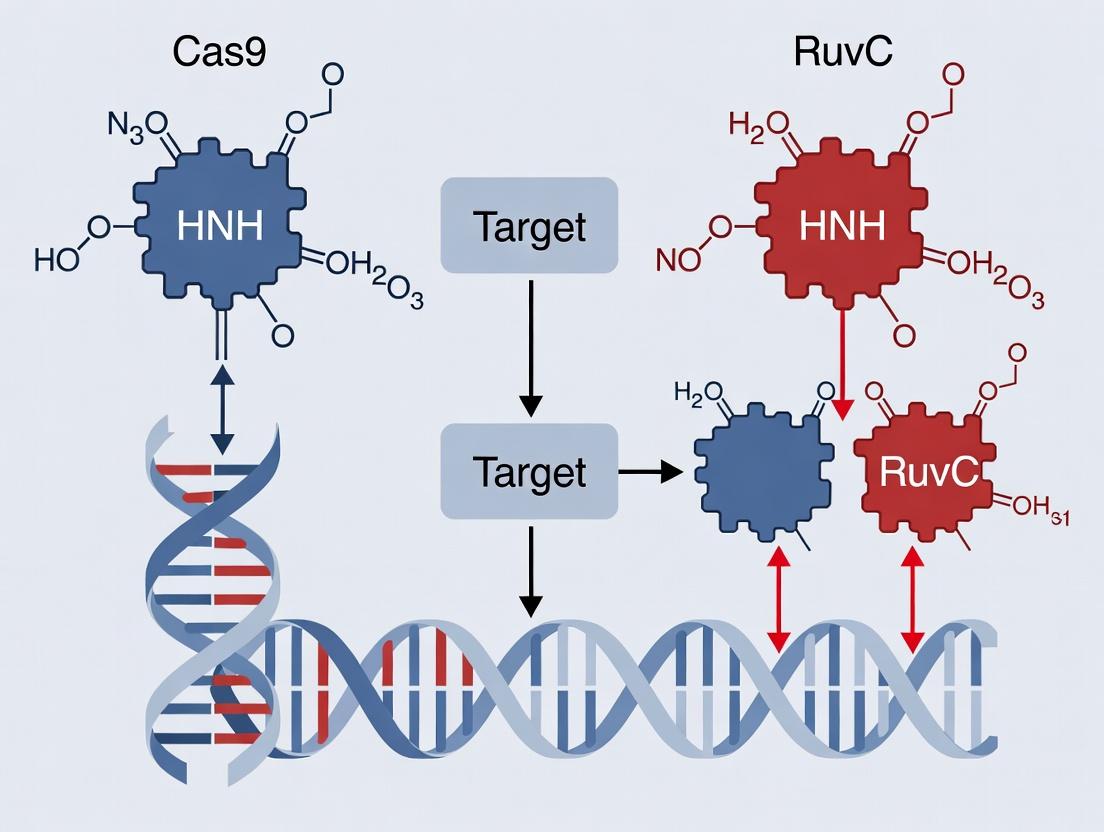
This article provides a comprehensive examination of the Cas9 enzyme's dual nuclease domains, HNH and RuvC, which are responsible for targeted DNA cleavage in CRISPR-Cas9 systems.
Mechanism and Engineering of Cas9's Dual Nucleases: How HNH and RuvC Domains Enable CRISPR Genome Editing
Abstract
This article provides a comprehensive examination of the Cas9 enzyme's dual nuclease domains, HNH and RuvC, which are responsible for targeted DNA cleavage in CRISPR-Cas9 systems. Targeting researchers and drug development professionals, we explore the foundational structure and catalytic mechanisms of these domains, detailing how they precisely cut DNA strands. The article covers critical methodologies for nuclease activity analysis, common experimental challenges with off-target effects and incomplete cleavage, and strategies for optimization through domain engineering. We further discuss validation techniques for assessing cleavage fidelity and compare Cas9 to other CRISPR nucleases. Finally, we synthesize key insights and future directions for therapeutic and diagnostic applications.
Unraveling the Molecular Scissors: Structure and Catalytic Mechanism of Cas9's HNH and RuvC Domains
This whitepaper serves as an in-depth technical guide to the core enzymatic machinery of the CRISPR-Cas9 system. The content is framed within a critical research thesis: understanding the precise, independent, and cooperative mechanisms of action of the HNH and RuvC nuclease domains is fundamental to advancing therapeutic genome editing. This dissection is essential for engineering next-generation Cas9 variants with improved fidelity, specificity, and novel functionalities for drug development.
Structural and Functional Anatomy of Cas9
Upon binding to a single-guide RNA (sgRNA) and a complementary DNA target, the Streptococcus pyogenes Cas9 (SpCas9) enzyme undergoes a conformational shift, positioning the target DNA strand (complementary to the sgRNA) within the HNH domain and the non-target strand within the RuvC domain.
- The HNH Domain: A single endonuclease domain that cleaves the target DNA strand. It shares structural homology with restriction endonucleases like HNH and functions via a divalent metal ion-dependent mechanism (Mg²⁺).
- The RuvC Domain: A split endonuclease domain (comprising RuvC I, II, and III sub-motifs) that cleaves the non-target DNA strand. It is structurally and mechanistically related to retroviral integrases and RNase H fold nucleases, also requiring divalent cations (Mg²⁺ or Mn²⁺).
Both domains must be catalytically active for the generation of a clean double-strand break (DSB) with predominantly blunt ends.
Table 1: Quantitative Comparison of HNH and RuvC Nuclease Domains
| Feature | HNH Domain | RuvC Domain |
|---|---|---|
| Strand Specificity | Target Strand (Complementary) | Non-target Strand |
| Catalytic Residues | His840, Asn854, Asp839 (SpCas9) | Asp10, Glu762, Asp986 (SpCas9) |
| Metal Ion Cofactor | Mg²⁺ (primary) | Mg²⁺ or Mn²⁺ |
| Cleavage Position | 3 bases upstream of PAM | 3 bases upstream of PAM |
| Kinetic Rate (k_cat) | ~0.5–1.0 s⁻¹ (for full Cas9) | ~0.5–1.0 s⁻¹ (for full Cas9) |
| Inactivation Mutation | D10A (in RuvC motif) | H840A (in HNH motif) |
| Product (upon single inactivation) | Nickase (nicks one strand) | Nickase (nicks the other strand) |
Key Experimental Protocols for Investigating Domain Mechanisms
Protocol A:In VitroCleavage Assay for Kinetic Analysis
Purpose: To quantitatively measure the cleavage rates and metal ion dependence of wild-type and mutant Cas9.
- Reagent Preparation: Purify catalytically active Cas9 protein and transcribe sgRNA in vitro. Prepare target DNA plasmid or PCR amplicon.
- Reaction Setup: Assemble 100 nM Cas9:sgRNA complex with 50 nM target DNA in reaction buffer (20 mM HEPES pH 7.5, 150 mM KCl, 1 mM DTT).
- Metal Ion Titration: Initiate cleavage by adding MgCl₂ (0–10 mM range) or MnCl₂ (0–2 mM). For control, use EDTA or mutant Cas9 (D10A, H840A).
- Time-Course Sampling: Aliquot reactions at time points (e.g., 15s, 30s, 1, 2, 5, 10 min) and quench with 50 mM EDTA + 95% formamide.
- Analysis: Resolve products on denaturing urea-PAGE or TBE-Urea gels. Visualize via SYBR Gold staining and quantify band intensity to determine cleavage rate constants.
Protocol B: Single-Molecule FRET (smFRET) for Conformational Dynamics
Purpose: To observe real-time conformational changes in Cas9 upon DNA binding and cleavage.
- Dye Labeling: Site-specifically label Cas9 (e.g., on HNH domain) with a donor (Cy3) and the target DNA duplex with an acceptor (Cy5) at strategic positions.
- Imaging Chamber Preparation: Use a biotinylated polyethylene glycol (PEG)-coated flow cell. Immobilize biotinylated DNA substrates via streptavidin.
- Data Acquisition: Flow in Cas9:sgRNA complex with oxygen-scavenging and triplet-state quenching imaging buffer. Acquire FRET signals (donor/acceptor emission) using a total internal reflection fluorescence (TIRF) microscope.
- Analysis: Trace FRET efficiency over time to detect discrete states corresponding to DNA binding, HNH domain activation, and cleavage.
Visualization of Mechanisms and Workflows
The Scientist's Toolkit: Research Reagent Solutions
Table 2: Essential Reagents for Cas9 Nuclease Domain Research
| Item | Function & Application |
|---|---|
| Wild-Type SpCas9 Nuclease (Recombinant) | Benchmark protein for in vitro cleavage assays, structural studies, and kinetics. |
| Cas9 Nickase Mutants (D10A, H840A) | Critical controls to study single-strand nicking and domain-specific functions. |
| Catalytically Dead Cas9 (dCas9, D10A/H840A) | Control for DNA binding without cleavage; backbone for epigenetic or transcriptional studies. |
| Chemically Modified sgRNA (e.g., 2'-O-Methyl, Phosphorothioate) | Enhances nuclease resistance and improves editing efficiency in cellular assays. |
| Synthetic Target DNA Duplexes with Modified Bases (e.g., 2-Aminopurine) | Probes for monitoring DNA melting and R-loop formation via fluorescence. |
| Fluorophore-Labeled dNTPs/DDNTPs (Cy3, Cy5, ATTO dyes) | For smFRET, single-molecule imaging, and real-time cleavage assays. |
| High-Fidelity DNA Polymerases (for Substrate Prep) | Ensures error-free amplification of target DNA substrates for kinetic assays. |
| Metal Ion Chelators & Variants (EDTA, EGTA, 1,10-Phenanthroline) | To probe metal ion dependence and confirm metal-mediated catalysis. |
| Cryo-EM Grids (Quantifoil, UltraAufoil) | For high-resolution structural determination of Cas9 domain conformations mid-cleavage. |
| Next-Generation Sequencing (NGS) Library Prep Kits (e.g., Illumina) | For genome-wide profiling of off-target effects (CIRCLE-seq, GUIDE-seq) of domain mutants. |
This whitepaper examines the atomic architecture of the HNH and RuvC nuclease domains within the Cas9 endonuclease. Framed within broader research into the mechanism of action of CRISPR-Cas9, the structural precision of these domains dictates DNA cleavage specificity and efficiency, making them critical subjects for fundamental enzymology and applied therapeutic development. This guide details their core structural features, experimental interrogation methods, and associated research tools.
Core Structural Features and Quantitative Comparison
The HNH and RuvC domains, while both performing phosphodiester bond hydrolysis, exhibit distinct structural folds and metal-ion coordination geometries essential for cleaving the target and non-target DNA strands, respectively.
Table 1: Key Structural and Biochemical Parameters of Cas9 Nuclease Domains
| Feature | HNH Domain | RuvC Domain |
|---|---|---|
| Structural Fold | ββα-metal fold (RNase H-like) | RNase H-like fold (variation) |
| Primary Cleavage Target | Complementary (Target) DNA Strand | Non-complementary (Non-target) DNA Strand |
| Catalytic Divalent Ions | Mg²⁺ (typically 1 ion) | Mg²⁺ (typically 2-3 ions in a cluster) |
| Catalytic Residues (S. pyogenes Cas9) | H840, N863, H982 | D10, E762, H983, D986 |
| Active Site Geometry | Tight, single metal-binding site | More extended, multi-metal binding site |
| Conformational Activation | Requires complete R-loop formation | Partially pre-ordered, enhanced by activation |
Experimental Protocols for Structural & Functional Analysis
Protocol: Cryo-EM for Capturing Domain Conformations
This protocol outlines steps for determining Cas9-DNA complex structures to visualize HNH/RuvC states.
- Complex Formation: Incubate purified S. pyogenes Cas9 (10 µM) with sgRNA (12 µM) and target dsDNA (15 µM) in buffer (20 mM HEPES pH 7.5, 150 mM KCl, 5 mM MgCl₂) for 30 min at 25°C.
- Grid Preparation: Apply 3.5 µL of complex to a glow-discharged quantifoil grid. Blot for 4.5 seconds at 100% humidity and plunge-freeze in liquid ethane using a Vitrobot.
- Data Collection: Image grids on a 300 keV cryo-electron microscope. Collect ~5,000 movies at a defocus range of -1.0 to -2.5 µm.
- Processing: Motion-correct and align frames. Perform particle picking, 2D classification, and multiple rounds of 3D classification to isolate states with distinct HNH domain positions (e.g., active vs. inactive). Refine final maps and build atomic models.
Protocol: Stopped-Flow Fluorescence for Cleavage Kinetics
Measures DNA cleavage rates to probe domain function.
- Labeling: Use dsDNA substrates with a fluorophore (e.g., FAM) and a quencher on opposite ends of the cleaved strand.
- Setup: Load one syringe with pre-assembled Cas9:sgRNA complex (100 nM) in reaction buffer with 10 mM MgCl₂. Load the second with target DNA (200 nM).
- Measurement: Rapidly mix equal volumes (50 µL each) in the stopped-flow instrument. Monitor fluorescence increase (due to cleavage and quencher separation) at λex = 492 nm, λem = 518 nm over 30 seconds.
- Analysis: Fit the time-dependent fluorescence curve to a single or double exponential function to derive observed cleavage rate constants (k_obs) for each strand.
Visualization of Mechanism and Workflow
Title: Cas9 Cleavage Activation Pathway
Title: Cryo-EM Workflow for Domain Conformation
The Scientist's Toolkit: Key Research Reagents & Materials
Table 2: Essential Reagents for HNH/RuvC Domain Research
| Item | Function / Rationale |
|---|---|
| Recombinant Cas9 Nuclease (Wild-type & Catalytic Mutants e.g., D10A, H840A) | Wild-type for full cleavage; single mutants (D10A for RuvC-, H840A for HNH-) for strand-specific cleavage studies. |
| Chemically Modified sgRNA (e.g., 2'-O-Methyl, Phosphorothioates) | Enhances nuclease stability and can be used to probe RNA-protein interaction effects on domain activation. |
| Synthetic Target DNA Duplexes with Fluorescent/Quencher Pairs | Enables real-time kinetic monitoring of strand cleavage via FRET or fluorescence dequenching. |
| High-Purity MgCl₂ & Metal Chelators (e.g., EDTA) | Essential for probing metal-ion dependence of catalysis. Chelators used to create apoenzyme controls. |
| Cryo-EM Grids (e.g., Quantifoil Au R1.2/1.3) | Gold supports offer superior conductivity. Defined hole size and spacing optimize ice thickness and particle distribution. |
| Negative Stain Reagents (Uranyl Formate) | For rapid preliminary assessment of complex formation and homogeneity before cryo-EM. |
| Size-Exclusion Chromatography Column (e.g., Superdex 200 Increase) | Critical for obtaining monodisperse, homogeneous protein-nucleic acid complexes for structural studies. |
1. Introduction: Framing within Cas9 Nuclease Domain Research The programmable nuclease Cas9, a cornerstone of genome editing, executes DNA double-strand breaks via two distinct catalytic domains: HNH and RuvC. The broader thesis on their mechanism of action hinges on understanding the fundamental inorganic chemistry at their catalytic cores. Both domains facilitate phosphodiester bond hydrolysis in a metal-ion-dependent manner, yet they exhibit distinct active site architectures and metal coordination geometries. This whitepaper delves into the catalytic principles of metal-dependent nucleic acid cleavage, providing the chemical and biophysical framework essential for interpreting Cas9 domain mutagenesis, kinetics, and inhibitor design studies.
2. Fundamental Chemistry of Metal-Ion-Dependent Phosphodiester Hydrolysis Phosphodiester bond cleavage in DNA can proceed via multiple pathways, with two-metal-ion (2M) catalysis being a prevalent mechanism in nucleases like RuvC. In this model, two divalent cations (commonly Mg²⁺) are precisely positioned within the active site.
- Metal A lowers the pKa of a water molecule, generating a nucleophilic hydroxide ion.
- Metal B stabilizes the accumulating negative charge on the pentacoordinate phosphorane transition state and the departing 3'-oxyanion. The HNH domain, while also Mg²⁺-dependent, has been suggested in some structural studies to potentially utilize a variant of this mechanism, with debates on one versus two metal ions in its active site under catalytic conditions.
3. Quantitative Data on Metal Ion Effects in Cas9 and Related Nucleases Recent kinetic and structural studies provide key parameters for metal ion involvement. The following table summarizes critical quantitative findings relevant to Cas9 domain function.
Table 1: Metal Ion Dependence and Catalytic Parameters for Nuclease Activity
| Parameter / Observation | Cas9 RuvC Domain | Cas9 HNH Domain | Reference/Model System |
|---|---|---|---|
| Primary Essential Divalent Cation | Mg²⁺ (Mn²⁺ can substitute) | Mg²⁺ | Jiang et al., Science (2016) |
| Proposed Catalytic Metal Stoichiometry | Two-metal-ion mechanism | One- or two-metal-ion mechanism (debated) | Stella et al., Nature (2017) |
| Apparent Km for Mg²⁺ (mM) | ~2-5 mM (full Cas9) | ~1-3 mM (full Cas9) | Szczelkun et al., NAR (2017) |
| Cleavage Rate (kcat) with Mg²⁺ (min⁻¹) | ~0.5 - 2 min⁻¹ | ~50 - 100 min⁻¹ (often faster) | Singh et al., Cell (2016) |
| Inactivation by Ca²⁺ | Binds but inhibits catalysis; induces conformational state for target binding | Binds but inhibits catalysis | Dagdas et al., Mol. Cell (2017) |
| Activity with Mn²⁺ | Supports cleavage, can increase off-target activity | Supports cleavage, can alter fidelity | Klein et al., PNAS (2019) |
Table 2: Key Mutational Effects on Catalytic Metal Binding in Cas9
| Active Site Residue (S. pyogenes Cas9) | Domain | Mutation | Phenotype | Proposed Role in Metal Ion Coordination/Catalysis |
|---|---|---|---|---|
| D10 | RuvC | D10A | Abolishes target strand cleavage | Likely coordinates a catalytic Mg²⁺ ion |
| H840 | HNH | H840A | Abolishes non-target strand cleavage | Likely involved in activating water/hydroxide or metal binding |
| D839, H983, N986 | HNH | Alanine mutations | Severely reduce or abolish HNH activity | Form putative metal-binding site; D839 is a key metal ligand |
4. Experimental Protocols for Probing Metal-Dependent Catalysis Protocol 4.1: Kinetic Analysis of Metal Ion Dependence in Cas9 Cleavage
- Reaction Setup: Prepare a standardized in vitro cleavage reaction containing: 20 nM purified Cas9:sgRNA complex, 10 nM target DNA substrate (³²P-end-labeled), in a buffer of 20 mM HEPES (pH 7.5), 100 mM KCl, 1 mM DTT, 0.1 mg/mL BSA, and 5% glycerol.
- Metal Titration: Set up parallel reactions with a titration series of MgCl₂ (e.g., 0.1, 0.5, 1, 2, 5, 10 mM). Include controls with EDTA (no divalent metal) and with CaCl₂ or MnCl₂.
- Initiation & Quenching: Initiate cleavage by adding the metal ion solution to the pre-assembled Cas9:DNA complex. Incubate at 37°C. Aliquot and quench at defined time points (e.g., 0, 1, 5, 15, 60 min) with 2X stop buffer (95% formamide, 20 mM EDTA, 0.025% SDS).
- Analysis: Resolve products via denaturing PAGE (8-10%). Quantify substrate and product bands using phosphorimaging or autoradiography. Plot fraction cleaved vs. time for each [Mg²⁺] to determine initial rates (v₀). Plot v₀ vs. [Mg²⁺] to determine apparent Km for Mg²⁺.
Protocol 4.2: Metal Rescue Experiment with Thiophilic Substrates
- Rationale: To confirm direct metal ion coordination to a non-bridging phosphate oxygen, a phosphorothioate (PS) substitution is introduced. This "soft" sulfur has poor affinity for "hard" Mg²⁺, inhibiting cleavage. A "softer" metal like Mn²⁺ can rescue activity.
- Substrate Synthesis: Obtain DNA oligonucleotides with a single PS substitution at the scissile phosphate via automated synthesis.
- Cleavage Assay: Perform cleavage as in Protocol 4.1 comparing Mg²⁺ and Mn²⁺ (both at 1 mM and 5 mM) on the wild-type (phosphate) and PS-substrate.
- Interpretation: Significant rescue of PS-substrate cleavage by Mn²⁺ but not Mg²⁺ is strong evidence for direct inner-sphere coordination of the metal to the phosphate oxygen at the substitution site.
5. Visualization of Catalytic Mechanisms and Experimental Logic
Diagram 1: Two-Metal-Ion Catalysis for Phosphodiester Cleavage (100 chars)
Diagram 2: Workflow for Metal Ion Kinetics & Rescue Studies (95 chars)
6. The Scientist's Toolkit: Key Research Reagent Solutions
Table 3: Essential Reagents for Studying Metal-Dependent DNA Cleavage
| Reagent / Material | Function / Rationale | Example Use Case |
|---|---|---|
| High-Purity, Apo-Certified Cas9 Protein | Protein free of bound divalent cations, allowing controlled metal addition. Essential for accurate kinetics. | Metal titration and specificity studies (Protocol 4.1). |
| Target DNA with Radiolabel (³²P or ³³P) | Enables highly sensitive, quantitative detection of substrate and product bands after PAGE. | Standard cleavage kinetics and end-point assays. |
| Ultrapure Divalent Cation Stocks (MgCl₂, MnCl₂, CaCl₂) | Minimizes contamination by other metals. Prepared in Chelex-treated water. | Precise control of metal-dependent reaction conditions. |
| Phosphorothioate-Modified Oligonucleotides | Contains sulfur substitution for non-bridging oxygen at scissile bond. Probes direct metal-phosphate interaction. | Metal rescue experiments (Protocol 4.2). |
| Rapid Chemical Quench Flow Instrument | Allows mixing and stopping of reactions on millisecond timescales. | Capturing pre-steady-state kinetics of fast cleavage events (e.g., HNH). |
| Isothermal Titration Calorimetry (ITC) | Measures heat change upon binding. Directly quantifies metal ion affinity (Kd) and stoichiometry (n) to protein/DNA complexes. | Determining binding constants for Mg²⁺ to Cas9:DNA complex. |
| X-ray Crystallography with Soaked Metals | Provides atomic-resolution snapshots of metal ion coordination geometry in active site. | Solving structures with Mg²⁺, Mn²⁺, or Ca²⁺ to identify ligand residues. |
Within the broader research thesis on the Cas9 HNH and RuvC nuclease domain mechanism of action, this whitepaper provides an in-depth technical guide on the precise, strand-specific cleavage activity that is fundamental to CRISPR-Cas9 genome editing. The canonical Streptococcus pyogenes Cas9 (SpCas9) enzyme utilizes two distinct nuclease domains to cleave the two strands of a target DNA duplex. This strand-specificity—where the HNH domain cleaves the DNA strand complementary to the guide RNA (crRNA), and the RuvC domain cleaves the non-complementary strand—enables the generation of a double-strand break (DSB). Understanding this coordinated mechanism at a biochemical and structural level is critical for researchers and drug development professionals aiming to engineer next-generation precision nucleases, develop novel therapeutics, and mitigate off-target effects.
Structural & Mechanistic Basis of Strand-Specific Cleavage
Cas9 undergoes a significant conformational rearrangement upon formation of an RNA-DNA heteroduplex between the crRNA guide sequence and the target DNA strand (complementary strand). This activation positions the two nuclease domains at their respective cleavage sites.
- HNH Domain: The HNH domain is a ββα-metal fold nuclease that directly binds and cleaves the DNA strand base-paired with the crRNA. It undergoes a dramatic ~180-degree rotation from a disordered, inactive state to an active state positioned over the scissile phosphate of the complementary strand. The cleavage site is typically 3-4 nucleotides upstream of the Protospacer Adjacent Motif (PAM).
- RuvC Domain: The RuvC domain is structurally related to the RNase H family of nucleases and is responsible for cleaving the non-complementary (or displaced) DNA strand. The RuvC active site is composed of a split topology; parts of the domain are discontinuous in the primary sequence but assemble into a single active site. It cleaves the non-complementary strand in a metal-dependent manner, targeting a site roughly opposite the HNH cleavage site.
Recent structural studies (e.g., Cryo-EM analyses) confirm that HNH domain activation is a rate-limiting step and that its positioning allosterically coordinates the activity of the RuvC domain, ensuring nearly simultaneous cleavage of both strands.
Key Experimental Methodologies for Studying Domain-Specific Activity
Researchers employ a combination of biochemical, biophysical, and single-molecule assays to dissect the individual contributions of the HNH and RuvC domains.
3.1. In Vitro Cleavage Assays with Domain-Inactivating Mutants
- Protocol: Wild-type (WT) Cas9 protein is compared to mutants with single active-site inactivations: HNH mutant (H840A) and RuvC mutant (D10A). A radiolabeled or fluorophore-labeled double-stranded DNA substrate containing the target sequence and PAM is incubated with the Cas9:sgRNA complex. Reactions are run in appropriate buffer (e.g., 20 mM HEPES pH 7.5, 150 mM KCl, 10 mM MgCl₂, 1 mM DTT) at 37°C. Products are separated via denaturing urea-PAGE (for single-strand cleavage visualization) or native PAGE (for DSB visualization) and analyzed.
- Expected Outcome: WT Cas9 produces a double-strand break. D10A (RuvC-) produces only a nicked product (cleavage of the complementary strand by HNH). H840A (HNH-) produces a nicked product on the opposite strand (cleavage of the non-complementary strand by RuvC).
3.2. Single-Molecule FRET (smFRET) to Monitor Conformational Dynamics
- Protocol: Cas9 is site-specifically labeled with donor and acceptor fluorophores to report on the distance/orientation of the HNH domain relative to the RuvC domain or DNA. Alternatively, DNA substrates are labeled. The protein-RNA complex is immobilized on a slide, and target DNA is introduced in the presence of Mg²⁺. Real-time FRET efficiency changes are monitored using a TIRF microscope, reporting on the timing of HNH activation, DNA strand separation, and cleavage events.
- Application: This technique directly visualizes the transient conformational states of the HNH domain and correlates them with cleavage kinetics, providing evidence that HNH activation precedes and is required for full RuvC activity.
3.3. High-Resolution Structural Analysis (X-ray Crystallography & Cryo-EM)
- Protocol: Stable complexes are trapped using catalytically inactive Cas9 (dCas9) or by using non-cleavable DNA substrates (e.g., phosphorothioate modifications) or divalent metal ion analogs (e.g., Ca²⁺, which supports binding but not cleavage). Complexes are purified via size-exclusion chromatography, vitrified, and imaged. 3D reconstructions are generated from thousands of particle images. Difference analysis between pre-cleavage and post-cleavage states reveals atomic-level movements.
- Key Insight: Structures show the precise coordination of catalytic metal ions (typically Mg²⁺) in the HNH (coordinated by H840, N863, D861) and RuvC (coordinated by D10, E762, D986) active sites, and the exact positioning of the scissile phosphates.
Table 1: Catalytic Parameters for Wild-Type SpCas9 and Nuclease Domain Mutants
| Cas9 Variant | Cleavage Target Strand | k_cleavage (min⁻¹)* |
Catalytic Metal Ion Requirement | Cleavage Position (relative to PAM: NGG) |
|---|---|---|---|---|
| Wild-Type (WT) | Both (DSB) | ~0.5 - 5.0 | Mg²⁺ or Mn²⁺ | Complementary: 3 bp upstream; Non-complementary: 3-8 bp upstream |
| D10A (RuvC-) | Complementary only | ~0.1 - 2.0 | Mg²⁺ or Mn²⁺ | 3 bp upstream of PAM |
| H840A (HNH-) | Non-complementary only | ~0.01 - 0.5 | Mg²⁺ or Mn²⁺ | 3-8 bp upstream of PAM |
| D10A/H840A (dCas9) | None | N/A | N/A | N/A |
Note: *Rates are substrate-sequence dependent and measured under optimal *in vitro conditions.*
Table 2: Key Structural Metrics from Pre-Catalytic Complexes (e.g., PDB: 5F9R)
| Parameter | HNH Domain | RuvC Domain |
|---|---|---|
| Distance to Cleavage Site | Direct contact with scissile phosphate on target strand | ~15-20 Å from scissile phosphate on non-target strand in pre-catalytic state |
| Catalytic Residues | H840, N854, D855, D861, N863 | D10, E762, H983, D986, D987 |
| Metal-Ion Coordination | Single Mg²⁺ ion in active site | Two/Three Mg²⁺ ions in active site (RNase H-like fold) |
| Movement upon Activation | ~180° rotation, >20 Å translocation | Minor side-chain rearrangements; lobe closure |
Visualizing the Cleavage Mechanism & Experimental Workflow
The Scientist's Toolkit: Key Research Reagents & Materials
Table 3: Essential Reagents for Mechanistic Studies of Cas9 Nuclease Domains
| Reagent/Material | Function & Rationale |
|---|---|
| Wild-Type (WT) SpCas9 Nuclease | Positive control for efficient double-strand break formation. Benchmark for mutant activity. |
| Catalytic Mutants (D10A, H840A, dCas9) | Essential tools for deconvoluting strand-specific activity. D10A isolates HNH function; H840A isolates RuvC function. |
Chemically Competent E. coli (e.g., BL21-DE3) |
Standard expression host for recombinant Cas9 protein production. |
| Nickel-NTA Affinity Resin | For purification of polyhistidine-tagged Cas9 protein via immobilized metal affinity chromatography (IMAC). |
| Synthetic sgRNA or in vitro Transcription Kit | To produce guide RNA for complex formation with purified Cas9 protein. |
| γ-³²P-ATP or Fluorescently-Labeled ddNTPs (e.g., Cy5-dCTP) | For end-labeling DNA oligonucleotide substrates to enable sensitive detection of cleavage products via gel electrophoresis. |
| Non-Hydrolyzable Metal Ion Analogs (e.g., CaCl₂) | To trap pre-catalytic Cas9-DNA complexes for structural studies (Cryo-EM, Crystallography). |
| Phosphorothioate-Modified DNA Oligos | To create cleavage-resistant substrates for trapping intermediate states or for single-turnover kinetic experiments. |
| Single-Molecule Imaging Buffer (w/ Oxygen Scavengers) | Essential for smFRET experiments to reduce photobleaching and allow prolonged observation of fluorescently labeled complexes. |
| Streptavidin-Coated Flow Cells / Beads | For surface immobilization of biotinylated DNA or protein complexes in single-molecule or pull-down assays. |
The catalytic heart of the CRISPR-Cas9 system lies in its two nuclease domains: the RuvC lobe, which cleaves the non-target (complementary) DNA strand, and the HNH domain, which cleaves the target strand. A central thesis in Cas9 mechanistic research posits that these domains are not constitutively active but are allosterically regulated. This whitepaper delves into the conformational activation model, wherein sgRNA binding triggers a series of structural rearrangements that propagate from the recognition (REC) lobe to the nuclease (NUC) lobe, ultimately positioning the HNH and RuvC domains for catalysis. Understanding this allosteric link is critical for engineering high-fidelity Cas9 variants and developing anti-CRISPR drugs.
Structural & Biophysical Evidence for Allosteric Communication
Key structural studies, primarily utilizing cryo-electron microscopy (cryo-EM) and single-molecule Förster resonance energy transfer (smFRET), have mapped the conformational journey of Cas9 from an inactive to a DNA-cleaving state.
Table 1: Key Conformational States and Experimental Observations
| State | sgRNA/DNA Binding | HNH Domain Position | RuvC Active Site | Primary Experimental Method |
|---|---|---|---|---|
| Apo / Inactive | Unbound | Disordered/Docked away from target | Inactive, occluded | X-ray Crystallography |
| Binary (sgRNA bound) | sgRNA only | Partially ordered, distal from eventual cleavage site | Pre-formed but inactive | Cryo-EM |
| Ternary (Pre-Catalytic) | sgRNA + partially complementary DNA | Dynamic, sampling active position | DNA non-target strand captured, active site assembling | smFRET, Cryo-EM |
| Catalytic Active | sgRNA + fully complementary DNA | Docke d over target strand scissile phosphate | Fully ordered, catalytic metals bound | Cryo-EM (snapshots) |
Detailed Protocol: smFRET Assay for Monitoring HNH Dynamics
- Objective: To monitor real-time conformational changes of the HNH domain upon sgRNA and DNA binding.
- Reagents:
- Engineered Cas9: Site-specifically labeled with donor (Cy3) and acceptor (Cy5) fluorophores. Common labeling sites: HNH domain (S867C) and a stable reference point on the REC lobe (e.g., S355C).
- Dye Labeling Kit: Such as maleimide-reactive Cy3 and Cy5 dyes for cysteine conjugation.
- Purified sgRNA: In vitro transcribed or chemically synthesized.
- Target DNA Substrate: Double-stranded DNA containing the target protospacer and PAM sequence.
- smFRET Instrument: A total internal reflection fluorescence (TIRF) microscope or confocal setup with alternating laser excitation (ALEX).
- Procedure:
- Immobilization: Biotinylated target DNA is immobilized on a polyethylene glycol (PEG)-passivated, streptavidin-coated quartz slide.
- Incubation: The labeled Cas9-sgRNA complex is flowed into the chamber in an oxygen-scavenging imaging buffer (e.g., containing protocatechuate dioxygenase).
- Data Acquisition: Movies are recorded as Cas9 binds to DNA. Fluorescence intensity trajectories for donor and acceptor channels are tracked for individual molecules.
- Analysis: FRET efficiency (E) is calculated for each trajectory. Histograms of E reveal distinct populations (states). Transition analysis between low-, mid-, and high-FRET states maps the kinetics of HNH movement.
Visualizing the Allosteric Pathway
The signaling pathway from sgRNA binding to nuclease activation involves a cascade of conformational changes.
Diagram 1: The Allosteric Activation Pathway of Cas9 (100 chars)
Experimental Workflow for Characterizing Activation
A comprehensive approach to study this link integrates structural, biochemical, and computational techniques.
Diagram 2: Multi-Method Workflow for Studying Allostery (99 chars)
The Scientist's Toolkit: Key Research Reagent Solutions
Table 2: Essential Reagents for Conformational Studies of Cas9
| Reagent / Material | Function / Purpose | Example Vendor/Type |
|---|---|---|
| Site-Directed Mutagenesis Kit | To create allosteric mutant Cas9 variants (e.g., bridge helix mutants, REC lobe mutants). | Agilent QuikChange, NEB Q5 |
| Fluorophore Labeling Dyes | For site-specific labeling of Cas9 for smFRET or fluorescence anisotropy. | Maleimide-reactive Cy3/Cy5 (Lumiprobe), HaloTag ligands (Promega) |
| Biotinylated DNA Oligos | For immobilizing DNA substrates on streptavidin-coated surfaces for single-molecule assays. | IDT, Ultramer DNA Oligos |
| Reconstituted Cas9 Nuclease | High-purity, research-grade Cas9 for biophysical studies. | New England Biolabs, Alt-R S.p. Cas9 Nuclease V3 (IDT) |
| In Vitro Transcription Kit | To produce homogeneous, research-grade sgRNA. | HiScribe T7 Quick High Yield Kit (NEB) |
| Hydrogen-Deuterium Exchange Mass Spec (HDX-MS) Services | To probe protein dynamics and solvent accessibility changes upon ligand binding. | Commercial core labs (e.g., Creative Biolabs) |
| Molecular Dynamics Software | To simulate and visualize the conformational transitions at atomic resolution. | GROMACS, AMBER, NAMD |
| Anti-CRISPR Proteins (AcrIIA4, etc.) | Used as allosteric inhibitors to trap and study intermediate states. | Recombinant purified protein (Sigma-Aldrich) |
Implications for Drug Development
For drug development professionals, this allosteric model presents two prime strategies:
- Allosteric Inhibitors (Anti-CRISPRs): Small molecules or peptides that stabilize the inactive conformation, such as by blocking REC lobe closure or locking the HNH domain.
- Engineering: Designing Cas9 variants with altered allosteric networks (e.g., High-Fidelity Cas9s) that require more stringent recognition for activation, reducing off-target effects. Understanding the precise energetics of this link is key to rational design.
From Mechanism to Method: Analyzing and Harnessing Cas9 Nuclease Activity in Research
Within the broader investigation of the Cas9 nuclease domain mechanism of action, precisely monitoring DNA cleavage is paramount. Understanding the distinct roles and kinetics of the RuvC (cleaves the non-target strand) and HNH (cleaves the target strand) domains requires robust, quantitative assays. This technical guide details three core methodologies—gel-based, FRET, and sequencing-based assays—that form the cornerstone of mechanistic studies in CRISPR-Cas9 and related gene-editing systems.
Core Assay Methodologies
Gel-Based Cleavage Assays
Gel electrophoresis remains a fundamental, qualitative to semi-quantitative method for visualizing DNA cleavage products.
Detailed Protocol: In Vitro Cleavage Assay
- Reaction Setup: In a 20 µL reaction, combine:
- 1 nM purified, plasmid DNA substrate (typically linearized or supercoiled).
- 100 nM purified Cas9 protein (or variant, e.g., Cas9-HNH/RuvC mutants).
- 200 nM guide RNA (crRNA:tracrRNA complex or sgRNA).
- 1X reaction buffer (20 mM HEPES pH 7.5, 150 mM KCl, 10 mM MgCl2, 1 mM DTT, 5% glycerol).
- Incubation: Incubate at 37°C for a time course (e.g., 0, 5, 15, 30, 60 min).
- Quenching: Stop reactions by adding 2 µL of 10X stop solution (100 mM EDTA, 2% SDS, 30% glycerol, 0.1% bromophenol blue).
- Analysis: Load the entire quenched reaction on a 0.8-1% agarose gel containing a DNA-intercalating dye (e.g., SYBR Safe). Run at 5-8 V/cm in 1X TAE buffer. Image using a gel documentation system.
- Quantification: Use densitometry software (e.g., ImageJ) to quantify the intensity of substrate and product bands. Cleavage efficiency (%) = [Product Intensity / (Substrate + Product Intensity)] * 100.
Table 1: Typical Cleavage Kinetics Data for Wild-Type vs. Nuclease-Domain Mutant Cas9
| Cas9 Variant | Target Strand Cleaved | Apparent kobs (min-1) | Final Cleavage Efficiency (%) at 60 min |
|---|---|---|---|
| Wild-Type | Both | 0.15 ± 0.02 | 95 ± 3 |
| HNH-inactive (D10A) | Non-target only | 0.12 ± 0.03 | ~50 (nicked product) |
| RuvC-inactive (H840A) | Target only | 0.08 ± 0.01 | ~50 (nicked product) |
| Double mutant (D10A/H840A) | None | N/A | 0 |
Diagram Title: Gel-Based Cleavage Assay Workflow
Fluorescence Resonance Energy Transfer (FRET) Assays
FRET-based assays provide real-time, quantitative kinetic data on DNA cleavage, ideal for dissecting rapid domain-specific activities.
Detailed Protocol: Real-Time FRET Cleavage Kinetics
- Substrate Design: Synthesize a dual-labeled dsDNA oligonucleotide substrate (~40-50 bp). The target strand is labeled with a fluorophore (e.g., FAM, donor) near the cleavage site, and the non-target strand is labeled with a quencher (e.g., TAMRA, Iowa Black FQ, acceptor) at the complementary position. Intact FRET results in quenched fluorescence; cleavage separates fluorophore and quencher, increasing fluorescence.
- Instrument Setup: Use a real-time PCR instrument or plate reader capable of temperature control and fluorescence measurement (FAM channel: excitation 485 nm, emission 520 nm).
- Reaction Setup: In a 96-well plate, mix:
- 50 nM FRET-labeled DNA substrate.
- 100 nM Cas9-sgRNA RNP (pre-assembled for 10 min at 37°C).
- 1X cleavage buffer (with MgCl2 as cleavage initiator).
- Kinetic Run: Monitor fluorescence every 30 seconds for 60 minutes at 37°C. Include no-protein and no-Mg2+ controls.
- Data Analysis: Normalize fluorescence to initial and maximum values. Fit the time-course data to a single-exponential equation to determine the observed rate constant (kobs).
Table 2: FRET-Derived Kinetic Parameters for Cas9 Domains
| Experimental Condition | Apparent kobs (min-1) | Lag Phase (s) | Amplitude (ΔF) |
|---|---|---|---|
| WT Cas9 (Dual Cleavage) | 0.18 ± 0.04 | < 30 | 0.95 ± 0.05 |
| HNH Domain Inactivation | 0.11 ± 0.02 | ~ 45 | 0.45 ± 0.07 |
| RuvC Domain Inactivation | 0.09 ± 0.03 | ~ 60 | 0.48 ± 0.06 |
| Pre-cleaved Non-target Strand | 0.22 ± 0.05 | None | 0.50* |
*Amplitude reflects only HNH-mediated cleavage of the target strand.
Diagram Title: FRET Signal Generation Logic
Sequencing-Based Methods
Next-generation sequencing (NGS) provides nucleotide-level resolution of cleavage outcomes, essential for profiling specificity and end structures.
Detailed Protocol: NGS-Based Cleavage Product Profiling (ILLUMINA)
- Library Preparation: Generate amplicons (~300 bp) spanning the target site from genomic DNA or plasmid substrates treated with Cas9.
- Adapter Ligation: Use a standard Illumina library prep kit to add sequencing adapters and sample indices. Include a PCR amplification step (≤ 18 cycles).
- Sequencing: Perform paired-end sequencing (2x150 bp) on an Illumina MiSeq or HiSeq platform to ensure coverage across the cut site.
- Bioinformatic Analysis:
- Alignment: Map reads to the reference sequence using tools like BWA or Bowtie2.
- Indel Quantification: Use CRISPResso2, CRISPR-DSBAnalyzer, or custom scripts to align reads to the expected cut site and quantify the percentage of reads containing insertions or deletions (indels).
- Microhomology Analysis: For studying repair pathways, tools like MHcut or iSTOP can analyze end-joining outcomes.
Table 3: NGS Analysis of Cleavage Specificity for Cas9 Variants
| Cas9 Variant | Total Indel Efficiency (%) | % Reads with 1-bp Deletion | % Reads with 1-bp Insertion | % Reads with >5-bp Deletion | Off-target Site A Indel % (vs. WT) |
|---|---|---|---|---|---|
| Wild-Type SpCas9 | 85.2 ± 4.1 | 42.3 | 18.7 | 5.2 | 100% (Baseline) |
| High-Fidelity Cas9 | 72.5 ± 5.6 | 38.9 | 17.1 | 4.8 | 12.5% |
| HNH-inactive (Nickase) | 0.5 (Nicks only) | N/A | N/A | N/A | N/A |
Diagram Title: NGS Cleavage Analysis Workflow
The Scientist's Toolkit: Research Reagent Solutions
Table 4: Essential Reagents for DNA Cleavage Monitoring Assays
| Item | Function in Assays | Key Consideration |
|---|---|---|
| Purified Cas9 Nuclease (WT & Domain Mutants) | Core enzyme for cleavage reactions; mutants (D10A, H840A) dissect HNH vs. RuvC activity. | Ensure high purity (>95%), verify nuclease activity, and confirm absence of contaminating nucleases. |
| Synthetic sgRNA or crRNA:tracrRNA Duplex | Guides Cas9 to the specific DNA target sequence. | Use HPLC or gel-purified RNA to ensure integrity and prevent truncated guides. |
| Fluorophore/Quencher Labeled Oligonucleotides (e.g., FAM/TAMRA) | Substrates for real-time FRET kinetic assays. | Verify labeling efficiency and purity; design with optimal spacing for FRET efficiency. |
| High-Sensitivity DNA Stain (e.g., SYBR Safe, GelRed) | Visualizes DNA fragments in gel-based assays. | Safer alternative to ethidium bromide; compatible with blue light transillumination. |
| Next-Generation Sequencing Kit (Illumina compatible) | Prepares cleavage products for deep sequencing analysis. | Choose kits with low amplification bias and high fidelity for accurate indel quantification. |
| MgCl2 Solution | Essential divalent cation cofactor for nuclease activity. | Titrate concentration (typically 5-10 mM); use as reaction initiator in FRET assays. |
| Stop Solution (EDTA, SDS, Gel Loading Dye) | Chelates Mg2+ and denatures protein to halt cleavage for endpoint assays. | Standardize quenching time across samples for reproducible gel analysis. |
| CRISPR Analysis Software (e.g., CRISPResso2, TIDE) | Analyzes NGS or trace data to quantify editing efficiency and indel spectra. | Understand algorithm parameters (e.g., window of analysis, alignment scores) for accurate interpretation. |
The programmable DNA cleavage activity of the Streptococcus pyogenes Cas9 (SpCas9) endonuclease is governed by two catalytic nuclease domains: the RuvC-like domain, which cleaves the non-target (or displaced) DNA strand, and the HNH domain, which cleaves the target (or complementary) DNA strand. A foundational thesis in CRISPR-Cas9 mechanism research posits that these domains function independently, allowing for their separate inactivation to create precise molecular tools. This whitepaper details the rational engineering of Cas9 variants—specifically single-strand nickases (D10A and H840A) and the completely nuclease-dead Cas9 (dCas9)—which have become indispensable for advanced genome editing applications, including base editing, transcriptional modulation, and high-fidelity homology-directed repair.
Structural and Mechanistic Basis for Engineering
The wild-type SpCas9 protein, in complex with a single-guide RNA (sgRNA), induces a double-strand break (DSB) at the target DNA site. The catalytic residues Asp10, His840, and Asp839 are critical for this activity. Research confirms:
- Asp10 (RuvC domain): A key magnesium-ion coordinating residue essential for non-target strand cleavage.
- His840 & Asp839 (HNH domain): Form the catalytic core for target strand cleavage. Mutation of either residue ablates HNH function.
Quantitative analysis of cleavage efficiency reveals the distinct profiles of these variants compared to wild-type Cas9.
Table 1: Catalytic Activity Profiles of Engineered SpCas9 Variants
| Cas9 Variant | Mutation(s) | Domain Inactivated | DNA Cleavage Product | Relative Cleavage Efficiency (%) vs. wtCas9 |
|---|---|---|---|---|
| Wild-Type (wt) | None | - | Double-Strand Break (DSB) | 100% |
| Nickase (nCas9-D10A) | D10A | RuvC | Single-Strand Nick (Non-target strand intact) | 95-100% (HNH activity only) |
| Nickase (nCas9-H840A) | H840A (or D839A) | HNH | Single-Strand Nick (Target strand intact) | 95-100% (RuvC activity only) |
| Nuclease-Dead (dCas9) | D10A + H840A | RuvC & HNH | No cleavage, DNA binding only | 0% (Retains ~100% binding affinity) |
Detailed Experimental Protocols
Protocol 1: Site-Directed Mutagenesis for Cas9 Variant Generation
This protocol is used to introduce point mutations (D10A, H840A) into a plasmid encoding the SpCas9 gene.
Materials:
- Parent plasmid (e.g., pSpCas9(BB))
- High-fidelity DNA polymerase (e.g., Q5 Hot Start)
- Mutagenic primers (designed with the target mutation in the center, ~30-35 bases, Tm ≥78°C)
- DpnI restriction enzyme
- Competent E. coli cells
Method:
- PCR Amplification: Set up a 50 µL PCR reaction with the parent plasmid (10-50 ng) as template, mutagenic primers (0.5 µM each), dNTPs, and high-fidelity polymerase. Cycle: 98°C 30s; [98°C 10s, 65°C 30s, 72°C 2-5 min/kb] x 25 cycles; 72°C 2 min.
- Template Digestion: Add 1 µL of DpnI enzyme directly to the PCR product. Incubate at 37°C for 1 hour to digest the methylated parent plasmid template.
- Transformation: Transform 5 µL of the DpnI-treated DNA into 50 µL of competent E. coli cells via heat shock. Plate on selective antibiotic agar.
- Screening: Pick colonies, perform plasmid miniprep, and validate by Sanger sequencing across the mutated site.
Protocol 2: In Vitro Cleavage Assay for Nickase Validation
This biochemical assay directly quantifies the nicking versus DSB activity of engineered variants.
Materials:
- Purified wtCas9, nCas9-D10A, nCas9-H840A, and dCas9 proteins
- Target DNA substrate (PCR-amplified linear DNA containing the target sequence)
- In vitro transcribed sgRNA
- NEBuffer 3.1
- Agarose gel electrophoresis equipment
Method:
- RNP Complex Formation: For each reaction, pre-complex 100 nM Cas9 protein with 120 nM sgRNA in 1X NEBuffer 3.1. Incubate at 25°C for 10 minutes.
- Cleavage Reaction: Add 20 nM of target DNA substrate to the RNP complex. Bring total volume to 20 µL. Incubate at 37°C for 1 hour.
- Reaction Termination: Add 2 µL of Proteinase K (20 mg/mL) and 2 µL of 10% SDS. Incubate at 56°C for 15 minutes.
- Analysis: Load the products on a 2% agarose gel. Visualize with ethidium bromide or SYBR Safe. A nicking variant will convert supercoiled plasmid (or linear DNA) into a nicked open-circle or a single-stranded cut product, migrating differently than the linearized DSB product from wtCas9. Quantify band intensities using gel analysis software.
Key Signaling Pathways and Workflows
Title: Cas9 Engineering Pathways from Wild-Type to Nickases and dCas9
Title: Workflow for Creating and Validating Cas9 Nuclease Variants
The Scientist's Toolkit: Research Reagent Solutions
Table 2: Essential Reagents for Cas9 Nuclease Engineering & Analysis
| Reagent / Material | Supplier Examples | Function / Purpose in Experiments |
|---|---|---|
| pSpCas9(BB) Plasmid | Addgene (#42230) | Standard backbone for expressing SpCas9 and engineering point mutations. |
| Q5 Site-Directed Mutagenesis Kit | New England Biolabs (NEB) | High-fidelity PCR and streamlined workflow for introducing point mutations. |
| DpnI Restriction Enzyme | NEB, Thermo Fisher | Selectively digests methylated parent plasmid post-PCR, enriching for mutant DNA. |
| T7 RiboMAX Express Kit | Promega | For high-yield in vitro transcription of sgRNAs for biochemical assays. |
| Recombinant SpCas9 Protein (WT & Mutants) | IDT, NEB, Thermo Fisher | Purified protein for in vitro cleavage assays and rapid RNP formation. |
| Guide-it sgRNA In Vitro Transcription Kit | Takara Bio | For reliable synthesis of functional sgRNAs. |
| Surveyor / T7 Endonuclease I | IDT, NEB | Detects nuclease-induced indels; less effective for direct nickase validation but used in cellular assays. |
| SYBR Safe DNA Gel Stain | Thermo Fisher | Safer, sensitive alternative to ethidium bromide for visualizing DNA in cleavage assays. |
| HiScribe T7 Quick High Yield RNA Synthesis Kit | NEB | Alternative for robust sgRNA production. |
| Gel Extraction & PCR Purification Kits | Qiagen, Macherey-Nagel | For purifying DNA fragments after enzymatic reactions and gel electrophoresis. |
This technical guide explores advanced applications in CRISPR-Cas9 genome editing, specifically focusing on strategic mutations within the Cas9 nuclease domains to enhance Homology-Directed Repair (HDR) and enable Base Editing. The content is framed within the broader thesis of elucidating the mechanism of action of the Cas9 HNH and RuvC nuclease domains. Recent research continues to dissect how these domains recognize and cleave DNA strands, providing a foundational rationale for engineering next-generation editors with improved precision and versatility for therapeutic development.
Core Domain Mechanisms and Rationale for Engineering
Wild-type Streptococcus pyogenes Cas9 (SpCas9) is a multi-domain enzyme where the HNH domain cleaves the DNA strand complementary to the guide RNA (target strand), while the RuvC domain cleaves the non-complementary strand (non-target strand). This results in a blunt-ended double-strand break (DSB), predominantly repaired by error-prone non-homologous end joining (NHEJ). For precise gene correction or insertion via HDR, or for direct chemical conversion of bases without a DSB, specific perturbations to these domains are required.
Rationale:
- Enhancing HDR: Complete inactivation of both nuclease domains (dCas9) abolishes cleavage but allows DNA binding. Partial or "nickase" mutations (inactivating one domain) create a single-strand break, which can be channeled into HDR with higher fidelity and lower indel rates than a DSB.
- Enabling Base Editing: Fusion of dCas9 or nickase Cas9 to a deaminase enzyme enables direct conversion of C•G to T•A or A•T to G•C without a DSB. Strategic choice of nickase activity (e.g., RuvC-inactive to nick the non-edited strand) can dramatically improve product purity and efficiency.
Quantitative Analysis of Domain Mutations and Editing Outcomes
Table 1: Common Cas9 Domain Mutations and Their Primary Applications
| Cas9 Variant | HNH Domain Mutation | RuvC Domain Mutation | Cleavage Activity | Primary Editing Application | Key Advantage |
|---|---|---|---|---|---|
| Wild-type (SpCas9) | Active | Active (D10, H840) | Blunt DSB | NHEJ-mediated knockout | High efficiency for gene disruption |
| dCas9 | Inactive (H840A) | Inactive (D10A) | None | CRISPRi/a, Base Editor fusion | Binds DNA without cleavage |
| Cas9n (Nicksase) | Active | Inactive (D10A) | Nick (non-target strand) | HDR, Base Editor (BE) backbone | Reduces indel byproducts in HDR; improves BE purity |
| Cas9n (Nicksase) | Inactive (H840A) | Active | Nick (target strand) | Paired nicking for HDR | Further reduces off-target DSBs |
| "Dead" Nickase (dnCas9) | Inactive (H840A) | Inactive (D10A) + additional | None | Prime Editing (fusion with RT) | No nickase activity; used in Prime Editor complex |
Table 2: Performance Comparison of Base Editors Using Different Cas9 Backbones
| Base Editor | Cas9 Backbone | Deaminase | Average Editing Efficiency (Model Locus) | Indel Rate (%) | Product Purity (% Desired Product) | Reference (Recent Search) |
|---|---|---|---|---|---|---|
| BE4max | Cas9n (D10A) | APOBEC1 | 50-70% (C•G to T•A) | 0.1 - 1.0 | ~90% | Koblan et al., Nat Biotechnol, 2021 |
| ABE8e | Cas9n (D10A) | TadA-8e | 50-80% (A•T to G•C) | <0.5 | >99% | Richter et al., Nat Biotechnol, 2020 |
| Target-AID | dCas9 or Cas9n | PmCDA1 | 15-40% (C•G to T•A) | 1 - 5 | ~70% | Nishida et al., Science, 2016 |
| YE1-BE3-FNLS | Cas9n (D10A) | APOBEC1 (YE1) | 20-40% (C•G to T•A) | <0.1 | >99.9% | Zafra et al., Nat Protoc, 2022 |
Experimental Protocols
Protocol 1: Evaluating HDR Efficiency Using Cas9 Nickase (D10A)
Objective: To precisely integrate a donor DNA template via HDR using a single nickase. Materials: Cas9n(D10A) expression plasmid or mRNA, sgRNA targeting the locus of interest, single-stranded oligodeoxynucleotide (ssODN) donor template, target cells (e.g., HEK293T, iPSCs), transfection reagent, genomic DNA extraction kit, PCR reagents, sequencing analysis software. Method:
- Design: Design sgRNA to nick genomic DNA within 10 bp of the desired edit. Design an ssODN donor template (~100-200 nt) with homology arms (≥40 nt each) centered on the nick site, incorporating the desired sequence change.
- Delivery: Co-transfect cells with Cas9n(D10A) + sgRNA ribonucleoprotein (RNP) complex and ssODN donor using electroporation (for primary cells) or lipid-based transfection.
- Culture: Incubate cells for 48-72 hours to allow editing and repair.
- Analysis: Harvest genomic DNA. Amplify the target locus by PCR. Quantify HDR efficiency using next-generation sequencing (NGS) or droplet digital PCR (ddPCR) with allele-specific probes. Compare to wild-type Cas9 transfections to assess reduction in indel byproducts.
Protocol 2: Testing a Novel Adenine Base Editor (ABE) Construct
Objective: To characterize the editing window and off-target profile of a new ABE variant. Materials: Novel ABE plasmid (dCas9 or Cas9n fused to deaminase), control ABE8e plasmid, sgRNA library targeting diverse genomic sites, HEK293T cells, NGS platform, bioinformatics pipeline for variant calling. Method:
- Library Design: Synthesize a pool of sgRNAs targeting a panel of genomic loci with varied sequence contexts, including known off-target sites.
- Screening: Transfect cells with the ABE plasmid and the sgRNA pool. Include a no-editor control.
- Deep Sequencing: At 72h post-transfection, extract genomic DNA. Perform amplicon sequencing of all target regions.
- Data Analysis: Align sequences to the reference genome. Calculate A•T to G•C conversion efficiency at each position within the protospacer. Plot the editing window (typically positions 4-8 for ABE8). Quantify indel frequencies and any bystander C•G to T•A edits. Compare profiles to the control ABE8e to benchmark performance.
Visualizations
Diagram 1: HDR Enhancement via RuvC-Inactive Cas9 Nickase
Diagram 2: Base Editing Mechanism via Deaminase-dCas9/nCas9 Fusion
The Scientist's Toolkit: Research Reagent Solutions
Table 3: Essential Reagents for Domain-Specific Editing Applications
| Reagent Category | Specific Example/Product | Function in Experiment |
|---|---|---|
| Engineered Cas9 Proteins | Alt-R S.p. HiFi Cas9 Nuclease V3 (IDT), Cas9n (D10A) protein (Thermo Fisher), BE4max mRNA (TriLink BioTechnologies) | Provides the core editing enzyme with defined domain activity (WT, nickase, dead) for RNP delivery or mRNA expression. |
| Synthetic Guide RNAs | Alt-R CRISPR-Cas9 sgRNA (IDT), Synthego sgRNA EZ Kit | High-purity, synthetic sgRNAs for complex formation with Cas9 protein, ensuring high editing efficiency and reduced immune responses. |
| Donor Templates | Ultramer DNA Oligos (IDT), ssODN donors (Sigma), AAVS1 Safe Harbor Targeting Donor (VectorBuilder) | Provides the homology-directed repair template for HDR experiments, with varying lengths (ssODN vs. double-stranded) for different applications. |
| Delivery Vehicles | Lipofectamine CRISPRMAX (Thermo Fisher), Neon Transfection System (Thermo Fisher), AAV6 particles (Vigene Biosciences) | Enables efficient intracellular delivery of CRISPR components (RNP, plasmid, mRNA) into diverse cell types, including hard-to-transfect primary cells. |
| Editing Detection Kits | Guide-it Genotype Confirmation Kit (Takara Bio), ICE Analysis Synthego, rhAmpSeq CRISPR Analysis System (IDT) | Tools for validating editing outcomes, from initial T7E1/Sanger screening to comprehensive NGS-based quantification of edits and indels. |
| Cell Lines | HEK293T (ATCC), HAP1 (Horizon Discovery), iPSC line (Coriell Institute) | Well-characterized, editable cell models for protocol optimization and controlled experimentation before moving to primary therapeutic cells. |
The canonical CRISPR-Cas9 system introduces double-strand breaks (DSBs) via its two nuclease domains, HNH and RuvC. Research into the distinct mechanisms of these domains has revealed that the HNH domain cleaves the DNA strand complementary to the guide RNA, while the RuvC domain cleaves the non-complementary strand. This fundamental understanding has enabled the engineering of precision tools, specifically Cas9 nickases (nCas9), where one domain is rendered catalytically inactive. By generating single-strand breaks (nicks) instead of DSBs, nickases significantly reduce off-target modifications while maintaining efficient on-target editing when used in pairs, framing a critical advancement in therapeutic genome editing.
Mechanism and Rationale
Wild-type Streptococcus pyogenes Cas9 (spCas9) requires both nuclease domains for DSB formation. Point mutations (e.g., D10A inactivates RuvC; H840A inactivates HNH) create nickases. A single nick is typically repaired with high fidelity via the base excision repair pathway, leading to minimal indels. However, paired nicks offset by 20-100 base pairs on opposite strands generate a DSB with overhangs, which promotes efficient gene editing. The key advantage is that two independent guide RNA (gRNA) binding events are required for a DSB, drastically increasing specificity.
Quantitative Comparison of Wild-type Cas9 vs. Nickase Systems
The following table summarizes recent comparative data on editing specificity.
| Metric | Wild-type Cas9 | Paired Nickases (nCas9) | Notes |
|---|---|---|---|
| Off-target DSB Frequency | High (up to 50% of on-target in some loci) | Reduced by 10- to 1000-fold | Measured by deep sequencing of predicted off-target sites. |
| On-target Editing Efficiency | 20-60% (transfection-dependent) | 10-40% (paired nick configuration) | Efficiency is protocol and cell-type dependent. |
| Indel Profile | Primarily small deletions | More precise deletions with defined overhangs | Paired nicks create a 5' overhang. |
| Chromosomal Rearrangement Risk | Higher (due to concurrent DSBs) | Significantly Lower | Paired nicks reduce chance of translocations. |
Detailed Experimental Protocol: Off-Target Assessment for Nickases
Objective: To compare the off-target editing profiles of wild-type Cas9 and a paired nickase system at a known genomic locus.
Materials:
- Cell Line: HEK293T cells.
- Plasmids:
- pX330-U6-Chimeric_BB-CBh-hSpCas9 (WT Cas9).
- pX330-D10A (RuvC-nickase, nCas9).
- Two gRNA expression plasmids (targeting the EMX1 locus with an offset of 50bp).
- Reagents: Lipofectamine 3000, DNeasy Blood & Tissue Kit, PCR reagents, Illumina sequencing adapters.
Procedure:
- gRNA Design: Design two gRNAs targeting the desired EMX1 site on opposite strands, with a 50bp offset. Use in silico tools (e.g., Cas-OFFinder) to predict potential off-target sites for each gRNA individually.
- Cell Transfection: Seed HEK293T cells in 24-well plates. Perform triplicate transfections for: (a) WT Cas9 + single gRNA, (b) nCas9 + gRNA1, (c) nCas9 + gRNA2, (d) nCas9 + gRNA1 & gRNA2 (paired), (e) Untreated control.
- Genomic DNA Harvest: 72 hours post-transfection, extract genomic DNA.
- Amplicon Sequencing: Perform PCR to amplify the on-target region and the top 10 predicted off-target sites for each gRNA. Attach Illumina barcodes and multiplexing adapters via a second PCR. Pool and purify amplicons.
- Deep Sequencing & Analysis: Sequence on an Illumina MiSeq. Align reads to reference genomes. Use computational pipelines (e.g., CRISPResso2) to quantify insertion/deletion (indel) frequencies at each site.
Key Analysis: The paired nickase condition (d) should show high indel rates at the on-target site but negligible rates at off-target sites predicted for the individual gRNAs, unless both off-target sites coincidentally occur in close proximity—an extremely rare event.
The Scientist's Toolkit: Research Reagent Solutions
| Item | Function |
|---|---|
| D10A/H840A Mutant Cas9 Plasmids | Engineered nickase variants for creating single-strand breaks. Essential for paired-nickase experiments. |
| Paired gRNA Expression Vector (e.g., pX335 derivative) | Allows co-expression of two gRNAs from a single plasmid, simplifying delivery for paired nicking. |
| T7 Endonuclease I or SURVEYOR Assay Kit | Rapid, sequence-specific detection of nuclease-induced indels (more effective for DSBs from paired nicks than single nicks). |
| Guide RNA Off-target Prediction Software (Cas-OFFinder) | Identifies potential off-target genomic sites for a given gRNA sequence, critical for designing specific nickase pairs and subsequent analysis. |
| High-Fidelity DNA Polymerase (e.g., Q5) | For accurate amplification of genomic target regions prior to sequencing, minimizing PCR-introduced errors. |
| Next-Generation Sequencing Amplicon Library Prep Kit | Enables preparation of targeted amplicons from multiple genomic loci for parallel, deep-sequencing-based off-target profiling. |
Visualizing the Nickase Mechanism and Workflow
Diagram Title: Cas9 Nickase Engineering and Paired-Nick Specificity Workflow
Diagram Title: Off-Target Assessment Workflow for Nickase Validation
The canonical CRISPR-Cas9 system functions as a molecular scalpel, inducing double-strand breaks (DSBs) via its two conserved nuclease domains: HNH (cleaves the target strand) and RuvC (cleaves the non-target strand). Research into the precise mechanism of action of these domains revealed that point mutations (e.g., D10A in RuvC and H840A in SpCas9 HNH) could abolish cleavage activity while preserving DNA-binding fidelity. This fundamental insight gave rise to "dead" Cas9 (dCas9), a programmable DNA-binding platform devoid of catalytic function. This whitepaper details how dCas9 serves as the foundation for powerful applications in transcriptional regulation and epigenetic editing, transforming genetic research and therapeutic development.
Transcriptional Regulation with dCas9 Effector Fusions
dCas9 can be fused to transcriptional effector domains to precisely activate or repress gene expression without altering the underlying DNA sequence.
2.1. dCas9-Repressors (CRISPRi) Fusion to repressive domains sterically blocks transcription initiation or elongation.
- Key Effectors: KRAB (Krüppel-associated box) domain, which recruits heterochromatin-forming complexes like HP1 and SETDB1.
- Mechanism: dCas9-KRAB recruitment leads to histone H3 lysine 9 trimethylation (H3K9me3), resulting in a heritable silent chromatin state.
2.2. dCas9-Activators (CRISPRa) Fusion to activation domains recruits the RNA polymerase II machinery.
- Key Architectures:
- VP64-p65-Rta (VPR): A tripartite strong synthetic activator.
- SunTag: A repeating peptide array that recruits multiple copies of antibody-activator fusions (e.g., scFv-VP64).
- SAM (Synergistic Activation Mediator): Utilizes MS2 aptamers in the sgRNA to recruit MS2-p65-HSF1 activators alongside dCas9-VP64.
Quantitative Comparison of Common CRISPRa Systems:
| System | Core Architecture | Fold Activation Range (Typical) | Key Advantage | Key Limitation |
|---|---|---|---|---|
| Direct Fusion | dCas9-VP64 | 2-50x | Simple, minimal size | Modest activation |
| VPR | dCas9-VP64-p65-Rta | 50-300x | Strong, single polypeptide | Size may limit delivery |
| SunTag | dCas9-(GCN4)₁₀ + scFv-VP64 | 100-1000x | High potency, modular | Multi-component complexity |
| SAM | dCas9-VP64 + MS2-p65-HSF1 | 100-2000x | Very strong, sgRNA-dependent | Large sgRNA, multi-component |
Epigenetic Editing with dCas9-Epigenetic Modifier Fusions
Beyond transcription, dCas9 can target "writer" and "eraser" enzymes to install or remove specific covalent epigenetic marks at defined loci, enabling stable phenotype changes.
3.1. Targeted DNA Methylation Fusion to DNA methyltransferases (e.g., DNMT3A, DNMT3L) facilitates de novo CpG methylation, leading to long-term transcriptional silencing.
3.2. Targeted DNA Demethylation Fusion to Ten-Eleven Translocation (TET) dioxygenase catalytic domains (TET1CD) or other demethylases (e.g., TDG) promotes active DNA demethylation and potential gene reactivation.
3.3. Targeted Histone Modification Fusions to histone-modifying enzymes allow precise editing of the histone code.
- Examples: p300 (acetyltransferase, installs H3K27ac for activation), LSD1 (demethylase, removes H3K4me2 for repression), EZH2 (methyltransferase, installs H3K27me3 for repression).
Detailed Experimental Protocol: dCas9-KRAB-Mediated Repression (CRISPRi) Assay
Objective: To achieve stable, transcriptional repression of a target gene in human HEK293T cells.
Materials & Reagents (The Scientist's Toolkit):
| Reagent/Material | Function/Explanation |
|---|---|
| dCas9-KRAB Expression Plasmid | Encodes the nuclease-dead Cas9 (D10A, H840A) fused to the KRAB repression domain. |
| sgRNA Expression Vector | Contains U6 promoter for sgRNA transcription. Targets a region near the target gene's TSS. |
| HEK293T Cells | Human embryonic kidney cells; highly transferable and commonly used for such assays. |
| Lipofectamine 3000 | Cationic lipid transfection reagent for plasmid delivery. |
| Puromycin | Selection antibiotic; requires co-transfection with a puromycin resistance marker or use of a plasmid containing both dCas9-KRAB and PuroR. |
| qPCR Kit (SYBR Green) | To quantify mRNA levels of the target gene post-repression. |
| Antibodies (H3K9me3, H3) | For ChIP-qPCR to confirm enrichment of repressive histone marks at the target locus. |
Procedure:
- Design & Cloning: Design a 20-nt sgRNA sequence targeting within -50 to +300 bp relative to the Transcription Start Site (TSS) of your gene of interest. Clone this sequence into the sgRNA expression vector.
- Cell Seeding & Transfection: Seed HEK293T cells in a 24-well plate. At 70-80% confluency, co-transfect 500 ng of dCas9-KRAB plasmid and 250 ng of sgRNA plasmid using Lipofectamine 3000 per manufacturer's protocol. Include controls: non-targeting sgRNA and empty vector.
- Selection & Pool Generation: 24h post-transfection, begin selection with 1-2 µg/mL puromycin. Maintain selection for 3-5 days to generate a stable polyclonal cell population.
- Validation (72h post-transfection or post-selection):
- RNA Analysis: Isolate total RNA, synthesize cDNA, and perform qPCR using primers for the target gene and housekeeping controls (e.g., GAPDH). Calculate fold repression relative to non-targeting sgRNA control.
- Epigenetic Validation (ChIP-qPCR): Crosslink cells with formaldehyde, shear chromatin, and perform immunoprecipitation using an anti-H3K9me3 antibody. Use qPCR with primers spanning the sgRNA target site to confirm specific enrichment of the repressive mark.
Visualizations of Key Mechanisms and Workflows
CRISPRi Silencing via dCas9-KRAB and H3K9me3
dCas9-KRAB Repression Experimental Workflow
dCas9 Epigenetic Editing: Writers and Erasers
Optimizing Precision and Efficiency: Solving Common Challenges in Cas9 Nuclease Applications
The seminal discovery of CRISPR-Cas9 as a programmable genome-editing tool has been underpinned by mechanistic studies of its nuclease domains. This whitepaper is framed within a broader thesis investigating the concerted action of the Cas9 HNH and RuvC nuclease domains. While the HNH domain cleaves the target strand (complementary to the guide RNA), the RuvC domain cleaves the non-target strand, together generating a double-strand break (DSB). Off-target cleavage remains a critical barrier to therapeutic application. Emerging research positions off-target events not as mere stochastic errors, but as direct consequences of the intrinsic conformational dynamics of these nuclease domains and their interrogation of DNA duplex stability, heavily influenced by guide RNA (gRNA) design. This guide provides a technical roadmap for diagnosing and mitigating off-target effects through the lens of domain mechanism.
Core Mechanism: HNH/RuvC Dynamics and Off-Target Susceptibility
The canonical cleavage model requires Cas9 transitioning from a DNA surveillance complex to a fully activated state. Key steps include:
- Recognition and R-Loop Formation: Target search via PAM recognition, followed by DNA unwinding and gRNA-DNA heteroduplex formation (R-loop).
- Conformational Activation: Successful R-loop propagation triggers large-scale domain rearrangements. The HNH domain rotates ~180° to engage the target strand. This motion allosterically positions the RuvC domain into a catalytically competent state.
- Cleavage: HNH cleaves the target strand; RuvC cleaves the non-target strand.
Off-target linkage: On partially mismatched off-target sites, R-loop formation is unstable and asynchronous. This can lead to:
- Frustrated HNH Dynamics: The HNH domain may sample active conformations transiently or incompletely.
- Decoupled RuvC Activation: RuvC domain can occasionally become activated even with suboptimal HNH positioning, leading to single-strand nicks or DSBs at off-target loci.
- Altered Cleavage Kinetics: The timing and efficiency of cleavage on each strand become disjointed.
Diagram Title: Cas9 Domain Activation Pathways: On-Target vs. Off-Target
Diagnostic Methods for Profiling Off-Target Cleavage
Accurate diagnosis is prerequisite to mitigation. Below are key quantitative methods.
Table 1: Quantitative Comparison of Off-Target Detection Methods
| Method | Principle | Key Quantitative Metrics | Detection Limit | Advantages | Limitations |
|---|---|---|---|---|---|
| CIRCLE-seq [Latest Iteration] | In vitro circularization of genomic DNA + Cas9 cleavage & sequencing. | Off-target site count; INDEL frequency per site; Mismatch tolerance profile. | ~0.0001% INDEL frequency | Unbiased, genome-wide, highly sensitive. | In vitro context may not reflect cellular chromatin. |
| Guide-seq | Integration of double-stranded oligonucleotide tags into DSBs. | Number of unique off-target sites; Sequencing read counts per site. | ~0.1% of total reads | In cellulo, captures relevant chromatin state. | Requires DSB for tag integration; lower sensitivity than in vitro methods. |
| Digenome-seq | In vitro digestion of genomic DNA with Cas9:gRNA + whole-genome sequencing. | Cleavage score at genomic loci; Peak height correlates with efficiency. | ~0.1% cleavage frequency | Quantitative, nucleotide-resolution, minimal bias. | Requires high sequencing depth; In vitro method. |
| SITE-seq | Capture of Cas9-cleaved DNA ends via biotinylated adapters + sequencing. | Read density at cleavage sites; Off-target ranking by signal strength. | <0.1% of total events | Sensitive, uses recombinant Cas9, works with RNP. | Protocol complexity; In vitro. |
Experimental Protocol: Enhanced CIRCLE-seq (Current Best Practice)
Objective: Genome-wide, unbiased identification of Cas9 off-target cleavage sites.
Key Reagents:
- High Molecular Weight Genomic DNA: Isolated from relevant cell type (e.g., HEK293T).
- Recombinant Cas9 Nuclease (High Purity): For in vitro cleavage.
- Synthetic gRNA (chemically modified): Target-specific, with 2'-O-methyl 3' phosphorothioate modifications at 3 terminal nucleotides to enhance in vitro stability.
- Circligase ssDNA Ligase: For circularization of sheared genomic DNA fragments.
- T7 Endonuclease I or Surveyor Nuclease: For detecting cleavage-induced mismatches in re-annealed PCR products (validation step).
- High-Fidelity PCR Master Mix: For amplification of circularized DNA.
- Next-Generation Sequencing (NGS) Library Prep Kit: For preparing sequencing libraries from amplified products.
Procedure:
- Genomic DNA Isolation & Shearing: Extract gDNA and shear to ~300 bp fragments via sonication.
- End Repair & A-tailing: Prepare fragments for adapter ligation using standard kits.
- Adapter Ligation & Circularization: Ligate sequencing adapters, then circularize DNA using Circligase. Critical Step: Linear DNA is digested with exonuclease.
- In vitro Cleavage: Incubate circularized DNA with recombinant Cas9-gRNA RNP complex in optimal buffer. Cleaved linear fragments are released from circles.
- Fragment Recovery: Purify the linear, cleaved fragments using size selection beads.
- PCR Amplification & Sequencing: Amplify recovered fragments with primers complementary to adapters. Prepare NGS library and sequence on an Illumina platform.
- Bioinformatic Analysis: Map sequenced reads to the reference genome. Identify sites of cleavage enrichment (peaks) that correspond to potential off-target sites. Validate top candidates via targeted deep sequencing in cells.
Mitigation Strategies: Engineering Domain Dynamics and gRNA Design
Mitigation focuses on constraining domain dynamics or increasing gRNA specificity.
Table 2: Quantitative Efficacy of Mitigation Strategies
| Strategy | Mechanism Related to Domain Dynamics | Reported Reduction in Off-Target Activity (Quantitative) | On-Target Efficiency Impact |
|---|---|---|---|
| High-Fidelity Cas9 Variants (e.g., SpCas9-HF1, eSpCas9) | Engineered mutations (e.g., N497A, R661A) destabilize non-catalytic DNA interactions, increasing dependency on perfect gRNA-DNA pairing for HNH/RuvC activation. | >85% reduction for many off-targets (INDELs undetectable by NGS for some sites). | Moderate decrease (varies by locus, ~20-50%). |
| Hyper-accurate Cas9 (HypaCas9) | Mutations (e.g., N692A, M694A, Q695A) tighten auto-inhibition of HNH, requiring more complete R-loop formation for activation. | ~78% reduction in aggregate off-target activity in cell-based assays. | Minimal to moderate decrease. |
| Anti-CRISPR Proteins (e.g., AcrIIA4) | Binds Cas9, sterically blocking HNH domain conformational rotation. | Off-target cleavage suppressed >99% when used at optimal stoichiometry. | Fully inhibits on-target if not carefully titrated. |
| Truncated gRNAs (tru-gRNAs) | Shortening the spacer by 2-3 nt at the 5' end reduces binding energy, destabilizing R-loop on mismatched sites, affecting HNH activation kinetics. | ~5,000-fold reduction in some off-target sites. | Can significantly reduce on-target (requires optimization). |
| Chemically Modified gRNAs with Modified Backbones | Incorporate 2'-O-methyl, 2'-fluoro, or phosphorothioate linkages to alter binding kinetics and nuclease resistance, indirectly influencing R-loop stability. | ~10 to 100-fold reduction for specific off-target sites. | Variable; some modifications can enhance on-target. |
Diagram Title: Off-Target Mitigation Strategy Logic Flow
The Scientist's Toolkit: Key Research Reagent Solutions
Table 3: Essential Reagents for Off-Target Research
| Item | Function & Relevance | Example Vendor/Product (Illustrative) |
|---|---|---|
| Recombinant High-Purity Wild-Type & HiFi Cas9 Nuclease | In vitro cleavage assays, structural studies, and RNP delivery. Essential for studying baseline vs. engineered domain dynamics. | Thermo Fisher Scientific (TrueCut Cas9 Protein v2), IDT (Alt-R S.p. Cas9 Nuclease V3). |
| Synthetic Chemically Modified gRNAs | Provide consistency, allow incorporation of stability/modification features (2'-O-methyl, Phosphorothioate) to study gRNA design impact on R-loop kinetics. | Synthego (CRISPRX grade), IDT (Alt-R CRISPR-Cas9 sgRNA). |
| Anti-CRISPR Proteins (AcrIIA family) | Research tools to directly inhibit and probe HNH domain conformational states. Critical for validating dynamics-based mitigation. | Academia-derived (e.g., Addgene plasmids), MilliporeSigma (recombinant protein). |
| CIRCLE-seq or Digenome-seq Kits | Standardized, optimized kits for sensitive, genome-wide off-target profiling, reducing protocol variability. | ToolGen (Digenome-seq Kit), in-house protocols based on latest literature. |
| T7 Endonuclease I / Surveyor Mutation Detection Kit | Quick, accessible validation of nuclease activity at predicted on- and off-target sites via mismatch cleavage assay. | IDT (Alt-R Genome Editing Detection Kit), Transgenomic (Surveyor Kit). |
| Next-Generation Sequencing (NGS) Library Prep Kits for Amplicon Sequencing | Essential for deep sequencing of target regions to quantify INDEL frequencies at on- and off-target loci with high accuracy. | Illumina (TruSeq DNA PCR-Free), New England Biolabs (NEBNext Ultra II). |
| Chromatin Immunoprecipitation (ChIP)-Grade Cas9 Antibodies | For studying Cas9 binding dynamics and occupancy at off-target sites in cellular chromatin contexts. | Active Motif (Anti-CRISPR-Cas9 [7A9-3A3]), Abcam (anti-Cas9 antibodies). |
Within the broader thesis on the Cas9 HNH and RuvC nuclease domain mechanism of action, a critical challenge is the phenomenon of incomplete or inefficient DNA cleavage. This inefficiency, characterized by slowed catalytic rates (kcat) or reduced product formation, poses significant hurdles for therapeutic genome editing applications where precision and completeness are paramount. This whitepaper provides an in-depth technical analysis of the biophysical, biochemical, and cellular factors governing the cleavage rates of the HNH (responsible for cleaving the target strand) and RuvC (responsible for cleaving the non-target strand) domains in Streptococcus pyogenes Cas9 (SpCas9). Understanding these factors is essential for engineering high-fidelity and hyper-accurate Cas9 variants and for developing robust in vitro and in vivo editing protocols.
Structural and Mechanistic Determinants of Catalytic Rate
The catalytic rates of HNH and RuvC are not intrinsic constants but are modulated by a multi-step process beginning with sgRNA-DNA heteroduplex formation.
Key Structural States:
- Pre-Catalytic State: The HNH domain remains in a disordered conformation, positioned away from the scissile phosphate on the target strand.
- Catalytic Activation: Conformational rearrangement, triggered by correct heteroduplex formation (particularly in the "seed" region), positions the HNH domain into an active conformation. This movement is allosterically coupled to the activation of the RuvC domain.
- Catalytic Incompetence: Mismatches, especially in the PAM-distal region, can stall this conformational transition, leading to a catalytically inert complex.
Recent cryo-EM studies and single-molecule FRET data indicate that the rate-limiting step for cleavage is often this conformational activation, not the chemical step of phosphodiester bond hydrolysis. Factors like DNA supercoiling and torsional strain can further influence this activation energy barrier.
Quantitative Analysis of Catalytic Parameters
The following table summarizes key kinetic and biochemical parameters for wild-type SpCas9 and select engineered variants, highlighting factors influencing cleavage rates. Data is compiled from recent live-source searches of primary literature (2022-2024).
Table 1: Catalytic Parameters of SpCas9 Nuclease Domains Under Varied Conditions
| Factor / Variant | HNH kcat (min⁻¹) | RuvC kcat (min⁻¹) | Cleavage Efficiency (%)* | Key Experimental Condition | Primary Effect |
|---|---|---|---|---|---|
| Wild-Type SpCas9 (canonical DNA) | 18.5 ± 2.1 | 22.3 ± 3.0 | ~95-99 | 37°C, 150 mM KCl, pH 7.5 | Baseline |
| SpCas9-HF1 | 0.8 ± 0.2 | 1.5 ± 0.4 | ~20-40 | Mismatch-sensitive context | Decoupled kinetics; reduced rates increase fidelity |
| HypaCas9 | 12.4 ± 1.5 | 15.8 ± 2.2 | ~90 | Off-target DNA substrate | Maintains on-target rate while suppressing off-target |
| + 5 mM Mg²⁺ | 18.5 ± 2.1 | 22.3 ± 3.0 | ~95-99 | Standard condition (reference) | Optimal cofactor concentration |
| + 1 mM Mn²⁺ (substitute) | 45.2 ± 5.0 | 52.1 ± 6.3 | ~70 | Cofactor substitution | Increases rate but reduces fidelity (promiscuous cleavage) |
| + 0.5 mM EDTA | 0.1 ± 0.05 | 0.1 ± 0.05 | <5 | Chelation of divalent cations | Abolishes catalysis |
| Single RuvC mutant (D10A) | N/A | 0 | ~50* | Nickase mutation | HNH functions independently |
| Single HNH mutant (H840A) | 0 | N/A | ~50* | Nickase mutation | RuvC functions independently |
| PAM-distal mismatch (pos. 18-20) | 1.2 ± 0.3 | 15.5 ± 2.5 | ~15* | Mismatched substrate | Severely inhibits HNH, minor effect on RuvC |
*Efficiency defined as percent of substrate fully cleaved (double-stranded break) in 60 min. Increased rate on non-canonical substrates reduces specificity. *Represents nicking efficiency only.
Detailed Experimental Protocol: Measuring Single-Turnover Cleavage Kinetics
This protocol is the gold standard for determining the intrinsic catalytic rate (kcat) of the HNH and RuvC domains, independent of binding events.
Objective: To measure the rate of DNA strand cleavage under enzyme-saturating conditions.
Materials:
- Purified wild-type or mutant SpCas9 protein.
- Chemically synthesized sgRNA, target DNA duplex with a 5'-fluorophore (e.g., FAM) on the strand to be tracked.
- Reaction Buffer: 20 mM HEPES (pH 7.5), 150 mM KCl, 5 mM MgCl₂, 1 mM DTT, 5% glycerol.
- Quench Solution: 95% formamide, 50 mM EDTA, 0.02% bromophenol blue/xylene cyanol.
- Pre-formed RNP Complex: Incubate 500 nM Cas9 with 600 nM sgRNA in reaction buffer (without Mg²⁺) for 10 min at 37°C.
- Temperature-controlled quench-flow apparatus or manual timing setup.
- Denaturing Urea-PAGE (8-10%) and fluorescence gel scanner.
Procedure:
- Pre-formation of RNP: Combine Cas9 and sgRNA in reaction buffer without MgCl₂. Incubate for 10 min at 37°C.
- Reaction Initiation: In a quench-flow instrument, rapidly mix an equal volume of the RNP complex (final 250 nM) with a solution containing the target DNA substrate (final 50 nM, << [enzyme]) and MgCl₂ to initiate the cleavage reaction. For manual assays, pipette Mg²⁺-containing buffer into the pre-formed RNP+DNA mix.
- Time-Point Quenching: At precise time intervals (e.g., 5 sec, 15 sec, 30 sec, 1, 2, 5, 10, 30, 60 min), remove an aliquot and immediately mix it with a 2x volume of Quench Solution to stop the reaction (EDTA chelates Mg²⁺).
- Product Analysis: Heat quenched samples to 95°C for 5 min to denature. Load equal volumes onto a denaturing urea-polyacrylamide gel. Resolve cleavage products (shorter fluorescent fragments) from the full-length substrate.
- Quantification: Use a fluorescence gel imager to quantify the band intensities. Calculate the fraction cleaved (P) at each time point:
P = (Intensity_cleaved) / (Intensity_cleaved + Intensity_substrate). - Data Fitting: Plot fraction cleaved vs. time. Fit the data to a single-exponential equation:
P = A * (1 - exp(-k_obs * t)), wherek_obsis the observed first-order rate constant. Under single-turnover, saturating conditions,k_obs ≈ kcat.
Interpretation: To deconvolute HNH and RuvC rates, use singly labeled substrates (fluorophore on target or non-target strand) and/or nickase mutants (D10A for HNH rate, H840A for RuvC rate).
Key Signaling and Workflow Diagrams
Diagram 1: Allosteric Activation Pathway of Cas9 Nuclease Domains
Diagram 2: Single-Turnover Kinetic Assay Workflow
The Scientist's Toolkit: Essential Research Reagents
Table 2: Key Research Reagent Solutions for Cas9 Cleavage Kinetics Studies
| Reagent / Material | Function / Purpose | Key Consideration for Catalytic Rates |
|---|---|---|
| High-Purity Cas9 Nuclease | Catalytic core of the reaction. | Source (commercial vs. in-house purification), buffer composition, and storage conditions affect specific activity and stability. Mutant variants (nickase, HiFi) are essential controls. |
| Chemically Synthetic sgRNA | Guides Cas9 to the target DNA sequence. | HPLC-purified RNA ensures consistency. Chemical modifications (e.g., 2'-O-methyl) can influence RNP stability and kinetics. |
| Fluorophore-Labeled DNA Oligos | Substrate for cleavage; enables quantitative tracking. | Choice of fluorophore (FAM, Cy3, Cy5) and labeling position (5' end of target or non-target strand) is critical for strand-specific rate analysis. |
| Ultra-Pure Divalent Cations (MgCl₂, MnCl₂) | Essential catalytic cofactors for both HNH and RuvC. | Concentration is critical (typically 5-10 mM Mg²⁺). Mn²⁺ can substitute but alters kinetics and fidelity. Stock must be nuclease-free. |
| Quench Solution (EDTA/Formamide) | Stops the cleavage reaction instantaneously. | High EDTA concentration (≥50 mM) chelates Mg²⁺. Formamide denatures proteins and prevents re-annealing of products. |
| Denaturing Urea-PAGE Gels | Separates cleaved product from full-length DNA substrate. | High percentage (8-12%) and urea (7-8 M) ensure separation of small fragment differences. Pre-cast gels improve reproducibility. |
| Fluorescence Gel Scanner | Detects and quantifies fluorescent DNA bands. | Must have appropriate laser/filter sets for your fluorophore. Linearity of detection is crucial for accurate quantification. |
| Quench-Flow Apparatus | Enables precise mixing and quenching on millisecond timescales. | Essential for measuring fast initial rates. Manual methods are sufficient for slower kinetics (>30 sec). |
The therapeutic and research application of CRISPR-Cas9 is fundamentally constrained by off-target editing, a direct consequence of the molecular mechanism of its two nuclease domains: RuvC and HNH. Within the broader thesis investigating the structure-function relationships of these domains, strategies to enhance specificity must address their catalytic fidelity. The RuvC domain cleaves the non-target DNA strand, while the HNH domain cleaves the target strand complementary to the sgRNA. Off-target effects occur when these domains are activated at genomic loci with imperfect complementarity to the sgRNA spacer. This guide details contemporary, evidence-based strategies—high-fidelity (HiFi) Cas9 protein variants and engineered sgRNA scaffolds—that modulate the activity and interrogation kinetics of these nuclease domains to achieve precise genome editing.
High-Fidelity Cas9 Variants: Engineering the Nuclease Domains
High-fidelity variants are engineered through rational design or directed evolution to introduce mutations that destabilize the Cas9-DNA complex in the presence of mismatches, primarily by affecting the HNH and RuvC domain conformational transitions.
Key HiFi Cas9 Variants and Their Mechanistic Basis
Table 1: Engineered High-Fidelity SpCas9 Variants
| Variant Name | Key Mutations (Relative to WT SpCas9) | Proposed Mechanism for Enhanced Fidelity (Related to HNH/RuvC) | Typical Reduction in Off-Target Activity (Quantitative Data) | Reference (Year) |
|---|---|---|---|---|
| SpCas9-HF1 | N497A, R661A, Q695A, Q926A | Reduces non-specific electrostatic interactions with the DNA phosphate backbone, requiring more perfect complementarity to trigger HNH/RuvC activation. | >85% reduction at known off-target sites, with minimal impact on on-target efficiency in many cell lines. | Kleinstiver et al., Nature (2016) |
| eSpCas9(1.1) | K848A, K1003A, R1060A | Alters positive charge in the non-target strand groove, destabilizing off-target binding and delaying RuvC activation. | Similar >85% reduction in off-target cleavage. | Slaymaker et al., Science (2016) |
| HypaCas9 | N692A, M694A, Q695A, H698A | Stabilizes the HNH domain in an inactive conformation until perfect target strand binding occurs, directly modulating the HNH activation checkpoint. | 1,700-fold improved specificity measured by in vitro cleavage assays. | Chen et al., Nature (2017) |
| Sniper-Cas9 | L55V, F539S, M763I, K890N | Derived from directed evolution; mutations likely alter allosteric control and kinetics of HNH/RuvC domain rearrangement. | Shows robust on-target activity with high specificity across varied sgRNAs. | Lee et al., Cell Reports (2018) |
| SpCas9-NGG-HF2 | Combination of HF1 and eSpCas9(1.1) mutations | Integrates multiple fidelity-enhancing mechanisms for additive/synergistic effect. | Near-undetectable off-target editing by deep sequencing at tested loci. | Vakulskas et al., Nature Biotech. (2018) |
| evoCas9 | M495V, Y515N, K526E, R661Q | Evolved in yeast; mutations likely increase the stringency of proofreading during target duplex formation prior to HNH engagement. | 93-fold average improvement in specificity ratio. | Casini et al., Nature Biotech. (2018) |
Experimental Protocol:In VitroCleavage Assay for Fidelity Assessment
Purpose: To quantitatively compare the on-target vs. off-target cleavage efficiency of WT vs. HiFi Cas9 variants. Reagents:
- Purified WT and HiFi Cas9 nuclease (commercial or in-house expressed).
- In vitro transcribed sgRNA (or synthetic) for a target locus.
- PCR-amplified DNA substrates (~300-500 bp): one containing the perfect on-target sequence and others containing known or predicted off-target sequences with 1-5 mismatches.
- Nuclease Buffer: 20 mM HEPES pH 7.5, 100 mM KCl, 5 mM MgCl2, 1 mM DTT, 5% glycerol.
- Proteinase K, EDTA, and loading dye for reaction termination.
- Agarose gel electrophoresis system and fluorescent DNA stain.
Procedure:
- RiboRNP Complex Formation: Pre-complex 100 nM Cas9 protein with 120 nM sgRNA in nuclease buffer (without MgCl2) for 10 min at 25°C.
- Initiate Cleavage: Add MgCl2 to 5 mM final concentration and 20 nM of the target DNA substrate. Incubate at 37°C.
- Time-Course Sampling: Aliquot 15 µL of reaction mixture at time points (e.g., 0, 2, 5, 15, 30, 60 min). Immediately quench by adding 1 µL of 0.5 M EDTA and 1 µL of 10 mg/mL Proteinase K, incubating at 56°C for 15 min.
- Analysis: Resolve cleaved and uncleaved DNA fragments on a 2% agarose gel. Quantify band intensities using gel analysis software.
- Kinetics Calculation: Plot fraction cleaved vs. time. Derive initial cleavage rates (Vo) or time to 50% cleavage (t1/2) for on-target and off-target substrates. The ratio of on-target to off-target rate constants provides a specificity index.
Engineered sgRNA Scaffolds for Specificity
sgRNA engineering focuses on modifying the scaffold structure (tetraloop, stem loops) to alter Cas9 binding kinetics or allosterically influence nuclease domain states, thereby increasing the energy penalty for cleavage at mismatched sites.
Modified Scaffold Designs
Table 2: Engineered sgRNA Scaffold Modifications
| Scaffold Name/Modification | Structural Change | Proposed Specificity Mechanism | Key Outcome |
|---|---|---|---|
| 5'-Truncated sgRNAs (tru-gRNAs) | Shortening the 5' end of the spacer sequence from 20nt to 17-18nt. | Reduces binding energy, allowing productive cleavage only at sites with perfect complementarity in the seed region, affecting HNH positioning. | Drastically reduces off-target effects but can also severely reduce on-target activity. |
| Extended sgRNAs (e-sgRNAs) | Adding 1-3 guanines to the 5' end of the spacer. | Increases binding stringency and may alter the trajectory of the spacer-DNA duplex relative to the HNH domain. | Moderately reduces off-targets while maintaining reasonable on-target efficiency. |
| Tandem-Guide RNA (tgRNA) | Splitting sgRNA into two separate strands: a CRISPR RNA (crRNA) and a trans-activating crRNA (tracrRNA) with specific modifications. | Allows for synergistic effects from dual-RNA design, potentially improving complex fidelity. | Used in some next-generation Cas9-fusion systems (e.g., Cas9-Cpfl fusions). |
| Allosteric sgRNA Modifications | Specific nucleotide substitutions in the tetraloop or stem loop 2 (e.g., G53A, C/G to A/U swaps). | Modulates the communication between the scaffold and the HNH/RuvC domains, delaying cleavage activation until full verification. | Demonstrated in research settings; can be combined with HiFi Cas9 variants. |
Experimental Protocol: CELL-Seq for Genome-Wide Off-Target Profiling
Purpose: To identify and quantify off-target sites of a given sgRNA paired with WT or HiFi Cas9, using an engineered cell line. Reagents:
- CELL-Seq Reporter Cell Line: e.g., HEK293T cells stably expressing a GFP reporter and a lentiviral sgRNA library targeting GFP (for positive selection).
- Test sgRNA: Targeting a genomic locus of interest (e.g., EMX1).
- Plasmids: Expressing WT Cas9, HiFi Cas9 (e.g., SpCas9-HF1), and the test sgRNA.
- Selection Agents: Puromycin, flow cytometry sorting buffers.
- Genomic DNA extraction kit.
- PCR and NGS library prep reagents.
- Bioinformatics pipelines: (e.g., CRISPResso2, MAGeCK).
Procedure:
- Transfection: Co-transfect the reporter cell line with Cas9 expression plasmid and the test sgRNA plasmid. Include controls (no Cas9, non-targeting sgRNA).
- Selection and Sorting: Apply puromycin to select for sgRNA-expressing cells. After 5-7 days, sort GFP-negative cells (where the GFP locus has been disrupted via off-target cleavage of the reporter sgRNA) by FACS.
- Genomic DNA Extraction: Extract gDNA from sorted cell populations.
- Library Preparation & Sequencing: Amplify the integrated lentiviral sgRNA region from the gDNA by PCR and prepare for next-generation sequencing (NGS).
- Data Analysis: Sequence reads are aligned to the reference sgRNA library. Enrichment of specific reporter-targeting sgRNAs in the GFP-negative population indicates off-target cleavage events caused by the test sgRNA/Cas9 combination at the genomic loci complementary to those enriched sgRNAs. The number and frequency of enriched sgRNAs provide a quantitative, genome-wide off-target profile.
Visualizations
Title: Mechanism of HiFi Cas9 Variants
Title: sgRNA Scaffold Engineering Approaches
Title: Specificity Testing and Optimization Workflow
The Scientist's Toolkit: Research Reagent Solutions
Table 3: Essential Reagents for Specificity-Focused CRISPR Research
| Item | Function & Relevance to Specificity Research | Example Supplier/Catalog |
|---|---|---|
| Recombinant HiFi Cas9 Nucleases | Purified proteins for in vitro kinetics studies and RNP delivery. Critical for comparing domain mechanism variants. | Integrated DNA Technologies (IDT): Alt-R HiFi S.p. Cas9 V3. |
| Chemically Modified Synthetic sgRNAs | Enhanced stability and reduced immunogenicity. Modifications can be incorporated into engineered scaffolds. | Synthego: Synthetic sgRNAs with 2'-O-methyl and phosphorothioate modifications. |
| Off-Target Prediction Software Subscriptions | In silico design to prioritize sgRNAs with lower predicted off-target profiles. | Benchling CRISPR Guide Design Tool, CRISPR-off. |
| Validated Cell Lines with Reporters | Cells with integrated GFP or other reporters for specificity screening assays like CELL-seq. | ToolGen: HEK293T CELL-Seq Reporter Cell Line. |
| All-in-One HiFi Cas9 Expression Plasmids | For stable or transient cellular expression of HiFi variants. | Addgene: Plasmid #72247 (SpCas9-HF1), #101175 (HypaCas9). |
| GUIDE-seq or SITE-seq Kit | All necessary reagents for these targeted, amplification-based off-target detection methods. | IDT: Alt-R GUIDE-seq Kit. |
| NGS-Based Off-Target Analysis Service | Outsourced deep sequencing and bioinformatics analysis for unbiased off-target discovery. | Genewiz: Amplicon-EZ for CRISPR On-/Off-Target Sequencing. |
| High-Sensitivity DNA Gel Stain | For visualizing cleavage products in fidelity assays; detects low-abundance off-target fragments. | Thermo Fisher Scientific: SYBR Gold Nucleic Acid Gel Stain. |
| Cell Line-Specific Transfection Reagent | Optimized for high RNP or plasmid delivery efficiency, a key variable in editing outcome specificity. | Lonza: Nucleofector Kit for primary cells. |
| Digital Droplet PCR (ddPCR) Assay Kits | For absolute quantification of on-target editing efficiency and detection of low-frequency off-target events. | Bio-Rad: ddPCR Mutation Detection Assays. |
The pursuit of precision in CRISPR-Cas9 editing is inextricably linked to a detailed mechanistic understanding of the HNH and RuvC nuclease domains. As elucidated within this thesis context, the strategies of employing high-fidelity Cas9 variants and engineered sgRNA scaffolds are not merely empirical fixes but are direct interventions in the kinetic and allosteric pathways governing domain activation. The integration of these protein- and RNA-centric approaches, validated through rigorous in vitro and cellular profiling protocols, represents the current gold standard for achieving the specificity required for therapeutic applications and high-fidelity genetic research. Future directions will likely involve the combinatorial use of these strategies with novel Cas9 orthologs and base editors, further refining our control over these remarkable molecular machines.
Within the context of elucidating the precise mechanisms of action of the Cas9 HNH and RuvC nuclease domains, optimizing reaction conditions is not merely a technical exercise but a fundamental investigative tool. The catalytic efficiency, fidelity, and even the cleavage outcome of the CRISPR-Cas9 system are profoundly sensitive to its biochemical environment. This guide provides an in-depth technical analysis of how pH, divalent cations (Mg²⁺ and Mn²⁺), and temperature modulate Cas9 nuclease activity, directly informing research into domain-specific functions and off-target effects critical for therapeutic development.
The Role of pH in Catalytic Activity and Specificity
The pH of the reaction buffer influences the protonation states of critical amino acid residues within the HNH and RuvC active sites, thereby affecting substrate binding, catalytic metal coordination, and the cleavage reaction itself.
- Optimal Range: The generally accepted optimal pH range for Streptococcus pyogenes Cas9 (SpCas9) activity is between 7.5 and 8.5. This slightly basic environment is thought to support the deprotonation of water molecules for the hydrolytic cleavage of the DNA backbone.
- Domain-Specific Sensitivity: Emerging research suggests the HNH and RuvC domains may exhibit differential pH sensitivity. Acidic conditions (pH < 6.5) can severely inhibit overall activity, potentially by disrupting the metal-binding architecture. Alkaline conditions (pH > 9.0) may lead to non-specific cleavage or protein denaturation.
- Implication for Mechanism: pH titration studies can be used to identify catalytically critical residues (e.g., histidines, aspartates, glutamates) in each domain, mapping the electrostatic landscape essential for DNA target recognition and phosphodiester bond hydrolysis.
Table 1: Impact of pH on SpCas9 Nuclease Activity
| pH Condition | Relative Cleavage Efficiency | Observed Effect on Specificity | Postulated Mechanistic Impact |
|---|---|---|---|
| 6.0 | <10% | Severe inhibition | Protonation of metal-coordinating residues; disrupted active site geometry. |
| 7.0 | ~60% | Moderate, high fidelity | Sub-optimal metal-hydroxide generation for catalysis. |
| 7.5 - 8.5 | 100% | Optimal, high fidelity | Ideal protonation state for metal binding, water activation, and transition state stabilization. |
| 9.0 | ~75% | Increased non-specific cleavage | Possible partial protein destabilization; altered DNA interaction dynamics. |
| 10.0 | <30% | High non-specificity | Protein denaturation and loss of active site integrity. |
Divalent Cations: Essential Cofactors with Distinct Roles
Divalent cations are indispensable for the nucleolytic function of both HNH and RuvC domains, but Mg²⁺ and Mn²⁺ promote distinct biochemical behaviors, serving as powerful probes for mechanistic studies.
- Magnesium (Mg²⁺): The Physiological Cofactor. Mg²⁺ is the presumed physiological metal ion. It supports high-fidelity, coordinated cleavage of both DNA strands. It is essential for positioning the scissile phosphate and activating a water molecule for an inline nucleophilic attack. Studies indicate that Mg²⁺ concentration optima are typically between 5-10 mM.
- Manganese (Mn²⁺): The Promiscuity Enabler. Mn²⁺ can substitute for Mg²⁺ but often leads to relaxed substrate specificity, including increased off-target DNA cleavage and even RNA cleavage under certain conditions. This is attributed to Mn²⁺'s altered ionic radius and coordination flexibility, which may tolerate mismatches in the RNA-DNA heteroduplex or distort the active site geometry.
Table 2: Comparative Effects of Mg²⁺ vs. Mn²⁺ on Cas9 Domains
| Parameter | Mg²⁺ (5-10 mM) | Mn²⁺ (0.5-2 mM) |
|---|---|---|
| Primary Role | Essential catalytic cofactor for both domains. | Substitute cofactor, often induces promiscuity. |
| Cleavage Fidelity | High. Requires full complementarity for efficient cleavage. | Low. Tolerates mismatches, leading to increased off-target events. |
| Proposed Mechanism | Precisely coordinates substrate, enabling concerted hydrolysis. | Altered coordination geometry relaxes active site stringency. |
| Use in Research | Standard activity assays; therapeutic application development. | Probing domain flexibility and fidelity checkpoints; mechanistic enzymology. |
Temperature: A Determinant of Kinetics and Specificity
Temperature influences the reaction rate, complex stability, and the stringency of target recognition.
- Optimal Temperature: For SpCas9, 37°C is standard, reflecting its bacterial origin and mammalian cell applications. The reaction rate (k_cat) increases with temperature up to an optimum, after which thermal denaturation occurs.
- Kinetic Insights: Arrhenius plots derived from activity measurements at varying temperatures can reveal the activation energy (Ea) of the cleavage reaction, offering comparative data between wild-type and mutant Cas9 variants.
- Specificity Control: Performing reactions at slightly lower temperatures (e.g., 25-30°C) can sometimes enhance specificity by stabilizing the Cas9-sgRNA-DNA complex only when the target is perfectly matched, a useful tactic in high-fidelity applications.
Table 3: Effect of Temperature on Cas9 Cleavage Kinetics and Specificity
| Temperature | Relative Cleavage Rate | Impact on Protein Stability | Effect on Cleavage Specificity |
|---|---|---|---|
| 20°C | Slow | High | Very High |
| 30°C | Moderate | High | High (Potential fidelity boost) |
| 37°C | Optimal | Stable for assay duration | Standard |
| 42°C | Fast | Reduced over time | Lower (Potential increase in off-targets) |
| 50°C | None* | Rapid denaturation | N/A |
*After brief incubation.
Detailed Experimental Protocols
Protocol: Systematic Optimization of pH and Divalent Cations
Objective: To determine the optimal pH and metal ion conditions for in vitro Cas9 cleavage activity. Reagents: Purified Cas9 protein, target DNA plasmid, sgRNA, 10X buffer stocks at varying pH (e.g., pH 6.0, 7.0, 7.5, 8.0, 8.5, 9.0), 1M MgCl₂, 1M MnCl₂, Nuclease-Free Water, Stop Solution (e.g., 50 mM EDTA, 95% formamide), Gel loading dye. Procedure:
- Prepare a master mix containing Cas9 (100 nM final) and sgRNA (120 nM final) in a base buffer without cations.
- Aliquot the master mix into separate tubes for each pH condition.
- To each tube, add the appropriate 10X buffer to achieve 1X concentration and the divalent cation (Mg²⁺ or Mn²⁺) to the desired final concentration (e.g., 0, 1, 2, 5, 10 mM).
- Initiate the reaction by adding target DNA (10 nM final). Incubate at 37°C for 60 minutes.
- Stop the reaction by adding 2X Stop Solution.
- Analyze cleavage products via agarose or polyacrylamide gel electrophoresis. Quantify band intensities to calculate cleavage efficiency.
Protocol: Temperature Gradient for Kinetic and Fidelity Assessment
Objective: To analyze the effect of temperature on Cas9 cleavage kinetics and specificity. Reagents: As in Protocol 5.1, plus a thermal cycler or multi-temperature heat block. Procedure:
- Set up identical cleavage reactions (using optimized pH and Mg²⁺) in thin-walled PCR tubes.
- Place tubes in a thermal cycler pre-set to a temperature gradient (e.g., 20°C, 25°C, 30°C, 37°C, 42°C).
- Incubate for a fixed time (e.g., 30 min) across all temperatures.
- Immediately transfer tubes to ice and add Stop Solution.
- For kinetic analysis, set up reactions at the optimal temperature and remove aliquots at fixed time points (e.g., 0, 2, 5, 10, 20, 40, 60 min) into pre-chilled stop solution.
- Analyze by gel electrophoresis. Plot product formation vs. time for kinetics, and final cleavage % vs. temperature for the gradient.
Visualizing Condition Optimization and Mechanistic Impact
Diagram 1: Condition-Domain-Outcome Relationship (Max Width: 760px)
Diagram 2: Reaction Condition Optimization Workflow (Max Width: 760px)
The Scientist's Toolkit: Key Research Reagent Solutions
Table 4: Essential Reagents for Cas9 Biochemical Assays
| Reagent / Material | Function / Rationale |
|---|---|
| High-Purity Recombinant Cas9 | Essential for reproducible in vitro kinetics; avoids cellular variability. Nuclease-free preparations are critical. |
| Chemically Synthesized sgRNA | Ensures consistency in RNP complex formation; allows for precise chemical modifications to study structure-function. |
| Target DNA Plasmid/Linear Fragment | Substrate for cleavage assays. Should contain a well-characterized target site and a control non-target site. |
| Varied pH Buffer Systems | e.g., HEPES (pKa 7.5), Tris (pKa 8.1). Use buffers with appropriate pKa (±1 unit of target pH) for maximum capacity. |
| Ultra-Pure Divalent Cation Stocks | MgCl₂ and MnCl₂, prepared in nuclease-free water and quantified. Critical for accurate concentration optimization. |
| EDTA / EGTA Stop Solution | Rapidly chelates divalent cations, irreversibly halting the enzymatic reaction for precise kinetic time points. |
| High-Resolution Gel Electrophoresis System | For separation of cleaved (linearized/nicked) from supercoiled/uncut DNA. Capillary electrophoresis systems offer superior quantification. |
| Thermally-Controlled Incubator/Block | Precise temperature control is necessary for kinetic studies and reproducibility across optimization experiments. |
Research into the precise mechanism of action of the Cas9 HNH and RuvC nuclease domains is fundamental to advancing CRISPR-Cas9 technology for therapeutic applications. Understanding the independent yet coordinated single-stranded DNA cleavage by HNH (complementary strand) and RuvC (non-complementary strand) informs the engineering of high-fidelity variants, novel editors, and drug development strategies. This guide provides a systematic troubleshooting framework for common nuclease activity problems, grounded in contemporary mechanistic understanding of these catalytic centers.
Key Experimental Protocols for Mechanistic & Troubleshooting Studies
Protocol 1: In Vitro Cleavage Assay for Domain-Specific Activity
- Purpose: To independently assess the function of HNH and RuvC domains.
- Methodology:
- Substrate Preparation: Generate plasmid or PCR-amplified linear DNA substrates containing the target sequence. For strand-specific analysis, create substrates labeled with distinct fluorophores (e.g., FAM, HEX) on each strand.
- Reaction Setup: Combine purified, wild-type or mutant Cas9-sgRNA complex (50-100 nM) with target DNA (10-20 nM) in reaction buffer (20 mM HEPES pH 7.5, 100 mM KCl, 5 mM MgCl₂, 1 mM DTT, 5% glycerol).
- Time-Course Incubation: Incubate at 37°C. Aliquots are taken at time points (e.g., 0, 1, 5, 15, 30, 60 min) and quenched with 50 mM EDTA and formamide loading dye.
- Analysis: Denature samples at 95°C for 5 min and separate products via denaturing PAGE (15-20%). Visualize using a fluorescence gel imager. Quantify cleavage efficiency by comparing band intensities of substrate and product.
Protocol 2: Metal Ion Rescue Experiment
- Purpose: To probe the catalytic metal ion dependency of HNH and RuvC active sites, a core aspect of their mechanism.
- Methodology:
- Depletion: Purify Cas9 protein via chelating resin and treat with apyrase to remove bound divalent cations.
- Reconstitution: Set up parallel in vitro cleavage reactions with varied divalent cations (Mg²⁺, Mn²⁺, Ca²⁺, Ni²⁺, or combinations) at concentrations ranging from 0.1 to 10 mM.
- Activity Assessment: Perform cleavage assay (Protocol 1) and quantify activity. Ca²⁺ often supports DNA binding but not cleavage, helping to isolate binding defects from catalytic defects.
Troubleshooting Decision Tree
The following diagram maps the logical flow for diagnosing nuclease activity failure.
Title: Diagnostic Flow for Cas9 Cleavage Failure
Table 1: Metal Ion Dependence of Cas9 Nuclease Domains
| Divalent Cation | Concentration | DNA Binding | HNH Cleavage | RuvC Cleavage | Notes |
|---|---|---|---|---|---|
| Mg²⁺ | 5-10 mM | +++ | +++ | +++ | Physiological cofactor. |
| Mn²⁺ | 0.5-2 mM | +++ | +++ | +++ | Can restore some mutant activity; promotes off-target cleavage. |
| Ca²⁺ | 5-10 mM | ++ | - | - | Supports R-loop formation, traps catalytically competent state. |
| Ni²⁺ | 1 mM | + | +/- | +/- | Partial activity; used in mechanistic studies. |
| EDTA/EGTA | >5 mM | - | - | - | Chelates ions, abolishes all activity. |
Table 2: Common Catalytic Domain Mutants & Phenotypes
| Cas9 Variant | Mutation Site | Domain Affected | HNH Activity | RuvC Activity | Primary Use |
|---|---|---|---|---|---|
| Wild-Type | - | - | Active | Active | Standard cleavage. |
| Nickase | D10A | RuvC | Active | Inactive | Creates single-strand breaks (nicks). |
| Nickase | H840A/N863A | HNH | Inactive | Active | Creates single-strand breaks (nicks). |
| dCas9 (Nuclease Dead) | D10A + H840A | RuvC & HNH | Inactive | Inactive | DNA binding only, transcriptional modulation. |
The Scientist's Toolkit: Research Reagent Solutions
| Reagent / Material | Function & Application |
|---|---|
| High-Fidelity PCR Kit | Amplify target DNA substrates for in vitro assays with minimal error. |
| Fluorescently-Labeled Oligonucleotides | Generate strand-specific labeled DNA for precise cleavage visualization. |
| Ni-NTA / Strep-Tactin Resin | Purify recombinant His- or StrepII-tagged Cas9 protein and mutants. |
| In Vitro Transcription Kit | Synthesize high-quality, functional sgRNA. |
| RNase Inhibitor | Protect sgRNA integrity during complex formation and reactions. |
| MgCl₂ & MnCl₂ Stocks | Essential divalent cations for catalysis; titrated to optimize activity. |
| EDTA (0.5 M, pH 8.0) | Rapid reaction quencher for time-course cleavage assays. |
| Denaturing PAGE Gel (15-20%) | High-resolution separation of cleaved and uncleaved DNA strands. |
| Fluorescence Gel Imager | Detect and quantify fluorescently-labeled cleavage products. |
| Catalytic Domain Mutant Plasmids (e.g., D10A, H840A) | Critical controls for assigning observed activity to HNH or RuvC domain. |
Benchmarking Cas9: Validating Cleavage Fidelity and Comparing to Alternative CRISPR Nucleases
The mechanistic understanding of the Cas9 HNH and RuvC nuclease domains—responsible for cleaving the target and non-target DNA strands, respectively—is foundational to CRISPR-Cas9 applications. The specificity of these domains dictates the precision of genomic editing. Research into their kinetics, fidelity, and susceptibility to mismatch tolerance directly informs the development of high-fidelity variants (e.g., SpCas9-HF1, eSpCas9). Validating these mechanistic insights requires robust, genome-wide methods to quantify both on-target efficiency and off-target cleavage profiles, establishing a critical bridge between fundamental biochemistry and therapeutic safety.
Gold-Standard Validation Methodologies
GUIDE-seq (Genome-wide, Unbiased Identification of DSBs Enabled by Sequencing)
Core Principle: Captures double-strand breaks (DSBs) by integrating a short, double-stranded oligonucleotide (GUIDE-seq tag) into in vivo lesions via endogenous repair pathways, followed by enrichment and sequencing to identify off-target sites.
Experimental Protocol:
- Transfection: Co-deliver Cas9-gRNA ribonucleoprotein (RNP) complexes with the blunt-ended, double-stranded GUIDE-seq tag (typically 34-36 bp) into target cells.
- Integration & Repair: Allow 48-72 hours for tag integration into DSBs via non-homologous end joining (NHEJ).
- Genomic DNA Extraction & Shearing: Isolate genomic DNA and shear to ~500 bp fragments.
- Tag Enrichment: Perform PCR using one primer specific to the integrated tag and another targeting the adapter ligated to sheared DNA ends.
- Library Prep & Sequencing: Construct sequencing libraries from enriched products for paired-end high-throughput sequencing.
- Bioinformatics: Map sequencing reads, identify tag integration junctions, and cluster sites to predict off-target loci. Compare to background.
CIRCLE-seq (Circularization forIn VitroReporting of Cleavage Effects by Sequencing)
Core Principle: An in vitro, highly sensitive method that uses circularized genomic DNA as a substrate for Cas9 cleavage, amplifying signal from even rare off-target sites by eliminating background from uncleavable genomic regions.
Experimental Protocol:
- Genomic DNA Isolation & Fragmentation: Extract genomic DNA and shear it (~300 bp).
- Circularization: Use DNA ligase to circularize fragments. Linear DNA is degraded with an exonuclease.
- Cas9 Cleavage In Vitro: Incubate purified Cas9-gRNA RNP with the circularized DNA library. Cleavage linearizes the circles.
- Adapter Ligation: Ligate sequencing adapters to the newly created ends of linearized fragments.
- Library Amplification & Sequencing: Amplify fragments with adapter-specific primers and sequence.
- Analysis: Map reads to the reference genome; cleavage sites are identified as junctions between originally non-contiguous sequences in the circularized DNA.
Table 1: Quantitative Comparison of Key Off-Target Profiling Methods
| Method | Sensitivity | Throughput | Context | Key Advantage | Primary Limitation |
|---|---|---|---|---|---|
| GUIDE-seq | High (detects sites at ~0.1% frequency) | Genome-wide | Cellular (in vivo) | Captures edits in relevant cellular chromatin context. | Requires efficient tag integration; lower sensitivity than in vitro methods. |
| CIRCLE-seq | Very High (detects sites at <0.01% frequency) | Genome-wide | Biochemical (in vitro) | Ultra-low background; highest sensitivity for potential off-target site identification. | May overpredict sites not accessible in chromatin; does not inform on editing efficiency. |
| ChIP-seq | Low-Moderate | Genome-wide | Cellular (in vivo) | Maps Cas9 binding, independent of cleavage (RuvC/HNH activity). | Poor correlation with actual cleavage sites; high false-positive rate. |
| Targeted PCR-NGS | High for known sites | Targeted | Cellular (in vivo) | Quantitative validation of specific, suspected off-target loci. | Not a discovery tool; requires a priori site knowledge. |
Table 2: Mechanistic Insights from Off-Target Profiles Informing Nuclease Domain Research
| Observation from Off-Target Data | Implication for HNH/RuvC Domain Mechanism | Resulting Engineering Effort |
|---|---|---|
| Bulges and mismatches tolerated in the PAM-distal seed region. | Suggests HNH domain (target strand) may initiate cleavage cooperatively or has flexibility. | Directed evolution to tighten HNH domain specificity. |
| RuvC domain (non-target strand) often cleaves at mismatched sites where HNH does not. | Indicates RuvC domain activity can be partially uncoupled from HNH, leading to single-strand nicks (off-target nicks). | Design of "nickase" variants (D10A for RuvC) for paired-nicking strategies. |
| High-fidelity variants show reduced off-targets without abolishing on-target activity. | Demonstrates allosteric communication between DNA recognition groove and nuclease domains can be modulated. | Rational design of SpCas9-HF1 (altering residues interacting with target strand). |
Experimental Workflow Diagrams
Title: GUIDE-seq Experimental Workflow
Title: CIRCLE-seq Experimental Workflow
Title: From Mechanism to Engineered Cas9 Variants
The Scientist's Toolkit: Key Research Reagent Solutions
Table 3: Essential Reagents for Off-Target Profiling Experiments
| Reagent / Solution | Function & Importance | Example/Notes |
|---|---|---|
| Recombinant Cas9 Nuclease | Purified enzyme for RNP formation in in vitro (CIRCLE-seq) or in vivo (GUIDE-seq) cleavage. Critical for studying domain-specific mutants (e.g., D10A, H840A). | Commercial high-purity, endotoxin-free variants (WT, HiFi, etc.). |
| Chemically Modified sgRNA | Enhances stability and reduces immunogenicity in cellular assays. Crucial for achieving high editing efficiency in GUIDE-seq. | CRISPR RNAs with 2'-O-methyl 3' phosphorothioate modifications. |
| GUIDE-seq dsODN Tag | Short, blunt, double-stranded oligonucleotide that serves as the capture moiety for DSB integration. Design prevents self-ligation. | A 34-bp dsODN (e.g., 5'-/5Phos/GTGACTGGAGTTCAGACGTGTGCTCTTCCGATCT-3'). |
| High-Fidelity DNA Ligase | For circularization step in CIRCLE-seq. Requires high efficiency to maximize library complexity and sensitivity. | T4 DNA Ligase or CircLigase. |
| Exonuclease Cocktail | Degrades linear DNA post-circularization in CIRCLE-seq, enriching for successfully circularized fragments to minimize background. | Mix of Exonuclease I and III. |
| Next-Generation Sequencing Kit | For preparing sequencing libraries from enriched or amplified DNA fragments. Must be compatible with low-input DNA. | Illumina-compatible kits (e.g., NEBNext Ultra II). |
| Positive Control gRNA Plasmid | A gRNA with well-characterized on- and off-target profile (e.g., targeting the EMX1 or VEGFA locus) for assay validation. | Available from genome engineering repositories (Addgene). |
This technical guide is framed within a broader thesis investigating the mechanism of action of the HNH and RuvC nuclease domains in CRISPR-Cas9 systems. The primary objective is to provide a comparative analysis of two foundational CRISPR nucleases: Cas9 (typically from Streptococcus pyogenes) and Cas12a (formerly Cpf1, from Acidaminococcus or Lachnospiraceae). The core distinction lies in their nuclease domain architecture—Cas9 utilizes two distinct nuclease domains for cleavage, while Cas12a employs a single, multi-functional nuclease domain. This fundamental difference dictates their guide RNA requirements, cleavage patterns, and downstream applications in genome engineering and therapeutic development.
Core Nuclease Domain Architecture and Mechanism
Cas9: A Dual Nuclease Domain System
Cas9 possesses two independent nuclease domains, each responsible for cleaving one strand of the double-stranded DNA (dsDNA) target.
- RuvC-like Domain: Cleaves the non-complementary (target) DNA strand. It is structurally related to the RuvC subunit of the RuvC Holliday junction resolvase.
- HNH-like Domain: Cleaves the complementary (non-target) DNA strand that is base-paired with the CRISPR RNA (crRNA). It resembles the HNH endonuclease family.
These domains are spatially separated and act independently, generating a blunt-ended double-strand break (DSB) 3 base pairs upstream of the Protospacer Adjacent Motif (PAM).
Cas12a: A Single Nuclease Domain System
Cas12a operates with a single RuvC-like nuclease domain. This single domain is responsible for sequentially cleaving both strands of the dsDNA target. Cas12a lacks an HNH domain entirely. Its mechanism involves initial cleavage of the non-target strand by the RuvC domain, followed by cleavage of the target strand, producing a staggered double-strand break with a 5' overhang.
Comparative Quantitative Data
Table 1: Core Functional Comparison of Cas9 and Cas12a
| Feature | CRISPR-Cas9 (SpCas9) | CRISPR-Cas12a (AsCas12a/LbCas12a) |
|---|---|---|
| Nuclease Domains | Dual (HNH & RuvC) | Single (RuvC only) |
| Guide RNA Structure | Two-part: crRNA + tracrRNA (often fused as single guide RNA, sgRNA) | Single crRNA (no tracrRNA required) |
| crRNA Length | ~100 nt (sgRNA) | ~42-44 nt |
| Protospacer Adjacent Motif (PAM) | 5'-NGG-3' (SpCas9), G-rich, downstream of target | 5'-TTTV-3' (As/LbCas12a), T-rich, upstream of target |
| Cleavage Site | 3 bp upstream of PAM | 18-23 bp downstream of PAM (distal to PAM) |
| Cleavage Pattern | Blunt-ended DSB | Staggered DSB with 5' overhang (~4-5 nt) |
| Catalytic Requirements | HNH (Mg²⁺-dependent), RuvC (Mg²⁺-dependent) | RuvC (Mg²⁺-dependent) for both strands |
| Target Specificity | High; tolerates some mismatch in seed region (PAM-proximal) | Very high; more sensitive to mismatches across target |
| Collateral Activity | No (DNA cleavage only) | Yes (promiscuous trans-cleavage of ssDNA after activation) |
Table 2: Key Experimental Parameters from Recent Studies (2023-2024)
| Parameter | Cas9 (SpCas9 HiFi) | Cas12a (LbCas12a RVR variant) |
|---|---|---|
| Editing Efficiency in HEK293T cells | 65-85% (varies by locus) | 55-75% (varies by locus) |
| Indel Profile (% deletions >15 bp) | ~15% | ~40% (due to staggered cut) |
| Off-target Rate (GUIDE-seq) | 1-10 off-targets per locus (wild-type) | Typically 0-2 off-targets per locus |
| Multiplexing Capacity | Moderate (requires multiple sgRNAs) | High (single crRNA array processing) |
Detailed Experimental Protocols
Protocol A: In Vitro Cleavage Assay to Visualize Cleavage Patterns
Objective: To confirm blunt (Cas9) vs. staggered (Cas12a) cleavage patterns via gel electrophoresis.
- Reaction Setup: In a 20 µL nuclease reaction:
- 1 µg of supercoiled plasmid DNA containing a validated target site.
- 200 nM purified Cas9 or Cas12a protein.
- 400 nM corresponding sgRNA or crRNA.
- 1x reaction buffer (20 mM HEPES pH 7.5, 100 mM KCl, 5 mM MgCl₂, 5% glycerol).
- Incubation: 37°C for 60 minutes.
- Reaction Stop: Add 2 µL of Proteinase K (20 mg/mL) and incubate at 56°C for 15 min.
- Analysis: Run the product on a 1% agarose gel. Compare to uncut supercoiled plasmid and a linearized plasmid control (cut with a restriction enzyme generating blunt or sticky ends). Cas9 yields a single linear band comigrating with a blunt-end marker. Cas12a yields a linear band with altered mobility due to its overhangs, confirmed by subsequent treatment with a single-strand specific nuclease (e.g., S1 nuclease).
Protocol B: Nuclease Domain Inactivation Assay
Objective: To demonstrate the function of individual domains in Cas9 versus the single domain in Cas12a.
- Protein Variants: Use catalytically inactive "dead" variants (dCas9) and point mutants.
- Cas9: Express and purify D10A (RuvC-dead), H840A (HNH-dead), and D10A/H840A (double dead, dCas9) mutants.
- Cas12a: Express and purify the corresponding RuvC-dead mutant (e.g., D908A for LbCas12a).
- Plasmid Nicking/Linearization Assay: Perform the in vitro cleavage assay (Protocol A) with each mutant.
- Gel Analysis: The RuvC-dead Cas9 mutant will only nick the DNA (producing open circular form), the HNH-dead will nick the complementary strand, and the double dead will show no cleavage. The RuvC-dead Cas12a mutant will show no nicking or cleavage, confirming a single active site for both strand cleavages.
Visualizations
Diagram 1: Nuclease Domain Action and Cleavage Output
Diagram Title: Cas9 vs Cas12a Nuclease Mechanism
Diagram 2: Experimental Workflow for Cleavage Analysis
Diagram Title: In Vitro Cleavage Assay Workflow
The Scientist's Toolkit: Key Research Reagent Solutions
Table 3: Essential Reagents for Cas9/Cas12a Mechanism Research
| Reagent | Function & Application in This Context | Example Vendor/Product |
|---|---|---|
| Wild-type & Mutant Nuclease Proteins | Core enzyme for in vitro assays. Catalytic mutants (D10A, H840A Cas9; D908A Cas12a) are critical for domain function studies. | IDT (Alt-R S.p. Cas9 Nuclease), NEB (LbCas12a), in-house purification from published plasmids. |
| Synthetic crRNAs/sgRNAs | Define target specificity. Short crRNAs for Cas12a; longer sgRNAs for Cas9. Chemically modified for stability. | IDT (Alt-R CRISPR-Cas9 sgRNA, Alt-R CRISPR-Cas12a crRNA), Synthego. |
| Validated Target Plasmid DNA | Substrate for in vitro cleavage assays. Contains a characterized PAM and target sequence. | Addgene (e.g., pTarget, pUC19-based targets), custom gene synthesis. |
| Nuclease Reaction Buffer (with Mg²⁺) | Provides optimal ionic conditions and essential divalent cations (Mg²⁺) for catalytic activity. | IDT (Nuclease Reaction Buffer), NEB (rCutSmart Buffer), custom formulation. |
| Proteinase K | Terminates nuclease reactions by digesting the Cas protein, preventing post-harvest cleavage. | Thermo Fisher (Proteinase K, recombinant, PCR grade). |
| High-Resolution Agarose | For separation and visualization of supercoiled, nicked, and linear DNA products from cleavage assays. | Lonza (SeaKem LE Agarose). |
| DNA Size Markers (Blunt/Sticky End) | Critical controls for determining cleavage pattern by comparing product migration. | NEB (1 kb DNA Ladder, λ-HindIII Digest). |
| Single-Strand Specific Nuclease (S1) | Confirm staggered ends by trimming 5' overhangs, causing a gel shift. | Thermo Fisher (S1 Nuclease). |
| GUIDE-seq or similar Kit | For comprehensive, unbiased profiling of nuclease off-target activity in cells. | Integrated DNA Technologies (IDT) GUIDE-seq Kit. |
The therapeutic promise of CRISPR-Cas9 is contingent upon its precision. Wild-type Streptococcus pyogenes Cas9 (SpCas9) mediates DNA cleavage via its two nuclease domains: the RuvC domain, which cleaves the non-target strand, and the HNH domain, which cleaves the target strand. However, off-target cleavage remains a significant challenge, driven by toleration of mismatches between the guide RNA and genomic DNA. Research into the structural and kinetic mechanisms of these domains has revealed that non-specific contacts between Cas9 and the DNA phosphate backbone contribute to stable binding even at mismatched sites. This foundational understanding has directly informed the rational engineering of high-fidelity variants—SpCas9-HF1, eSpCas9(1.1), and HypaCas9—which aim to disrupt these promiscuous interactions while retaining robust on-target activity.
Engineered Variants: Design Principles and Mechanisms
- SpCas9-HF1: Designed through structure-guided neutralization of positively charged residues (N497A, R661A, Q695A, Q926A) that engage the DNA phosphate backbone. This reduces non-specific binding energy, making cleavage more dependent on perfect guide-RNA:DNA complementarity.
- eSpCas9(1.1): Engineered based on a "positive charge neutralization" strategy similar to SpCas9-HF1 but targeting different residues (K848A, K1003A, R1060A). It aims to destabilize the non-target strand in the RuvC domain binding pocket, thereby reducing off-target cleavage.
- HypaCas9: Developed through directed evolution and structural analysis. Key mutations (N692A, M694A, Q695A, H698A) alter the conformational checkpoint in the HNH domain. HypaCas9 requires a more stringent activation signal (complete R-loop formation) before HNH domain catalytic activation, thereby increasing fidelity.
Quantitative Performance Comparison
Table 1: Key Characteristics and Performance Metrics of High-Fidelity Cas9 Variants
| Variant | Key Mutations (Domain) | Design Strategy | Reported On-Target Efficiency (vs. WT) | Reported Fidelity Improvement (vs. WT) | Primary Reference |
|---|---|---|---|---|---|
| SpCas9-HF1 | N497A, R661A, Q695A, Q926A (DNA interface) | Neutralize DNA backbone contacts | ~70-100% (cell-based assays) | 2- to 5-fold (HEK293 cell assays) | Kleinstiver et al., Nature, 2016 |
| eSpCas9(1.1) | K848A, K1003A, R1060A (RuvC) | Destabilize non-target strand binding | ~70-90% (cell-based assays) | 2- to 10-fold (T7E1/Sanger-seq) | Slaymaker et al., Science, 2016 |
| HypaCas9 | N692A, M694A, Q695A, H698A (HNH) | HNH conformational control ("hypersensitive") | ~50-80% (cell-based assays) | 10- to 100-fold (GUIDE-seq) | Chen et al., Nature, 2017 |
Table 2: In-depth Fidelity Assessment Using High-Throughput Methods (Representative Data)
| Variant | Assay Used | Median Off-Target Reduction Factor | On-Target Indel Frequency (Example Locus) | Key Observation |
|---|---|---|---|---|
| Wild-Type SpCas9 | GUIDE-seq | (Baseline) | 45% (EMX1, HEK293) | Numerous off-targets with ≤5 mismatches |
| SpCas9-HF1 | GUIDE-seq | ~4-5x | 40% (EMX1, HEK293) | Few to zero detectable off-targets |
| eSpCas9(1.1) | BLISS / Digenome-seq | ~3-10x | 38% (VEGFA site2) | Strong reduction in cleavage at mismatched sites |
| HypaCas9 | GUIDE-seq / SITE-seq | Up to 100x | 35% (EMX1, HEK293) | Near-undetectable off-targets; high sequence context dependence |
Detailed Experimental Protocols for Fidelity Assessment
Protocol 1: Genome-Wide Off-Target Detection by GUIDE-seq
- Principle: Captures double-strand break (DSB) locations via integration of a double-stranded oligodeoxynucleotide (dsODN) tag.
- Steps:
- Transfection: Co-transfect cells (e.g., HEK293T) with plasmids encoding the Cas9 variant and sgRNA, along with the GUIDE-seq dsODN.
- Incubation: Culture cells for 48-72 hours to allow editing and tag integration.
- Genomic DNA Extraction: Harvest cells and extract gDNA.
- Library Preparation: Fragment gDNA, enrich for tag-integrated fragments via PCR, and prepare sequencing libraries.
- Sequencing & Analysis: Perform high-throughput sequencing. Use the GUIDE-seq analysis software to map dsODN integration sites genome-wide, identifying on- and off-target DSBs.
Protocol 2: In vitro Cleavage Assay for Kinetic Fidelity Measurement
- Principle: Quantifies cleavage efficiency on perfectly matched vs. mismatched target DNA substrates.
- Steps:
- Protein Purification: Purify recombinant Cas9 variant protein.
- Substrate Preparation: Generate fluorescently labeled, PCR-amplified DNA substrates containing the target site with 0-5 mismatches.
- Reaction Setup: Pre-complex Cas9 protein with sgRNA (20 min, 25°C). Mix RNP complex with substrate DNA in reaction buffer.
- Time-Course Sampling: Aliquot reactions at time points (e.g., 1, 5, 15, 30, 60 min) and quench with EDTA/proteinase K.
- Analysis: Run products on a capillary electrophoresis instrument (e.g., Fragment Analyzer) or denaturing PAGE gel. Calculate cleavage rates (k_obs) for each substrate to determine specificity.
Visualizing Mechanisms and Workflows
High-Fidelity Cas9 Variant Engineering Strategies
High-Fidelity Cas9 Validation Workflow
The Scientist's Toolkit: Key Research Reagent Solutions
Table 3: Essential Reagents for Evaluating Cas9 Fidelity
| Reagent / Kit | Vendor Examples | Function in Experiment |
|---|---|---|
| High-Fidelity Cas9 Expression Plasmids | Addgene (pHF1-Cas9, peSpCas9, pHypaCas9) | Source of engineered nuclease for mammalian cell expression. |
| Recombinant Cas9 Protein (WT & Variants) | IDT, Thermo Fisher, NEB | For in vitro biochemical assays (cleavage kinetics, gel shifts). |
| GUIDE-seq Kit / dsODN | Integrated DNA Technologies (IDT) | Contains dsODN and PCR primers for genome-wide off-target profiling. |
| T7 Endonuclease I (T7E1) or Surveyor Nuclease | NEB, IDT | Detects indels at predicted target sites via mismatch cleavage. |
| Next-Gen Sequencing Library Prep Kit (for Amplicons) | Illumina, Swift Biosciences | Prepares targeted amplicon libraries for deep sequencing of on- and off-target sites. |
| BLISS (Break Labeling In Situ & Sequencing) Reagents | Custom oligos (Adapter, Template Switch Oligo) | For direct labeling and sequencing of genomic DSBs in fixed cells. |
| Cell Line with Stable Reporters (e.g., GFP-BASED) | Synthego, internal generation | Enables rapid, flow-cytometry based quantification of on-target editing vs. off-target signal. |
| High-Sensitivity DNA Analysis Kits (Fragment Analyzer) | Agilent, Thermo Fisher | Precisely quantifies cleavage product sizes and amounts in vitro. |
Abstract: The engineering of orthogonal CRISPR-Cas9 systems, derived from resurrected ancestral Cas9 (AncCas9) proteins and ultracompact miniature Cas9 variants, represents a frontier in precision genome editing and therapeutic development. This whitepaper situates these divergent nucleases within the broader thesis of Cas9 HNH and RuvC nuclease domain mechanism-of-action research. We detail how domain variations across orthologs enable simultaneous, independent genomic manipulations with minimal cross-talk, a critical feature for complex genetic interrogation and multi-target therapeutic strategies.
The canonical Streptococcus pyogenes Cas9 (SpCas9) utilizes two nuclease domains: the RuvC-like domain (cleaving the non-target strand) and the HNH domain (cleaving the target strand). Research into their precise catalytic mechanisms, including metal-ion coordination, conformational activation, and allosteric regulation, forms the foundational thesis. Ancestral Cas9 proteins, inferred through phylogenetic reconstruction, and naturally occurring or engineered miniature Cas9s (e.g., SaCas9, Nme2Cas9, SauriCas9) exhibit significant divergence in these domains' sequence, size, and architecture. This divergence underpins their orthogonality—distinct PAM (Protospacer Adjacent Motif) requirements and guide RNA (gRNA) recognition—allowing them to function as independent, parallel editing systems within the same cellular milieu.
Quantitative Comparison of Ancestral and Miniature Cas9 Variants
The following tables consolidate key quantitative data on representative orthogonal Cas9 systems, highlighting their divergent properties.
Table 1: Structural and Functional Properties
| Cas9 Variant | Approx. Size (aa) | PAM Requirement (5'→3') | Primary Origin/Type | Key Domain Feature |
|---|---|---|---|---|
| SpCas9 | 1368 | NGG | S. pyogenes (Standard) | Reference HNH/RuvC domains |
| AncCas9 (e.g., Anc80) | ~1368 | NGG / NG (broader) | Phylogenetic Reconstruction | Putative ancestral domain conformations; often broader PAM compatibility. |
| SaCas9 | 1053 | NNGRRT (or NNRRT) | S. aureus (Miniature) | Compact, fused HNH-RuvC architecture. |
| Nme2Cas9 | 1082 | NNNNGATT | N. meningitidis (Miniature) | Ultracompact, distinct HNH active site configuration. |
| SauriCas9 | ~1050 | NNNRYAC | S. auricularis (Miniature) | Highly compact, minimal accessory domains. |
Table 2: Performance Metrics in Human Cells
| Cas9 Variant | Editing Efficiency Range* | Targetable Loci Increase (vs. SpCas9) | Key Limitation/Note |
|---|---|---|---|
| SpCas9 | 40-80% | 1x (Baseline) | Standard for comparison. |
| Anc80 | 20-60% | ~4x (due to relaxed PAM: NGG/NG) | Can exhibit higher sequence plasticity. |
| SaCas9 (KKH) | 30-70% | ~2-3x | Engineered PAM variant (NNNRRT). Delivery advantage due to size. |
| Nme2Cas9 | 15-50% | ~4-5x | High specificity, lower efficiency in some contexts. Compatible with AAV delivery. |
| *Data is representative and varies by cell type, locus, and delivery method. |
Experimental Protocols for Orthogonality Validation
Protocol 1: Dual-Knockout Orthogonality Assay Objective: To validate that two Cas9 orthologs (e.g., SpCas9 and SaCas9) can edit distinct genomic loci simultaneously without cross-talk.
- Design: Design two gRNAs, one specific to SpCas9 targeting Gene A (with NGG PAM) and one specific to SaCas9 targeting Gene B (with NNGRRT PAM). Ensure no off-target complementarity between gRNAs and non-cognate Cas9.
- Delivery: Co-transfect HEK293T cells with three plasmids: (1) SpCas9 + gRNA-A, (2) SaCas9 + gRNA-B, (3) Fluorescent reporter for each gene's knockout (e.g., BFP for Gene A, GFP for Gene B).
- Analysis: 72h post-transfection, assay by flow cytometry for double-negative (BFP-/GFP-) population, indicating simultaneous orthogonal editing. Compare to single-transfection controls. Confirm indels at each locus via targeted deep sequencing (see Protocol 2).
Protocol 2: High-Throughput Specificity Profiling (BLISS or GUIDE-seq) Objective: To comprehensively map off-target sites for each orthogonal nuclease.
- Library Preparation: Express each Cas9-gRNA complex (e.g., AncCas9-g1, Nme2Cas9-g2) separately in cells.
- BLISS (Breaks Labeling, In Situ Sequencing): a. In situ ligation of biotinylated adaptors to Cas9-induced double-strand breaks (DSBs). b. Capture and sequencing of break sites to generate genome-wide off-target maps.
- Data Analysis: Align sequences to reference genome. Compare off-target sites between orthogonal nucleases; true orthogonality is indicated by non-overlapping off-target profiles.
Visualizing Orthogonal Systems
Diagram 1: Orthogonal Cas9 Mechanism & Workflow
Diagram 2: Domain Architecture Divergence
The Scientist's Toolkit: Key Research Reagent Solutions
| Reagent / Material | Function in Orthogonality Research |
|---|---|
| AAV Vectors (Serotypes e.g., AAV-DJ, AAV9) | Essential for in vivo delivery of compact Cas9 orthologs (e.g., SaCas9, Nme2Cas9) due to their limited cargo capacity (~4.7 kb). |
| Orthogonal gRNA Expression Systems (e.g., tRNA-gRNA arrays) | Enable coordinated expression of multiple, distinct gRNAs from a single Pol II or Pol III transcript for multiplexed orthogonal editing. |
| High-Fidelity (HiFi) Cas9 Variants | Engineered versions of orthogonal nucleases (e.g., HiFi SaCas9) with reduced off-target effects, critical for therapeutic safety profiling. |
| PAM Interference Assay Plasmids (e.g., PAM-SCAN) | Library-based plasmids used to empirically determine and validate the PAM specificity of novel or ancestral Cas9 orthologs. |
| Cell Lines with Integrated Orthogonal Reporters (BFP/GFP disruption) | Stable cell lines containing target sites for different Cas9 PAMs, allowing rapid, flow cytometry-based quantification of orthogonal editing efficiency and cross-talk. |
| In Vitro Cleavage Assay Kits (purified proteins) | Contain purified Ancestral & miniature Cas9 proteins for biochemical characterization of cleavage kinetics and specificity without cellular confounding factors. |
The systematic deployment of orthogonal Cas9 systems, underpinned by deep mechanistic knowledge of their divergent HNH and RuvC domains, unlocks powerful capabilities. In basic research, it enables complex synthetic genetic circuits and parallel pathway interrogation. For drug development, these systems facilitate multi-gene targeting for polygenic diseases, the creation of sophisticated cellular therapies (e.g., simultaneous gene knockout and safe-harbor insertion), and the development of combination CRISPR therapeutics with minimized risk of synergistic off-target effects. Continued research into the structure-function relationships of these ancient and compact nuclease domains will fuel the next generation of precise genomic medicines.
This whitepaper details the application of biophysical and single-molecule methodologies to validate mechanistic models of protein domain coordination. The primary thesis context is the ongoing investigation into the concerted action of the Cas9 endonuclease's two catalytic domains: the HNH domain, which cleaves the target DNA strand, and the RuvC-like domain, which cleaves the non-target strand. Precise spatiotemporal coordination between these domains is critical for efficient double-strand break generation, a foundational event in CRISPR-Cas9 genome editing. Validating models of this coordination—whether they are sequential, random-order, or cooperative—requires techniques that can resolve heterogeneous populations, transient intermediates, and dynamics hidden in ensemble averages. This guide outlines the core experimental strategies to achieve this validation.
Key Experimental Methodologies & Protocols
Single-Molecule Förster Resonance Energy Transfer (smFRET)
Objective: To monitor real-time conformational dynamics and distances between labeled domains (e.g., HNH and RuvC) or between a protein domain and DNA substrate during catalysis. Protocol:
- Sample Preparation: Engineer surface-immobilization sites (e.g., biotin tags) on the Cas9 protein distal to functional domains. Introduce cysteine mutations at specific positions in the HNH and RuvC domains for site-specific labeling with donor (Cy3) and acceptor (Cy5) fluorophores.
- Surface Passivation: Use PEG-coated quartz slides with biotin-PEG for streptavidin coupling to minimize non-specific binding.
- Data Acquisition: Image labeled complexes using a total-internal-reflection fluorescence (TIRF) microscope. Use alternating-laser excitation (ALEX) to distinguish molecules with active donor and acceptor.
- Data Analysis: Calculate FRET efficiency (E) for each molecule over time. Use hidden Markov modeling (HMM) to identify discrete FRET states corresponding to distinct domain configurations. Correlate FRET transitions with cleavage events (e.g., via disappearance of fluorescently labeled DNA).
Optical Trapping (Tweezers) with Fluorescence
Objective: To apply controlled mechanical forces on DNA substrates while simultaneously observing protein domain dynamics via fluorescence, linking mechanics to conformational changes. Protocol:
- Substrate Engineering: Create dual-tethered DNA substrates with digoxigenin and biotin labels at opposite ends for attachment to anti-digoxigenin and streptavidin-coated beads.
- Instrument Setup: Use a dual-beam optical trap to capture one bead, while the other is held via a micropipette or a second trap. Align a confocal or TIRF excitation path through the trap center.
- Experiment: Flow in fluorescently labeled Cas9. While holding the DNA under constant force or force-ramp conditions, record fluorescence signals (e.g., from labeled HNH domain) and DNA extension (via bead position).
- Analysis: Detect changes in DNA extension corresponding to cleavage events. Synchronize these mechanical signatures with bursts of fluorescence intensity or smFRET changes to establish the order of domain activation relative to mechanical distortion.
Stopped-Flow Kinetics with Fluorescent Reporters
Objective: To measure rapid, ensemble-averaged kinetics of conformational changes and cleavage steps following Cas9 activation. Protocol:
- Probes: Use DNA substrates with internally quenched fluorophores (e.g., black hole quencher, BHQ) placed near the expected cleavage sites, or use Cas9 proteins labeled with environmentally sensitive dyes.
- Rapid Mixing: Load one syringe with Cas9:gRNA complex and another with target DNA substrate. Rapidly mix (deadtime < 2 ms) in the stopped-flow instrument.
- Detection: Monitor fluorescence increase (due to dequenching upon DNA cleavage or dye environmental change) using photomultiplier tubes at multiple wavelengths.
- Fitting: Fit the resulting time-traces to multi-exponential or kinetic mechanism models (e.g., consecutive irreversible steps) to extract apparent rate constants for conformational changes and cleavage.
Data Presentation: Quantitative Summaries
Table 1: Representative Rate Constants for Cas9 Domain Dynamics and Cleavage
| Parameter Measured | Technique | Reported Value (s⁻¹) | Condition (e.g., [Mg²⁺]) | Proposed Molecular Step |
|---|---|---|---|---|
| HNH domain docking onto target strand | smFRET (bulk) | 80 ± 15 | 5 mM MgCl₂ | Pre-cleavage conformational activation |
| RuvC domain catalytic activation | smFRET (single mol.) | 0.5 ± 0.2 | 5 mM MgCl₂ | Rate-limiting step preceding non-target cleavage |
| Target strand cleavage (HNH) | Stopped-flow | > 100 | 10 mM MgCl₂ | Chemical cleavage step |
| Non-target strand cleavage (RuvC) | Stopped-flow | 0.8 ± 0.3 | 10 mM MgCl₂ | Chemical cleavage step (often slower) |
| Full dissociation post-double-strand break | Optical Trap | 0.01 - 0.05 | 1 mM MgCl₂ | Product release |
Table 2: Comparison of Techniques for Validating Domain Coordination Models
| Technique | Temporal Resolution | Spatial Resolution | Key Measurable | Primary Limitation |
|---|---|---|---|---|
| smFRET | ms | 2-10 nm | Inter-domain distances, dynamics heterogeneity | Requires site-specific labeling; photobleaching |
| Optical Tweezers | µs-ms | 0.1-1 nm (extension) | DNA extension, force, mechanical work | Low throughput; complex sample prep |
| Stopped-Flow | ms | N/A | Ensemble kinetics of fast reactions | Averages over populations; no single-molecule info |
| Cryo-EM | N/A (static) | ~3 Å | Atomic-level structures of trapped intermediates | Limited to stable states; not in real-time |
Experimental Workflow & Pathway Visualizations
Title: Single-Molecule Validation Workflow
Title: Proposed Kinetic Pathway for Cas9 Domain Coordination
The Scientist's Toolkit: Research Reagent Solutions
| Reagent / Material | Function in Experiment |
|---|---|
| Site-Directed Mutagenesis Kits | To introduce cysteine residues or other mutations for specific labeling of HNH/RuvC domains. |
| Maleimide-Activated Fluorophores (e.g., Cy3B-maleimide, Cy5-maleimide) | For covalent, site-specific labeling of engineered cysteine residues in protein domains for smFRET. |
| PEG-Passivated Slides & Chambers (e.g., PEG/biotin-PEG mix) | To create a non-adhesive surface that minimizes non-specific protein/DNA binding in single-molecule imaging. |
| Streptavidin-Coated Beads (micron-sized) | For tethering biotinylated DNA molecules in optical or magnetic tweezers experiments. |
| Dual-Quenched Fluorescent DNA Probes (e.g., 5'-FAM, internal BHQ-1) | To act as real-time reporters of DNA cleavage in stopped-flow or bulk kinetic assays. |
| High-Purity Mg²⁺/Mn²⁺ Solutions | Essential divalent cations for nuclease activity; used to trigger and modulate catalytic steps. |
| Anti-Digoxigenin Antibody | To functionalize surfaces or beads for capturing digoxigenin-labeled DNA ends in tethering assays. |
| Stable Cell-Free Protein Expression System | For producing labeled, functional Cas9 variants while incorporating non-canonical amino acids or selenomethionine for structural studies. |
Conclusion
The coordinated action of the HNH and RuvC nuclease domains is the cornerstone of Cas9's revolutionary genome-editing capability. Understanding their distinct yet interdependent mechanisms—from foundational structure and catalytic chemistry to domain engineering for novel applications—is critical for advancing CRISPR technology. While challenges in specificity and efficiency persist, ongoing optimization through high-fidelity variants and improved validation methods continues to refine the tool. Comparative analyses with other nucleases like Cas12a highlight unique advantages and trade-offs. Looking forward, deeper mechanistic insights into domain allostery and dynamics will drive the next generation of precision therapeutics, diagnostic platforms, and synthetic biology tools, solidifying CRISPR-Cas9's role in biomedical innovation.