Strategies to Reduce CRISPR Knockout False Negatives: A 2024 Guide for Genetic Researchers
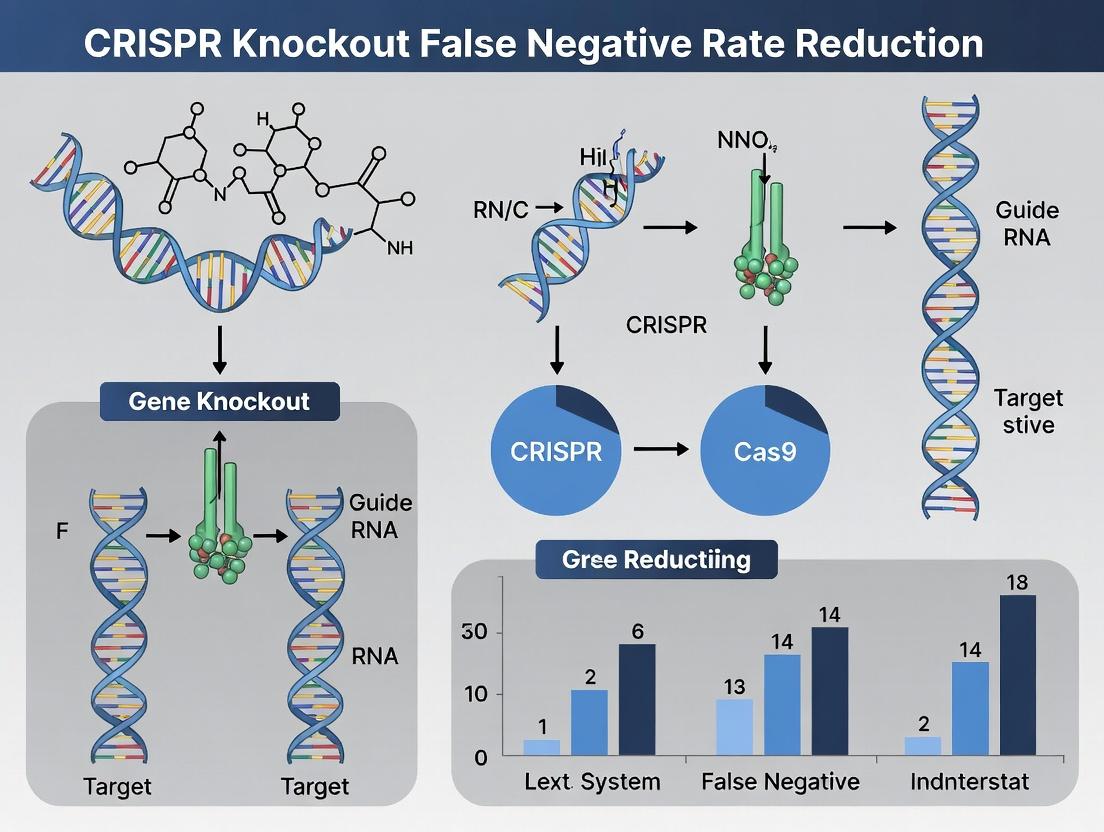
This article provides a comprehensive, up-to-date guide for researchers and drug developers on identifying, troubleshooting, and minimizing false negative results in CRISPR-Cas9 knockout experiments.
Strategies to Reduce CRISPR Knockout False Negatives: A 2024 Guide for Genetic Researchers
Abstract
This article provides a comprehensive, up-to-date guide for researchers and drug developers on identifying, troubleshooting, and minimizing false negative results in CRISPR-Cas9 knockout experiments. We cover foundational causes, advanced methodological optimizations, systematic troubleshooting workflows, and robust validation protocols. By addressing key pitfalls from sgRNA design to phenotypic analysis, this resource aims to enhance the reliability, reproducibility, and efficiency of functional genomics screens and target validation studies.
Understanding CRISPR Knockout False Negatives: Root Causes and Impact on Research
Technical Support Center: Troubleshooting False Negatives
FAQs
Q1: What is a false negative in the context of a CRISPR-Cas9 knockout (KO) experiment? A false negative occurs when the experimental assay fails to detect a phenotypic change, leading to the incorrect conclusion that a gene knockout has no functional effect, despite the successful generation of biallelic disruptive mutations in the target gene.
Q2: What are the primary technical sources of false negatives? The main sources are:
- Incomplete KO: Residual gene function from in-frame mutations, inefficient guide RNAs (gRNAs), or low editing efficiency.
- Assay Insensitivity: The chosen phenotypic readout (e.g., cell viability, western blot) lacks the sensitivity to detect subtle but biologically relevant changes.
- Genetic Compensation & Adaptation: The cell activates bypass mechanisms, such as transcriptional adaptation or pathway redundancy, masking the KO's effect.
- Clonal Selection Bias: The expansion and analysis of a single clone that is not representative due to clonal heterogeneity or compensatory mutations.
Q3: How can I verify a true knockout before phenotyping? Employ a multi-layered validation strategy:
- Genotyping: Use Sanger sequencing (with decomposition tools like TIDE or ICE) or next-generation sequencing (NGS) of the target locus to confirm the presence of disruptive indels in >90% of alleles.
- Protein-Level Check: Perform a western blot or flow cytometry to confirm the absence of the target protein. This is critical, as some indels may not be protein-null.
Q4: My genotyping confirms biallelic frameshift, but my phenotype assay is negative. What should I do? This is a classic false negative scenario. Troubleshoot by:
- Using a more sensitive orthogonal phenotypic assay.
- Testing multiple independent clones or a polyclonal population to avoid clonal artifacts.
- Investigating pathway redundancy by performing a double KO of paralogous genes.
- Considering temporal effects; the phenotype may only manifest after extended culture or under specific stress conditions.
Troubleshooting Guides
Guide 1: Minimizing False Negatives from Incomplete Editing
Problem: Phenotype is absent due to residual protein function. Solution Protocol:
- Design: Use multiple high-efficiency gRNAs (predicted by tools like ChopChop or CRISPick) targeting early exons.
- Delivery: Optimize transfection/transduction to maximize editing efficiency. Use a validated Cas9 expression system.
- Validation:
- Day 1-3: Transfert cells.
- Day 4: Harvest polyclonal population. Isolate genomic DNA.
- Day 5: Perform NGS amplicon sequencing of the target locus. Calculate indel percentage. Target >90% total indel frequency with a high proportion of frameshifts.
- In parallel: Perform western blot on the polyclonal pool. Absence of protein band is a strong indicator of successful KO.
Guide 2: Addressing False Negatives from Genetic Compensation
Problem: Cells adapt to the KO by upregulating related genes or pathways. Solution Protocol: Transcriptional Analysis Post-KO.
- Generate KO Clones: Isolate at least 3-5 single-cell clones from edited polyclonal population. Confirm KO by sequencing and western.
- RNA Sequencing:
- Extract total RNA from KO clones and wild-type controls (in biological triplicate).
- Prepare libraries and perform RNA-seq.
- Analyze differential gene expression, focusing on the pathway of the target gene and known paralogs.
- Interpretation: Significant upregulation of genes within the same family or pathway suggests compensatory mechanisms. This may necessitate combinatorial targeting.
Data Presentation
Table 1: Common Causes of False Negatives and Diagnostic Experiments
| Cause | Description | Diagnostic Experiment | Key Metric to Assess |
|---|---|---|---|
| Incomplete KO | Residual wild-type protein or function persists. | NGS of target locus; Western blot. | Indel % >90%; Frameshift % >70%; Absence of protein band. |
| Assay Insensitivity | Phenotypic readout lacks dynamic range or precision. | Use a positive control (known essential gene); Employ orthogonal assay (e.g., swap viability for imaging). | Positive control shows strong effect; Orthogonal assay yields different result. |
| Clonal Heterogeneity | Analyzed clone is an outlier with atypical adaptations. | Phenotype multiple independent KO clones. | Phenotype concordance across ≥3 clones. |
| Genetic Compensation | Network rewiring or upregulation of paralogs masks effect. | RNA-seq on KO vs. WT cells; Double KO of suspected paralogs. | Significant upregulation of pathway genes; Synthetic lethal effect in double KO. |
Table 2: Reagent Solutions for False Negative Mitigation
| Research Reagent Solution | Function in Experiment | Key Consideration |
|---|---|---|
| High-Efficiency gRNA | Directs Cas9 to the target site for DNA cleavage. | Use algorithms (e.g., CRISPick) with on-target and off-target scores. Validate with publicly available datasets. |
| NGS Amplicon-Seq Kit | Quantifies editing efficiency and mutation spectrum at the target locus. | Provides quantitative, base-pair resolution data superior to T7E1 or surveyor assays. |
| Validated Cas9 Cell Line | Stably expresses Cas9, ensuring consistent editing capacity. | Reduces variability from delivery efficiency. Requires blasticidin or puromycin selection maintenance. |
| CLD1 (ClonDONE) Reagent | Improves single-cell cloning efficiency after transfection. | Critical for reliable isolation of monoclonal populations with minimal stress-induced artifacts. |
| Pathway-Specific Reporter Assay | Provides a sensitive, direct readout of pathway activity post-KO. | More sensitive than downstream phenotypic assays like growth. Can be luminescence or fluorescence-based. |
Experimental Protocols
Protocol: NGS Amplicon Sequencing for KO Validation
Objective: Precisely quantify CRISPR-Cas9 editing efficiency and characterize induced mutations. Materials: Genomic DNA, high-fidelity PCR master mix, NGS library prep kit, index primers, sequencer. Steps:
- PCR Amplification: Design primers ~150-300bp flanking the gRNA target site. Perform PCR on genomic DNA from edited and control populations.
- Library Preparation: Clean amplicons. Perform a second, limited-cycle PCR to add Illumina adapters and unique dual indices.
- Pooling & QC: Pool libraries equimolarly. Check fragment size on a bioanalyzer. Quantify by qPCR.
- Sequencing: Run on a MiSeq or similar platform (2x250bp or 2x300bp recommended).
- Analysis: Use CRISPR-specific pipelines (e.g., CRISPResso2) to align reads, identify the cut site, and calculate percentages of indels, frameshifts, and specific alleles.
Protocol: Rapid Protein Validation by Western Blot
Objective: Confirm loss of target protein in polyclonal or monoclonal cell populations. Materials: RIPA lysis buffer, protease inhibitors, BCA assay kit, SDS-PAGE gel, transfer apparatus, target protein antibody, loading control antibody. Steps:
- Lysis: Harvest cells. Lyse in RIPA buffer (+ inhibitors) on ice for 30 min. Centrifuge to clear debris.
- Quantification: Determine protein concentration using BCA assay. Normalize all samples.
- Electrophoresis & Transfer: Load equal protein amounts (e.g., 20-30µg) onto an SDS-PAGE gel. Run and transfer to PVDF membrane.
- Immunoblotting: Block membrane. Incubate with primary antibody (vs. target protein) overnight at 4°C. Wash. Incubate with HRP-conjugated secondary antibody. Develop with ECL reagent.
- Stripping & Re-probing: Strip membrane and re-probe for a loading control (e.g., GAPDH, β-Actin).
Visualizations
Title: Decision Tree for Diagnosing CRISPR KO False Negatives
Title: Multi-Layer Validation Workflow to Prevent False Negatives
Troubleshooting Guides & FAQs
FAQ 1: Why does my CRISPR-Cas9 experiment show successful editing via sequencing but no observable phenotypic change?
- Answer: This is a classic "false negative" in functional assays, often due to Phenotypic Buffering or Genetic Redundancy. The targeted gene's function may be compensated for by paralogs or alternative pathways. Validate by creating combinatorial knockouts or using acute protein degradation (e.g., auxin-inducible degron) alongside CRISPR to observe latent phenotypes.
FAQ 2: Sanger sequencing confirms indels, but NGS reveals a high percentage of wild-type alleles. What went wrong?
- Answer: This indicates Incomplete Editing. The editing efficiency is low, and a polyclonal population is being analyzed. The functional assay is likely dominated by unedited cells. Troubleshoot by:
- Confirming transfection/transduction efficiency.
- Optimizing guide RNA (gRNA) design and delivery.
- Implementing stringent selection (e.g., puromycin, FACS) to isolate a pure knockout pool.
- Performing single-cell cloning and genotyping individual clones.
FAQ 3: How can I distinguish between genetic redundancy and off-target effects when I see no phenotype?
- Answer: First, perform comprehensive off-target analysis using GUIDE-seq or CIRCLE-seq for your specific gRNA. If off-targets are ruled out, proceed to test for redundancy:
- Bioinformatics: Analyze expression data of paralogous genes.
- Experimental: Perform double or triple knockouts of suspected redundant family members.
- Pathway Analysis: Use a constitutive/inducible pathway reporter assay to see if the pathway remains active despite the knockout.
Table 1: Common Causes of False Negatives in CRISPR Knockout Studies
| Biological Cause | Typical Manifestation | Estimated Contribution to False Negatives* | Key Validation Method |
|---|---|---|---|
| Incomplete Editing | Mixed wild-type/edited cell population; PCR bias. | 20-40% | Single-cell cloning & NGS of target site. |
| Genetic Redundancy | No phenotype despite confirmed biallelic knockout. | 15-30% | Combinatorial knockout or knockdown. |
| Phenotypic Buffering | Pathway output remains unchanged; adaptive signaling. | 10-25% | Acute protein degradation + knockout. |
| Alternative Splicing/Isoforms | Functional isoform persists despite frameshift in targeted exon. | 5-15% | Isoform-specific RT-PCR & knockout. |
| Selective Pressure/Clonal Adaptation | Edited cells gain compensatory mutations. | 5-20% | Phenotype tracking in early vs. late passages. |
Note: Estimates are synthesized from recent literature and represent approximate ranges.
Table 2: Recommended Solutions for False Negative Reduction
| Solution | Protocol Complexity | Time Investment | Effectiveness (Relative Score 1-5) |
|---|---|---|---|
| Single-Cell Cloning | Medium | High (weeks) | 5 |
| Dual gRNA per Gene | Low | Low | 3 |
| Combinatorial Gene Targeting | High | High | 4 |
| CRISPR + RNAi (CRISPRi) | Medium | Medium | 4 |
| Acute Degradation + Knockout | High | Medium | 5 |
Experimental Protocols
Protocol: Validating Genetic Redundancy via Combinatorial CRISPR Knockout
- Design: Use bioinformatics tools (e.g., Ensembl, Phylogenetic trees) to identify paralogs of your gene of interest (GOI). Design 2-3 high-efficiency gRNAs per gene.
- Vector Construction: Clone gRNAs into a plasmid expressing Cas9 (e.g., lentiCRISPRv2) using BsmBI ligation. For combinatorial knockouts, use a multi-guide array or co-transfect multiple vectors.
- Delivery: Transduce target cells at a low MOI (<0.3) to ensure single copy integration. Include puromycin (1-5 µg/mL) selection for 3-5 days.
- Genotyping: After selection, extract genomic DNA. Perform PCR amplification of all targeted loci and analyze by T7 Endonuclease I assay or Sanger sequencing (followed by decomposition tools like ICE or TIDE).
- Phenotyping: Perform functional assays 7-10 days post-transduction. Always include a positive control gRNA (targeting an essential gene) and a non-targeting control.
Protocol: Assessing Incomplete Editing with NGS
- Sample Prep: Isolate genomic DNA from the polyclonal CRISPR-treated population.
- PCR Amplification: Design primers with overhangs to amplify a ~300bp region surrounding the cut site. Use a high-fidelity polymerase.
- Library Prep & Sequencing: Clean PCR products, attach dual-index barcodes via a second PCR, and pool for sequencing on an Illumina MiSeq (2x300bp).
- Analysis: Use CRISPR-specific analysis pipelines (e.g., CRISPResso2). Key metrics: % Indels, % Read Alignment, and % Wild-Type Reads. An editing efficiency >80% is recommended for pool-based phenotyping.
Visualizations
Title: False Negative Diagnosis & Solution Pathway
Title: Genetic Redundancy Enables Compensation
The Scientist's Toolkit: Research Reagent Solutions
| Reagent/Material | Function | Example Product/Catalog |
|---|---|---|
| High-Efficiency Cas9 Vector | Stable expression of Cas9 nuclease for consistent editing. | lentiCRISPRv2 (Addgene #52961) |
| NGS-based Editing QC Kit | Quantifies editing efficiency and purity in polyclonal pools. | Illumina CRISPResso2 Library Prep Kit |
| CRISPR Dual-sgRNA Cloning Kit | Enables knockout of two genes or two exons simultaneously. | Thermo Fisher GeneArt CRISPR nuclease vector kit |
| Auxin-Inducible Degron (AID) System | Allows rapid, post-translational protein degradation to test buffering. | OsTIR1 expression plasmid + AID-tagged target gene line |
| Positive Control gRNA | Targets an essential gene (e.g., ribosomal protein) to confirm cell death phenotype. | Human RPL23A gRNA (Sigma) |
| Non-Targeting Control gRNA | Controls for non-specific effects of the CRISPR machinery. | Addgene #105000 (scrambled sequence) |
| High-Fidelity Polymerase | For accurate amplification of target loci for NGS or cloning. | NEB Q5 Hot-Start Polymerase (M0493) |
| Single-Cell Cloning Medium | Ensives high viability for dilution cloning post-editing. | CloneR (STEMCELL Technologies, #05888) |
Welcome to the CRISPR Troubleshooting Center. This resource is designed to support researchers in mitigating false negatives in CRISPR knockout studies by addressing common technical failures.
Troubleshooting Guides & FAQs
Q1: My sequencing confirms indel formation, but my Western blot shows persistent protein expression. Is this a false negative? A: Likely not a true false negative. This often stems from in-frame deletions/insertions or alternative start codon usage that bypasses the edit. Troubleshooting Steps:
- Analyze Sequencing Data: Use tools like ICE (Inference of CRISPR Edits) or TIDE to quantify the percentage of out-of-frame indels. A high percentage of in-frame edits (≈33% by chance) can maintain protein function.
- Validate Knockout: Employ multiple orthogonal assays:
- Perform an immunofluorescence assay to check for heterogeneous protein loss at the single-cell level.
- Use a functional assay (e.g., enzymatic activity readout) if available.
- Design qPCR primers spanning the cut site to detect large deletions that may be missed by short-read sequencing.
Q2: I observe high editing efficiency in my bulk PCR validation, but no phenotypic change in my cell population assay. What's wrong? A: This discrepancy frequently points to delivery inefficiency or heterogeneous editing. Troubleshooting Steps:
- Measure Delivery & Editing Concordance: Co-transfect/co-infect with a fluorescent marker (e.g., GFP) and FACS-sort. Compare editing efficiency in the GFP+ (successfully transfected) population versus the bulk, unsorted population.
- Move to Single-Cell Cloning: Isolate and expand single-cell clones. Genotype individual clones to identify pure knockout lines, as bulk populations can be masked by wild-type or heterozygote cells.
Q3: My negative control sgRNA is causing an unexpected phenotype. How is this possible? A: This is a classic sign of off-target effects masquerading as a phenotype. A "negative control" sgRNA with high off-target activity can cause confounding results. Troubleshooting Steps:
- Profile Off-Targets: Use CIRCLE-seq or SITE-Seq experimentally, or employ multiple in silico prediction tools (Cas-OFFinder, CCTop) to profile your control sgRNA.
- Employ Rigorous Controls: Use at least two distinct sgRNAs targeting the same gene that produce congruent phenotypes. Implement a rescue experiment by expressing an editing-resistant cDNA of the target gene.
Q4: What are the top strategies to reduce sgRNA inefficiency from the start? A: sgRNA inefficiency is a primary driver of false negatives. Follow this protocol for sgRNA Design & Validation:
- Design: Use algorithms (Doench et al. 2016 rules, ChopChop, CRISPick) that incorporate chromatin accessibility (e.g., ATAC-seq data) and sequence features.
- Synthesis: Use chemically modified sgRNAs (e.g., with 2'-O-methyl 3' phosphorothioate) to enhance stability and RNP complex formation.
- Validation: Perform a T7 Endonuclease I (T7E1) or Surveyor Assay 48-72 hours post-transfection in a highly transfectable cell line (e.g., HEK293T) to benchmark cleavage activity before moving to your target cell line.
- Quantification: Transition to digital PCR (dPCR) or next-generation sequencing (NGS) for precise, quantitative efficiency measurements.
Table 1: Common Pitfalls and Diagnostic Assays
| Pitfall | Primary Diagnostic Assay | Secondary Confirmatory Assay | Expected Outcome for True KO |
|---|---|---|---|
| sgRNA Inefficiency | NGS of target locus (bulk) | T7E1/Surveyor in HEK293T; dPCR | >80% out-of-frame indel rate in bulk. |
| Delivery Failure | FACS for transfection/transduction marker | Edit efficiency in sorted+ vs. unsorted population | Editing efficiency in marker+ population >> unsorted. |
| In-Frame Edits | NGS analysis with in-frame % calculation | Western Blot / Immunofluorescence | High in-frame indel %; persistent protein. |
| Off-Target Effects | NGS of predicted off-target sites | Phenotype with 2+ sgRNAs + Rescue | Phenotype not rescued; off-target site indels detected. |
Table 2: Quantitative Impact of Modifications on sgRNA Efficacy
| sgRNA Format | Relative Cleavage Efficiency* | Nuclease Stability | Recommended Use Case |
|---|---|---|---|
| Unmodified (plasmid) | 1.0 (Baseline) | Low | Initial screening, cost-sensitive bulk experiments. |
| Unmodified (IVT) | 1.2 - 1.5 | Low | RNP delivery for reduced off-targets. |
| Chemically Modified (Synthego) | 1.8 - 2.5 | High | Difficult-to-edit cells, primary cells, RNP delivery. |
| Example data relative to plasmid-derived sgRNA in HEK293 cells. Actual multipliers vary by cell type. |
Experimental Protocol: Combined Off-Target & On-Target Validation via NGS
Objective: Simultaneously quantify on-target efficiency and profile major off-target sites. Protocol:
- Amplicon Library Design: Design PCR primers to generate amplicons (300-500 bp) covering the on-target locus and top 10-20 predicted off-target loci.
- PCR Amplification: Isolate genomic DNA 72h post-editing. Perform first-round PCR with locus-specific primers containing overhang adapters.
- Indexing PCR: Add dual indices and sequencing adapters via a second, limited-cycle PCR.
- Sequencing: Pool libraries and sequence on an Illumina MiSeq (2x300 bp recommended).
- Analysis: Process reads with a pipeline (CRISPResso2, ampliCan) to calculate indel percentages at each locus.
Visualizations
Title: Decision Tree for Diagnosing CRISPR False Negatives
Title: Optimized sgRNA Workflow to Minimize False Negatives
The Scientist's Toolkit: Research Reagent Solutions
Table 3: Essential Reagents for Robust CRISPR Knockout Validation
| Reagent / Material | Function & Rationale |
|---|---|
| Chemically Modified sgRNA (2'-O-Methyl 3' Phos.) | Enhances stability, reduces immune response, and improves RNP formation efficiency, directly combating sgRNA inefficiency. |
| Recombinant Cas9 Protein (NLS-tagged) | For RNP delivery. Faster action, reduced off-target time, and higher efficiency in hard-to-transfect cells compared to plasmid DNA. |
| Electroporation/ Nucleofector Kit | Physically maximizes delivery efficiency in immune/primary/stem cells, addressing the core delivery issue. |
| Magnetic Bead Cell Separation Kits | For rapid enrichment of transfected/transduced cells (e.g., via GFP or surface markers) to isolate the successfully delivered population. |
| T7 Endonuclease I / Surveyor Nuclease | Fast, cost-effective initial screen for nuclease activity at the target locus. |
| ddPCR Assay for Indel Quantification | Provides absolute, sensitive quantification of editing efficiency without NGS, ideal for longitudinal studies. |
| Off-Target Prediction Software (Cas-OFFinder) | Identifies potential off-target sites for subsequent validation, critical for control sgRNA design. |
| CRISPResso2 Software | Essential, user-friendly bioinformatics tool for accurate quantification of indel frequencies from NGS data. |
The High Cost of False Negatives in Drug Target Identification and Functional Genomics
Troubleshooting & FAQs for CRISPR Knockout False Negative Rate Reduction
Q1: Our CRISPR-Cas9 knockout screen shows a high rate of false negatives (targets are not identified as hits despite known phenotypic impact). What are the primary technical causes?
A1: Primary causes include:
- Incomplete Knockout Efficiency: Guide RNA (gRNA) inefficiency due to poor design, chromatin inaccessibility, or variable Cas9 activity.
- Genetic Redundancy/Compensation: Paralogs or alternative pathways compensate for the loss of the target gene, masking the phenotype.
- Phenotypic Assay Sensitivity Limit: The readout (e.g., cell viability, fluorescence) lacks the dynamic range to detect subtle but biologically significant effects.
- Off-target Effects: Unintended editing can confound phenotype attribution and downstream validation.
- Library Design Flaw: Inadequate gRNA coverage per gene or poor library diversity.
Q2: How can we validate that a lack of phenotype is a true biological result versus a false negative from incomplete editing?
A2: Implement a multi-layered validation protocol:
- Amplicon Sequencing (Amplicon-Seq): Quantify indel frequency and biallelic knockout rate at the genomic DNA level for candidate hits and non-hits.
- Functional Protein Assessment: Use Western blot or flow cytometry (for surface proteins) to confirm protein loss, as indels may not always lead to a null allele.
- Orthogonal Gene Perturbation: Use siRNA/shRNA or a second, independent set of CRISPR gRNAs to reproduce the phenotype.
- Rescue Experiments: Re-introduce a cDNA copy of the gene (resistant to gRNA targeting) to confirm phenotype reversal.
Q3: What experimental design steps minimize false negatives in a pooled CRISPR screen?
A3:
- Use High-Quality, Optimized Libraries: Employ libraries with 6-10 gRNAs per gene (e.g., Brunello, Calabrese) and include non-targeting control gRNAs.
- Increase Screen Stringency: Use a high MOI to ensure single-guide delivery per cell and maintain a high representation (500-1000x coverage) throughout the screen.
- Employ Dual Screening Modalities: Combine CRISPRko with CRISPR interference (CRISPRi) for transcriptional repression to target different regulatory mechanisms.
- Extend Phenotypic Duration: Allow sufficient time post-infection for protein turnover and phenotypic manifestation before assaying.
- Utilize Sensitive Assays: Implement high-content imaging or single-cell RNA-seq as readouts instead of bulk viability.
Q4: Are there specific bioinformatic tools to help identify and correct for false negatives in screening data?
A4: Yes, key tools include:
- MAGeCK and MAGeCK-VISPR: Robust statistical models that account for gRNA variance and screen quality.
- CRISPRcleanR: Corrects gene-independent responses (e.g., copy-number effects) that can create false negatives/positives.
- BAGEL: Uses a gold-standard reference set of essential and non-essential genes to improve classification accuracy.
- PinAPL-Py: A platform for pooled screen analysis that integrates multiple analysis methods.
Experimental Protocol: Validating Knockout Efficiency Post-Screen
Title: Protocol for Genotypic and Phenotypic Validation of CRISPR Knockout
Materials:
- Genomic DNA from sorted cell populations (phenotype+ and phenotype-).
- PCR primers flanking the target site (~200-300bp amplicon).
- Next-Generation Sequencing (NGS) library prep kit.
- Antibodies for target protein (for Western Blot).
- cDNA expression construct for rescue.
Method:
- Isolate Genomic DNA: Extract gDNA from at least 500,000 cells per population.
- Amplify Target Loci: Perform PCR for each gene of interest.
- Prepare NGS Libraries: Barcode and pool amplicons for deep sequencing (aim for >10,000x read depth per amplicon).
- Bioinformatic Analysis: Use tools like Cas9-Analyzer or CRISPResso2 to align reads, quantify indel percentages, and infer frameshift frequency.
- Correlate with Phenotype: A false negative is suspected if the phenotype- population shows <80% frameshift indels AND protein is still detectable by Western blot.
- Orthogonal Confirmation: Proceed with siRNA or secondary gRNA validation for genes failing step 5.
Key Quantitative Data on False Negative Impact
Table 1: Estimated Rates and Costs of False Negatives in Early Drug Discovery
| Stage | Typical False Negative Rate | Potential Consequence | Estimated Cost Impact |
|---|---|---|---|
| Primary CRISPRko Screen | 15-30% (for subtle phenotypes) | Missed therapeutic target | $500K - $2M in redundant research |
| Secondary Validation | 5-15% (with poor validation) | Invalidated true target; project halt | Loss of potential $1B+ asset |
| Pre-clinical Development | <5% (if rigorous) | Advancement of inferior lead; late-stage failure | $10M - $100M in wasted development |
Table 2: Comparison of CRISPR Screening Approaches for False Negative Mitigation
| Approach | Principle | Relative FN Reduction | Key Limitation |
|---|---|---|---|
| CRISPR Knockout (ko) | Disrupts gene coding sequence | Baseline | Genetic compensation |
| CRISPR Interference (i) | Epigenetic repression of transcription | ~20-40% improvement | Incomplete repression |
| CRISPR Activation (a) | Overexpression to sensitize | Useful for modifier screens | Non-physiological levels |
| Dual gRNA (paired) | Deletes large genomic segments | ~30-50% improvement | Low efficiency, complex logistics |
| Single-Cell RNA-seq + CRISPR | Links genotype to transcriptome | Major improvement for complex phenotypes | Very high cost & computational load |
Diagram: CRISPR Screen Validation Workflow
Title: Validation Workflow for Suspected False Negatives
Diagram: Mechanisms Leading to False Negatives
Title: Technical vs. Biological Causes of False Negatives
The Scientist's Toolkit: Key Reagents for False Negative Reduction
Table 3: Essential Research Reagents & Solutions
| Reagent/Solution | Function | Example Product/Note |
|---|---|---|
| High-Efficiency Cas9 | Ensures maximal cutting activity. | NLS-SpCas9-GFP variants for tracking. |
| Optimized gRNA Library | Minimizes off-targets, maximizes on-target. | Brunello (human) or Mouse GeCKO v2. |
| CRISPRi sgRNA Library | For transcriptional repression; combats compensation. | Dolcetto or CRISPRi v2 libraries. |
| Polybrene / Spinoculation | Enhances viral transduction efficiency. | Critical for hard-to-transduce cells. |
| Puromycin / Antibiotics | Selects for successfully transduced cells. | Titrate to find minimal effective dose. |
| NGS Amplicon-Seq Kit | Quantifies indel efficiency at target locus. | Illumina MiSeq compatible kits. |
| CRISPResso2 Software | Analyzes NGS data to quantify editing outcomes. | Open-source tool for indel analysis. |
| Cell Viability Assay (Sensitive) | Detects subtle proliferation differences. | CellTiter-Glo 2.0 or high-content imaging. |
Troubleshooting Guide & FAQs
Q1: Why do I observe high knockout efficiency by genomic PCR or NGS but no phenotype in my functional assay? A: This is a common false negative scenario. High genomic editing efficiency does not guarantee loss of protein function. Key culprits include:
- Incomplete protein degradation: The edit may not create a frameshift, or the truncated protein may retain partial function.
- Compensatory mechanisms: Related genes or pathways may compensate for the loss.
- Assay sensitivity: Your functional readout may not be sensitive enough to detect a partial reduction in activity.
- Clonal heterogeneity: Bulk population metrics (like NGS) average high efficiency, but the cells you assay functionally may not be edited.
Q2: My Western blot shows complete protein loss, but my cellular viability/phenotype assay shows no effect. What should I check? A: This indicates a discrepancy between molecular and functional validation.
- Confirm knockout specificity: Ensure your antibody is specific for the targeted epitope. A truncation might remove the epitope, giving a false-negative Western blot while a functional protein fragment remains.
- Check assay timing: Phenotypic consequences, especially in viability assays, may manifest later than protein turnover. Extend the time course of your functional readout.
- Evaluate pathway redundancy: Use a double knockout or acute chemical inhibition alongside your KO to test for genetic compensation.
Q3: How can I systematically reduce false negatives in my CRISPR knockout screens or experiments? A: Implement a multi-layered validation strategy:
| Validation Layer | Technique | Purpose | Typical Data Range to Flag Discrepancy |
|---|---|---|---|
| Genomic | NGS of amplicons | Quantify indel frequency at DNA level | >80% indels but no phenotype |
| Transcriptomic | RT-qPCR | Check for Nonsense-Mediated Decay (NMD) | <20% residual mRNA |
| Proteomic | Western Blot, Flow Cytometry | Confirm protein depletion | >90% protein reduction |
| Functional | Target-specific assay (e.g., apoptosis, migration) | Measure biological outcome | Statistically insignificant change vs. control |
| Orthogonal | Pharmacological inhibitor, siRNA rescue | Confirm phenotype is target-specific | Phenotype recapitulated with inhibitor |
Q4: What are the best practices for measuring knockout efficiency to predict functional outcomes accurately? A: Move beyond bulk genomic efficiency.
- Use NGS for quality, not just quantity: Analyze the spectrum of indels. Frameshift-inducing indels should dominate (>75% of all reads).
- Combine with protein-level analysis: Always pair DNA data with a direct protein measurement (Western, flow) for your key candidates.
- Employ single-cell cloning: For critical experiments, isolate clonal populations and genotype/protein-validate each clone before functional testing.
- Implement early functional QC: Use a rapid, surrogate functional readout (e.g., a downstream phosphorylation marker by flow cytometry) early in the pipeline to triage clones.
Detailed Experimental Protocols
Protocol 1: Integrated Genotypic and Phenotypic Single-Cell Validation
- Purpose: To directly link knockout status to functional output in individual cells, resolving population heterogeneity.
- Method:
- Cell Preparation: Generate a polyclonal CRISPR knockout pool.
- Barcoding & Sorting: Use a method like CITE-seq or intracellular staining followed by FACS.
- Intracellular Staining: Fix and permeabilize cells. Stain with a validated antibody against the target protein (Alexa Fluor 647) and an antibody for a key downstream phospho-protein (p-ERK, p-AKT; Alexa Fluor 488) as a functional proxy.
- FACS Sorting: Sort single cells from four quadrants (Protein-High/Function-High, Protein-High/Function-Low, Protein-Low/Function-High, Protein-Low/Function-Low) into 96-well plates pre-loaded with lysis buffer.
- Genotypic Analysis: Perform nested PCR on the genomic target site from single-cell lysates and send for Sanger sequencing. Align sequences to reference to determine indel type.
- Data Correlation: Correlate the indel type (frameshift/non-frameshift) with the protein and functional marker levels from the original flow data for each cell.
Protocol 2: Time-Course Multi-Omic Validation Cascade
- Purpose: To track the temporal relationship between genomic editing, transcript loss, protein depletion, and functional decline.
- Method:
- Sample Collection: At days 2, 4, 6, and 8 post-transfection/transduction of CRISPR components, harvest cells for parallel analysis.
- Parallel Processing:
- Genomic DNA: Isolate gDNA. Perform PCR amplicon deep sequencing to track indel evolution over time.
- RNA: Isolate total RNA. Perform RT-qPCR for the target gene and known compensatory genes.
- Protein: Lyse cells for Western blot analysis of target protein and 1-2 key pathway components.
- Function: Perform the endpoint functional assay (e.g., cell viability via CTG, caspase activity).
- Data Integration: Plot all metrics (indel %, mRNA %, protein %, functional %) on a shared timeline to identify lag periods and discrepancies.
Visualizations
Title: Multi-Layer Knockout Validation Cascade
Title: Troubleshooting KO-Phenotype Discrepancy
The Scientist's Toolkit: Research Reagent Solutions
| Item | Function in KO Validation |
|---|---|
| Validated Knockout Cell Line | Positive control for protein loss and phenotype. Essential for assay validation and antibody specificity testing. |
| Isotype Control gRNA/Cas9 Complex | Negative control for CRISPR delivery and off-target effects. Should be sequenced to confirm no targeting. |
| Pharmacological Inhibitor (of target) | Orthogonal tool to confirm phenotype is target-specific and to benchmark expected functional effect size. |
| Antibody for Target Protein (for Flow Cytometry) | Enables quantitative, single-cell level protein quantification to assess population heterogeneity in KO pools. |
| Antibody for Pathway Marker (phospho-specific) | Provides an early, rapid functional readout downstream of the target to triage clones or pools. |
| NGS Amplicon Sequencing Kit | For deep, quantitative analysis of indel spectra and frequency, moving beyond T7E1 or surveyor assays. |
| Single-Cell Lysis & Genotyping Kit | Allows direct correlation of a cell's genotype (indel) with its observed phenotype after sorting or functional screening. |
Proactive Experimental Design to Minimize False Negative Rates
Technical Support & Troubleshooting Center
FAQs and Troubles Guides
Q1: My CRISPR knockout experiment shows successful transfection and high cell viability, but sequencing reveals no mutagenesis at the target site. What are the primary sgRNA design-related causes? A: This common false negative can stem from poor predicted on-target activity. Use a next-generation scoring algorithm (e.g., DeepCRISPR, Rule Set 2) that integrates genomic context. Avoid regions with high DNA methylation or within nucleosome-occupied sequences, as these reduce Cas9 accessibility. Always verify your target sequence is unique via comprehensive off-target scanning (e.g., using CCTop or Cas-OFFinder) against the correct reference genome build.
Q2: How do I interpret different on-target activity scores from tools like Chop-Chop, CRISPick, and others? A: Different tools use varying algorithms and training data. The scores are relative, not absolute. For reliable comparison, pick one primary tool and use its score rank (e.g., top 5% within your gene) rather than comparing raw numbers across platforms. The table below summarizes key scoring algorithms and their features.
Table 1: Comparison of Major sgRNA On-Target Activity Prediction Tools
| Tool Name | Core Algorithm | Key Features Considered | Output Score Type | Reference Year |
|---|---|---|---|---|
| Rule Set 2 | Regression Model | Sequence composition (positions 1-20, +1 PAM), chromatin accessibility (DNase-seq) | Continuous (0-100) | 2016 |
| DeepCRISPR | Deep Learning | Sequence features, epigenetic markers (from public datasets) | Probability Score | 2018 |
| CRISPick | Rule Set 2 / CFD | Sequence, genomic context, off-target potential | Rank & Score | Ongoing |
| Chop-Chop | Multiple Models | Sequence, GC%, melting temperature, epigenetic features | Efficiency Grade (A-F) | Ongoing |
| SgRNA Scorer 2.0 | Random Forest | Sequence, DNA shape, chromatin features | Continuous Score | 2016 |
Q3: What specific genomic context pitfalls should I screen for during design? A: Key pitfalls to avoid include:
- CpG Islands: Target sites within CpG islands are prone to methylation, silencing Cas9 cutting.
- Nucleosome Occupancy: Dense nucleosome packaging physically blocks Cas9 access. Use public MNase-seq data to guide avoidance.
- Repetitive Elements: Alu, LINE, or other repeats dramatically increase off-target risk.
- Common SNPs: A single-nucleotide polymorphism (SNP) in the seed region (PAM-proximal 8-12 bases) can abolish cutting. Always check dbSNP.
- Transcription Factor Binding Sites (TFBS): Competition with bound TFs can hinder Cas9 binding.
Q4: Can you provide a protocol for validating sgRNA activity in vitro prior to complex cell experiments? A: Protocol: sgRNA Pre-validation Using an In Vitro Cleavage Assay Principle: Incubate purified Cas9 protein with in vitro transcribed sgRNA and a PCR-amplified DNA target template. Assess cleavage efficiency via gel electrophoresis. Materials:
- Purified Cas9 Nuclease (commercial source)
- T7 RNA Polymerase Kit for sgRNA transcription
- Target Genomic DNA
- High-Fidelity PCR Master Mix
- Agarose Gel Electrophoresis System Steps:
- Template Preparation: PCR amplify a 500-1000 bp genomic region containing your target site from your experimental cell line's DNA. Purify the amplicon.
- sgRNA Synthesis: Generate DNA oligonucleotide templates with a T7 promoter for your sgRNA sequence. Perform in vitro transcription, followed by purification (e.g., phenol-chloroform extraction or column-based).
- Cleavage Reaction:
- Set up a 20 µL reaction: 100 ng PCR amplicon, 50 nM purified Cas9, 100 nM sgRNA, 1x Cas9 reaction buffer.
- Incubate at 37°C for 1 hour.
- Include controls: "Cas9 only", "sgRNA only", and "No Protein/no sgRNA".
- Analysis: Run the reaction products on a 2% agarose gel. Successful cleavage will produce two smaller, predictable fragment bands. Quantify the band intensities to calculate cleavage efficiency (% cleaved = [intensity of cut bands]/[total intensity] * 100).
Q5: How does reducing false negatives in knockout research directly impact drug development pipelines? A: In target validation and phenotypic screening, false negatives (where a gene is essential but appears non-essential due to ineffective knockout) are critically harmful. They can lead to the erroneous deprioritization of a promising therapeutic target. Rigorous sgRNA design that minimizes false knockout rates increases confidence in hit identification, accelerates pipeline decisions, and reduces costs associated with pursuing incorrect leads.
The Scientist's Toolkit: Research Reagent Solutions
Table 2: Essential Reagents for sgRNA Validation & Knockout Studies
| Item | Function & Rationale |
|---|---|
| High-Fidelity DNA Polymerase (e.g., Q5, Phusion) | To error-free amplify genomic target regions for in vitro assays and genotyping PCR. |
| T7 In Vitro Transcription Kit | For high-yield, cost-effective synthesis of multiple sgRNAs for pre-validation. |
| Recombinant S. pyogenes Cas9 Nuclease (Purified) | For in vitro cleavage assays and RNP complex formation for high-efficiency transfection. |
| Nucleofection/K2 Transfection System | For efficient delivery of RNP complexes or plasmids into hard-to-transfect primary or stem cells. |
| Next-Generation Sequencing Library Prep Kit | For deep-sequencing amplicons of target sites to quantitatively assess editing efficiency and heterogeneity. |
| Guide-it Genotype Confirmation Kit | For rapid, gel-based detection of small indels without sequencing. |
| Methyltransferase Inhibitors (e.g., 5-Azacytidine) | To test if poor cutting efficiency is due to target site methylation (pre-treatment may restore activity). |
Visualizations
Title: Next-Gen sgRNA Design & Validation Workflow
Title: Genomic Pitfalls Impact on sgRNA Activity
Troubleshooting Guide & FAQs
FAQ 1: Why am I observing a high rate of false negatives in my CRISPR knockout validation screens, and how can I mitigate this?
- Answer: High false negative rates often stem from inefficient editing, poor gRNA design, or inadequate validation assays. False negatives occur when a gene is successfully edited but the assay fails to detect it, skewing your functional data. To mitigate:
- System Selection: Use HiFi Cas9 or Cas12a for higher on-target fidelity, reducing off-target effects that can confound results.
- gRNA Design: Utilize updated algorithms (e.g., from ChopChop, CRISPick) that account for chromatin accessibility and specific nuclease features. Design and test multiple gRNAs per target.
- Validation: Employ a multi-modal validation strategy. Do not rely solely on Sanger sequencing. Implement Next-Generation Sequencing (NGS) for indel profiling and utilize functional assays (e.g., Western blot, flow cytometry) alongside genomic DNA analysis.
FAQ 2: I am using a base editor, but I am getting unwanted indels instead of pure point mutations. What went wrong?
- Answer: Base editors can cause unintended double-strand breaks (DSBs) and subsequent indel formation, especially with high-expression levels or prolonged exposure. This is a key source of experimental noise in precise editing applications.
- Troubleshooting Steps:
- Titrate Editor Expression: Reduce the amount of base editor plasmid or mRNA transfected. Use a doxycycline-inducible system for tighter control.
- Optimize gRNA: Avoid gRNAs with sequences prone to forming DNA-RNA heteroduplex structures that recruit endogenous nucleases.
- Shorten Exposure Time: Harvest cells earlier (e.g., 48-72 hours post-transfection instead of 96 hours).
- Switch System: Consider using a high-fidelity version of the base editor or an evolved variant with reduced off-target activity.
- Troubleshooting Steps:
FAQ 3: My Cas12a editing efficiency in mammalian cells is consistently low. How can I improve it?
- Answer: Cas12a (Cpfl) has different requirements than Cas9. Common issues include:
- gRNA Length: Ensure you are using the correct, often longer, direct repeat sequence native to your Cas12a variant.
- Temperature: Cas12a from some bacterial species (e.g., Lachnospiraceae bacterium LbCas12a) has optimal activity at higher temperatures (37°C may be suboptimal). Consider using the Acidaminococcus sp. (AsCas12a) or engineered variants (e.g., enAsCas12a) optimized for mammalian systems.
- Delivery: Cas12a is larger than SpCas9; ensure your delivery vector (AAV, lentivirus) has sufficient packaging capacity. Using mRNA or protein delivery can also improve efficiency.
FAQ 4: When should I choose HiFi Cas9 over standard SpCas9 for my knockout experiment?
- Answer: Choose HiFi Cas9 (e.g., SpCas9-HF1, eSpCas9) in the following scenarios, which are critical for reducing false interpretations in knockout studies:
- When working in a genetically unstable background (e.g., cancer cell lines).
- When performing genome-wide or large-scale pooled screens where off-target effects can create widespread false positives/negatives.
- When your downstream validation assays are highly sensitive to confounding phenotypes from off-target edits.
- Trade-off: Be prepared for a potential slight reduction in on-target efficiency compared to wild-type SpCas9, which you must quantify.
Table 1: Comparison of Key CRISPR-Cas Systems for Knockout Applications
| Feature | Wild-Type SpCas9 | HiFi Cas9 (eSpCas9/SpCas9-HF1) | Cas12a (AsCas12a) | Cytosine Base Editor (BE4max) | Adenine Base Editor (ABEmax) |
|---|---|---|---|---|---|
| Primary Application | Gene knockout, screening | High-fidelity knockout, screening | Gene knockout, multiplexing | C•G to T•A conversion | A•T to G•C conversion |
| Typical On-Target Efficiency* | High (60-90%) | Moderate-High (50-80%) | Moderate (40-70%) | High (30-70%) | High (30-70%) |
| Relative Off-Target Rate | High | >90% Reduction vs. SpCas9 | Low (different profile than Cas9) | Very Low (no DSBs) but can have sgRNA-independent off-targets | Very Low (no DSBs) but can have sgRNA-independent off-targets |
| PAM Requirement | NGG | NGG | TTTV (V = A/C/G) | NGG (for SpCas9-derived) | NGG (for SpCas9-derived) |
| Cleavage Type | Blunt ends | Blunt ends | Staggered ends (5' overhang) | No cleavage | No cleavage |
| Key Advantage for False Negative Reduction | High efficiency | Maximizes signal-to-noise by minimizing confounding off-target effects. | Low off-target, simple gRNA design for multiplexing | Enables precise mutation without DSB-associated noise (indels, p53 response) | Enables precise mutation without DSB-associated noise |
| Major Limitation | High off-target potential | Potential slight efficiency drop | Lower efficiency in some systems | Restricted editing window (~5nt), bystander edits | Restricted editing window (~5nt), bystander edits |
Efficiencies are highly dependent on cell type, delivery, and target locus. *Efficiency defined as percentage of alleles with the desired base conversion within the editing window.
Experimental Protocols
Protocol 1: Validating Knockout Efficiency and Reducing False Negatives with NGS
Objective: Accurately quantify indel formation at on-target loci to confirm editing and calculate true knockout rates, minimizing false negatives from inadequate detection.
Materials: Genomic DNA extraction kit, PCR primers flanking target site, high-fidelity PCR mix, NGS library prep kit (e.g., Illumina), bioinformatics tools (CRISPResso2, Geneious).
Method:
- Harvest Genomic DNA: Collect cells 72-96 hours post-transfection/transduction.
- Amplify Target Locus: Perform PCR (~300-400bp amplicon) using barcoded primers to allow multiplexing.
- Prepare NGS Library: Purify PCR products and prepare sequencing library following kit instructions. Use a minimum read depth of 10,000x per sample.
- Sequence: Run on a MiSeq or similar platform.
- Bioinformatic Analysis: Align reads to reference sequence. Use CRISPResso2 to quantify the percentage of reads with insertions, deletions, or substitutions. Define a minimum variant frequency threshold (e.g., 0.5%) to filter sequencing noise.
- Correlate with Phenotype: Compare indel percentage with functional assay results (e.g., % protein-negative cells via flow cytometry). A significant discrepancy suggests false negatives/positives.
Protocol 2: Comparing On-target vs. Off-target Activity for System Selection
Objective: Empirically determine the specificity of your chosen CRISPR system for a given target.
Materials: Predicted off-target site list (from tools like Cas-OFFinder), PCR primers for top 5-10 predicted off-target loci, NGS supplies as in Protocol 1.
Method:
- Predict Off-Targets: Input your gRNA sequence into a prediction tool for both SpCas9 and HiFi Cas9 or Cas12a.
- Edit Cells: Create separate cultures edited with Wild-Type SpCas9, HiFi Cas9, and/or Cas12a + the same target gRNA.
- Amplify Loci: Perform PCR for the on-target and each predicted off-target site from the pooled genomic DNA of each culture.
- NGS & Analysis: Process as in Protocol 1. Calculate the editing efficiency (%) at each off-target site.
- Calculate Specificity Ratio: (On-target Efficiency) / (Average Off-target Efficiency). A higher ratio indicates a more specific system, directly contributing to lower false positive rates in screens.
Visualizations
Title: CRISPR System Selection Workflow for Research Goals
Title: Multi-Modal Validation Workflow to Reduce False Negatives
The Scientist's Toolkit: Key Research Reagent Solutions
| Reagent / Material | Function & Role in False Negative Reduction |
|---|---|
| High-Fidelity Cas9 Nuclease (e.g., Alt-R S.p. HiFi Cas9) | Engineered variant with drastically reduced off-target cleavage. Critical for ensuring observed phenotypes are due to on-target edits, not confounding off-target effects. |
| Validated Positive Control gRNA/Cas9 Complex | A gRNA with known high efficiency against a well-characterized locus (e.g., human AAVS1). Serves as a crucial experimental control to confirm editing machinery is working, ruling out technical failure. |
| NGS-based Indel Detection Kit (e.g., Illumina CRISPR QIAseq) | Provides a standardized, highly sensitive method for quantifying editing efficiency. Far more accurate than Surveyor/T7E1 assays, allowing detection of low-frequency edits that might otherwise be false negatives. |
| CRISPR-Competent Cell Line (e.g., HEK293T, HAP1) | A cell line known for high transfection/editing efficiency. Using a difficult-to-transfect cell line can introduce high noise and false negatives from unedited cells. |
| p53 Inhibitor (e.g., Alt-R p53 HiFi Cas9 Electroporation Enhancer) | Temporary p53 inhibition during editing of primary or p53-sensitive cells. Reduces false negatives stemming from selective outgrowth of unedited cells due to p53-mediated cell cycle arrest in edited cells. |
| Bioinformatics Analysis Tool (CRISPResso2) | Specialized software for precise quantification of NGS data from CRISPR experiments. Accurately distinguishes true low-frequency editing from sequencing errors, a key source of false positive/negative calls in validation. |
Welcome to the Technical Support Center for advanced CRISPR knockout strategies. This resource is designed within the context of ongoing research to minimize false negative rates in gene knockout validation, providing troubleshooting and FAQs for implementing dual sgRNA, RNP delivery, and prolonged selection protocols.
Frequently Asked Questions & Troubleshooting
Q1: Why should I use two sgRNAs instead of one for knockout experiments? A: A single sgRNA can produce indels that may not disrupt the gene's open reading frame (e.g., in-frame deletions). Using two sgRNAs targeting the same exon excises a genomic segment, dramatically increasing the probability of a complete, frameshift-mediated knockout and reducing false negatives from partial function.
Q2: My RNP transfection efficiency is low in my primary cell line. What can I optimize? A: Key parameters to troubleshoot:
- RNP Complex Formation: Ensure you are incubating the Cas9 protein with sgRNAs at optimal molar ratios (typically 1:2 to 1:3 Cas9:sgRNA) for at least 10-20 minutes at room temperature before delivery.
- Delivery Method: For hard-to-transfect cells, consider using electroporation (e.g., Neon or Amaxa systems) instead of lipid-based transfection. Optimize voltage and pulse parameters using a cell-specific kit.
- RNP Purity: Use HPLC-purified sgRNAs and endotoxin-free Cas9 protein to reduce cellular toxicity.
Q3: After prolonged puromycin selection, I still see residual protein via Western blot. What went wrong? A: This indicates incomplete knockout. Potential issues and solutions:
- Selection Timing: Initiate antibiotic selection 48-72 hours post-RNP delivery to allow for genome editing and turnover of pre-existing protein.
- Selection Duration: Standard 3-5 day selection may be insufficient. Extend puromycin treatment to 7-10 days to eliminate cells with partial protein persistence.
- sgRNA Efficiency: One or both sgRNAs may have low cutting efficiency. Always validate sgRNA efficiency individually via T7E1 or TIDE assay before dual targeting.
Q4: How do I verify a large deletion between two sgRNAs and rule out alternative edits? A: Standard PCR across the target locus may yield a smaller product if a deletion occurred. However, you must sequence the amplified product to confirm the precise junction. Use primers flanking the outer regions of the two sgRNA cut sites. Be aware that PCR across very large deletions (>1-2kb) may be inefficient.
Q5: What is the critical control for dual sgRNA experiments to attribute phenotype correctly? A: You must include controls for each sgRNA alone (as RNP) and a non-targeting control. This confirms that the observed phenotype is due to the large deletion and not an off-target effect of a single sgRNA.
Research Reagent Solutions Toolkit
| Item | Function & Rationale |
|---|---|
| Recombinant Cas9 Nuclease | High-activity, endotoxin-free protein for RNP complex formation. Reduces DNA vector-related risks (e.g., random integration, prolonged Cas9 expression). |
| Chemically Modified sgRNA | Synthetic sgRNAs with phosphorothioate bonds and 2'-O-methyl modifications at terminal nucleotides increase stability and reduce innate immune response in cells. |
| Electroporation Kit | Cell-type specific kits (e.g., Lonza P3, Thermo Neon) provide optimized buffers and protocols for efficient RNP delivery into challenging cell types. |
| Selection Antibiotic | Puromycin dihydrochloride is the standard for selecting cells with integrated resistance markers following the RNP + donor template strategy for prolonged selection. |
| PCR Kit for Long Fragments | High-fidelity polymerase kits (e.g., KAPA HiFi, PrimeSTAR GXL) are essential for reliably amplifying across deletion junctions for validation. |
Table 1: Comparison of Knockout Strategies in HEK293T Cells
| Strategy | Delivery Method | Reported Knockout Efficiency (Western Blot) | False Negative Rate (by Functional Assay) | Key Limitation |
|---|---|---|---|---|
| Single sgRNA (Plasmid) | Lipofectamine 3000 | 60-80% | 15-30% | High off-target, in-frame edits likely |
| Single sgRNA (RNP) | Electroporation | 70-90% | 10-25% | Protein persistence can mask knockout |
| Dual sgRNAs (RNP) | Electroporation | >95% | <5% | Requires validation of large deletion |
| Dual sgRNAs + 7-day Selection | Electroporation + Puromycin | ~99% | <1% | Extended culture may induce adaptive changes |
Table 2: Optimal RNP Complex Formation Parameters
| Component | Recommended Ratio (Cas9:sgRNA) | Incubation Time | Temperature | Buffer |
|---|---|---|---|---|
| Dual sgRNA RNP (Co-complex) | 1:2:2 (Cas9:sgRNA1:sgRNA2) | 20 min | 25°C (Room Temp) | 1X PBS or Opti-MEM |
| Individual sgRNA RNP (Control) | 1:2 | 10 min | 25°C (Room Temp) | 1X PBS or Opti-MEM |
Detailed Experimental Protocols
Protocol 1: Dual sgRNA RNP Complex Assembly & Electroporation
- Resuspend Components: Thaw Cas9 protein (e.g., 10µg/µL) and synthetic sgRNAs (100µM in IDTE buffer) on ice.
- Prepare RNP Complex:
- For a single reaction, mix 3µL Cas9 (30µg) with 2.4µL of each 100µM sgRNA (total 4.8µL for two sgRNAs).
- Add nuclease-free buffer to a total volume of 20µL.
- Incubate at room temperature for 20 minutes.
- Prepare Cells: Harvest and wash 1x10^6 cells in 1X PBS. Resuspend in the appropriate electroporation buffer (e.g., Lonza P3 buffer).
- Electroporate: Mix cell suspension with the 20µL RNP complex. Transfer to a certified cuvette. Electroporate using a pre-optimized program (e.g., for HEK293T: Lonza 4D-Nucleofector, program DS-138).
- Recovery: Immediately add pre-warmed medium and transfer cells to a culture plate.
Protocol 2: Prolonged Puromycin Selection for Clonal Enrichment
- Determine Kill Curve: 72 hours before your experiment, plate wild-type cells at standard density. Treat with a range of puromycin concentrations (0.5 - 10 µg/mL). The minimum concentration that kills all cells in 3-5 days is the optimal dose.
- Initiate Selection: At 48-72 hours post-electroporation, split edited cells and initiate selection with the predetermined puromycin concentration.
- Maintain Selection: Replace the medium with fresh puromycin-containing medium every 2-3 days. Continue selection for a minimum of 7 days.
- Recovery and Analysis: After selection, allow cells to recover in standard medium for 48 hours before harvesting for genomic DNA or protein analysis.
Visualizations
Dual sgRNA RNP Knockout and Selection Workflow
Problem-Solution Logic for Reducing False Negatives
Troubleshooting Guide & FAQ
This support center provides targeted solutions for common experimental hurdles in designing and implementing critical controls for CRISPR-Cas9 editing efficiency, specifically within the context of reducing false negative rates in knockout screens.
FAQ 1: Why is my fluorescent reporter (e.g., GFP) for editing efficiency not showing a clear bimodal population post-transfection?
- Answer: This often indicates low editing efficiency or poor reporter design.
- Check Guide RNA (gRNA) Efficacy: Use a positive control gRNA targeting a known essential gene (e.g., RPA3) in your cell line. If the positive control also fails, the issue is systemic.
- Validate Reporter Construct: Ensure the fluorescent reporter (like a GFP-PEST cassette) is integrated in-frame downstream of the start codon of your target gene or a synthetic construct, and that the PEST sequence is functional to destabilize the protein.
- Optimize Transfection/Nucleofection: Titrate your Cas9/gRNA RNP or plasmid amounts. Use a transfection control (e.g., Cy3-labeled siRNA) to monitor delivery efficiency.
- Allow Sufficient Time: For protein turnover-based reporters, wait at least 72-96 hours post-editing for fluorescence loss in successfully edited cells.
FAQ 2: My non-essential gene negative control is showing a significant fitness defect, skewing my screen results. What could be the cause?
- Answer: A fitness defect in a presumed non-essential gene control suggests either off-target effects or context-specific essentiality.
- Verify Non-Essentiality: Confirm the gene's non-essential status in your specific cell line using reference databases (e.g., DepMap). Avoid genes in amplified genomic regions.
- Mitigate Off-Targets: Design and test multiple gRNAs for the same non-essential locus. Consistent phenotypes across guides suggest true essentiality; divergent phenotypes suggest off-target effects. Use high-fidelity Cas9 variants (e.g., SpCas9-HF1).
- Check Flanking Genes: Ensure your gRNA does not disrupt the regulatory elements (promoters, enhancers) of adjacent essential genes.
FAQ 3: How do I distinguish between a true false negative and simply inefficient editing?
- Answer: This requires a layered control strategy.
- Implement an Internal Editing Control: Co-deliver a reporter plasmid (expressing RFP) that contains the same gRNA target site. The RFP+ population directly reports on transfection and Cas9/gRNA activity. Lack of editing in the RFP+ population indicates a gRNA-specific failure.
- Perform T7E1 or NGS Validation: Sort the "unedited" (e.g., GFP+) population from your primary screen and perform a bulk cleavage assay or next-generation sequencing (NGS) on the target site. A high indel rate in this population confirms a false negative due to phenotypic lag or redundancy.
- Use a Rescue Construct: For candidate hits, introduce a cDNA version of the target gene resistant to the gRNA (via silent mutations). Failure to rescue confirms a true negative; successful rescue may indicate a false negative in the original screen if editing was efficient.
FAQ 4: What are the best practices for choosing and using fluorescent reporters to normalize editing efficiency?
- Answer: Use reporters to gate specifically on edited cells.
| Reporter Type | Target Locus | Function | Key Consideration |
|---|---|---|---|
| Direct Fusion | Endogenous gene (GFP-PEST knock-in) | Reports on editing & protein loss at native locus. | Complex cloning & low knock-in efficiency. |
| Surrogate Vector | Transfected plasmid with target site | Measures transfection & Cas9 activity only. | Does not report on specific genomic editing. |
| Co-transfection Marker | Separate fluorescent protein plasmid | Normalizes for transfection variability. | Least specific; assumes correlation with editing. |
- Protocol: Using a Surrogate Reporter Plasmid for Normalization:
- Co-transfect your cells with the Cas9/gRNA complex and a reporter plasmid (e.g., pMAX-GFP containing the target sequence).
- 48-72 hours post-transfection, analyze cells by flow cytometry.
- Gate analysis only on the GFP+ (successfully transfected) population.
- Within this GFP+ gate, measure the phenotypic readout (e.g., cell viability via a dye, loss of a different fluorophore). This directly correlates the phenotype to cells that received the editing machinery, controlling for transfection inefficiency.
Experimental Protocols
Protocol 1: Validating gRNA Efficiency with a Fluorescent Reporter Construct Objective: To rapidly quantify the cleavage efficiency of a gRNA in vitro before a full-screen experiment. Materials: Synthetic gRNA, SpCas9 Nuclease, pSELECT-GFPzeo-gRNA_Cloning Vector (or similar), HEK-293T cells. Steps:
- Clone your target gRNA sequence into the reporter vector downstream of a GFP-PEST cassette.
- Co-transfect HEK-293T cells (in triplicate) with: (a) the reporter vector, and (b) a Cas9 expression plasmid (or RNP complex).
- Include a non-targeting gRNA control and a positive control gRNA (e.g., targeting AAVS1 safe harbor).
- After 72 hours, analyze by flow cytometry. Calculate editing efficiency as:
% GFP-Negative Cells (in sample) - % GFP-Negative Cells (non-targeting control).
Protocol 2: Post-Screen Validation of Putative False Negatives Using NGS Objective: To determine if a gene called "non-hit" was actually edited, distinguishing false negatives from inefficient guides. Materials: Genomic DNA from screened cell population, PCR primers flanking target site, NGS library prep kit. Steps:
- From the final screen population, sort or select cells that are phenotypically wild-type (e.g., viable, or GFP+ if using a reporter).
- Isolate genomic DNA from this "surviving" population and a pre-screening input control.
- Amplify the target genomic locus from both samples via PCR.
- Prepare NGS libraries and sequence on a MiSeq or similar platform (aim for >10,000x read depth per target).
- Analyze sequences using a tool like CRISPResso2 to quantify indel percentages.
- Interpretation: An indel rate >5% in the "surviving" population suggests efficient editing but no fitness defect—a potential false negative requiring orthogonal validation (e.g., rescue).
Diagrams
Title: CRISPR Screen Control Strategy & Troubleshooting Flow
Title: Impact of Reporter Gating on Phenotype Precision
The Scientist's Toolkit: Research Reagent Solutions
| Reagent/Material | Function in Control Experiments | Key Consideration |
|---|---|---|
| Validated Non-Essential Gene gRNAs | Provide baseline for screen normalization and cell fitness. | Select genes with consensus non-essentiality across cell lines (e.g., AAVS1, Rosa26, HPRT1 in some contexts). |
| Essential Gene Positive Control gRNA | Confirms system-wide Cas9/gRNA activity and phenotypic readout. | Use a gene lethal in all cell types (e.g., RPA3, PCNA). |
| Fluorescent Reporter Plasmid (e.g., GFP-PEST with cloning site) | Rapid, quantitative assessment of gRNA cutting efficiency in living cells. | Destabilized PEST sequence ensures rapid protein turnover upon editing. |
| High-Fidelity Cas9 Variant (SpCas9-HF1, eSpCas9) | Reduces off-target effects that can confound control gene phenotypes. | May trade off some on-target efficiency; requires validation. |
| NGS Validation Kit (e.g., CRISPResso2 Kit) | Gold-standard quantification of indel rates at target loci to confirm editing. | Critical for auditing screen results and verifying false negatives. |
| Transfection Efficiency Marker (e.g., Cy3-labeled siRNA) | Visual confirmation of delivery success independent of editing. | Helps troubleshoot initial delivery steps. |
| Rescue cDNA Construct (with silent mutations) | Confirms on-target phenotype and identifies false negatives. | Definitive test for gene-specific phenotype causality. |
FAQs & Troubleshooting Guides
Q1: Our NGS data from CRISPR-edited pools shows low read coverage at the expected cut site. What are the primary causes and solutions?
- A: Low local coverage is a common pre-analytical issue that can lead to false negatives in INDEL detection.
- Cause 1: PCR Bias During Library Prep. Amplicons containing large deletions or complex rearrangements may amplify less efficiently.
- Solution: Use a high-fidelity, polymerase with proven performance on complex templates. Limit PCR cycles (<25) and consider using additive reagents like DMSO or betaine. Validate with a control plasmid containing a known large deletion.
- Cause 2: Poor Primer Design. Primers too close to the cut site or with secondary structure.
- Solution: Redesign primers to be at least 50-100 bp away from the expected cut site. Use tools like Primer3 with stringent settings and perform in silico PCR check. Implement a two-step PCR strategy with unique molecular identifiers (UMIs) to reduce bias.
- Protocol - Bias-Minimized Amplicon Sequencing:
- Lysis & Genomic Extraction: Use a column-based or magnetic bead-based kit for high-quality gDNA.
- First-Stage PCR (with UMIs): Perform 10-12 cycles using primers containing random UMI sequences (8-12 bp) and partial overhangs for the second stage.
- Purification: Clean up PCR product with magnetic beads (0.8x ratio).
- Second-Stage PCR (Indexing): Perform 8-12 cycles using indexing primers that bind the overhangs. Keep cycle count as low as possible.
- Pool, Quantify, and Sequence: Pool libraries at equimolar ratios. Sequence on a platform yielding 2x250bp or 2x300bp reads to ensure full amplicon overlap.
- Cause 1: PCR Bias During Library Prep. Amplicons containing large deletions or complex rearrangements may amplify less efficiently.
Q2: Our frameshift detection algorithm is missing expected mutations, potentially inflating false negative rates. How can we optimize bioinformatic parameters?
- A: Overly stringent alignment parameters can filter out true positive INDELs.
- Critical Parameters to Adjust:
- Alignment Score Threshold: Reduce the minimum score for local alignment around the cut site.
- INDEL Detection Window: Widen the genomic window analyzed from the expected cut site (e.g., ±10 bp to ±25 bp).
- Minimum Read Support: Set this based on expected editing efficiency and coverage. A threshold of 3-5 reads is typical for initial discovery, but statistical models (like Poisson) should inform final validation thresholds.
- Solution: Use a positive control sample (e.g., a known mixture of edited and wild-type DNA) to benchmark and calibrate your pipeline. The table below summarizes key parameters for common aligners in this context:
- Critical Parameters to Adjust:
Table 1: Optimized Bioinformatic Parameters for INDEL Detection
| Tool/Step | Parameter | Typical Default | Recommended for CRISPR-Cut Site |
|---|---|---|---|
| BWA-MEM | -A (match score) |
1 | 1 |
-B (mismatch penalty) |
4 | 3 | |
-O (gap open penalty) |
6 | 5 | |
| Bowtie2 | --score-min |
G,20,8 | L,0,-0.2 |
| Samtools | mpileup -B |
Disabled | Enabled (disables BAQ to aid in INDEL calling) |
| GATK | HaplotypeCaller --min-pruning |
2 | 1 or 2 |
| General Filter | Window from cut site | N/A | ± 20-25 bp |
| Min. supporting reads | N/A | 3-5 (for initial detection) |
Q3: How do we distinguish true CRISPR-mediated frameshifts from background sequencing errors or pre-existing genomic variants?
- A: This requires experimental and bioinformatic controls.
- Experimental Control: Always sequence an untreated or non-targeting guide control sample from the same cell population/passage processed identically.
- Bioinformatic Subtraction: Subtract any INDELs found in the control sample (above a noise threshold, e.g., 0.1% frequency) from the treated sample calls. Use a statistical test (e.g., Fisher's exact test) to compare read counts supporting an INDEL in treated vs. control.
- Protocol - Background Error Subtraction Workflow:
- Process treated (Tx) and control (Ctrl) samples through the same alignment/variant calling pipeline.
- Generate a list of all INDELs within the target window for both samples.
- For each INDEL in the Tx sample, calculate its frequency and the supporting read count in both Tx and Ctrl.
- Apply a filter:
Keep IF (Tx_freq > 0.5%) AND (Fisher's Exact Test p-value (Tx_reads vs Ctrl_reads) < 0.01). - Manually inspect aligned reads (e.g., in IGV) for remaining high-confidence calls.
Q4: What are the best practices for characterizing and reporting complex INDELs (e.g., long deletions, inversions, microhomology)?
- A: Standard variant callers (GATK) often miss complex events. Specialized tools are required.
- Solution: Implement a secondary analysis pipeline using tools designed for CRISPR outcomes.
- For large deletions (>50 bp) and complex rearrangements: Use CRISPResso2 or DECODR.
- For microhomology-mediated end joining (MMEJ) patterns: Use mhmm or the alignment visualization in ICE (Synthego).
- Reporting: Quantify and report INDELs by:
- Frameshift vs. In-Frame Ratio: The core metric for knockout efficacy.
- Spectrum Summary: % Wild-type, % Frameshift INDELs, % In-frame INDELs, % Complex (deletion >50bp).
- Top Alleles: List the 5-10 most frequent specific sequences.
- Solution: Implement a secondary analysis pipeline using tools designed for CRISPR outcomes.
The Scientist's Toolkit: Research Reagent Solutions
Table 2: Essential Reagents for Robust NGS-Based Frameshift Detection
| Item | Function | Key Consideration |
|---|---|---|
| High-Fidelity PCR Master Mix (e.g., Q5, KAPA HiFi) | Generates amplicons for sequencing with ultra-low error rates, minimizing PCR artifacts. | Essential for unbiased amplification of mixed INDEL populations. |
| Unique Molecular Identifier (UMI) Adapters | Tags each original DNA molecule with a random barcode to enable error correction and accurate consensus building. | Critical for distinguishing PCR duplicates from biological repeats and reducing noise. |
| Magnetic Bead Clean-up Kit (SPRI) | For size selection and purification of PCR products. Allows for fine-tuning of size selection (e.g., 0.6x-0.8x ratio). | Removes primer dimers and ensures clean library preparation. |
| Validated Control gDNA | Genomic DNA from a cell line with a known, characterized CRISPR-induced mutation. | Serves as a positive control for the entire wet-lab and bioinformatic pipeline. |
| High-Sensitivity DNA Assay (e.g., Bioanalyzer, TapeStation) | Accurately quantifies library concentration and assesses amplicon size distribution. | Prevents over- or under-sequencing and identifies library preparation issues. |
Diagram 1: NGS Workflow for CRISPR INDEL Analysis
Diagram 2: False Negative Reduction Logic
Systematic Troubleshooting: Diagnosing and Resolving Failed Knockouts
Technical Support Center: Troubleshooting CRISPR KO Validation
FAQs & Troubleshooting Guides
Q1: My post-KO genomic DNA PCR shows the expected band shift, but my western blot shows no reduction in target protein. What went wrong?
- A: This is a classic sign of a false negative at the protein level. Potential causes and solutions are detailed below.
Potential Cause Diagnostic Experiment Solution & Protocol Inefficient Biallelic Editing Next-Generation Sequencing (NGS) of the target locus. Clone PCR amplicons or perform amplicon-seq to quantify editing efficiency and allele frequency. Protocol: Design primers ~150-200bp flanking the cut site. Perform PCR, purify, and prepare library for Illumina sequencing. Analyze reads with CRISPResso2 to quantify indel percentages and frameshift frequency. Alternative Translation Start Site Usage 5' RACE (Rapid Amplification of cDNA Ends) and Western Blot with N-terminal antibodies. Protocol: Isolate RNA from KO cells. Use a 5' RACE kit to map transcription start sites and potential novel splice variants. Perform western blot with antibodies against epitopes downstream of the original start codon. Compensatory Upregulation or Protein Stability qRT-PCR for mRNA expression & Cycloheximide Chase Assay. Protocol: Extract RNA, convert to cDNA, and perform qPCR for target gene. For stability, treat WT and KO cells with cycloheximide (100µg/mL), harvest lysates at time points (0, 2, 4, 8h), and run western blot to measure protein half-life. Off-target Antibody Binding Use a second, orthogonal antibody targeting a different epitope, or perform mass spectrometry. Protocol: Validate KO with an antibody from a different supplier or against a C-terminal epitope. For confirmation, perform immunoprecipitation of the target protein from WT and KO lysates, followed by silver staining or LC-MS/MS. Q2: My Sanger sequencing traces become messy downstream of the cut site. How do I confirm editing?
- A: This indicates a polyclonal population with mixed indels. You must clone the PCR product before sequencing.
- Protocol: Gel-purify the genomic PCR product. Ligate into a T/A cloning vector. Transform competent E. coli. Pick 10-20 individual bacterial colonies for colony PCR and Sanger sequencing. This reveals the spectrum of individual indel events.
- A: This indicates a polyclonal population with mixed indels. You must clone the PCR product before sequencing.
Q3: I see no band shift in my genomic PCR screening assay. Does this mean editing failed?
- A: Not necessarily. Small indels (<50bp) may not resolve on a standard agarose gel.
- Troubleshooting: Use a high-percentage agarose gel (3-4%) or a bioanalyzer/TapeStation system for better resolution. Proceed to sequencing (Surveyor/T7E1 assay or direct Sanger sequencing of the PCR product) as the primary validation step, not gel shift.
- A: Not necessarily. Small indels (<50bp) may not resolve on a standard agarose gel.
Experimental Protocols Cited
Genomic DNA QC & PCR for Target Locus Amplification:
- Use a nanodrop/spectrophotometer to assess DNA purity (A260/A280 ~1.8).
- PCR Mix (50µL): 100ng genomic DNA, 1x High-Fidelity PCR Buffer, 200µM dNTPs, 0.5µM forward/reverse primer, 1-2 units High-Fidelity DNA Polymerase.
- Cycling: 98°C 30s; [98°C 10s, 65°C 30s, 72°C 30s/kb] x 35 cycles; 72°C 5min.
- Purify PCR product with a spin column before sequencing or cloning.
Western Blot for Protein-Level Validation:
- Harvest cells in RIPA buffer with protease inhibitors.
- Separate 20-30µg total protein on an SDS-PAGE gel and transfer to PVDF membrane.
- Block with 5% BSA in TBST for 1h. Incubate with primary antibody (diluted in block) overnight at 4°C.
- Wash, incubate with HRP-conjugated secondary antibody (1:5000) for 1h at RT.
- Develop with ECL reagent and image. Always include a loading control (e.g., GAPDH, Actin).
The Scientist's Toolkit: Key Research Reagent Solutions
| Item | Function in KO Validation |
|---|---|
| High-Fidelity DNA Polymerase | Reduces PCR errors during amplification of the target locus for sequencing. |
| T/A Cloning Kit | Enables ligation of PCR products for Sanger sequencing of single alleles from a polyclonal pool. |
| CRISPResso2 Software | Open-source tool for quantifying CRISPR editing from NGS data. Calculates indel % and reading frames. |
| RIPA Lysis Buffer | Efficiently extracts total cellular protein for downstream western blot analysis. |
| HRP-conjugated Secondary Antibodies | Provides sensitive detection of primary antibodies in western blot via chemiluminescence. |
| Housekeeping Protein Antibodies (e.g., GAPDH) | Serves as a loading control to ensure equal protein amounts are compared in western blot. |
Workflow Diagram: CRISPR KO Validation Cascade
Pathway Diagram: Investigation of Persistent Protein
Troubleshooting Guide & FAQs
Q1: Despite using a validated sgRNA, my CRISPR-Cas9 knockout experiment shows high cell viability but no edit detected by sequencing. What are the primary causes? A1: This classic false negative can stem from low transfection efficiency, insufficient Cas9 activity, or inefficient HDR/NHEJ. First, quantify your transfection efficiency using a fluorescent reporter plasmid. If efficiency is below 70-80% for your cell line, proceed to optimize delivery. Concurrently, verify nuclease activity via a T7E1 or SURVEYOR assay on a control target.
Q2: How can I optimize lipid-based transfection for hard-to-transfect primary cells? A2: Key parameters to titrate are the DNA:lipid ratio, cell density at transfection, and the timing of reagent exposure. Use a GFP-expressing plasmid to optimize. A recommended starting protocol is below, but conditions require empirical optimization.
Experimental Protocol: Lipid-mediated Transfection Optimization for Adherent Cells
- Seed cells in a 24-well plate to reach 60-80% confluence at the time of transfection.
- Prepare two separate mixtures:
- Mixture A (DNA): Dilute 0.5 µg of plasmid DNA (e.g., pCas9-GFP) in 50 µL of serum-free Opt-MEM.
- Mixture B (Lipid): Dilute 1-3 µL of lipid transfection reagent (e.g., Lipofectamine 3000) in 50 µL of serum-free Opt-MEM. Incubate for 5 minutes.
- Combine Mixtures A and B, mix gently, and incubate for 20-25 minutes at room temperature.
- Add the 100 µL complex dropwise to cells with complete medium. Gently rock the plate.
- Assay transfection efficiency via fluorescence microscopy or flow cytometry 48-72 hours post-transfection.
Q3: What are chemical enhancers like L755507 and SCR7, and how do they reduce false negatives? A3: These small molecules modulate DNA repair pathways to bias outcomes towards desired edits, thereby increasing the rate of detectable knockout alleles.
- L755507: A β-adrenergic receptor agonist that transiently inhibits the non-homologous end joining (NHEJ) pathway. This can favor homology-directed repair (HDR) when a template is present, but more critically, it can also promote more productive mutagenic repair events by alternative end-joining (Alt-EJ) or microhomology-mediated end-joining (MMEJ), increasing indel formation rates.
- SCR7: A DNA ligase IV inhibitor that more directly and potently blocks the canonical NHEJ pathway. This shifts repair towards Alt-EJ/MMEJ, which is more error-prone, thereby increasing the frequency of frameshift indels that lead to functional knockouts.
Q4: When and at what concentration should I add chemical enhancers like SCR7? A4: Add SCR7 at the time of transfection and maintain it in the culture medium for 48-72 hours post-transfection to cover the peak period of DNA repair activity. Concentrations typically range from 1-10 µM. A dose-response experiment is critical to balance enhancement of editing with cell toxicity.
Experimental Protocol: SCR7 Treatment for NHEJ Inhibition
- Prepare a 10 mM stock solution of SCR7 in DMSO. Aliquot and store at -20°C.
- Transfect cells with your CRISPR-Cas9 components as usual.
- Immediately after transfection, add SCR7 to the culture medium to achieve the desired final concentration (e.g., 1 µM, 5 µM, 10 µM). Include a vehicle control (DMSO at the same dilution).
- Refresh medium with fresh SCR7 at 24 hours.
- At 48-72 hours post-transfection, harvest cells for genomic DNA extraction and analysis (e.g., T7E1 assay, NGS). Always assess cell viability in parallel (e.g., via MTT assay).
Q5: How do I choose between L755507 and SCR7? A5: The choice depends on your cell type and desired repair outcome. See the comparison table below.
Data Presentation
Table 1: Comparison of Chemical Enhancers for CRISPR Knockout Efficiency
| Enhancer | Target Pathway | Typical Working Concentration | Primary Effect | Key Consideration |
|---|---|---|---|---|
| SCR7 | Inhibits DNA Ligase IV (NHEJ) | 1 - 10 µM | Potently blocks c-NHEJ, shifts repair to error-prone Alt-EJ. | Can be cytotoxic at higher doses; multiple isomers exist (active form is SCR7-X). |
| L755507 | β-adrenergic receptor agonist | 5 - 20 µM | Transiently inhibits NHEJ, may promote Alt-EJ/MMEJ. | Generally lower toxicity; effect can be cell-type dependent. |
Table 2: Troubleshooting Transfection & Edit Detection
| Symptom | Possible Cause | Diagnostic Experiment | Potential Solution |
|---|---|---|---|
| No edits detected, low viability. | Cytotoxicity from transfection reagent or Cas9. | Perform viability assay (MTT/ATP) 24h post-transfection. | Titrate DNA:reagent ratio; use a milder reagent; try ribonucleoprotein (RNP) delivery. |
| No edits detected, high viability. | Low transfection/editing efficiency. | Co-transfect fluorescent reporter plasmid; run T7E1 assay. | Optimize transfection protocol; use a different transfection method (e.g., nucleofection); include a chemical enhancer. |
| Inconsistent edits between replicates. | Variable cell density or reagent mixing. | Standardize seeding protocol and passage number. | Use large-volume master mixes; ensure consistent cell counting. |
| High background in PCR/Sanger detection. | Poor primer design or PCR conditions. | Run no-template control; check primer specificity. | Redesign primers; use touchdown PCR; employ nested PCR for low-abundance edits. |
The Scientist's Toolkit: Research Reagent Solutions
| Item | Function in CRISPR Knockout Optimization |
|---|---|
| Lipofectamine 3000 | Lipid-based transfection reagent for delivering plasmid DNA or Cas9 RNP complexes into a wide range of cell types. |
| pCas9-GFP Reporter Plasmid | Control plasmid expressing both Cas9 and GFP. Used to quickly visualize and quantify transfection efficiency via flow cytometry. |
| SCR7 (active isomer, SCR7-X) | Chemical inhibitor of DNA Ligase IV. Used in cell culture media to bias DNA repair away from precise NHEJ toward error-prone end-joining, increasing indel rates. |
| L755507 | Small molecule β-agonist that transiently inhibits NHEJ. Used as an alternative to SCR7 to enhance mutagenic repair with potentially lower toxicity. |
| T7 Endonuclease I (T7E1) | Enzyme used in a mismatch cleavage assay to detect and quantify CRISPR-induced indels without the need for deep sequencing. |
| Cell Counting Kit-8 (CCK-8) | Colorimetric viability assay. Essential for titrating transfection conditions and chemical enhancers to minimize cytotoxicity. |
| Neon or Amaxa Nucleofector | Electroporation-based systems for high-efficiency delivery of RNP complexes into hard-to-transfect cell lines (e.g., primary cells, immune cells). |
| Guide-it Genotype Confirmation Kit | Provides optimized reagents for PCR amplification of the target locus and analysis via Sanger sequencing or T7E1 assay. |
Visualizations
Title: Chemical Enhancers Shift DNA Repair from Precise to Error-Prone Pathways
Title: Systematic Troubleshooting Flowchart for CRISPR False Negatives
Technical Support Center: Troubleshooting & FAQs
FAQ: General Concept & Design
Q1: What is genetic compensation, and why does it increase false negative rates in CRISPR knockout studies? A1: Genetic compensation is a phenomenon where the loss of a gene's function is buffered by the upregulation or altered activity of related genes (paralogs) or alternative splicing variants. This can mask phenotypic outcomes, leading to false negative conclusions in functional genomics screens. In CRISPR-Cas9 knockout experiments, this often occurs due to frame-shift mutations triggering nonsense-mediated mRNA decay (NMD), which can activate compensatory networks.
Q2: What are the primary strategies to overcome genetic compensation? A2: The core strategy is multi-locus targeting to eliminate functional redundancy. This includes:
- Multi-exon Targeting: Using multiple gRNAs to delete large genomic segments or target several critical exons within a single gene to prevent the expression of functional truncated proteins.
- Paralog Targeting: Simultaneously knocking out multiple members of a gene family using a pooled or multiplexed gRNA approach.
- Combination with Transcriptional Suppression: Coupling CRISPR-KO with CRISPR interference (CRISPRi) for knock-down of potential compensatory genes.
Troubleshooting Guide: Experimental Issues
Q3: Issue: After a successful multi-exon deletion, I still detect protein expression via Western blot. What could be wrong? A3: Possible Causes & Solutions:
- Incomplete Deletion: The large deletion may not be biallelic in all cells. Solution: Perform subcloning to isolate single-cell clones and genotype each allele via long-range PCR followed by sequencing.
- Alternative Transcription Start Sites or Exon Skipping: The deletion may not remove all possible protein-coding sequences. Solution: Design gRNAs targeting the most 5' upstream exon(s) and/or exons containing critical functional domains. Use RNA-seq to map all transcript isoforms.
- Compensatory Upregulation of a Paralog: A related gene may be upregulated. Solution: Perform qPCR or RNA-seq to check expression of known paralogs and consider expanding your targeting strategy.
Q4: Issue: My multiplexed paralog knockout has very low cell viability, hindering phenotyping. How can I proceed? A4: Possible Causes & Solutions:
- Essential Gene Family: The paralog family may be essential for cell survival. Solution: Use an inducible CRISPR system (e.g., iCRISPR) to control the timing of knockout. Alternatively, employ a CRISPRi knockdown approach to titrate gene expression instead of complete knockout.
- Off-Target Effects: Multiple gRNAs increase cumulative off-target risk. Solution: Use high-fidelity Cas9 variants (e.g., SpCas9-HF1) and design gRNAs with validated high specificity scores. Perform off-target analysis (e.g., GUIDE-seq, CIRCLE-seq) on your gRNA pool.
- High Transfection Toxicity: Solution: Use lentiviral delivery with a low MOI or switch to ribonucleoprotein (RNP) electroporation for better dose control.
Q5: Issue: How do I validate a successful multi-exon or paralog knockout at the molecular level? A5: Required Validation Cascade:
- Genomic DNA Level: PCR amplification across the predicted deletion junction(s) using flanking primers. For paralogs, perform individual PCR genotyping for each targeted locus.
- mRNA Level: Use RT-qPCR with primer sets located in the deleted exons (should show no product) and in untargeted exons (may show product if truncated transcripts persist). RNA-seq is ideal for comprehensive analysis.
- Protein Level: Use Western blot with antibodies targeting an epitope encoded within the deleted region. For paralogs, use isoform-specific antibodies if available. Note: The absence of signal is the goal.
Experimental Protocols
Protocol 1: Designing and Implementing a Multi-Exon Deletion Strategy
Method:
- Target Identification: Identify all annotated exons of your target gene via ENSEMBL or NCBI. Prioritize early exons (before functional domains) and exons common to all major splice variants.
- gRNA Design: Design two gRNAs flanking the genomic region to be deleted. Follow standard design rules (high on-target, low off-target scores). Tools: Benchling, CHOPCHOP.
- Cloning: Clone both gRNA sequences into a single plasmid expressing both gRNAs and Cas9 (e.g., pSpCas9(BB)-2A-Puro or a lentiviral vector like lentiCRISPRv2 modified for dual gRNAs).
- Delivery & Selection: Transfect or transduce your cell line. Apply appropriate selection (e.g., puromycin) for 48-72 hours.
- Screening: Harvest bulk population genomic DNA. Perform PCR with primers outside the deletion region. A successful large deletion will yield a smaller PCR product alongside the wild-type band.
- Clonal Isolation: Dilution plate the bulk population to derive single-cell clones. Screen individual clones by PCR as in step 5.
- Sequence Validation: Sanger sequence the novel junction PCR product to confirm precise deletion.
Protocol 2: Multiplexed Paralog Knockout via Lentiviral Pooled gRNA Delivery
Method:
- Paralog Identification: Use databases (e.g., HGNC, GeneCards) to identify all human paralogs of your gene of interest.
- gRNA Library Design: Design 3-4 high-quality gRNAs per paralog gene. Include non-targeting control gRNAs.
- Library Cloning: Clone the pooled gRNA oligonucleotides into a lentiviral gRNA backbone (e.g., lentiGuide-Puro) via pooled ligation and transform into high-efficiency electrocompetent E. coli. Ensure >200x coverage of the library.
- Virus Production & Transduction: Produce lentivirus from the pooled plasmid library. Transduce the target cell population at a low MOI (<0.3) to ensure most cells receive only one gRNA.
- Selection & Phenotyping: Select with puromycin. After selection, split cells for molecular validation and phenotypic assays (e.g., proliferation, migration).
- gRNA Abundance Analysis: For pooled screens, extract genomic DNA from the population pre- and post-selection/phenotypic challenge. Amplify the integrated gRNA cassette via PCR and sequence on a NextSeq platform. Depletion or enrichment of specific gRNAs indicates phenotype relevance.
Data Presentation
Table 1: Comparison of Strategies to Mitigate Genetic Compensation
| Strategy | Key Mechanism | Typical False Negative Rate Reduction* | Primary Technical Challenge | Best For |
|---|---|---|---|---|
| Single Exon KO | Frameshift/NMD induction | Baseline (High) | High rate of genetic compensation | Initial gene screening |
| Multi-Exon Deletion | Removal of critical coding sequence | ~40-60% | Ensuring biallelic deletion in clonal populations | Eliminating stable truncated proteins |
| Dual Paralog KO | Removing redundancy from 2 genes | ~50-70% | Identifying relevant functional paralogs | Small, defined gene families |
| Multiplexed Paralog KO | Removing redundancy from >2 genes | ~70-90% | Library complexity & delivery optimization | Large gene families & network targeting |
| KO + CRISPRi | Knockout + transcriptional knockdown | ~60-80% | Coordinating two different CRISPR systems | Targeting essential genes & dynamic networks |
*Estimated reduction in false negative phenotypic calls based on comparative studies in cell lines (e.g., MCF10A, HEK293T). Actual rates vary by gene family and phenotype assay.
Table 2: Essential Research Reagent Solutions
| Reagent / Material | Function & Explanation | Example Product/Catalog |
|---|---|---|
| High-Fidelity Cas9 | Reduces off-target effects critical for multi-gRNA experiments. | SpCas9-HF1 (Addgene #72247) |
| Dual gRNA Expression Vector | Allows expression of two gRNAs from a single transcript for co-dependent excision. | pX330A-1x2 (Addgene #58766) |
| Lentiviral gRNA Pool Library | Enables stable, pooled delivery of multiplexed gRNA sets for paralog targeting. | Custom library cloned in lentiGuide-Puro |
| Next-Generation Sequencing Kit | For sequencing amplicons of deleted junctions or profiling pooled gRNA abundance. | Illumina MiSeq Reagent Kit v3 |
| Long-Range PCR Kit | Amplifies large genomic regions to validate multi-kilobase deletions. | Takara LA Taq |
| Isoform-Specific Antibody | Validates protein-level knockout of specific paralogs where pan antibodies fail. | CST, Abcam, custom |
Visualizations
Title: Experimental Strategy Workflow for Addressing Genetic Compensation
Title: Genetic Compensation Signaling Pathway & Intervention Points
Technical Support Center: Troubleshooting CRISPR Knockout False Negatives
Core Thesis Context: This support center provides targeted guidance to reduce false negative rates in CRISPR-Cas9 knockout validation, specifically by addressing confounding factors arising from cell line-specific genetics (ploidy, p53 status, DNA repair).
Troubleshooting Guide: FAQs
Q1: Despite high cutting efficiency confirmed by T7E1 or Surveyor assay, I cannot detect protein loss by western blot in my polyploid cell line. What is happening? A: Polyploid cell lines (e.g., many cancer lines like MCF-7, U2OS) possess multiple copies of the target gene. CRISPR-Cas9 may disrupt only one or two alleles, leaving others functional and resulting in residual protein expression.
- Solution: Perform digital PCR (ddPCR) or deep sequencing (NGS) to quantify the allele editing frequency. A guide RNA may need to achieve biallelic or multi-allelic editing in >90% of alleles for complete knockout in polyploid cells. Consider using a dual-guRNA strategy to excise a genomic segment.
Q2: My p53-wildtype cell line shows severe growth arrest or senescence post-transfection/electroporation, preventing clonal expansion. How can I proceed? A: Efficient DNA double-strand break induction by Cas9 can trigger a strong p53-mediated DNA damage response in normal or p53-wt cells, halting proliferation.
- Solution:
- Use transient p53 inhibitors (e.g., small molecules like Pifithrin-α) during the first 48-72 hours post-editing to bypass initial arrest.
- Switch to a ribonucleoprotein (RNP) delivery method, which is faster and may reduce persistent DNA damage signaling.
- Consider using a modified "hit-and-run" protocol with shorter Cas9 expression time.
Q3: In my DNA repair-deficient cell line (e.g., BRCA1-/-, ATM-/-), I observe exceptionally high indel efficiency but also high cell death. How do I recover viable clones? A: Cells deficient in homologous recombination (HR) or other repair pathways are hyper-reliant on error-prone non-homologous end joining (NHEJ). This leads to efficient indels but also genomic instability and cytotoxicity from unrepaired or mis-repaired cuts.
- Solution: Lower the amount of Cas9/sgRNA delivered. Use a "pulsed" RNP strategy. Plate cells at very low density post-editing to minimize bystander effects and allow isolated clones to recover. Increase genomic DNA harvest time to 72-96 hours post-editing for initial screening, as peak indel detection may be delayed.
Q4: How do I accurately interpret Sanger sequencing chromatograms from polyploid or aneuploid cell populations? A: Direct sequencing of PCR products from mixed alleles creates overlapping traces after the cut site, often misinterpreted as failed editing.
- Solution: Clone PCR amplicons into a plasmid vector and sequence 10-20 individual colonies. This isolates individual alleles for accurate genotyping. Alternatively, use TIDE or ICE analysis tools, which are designed to deconvolute complex chromatograms and estimate editing efficiencies.
Q5: My knockout clone shows the expected frameshift mutation but still expresses detectable protein via a sensitive immunoassay. Could this be a false negative? A: Possibly. This can result from: 1. Alternative start codon usage: Translation may initiate from a downstream methionine. 2. Exon skipping: The edit may cause splicing around the disrupted exon. 3. Transcriptional adaptation: Rare, but compensatory upregulation of a paralog or related gene can cross-react with some antibodies. * Solution: Perform RT-PCR across the target region and sequence the cDNA. Use multiple antibodies targeting different protein epitopes. Employ a functional assay to confirm loss of protein activity.
Table 1: Impact of Cell Line Characteristics on CRISPR-Cas9 Editing Outcomes
| Cell Line Characteristic | Typical Editing Efficiency (NHEJ) | Risk of False Negative in Protein Assay | Recommended Validation Method |
|---|---|---|---|
| Diploid (p53 wt) | Moderate to High | Low | WB, Flow (after clonal expansion) |
| Polyploid/Aneuploid | Variable (per allele) | Very High | ddPCR, NGS, Single-Cell Cloning |
| p53 Mutant/Null | High | Low | Early genomic DNA screening (48-72h) |
| p53 Wild-Type | Moderate | Medium (due to senescence) | Use of p53i, RNP delivery |
| HR-Deficient (e.g., BRCA1-/-) | Very High | Low (but high cell death) | Low-dose RNP, careful clone picking |
| NHEJ-Deficient | Very Low | High | Consider HDR-based strategies |
Table 2: Guide RNA Design and Delivery Optimization Parameters
| Parameter | Standard Condition | Challenge Condition (e.g., Polyploid/p53 wt) | Adjusted Protocol |
|---|---|---|---|
| sgRNA Number | 1 | Polyploid | 2 sgRNAs for deletion |
| Cas9 Format | Plasmid | p53 wt, Repair-deficient | RNP (reduces exposure time) |
| Screening Timepoint | 5-7 days post-transduction | p53 wt (arrest) | 3 days (genomic), later for clones |
| Cloning Method | Limiting dilution | All challenging lines | FACS-single cell sorting into 96-well plates |
Experimental Protocols
Protocol 1: Dual-guRNA Genomic Deletion for Polyploid Cell Lines Objective: Increase probability of complete gene knockout by excising a critical exon.
- Design: Using a tool like CHOPCHOP or Benchling, design two sgRNAs flanking a 200-500bp essential exon. Ensure minimal off-targets for each.
- RNP Complex Formation: For each sgRNA, complex 10pmol of purified Cas9 protein with 30pmol of synthetic sgRNA in 5µL Opti-MEM. Incubate 10 min at RT.
- Delivery: Combine both RNPs. Transfect using your cell line's optimal method (e.g., nucleofection). Include a single-guide RNP control.
- Analysis (72h post): Extract genomic DNA. Perform PCR with primers outside the deletion region. A successful deletion yields a smaller product gel band alongside the wild-type band. Sequence to confirm.
Protocol 2: Transient p53 Inhibition to Enhance Clonal Recovery Objective: Temporarily suppress p53-driven senescence in p53-wt cells post-editing.
- Editing: Perform CRISPR delivery via RNP or plasmid.
- Inhibitor Treatment: 6 hours post-editing, add Pifithrin-α (PFT-α) to culture medium at a final concentration of 10-20µM.
- Duration: Maintain PFT-α in the medium for 48-72 hours only.
- Recovery: Wash cells with PBS and replace with complete medium without inhibitor. Proceed with single-cell cloning 5-7 days post-editing.
Pathway & Workflow Diagrams
Title: p53 Activation by CRISPR Causes False Negatives
Title: Workflow for Knockout in Polyploid Cells
Title: DNA Repair Pathway Competition Post-CRISPR
The Scientist's Toolkit: Key Research Reagent Solutions
| Reagent/Material | Function & Relevance to Challenge |
|---|---|
| Recombinant Cas9 Protein | Enables rapid RNP delivery, reducing DNA damage duration; critical for p53-wt and repair-deficient lines. |
| Synthetic, Chemically Modified sgRNA | Increases stability and cutting efficiency; allows precise titration in RNP complexes for sensitive lines. |
| Pifithrin-α (PFT-α) | Reversible, small-molecule p53 inhibitor. Used transiently to improve clonal survival in p53-wt cells. |
| ddPCR Assay for Copy Number Variation | Absolutely quantifies target gene copy number in polyploid/aneuploid lines; sets baseline for required editing %. |
| NGS Knockout Validation Panel | Provides comprehensive, quantitative allele-resolution editing data, essential for complex genotypes. |
| FACS Aria or Equivalent Cell Sorter | Guarantees true single-cell deposition for clonal derivation, vastly improving recovery in challenging lines. |
| HDR Donor Template with Puromycin | For repair-deficient lines, a selectable HDR donor can sometimes yield more predictable outcomes than NHEJ. |
Troubleshooting Guide & FAQs
Q1: We performed a CRISPR-Cas9 knockout in our cell line, but a Western blot 72 hours post-transfection shows persistent protein expression. Is this a false negative? A1: Not necessarily. The observed signal is likely due to protein half-life. Many proteins have stability lasting days to weeks. A 72-hour assay is often too early to assess knockout efficiency for stable proteins.
- Solution: Determine the protein's half-life via cycloheximide chase or literature review. Schedule your first phenotype assay window after at least 5-7 protein half-lives have passed. Use genomic DNA PCR or T7E1/Sanger sequencing at 48-72h to confirm editing at the DNA level first.
Q2: How do we optimize the timing for assaying a phenotype (e.g., cell proliferation) after CRISPR editing to avoid missing effects? A2: A tiered, longitudinal assay approach is critical to reduce false negatives from delayed phenotypes.
- Solution: Implement the following staggered assay schedule on the same edited population:
- T1 (3-7 days): Initial genomic/edit efficiency validation.
- T2 (1-2 weeks): Early phenotype assays (e.g., mRNA downregulation, early apoptosis markers).
- T3 (2-4 weeks): Primary phenotype assays (e.g., proliferation, migration).
- T4 (4+ weeks): Long-term or stable phenotype assays (e.g., clonogenic survival, sustained pathway inhibition).
Q3: What is the recommended control strategy to differentiate between editing inefficiency and a true biological result (no phenotype)? A3: A multi-layered control system is required.
- Solution:
- Positive Control gRNA: Target a gene with a known essential phenotype (e.g., PLK1).
- Negative Control gRNA: Non-targeting scrambled sequence.
- Targeting Control: Multiple independent gRNAs against your gene of interest to rule out off-target or clone-specific effects.
- Rescue Control: Co-express an edited-resistant cDNA of your target to confirm phenotype specificity.
Q4: Our edited polyclonal population shows high editing efficiency by NGS but a weak phenotype. What could be wrong? A4: This is a common source of false negatives. High indel efficiency does not guarantee high functional knockout efficiency. Frameshift indels that are not in-frame can still produce functional protein fragments.
- Solution:
- Analysis: Use computational tools (e.g., ICE, Synthego) or NGS analysis to calculate the percentage of biallelic frameshift mutations. This is the true "functional knockout" rate.
- Experimental: Move to single-cell cloning to isolate homozygous knockout clones. Use a dual-reporter system (e.g., GFP-Cas9 coupled with a fluorescent HDR reporter) to enrich for edited cells.
Table 1: Protein Degradation Timeline Post-Genomic Editing
| Protein Category | Approximate Half-Life | Recommended Minimum Assay Wait Time | Key Considerations |
|---|---|---|---|
| Short-lived (e.g., p53, c-MYC) | 0.5 - 2 hours | 24 - 48 hours | Phenotype may appear rapidly. |
| Moderate (e.g., many kinases) | 10 - 24 hours | 5 - 7 days | Standard window for many assays. |
| Long-lived (e.g., Histones, Structural) | Days to Weeks | 2 - 4+ weeks | Requires validation of genomic knockout; long-term assays or clonal expansion needed. |
Table 2: Optimized Staggered Phenotyping Schedule
| Assay Window (Post-Editing) | Primary Readout | Purpose | Method/Technology |
|---|---|---|---|
| 48-72 hours | Genomic Edit Efficiency | Confirm target cleavage and indel spectrum. | T7E1 assay, TIDE analysis, NGS amplicon sequencing. |
| Day 5-7 | mRNA & Protein Knockdown | Assess functional knockout at molecular level. | qRT-PCR, Western Blot (for short-lived proteins). |
| Day 7-14 | Early/Intermediate Phenotype | Capture initial phenotypic consequences. | Flow cytometry (apoptosis, cell cycle), early viability assays (MTT, CellTiter-Glo). |
| Day 14-30+ | Stable/Long-term Phenotype | Measure definitive biological outcome. | Clonogenic survival, long-term proliferation tracing, differentiation assays. |
Experimental Protocols
Protocol 1: Determining Optimal Phenotype Assay Window via Longitudinal Tracking Objective: To systematically determine the earliest reliable timepoint for phenotype detection post-CRISPR editing. Materials: Cas9/gRNA RNP, target cell line, multi-well plate reader, viability assay reagent. Steps:
- Generate a polyclonal knockout pool via nucleofection/transfection of RNP.
- Plate equal numbers of cells into multiple 96-well plates at time of editing (Day 0).
- Time-Course Assay: On Days 3, 5, 7, 10, and 14, lyse cells from one plate and quantify cell viability/metabolism using a luminescent assay (e.g., CellTiter-Glo).
- Parallel Genomic Validation: Harvest genomic DNA from parallel wells on Days 3 and 7. Perform PCR and NGS to calculate editing efficiency and biallelic frameshift percentage.
- Analysis: Plot viability (%) against time. The optimal assay window is the timepoint where the difference between control and knockout populations becomes statistically significant and plateaus.
Protocol 2: Dosage Optimization for RNP Transfection Objective: To identify the RNP concentration that maximizes functional knockout while minimizing toxicity. Materials: Fluorescently labeled tracer RNA (e.g., crRNA with Cy5), Cas9 protein, nucleofection/transfection kit, flow cytometer. Steps:
- Complex Cy5-crRNA with Cas9 protein at a fixed molar ratio to form fluorescent RNP.
- Test 3-5 concentrations of this RNP (e.g., 1, 2.5, 5, 10 pmol) in a transfection optimization.
- 24h Post-Transfection: Analyze transfection efficiency (% fluorescent cells) and early toxicity (via viability dye) by flow cytometry.
- 72h Post-Transfection: Harvest genomic DNA from remaining cells for each dose. Perform targeted NGS to calculate indel efficiency.
- Determine Optimal Dose: Select the lowest dose that achieves >80% transfection efficiency and >70% indel frequency with <20% cell death at 24h.
Diagrams
Diagram 1: Tiered Phenotype Assay Workflow
Diagram 2: CRISPR KO False Negative Analysis Logic
The Scientist's Toolkit: Research Reagent Solutions
Table 3: Essential Reagents for Editing & Phenotype Window Optimization
| Reagent / Material | Function in Optimization | Example Product(s) |
|---|---|---|
| Nuclease-Max Cas9 | High-activity Cas9 variants improve editing efficiency, reducing one source of false negatives. | Alt-R S.p. HiFi Cas9, TrueCut Cas9 Protein v2. |
| Chemical Transfection Enhancers | Boost RNP delivery in hard-to-transfect cells (e.g., primary cells). | Cell-specific Nucleofection Kits, Lipofectamine CRISPRMAX. |
| Long-term Cell Viability Dyes | Track proliferation and survival of edited cells over weeks. | CellTrace dyes (CFSE, Violet), Incucyte Annexin V Dyes. |
| Rapid Protein Degradation Tags | Couple target protein to a destabilizing domain (e.g., dTAG) for rapid removal post-editing, validating phenotype timing. | dTAG-13 ligand, HaloPROTAC. |
| Multiplexed NGS Amplicon Sequencing Kit | Quantitatively track editing efficiency and biallelic frameshift percentage across multiple timepoints and gRNAs in one run. | Illumina CRISPR Amplicon sequencing, Paragon NGS kits. |
| Clonal Isolation Medium | Efficiently derive single-cell knockout clones for definitive phenotype assessment. | Semi-solid methylcellulose media, FACS single-cell sorting into 96-well plates. |
Robust Validation Frameworks and Comparative Analysis of KO Confirmation Methods
Welcome to the Technical Support Center This center provides troubleshooting guidance for researchers implementing the Gold Standard Triad validation framework to reduce false negatives in CRISPR-Cas9 knockout experiments.
FAQs & Troubleshooting Guides
Q1: My Sanger sequencing chromatogram post-CRISPR shows a clean, single-sequence trace. Does this confirm a homozygous knockout? A: Not necessarily. A clean trace is a common false negative indicator.
- Primary Issue: It may result from unsuccessful transfection/transduction where only the wild-type allele is amplified.
- Troubleshooting Steps:
- Control Validation: Ensure your PCR primers flank the cut site. Always include the wild-type control from the same batch of cells.
- Assay Sensitivity: Clean traces can mask indels in a polyclonal population. Implement next-generation sequencing (NGS) of the target amplicon for a quantitative view of editing efficiency.
- Triad Integration: Proceed to RNA and protein analysis. A clean DNA trace with wild-type mRNA and protein levels confirms a false negative at the DNA level.
Q2: RT-qPCR shows significant mRNA knockdown, but my Western blot shows persistent protein expression. Why this discrepancy? A: This is a critical red flag for a false negative at the functional level.
- Primary Issues:
- Truncated Protein Stability: The CRISPR edit may cause a frameshift or early stop codon, but the truncated protein remains stable and is detected by your antibody.
- Antibody Epitope: Your antibody binds to an epitope N-terminal to the CRISPR-induced disruption.
- Troubleshooting Steps:
- Antibody Validation: Use an antibody that binds to an epitope C-terminal to the predicted cut site. Alternatively, employ N-terminal tag knockout validation strategies.
- Assay Modification: Perform a Western blot under denaturing conditions with a longer gel run to detect smaller, truncated products.
- Functional Assay: Implement a direct functional assay (e.g., enzymatic activity, co-immunoprecipitation of interacting partners) to confirm loss of protein function.
Q3: In my flow cytometry analysis for a cell surface protein knockout, I see a shift but not a complete negative population. How should I interpret this? A: This indicates a mixed or heterozygous population, a source of false negatives if not properly characterized.
- Troubleshooting Steps:
- Single-Cell Cloning: Isolate single cells from the shifted population to generate monoclonal lines. Re-validate each clone.
- Gating Strategy: Clearly define your "knockout" gate using an isotype control and a known positive control. Quantify the percentage of cells in each gate.
- Triad Cross-Check: Subject the sorted "negative" population to gDNA extraction and NGS to confirm the presence of frameshift indels in both alleles.
Key Experimental Protocols
Protocol 1: NGS Amplicon Sequencing for CRISPR Edit Quantification
- Design Primers: Design primers with overhangs for Illumina indices, flanking the CRISPR target site (amplicon size: 250-350 bp).
- PCR Amplification: Perform two-step PCR. First, amplify target from purified gDNA. Second, add unique dual indices and adapters.
- Library Purification: Use magnetic bead-based clean-up.
- Sequencing: Run on a MiSeq or comparable platform for high-depth coverage (>10,000x).
- Analysis: Use CRISPR-specific tools (e.g., CRISPResso2) to quantify percentages of wild-type, indels, and allelic genotypes.
Protocol 2: Multiplexed Western Blot for Knockout & Loading Control
- Sample Prep: Lyse cells in RIPA buffer with protease inhibitors. Quantify protein concentration.
- Gel Electrophoresis: Load 20-30 µg of protein per lane on a 4-12% Bis-Tris gel. Include a protein ladder and a positive control.
- Transfer: Perform wet transfer to a PVDF membrane.
- Blocking & Incubation: Block with 5% BSA for 1 hour. Incubate with primary antibodies (target protein and loading control, e.g., GAPDH) overnight at 4°C. Use antibodies from different host species.
- Detection: Incubate with IRDye fluorescent secondary antibodies (e.g., 680RD and 800CW). Image using a dual-channel Li-Cor Odyssey or similar system to visualize both proteins simultaneously.
Table 1: Comparison of Validation Methods for CRISPR Knockout Confirmation
| Method | Target Level | Key Metric | Advantage | Limitation | Typical False Negative Cause |
|---|---|---|---|---|---|
| Sanger Sequencing | DNA | Chromatogram decomposition | Low cost, fast | Low sensitivity (<15-20% indels) | Polyclonal mixes, inefficient editing |
| NGS Amplicon Seq | DNA | % Indel frequency per allele | Quantitative, detects mosaicism | Higher cost, complex analysis | Primers failing to amplify large deletions |
| RT-qPCR | RNA | % mRNA reduction (ΔΔCt) | Sensitive, medium throughput | Does not confirm protein loss | NMD escape, alternative isoforms |
| Western Blot | Protein | Band intensity loss/shift | Confirms protein ablation | Throughput, antibody quality | Truncated stable protein, epitope location |
| Flow Cytometry | Protein | MFI shift, % positive cells | Single-cell resolution, live cells | Only for surface/marker proteins | Autofluorescence, low antigen density |
The Scientist's Toolkit: Research Reagent Solutions
Table 2: Essential Reagents for Triad Validation
| Reagent / Kit | Primary Function in Triad Validation |
|---|---|
| High-Fidelity DNA Polymerase (e.g., Q5) | Accurate amplification of target locus for NGS library prep, minimizing PCR errors. |
| CRISPResso2 Software | Bioinformatics tool for quantitative analysis of NGS data to determine indel spectra and frequencies. |
| TriZol / Total RNA Kit | Simultaneous isolation of RNA, DNA, and protein from a single sample for correlated analysis. |
| One-Step RT-qPCR Kit | Efficient, contamination-minimized workflow for quantifying mRNA knockdown from precious samples. |
| Phospho-STOP / Protease Inhibitor Cocktail | Essential for protein lysate prep to preserve post-translational modifications and prevent degradation. |
| Fluorescent Secondary Antibodies (e.g., 680RD, 800CW) | Enable multiplex Western blotting for target protein and loading control on the same blot. |
| Recombinant Protein Standard | Positive control for Western blot to confirm antibody specificity and identify truncated products. |
| Single-Cell Cloning Dilution Plate | Low-adhesion 96-well plates for reliable monoclonal cell line generation from edited pools. |
Visualization Diagrams
Title: CRISPR Knockout Validation Triad Workflow (76 characters)
Title: False Negative Pathways & Detection Methods (62 characters)
This technical support center is framed within a broader research thesis aimed at reducing false negative rates in CRISPR-Cas9 knockout validation. Selecting the appropriate method for detecting insertion/deletion (INDEL) mutations is critical for accurate genotyping and minimizing false negatives that can compromise experimental conclusions. This guide compares the sensitivity, workflow, and applications of four common techniques: Next-Generation Sequencing (NGS), T7 Endonuclease I (T7E1) assay, Tracking of Indels by Decomposition (TIDE), and Sanger Sequencing.
Sensitivity & Performance Comparison Table
| Method | Theoretical Sensitivity (Lower Limit of Detection) | Typical Practical Sensitivity* | Throughput | Quantitative Output? | Primary Use Case |
|---|---|---|---|---|---|
| NGS (Amplicon) | <0.1% - 0.01% | ~1% (for cost-effective depth) | High | Yes | Gold-standard validation; deep profiling of heterogeneous edits; low-frequency variant detection. |
| T7E1 Assay | ~5% | 5-10% | Low | Semi-Quantitative | Rapid, low-cost screening of transfection efficiency and gross INDEL presence. |
| TIDE Analysis | ~1-5% | ~5% | Medium | Yes | Quick, quantitative estimation of INDEL spectrum and efficiency from Sanger traces. |
| Sanger Sequencing | ~15-20% | ~20% | Low | No | Clonal validation; confirming homozygous or biallelic edits in purified samples. |
*Practical sensitivity depends on experimental conditions, sample purity, and data analysis parameters.
Troubleshooting Guides & FAQs
General INDEL Detection Issues
Q: My positive control (known INDEL sample) is not detected by T7E1/TIDE. What could be wrong? A: This indicates a potential assay failure.
- Check reagent integrity: T7E1 enzyme is sensitive to freeze-thaw cycles. Aliquot and store at -80°C.
- Verify heteroduplex formation: Ensure annealing protocol creates hybrid wild-type/mutant DNA strands. Re-optimize annealing ramp-down rate (typically 0.1°C/sec to 4°C).
- Confirm PCR product quality: Run agarose gel. Smeared or non-specific bands interfere. Re-optimize PCR conditions or use a high-fidelity polymerase.
Q: Why does NGS show INDELs, but TIDE/Sanger from the same sample does not? A: This is a classic false-negative scenario central to our thesis research.
- Low editing efficiency: The INDEL frequency may be below TIDE/Sanger detection limits (e.g., 10%). NGS can detect these low-frequency events. Use NGS for accurate validation in polyclonal populations.
- Complex polyclonal background: Sanger traces become unreadable with high complexity. TIDE decomposition may fail if INDELs are too diverse or outside its pre-set size range.
Method-Specific Troubleshooting
NGS (Amplicon Sequencing) Q: We observe high "noise" or false INDEL calls in our NGS data from untreated controls. A: This is often PCR-induced errors during library prep.
- Solution: Use a high-fidelity, low-error-rate polymerase (e.g., Q5, KAPA HiFi) for amplicon generation. Include duplicate reads removal and UMIs (Unique Molecular Identifiers) in your analysis pipeline to distinguish true biological variants from PCR/sequencing errors.
T7E1 Assay Q: The gel shows multiple non-specific bands after T7E1 digestion. A: Non-specific T7E1 cleavage can occur.
- Optimize enzyme amount: Titrate T7E1 (commonly 0.5-1 unit) and digestion time (15-45 min). Excess enzyme increases star activity.
- Purify PCR product: Remove primers, dNTPs, and salts using a column purification kit before heteroduplex formation and digestion.
TIDE Analysis Q: The TIDE decomposition report shows a poor fit (low R² value). A: This means the trace decomposition model does not match the data well.
- Check Sanger sequence quality: The control (unedited) and experimental traces must be high-quality (Phred score >30). Re-sequence if necessary.
- Adjust analysis window: Manually set the decomposition window to immediately flank the cut site, avoiding poor-quality sequence regions at the trace ends.
Sanger Sequencing Q: Sanger chromatogram shows messy, overlapping peaks starting at the cut site. A: This indicates a heterogeneous, polyclonal cell population.
- Solution: This sample is not suitable for direct Sanger sequencing. You must clone the PCR product and sequence individual colonies to assess edits clonally, or switch to a quantitative method like NGS or TIDE.
Detailed Experimental Protocols
Protocol 1: T7E1 Assay for Rapid INDEL Screening
- PCR Amplification: Amplify 100-200ng of genomic DNA spanning the target site using a high-fidelity PCR protocol. Verify amplicon size and purity on an agarose gel.
- Heteroduplex Formation: Purify PCR product. Use 100-200ng of purified product in a 10-20µL reaction. Denature at 95°C for 5 min, then re-anneal using a ramp from 95°C to 85°C at -2°C/sec, then 85°C to 25°C at -0.1°C/sec.
- T7E1 Digestion: To the annealed product, add NEB Buffer 2 and 0.5-1 µL of T7 Endonuclease I (NEB #M0302S). Incubate at 37°C for 30 minutes.
- Analysis: Run the digested product on a 2-2.5% agarose gel. Cleaved fragments indicate presence of INDELs. Calculate efficiency using band intensity analysis software.
Protocol 2: TIDE Analysis for Quantitative INDEL Profiling
- Sample Preparation: Perform PCR amplification of the target locus from test and control (unmodified) samples using the same primer pair.
- Sanger Sequencing: Purify PCR products and submit for Sanger sequencing with the same PCR primer used for amplification.
- Data Analysis: Upload the control (reference) and test (edited) .ab1 chromatogram files to the TIDE web tool.
- Set the sequence of the reference amplicon.
- Define the cut site location precisely.
- Set the INDEL size range for decomposition (typically -30 to +30).
- Execute analysis. The output provides INDEL percentages, spectra, and fitting quality (R²).
Protocol 3: NGS Amplicon Sequencing for Sensitive Detection
- Primer Design: Design primers with overhangs containing Illumina adapter sequences, ~150-300bp amplicon length.
- Library Preparation: Amplify genomic DNA with high-fidelity polymerase. Perform a limited-cycle PCR to add full Illumina adapter indices and barcodes.
- Purification & Pooling: Purify libraries with magnetic beads, quantify by qPCR, and pool equimolar amounts.
- Sequencing: Run on an Illumina MiSeq or similar platform (2x250bp or 2x300bp for overlap).
- Bioinformatics Analysis:
- Demultiplex: Sort reads by sample barcode.
- Align: Map reads to reference genome (BWA, Bowtie2).
- Call Variants: Use specialized tools (CRISPResso2, CRISPResso2Batch, ampliconDIVider) to quantify INDELs precisely at the target site, accounting for alignment artifacts.
Workflow & Relationship Diagrams
Title: CRISPR Genotyping Workflow & Method Decision Path
Title: Method Selection Logic for Reducing False Negatives
The Scientist's Toolkit: Research Reagent Solutions
| Item | Function in INDEL Detection | Example Product/Kit |
|---|---|---|
| High-Fidelity DNA Polymerase | Minimizes PCR errors during amplicon generation for NGS or T7E1, crucial for accurate variant calling. | NEB Q5, KAPA HiFi, Platinum SuperFi II |
| T7 Endonuclease I | Recognizes and cleaves mismatched DNA in heteroduplexes, enabling detection of INDELs via gel electrophoresis. | NEB #M0302S, Surveyor Nuclease |
| PCR Purification Kit | Cleans up PCR products prior to T7E1 digestion, Sanger sequencing, or NGS library prep to remove enzymes and primers. | Qiagen QIAquick, AMPure XP Beads |
| NGS Amplicon Library Prep Kit | Streamlines addition of sequencing adapters and indices for multiplexed, high-sensitivity sequencing. | Illumina Nextera XT, Swift Accel-NGS |
| CRISPR Analysis Software | Specialized bioinformatics tools for quantifying INDELs from NGS or trace data, reducing analysis false negatives. | CRISPResso2, TIDE Web Tool, ICE (Synthego) |
| Genomic DNA Extraction Kit | Provides high-quality, high-molecular-weight genomic DNA as input for all downstream PCR assays. | DNeasy Blood & Tissue (Qiagen), Quick-DNA Kit |
Technical Support Center
Troubleshooting Guides & FAQs
Q1: Our CRISPR knockout cell line shows no phenotypic change (potential false negative). How do we design a functional complementation assay to test if the gene is truly not involved? A: First, confirm knockout via sequencing and protein blot. If knockout is confirmed but phenotype is absent, design a complementation experiment. Clone the full-length wild-type cDNA of your target gene into a mammalian expression vector with a selectable marker (e.g., puromycin) and a different fluorescent tag (e.g., GFP) than your original knockout validation tag. Transfect this construct into the knockout cell line and select stable pools or clones. The key control is to also transfect the empty vector into the knockout line. Assay for the rescue of the expected phenotype (e.g., restored cell proliferation, renewed pathway activation) only in the cDNA-transfected population, confirming the gene-outcome linkage.
Q2: We performed complementation but see only partial phenotypic rescue. What are the likely causes? A: Partial rescue is common and can be diagnosed via this guide:
| Potential Cause | Diagnostic Experiment | Solution |
|---|---|---|
| Insufficient Expression | Perform qRT-PCR and Western blot on rescued cell pool. Compare to endogenous levels in wild-type. | Use a stronger promoter (e.g., EF1α, CAG), try a lentiviral system for higher copy number, or FACS-sort for high-expressing cells. |
| Mislocalization of cDNA Protein | Perform immunofluorescence comparing tagged cDNA protein localization to endogenous protein in parental cells. | Ensure cDNA includes all regulatory sequences (e.g., N-terminal localization signals). Consider using a bicistronic vector with an IRES. |
| Off-target CRISPR effects | Perform a second, independent rescue with an orthologous cDNA (e.g., human gene in mouse cells) which avoids the same sgRNA target sequence. | If orthologous cDNA rescues, the original gene is validated. If not, off-targets may be contributing. |
| Alternative Splicing | Check if your cDNA represents the major isoform present in your cell model. Use RNA-seq data from parental cells. | Clone the specific endogenous isoform or a cocktail of major isoforms. |
Q3: What are critical controls for a definitive complementation assay? A: Always include these three control cell lines in parallel experiments:
- Parental Wild-Type Cells: Baseline for phenotype and expression.
- CRISPR Knockout + Empty Vector (KO+EV): Confirms the knockout phenotype is stable.
- CRISPR Knockout + cDNA Vector (KO+Rescue): The experimental rescue line. Additional Advanced Control: A catalytically dead or disease-relevant mutant version of the cDNA. This should not rescue the phenotype, confirming the need for specific gene function.
Q4: How do we quantify rescue efficiency to include in our thesis on false negative reduction? A: Quantification is key. Structure your data as follows:
| Cell Line | Phenotypic Metric (e.g., % Apoptosis) | Protein Expression (AU) | Rescue Efficiency* |
|---|---|---|---|
| Parental WT | 10% ± 2% | 1.0 ± 0.1 | -- |
| KO + Empty Vector | 12% ± 3% | 0.05 ± 0.01 | -- |
| KO + cDNA Rescue | 11% ± 2% | 1.5 ± 0.3 | 100% |
| KO + Mutant cDNA | 45% ± 5% | 1.2 ± 0.2 | -15% |
Rescue Efficiency = [(KO_Rescue - KO_EV) / (WT - KO_EV)] * 100% for a phenotype where WT is the desired state. For an induced phenotype (e.g., drug sensitivity), the formula is adjusted. * A result near 100% indicates complete rescue and a definitive gene-outcome link, reducing the false negative concern.
Experimental Protocol: Definitive Functional Complementation Assay
Objective: To rescue a drug-sensitive phenotype in a CRISPR-generated ABCG1 knockout cell line suspected of being a false negative. Materials: See "Research Reagent Solutions" below. Procedure:
- Clone cDNA: Amplify full-length human ABCG1 ORF (isoform 1) from a parental cell cDNA library. Clone into a lentiviral expression vector (e.g., pLX307) with a C-terminal mCherry tag and puromycin resistance via Gibson assembly.
- Produce Lentivirus: Co-transfect 293T cells with the transfer plasmid (pLX307-ABCG1), psPAX2, and pMD2.G using polyethylenimine (PEI). Harvest virus-containing supernatant at 48 and 72 hours.
- Transduce and Select: Transduce ABCG1-KO cells and parental control cells with the lentivirus or a control empty virus. Add puromycin (1.5 µg/mL) 48 hours post-transduction for 7 days to select stable pools.
- Validate Expression: Harvest cells. Analyze mCherry fluorescence via flow cytometry and ABCG1 protein expression via Western blot using an anti-ABCG1 antibody.
- Phenotype Rescue Assay: Treat all cell lines (Parental, KO+EV, KO+Rescue) with the investigational drug (e.g., 10 µM Compound X) for 72 hours. Perform a CellTiter-Glo viability assay. Include a no-drug control for each.
- Analysis: Normalize luminescence of drug-treated wells to untreated controls. Calculate % viability. Confirm rescue is statistically significant (KO+Rescue vs. KO+EV, p<0.01) and approximates parental cell viability.
Research Reagent Solutions
| Item | Function & Rationale |
|---|---|
| Full-Length cDNA Clone (ORF) | Provides the coding sequence for the knocked-out gene. Must be sequence-verified and in a mammalian expression vector. |
| Lentiviral Expression System | Ensures stable, high-efficiency integration and uniform expression across the polyclonal cell population, critical for robust phenotypic rescue. |
| Fluorescent Protein Tag (e.g., GFP, mCherry) | Enables rapid sorting (FACS) or monitoring of successfully transduced cells, separating them from untransduced cells. |
| Dual-Selectable Marker (e.g., Puromycin + Fluorescence) | Allows for both antibiotic selection and FACS enrichment to generate a highly expressing rescue pool. |
| Orthologous cDNA (e.g., Mouse Gene in Human Cells) | Serves as a powerful control that avoids potential sgRNA-dependent off-target effects, strengthening validation. |
| Mutant (Catalytically Dead) cDNA Construct | Critical control to demonstrate that rescue is specific to the gene's function, not a non-specific artifact of protein overexpression. |
Diagram 1: Complementation Assay Workflow
Diagram 2: Key Control Lines for Validation
Technical Support Center: Troubleshooting & FAQs
FAQ: General Resource Utilization
Q1: What are the key differences between the DepMap and KOMP resources, and how should I choose which one to use for benchmarking my CRISPR screen?
A: DepMap is focused on cancer dependencies in cell lines, while KOMP provides phenotypic data primarily from mouse embryonic stem cells. Use DepMap for oncology-focused benchmark comparisons and KOMP for developmental biology or in vivo model validation.
Q2: My laboratory's internal CRISPR knockout viability scores show a poor correlation with DepMap CERES scores. What are the primary technical factors I should investigate?
A: The most common factors are:
- Cell Line Identity: Confirm your cell line is not misidentified. Cross-check STR profiles with the DepMap listed lineage.
- sgRNA Efficacy: The DepMap uses highly optimized Avana/CERES libraries. Ensure your sgRNA design and validation protocol matches their rigor.
- Experimental Readout Timing: CERES scores are derived from a pooled screen over many doublings. Ensure your assay duration captures long-term fitness effects.
- Data Normalization: Apply the CERES algorithm or similar batch-effect correction to your data for a direct comparison.
Troubleshooting Guide: Experimental Pitfalls
Issue: High False Negative Rate in Validating Essential Genes from DepMap
- Symptom: Known pan-essential genes (e.g., ribosomal proteins) from DepMap show no fitness defect in your hand.
- Diagnostic Steps:
- Check Guide Efficiency: Use sequencing to confirm >90% editing efficiency at the target locus for your guides.
- Check Assay Sensitivity: Ensure your viability assay (e.g., CellTiter-Glo) has a sufficient dynamic range and is performed at an optimal cell density.
- Check Control Guides: Include the same positive/negative control guides used in DepMap studies in your experiment.
- Solution: Implement a pilot "benchmarking" screen targeting 50 high-confidence essential and non-essential genes from DepMap. Use the correlation of your log2 fold-changes with DepMap scores to diagnose systematic assay issues.
Issue: Discrepancy Between KOMP Phenotype and Your Mouse Model
- Symptom: The KOMP repository reports an embryonic lethal phenotype for your gene of interest, but your constitutive knockout mouse is viable.
- Diagnostic Steps:
- Check Allele Type: KOMP often uses null "knockout-first" alleles. Confirm your model generates a true null, not a hypomorph or conditional-ready allele that may retain function.
- Check Genetic Background: Phenotypes can vary drastically between mouse strains (e.g., C57BL/6J vs. 129). Verify the genetic background matches or is appropriately controlled.
- Check for Compensatory Mechanisms: In your viable model, investigate the potential for transcriptional adaptation or paralog upregulation.
- Solution: Use the IKMC (International Knockout Mouse Consortium) detailed allele design page on the KOMP portal to understand the exact construct used. Consider ordering the same ES cell clone from KOMP to eliminate construction variables.
Data Presentation
| Feature | DepMap (Cancer Dependency Map) | KOMP (Knockout Mouse Project) |
|---|---|---|
| Primary Organism | Human | Mouse |
| Key Model Systems | ~1000 Cancer Cell Lines | Mouse Embryonic Stem (ES) Cells, Live Mice |
| Core Technology | CRISPR-Cas9 (shRNA/CRISPRi historical) | Gene-Trap and Targeted KO in ES Cells |
| Primary Phenotypic Data | Quantitative Fitness/Dependency Scores (CERES, Chronos) | Embryonic Lethality, Viability, Morphological Data |
| Key Use in FNR Research | Benchmarking screen performance; defining gold-standard essential genes | Validating in vivo essentiality; controlling for model organism divergence |
| Typical Correlation with Internal Screens | 0.6 - 0.8 (Pearson R for essential genes) | Qualitative (Yes/No) for viability; requires careful strain matching |
| Source of False Negative | Diagnostic Question | Public Resource Benchmarking Tool |
|---|---|---|
| Ineffective sgRNA | Is my guide cutting as efficiently as the public resource's? | Compare to DepMap guide-level efficiency metrics (e.g., Rule Set 2 score). |
| Assay Insensitivity | Can my assay detect subtle fitness defects? | Test against DepMap's low-dependency (negative control) genes. |
| Genetic Compensation | Is a paralog masking the knockout phenotype? | Check KOMP for viability data; use DepMap to check paralog co-dependency. |
| Cell Line Drift | Is my cell line still representative? | Cross-check DepMap omics data (RNAseq, mutational status) for your lineage. |
Experimental Protocols
Protocol 1: Benchmarking Internal CRISPR Screen Performance Using DepMap
Purpose: To calculate a correlation metric between your internal screen data and public DepMap scores, diagnosing systematic false negative rates. Materials: See "Scientist's Toolkit" below. Method:
- Gene Selection: Select a benchmark gene set (e.g., 100 high-confidence essential genes and 100 non-essential genes from DepMap's Achilles project).
- Internal Screening: Perform your standard CRISPR-Cas9 knockout pooled screen in a cell line available in DepMap (e.g., A549). Use the Avana library or equivalent for direct comparison.
- Data Processing: Generate log2(fold-change) values for each guide using your standard pipeline (e.g., MAGeCK).
- Normalization & Comparison: Aggregate guide-level data to gene-level scores. Calculate the Pearson correlation between your gene scores and the corresponding DepMap CERES scores for the same cell line.
- Interpretation: A correlation of R < 0.5 indicates major technical discrepancies (high FNR potential). Investigate guide efficiency and assay sensitivity. An R > 0.7 suggests good alignment.
Protocol 2: Validating In Vivo Essentiality Using KOMP Data
Purpose: To contextualize your mouse knockout phenotype against the community gold standard, reducing false negatives from allele design issues. Method:
- Resource Query: On the KOMP portal, search for your gene of interest. Note the exact IKMC allele designation (e.g., Tm1a(KOMP)Wtsi).
- Phenotype Extraction: Record the reported viability status (e.g., "viable", "subviable", "embryonic lethal"), the developmental stage of lethality, and the genetic background of the assay.
- Allele Comparison: Compare the targeting strategy of the KOMP allele to your in-house model. Pay specific attention to critical exons targeted and the presence of residual selectable markers or splice acceptors.
- Experimental Cross-Check: If phenotypes differ, design a targeted PCR genotyping assay to confirm the integrity of your knockout allele. Consider RNA-seq on knockout tissue to check for truncated transcripts or compensatory paralog expression.
Mandatory Visualizations
Diagram Title: Decision Tree for Diagnosing KO False Negatives
Diagram Title: DepMap Benchmarking Workflow for FNR Check
The Scientist's Toolkit: Research Reagent Solutions
| Item | Function in KO Benchmarking | Example/Supplier |
|---|---|---|
| Avana CRISPR Library | The gold-standard sgRNA library used by DepMap; essential for direct comparison of guide performance. | Addgene, #1000000092 |
| Cell Line Authentication Kit | STR profiling service to ensure cell line identity matches DepMap metadata, critical for comparison. | ATCC, IDELLIC |
| MAGeCK or CERES Software | Computational tools to calculate gene dependency scores from screen data, aligning with DepMap's pipeline. | Open-source (GitHub) |
| Deep Sequencing Reagents | For high-coverage sequencing of the sgRNA pool pre- and post-screen to calculate precise fold-changes. | Illumina NovaSeq kits |
| High-Efficiency Transfection Reagent | To ensure maximal Cas9/sgRNA delivery, minimizing false negatives from low editing rates. | Lipofectamine CRISPRMAX |
| IKMC ES Cell Clone | The precise mouse embryonic stem cell knockout clone from KOMP for in vivo phenotype validation. | KOMP Repository |
| Rule Set 2 Scoring Algorithm | Predicts sgRNA efficacy; used to filter/compare your guides against DepMap's effective guides. | Doench et al., Nat Biotech 2016 |
Statistical Approaches for Distinguishing True Negatives from Technical Failures in Screen Data
TROUBLESHOOTING GUIDES & FAQS
Q1: Our CRISPR knockout screen shows a high number of hits with no phenotype. Are these true negatives or did something go wrong with the assay? A: This is a classic sign of potential technical failures. First, verify your assay's dynamic range and positive/negative controls. A high "no phenotype" rate often stems from poor transfection/transduction efficiency, insufficient assay sensitivity, or incorrect guide RNA design. Implement the following checks:
- Control Analysis: Ensure your positive control guides (targeting essential genes) show strong depletion and your negative controls (non-targeting guides) show neutral profiles. If positive controls are not depleted, transduction/editing efficiency is low.
- Guide-Level Correlation: Analyze phenotype correlation between multiple guides targeting the same gene. Low correlation suggests off-target effects or technical noise rather than a true biological effect.
Q2: What statistical models can I use to differentiate true negatives from false negatives caused by poor guide efficiency? A: The key is to use multi-guide consensus and variance modeling.
- Redundant Guide Activity (RSA) & STARS: These methods rank genes based on the collective activity of multiple guides. A gene with multiple inactive guides that show consistent, non-scoring phenotypes is more likely a true negative.
- BAGEL: Uses a Bayesian framework to compare the phenotype of guides targeting a gene of interest to a training set of known essential and non-essential genes. It provides a probability (BF) that a gene is a true essential (positive) or true non-essential (negative).
- MAGeCK & MAGeCK-VISPR: Incorporate negative binomial models to account for read count variance and can flag low-confidence hits. MAGeCK-VISPR's visual pipeline helps identify failed samples.
Q3: How do I handle screens with high replicate variability? A: High replicate variability obscures true signals. Use these approaches:
- Quality Control (QC) Metrics: Calculate the Pearson correlation between replicate log-fold changes. A correlation below 0.7 for biological replicates often indicates a problematic screen.
- Normalization: Apply robust normalization methods (like median normalization or LOESS) across replicates to remove systematic bias.
- Statistical Modeling: Use tools like DESeq2 or edgeR, which are designed to model over-dispersed count data and incorporate replicate information to estimate reliable variance. Screen-specific tools like MAGeCK MLE explicitly model replicate variance.
Q4: What are critical wet-lab protocols to minimize technical failures in CRISPR screens? A: Detailed protocols are essential for reproducibility.
Protocol 1: Library Transduction for Pooled Screens
- Cell Preparation: Seed cells at optimal density for proliferation. Ensure cells are healthy and >95% viable.
- Viral Transduction: Perform a pilot transduction with a GFP-marked virus to determine the MOI that achieves ~30-40% infection. For the main screen, transduce at an MOI of 0.3-0.4 to ensure most cells receive a single guide.
- Selection: Begin antibiotic selection (e.g., puromycin) 24-48 hours post-transduction. Maintain selection for 5-7 days to eliminate uninfected cells. Include a non-transduced control to confirm complete death.
- Harvest T0 Sample: Harvest at least 5e6 cells (or 500x library coverage) at the end of selection as your baseline reference. Snap freeze pellet.
- Phenotype Application: Passage cells under experimental conditions (e.g., drug treatment, time course) for 14-21 population doublings, maintaining >500x library coverage at all times.
- Harvest Endpoint (Tx) Samples: Harvest final cell pellets and freeze.
Protocol 2: Guide RNA Readout by Next-Generation Sequencing (NGS) Library Prep
- Genomic DNA Extraction: Use a mass-preparation kit (e.g., Qiagen Maxi Prep) to extract gDNA from frozen cell pellets. Quantify by fluorometry.
- PCR Amplification of Guide Locus: Perform a first-round PCR (PCR1) using gene-specific primers that flank the integrated guide sequence. Use a high-fidelity polymerase. The number of reactions is scaled to maintain >500x library coverage in total PCR product.
- Typical Reaction: 1ug gDNA per 50uL reaction. Cycle number should be minimized (typically 18-22 cycles) to prevent skewing.
- Indexing PCR (PCR2): Pool purified PCR1 products. Use a second PCR (8-12 cycles) to add Illumina adapters and sample-specific barcodes.
- Sequencing: Purify the final library, quantify by qPCR, and sequence on an Illumina platform. Aim for >500 reads per guide as a minimum.
Q5: How do I interpret the final statistical output to call a confident true negative? A: A confident true negative call requires convergence of multiple data points. See the table below for key criteria.
Table 1: Criteria for Distinguishing True Negatives from Technical Failures
| Data Feature | True Negative Indication | Technical Failure Indication |
|---|---|---|
| Multiple Guides | All guides (e.g., 4-6) show a consistent, neutral phenotype. | High discordance among guides targeting the same gene. |
| Replicate Consistency | Phenotype log-fold change is consistent across biological replicates. | High variance between replicates for the same guide. |
| Control Performance | Positive controls are significantly depleted; negative controls are neutral. | Positive controls show weak or no depletion. |
| Statistical Score | BAGEL BF probability near 0; MAGeCK FDR/p-value is non-significant (>0.1). | Gene has a borderline FDR (e.g., 0.05-0.1) with low log-fold change. |
| Read Count Depth | Guide read counts are high and stable across timepoints. | Guide read counts are very low or drop to zero (indicating PCR dropout). |
RESEARCH REAGENT SOLUTIONS
Table 2: Essential Toolkit for CRISPR Knockout Screen Validation
| Item | Function | Example/Details |
|---|---|---|
| Validated sgRNA Library | Pre-designed, pooled guides with high on-target scores. | Brunello, TorontoKO, or custom libraries from suppliers like Synthego. |
| High-Titer Lentivirus | For efficient library delivery. Essential for consistent MOI. | Produce in-house using 2nd/3rd gen packaging systems or source from core facilities. |
| Next-Gen Sequencing Kit | For accurate guide abundance quantification. | Illumina kits (NovaSeq, NextSeq). Use dual-indexing to avoid cross-sample contamination. |
| Cell Viability Assay Reagent | To confirm phenotype post-selection. | CellTiter-Glo for ATP-based viability readout. |
| Genomic DNA Extraction Kit | For high-yield, high-quality gDNA from large cell pellets. | Qiagen Blood & Cell Culture DNA Maxi Kit. |
| High-Fidelity PCR Enzyme | To amplify guide region with minimal bias. | KAPA HiFi HotStart ReadyMix or Q5 Hot Start. |
| Analysis Software Pipeline | For statistical analysis and hit calling. | MAGeCK-VISPR, BAGEL, or custom R/Python scripts using DESeq2. |
VISUALIZATIONS
Title: CRISPR Screen Data Analysis Workflow for TN Identification
Title: Decision Tree for No-Phenotype Results in Screens
Conclusion
Reducing the false negative rate in CRISPR knockout experiments is not a single intervention but a holistic strategy encompassing intelligent design, rigorous methodology, systematic troubleshooting, and multi-layered validation. By understanding the biological and technical roots of failed knockouts, researchers can design more robust experiments, saving critical time and resources in target discovery and validation pipelines. The future lies in integrating improved computational sgRNA design tools, next-generation Cas variants with higher fidelity, and standardized phenotypic validation protocols. Embracing these comprehensive best practices will significantly enhance the reliability of functional genomic data, accelerating the translation of CRISPR discoveries into viable therapeutic targets and clinical applications.